Phrase-based Statistical Language Generation using
Graphical Models and Active Learning
Franc¸ois Mairesse,Milica Gaˇsi´c,Filip Jurˇc´ıˇcek,
Simon Keizer,Blaise Thomson,Kai Yu and Steve Young∗
Cambridge University Engineering Department, Trumpington Street, Cambridge, CB2 1PZ, UK {f.mairesse, mg436, fj228, sk561, brmt2, ky219, sjy}@eng.cam.ac.uk
Abstract
Most previous work on trainable language generation has focused on two paradigms: (a) using a statistical model to rank a set of generated utterances, or (b) using statistics to inform the generation
deci-sion process. Both approaches rely on
the existence of a handcrafted generator, which limits their scalability to new
do-mains. This paper presents BAGEL, a
sta-tistical language generator which uses dy-namic Bayesian networks to learn from semantically-aligned data produced by 42
untrained annotators. A human
evalua-tion shows that BAGEL can generate
nat-ural and informative utterances from
un-seeninputs in the information presentation
domain. Additionally, generation perfor-mance on sparse datasets is improved sig-nificantly by using certainty-based active learning, yielding ratings close to the hu-man gold standard with a fraction of the data.
1 Introduction
The field of natural language generation (NLG) is one of the last areas of computational linguistics to embrace statistical methods. Over the past decade, statistical NLG has followed two lines of research. The first one, pioneered by Langkilde and Knight (1998), introduces statistics in the generation pro-cess by training a model which reranks candi-date outputs of a handcrafted generator. While
their HALOGENsystem uses an n-gram language
model trained on news articles, other systems have used hierarchical syntactic models (Bangalore and Rambow, 2000), models trained on user ratings of
∗
This research was partly funded by the UK EPSRC un-der grant agreement EP/F013930/1 and funded by the EU FP7 Programme under grant agreement 216594 (CLASSiC project:www.classic-project.org).
utterance quality (Walker et al., 2002), or align-ment models trained on speaker-specific corpora (Isard et al., 2006).
A second line of research has focused on intro-ducing statistics at the generation decision level, by training models that find the set of genera-tion parameters maximising an objective funcgenera-tion, e.g. producing a target linguistic style (Paiva and Evans, 2005; Mairesse and Walker, 2008), gener-ating the most likely context-free derivations given a corpus (Belz, 2008), or maximising the expected reward using reinforcement learning (Rieser and Lemon, 2009). While such methods do not suffer from the computational cost of an overgeneration phase, they still require a handcrafted generator to define the generation decision space within which statistics can be used to find an optimal solution.
This paper presents BAGEL(Bayesian networks
for generation using active learning), an NLG sys-tem that can be fully trained from aligned data. While the main requirement of the generator is to produce natural utterances within a dialogue sys-tem domain, a second objective is to minimise the overall development effort. In this regard, a major advantage of data-driven methods is the shift of the effort from model design and implementation to data annotation. In the case of NLG systems, learning to produce paraphrases can be facilitated by collecting data from a large sample of annota-tors. Our meaning representation should therefore (a) be intuitive enough to be understood by un-trained annotators, and (b) provide useful gener-alisation properties for generating unseen inputs.
Section 2 describes BAGEL’s meaning
represen-tation, which satisfies both requirements.
Sec-tion 3 then details how our meaning representaSec-tion is mapped to a phrase sequence, using a dynamic Bayesian network with backoff smoothing.
Within a given domain, the same semantic concept can occur in different utterances.
Sec-tion 4 details how BAGELexploits this redundancy
to improve generation performance on sparse datasets, by guiding the data collection process
using certainty-based active learning(Lewis and
Catlett, 1994). We train BAGEL in the
informa-tion presentainforma-tion domain, from a corpus of utter-ances produced by 42 untrained annotators (see Section 5.1). An automated evaluation metric is used to compare preliminary model and training configurations in Section 5.2, while Section 5.3 shows that the resulting system produces natural and informative utterances, according to 18 hu-man judges. Finally, our huhu-man evaluation shows that training using active learning significantly im-proves generation performance on sparse datasets, yielding results close to the human gold standard using a fraction of the data.
2 Phrase-based generation from semantic stacks
BAGEL uses a stack-based semantic
representa-tion to constrain the sequence of semantic con-cepts to be searched. This representation can be seen as a linearised semantic tree similar to the one previously used for natural language under-standing in the Hidden Vector State model (He and Young, 2005). A stack representation provides useful generalisation properties (see Section 3.1), while the resulting stack sequences are relatively easy to align (see Section 5.1). In the context of dialogue systems, Table 1 illustrates how the input dialogue act is first mapped to a set of stacks of semantic concepts, and then aligned with a word sequence. The bottom concept in the stack will
typically be adialogue act type, e.g. an utterance
providing information about the object under
dis-cussion (inform) or specifying that the request
of the user cannot be met (reject). Other
con-cepts include attributes of that object (e.g.,food,
area), values for those attributes (e.g.,Chinese,
riverside), as well as special symbols for
negat-ing underlynegat-ing concepts (e.g., not) or specifying
that they are irrelevant (e.g.,dontcare).
The generator’s goal is thus finding the
most likely realisation given an unordered
set of mandatory semantic stacks Sm derived
from the input dialogue act. For example,
s=inform(area(centre))is a mandatory stack
associated with the dialogue act in Table 1 (frame 8). While mandatory stacks must all be conveyed
in the output realisation,Sm does not contain the
optional intermediary stacks Si that can refer to
(a) general attributes of the object under
discus-sion (e.g., inform(area) in Table 1), or (b) to
concepts that are not in the input at all, which are
associated with the singleton stackinform(e.g.,
phrases expressing the dialogue act type, or clause aggregation operations). For example, the stack sequence in Table 1 contains 3 intermediary stacks
fort= 2,5and7.
BAGEL’s granularity is defined by the semantic
annotation in the training data, rather than external linguistic knowledge about what constitutes a unit of meaning, i.e. contiguous words belonging to the same semantic stack are modelled as an atomic
observation unit orphrase.1In contrast with
word-level models, a major advantage of phrase-based generation models is that they can model long-range dependencies and domain-specific idiomatic phrases with fewer parameters.
3 Dynamic Bayesian networks for NLG
Dynamic Bayesian networks have been used suc-cessfully for speech recognition, natural language understanding, dialogue management and text-to-speech synthesis (Rabiner, 1989; He and Young, 2005; Lef`evre, 2006; Thomson and Young, 2010;
Tokuda et al., 2000). Such models provide a
principled framework for predicting elements in a large structured space, such as required for non-trivial NLG tasks. Additionally, their probabilistic nature makes them suitable for modelling linguis-tic variation, i.e. there can be multiple valid para-phrases for a given input.
BAGEL models the generation task as finding
the most likely sequence of realisation phrases
R∗ = (r1...rL)given an unordered set of
manda-tory semantic stacksSm, with|Sm| ≤L. BAGEL
must thus derive the optimal sequence of semantic
stacks S∗ that will appear in the utterance given
Sm, i.e. by inserting intermediary stacks if needed
and by performing content ordering. Any num-ber of intermediary stacks can be inserted between two consecutive mandatory stacks, as long as all their concepts are included in either the previous or following mandatory stack, and as long as each stack transition leads to a different stack (see ex-ample in Table 1). Let us define the set of possi-ble stack sequences matching these constraints as
Seq(Sm)⊆ {S= (s1...sL)s.t.st∈ Sm∪ Si}.
We propose a model which estimates the
dis-1The term
Charlie Chan is a Chinese restaurant near Cineworld in the centre of town
Charlie Chan Chinese restaurant Cineworld centre
name food type near near area area
inform inform inform inform inform inform inform inform
t= 1 t= 2 t= 3 t= 4 t= 5 t= 6 t= 7 t= 8
Table 1: Example semantic stacks aligned with an utterance for the dialogue act
inform(name(Charlie Chan)type(restaurant)area(centre)food(Chinese)near(Cineworld)). Mandatory stacks are in bold.
tribution P(R|Sm) from a training set of
real-isation phrases aligned with semantic stack se-quences, by marginalising over all stack sequences
inSeq(Sm):
P(R|Sm) = X
S∈Seq(Sm)
P(R,S|Sm)
= X
S∈Seq(Sm)
P(R|S,Sm)P(S|Sm)
= X
S∈Seq(Sm)
P(R|S)P(S|Sm) (1)
Inference over the model defined in (1) requires the decoding algorithm to consider all possible
or-derings over Seq(Sm) together with all possible
realisations, which is intractable for non-trivial do-mains. We thus make the additional assumption that the most likely sequence of semantic stacks
S∗ givenSmis the one yielding the optimal
reali-sation phrase sequence:
P(R|Sm)≈P(R|S
∗
)P(S∗|Sm) (2) withS∗= argmax
S∈Seq(Sm)
P(S|Sm) (3)
The semantic stacks are therefore decoded first
using the model in Fig. 1 to solve the argmax
in (3). The decoded stack sequence S∗ is then
treated as observed in the realisation phase, in which the model in Fig. 2 is used to find the
real-isation phrase sequenceR∗maximisingP(R|S∗)
over all phrase sequences of length L = |S∗| in
our vocabulary:
R∗= argmax
R=(r1...rL)
P(R|S∗)P(S∗|Sm) (4)
= argmax
R=(r1...rL)
P(R|S∗) (5)
In order to reduce model complexity, we fac-torise our model by conditioning the realisation
phrase at time t on the previous phrase rt−1,
and the previous, current, and following semantic
stacks. The semantic stackstat timetis assumed
last mandatory stack stack set validator
first frame semantic
stack s
stack set tracker
[image:3.595.77.524.63.161.2]repeated frame final frame validator
Figure 1: Graphical model for the semantic decod-ing phase. Plain arrows indicate smoothed proba-bility distributions, dashed arrows indicate deter-ministic relations, and shaded nodes are observed.
The generation of theendsemantic stack symbol
deterministically triggers the final frame.
to depend only on the previous two stacks and the
last mandatory stacksu ∈ Smwith1≤u < t:
P(S|Sm) =
QT
t=1P(st|st−1, st−2, su)
ifS∈Seq(Sm) 0 otherwise
(6)
P(R|S∗) = T Y
t=1
P(rt|rt−1, s
∗
t−1, s
∗
t, s
∗
t+1) (7)
While dynamic Bayesian networks typically
take sequential inputs, mapping a set of
seman-tic stacks to a sequence of phrases is achieved by keeping track of the mandatory stacks that were visited in the current sequence (see stack set tracker variable in Fig. 1), and pruning any se-quence that has not included all mandatory input stacks on reaching the final frame (see observed stack set validator variable in Fig. 1). Since the number of intermediary stacks is not known at de-coding time, the network is unrolled for a fixed
number of framesT defining the maximum
num-ber of phrases that can be generated (e.g., T =
50). The end of the stack sequence is then
deter-mined by a specialend symbol, which can only
be emitted within theTframes once all mandatory
stacks have been visited. The probability of the re-sulting utterance is thus computed over all frames
LofS∗ andR∗. While the decoding constraints
enforce thatL > |Sm|, the search forS∗ requires
comparing sequences of different lengths. A con-sequence is that shorter con-sequences containing only mandatory stacks are likely to be favoured. While future work should investigate length normalisa-tion strategies, we find that the learned transinormalisa-tion probabilities are skewed enough to favour stack sequences including intermediary stacks.
Once the topology and the decoding constraints of the network have been defined, any inference
al-gorithm can be used to search forS∗ andR∗. We
use the junction tree algorithm implemented in the Graphical Model ToolKit (GMTK) for our exper-iments (Bilmes and Zweig, 2002), however both problems can be solved using a standard Viterbi search given the appropriate state representation. In terms of computational complexity, it is impor-tant to note that the number of stack sequences
Seq(Sm) to search over increases exponentially
with the number of input mandatory stacks. Nev-ertheless, we find that real-time performance can be achieved by pruning low probability sequences, without affecting the quality of the solution.
3.1 Generalisation to unseen semantic stacks
In order to generalise to semantic stacks which have not been observed during training, the
re-alisation phrase r is made dependent on
under-specified stack configurations, i.e. the tail l
and the head h of the stack. For example, the
last stack in Table 1 is associated with the head
centre and the tail inform(area). As a
re-sult, BAGEL assigns non-zero probabilities to
re-alisation phrases in unseen semantic contexts, by backing off to the head and the tail of the stack.
A consequence is that BAGEL’s lexical
realisa-tion can generalise across contexts. For
exam-ple, if reject(area(centre)) was never
ob-served at training time,P(r=centre of town|s=
reject(area(centre))) will be estimated by
backing off to P(r = centre of town|h =
centre). BAGEL can thus generate ‘there are
no venues in the centre of town’ if the phrase ‘centre of town’ was associated with the
con-cept centre in a different context, such as
inform(area(centre)). The final realisation
model is illustrated in Fig. 2:
realisation
phrase r
repeated frame final frame
first frame
stack head h
semantic stack s
[image:4.595.307.522.61.167.2]stack tail l
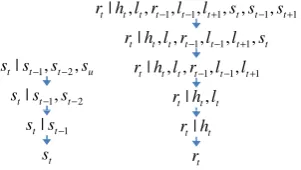
Figure 2: Graphical model for the realisation
phase. Dashed arrows indicate deterministic re-lations, and shaded node are observed.
!"#$%&& '(")*+
1 1 1 1
1, , , , ,
, , |
+ − + −
− t t t t t
t t t
t h l r l l s s s r
t t t t t t
t h l r l l s
r| , , 1, 1, 1,
+ − −
1 1 1, ,
, , |
+ −
− t t
t t t
t h l r l l r
t t t h l
r| ,
2 1,
|
−
− t
t t s s s
u t t t s s s
s | 1, 2,
− −
t t h r|
1
|
− t t s s
t r t
s
Figure 3: Backoff graphs for the semantic decod-ing and realisation models.
P(R|S∗) = L Y
t=1
P(rt|rt−1, ht, lt−1, lt, lt+1,
s∗t−1, s
∗
t, s
∗
t+1) (8)
Conditional probability distributions are repre-sented as factored language models smoothed us-ing Witten-Bell interpolated backoff smoothus-ing (Bilmes and Kirchhoff, 2003), according to the backoff graphs in Fig. 3. Variables which are the furthest away in time are dropped first, and par-tial stack variables are dropped last as they are ob-served the most.
It is important to note that generating unseen mantic stacks requires all possible mandatory se-mantic stacks in the target domain to be prede-fined, in order for all stack unigrams to be assigned a smoothed non-zero probability.
3.2 High cardinality concept abstraction
While one should expect a trainable generator to learn multiple lexical realisations for low-cardinality semantic concepts, learning lexical realisations for high-cardinality database entries (e.g., proper names) would increase the number of model parameters prohibitively. We thus divide pre-terminal concepts in the semantic stacks into
two types: (a) enumerable attributes whose
[image:4.595.342.493.224.309.2]our model (e.g., inform(pricerange(cheap))),
and (b) non-enumerable attributes whose values
are replaced by a generic symbol before train-ing in both the utterance and the semantic stack
(e.g., inform(name(X)). These symbolic values
are then replaced in the surface realisation by the corresponding value in the input specification. A consequence is that our model can only learn syn-onymous lexical realisations for enumerable at-tributes.
4 Certainty-based active learning
A major issue with trainable NLG systems is the lack of availability of domain-specific data. It is therefore essential to produce NLG models that minimise the data annotation cost.
BAGEL supports the optimisation of the data
collection process through active learning, in which the next semantic input to annotate is de-termined by the current model. The
probabilis-tic nature of BAGEL allows the use of
certainty-based active learning (Lewis and Catlett, 1994),
by querying the k semantic inputs for which the
model is the least certain about its output
real-isation. Given a finite semantic input space I
representing all possible dialogue acts in our do-main (i.e., the set of all sets of mandatory
seman-tic stacks Sm), BAGEL’s active learning training
process iterates over the following steps:
1. Generate an utterance for each semantic inputSm∈ I using the current model.2
2. Annotate the k semantic inputs {S1
m...Smk}yielding the lowest realisation probability, i.e. forq∈(1..k)
Sq
m= argmin
Sm∈I\{Sm1...S q−1
m }
(max
R P(R|Sm)) (9)
withP(R|Sm)defined in (2).
3. Retrain the model with the additionalkdata points.
The number of utterances to be queriedkshould
depend on the flexibility of the annotators and the time required for generating all possible utterances in the domain.
5 Experimental method
BAGEL’s factored language models are trained
us-ing the SRILM toolkit (Stolcke, 2002), and de-coding is performed using GMTK’s junction tree inference algorithm (Bilmes and Zweig, 2002).
2Sampling methods can be used if I is infinite or too
large.
Since each active learning iteration requires gen-erating all training utterances in our domain, they are generated using a larger clique pruning thresh-old than the test utterances used for evaluation.
5.1 Corpus collection
We train BAGEL in the context of a dialogue
system providing information about restaurants
in Cambridge. The domain contains two
dia-logue act types: (a) inform: presenting
infor-mation about a restaurant (see Table 1), and (b)
reject: informing that the user’s constraints
can-not be met (e.g., ‘There is no cheap restaurant in the centre’). Our domain contains 8
restau-rant attributes: name, food, near, pricerange,
postcode, phone, address, and area, out of
which food, pricerange, and area are treated
as enumerable.3 Our input semantic space is
ap-proximated by the set of information presentation dialogue acts produced over 20,000 simulated di-alogues between our statistical dialogue manager (Young et al., 2010) and an agenda-based user simulator (Schatzmann et al., 2007), which results in 202 unique dialogue acts after replacing non-enumerable values by a generic symbol. Each di-alogue act contains an average of 4.48 mandatory semantic stacks.
As one of our objectives is to test whether
BAGEL can learn from data provided by a large
sample of untrained annotators, we collected a corpus of semantically-aligned utterances using Amazon’s Mechanical Turk data collection
ser-vice. A crucial aspect of data collection for
NLG is to ensure that the annotators under-stand the meaning of the semantics to be
con-veyed. Annotators were first asked to provide
an utterance matching an abstract description of the dialogue act, regardless of the order in
which the constraints are presented (e.g., Offer
the venue Taj Mahal and provide the information
type(restaurant), area(riverside), food(Indian),
near(The Red Lion)). The order of the constraints
in the description was randomised to reduce the effect of priming. The annotators were then asked
to align the attributes (e.g.,Indicate the region of
the utterance related to the concept ‘area’), and
the attribute values (e.g.,Indicate only the words
related to the concept ‘riverside’). Two
para-phrases were collected for each dialogue act in our domain, resulting in a total of 404 aligned
rt st ht lt
<s> START START START
The Rice Boat inform(name(X)) X inform(name)
is a inform inform EMPTY
restaurant inform(type(restaurant)) restaurant inform(type)
in the inform(area) area inform
riverside inform(area(riverside)) riverside inform(area)
area inform(area) area inform
that inform inform EMPTY
serves inform(food) food inform
French inform(food(French)) French inform(food)
food inform(food) food inform
[image:6.595.144.455.60.195.2]</s> END END END
Table 2: Example utterance annotation used to estimate the conditional probability distributions of the
models in Figs. 1 and 2 (rt=realisation phrase,st=semantic stack,ht=stack head,lt=stack tail).
terances produced by 42 native speakers of En-glish. After manually checking and normalising
the dataset,4 the layered annotations were
auto-matically mapped to phrase-level semantic stacks by splitting the utterance into phrases at annotation boundaries. Each annotated utterance is then con-verted into a sequence of symbols such as in Ta-ble 2, which are used to estimate the conditional probability distributions defined in (6) and (8). The resulting vocabulary consists of 52 distinct se-mantic stacks and 109 distinct realisation phrases, with an average of 8.35 phrases per utterance.
5.2 BLEU score evaluation
We first evaluate BAGEL using the BLEU
auto-mated metric (Papineni et al., 2002), which mea-sures the word n-gram overlap between the gen-erated utterances and the 2 reference paraphrases
over a test corpus (withnup to 4). While BLEU
suffers from known issues such as a bias towards statistical NLG systems (Reiter and Belz, 2009), it provides useful information when comparing
sim-ilar systems. We evaluate BAGEL for different
training set sizes, model dependencies, and active learning parameters. Our results are averaged over a 10-fold cross-validation over distinct dialogue
acts, i.e. dialogue acts used for testing arenot seen
at training time,5and all systems are tested on the
same folds. The training and test sets respectively contain an average of 181 and 21 distinct dialogue acts, and each dialogue act is associated with two paraphrases, resulting in 362 training utterances.
4The normalisation process took around 4 person-hour for
404 utterances.
5We do not evaluate performance on dialogue acts used
for training, as the training examples can trivially be used as generation templates. !"#$ !"% !"%$ !"# !"#$ !"% !"%$ ! " #$ %& '() %* +, -" !"$ !"$$ !"# !"#$ !"% !"%$ ! " #$ %& '() %* +, -" !"$ !"$$ !"# !"#$ !"% !"%$ ! " #$ %& '() %* +, -" &'(()*+,-( !". !".$ !"$ !"$$ !"# !"#$ !"% !"%$ ! " #$ %& '() %* +, -" &'(()*+,-( /+)01234)5234+66 /+)01234)5234+667)8+)6'1'9-)0-*281:30 !";$ !". !".$ !"$ !"$$ !"# !"#$ !"% !"%$
<! =! .! #! >! <!! <=! <$! =!! =$! ;!! ;#=
! " #$ %& '() %* +, -" .-#/$/$0%*"1%*/2" &'(()*+,-( /+)01234)5234+66 /+)01234)5234+667)8+)6'1'9-)0-*281:30 !";$ !". !".$ !"$ !"$$ !"# !"#$ !"% !"%$
<! =! .! #! >! <!! <=! <$! =!! =$! ;!! ;#=
! " #$ %& '() %* +, -" .-#/$/$0%*"1%*/2" &'(()*+,-( /+)01234)5234+66 /+)01234)5234+667)8+)6'1'9-)0-*281:30 !";$ !". !".$ !"$ !"$$ !"# !"#$ !"% !"%$
<! =! .! #! >! <!! <=! <$! =!! =$! ;!! ;#=
! " #$ %& '() %* +, -" .-#/$/$0%*"1%*/2" &'(()*+,-( /+)01234)5234+66 /+)01234)5234+667)8+)6'1'9-)0-*281:30
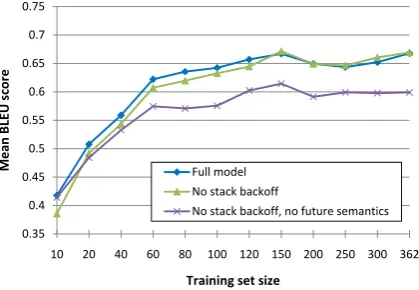
Figure 4: BLEU score averaged over a 10-fold cross-validation for different training set sizes and network topologies, using random sampling.
Results: Fig. 4 shows that adding a dependency on the future semantic stack improves perfor-mances for all training set sizes, despite the added model complexity. Backing off to partial stacks also improves performance, but only for sparse training sets.
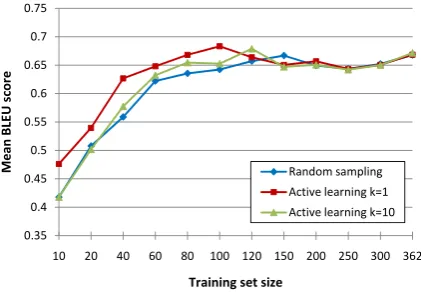
Fig. 5 compares the full model trained using random sampling in Fig. 4 with the same model trained using certainty-based active learning, for
different values of k. As our dataset only
con-tains two paraphrases per dialogue act, the same dialogue act can only be queried twice during the active learning procedure. A consequence is that the training set used for active learning converges towards the randomly sampled set as its size in-creases. Results show that increasing the train-ing set one utterance at a time ustrain-ing active
learn-ing (k = 1) significantly outperforms random
sampling when using 40, 80, and 100 utterances (p < .05, two-tailed). Increasing the number of
utterances to be queried at each iteration tok= 10
[image:6.595.310.520.249.394.2]possi-!"# !"## !"$ !"$# !"% !"%#
!"
#$
%&
'(
)
%*
+,-"
&'()*+,-'+./0(1
!"2# !"3 !"3# !"# !"## !"$ !"$# !"% !"%#
4! 5! 3! $! 6! 4!! 45! 4#! 5!! 5#! 2!! 2$5
!"
#$
%&
'(
)
%*
+,-"
.-#/$/$0%*"1%*/2"
[image:7.595.74.285.63.209.2]&'()*+,-'+./0(1 7890:;,/;'<(0(1,=>4 7890:;,/;'<(0(1,=>4!
Figure 5: BLEU score averaged over a 10-fold cross-validation for different numbers of queries per iteration, using the full model with the query selection criterion (9).
!"# !"## !"$ !"$# !"% !"%#
!"
#$
%&
'(
)
%*
+,
-"
&'(()(*+,-*.
!"/# !"0 !"0# !"# !"## !"$ !"$# !"% !"%#
1! 2! 0! $! 3! 1!! 12! 1#! 2!! 2#! /!! /$2
!"
#$
%&
'(
)
%*
+,
-"
.-#/$/$0%*"1%*/2"
&'(()(*+,-*. 4*+,-*.),5-)6-785 4*9+5:;)<9,';)6<-:;
Figure 6: BLEU score averaged over a 10-fold cross-validation for different query selection
cri-teria, using the full model withk= 1.
ble explanation is that the model is likely to assign low probabilities to similar inputs, thus any value
above k = 1 might result in redundant queries
within an iteration.
As the length of the semantic stack sequence is not known before decoding, the active learn-ing selection criterion presented in (9) is biased towards longer utterances, which tend to have a
lower probability. However, Fig. 6 shows that
normalising the log probability by the number of semantic stacks does not improve overall learn-ing performance. Although a possible explanation is that longer inputs tend to contain more infor-mation to learn from, Fig. 6 shows that a base-line selecting the largest remaining semantic input at each iteration performs worse than the active learning scheme for training sets above 20 utter-ances. The full log probability selection criterion defined in (9) is therefore used throughout the rest
of the paper (withk= 1).
5.3 Human evaluation
While automated metrics provide useful informa-tion for comparing different systems, human
feed-back is needed to assess (a) the quality of BAGEL’s
outputs, and (b) whether training models using ac-tive learning has a significant impact on user
per-ceptions. We evaluate BAGEL through a
large-scale subjective rating experiment using Amazon’s Mechanical Turk service.
For each dialogue act in our domain, partici-pants are presented with a ‘gold standard’ human utterance from our dataset, which they must com-pare with utterances generated by models trained with and without active learning on a set of 20, 40, 100, and 362 utterances (full training set), as well as with the second human utterance in our dataset. See example utterances in Table 3. The judges are
then asked to evaluate theinformativenessand
nat-uralness of each of the 8 utterances on a 5 point
likert-scale. Naturalness is defined as whether the utterance could have been produced by a human, and informativeness is defined as whether it con-tains all the information in the gold standard utter-ance. Each utterance is taken from the test folds of the cross-validation experiment presented in Sec-tion 5.2, i.e. the models are trained on up to 90% of the data and the training set does not contain the dialogue act being tested.
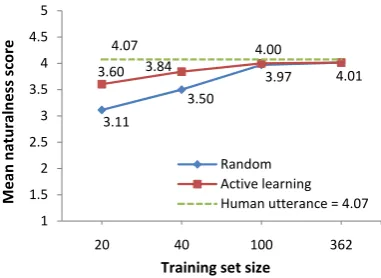
Results: Figs. 7 and 8 compare the naturalness and informativeness scores of each system aver-aged over all 202 dialogue acts. A paired t-test shows that models trained on 40 utterances or less produce utterances that are rated significantly lower than human utterances for both naturalness
and informativeness (p < .05, two-tailed).
How-ever, models trained on 100 utterances or more do not perform significantly worse than human utter-ances for both dimensions, with a mean difference below .10 over 202 comparisons. Given the large
sample size, this result suggests that BAGEL can
successfully learn our domain using a fraction of our initial dataset.
As far as the learning method is concerned, a paired t-test shows that models trained on 20 and 40 utterances using active learning significantly outperform models trained using random
sam-pling, for both dimensions (p < .05). The largest
In-Input inform(name(the Fountain)near(the Arts Picture House)area(centre)pricerange(cheap)) Human There is an inexpensive restaurant called the Fountain in the centre of town near the Arts Picture House Rand-20 The Fountain is a restaurant near the Arts Picture House located in the city centre cheap price range Rand-40 The Fountain is a restaurant in the cheap city centre area near the Arts Picture House
AL-20 The Fountain is a restaurant near the Arts Picture House in the city centre cheap AL-40 The Fountain is an affordable restaurant near the Arts Picture House in the city centre Full set The Fountain is a cheap restaurant in the city centre near the Arts Picture House Input reject(area(Barnwell)near(Saint Mary0s Church))
Human I am sorry but I know of no venues near Saint Mary’s Church in the Barnwell area Full set I am sorry but there are no venues near Saint Mary’s Church in the Barnwell area Input inform(name(the Swan)area(Castle Hill)pricerange(expensive)) Human The Swan is a restaurant in Castle Hill if you are seeking something expensive Full set The Swan is an expensive restaurant in the Castle Hill area
[image:8.595.67.529.61.229.2]Input inform(name(Browns)area(centre)near(the Crowne Plaza)near(El Shaddai)pricerange(cheap)) Human Browns is an affordable restaurant located near the Crowne Plaza and El Shaddai in the centre of the city Full set Browns is a cheap restaurant in the city centre near the Crowne Plaza and El Shaddai
Table 3: Example utterances for different input dialogue acts and system configurations.AL-20= active
learning with 20 utterances,Rand= random sampling.
!"##
!"$%
!"&' !"(% !")*
*"%%
*"%# *"%'
+ +"$ ! !"$ * *"$ $
!"
#$
%$
#&
'
(#
)$
"
**%
*+
,(
"
,-./01 !"##
!"$%
!"&' !"(% !")*
*"%%
*"%# *"%'
# #"$ + +"$ ! !"$ * *"$ $
+% *% #%% !(+
!"
#$
%$
#&
'
(#
)$
"
**%
*+
,(
"
[image:8.595.83.274.277.416.2]-(#.$.$/%*"&%*.0" ,-./01 234567897-:.5.; <=1-.8=447:-.378>8*"%'
Figure 7: Naturalness mean opinion scores for dif-ferent training set sizes, using random sampling and active learning. Differences for training set
sizes of 20 and 40 are all significant (p < .05).
terestingly, while models trained on 100 utterances outperform models trained on 40 utterances using
random sampling (p < .05), they do not
signifi-cantly outperform models trained on 40 utterances
using active learning (p=.15for naturalness and
p = .41 for informativeness). These results
sug-gest that certainty-based active learning is benefi-cial for training a generator from a limited amount of data given the domain size.
Looking back at the results presented in Sec-tion 5.2, we find that the BLEU score correlates with a Pearson correlation coefficient of .42 with the mean naturalness score and .35 with the mean informativeness score, over all folds of all systems
tested (n = 70, p < .01). This is lower than
previous correlations reported by Reiter and Belz (2009) in the shipping forecast domain with
non-expert judges (r =.80), possibly because our
do-main is larger and more open to subjectivity.
!"##
!"$$ #"%& !"'& !"()
#"%$
#"%# #"&!
* *"+ ! !"+ # #"+ +
!"
#$
%&$
'()
*
#+
&,
"
$
"
--%
-.
()
"
,-./01 !"##
!"$$ #"%& !"'& !"()
#"%$
#"%# #"&!
& &"+ * *"+ ! !"+ # #"+ +
*% #% &%% !)*
!"
#$
%&$
'()
*
#+
&,
"
$
"
--%
-.
()
"
/)#&$&$0%-"+%-&1" ,-./01 234567897-:.5.; <=1-.8=447:-.378>8#"&!
Figure 8: Informativeness mean opinion scores for different training set sizes, using random sampling and active learning. Differences for training set
sizes of 20 and 40 are all significant (p < .05).
6 Related work
While most previous work on trainable NLG re-lies on a handcrafted component (see Section 1), recent research has started exploring fully data-driven NLG models.
Factored language models have recently been used for surface realisation within the OpenCCG framework (White et al., 2007; Espinosa et al.,
2008). More generally, chart generators for
different grammatical formalisms have been trained from syntactic treebanks (White et al., 2007; Nakanishi et al., 2005), as well as from semantically-annotated treebanks (Varges and Mellish, 2001). However, a major difference with
our approach is that BAGELuses domain-specific
[image:8.595.319.509.279.414.2]This work is strongly related to Wong and
Mooney’s WASP−1 generation system (2007),
which combines a language model with an in-verted synchronous CFG parsing model, effec-tively casting the generation task as a translation problem from a meaning representation to
natu-ral language. WASP−1relies on GIZA++ to align
utterances with derivations of the meaning repre-sentation (Och and Ney, 2003). Although early
experiments showed that GIZA++ did not perform
well on our data—possibly because of the coarse granularity of our semantic representation—future work should evaluate the generalisation perfor-mance of synchronous CFGs in a dialogue system domain.
Although we do not know of any work on ac-tive learning for NLG, previous work has used active learning for semantic parsing and informa-tion extracinforma-tion (Thompson et al., 1999; Tang et al., 2002), spoken language understanding (Tur et al., 2003), speech recognition (Hakkani-T¨ur et al., 2002), word alignment (Sassano, 2002), and more recently for statistical machine translation (Blood-good and Callison-Burch, 2010). While certainty-based methods have been widely used, future work
should investigate the performance of
committee-basedactive learning for NLG, in which examples
are selected based on the level of disagreement be-tween models trained on subsets of the data (Fre-und et al., 1997).
7 Discussion and conclusion
This paper presents and evaluates BAGEL, a
sta-tistical language generator that can be trained en-tirely from data, with no handcrafting required be-yond the semantic annotation. All the required subtasks—i.e. content ordering, aggregation, lex-ical selection and realisation—are learned from
data using a unified model. To train BAGELin a
di-alogue system domain, we propose a stack-based semantic representation at the phrase level, which is expressive enough to generate natural utterances
fromunseeninputs, yet simple enough for data to
be collected from 42 untrained annotators with a minimal normalisation step. A human evaluation over 202 dialogue acts does not show any differ-ence in naturalness and informativeness between
BAGEL’s outputs and human utterances.
Addition-ally, we find that the data collection process can be optimised using active learning, resulting in a significant increase in performance when training
data is limited, according to ratings from 18
hu-man judges.6 These results suggest that the
pro-posed framework can largely reduce the develop-ment time of NLG systems.
While this paper only evaluates the most likely realisation given a dialogue act, we believe that
BAGEL’s probabilistic nature and generalisation
capabilities are well suited to model the linguis-tic variation resulting from the diversity of annota-tors. Our first objective is thus to evaluate the
qual-ity of BAGEL’s n-best outputs, and test whether
sampling from the output distribution can improve naturalness and user satisfaction within a dialogue. Our results suggest that explicitly modelling syntax is not necessary for our domain, possi-bly because of the lack of syntactic complexity compared with formal written language. Never-theless, future work should investigate whether syntactic information can improve performance in more complex domains. For example, the reali-sation phrase can easily be conditioned on syntac-tic constructs governing that phrase, and the recur-sive nature of syntax can be modelled by keeping track of the depth of the current embedded clause. While syntactic information can be included with no human effort by using syntactic parsers, their robustness to dialogue system utterances must first be evaluated.
Finally, recent years have seen HMM-based synthesis models become competitive with unit se-lection methods (Tokuda et al., 2000). Our long term objective is to take advantage of those ad-vances to jointly optimise the language genera-tion and the speech synthesis process, by combin-ing both components into a unified probabilistic concept-to-speech generation model.
References
S. Bangalore and O. Rambow. Exploiting a probabilistic hi-erarchical model for generation. In Proceedings of the 18th International Conference on Computational Linguis-tics (COLING), pages 42–48, 2000.
A. Belz. Automatic generation of weather forecast texts us-ing comprehensive probabilistic generation-space models.
Natural Language Engineering, 14(4):431–455, 2008. J. Bilmes and K. Kirchhoff. Factored language models and
generalized parallel backoff. In Proceedings of HLT-NAACL, short papers, 2003.
J. Bilmes and G. Zweig. The Graphical Models ToolKit: An open source software system for speech and time-series processing. InProceedings of ICASSP, 2002.
6The full training corpus and the generated
M. Bloodgood and C. Callison-Burch. Bucking the trend: Large-scale cost-focused active learning for statistical ma-chine translation. In Proceedings of the 48th Annual Meeting of the Association for Computational Linguistics (ACL), 2010.
D. Espinosa, M. White, and D. Mehay. Hypertagging: Su-pertagging for surface realization with CCG. In Proceed-ings of the 46th Annual Meeting of the Association for Computational Linguistics (ACL), 2008.
Y. Freund, H. S. Seung, E.Shamir, and N. Tishby. Selective sampling using the query by committee algorithm. Ma-chine Learning, 28:133–168, 1997.
D. Hakkani-T¨ur, G. Riccardi, and A. Gorin. Active learn-ing for automatic speech recognition. InProceedings of ICASSP, 2002.
Y. He and S. Young. Semantic processing using the Hidden Vector State model. Computer Speech & Language, 19 (1):85–106, 2005.
A. Isard, C. Brockmann, and J. Oberlander. Individuality and alignment in generated dialogues. InProceedings of the 4th International Natural Language Generation Confer-ence (INLG), pages 22–29, 2006.
I. Langkilde and K. Knight. Generation that exploits corpus-based statistical knowledge. InProceedings of the 36th Annual Meeting of the Association for Computational Lin-guistics (ACL), pages 704–710, 1998.
F. Lef`evre. A DBN-based multi-level stochastic spoken lan-guage understanding system. InProceedings of the IEEE Workshop on Spoken Language Technology (SLT), 2006. D. D. Lewis and J. Catlett. Heterogeneous uncertainty
am-pling for supervised learning. InProceedings of ICML, 1994.
F. Mairesse and M. A. Walker. Trainable generation of Big-Five personality styles through data-driven parameter esti-mation. InProceedings of the 46th Annual Meeting of the Association for Computational Linguistics (ACL), 2008. H. Nakanishi, Y. Miyao, , and J. Tsujii. Probabilistic methods
for disambiguation of an HPSG-based chart generator. In
Proceedings of the IWPT, 2005.
F. J. Och and H. Ney. A systematic comparison of various statistical alignment models. Computational Linguistics, 29(1):19–51, 2003.
D. S. Paiva and R. Evans. Empirically-based control of nat-ural language generation. InProceedings of the 43rd An-nual Meeting of the Association for Computational Lin-guistics (ACL), pages 58–65, 2005.
K. Papineni, S. Roukos, T. Ward, and W. J. Zhu. BLEU: a method for automatic evaluation of machine translation. In
Proceedings of the 40th Annual Meeting of the Association for Computational Linguistics (ACL), 2002.
L. R. Rabiner. Tutorial on Hidden Markov Models and se-lected applications in speech recognition. Proceedings of the IEEE, 77(2):257–285, 1989.
E. Reiter and A. Belz. An investigation into the validity of some metrics for automatically evaluating natural lan-guage generation systems.Computational Linguistics, 25: 529–558, 2009.
V. Rieser and O. Lemon. Natural language generation as planning under uncertainty for spoken dialogue systems. In Proceedings of the Annual Meeting of the European Chapter of the ACL (EACL), 2009.
M. Sassano. An empirical study of active learning with sup-port vector machines for japanese word segmentation. In
Proceedings of the 40th Annual Meeting of the Association for Computational Linguistics (ACL), 2002.
J. Schatzmann, B. Thomson, K. Weilhammer, H. Ye, and S. Young. Agenda-based user simulation for bootstrap-ping a POMDP dialogue system. InProceedings of HLT-NAACL, short papers, pages 149–152, 2007.
A. Stolcke. SRILM – an extensible language modeling toolkit. InProceedings of the International Conference on Spoken Language Processing, 2002.
M. Tang, X. Luo, and S. Roukos. Active learning for statis-tical natural language parsing. InProceedings of the 40th Annual Meeting of the Association for Computational Lin-guistics (ACL), 2002.
C. Thompson, M. E. Califf, and R. J. Mooney. Active learn-ing for natural language parslearn-ing and information extrac-tion. InProceedings of ICML, 1999.
B. Thomson and S. Young. Bayesian update of dialogue state: A POMDP framework for spoken dialogue systems. Com-puter Speech & Language, 24(4):562–588, 2010. Y. Tokuda, T. Yoshimura, T. Masuko, T. Kobayashi, and
T. Kitamura. Speech parameter generation algorithms for HMM-based speech synthesis. InProceedings of ICASSP, 2000.
G. Tur, R. E. Schapire, and D. Hakkani-T¨ur. Active learn-ing for spoken language understandlearn-ing. InProceedings of ICASSP, 2003.
S. Varges and C. Mellish. Instance-based natural language generation. InProceedings of the Annual Meeting of the North American Chapter of the ACL (NAACL), 2001. M. A. Walker, O. Rambow, and M. Rogati. Training a
sen-tence planner for spoken dialogue using boosting. Com-puter Speech and Language, 16(3-4), 2002.
M. White, R. Rajkumar, and S. Martin. Towards broad cov-erage surface realization with CCG. InProceedings of the Workshop on Using Corpora for NLG: Language Genera-tion and Machine TranslaGenera-tion, 2007.
Y. W. Wong and R. Mooney. Generation by inverting a se-mantic parser that uses statistical machine translation. In
Proceedings of HLT-NAACL, 2007.