Joint and conditional estimation of tagging and parsing models
∗Mark Johnson Brown University
Mark [email protected]
Abstract
This paper compares two different ways of estimating statistical language mod-els. Many statistical NLP tagging and parsing models are estimated by max-imizing the (joint) likelihood of the fully-observed training data. How-ever, since these applications only re-quire the conditional probability distri-butions, these distributions can in prin-ciple be learnt by maximizing the con-ditional likelihood of the training data. Perhaps somewhat surprisingly, models estimated by maximizing the joint were superior to models estimated by max-imizing the conditional, even though some of the latter models intuitively had access to “more information”.
1 Introduction
Many statistical NLP applications, such as tag-ging and parsing, involve finding the value of some hidden variable Y (e.g., a tag or a parse tree) which maximizes a conditional prob-ability distribution Pθ(Y|X), where X is a
given word string. The model parameters θ are typically estimated by maximum likelihood: i.e., maximizing the likelihood of the training
∗
I would like to thank Eugene Charniak and the other members of BLLIP for their comments and suggestions. Fer-nando Pereira was especially generous with comments and suggestions, as were the ACL reviewers; I apologize for not being able to follow up all of your good suggestions. This re-search was supported by NSF awards 9720368 and 9721276 and NIH award R01 MH60922-01A2.
data. Given a (fully observed) training cor-pus D = ((y1, x1), . . . ,(yn, xn)), the maximum (joint) likelihood estimate (MLE) ofθis:
ˆ
θ = argmax
θ n Y
i=1
Pθ(yi, xi). (1)
However, it turns out there is another maximum likelihood estimation method which maximizes the conditional likelihood or “pseudo-likelihood” of the training data (Besag, 1975). Maximum conditional likelihood is consistent for the
con-ditional distribution. Given a training corpus D, the maximum conditional likelihood estimate (MCLE) of the model parametersθis:
ˆ
θ = argmax
θ n Y
i=1
Pθ(yi|xi). (2)
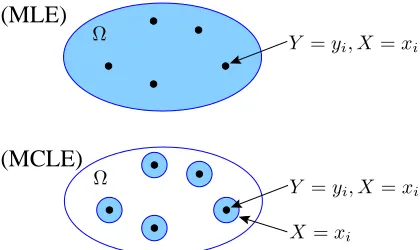
Figure 1 graphically depicts the difference be-tween the MLE and MCLE. LetΩbe the universe of all possible pairs (y, x) of hidden and visible values. Informally, the MLE selects the model parameter θ which make the training data pairs
(yi, xi) as likely as possible relative to all other
pairs(y0, x0)
inΩ. The MCLE, on the other hand, selects the model parameterθin order to make the training data pair (yi, xi) more likely than other
pairs(y0, x
i)inΩ, i.e., pairs with the same visible
valuexias the training datum.
(MLE)
(MCLE)
Ω Y =y
i, X=xi
Ω
X =xi
[image:2.612.74.284.63.188.2]Y =yi, X =xi
Figure 1: The MLE makes the training data(yi, xi)as likely as possible (relative to Ω), while the MCLE makes
(yi, xi)as likely as possible relative to other pairs(y0
, xi).
Maximum-Entropy Markov Models (McCallum et al., 2000) and Stochastic Unification-based Grammars (Johnson et al., 1999) are standardly estimated with conditional estimators, and it would be interesting to know whether conditional estimation affects the quality of the estimated model. It should be noted that in practice, the MCLE of a model with a large number of features with complex dependencies may yield far better performance than the MLE of the much smaller model that could be estimated with the same computational effort. Nevertheless, as this paper shows, conditional estimators can be used with other kinds of models besides MaxEnt models, and in any event it is interesting to ask whether the MLE differs from the MCLE in actual appli-cations, and if so, how.
Because the MLE is consistent for the joint distribution P(Y, X) (e.g., in a tagging applica-tion, the distribution of word-tag sequences), it is also consistent for the conditional distribution
P(Y|X) (e.g., the distribution of tag sequences given word sequences) and the marginal distribu-tionP(X)(e.g., the distribution of word strings). On the other hand, the MCLE is consistent for the conditional distribution P(Y|X) alone, and pro-vides no information about either the joint or the marginal distributions. Applications such as lan-guage modelling for speech recognition and EM procedures for estimating from hidden data ei-ther explicitly or implicitly require marginal dis-tributions over the visible data (i.e., word strings), so it is not statistically sound to use MCLEs for such applications. On the other hand, applications which involve predicting the value of the hidden variable from the visible variable (such as tagging
or parsing) usually only involve the conditional distribution, which the MCLE estimates directly.
Since both the MLE and MCLE are consistent for the conditional distribution, both converge in
the limit to the “true” distribution if the true dis-tribution is in the model class. However, given
that we often have insufficient data in computa-tional linguistics, and there are good reasons to believe that the true distribution of sentences or parses cannot be described by our models, there is no reason to expect these asymptotic results to hold in practice, and in the experiments reported below the MLE and MCLE behave differently ex-perimentally.
A priori, one can advance plausible arguments in favour of both the MLE and the MCLE. Infor-mally, the MLE and the MCLE differ in the fol-lowing way. Since the MLE is obtained by maxi-mizingQ
iPθ(yi|xi)Pθ(xi), the MLE exploits
in-formation about the distribution of word stringsxi
in the training data that the MCLE does not. Thus one might expect the MLE to converge faster than the MCLE in situations where training data is not over-abundant, which is often the case in compu-tational linguistics.
On the other hand, since the intended applica-tion requires a condiapplica-tional distribuapplica-tion, it seems reasonable to directly estimate this conditional distribution from the training data as the MCLE does. Furthermore, suppose that the model class is wrong (as is surely true of all our current lan-guage models), i.e., the “true” modelP(Y, X) 6= Pθ(Y, X) for allθ, and that our best models are particularly poor approximations to the true dis-tribution of word strings P(X). Then ignoring the distribution of word strings in the training data as the MCLE does might indeed be a reasonable thing to do.
The rest of this paper is structured as fol-lows. The next section formulates the MCLEs for HMMs and PCFGs as constrained optimiza-tion problems and describes an iterative dynamic-programming method for solving them. Because of the computational complexity of these prob-lems, the method is only applied to a simple PCFG based on the ATIS corpus. For this ex-ample, the MCLE PCFG does perhaps produce slightly better parsing results than the standard MLE (relative-frequency) PCFG, although the re-sult does not reach statistical significance.
which the MLE and MCLE are both easy to com-pute. However, often it is possible to find two closely related model classes, one of which has an easily computed MLE and the other which has an easily computed MCLE. Typically, the model classes which have an easily computed MLE de-fine joint probability distributions over both the hidden and the visible data (e.g., over word-tag pair sequences for word-tagging), while the model classes which have an easily computed MCLE de-fine conditional probability distributions over the hidden data given the visible data (e.g., over tag sequences given word sequences).
Section 3 investigates closely related joint and conditional tagging models (the lat-ter can be regarded as a simplification of the Maximum Entropy Markov Models of McCallum et al. (2000)), and shows that MLEs outperform the MCLEs in this application. The final empirical section investigates two different kinds of stochastic shift-reduce parsers, and shows that the model estimated by the MLE outperforms the model estimated by the MCLE.
2 PCFG parsing
In this application, the pairs (y, x) consist of a parse tree y and its terminal string or yield x(it may be simpler to think ofycontaining all of the parse tree except for the string x). Recall that in a PCFG with production set R, each produc-tion (A→α) ∈ R is associated with a parameter θA→α. These parameters satisfy a normalization constraint for each nonterminalA:
X
α:(A→α)∈R
θA→α = 1 (3)
For each productionr∈R, letfr(y)be the num-ber of timesris used in the derivation of the tree y. Then the PCFG defines a probability distribu-tion over trees:
Pθ(Y) = Y
(A→α)∈R
θA→αfA →α(Y)
The MLE for θ is the well-known “relative-frequency” estimator:
ˆ
θA→α =
Pn
i=1fA→α(yi)
Pn
i=1Pα0:(A→α0)∈RfA→α0(yi) .
Unfortunately the MCLE for a PCFG is more complicated. Ifxis a word string, then letτ(x)be
the set of parse trees with terminal string or yield x generated by the PCFG. Then given a training corpusD = ((y1, x1), . . . ,(yn, xn)), whereyiis
a parse tree for the string xi, the log conditional
likelihood of the training datalog P(~y|~x)and its derivative are given by:
log P(~y|~x) =
n X
i=1
log Pθ(yi)−log
X
y∈τ(xi) Pθ(y)
∂log P(~y|~x)
∂θA→α
= 1
θA→α
n X
i=1
(fA→α(yi)−Eθ(fA→α|xi))
HereEθ(f|x) denotes the expectation off with respect to Pθ conditioned on Y ∈ τ(x). There
does not seem to be a closed-form solution for the θthat maximizes P(~y|~x) subject to the con-straints (3), so we used an iterative numerical gra-dient ascent method, with the constraints (3) im-posed at each iteration using Lagrange multipli-ers. Note that Pn
i=1Eθ(fA→α|xi) is a quantity calculated in the Inside-Outside algorithm (Lari and Young, 1990) andP(~y|~x)is easily computed as a by-product of the same dynamic program-ming calculation.
Since the expected production counts Eθ(f|x)
depend on the production weights θ, the entire training corpus must be reparsed on each itera-tion (as is true of the Inside-Outside algorithm). This is computationally expensive with a large grammar and training corpus; for this reason the MCLE PCFG experiments described here were performed with the relatively small ATIS tree-bank corpus of air travel reservations distributed by LDC.
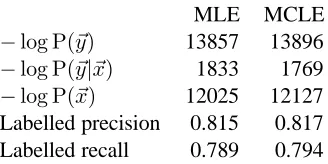
In this experiment, the PCFGs were always trained on the 1088 sentences of the ATIS1 corpus and evaluated on the 294 sentences of the ATIS2 corpus. Lexical items were ignored; the PCFGs generate preterminal strings. The iterative algo-rithm for the MCLE was initialized with the MLE parameters, i.e., the “standard” PCFG estimated from a treebank. Table 1 compares the MLE and MCLE PCFGs.
MLE MCLE −log P(~y) 13857 13896 −log P(~y|~x) 1833 1769 −log P(~x) 12025 12127 Labelled precision 0.815 0.817 Labelled recall 0.789 0.794
Table 1: The likelihoodP(~y)and conditional likelihood P(~y|~x)of the ATIS1 training trees, and the marginal likeli-hoodP(~x)of the ATIS1 training strings, as well as the la-belled precision and recall of the ATIS2 test trees, using the MLE and MCLE PCFGs.
both the test data set and the differences are so small, the significance of these results was esti-mated using a bootstrap method with the differ-ence in F-score in precision and recall as the test statistic (Cohen, 1995). This test showed that the difference was not significant (p≈0.1). Thus the MCLE PCFG did not perform significantly bet-ter than the MLE PCFG in bet-terms of precision and recall.
3 HMM tagging
As noted in the previous section, maximizing the conditional likelihood of a PCFG or a HMM can be computationally intensive. This section and the next pursues an alternative strategy for com-paring MLEs and MCLEs: we compare similiar (but not identical) model classes, one of which has an easily computed MLE, and the other of which has an easily computed MCLE. The appli-cation considered in this section is bitag POS tag-ging, but the techniques extend straight-forwardly ton-tag tagging. In this application, the data pairs
(y, x) consist of a tag sequence y = t1. . . tm
and a word sequence x = w1. . . wm, where tj
is the tag for word wj (to simplify the
formu-lae, w0, t0, wm+1 and tm+1 are always taken to
be end-markers). Standard HMM tagging models define a joint distribution over word-tag sequence pairs; these are most straight-forwardly estimated by maximizing the likelihood of the joint train-ing distribution. However, it is straight-forward to devise closely related HMM tagging models which define a conditional distribution over tag sequences given word sequences, and which are most straight-forwardly estimated by maximizing the conditional likelihood of the distribution of tag sequences given word sequences in the train-ing data.
(4) · · · // Tj //
Tj+1 //
· · ·
Wj Wj+1
(5) · · · // Tj // Tj+1 //· · ·
Wj
O
O
Wj+1
O
O
(6) · · · // Tj //
Tj+1 //
· · · = = | | | | | | | | | | |
| Wj
; ; x x x x x x x x x x
Wj+1
= = | | | | | | | | | | |
(7) · · · //
! ! D D D D D D D D D D
D Tj //
# # F F F F F F F F F F
Tj+1 //
! ! B B B B B B B B B B B B · · · Wj O O
Wj+1
O
O
Figure 2: The HMMs depicted as “Bayes net” graphical models.
All of the HMM models investigated in this section are instances of a certain kind of graph-ical model that Pearl (1988) calls “Bayes nets”; Figure 2 sketches the networks that correspond to all of the models discussed here. (In such a graph, the set of incoming arcs to a node depicting a vari-able indicate the set of varivari-ables on which this variable is conditioned).
Recall the standard bitag HMM model, which defines a joint distribution over word and tag se-quences:
P(Y, X) = m+1
Y
j=1
ˆ
P(Tj|Tj−1)ˆP(Wj|Tj) (4)
As is well-known, the MLE for (4) sets Pˆ to the empirical distributions on the training data.
Now consider the following conditional model of the conditional distribution of tags given words (this is a simplified form of the model described in McCallum et al. (2000)):
P(Y|X) = m+1
Y
j=1
[image:4.612.101.265.63.145.2]The MCLE of (5) is easily calculated: P0 should
be set the empirical distribution of the training data. However, to minimize sparse data prob-lems we estimatedP0(Tj|Wj, Tj−1)as a mixture
of P(ˆ Tj|Wj), P(ˆ Tj|Tj−1) and P(ˆ Tj|Wj, Tj−1),
where the Pˆ are empirical probabilities and the (bucketted) mixing parameters are determined us-ing deleted interpolation from heldout data (Je-linek, 1997).
These models were trained on sections 2-21 of the Penn tree-bank corpus. Section 22 was used as heldout data to evaluate the interpola-tion parameters λ. The tagging accuracy of the models was evaluated on section 23 of the tree-bank corpus (in both cases, the tagtj assigned to
wordwjis the one which maximizes the marginal P(tj|w1. . . wm), since this minimizes the
ex-pected loss on a tag-by-tag basis).
The conditional model (5) has the worst perfor-mance of any of the tagging models investigated in this section: its tagging accuracy is 94.4%. The joint model (4) has a considerably lower error rate: its tagging accuracy is 95.5%.
One possible explanation for this result is that the way in which the interpolated estimate of P0
is calculated, rather than conditional likelihood estimation per se, is lowering tagger accuracy somehow. To investigate this possibility, two ad-ditional joint models were estimated and tested, based on the formulae below.
P(Y, X) = m+1
Y
j=1
ˆ
P(Wj|Tj)P1(Tj|Wj−1, Tj−1) (6)
P(Y, X) = m+1
Y
j=1
P0(Tj|Wj, Tj−1)ˆP(Wj|Tj−1) (7)
The MLEs for both (6) and (7) are easy to cal-culate. (6) contains a conditional distribution P1
which would seem to be of roughly equal com-plexity to P0, and it was estimated using deleted
interpolation in exactly the same way as P0, so
if the poor performance of the conditional model was due to some artifact of the interpolation pro-cedure, we would expect the model based on (6) to perform poorly. Yet the tagger based on (6) performs the best of all the taggers investigated in this section: its tagging accuracy is 96.2%.
(7) is admitted a rather strange model, since the right hand term in effect predicts the
follow-ing word from the current word’s tag. However,
note that (7) differs from (5) only via the pres-ence of this rather unusual term, which effectively converts (5) from a conditional model to a joint model. Yet adding this term improves tagging ac-curacy considerably, to 95.3%. Thus for bitag tag-ging at least, the conditional model has a consid-erably higher error rate than any of the joint mod-els examined here. (While a test of significance was not conducted here, previous experience with this test set shows that performance differences of this magnitude are extremely significant statis-tically).
4 Shift-reduce parsing
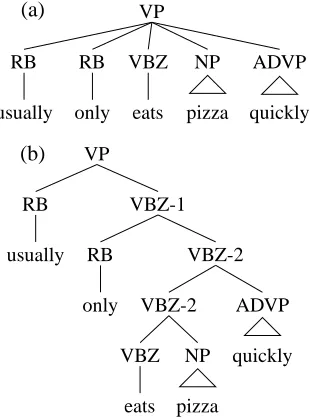
The previous section compared similiar joint and conditional tagging models. This section com-pares a pair of joint and conditional parsing mod-els. The models are both stochastic shift-reduce parsers; they differ only in how the distribution over possible next moves are calculated. These parsers are direct simplifications of the Structured Language Model (Jelinek, 2000). Because the parsers’ moves are determined solely by the top two category labels on the stack and possibly the look-ahead symbol, they are much simpler than stochastic LR parsers (Briscoe and Carroll, 1993; Inui et al., 1997). The distribution over trees generated by the joint model is a probabilistic context-free language (Abney et al., 1999). As with the PCFG models discussed earlier, these parsers are not lexicalized; lexical items are ig-nored, and the POS tags are used as the terminals. These two parsers only produce trees with unary or binary nodes, so we binarized the train-ing data before traintrain-ing the parser, and debina-rize the trees the parsers produce before evaluat-ing them with respect to the test data (Johnson, 1998). We binarized by insertingn−2additional nodes into each local tree with n > 2 children. We binarized by first joining the head to all of the constituents to its right, and then joining the re-sulting structure with constituents to the left. The label of a new node is the label of the head fol-lowed by the suffix “-1” if the head is (contained in) the right child or “-2” if the head is (contained in) the left child. Figure 3 depicts an example of this transformation.
(b) (a)
VP
RB
usually
VBZ-1
RB
only
VBZ-2
VBZ-2
VBZ
eats NP
pizza
ADVP
quickly ADVP
quickly VP
RB
usually RB
only VBZ
eats NP
[image:6.612.106.261.66.275.2]pizza
Figure 3:The binarization transformation used in the shift-reduce parser experiments transforms tree (a) into tree (b).
labels (possibly including labels introduced by bi-narization). In what follows, s1 refers to the top element of the stack, or ‘?’ if the stack is empty; similarly s2 refers to the next-to-top element of
the stack or ‘?’ if the stack contains less than two elements. We also append a ‘?’ to end of the ac-tual terminal string being parsed (just as with the HMMs above), as this simplifies the formulation of the parsers, i.e., if the string to be parsed is w1. . . wm, then we takewm+1 =?.
A shift-reduce parse is defined in terms of moves. A move is either shift(w),reduce1(c)or
reduce2(c), wherecis a nonterminal label andw
is either a terminal label or ‘?’. Moves are par-tial functions from stacks to stacks: a shift(w)
move pushes a w onto the top of stack, while a
reducei(c) move pops the topiterminal or non-terminal labels off the stack and pushes a conto the stack. A shift-reduce parse is a sequence of moves which (when composed) map the empty stack to the two-element stack whose top element is ‘?’ and whose next-to-top element is the start symbol. (Note that the last move in a shift-reduce parse must always be a shift(?) move; this cor-responds to the final “accept” move in an LR parser). The isomorphism between shift-reduce parses and standard parse trees is well-known (Hopcroft and Ullman, 1979), and so is not de-scribed here.
A (joint) shift-reduce parser is defined by
a distribution P(m|s1, s2) over next moves m
given the top and next-to-top stack labels s1
and s2. To ensure that the next move is in fact a possible move given the current stack, we require that P(reduce1(c)|?, ?) = 0 and
P(reduce2(c)|c0, ?) = 0 for all c, c0, and that
P(shif t(?)|s1, s2) = 0unlesss1is the start
sym-bol and s2 = ?. Note that this extends to a
probability distribution over shift-reduce parses (and hence parse trees) in a particularly simple way: the probability of a parse is the product of the probabilities of the moves it consists of. As-suming thatPmeets certain tightness conditions, this distribution over parses is properly normal-ized because there are no “dead” stack configura-tions: we require that the distribution over moves be defined for all possible stacks.
A conditional shift-reduce parser differs only minimally from the shift-reduce parser just described: it is defined by a distribution
P(m|s1, s2, t) over next moves m given the top and next-to-top stack labels s1, s2 and the next
input symbolw(wis called the look-ahead
sym-bol). In addition to the requirements on P
above, we also require that if w0 6= w then
P(shift(w0
)|s1, s2, w) = 0 for all s1, s2; i.e., shift moves can only shift the current look-ahead symbol. This restriction implies that all non-zero probability derivations are derivations of the parse string, since the parse string forces a single se-quence of symbols to be shifted in all derivations. As before, since there are no “dead” stack con-figurations, so long as P obeys certain tightness conditions, this defines a properly normalized dis-tribution over parses. Since all the parses are re-quired to be parses of of the input string, this de-fines a conditional distribution over parses given the input string.
It is easy to show that the MLE for the joint model, and the MCLE for the conditional model, are just the empirical distributions from the train-ing data. We ran into sparse data problems ustrain-ing the empirical training distribution as an estimate for P(m|s1, s2, w) in the conditional model, so in fact we used deleted interpolation to interpo-late P(ˆ m|s1, s2, w), and P(ˆ m|s1, s2) to estimate
Joint SR Conditional SR PCFG Precision 0.666 0.633 0.700
Recall 0.650 0.639 0.657
Table 2: Labelled precision and recall results for joint and conditional shift-reduce parsers, and for a PCFG.
22.
We calculated the most probable parses using a dynamic programming algorithm based on the one described in Jelinek (2000). Jelinek notes that this algorithm’s running time isn6(wherenis the length of sentence being parsed), and we found exhaustive parsing to be computationally imprac-tical. We used a beam search procedure which thresholded the best analyses of each prefix of the string being parsed, and only considered analyses whose top two stack symbols had been observed in the training data. In order to help guard against the possibility that this stochastic pruning influ-enced the results, we ran the parsers twice, once with a beam threshold of10−6(i.e., edges whose
probability was less than 10−6 of the best edge
spanning the same prefix were pruned) and again with a beam threshold of 10−9. The results of
the latter runs are reported in table 2; the labelled precision and recall results from the run with the more restrictive beam threshold differ by less than
0.001, i.e., at the level of precision reported here, are identical with the results presented in table 2 except for the Precision of the Joint SR parser, which was 0.665. For comparision, table 2 also reports results from the non-lexicalized treebank PCFG estimated from the transformed trees in sections 2-21 of the treebank; here exhaustive CKY parsing was used to find the most probable parses.
All of the precision and recall results, including those for the PCFG, presented in table 2 are much lower than those from a standard treebank PCFG; presumably this is because the binarization trans-formation depicted in Figure 3 loses informa-tion about pairs of non-head constituents in the same local tree (Johnson (1998) reports similiar performance degradation for other binarization transformations). Both the joint and the condi-tional shift-reduce parsers performed much worse than the PCFG. This may be due to the pruning effect of the beam search, although this seems unlikely given that varying the beam threshold
did not affect the results. The performance dif-ference between the joint and conditional shift-reduce parsers bears directly on the issue ad-dressed by this paper: the joint shift-reduce parser performed much better than the conditional shift-reduce parser. The differences are around a per-centage point, which is quite large in parsing re-search (and certainly highly significant).
The fact that the joint shift-reduce parser out-performs the conditional shift-reduce parser is somewhat surprising. Because the conditional parser predicts its next move on the basis of the lookahead symbol as well as the two top stack categories, one might expect it to predict this next move more accurately than the joint shift-reduce parser. The results presented here show that this is not the case, at least for non-lexicalized pars-ing. The label bias of conditional models may be responsible for this (Bottou, 1991; Lafferty et al., 2001).
5 Conclusion
expect a modest performance improvement. As explained in the introduction, because max-imum likelihood estimation exploits not just the conditional distribution of hidden variable (e.g., the tags or the parse) conditioned on the visible variable (the terminal string) but also the marginal distribution of the visible variable, it is reason-able to expect that it should outperform maxi-mum conditional likelihood estimation. Yet it is counter-intuitive that joint tagging and shift-reduce parsing models, which predict the next tag or parsing move on the basis of what seems to be less information than the corresponding con-ditional model, should nevertheless outperform that conditional model, as the experimental re-sults presented here show. The recent theoreti-cal and simulation results of Lafferty et al. (2001) suggest that conditional models may suffer from
label bias (the discovery of which Lafferty et. al.
attribute to Bottou (1991)), which may provide an insightful explanation of these results.
None of the models investigated here are state-of-the-art; the goal here is to compare two dif-ferent estimation procedures, and for that rea-son this paper concentrated on simple, easily im-plemented models. However, it would also be interesting to compare the performance of joint and conditional estimators on more sophisticated models.
References
Steven Abney, David McAllester, and Fernando Pereira. 1999. Relating probabilistic grammars and automata. In Proceedings of the 37th Annual
Meet-ing of the Association for Computational LMeet-inguis- Linguis-tics, pages 542–549, San Francisco. Morgan
Kauf-mann.
Adam L. Berger, Vincent J. Della Pietra, and
Stephen A. Della Pietra. 1996. A maximum
entropy approach to natural language processing.
Computational Linguistics, 22(1):39–71.
J. Besag. 1975. Statistical analysis of non-lattice data.
The Statistician, 24:179–195.
L´eon Bottou. 1991. Une Approche th´eorique de
l’Apprentissage Connexionniste: Applications `a la Reconnaissance de la Parole. Ph.D. thesis,
Univer-sit´e de Paris XI.
Ted Briscoe and John Carroll. 1993. Generalized
probabilistic LR parsing of natural language (cor-pora) with unification-based methods.
Computa-tional Linguistics, 19:25–59.
Paul R. Cohen. 1995. Empirical Methods for
Artifi-cial Intelligence. The MIT Press, Cambridge,
Mas-sachusetts.
Stephen Della Pietra, Vincent Della Pietra, and John Lafferty. 1997. Inducing features of random fields.
IEEE Transactions on Pattern Analysis and Ma-chine Intelligence, 19(4):380–393.
John E. Hopcroft and Jeffrey D. Ullman. 1979.
Intro-duction to Automata Theory, Languages and Com-putation. Addison-Wesley.
K. Inui, V. Sornlertlamvanich, H. Tanaka, and T. Toku-naga. 1997. A new formalization of probabilistic GLR parsing. In Proceedings of the Fifth
Interna-tional Workshop on Parsing Technologies (IWPT-97), pages 123–134, MIT.
Frederick Jelinek. 1997. Statistical Methods for
Speech Recognition. The MIT Press, Cambridge,
Massachusetts.
Frederick Jelinek. 2000. Stochastic analysis of struc-tured language modeling. Technical report, Center for Language and Speech Modeling, Johns Hopkins University.
Mark Johnson, Stuart Geman, Stephen Canon, Zhiyi
Chi, and Stefan Riezler. 1999. Estimators for
stochastic “unification-based” grammars. In The
Proceedings of the 37th Annual Conference of the Association for Computational Linguistics, pages
535–541, San Francisco. Morgan Kaufmann.
Mark Johnson. 1998. PCFG models of linguistic
tree representations. Computational Linguistics,
24(4):613–632.
John Lafferty, Andrew McCallum, and Fernando Pereira. 2001. Conditional Random Fields: Prob-abilistic models for segmenting and labeling se-quence data. In Machine Learning: Proceedings
of the Eighteenth International Conference (ICML 2001).
K. Lari and S.J. Young. 1990. The estimation
of Stochastic Context-Free Grammars using the Inside-Outside algorithm. Computer Speech and
Language, 4(35-56).
Andrew McCallum, Dayne Freitag, and Fernando Pereira. 2000. Maximum Entropy Markov Mod-els for information extraction and segmentation. In
Machine Learning: Proceedings of the Seventeenth International Conference (ICML 2000), pages 591–
598, Stanford, California.
Judea Pearl. 1988. Probabalistic Reasoning in
In-telligent Systems: Networks of Plausible Inference.