Development of Mg Based Amorphous Alloys with Higher Amounts
of Rare Earth Elements
T. H. Hung
1, Y. C. Chang
1, Y. N. Wang
1;2, C. W. Tang
1, J. N. Kuo
1, H. M. Chen
1,
Y. L. Tsai
1, J. C. Huang
1;*, J. S. C. Jang
3and C. T. Liu
41Institute of Materials Sci. & Eng.; Center for Nanoscience and Nanotechnology, National Sun Yat-Sen University,
Kaohsiung, Taiwan 804, R.O. China
2Institute of Materials Sci. & Eng., Dalian University of Technology, Dalian 116024, P.R. China 3Department of Materials Sci. & Eng., I-Shou University, Kaohsiung, Taiwan 840, R.O. China 4Department of Materials Sci. & Eng., University of Tennessee, Knoxville, TN 37996-2200, USA
There have been many alloy systems for the Mg based bulk metallic glasses (BMGs), with the previous optimum composition being Mg65Cu25Y10. In this study, new optimum alloy designs are made based on the theoretical model involving the electron per atome=a-related
criterion and the recent model of optimum composition extension from the binary eutectic-pair criterion. Both models suggest that the optimum Mg based BMGs might possess a composition with a lower amount of Mg element. It follows that a series of Mg based BMGs with 50–65 at% Mg and 10–25 at% rare earth element are prepared. The glass forming ability, thermal characteristics, and mechanical performance are examined and discussed. [doi:10.2320/matertrans.MJ200724]
(Received November 14, 2006; Accepted February 13, 2007; Published June 20, 2007)
Keywords: metallic glasses, phase diagrams, rapid solidification processing, electronic structure
1. Introduction
In 1990s, new ternary amorphous alloys were found in the Mg-TM-Ln,1) La-Al-Tm2) and Zr-Al-TM3) systems by Inoue’s group with much lower minimum critical cooling rates between 10–100 K/s. The Inoue’s group also proposed the optimum composition in ternary Mg-Cu-Y system to be Mg65Cu25Y10.4) The follow-up investigations on the
Mg-based bulk metallic glasses (BMG) have been directed to the addition of the quaternary element to improve the glass forming ability (GFA). Men et al.5)and Yuan and Inoue6)
reported that the addition of Ni and Gd can change the properties of Mg-TM-Ln system alloys. Senkov and Scott7)
reported that the medium size of element in a ternary amorphous system should have the minimum amount, and the Mg65Cu25Y10system is not consistent with this idea.
There have been many attempts to predict the optimum alloy compositions based on theoretic modeling. For exam-ple, Lu et al.8) and Dong et al.9–11) presented the binary eutectic pairs criterion and thee=a-related criterion to predict the optimum compositions of Zr or Cu based amorphous alloys. In this paper, the application of these two models for the Mg based system is addressed. The feasibility and the thermal characteristics of the resulting amorphous alloys are discussed.
2. The Binary Eutectic Pairs Criterion
Based on this binary eutectic-pairs model,8)the optimum
ternary composition can be roughly located by the extension from the binary eutectic pairs. For optimum ternary compo-sitions, it is suggested to have the heat of mixing (Hm)
in the eutectic elements to be within 20 to 30kJ/mol. Second, the eutectic reaction occurs at the lowest
temper-ature. Finally, the eutectic reaction lies between two line components. Successful trials have been made on the Zr-Ni-Cu-Al and Zr-Fe-Zr-Ni-Cu-Al systems. For Mg based amorphous alloys,Hmof Mg and its associated elements (e.g.Cu, Ag,
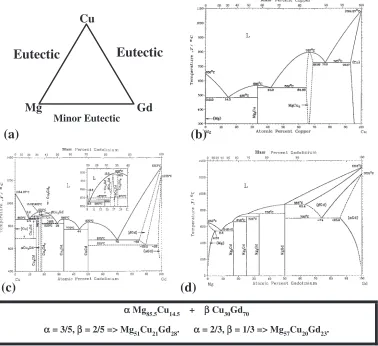
Ni, Y, or Gd) is generally higher than 10kJ/mol. The feasibility of this model is worthy of examination. Taking a ternary Mg-Cu-Gd amorphous system for instant, there happen to be an apparent eutectic reaction at Mg85:5Cu14:5
(on the Mg side, but withHm,Mg-Cuof only3kJ/mol), and
many eutectic reactions at Cu71Gd29, Cu55Gd44 and Cu30
-Gd70 (with Hm,Cu-Gd of 22kJ/mol), and a less apparent
eutectic reaction at Mg91Gd9 (with Hm,Mg-Gd of 6kJ/
mol), as shown in Fig. 1. Since theHm values of the base
metal Mg with the alloying elements of Cu and Gd are both low, it is difficult to extract the optimum composition using the same rule previously for Zr based alloys.8) If
compul-sorily applied, the composition yielded will be Mg87Cu10Gd3
or Mg69Cu28Gd3. The 3% Gd as the only large-sized element
in this alloy has been found in our laboratory to be too low to impose the randomization effect to form an amorphous alloy. In this study, alternative combinations are tried to determine the ternary composition. According to the concept of binary eutectic pairs, a binary eutectic phase with the lower negative heat of mixing possesses the larger part in the ternary system than the phase with higher one. For example, using Mg85:5Cu14:5 + Cu71Gd29 with¼2=3 and¼
1=3, the resulting ternary alloy is Mg57Cu33Gd10. Similarly,
based on Mg85:5Cu14:5 + Cu55Gd44 with ¼2=3 and
¼1=3, orMg85:5Cu14:5 +Cu30Gd70with¼2=3and
¼1=3, the alloy has the composition of Mg57Cu28Gd15and
Mg57Cu20Gd23, respectively. These alloy compositions are
close but not the same as the model alloy Mg65Cu25Gd10.
If the above combinations are made but with differentand
(e.g. ¼3=5 and ¼2=5), then another set of alloy compositions will be yielded, namely, Mg51Cu37Gd12,
Mg51Cu31Gd18, and Mg51Cu21Gd28. It is interesting to
*Corresponding author, E-mail: [email protected]
examine the GFA behavior of these alloys with the amount of the rare-earth element greater than 10%.
3. Thee=a-Related Criterion
It is well know that the Hume-Rothery phases are kinds of electronically stabilized composition when a pseudo-gap is formed across the Fermi level (EF). In this case, the total
kinetic energy of valence electrons would be reduced, which results in lowering the system energy. Therefore, the Fermi surface-Brillouin zone (FS-BZ) interaction, denoted as 2Kf Kp, where Kf is the Fermi sphere diameter andKp is
the reciprocal peak vector defining a width of the Brillouin zone, is believed to be a mechanism directly related to the formation of the pseudo-gap at EF.12,13) For the
Hume-Rothery phase, the density of states manifests pseudo-gap at specific reciprocal lattice vectors. As result, the predominant BZs are defined with these reciprocal lattice vectors (Khkl)
associated with the FS-BZ interaction. Also, the 2Kf Kp,
criterion was proposed by Nagel and Tauc for the amorphous Hume-Rothery phase.14)Thereby, the formation and stability
of amorphous alloys, and quasi-crystals and their crystalline approximants were extensively discussed by the similar Hume-Rothery interaction mechanism.15–17) Based on the above mentioned FS-BZ mechanism, both empirical elec-trons/atom constant rule and empirical elecelec-trons/atom variant rule (usually called as e=a-related criteria) were
mostly proposed by Dong to optimize the multi-component compositions with high GFA.9–11)Some successful examples
have been achieved by applying the e=a-related criteria to predict the optimal multi-component compositions in Zr-based and Cu-Zr-based amorphous alloys.18–20)Thee=a-variant
criterion is embodied in a ternary system by special e=a -variant line, which is defined by linking the third element to a special composition point in a binary subsystem, usually the deep eutectic point or a special atomic cluster composition. For the Mg-Cu-Gd ternary system, the f-shell electrons for Gd will lead to the uncertainty of thee=aratio. By using the X-ray diffraction information and the alloy density, the width of the Brillouin zoneKp, and finally the e=a ration can be
evaluated.9–11)
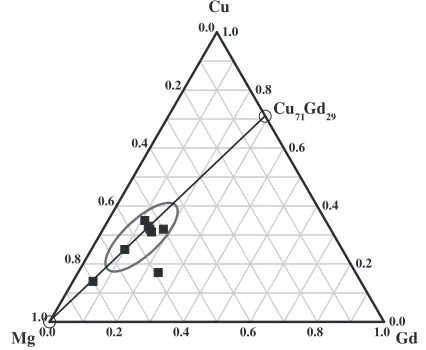
In order to predict the ternary Mg-based amorphous compositions, the e=a-values for Mg, Cu and Gd are first evaluated as 2.0, 1.0, and1:0, respectively. There are many eutectic reactions between Cu-Gd. Among these eutectics, the composition is Cu71Gd29is closer to the Cu-rich side, thus
allowing the resulting ternary alloys to have a composition with a lower amount of the expensive Gd rare-earth element. Therefore, the composition is taken as the starting point to construct the e=a-variant lines in the ternary Mg-Cu-Gd system, as illustrated in Fig. 2. The composition in thee=a -variant line is Mgx(Cu71Gd29)1-x for the present ternary
system. Meanwhile, according to previous experiences, the range of optimum composition of Mg element is usually from αα Mg85.5Cu14.5 + β Cu30Gd70
α = 3/5, β = 2/5 => Mg51Cu21Gd28. α = 2/3, β = 1/3 => Mg57Cu20Gd23.
Cu
Gd
Mg
Eutectic
Minor Eutectic
Eutectic
(a)
(b)
(c) (d)
[image:2.595.111.489.75.421.2]55% to 65%. Ternary alloys along or close to thise=a-variant line include, for instance, Mg65Cu25Gd10, Mg54Cu32Gd14,
Mg50Cu32Gd18, etc.
4. Experimental Methods
The Mg-TM-Ln amorphous alloys were chosen for the investigation. The pre-alloyed ingots of binary (Cu-Y, Cu-Gd and Cu-Nd) and quaternary (Cu-Gd-Nd-Y) alloys were first prepared by arc melting under a Ti-gettered argon atmo-sphere. The purity of Cu, Nd, Gd and Y is 99.999%, 99.9%, 99.9% and 99.9%, respectively. Then the ingots and pure Mg (99.99%) were melted in an induction furnace under a purified argon atmosphere. After complete melting, metallic glassy ribbons of about 100mm in thickness and 10 mm in width were subsequently prepared by the single roller melt-spinning technique, which the Cu wheel is rotated with high speed of 25 m/s. The as-quenched ribbons were first confirmed to be amorphous using Siemens D5000 X-ray diffraction (XRD) with monochromatic Cu-K radiation.
Thermal properties of the metallic glassy ribbons were characterized by Setaram differential scanning calorimeter (DSC) with a heating rate of 40 K/min under a flowing argon atmosphere.
5. Results and Discussions
Due to the difficulty in precise control of alloy content, some of resulting alloys have compositions only close to the set goal, but mostly within 1–3% discrepancy. Figure 3 shows the X-ray diffraction patterns obtained from some representative melt-spun specimens. Most of the specimens exhibit a broad diffused peak in the range of 30–50, and no detectable crystalline peak is observed. It is evident that these Mg-based melt-spun ribbons are mostly of the amorphous state. But alloys with the large-sized elements (Gd, Nd or Y) greater than 18% tend to show crystalline peaks in the X-ray patterns, including Mg50Cu32Gd18, Mg50Cu27:5Nd7:5Gd7:5
-Y7:5 (i.e. with overall large-sized elements of 22.5%), and
Mg59Cu17Gd24. On the basis of X-ray results, it is apparent
that excessive large-size rare-earth elements will promote nano-crystallization of, for example, GdCu, as a result of the high heat of mixing between Gd and Cu.
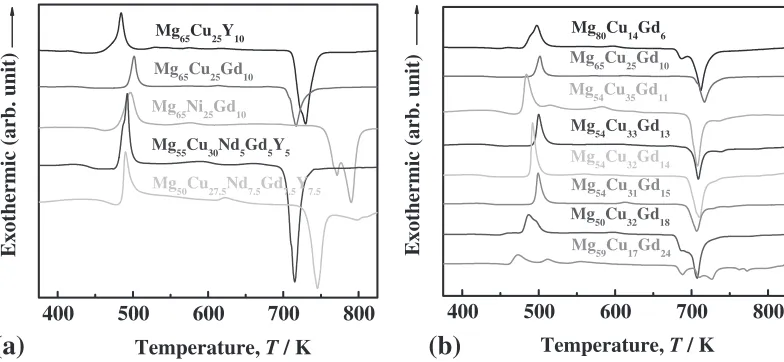
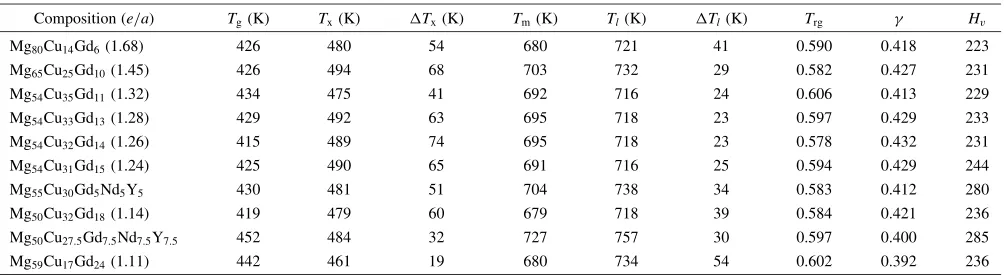
The DSC tracts of some of the representative melt-spun specimens are shown in Fig. 4. All of the Mg-based specimens show distinct glass transition followed by a supercooled region and then exothermic reactions due to crystallization. The thermal characteristics of the representa-tive specimens at the heating rate of 40 K/min are summa-rized in Table 1. The model alloy, Mg65Cu25Y10does exhibit
promising thermal behavior, with large Tx, Trg, and
values of 68 K, 0.582, 0.427, respectively, and a smallestTl
of 29 K. Based on the two models using binary eutectic extension ore=a-variant line, alloys with a higher amount of the large-sized rare-earth element and the small-sized Cu also exhibit good performance. The Mg54Cu32Gd14gives the best
combination ofTx,Trg,, and Tl of 74 K, 0.578, 0.432,
and 23 K. The neighboring alloys of Mg54Cu33Gd13, Mg54
-Cu31Gd15, Mg55Cu30Gd5Nd5Y5, and even Mg50Cu32Gd18
also yield satisfactory thermal characteristics.
The experimental results suggest that the alloys with a lower amount of the medium-size matrix element of Mg, from 65% down to 50–55%, coupled with a higher amount of the large-sized element(s) to 11–15% and the small-sized element to 30–35%, will still be within the promising range. Some of the predicted alloy compositions from the two models basically reside in this region.
According to the three empirical rules, proposed by Inoue,21) the multi-component system consisting of more than three main elements tends to show a higher GFA. In this study, the multi-component specimens of Mg55Cu30Gd5
-Nd5Y5and Mg55Cu27:5Gd7:5Nd7:5Y7:5did not reveal superior
thermal properties, as compared with the Mg65Cu25Gd10,
Mg54Cu32Gd14and Mg54Cu31Gd15specimens. This might be
caused by the high heat of mixing and thus the high chance for Gd, Nd and Y to form intermetallic compounds with Cu, resulting in the degraded thermal properties.
Meanwhile, according to thee=acriterion, the Mg-Cu-Gd specimens all locate on or close to thee=a-variant line except for the Mg59Cu17Gd24(Fig. 2); the Mg59Cu17Gd24is close to
the predicted composition by the binary eutectic-pairs criterion but with maybe too excessive Gd. For the Mg-Cu-Gd alloys with thee=aratio ranging from 1.24 to 1.45, the thermal properties do not reveal distinct degradation. It implies that the Gd-containing alloys might have a looser constraint in terms of satisfactory GFA.
The application of the binary eutectic pair scheme to the Mg based amorphous alloys is subject to the problem that the Mg-Cu-Gd(Y) liquids can not be classified as ‘‘ideal glass-forming liquids’’ as defined in the original paper.8) For an
ideal glass-forming liquid in a ternay alloy system B-C, A-B and A-C atom pairs are required to form strong bonding while B-C atom pairs should have much weaker bonding (or with a low heat of mixing). In this case, A-B and A-C eutectic pairs would exist in the liqhid state and thus affect the stability of the glass state. For the Mg-Cu-Gd system, only the Cu and Gd atoms form strong atomic pairs due to their high negative heat of mixing (22kJ/mol), while Cu-Mg and Mg-Gd atomic pairs are much weaker because of their low negative heat of mixing (3and6kJ/mol). In view of 0.0 0.2 0.4 0.6 0.8 1.00.0
0.2 0.4 0.6 0.8 1.0 0.0
0.2
0.4
0.6
0.8
1.0
Gd Cu
Mg
Cu71Gd29
[image:3.595.61.274.75.250.2]this heat-mixing analysis, the Mg-Cu-Gd system does not belong to the class of the ideal glass-forming liquids, even Cu-Mg and Cu-Gd form eutectics as shown in their binary phase diagrams. It is for the above reasons that the predictions for the Mg-Cu-Gd(Y) systems on the base of binary eutectic pair scheme are sometimes not as valid.
Finally, the hardness results of the resulting Mg-based specimens are also included in Table 1. Most of the amorphous alloys exhibit average Hv hardness readings
within 220–240. The Mg80Cu14Gd6 is the softest one
(Hv¼223) among the whole Mg-Cu-Gd systems, resulting
from the high amount of the soft Mg element. With increasing amount of Gd, the hardness increases slightly. It is noted that the two multi-components specimens with higher amounts of rare-earth elements, namely the Mg55
-Cu30Gd5Nd5Y5 and Mg55Cu27:5Gd7:5Nd7:5Y7:5, have much
higher hardness values of 280 and 285Hv. The Tg
temper-atures of these two specimens, 430 and 452 K, are also higher than the ternary alloys with similar amounts of Gd;Tgof the
Mg54Cu31Gd15, Mg50Cu32Gd18, and Mg59Cu17Gd24 is 425,
419, and 442 K. The higherTgand hardness suggest that the
average mutual bonding strength of the multi-component Mg55Cu30Gd5Nd5Y5 and Mg55Cu27:5Gd7:5Nd7:5Y7:5 might
be stronger. For applications which need higher glass transition temperature and higher hardness, the incorporation of a higher total amount of multi-component elements might be an alternate route.
6. Conclusions
Based on the results observed from the Mg-TM-Ln amorphous alloys, the thermal properties can be summarized below:
(1) The binary eutectic-pairs and thee=a-invariant criteria are applied to the Mg-Cu-Gd based amorphous alloys. The experimental results are partly consistent with the predictions, but the models would fail when an excessive amount of the large-sized rare-earth element is added, as a result of crystallization tendency between Gd and Cu with a higher heat of mixing.
(2) Among the Mg-Cu-Gd based alloys with Gd from 6 to 24%, the Mg54Cu32Gd14 specimen shows the best
combination of Tx, Trg, , and Tl of 74 K, 0.578,
0.432, and 23 K, even superior to the Mg65Cu25Gd10
model alloy which exhibits the data of 68 K, 0.582, 0.427, and 29 K.
20 30 40 50 60 70 80
Mg50Cu27.5Nd7.5Gd7.5Y7.5 Mg55Cu30Nd5Gd5Y5 Mg65Ni25Gd10 Mg65Cu25Gd10
Mg65Cu25Y10
Intensity
2θ
20 30 40 50 60 70 80
Mg80Cu14Gd6
Mg65Cu25Gd10
Mg54Cu35Gd11
Mg54Cu33Gd13
Mg54Cu32Gd14
Mg54Cu31Gd15
Mg50Cu32Gd18
Mg59Cu17Gd24
Intensity
2θ
(b)
(a)
Fig. 3 The XRD patterns of the (a) Mg-TM-Ln and Mg-Cu-Gd-Nd-Y, and (b) Mg-Cu-Gd based amorphous alloys.
400 500 600 700 800
Mg65Cu25Y10
Mg65Cu25Gd10
Mg65Ni25Gd10
Mg55Cu30Nd5Gd5Y5
Mg50Cu27.5Nd7.5Gd7.5Y7.5
Exothermic (arb. unit)
Temperature, T / K
400 500 600 700 800
Mg80Cu14Gd6
Mg65Cu25Gd10
Mg54Cu35Gd11
Mg54Cu33Gd13
Mg54Cu32Gd14
Mg54Cu31Gd15
Mg50Cu32Gd18
Mg59Cu17Gd24
Exothermic (arb. unit)
Temperature, T / K
(a)
(b)
[image:4.595.100.495.71.247.2] [image:4.595.102.494.293.474.2](3) For the Mg-Cu-Gd based alloys with the e=a ratio within 1.24–1.45, the thermal properties do not reveal distinct degradation. It implies that the Gd-containing alloys might have a looser constraint in terms of satisfactory GFA.
(4) The multi-component specimens of Mg55Cu30Nd5
-Gd5Y5 and Mg55Cu27:5Nd7:5Gd7:5Y7:5 have higher
hardness values of 280 and 285 Hv and higher Tg
temperatures of 430 and 452 K than the Mg-Cu-Gd ternary alloys with a similar amount of Gd.
Acknowledgement
The authors are gratefully acknowledge the sponsorship by National Science Council of Taiwan, ROC, under the project no. NSC 95-2218-E-110-006.
REFERENCES
1) T. Zhang and A. Inoue: Mater. Trans. JIM40(1999) 301–306. 2) A. Inoue, T. Zhang and T. Masumoto: Mater. Trans. JIM30(1989)
965–970.
3) A. Inoue, T. Zhang and T. Masumoto: Mater. Trans. JIM31(1990) 177–183.
4) A. Inoue, T. Nakamura, N. Nishiyama and T. Masumoto: Mater. Trans. JIM33(1992) 937–945.
5) H. Men, W. T. Kim and D. H. Kim: J. Non-Cryst. Solids337(2004) 29–35.
6) G. Yuan and A. Inoue: J. Alloys and Compounds387(2005) 134–138. 7) O. N. Senkov and J. M. Scott: Mater. Lett.58(2004) 1375–1378. 8) Z. P. Lu, J. Shen, D. W. Xing, J. F. Sun and C. T. Liu: Appl. Phys. Lett.
89(2006) 071910.
9) C. Dong, A. Perrot, J. M. Dubois and E. Belin: Mater. Sci. Forum.150– 151(1994) 403–416.
10) C. Dong: Scripta Metall. Mater.33(1995) 239–243.
11) J. B. Qiang, D. H. Wang, C. M. Bao, Y. M. Wang, W. P. Xu, M. L. Song and C. Dong: J. Mater. Res.16(2001) 2653–2660.
12) N. F. Mott and H. Jones:The theory of the properties of metals and alloys, (Oxford University Press, Oxford, U.K., 1936).
13) T. B. Massalski and Mizutani: Prog. Mater. Sci.22(1978) 151–262. 14) S. R. Nagel and J. Tauc: Phys. Rev. Lett.35(1975) 380–383. 15) T. Fujiwara and T. Yokokawa: Phys. Rev. Lett.66(1991) 333–336. 16) J. Hafner and M. Krajci: Phys. Rev. B47(1993) 11795–11809. 17) U. Mizutani, T. Takeuchi and H. Sato: Prog. Mater. Sci.49(2004) 227–
261.
18) Y. Wang, C. H. Shek, J. B. Qiang, C. H. Wong, Q. Wang, X. F. Zhang and C. Dong: Mater. Trans. JIM45(2004) 1180–1183.
19) Y. M. Wang, W. P. Xu, J. B. Qiang, C. H. Wong, C. H. Shek and C. Dong: Mater. Sci. Eng. A375–377(2004) 411–416.
20) Q. Wang, Y. M. Wang, J. B. Qiang, X. F. Zhang, C. H. Shek and C. Dong: Intermetallic12(2004) 1229–1232.
[image:5.595.48.550.83.221.2]21) A. Inoue: Acta Mater.48(2000) 279–306. Table 1 The DSC results of the Mg ribbons.
Composition (e=a) Tg(K) Tx(K) Tx(K) Tm(K) Tl(K) Tl(K) Trg Hv
Mg80Cu14Gd6(1.68) 426 480 54 680 721 41 0.590 0.418 223
Mg65Cu25Gd10(1.45) 426 494 68 703 732 29 0.582 0.427 231
Mg54Cu35Gd11(1.32) 434 475 41 692 716 24 0.606 0.413 229
Mg54Cu33Gd13(1.28) 429 492 63 695 718 23 0.597 0.429 233
Mg54Cu32Gd14(1.26) 415 489 74 695 718 23 0.578 0.432 231
Mg54Cu31Gd15(1.24) 425 490 65 691 716 25 0.594 0.429 244
Mg55Cu30Gd5Nd5Y5 430 481 51 704 738 34 0.583 0.412 280
Mg50Cu32Gd18(1.14) 419 479 60 679 718 39 0.584 0.421 236
Mg50Cu27:5Gd7:5Nd7:5Y7:5 452 484 32 727 757 30 0.597 0.400 285
Mg59Cu17Gd24(1.11) 442 461 19 680 734 54 0.602 0.392 236