Appearance of Two-Way Strain in Shape Memory Effect of Ti–Ni–Nb Alloy
—Influence of Applied Strain on Two-Way Strain—
*1Keisuke Okita
*2, Nagatoshi Okabe, Tomoyuki Sato
*2and Takashi Nakao
*3Department of Mechanical Engineering, Ehime University, Matsuyama 790-8577, Japan
A promising field for applications of shape memory alloys (SMAs) in the near future is the micro-actuator technology. Especially, two-way shape memory effect (TWSME) is the most suitable to apply in actuators, because a pre-determined response can be obtained very easily by thermal changes against shape memory elements.
In this paper, the TWSME in Ti–Ni–Nb alloy was investigated quantitatively by applying various levels of pre-deformation. The deformation in a complete martensite phase was applied by a thermo-mechanical treatment in order to obtain the two-way memory strain. The experimental results indicated that the deformation mechanism in a martensite phase was just the martensite reorientation accompanied by the dislocation slip. The dislocation due to the slip deformation is the origin of the internal stress field that is necessary to generate the two-way memory strain. However, excessive introduction of the dislocation decreases the two-way memory strain. The maximum two-way memory strain observed in this experiment was 2.1% at an applied strain of 18%. In addition, pre-deformation increases the temperature of reverse transformation, but decreases the temperature of martensitic transformation. These experimental results can be explained by using the series-parallel combined model that has been suggested in our previous work.
(Received August 22, 2005; Accepted November 7, 2005; Published March 15, 2006)
Keywords: shape memory alloy, titanium–nickel–niobium alloy, two-way shape memory effect, thermo-mechanical treatment, series-parallel combined model
1. Introduction
Shape memory alloys generate the recovery deformation and the recovery force due to the reverse transformation by increasing temperature. Since the recovery characteristics have functions of both a temperature sensor and a driving device, various developments for the practical use of the
shape memory alloy have been conducted previously.1)These
developments have been expanded actively in the medical and aerospace fields as well as in the general industry fields. Particular attention has been paid to the application of the SMA elements to a driving device for robots or
micro-machines.2)Essentially, SMA elements have a high degree of
usability for actuators requiring complex movements. Addi-tionally, this use as micro-actuators is effective in the point that the response to the temperature change can be improved
by the miniaturization.3)And then such material technology
as Ti–Ni shape memory alloy can be formed as a thin film has
been developed with the progress of miniaturization.4)
Especially when SMA is applied as the actuator, two-way shape memory effect (TWSME) of SMA is more useful than the material properties. Using TWSME, reversible shape change and driving force by thermal cycle can be obtained easily and repeatedly, because the alloy remembers the shapes of not only a parent phase but also a martensite phase. Moreover, another great merit for using TWSME is that the shape change and the driving force of the alloy can be given beforehand by thermo-mechanical treatments, which are well known as training procedures. These procedures for taking out the property of TWSME can be achieved by each of
various trainings as follows;5,6)
(1) Shape memory training that is caused by applying a large deformation, which the shape recovery is not completed, to the alloy in a martensite phase.
(2) Pseudo-elastic training that is caused by applying a large deformation, which the shape recovery is not completed, to the alloy in a parent phase.
(3) Thermo-mechanical cycle training that is caused by proceeding reverse transformation with constraining the recovery during heating after pre-deforming in a martensite phase.
(4) Thermal cycle training that is caused by repeating thermal transformations subjected to a constant external stress.
In this paper, we focused our attention on the shape memory training and we have investigated quantitatively the influence of pre-strain on the generation of two-way strain by fundamental experiments changing the pre-strain. And the influence of pre-strain obtained as experimental results can be described clearly by modeling the mechanism of the appearance of two-way strain.
2. Experiment
2.1 Specimen
Ti–Ni–Nb shape memory alloys were hot forged and hot extruded, and followed by cold drawing and intermediate annealing to make wires with a diameter of 1.0 mm. The alloys are composed of Ti–45.5Ni–9.0Nb[at%]. The wires
were finished by cold drawing with CW¼30% reduction
and were cut to 100 mm in length. The specimens were
annealed at THT¼1223K for 3.6 ks. The transformation
temperatures were determined from differential scanning
calorimetry (DSC) measurement to be Mf ¼277K, Ms¼
286K,As¼319K and Af ¼330K as shown in Fig. 1. The
specimens were cooled in liquid nitrogen prior to experiment in order to ensure a martensite structure.
*1This Paper was Originally Published in Japanese in J. Jpn. Inst. Met.69 (2005) 622–627.
*2Graduate Student, Ehime University, Matsuyama
*3Under Graduate Student, Ehime University, Matsuyama. Present address: Mazda Motor Co. Ltd., Hiroshima
Special Issue on Shape Memory Alloys and Their Applications
2.2 Experimental procedure
In order to investigate the generation of the two-way strain of Ti–Ni–Nb alloys, the two-way tests were carried out by the following method as shown in Fig. 2. The tests consist of five processes which were pre-deformation, unloading, heating, cooling and re-heating.
First the specimen is elongated until a given pre-strain,"pr,
(A–B) at a given temperature,TC, which is 25 K below theAs
temperature and then unloaded down to be stress free (B–C).
Next the specimen is heated until a temperature, TH, (>Af)
without constraint. During the heating, recovery strain,"re, is
generated due to the reverse transformation (C–D). The specimen is cooled down without constraint after the heating enough to complete the reverse transformation (D–E). In this
cooling process, the two-way strain, "tw, due to the
martensitic transformation is generated toward the opposite direction of the pre-strain. Finally the specimen is re-heated without constraining (E–F). The tests were conducted for
various pre-strains,"pr, listed in Table 1.
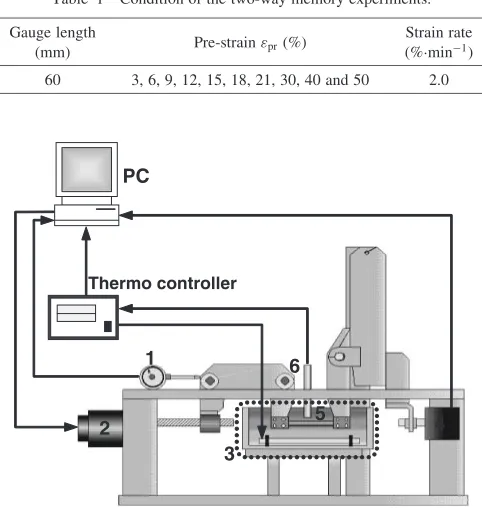
Schematic diagram of the testing machine and the measurement devices used in the test is shown in Fig. 3.
The specimen was loaded and unloaded by griping both its ends in the container for heating/cooling. The specimen was heated by silicon oil as a heat medium and was cooled down by evaporated liquid nitrogen. The test data such as stress, strain and temperature were measured by using a loadcell, a dial gauge and a thermo couple, respectively.
3. Results
3.1 Stress–strain behavior in pre-strain
Stress–strain curves that were obtained by pre-deforma-tions in martensite phase under a constant strain rate are shown in Fig. 4. The deformation behavior is that the elastic
deformation keeps until "1:1% and the reorientation of
martensite variants progresses until"6:5% following first
250
300
350
400
Temperature, T / K
endothermic
DSC
exothermic
Cooling
Heating Mf Ms
As Af
Mf=277K, s=286K
As=319K, Af=330K M
Fig. 1 Transformation behavior of solution-treated Ti45:5Ni45:5Nb9
speci-men in the DSC measurespeci-ment.
Mf
Ms
Af
As
Strain
Stress
Strain
re tw p
A
B
C
D E
F
re: Reverse transformation strain tw: Two-way memory strain p: Plastic strain
ε ε ε
2 s
A
2 f
A
Temperature
ε ε
ε
[image:2.595.62.274.69.233.2]Fig. 2 Schematic illustration of thermo-mechanical cycle in the two-way memory experiment.
Table 1 Condition of the two-way memory experiments.
Gauge length
(mm) Pre-strain"pr(%)
Strain rate (%min1)
60 3, 6, 9, 12, 15, 18, 21, 30, 40 and 50 2.0
2
3
5
4 6
PC
Thermo controller
1
Fig. 3 Test machine and measuring system. 1: dial gauge, 2: displacement control motor, 3: heating or cooling unit, 4: load cell, 5: specimen, 6: thermo couple.
10 20 30 40 50
200 400 600 800 1000 1200
0
Strain,
Plastic deformation region
Stress
,
deformed at 295 K
ε(%) σ/ MPa
[image:2.595.306.547.76.330.2] [image:2.595.57.283.285.485.2] [image:2.595.321.533.399.553.2]yield deformation of200MPa. The flow stress increases rapidly with further applied deformation and second yield
deformation occurs at750MPa. Typical deformation of
slip progresses beyond the second yield stress. On the other hand, in the recovery behavior during unloading process, the
apparent young’s modulus E decreases gradually with
increasing pre-strain and then the deformation behavior becomes nonlinear. The nonlinear behavior involves the increase of deformation just by twins that is caused by internal stress due to pre-strain.
3.2 Influence of pre-strain on shape recovery and reverse transformation
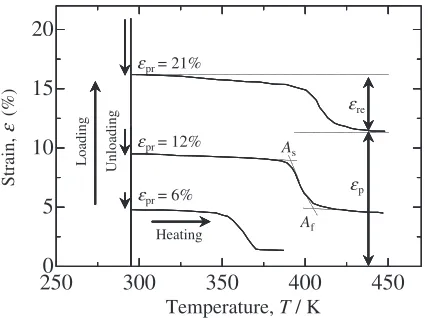
Figure 5 shows the strain-temperature relations in the processes of loading, unloading and heating in the cases of
"pr¼6, 12, 21%. Figures 6 and 7 show the influence of the
pre-strain,"pr, on both generations of the recovery strain,"re,
due to reverse transformation by heating and the residual
strain after heating, "p, respectively. Figure 8 shows the
influence of the "pr on the transformation temperatures,As
andAf, after loading.
As shown in Fig. 6 the recovery strain increases with
proceeding deformation by reorientation until "pr¼12%
where the second yield deformation is recognized in Fig. 4
and becomes maximum ("re¼5:4%) in the region of "pr¼
12{18%. However, by applying further deformation, the
recovery strain,"re, tends to decrease and saturates gradually
because of the progressing only the slip-deformation without generating new twins. On the other hand, the slip-deforma-tion generated in loading remains in the material as
irrecoverable strain and is observed as permanent strain,"p,
because it can not revert to the original shape. In addition the slip-deformation is found to be generated even by slight
pre-strain,"pr, by judging from the appearance of the"pin Fig. 7.
The "p increases with increasing "pr, and finally @"p=@"pr
becomes 1.0 as shown in Fig. 7. This experimental fact suggests that the deformation of the alloy in the strain region above 20% is progressing only by slip.
Moreover, the transformation temperatures, As and Af,
tend to increase and saturate gradually with increasing the"pr
as shown in Fig. 8, respectively. Focusing attention on
@A=@"pr as an influence coefficient of the pre-strain for
increasing the transformation temperatures, it is found that the stabilization of martensites is promoted by applying the excessive pre-strain. The stabilization of martensites is recognized from the experimental fact that the transformation temperatures increase about 120 K at the maximum com-pared with un-deformed specimen. The increase of trans-formation temperatures is very high compared with the value
of previous studies.7,8) Moreover, both transformation
tem-250
0
300
350
400
450
5
10
15
20
Temperature, T / K
Loading
Heating
As
Af pr= 6%
ε pr= 12% ε
ε pr= 21%
ε
ε
p re
Unloading
Strain,
ε
(%)
Fig. 5 Strain behaviors corresponding to change of temperature in the heating process together with the deformation process.
10
20
30
40
50
2
4
6
8
0
Reverse transformation strain,
(%)
ε
pr(%)
Pre-strain, ε
re
Fig. 6 Relationship between reverse transformation strain "re and pre-strain"pr.
10 20 30 40 50
10 20 30 40 50
0 0.2 0.4 0.6 0.8 1 1.2
0
Plastic strain,
p
pr (%)
Pre-strain,ε
ε
εp
(%)
∂εp εpr
∂ε
ε
p
pr
∂
/
/
∂
Fig. 7 Pre-strain"prdependence of plastic strain"pand@"p=@"pr.
[image:3.595.64.279.71.230.2] [image:3.595.322.535.75.215.2] [image:3.595.319.534.258.404.2] [image:3.595.63.276.287.453.2]peratures increase rapidly until "pr¼15%, but increase
slightly in further pre-strain. The value of A¼ ðAfAsÞ
also increases slightly with increasing"pr.
3.3 Influence of pre-strain on two-way strain
Figure 9 shows the behavior of strain against thermal cycle consisting of the three processes of cooling and re-heating following the first heating with one-way recovery. The
two-way strain,"tw, is generated due to martensitic transformation
toward the opposite direction of pre-strain and vanishes completely by re-heating. Next, both influences of the
pre-strain on the generation of the two-way pre-strain,"tw, and the
transformation temperatures, Ms and Mf, are shown in
Figs. 10 and 11, respectively. The two-way strain, "tw,
increases until "pr¼18% with increasing"pr, but decreases
in reversal by further pre-strain and becomes zero at "pr¼
40%. The maximum value of the"tw is 2.1% at"pr¼18%.
Let us compare the"tw with the two-way strain that can be
obtained by thermo-mechanical cycles.9)
The"twis generated due to the internal stress in the matrix
that is caused by deformation and phase transformation. The residual internal stress in this test is formed due to the entangling of the dislocation propagated by slip-deformation
introduced in loading. However, as shown in Fig. 10, the"tw
continues to decrease with increasing "pr more than 18%.
This experimental fact suggests that the excessive introduc-tion of dislocaintroduc-tion becomes to disturb the formaintroduc-tion of the internal stress.
Transformation temperatures, Ms and Mf, concerning
directly the generation of "tw decrease with increasing "pr
as shown in Fig. 11 as opposed to the experimental fact that
As andAf increase with increasing"pr. TheMs and the Mf
decrease rapidly in extreme small pre-strain and become
saturated in further pre-strain higher than "pr¼18%. The
experimental results of Liu et al.,8,10) also, show similar
tendencies to this decreasing behavior ofMs andMf in the
deformed specimen.
4. Discussion
4.1 Influence of pre-strain on two-way strain
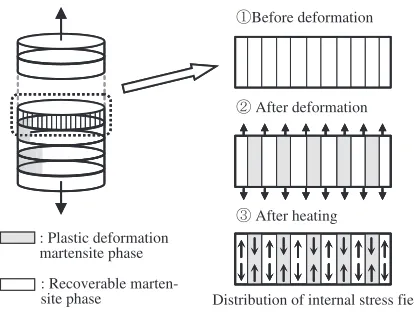
In this section, the mechanism of the generation of the two-way strain depending largely on pre-strain is discussed using our convenient model. The model is a series-parallel combined model, which consists of several serial combined micro-elements with parallel-combined models as shown in Fig. 12. The series-parallel combined model has been
proposed steadfastly in our previous works of SMAs.11–14)
The driving force for generating two-way strain is caused by
200
0
250
300
350
400
450
5
10
15
Temperature, T / K
Cooling Re-heating
tw
Ms
Mf As
2
Af 2 Two-way memory strain
pr= 12%
ε
pr= 6%
ε
pr= 21%
ε
Strain,
(%)
ε
ε
Fig. 9 Strain vs. temperature curves upon cooling and heating.
10
20
30
40
50
1
2
3
0
Two-way memory strain,
εtw
(%)
pr(%)
[image:4.595.64.277.66.232.2]Pre-strain,
ε
Fig. 10 Relationship between two-way memory strain"twand pre-strain "pr.
0
10
20
30
40
50
220
240
260
280
300
Ms
Mf
Temperature,
T
/ K
pr (%)
[image:4.595.319.534.74.233.2]Pre-strain,
ε
Fig. 11 Relationship between martensitic transformation temperatures and pre-strain"pr.
Before deformation
After deformation
Distribution of internal stress field After heating
: Plastic deformation martensite phase
[image:4.595.62.279.277.443.2]: Recoverable marten-site phase
[image:4.595.320.527.287.443.2]the internal stress in matrix due to entangling of the propagated dislocations by slip-deformation as mentioned above. In the series-parallel combined model, an element subjected to slip-deformation is modeled as a plastic damaged element, which has lost the function of the shape recovery, and the elements are presumed to be scattered in the micro-elements with parallel-combined models as shown in Fig. 12. A mismatch of strain occurs in the heating process at interface between the plastic damaged martensite element and the recoverable element, and then the internal stress begins to be generated. The martensitic transformation of the recoverable elements is caused in a subsequent cooling process while reducing the directional internal stress with the self-accommodation of martensites. The directional defor-mation growth in martensites is caused between micro-parallel elements, and the summation of the microscopic deformation growth becomes observable as the two-way strain, which is the bulk shape change. Using our model for the generation mechanism of two-way strain, the dependence of two-way strain on the pre-strain can be described as follows.
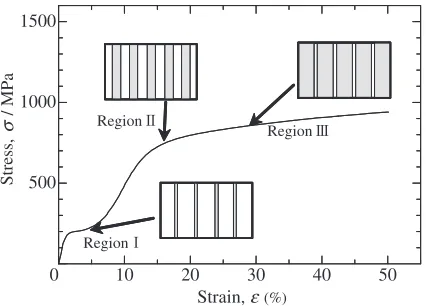
In the initial stage of pre-strain ‘‘Region I’’ in Fig. 13, the mismatch of strain between the plastic damaged element and the recoverable element is still small because both gener-ations of recovery strain and plastic strain due to slip-deformation occur scarcely as shown in Figs. 6 and 7. Thus, the generation of the two-way strain is also small because of the small internal stress. Increasing further pre-strain, both the recovery strain and the plastic strain start to increase and then the mismatch of strain also begins to increase. Thus, since the large internal stress accumulates in the matrix field, the two-way strain begins to increase. The two-way strain by
such mechanism continues to increase until "pr¼12{18%,
where is Region II, and becomes largest at"pr¼18% with
the largest internal stress. In contrast, increasing further pre-deformation in Region III, the recoverable elements start to decrease due to increasing of plastic damaged elements, because the deformation by slip progresses. Thus the magnitude of formed internal stress becomes small and the two-way strain decreases. In addition, judging from the
recovery strain that is still generated even in "pr>40% as
shown in Fig. 6, the internal stress seems to remain still in the
field. However, the shape change can not occur macroscopi-cally because the excessive dislocations introduced by the slip-deformation are very difficult to move by the entangling of themselves. Consequently the excessive dislocations restrain the two-way strain to be generated.
That is to say, the dislocation introduced by the slip-deformation not only forms the driving force that makes the two-way strain appear but also obstructs the generation of the two-way strain. By applying the series-parallel combined model it was found that the effect of the dislocations on such a phenomenon can be explained distinctly from both the macroscopic and microscopic points of view.
4.2 Influence of pre-strain on the transformation tem-peraturesMsandMf
The pre-deformation in martensite phase makes the
trans-formation temperatures Ms and Mf decrease as shown in
Fig. 11. Experimental data with the same tendency were
observed by Liu et al., however, they insist that the result
lacks credibility as follows.10)Considering that the two-way
strain needs internal stress to be generated in martensites, since the directional internal stress increases the
transforma-tion temperatures Ms,Mf of the thermo-elastic martensitic
transformation according to Clausius–Clapeyron relation,
both temperaturesMsandMf should increase due to the
pre-strain dependence. However, the temperatures Ms and Mf
decrease actually with increasing of pre-strain in the experimental results. Judging from our experimental results and model interpretation it can be considered that the discrepancy between the experimental results and their insistence on the above-mentioned is due to their discussion using only a simple parallel combined model. The issue on the discrepancy can be solved by applying our series-parallel combined model as follows.
If the internal stress field formed without propagation of dislocations, the transformation temperatures would increase
as Liuet al.discussed. However, the formation of the internal
stress involves the propagation of dislocations. Since the propagated dislocation entangles each other, the propagation of dislocations prevented the two-way strain from being generated as interpreted by the series-parallel combined model. Therefore, larger driving force, that is, non-chemical free energy is necessary for the martensitic transformation to overcome the restraint due to entangling of the propagated
dislocations, resulting in the decrease of Ms and Mf.
Moreover, although the critical temperature generating the two-way strain will be decided by competition of both potentials, it can be convinced from the experimental results
that the decrease ofMsandMfdepends predominantly on the
entangling of the propagated dislocation.
5. Conclusion
Experiments concerning the practical use of Ti–Ni–Nb alloys were carried out to clarify quantitatively the influence of pre-deformation on the TWSME. The results are summa-rized below
(1) Judging from the behavior of recovery strain by heating with increasing of pre-strain, the deformation due to twins proceeds even over deformation region beyond
10 20 30 40 50
500 1000 1500
0
Strain,
Region Region
Region
Stress,
ε(%)
σ
[image:5.595.64.277.71.224.2]/ MPa
the end of the stress plateau, and finishes at last at the
second yield deformation at750MPa.
(2) The slip-deformation deprives the alloy of shape recovery function, and remains as a permanent strain. The deformation of the alloy includes locally the slip deformation even within the stress plateau, and be-comes subjected only to the slip-deformation in the
region beyond the second yield deformation at
750MPa.
(3) The pre-deformation in martensite phase makes the
reverse transformation temperatures, As and Af,
in-crease, while the martensitic transformation
temper-atures,MsandMf, decrease.
(4) The two-way strain tends to increase with increasing pre-strain in the first stage of the pre-deformation, but the excessive pre-strain, rather, makes the two-way strain decrease with increasing pre-strain. The
max-imum two-way strain is 2.1% at"pr¼18%.
(5) The influence of pre-strain on the properties such as the two-way strain and the transformation temperatures in TWSME can be interpreted more clearly than in past by using series-parallel combined model.
REFERENCES
1) K. Tanaka, H. Tobushi and S. Miyazaki:Mechanical Properties of Shape Memory Alloy, (Yokendo Ltd., 1993).
2) K. Otsuka and C. M. Wayman:Shape Memory Materials, (Cambridge University press, 1998) pp. 1–41.
3) H. Scherngell and A. C. Kneissl: Acta Mater.50(2002) 327. 4) S. Miyazaki, T. Sakuma and T. Shibuya: Characteristics and
Applications of Shape Memory Alloys, (CMC Ltd., 2001) pp. 161. 5) K. Shimizu, M. Irie and T. Tadaki: Shape Memory Materials,
(Kyoritusyuppan Ltd., 1986) pp. 102.
6) H. Funakubo:Shape Memory Alloy, (Sangyotosyo Ltd., 1984) pp. 83. 7) M. Piao, K. Otsuka, S. Miyazaki and H. Horikawa: Mater. Trans., JIM
34(1993) 919.
8) Y. Liu and G. S. Tan: Intermetallics8(2000) 67.
9) T. Sakuma and U. Iwata: Trans. Jpn. Soc. Mech. Eng.63-610A(1997) 1320.
10) Y. Liu, Y. Liu and J. V. Humbeeck: Acta Mater.47(1999) 199. 11) N. Okabe, M. Hosogi, T. Sakuma and K. Okita: Mater. Trans.43(2002)
809.
12) M. Hosogi, N. Okabe, T. Sakuma and K. Okita: Mater. Sci. Forum394– 395(2002) 257.
13) M. Hosogi, N. Okabe, T. Sakuma and K. Okita: Mater. Trans.43(2002) 822.