Cheap and easy entity evaluation
Ben Hachey Joel Nothman Will Radford School of Information Technologies
University of Sydney NSW 2006, Australia
{joel,wradford}@it.usyd.edu.au
Abstract
The AIDA-YAGO dataset is a popular tar-get for whole-document entity recogni-tion and disambiguarecogni-tion, despite lacking a shared evaluation tool. We review eval-uation regimens in the literature while comparing the output of three approaches, and identify research opportunities. This utilises our open, accessible evaluation tool. We exemplify a new paradigm of distributed, shared evaluation, in which evaluation software and standardised, ver-sioned system outputs are provided online.
1 Introduction
Modern entity annotation systems detect mentions in text and disambiguate them to a knowledge base (KB). Disambiguation typically returns the corre-sponding Wikipedia page orNILif none exists.
Named entity linking (NEL) work is driven by the TAC shared tasks on query-driven knowledge base population (Ji and Grishman, 2011). Eval-uation focuses on disambiguating queried names and clustering NIL mentions, but most systems internally perform whole-document named en-tity recognition, coreference, and disambiguation (Cucerzan and Sil, 2013; Pink et al., 2013; Cheng et al., 2013; Fahrni et al., 2013). Wikification work generally evaluates end-to-end entity anno-tation including KB-driven mention spotting and disambiguation (Milne and Witten, 2008b; Kulka-rni et al., 2009; Ratinov et al., 2011; Ferragina and Scaiella, 2010). Despite important differences in mention handling,NELand wikification work have followed a similar trajectory. Yet to our knowl-edge, there are no comparative whole-document evaluations ofNELand wikification systems.
Public data sets have also driven research in whole-document entity disambiguation (Cucerzan, 2007; Milne and Witten, 2008b;
Kulkarni et al., 2009; Bentivogli et al., 2010; Hof-fart et al., 2011; Meij et al., 2012). However, with many task variants and evaluation methodologies proposed, it is very difficult to synthesise a clear picture of the state of the art.
We present an evaluation suite for named entity linking, leveraging and advocating for the AIDA disambiguation annotations (Hoffart et al., 2011) over the large and widely used CoNLL NERdata (Tjong Kim Sang and Meulder, 2003). This builds on recent rationalisation and benchmarking work (Cornolti et al., 2013), adding an isolated evalua-tion of disambiguaevalua-tion. Contribuevalua-tions include:
• a simple, open-source evaluation suite for end-to-end, whole-documentNEL;
• disambiguation evaluation facilitated by gold-standard mentions;
• reference outputs from state-of-the-art NEL and wikification systems published with the suite for easy comparison;
• implementation of statistical significance and error sub-type analysis, which are often lack-ing in entity linklack-ing evaluation;
• a venue for publishing benchmark results continuously, complementing the annual cy-cle of shared tasks;
• a repository for versioned corrections to ground truth annotation.
We see this repository, at https://github. com/wikilinks/conll03_nel_eval, as a model for the future of informal shared evaluation. We survey entity annotation tasks and evalua-tion, proposing a core suite of metrics for end-to-end linking and tagging, and settings that isolate mention detection and disambiguation. A compar-ison of state-of-the-art NEL and wikification sys-tems illustrates how key differences in mention handling affect performance. Analysis suggests that focusing evaluation too tightly on subtasks like candidate ranking can lead to results that do not reflect end-to-end performance.
2 Tasks and metrics
The literature includes many variants of the en-tity annotation task and even more evaluation ap-proaches. Systems can be invoked under two set-tings: given text with expressions to be linked (gold mentions); or given plain text only (system mentions). The former enables a diagnostic evalu-ation of disambiguevalu-ation, while the latter simulates a realistic end-to-end application setting.
Within each setting, metrics may consider different subsets of the gold (G) and system (S) annotations. Given sets of (doc, token span, kbid) tuples, we define precision, recall and F1 score
with respect to some annotation filterf:
Pf = |f(G)|f(S)|∩f(S)| , Rf = |f(G)|f(G)|∩f(S)|
We advocate two core metrics, corresponding to the major whole-document entity annotation tasks. Link annotationmeasures performance over every linked mention. Its filter fL matches spans and
link targets, disregardingNILs. This is particularly apt when entity annotation is a step in an informa-tion extracinforma-tion pipeline. Tag annotationmeasures performance over document-level entity sets: fT
disregards span information andNILs. This is ap-propriate when entity annotation is used, e.g., for document indexing or social media mining (Mi-halcea and Csomai, 2007; Meij et al., 2012). We proceed to ground these metrics and diagnostic variants in the literature.
2.1 End-to-end evaluation
We follow Cornolti et al. (2013) in evaluating end-to-end entity annotation, including both mention detection and disambiguation. In this context,
fL equates to Cornolti et al.’sstrong annotation
match;fT measures what they callentity match.
2.2 Mention evaluation
Mention detection performance may be evaluated regardless of linking decisions. A filter fM
dis-cards the link target (kbid). Of the present metrics, only this considersNIL-linked system mentions as different from non-mentions. For comparability with wikification, we consider an additional filter
fMKB toNELoutput that retains only linked
men-tions. fM andfMKB are equivalent to Cucerzan’s
(2007) mention evaluation and Cornolti et al.’s strong mention match respectively. fM is
com-parable to the NER evaluation from the CoNLL
2003 shared task (Tjong Kim Sang and Meulder, 2003): span equivalence is handled the same way, but metrics here ignore mention types.
2.3 Disambiguation evaluation
Most NEL and wikification literature focuses on disambiguation, evaluating the quality of link tar-get annotations in isolation from NERerror. Pro-viding systems with ground truth mentions makes
fL equivalent to Mihalcea and Csomai’s (2007)
sense disambiguation evaluation and Milne and Witten’s (2008b) disambiguation evaluation. It differs from Kulkarni et al.’s (2009) metric in be-ing micro-averaged (equal weight to each men-tion), rather than macro-averaged across docu-ments. fLrecall is comparable toTAC’sKBrecall
(Ji and Grishman, 2011). It differs in that all men-tions are evaluated rather than specific queries.
Related evaluations have also isolated disam-biguation performance by: considering the links of only correctly identified mentions (Cucerzan, 2007); or only true mentions where the correct entity appears among top candidates before dis-ambiguation (Ratinov et al., 2011; Hoffart et al., 2011; Pilz and Paass, 2012). We do not prefer this approach as it makes system comparison difficult. For comparability, we implement a filter fLHOF
that retains only Hoffart-linkable mentions having a YAGOmeansrelation to the correct entity.
Tag annotation (fT) with ground truth
men-tions is equivalent to Milne and Witten’s (2008b) link evaluation, Mihalcea and Csomai’s (2007) keyword extraction evaluation and Ratinov et al.’s (2011)bag-of-titles evaluation. It is compara-ble to Pilz and Paass’s (2012)bag-of-titles evalua-tion, but does not account for sequential order and keeps all gold-standard links regardless of whether they are found by candidate generation.
2.4 Further diagnostics and rank evaluation
3 Data
The CoNLL-YAGO dataset (Hoffart et al., 2011) is an excellent target for end-to-end, whole-document entity annotation. It is public, free and much larger than most entity annotation data sets. It is based on the widely used NER data from the CoNLL 2003 shared task (Tjong Kim Sang and Meulder, 2003), building disambiguation on ground truth mentions. It has standard training and development splits that are representative of the held-out test data, all being sourced from the Reuters text categorisation corpus (Lewis et al., 2004), which is provided free for research pur-poses. Training and development comprise 1,162 stories from 22-31 August 1996 and held-out test comprises 231 stories from 6-7 December 1996. The layered annotation provides useful informa-tion for analysis including categorisainforma-tion topics (e.g., general news, markets, sport) and NE type markup (PER,ORG,LOC,MISC).
The primary drawback is that KB annotations are currently present only if there is a YAGO
means relation between the mention string and the correct entity. This means that there are a number of CoNLL entity mentions referring to entities that exist in Wikipedia that are nonethe-less marked NIL in the ground truth (e.g. ‘DSE’ for ‘Dhaka Stock Exchange’). This may be ad-dressed by using a shared repository to adopt ver-sioned improvements to the ground truth. Anno-tation over CoNLL tokenisation sometimes results in strange mentions (e.g., ‘Washington-based’ in-stead of ‘Washington’). However, prescribed to-kenisation simplifies comparison and analysis.
Another concern is that link annotation goes stale, since Wikipedia titles are only canonical with respect to a particular point in time. This is because pages may be renamed or reorganised:
• to improve editorial structure, such as down-grading an entity from having a page of its own, to a mere section in another page; • to account for newly notable entities, such as
creating a disambiguation page for a title that formerly had a single known referent; or • because of changes in fact, such as corporate
mergers and name changes.
All systems compared provide Wikipedia titles as labels, which are mapped to current titles for com-parison: for each entity title t linked in the gold data, we query the WikipediaAPIto findt’s canon-ical formtcand retrieve titles of all redirects totc.
4 Reference systems
Even on public data sets, comparison to published results can be very difficult and extremely costly (Fokkens et al., 2013). We include reference sys-tem output in our repository for simple compar-ison. Other researchers are welcome to add ref-erence output, providing a continuous benchmark that complements the annual cycle of large shared tasks likeTAC KBP.
4.1 TagMe
TagMe (Ferragina and Scaiella, 2010) is an end-to-end wikification system specialising in short texts. TagMe performs best among publicly avail-able wikification systems (Cornolti et al., 2013). Mention detection uses a dictionary of anchor text from links between Wikipedia pages. Candi-date ranking is based on entity relatedness (Milne and Witten, 2008a), followed by mention prun-ing. We use thresholds on annotation scores sup-plied by Marco Cornolti (personal communica-tion) of 0.289 and 0.336 respectively for men-tion/link and tag evaluation. TagMe annota-tions may not align with CoNLL token bound-aries, e.g., <annot title=“Oakland, New Jer-sey”>OAKLAND, N.J</annot>. Before evalua-tion, we extend annotations to overlapping tokens.
4.2 AIDA
AIDA (Hoffart et al., 2011) is the system pre-sented with the CoNLL-YAGO dataset and places emphasis on state-of-the-art ranking of candi-date entity sets. Mentions are ground truth from the CoNLL data to isolate ranking performance, equivalent to applying thefLHOF filter. Ranking is
informed by a graph model of entity compatibility.
4.3 Schwa
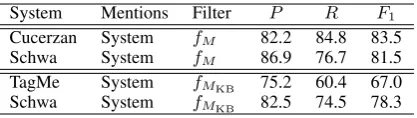
System Mentions Filter P R F1 Cucerzan System fM 82.2 84.8 83.5 Schwa System fM 86.9 76.7 81.5 TagMe System fMKB 75.2 60.4 67.0 Schwa System fMKB 82.5 74.5 78.3 Table 1: Mention detection results. Cucerzan re-sults as reported (Cucerzan, 2007).
5 Results
We briefly report results over the reference sys-tems to highlight characteristics of the evaluation metrics and task settings. Results hinge upon Schwa since we have obtained only its output in all settings. Except where noted, all differences are significant (p < 0.05) according to approximate randomisation (Noreen, 1989), permuting annota-tions over whole documents.
5.1 Mention evaluation
Table 1 evaluates mentions with and withoutNILs. None of the systems reported use a CoNLL-trainedNERtagger, for which top shared task par-ticipants approached 90% F1 in a stricter
evalu-ation thanfM. We note the impressive numbers
reported by Cucerzan (2007) using a novel ap-proach to mention detection based on capitalisa-tion and corpus co-occurrence statistics, and the similar performance1to Schwa, whoseNER
com-ponent is trained on another news corpus.
In wikification, NIL-linked mentions may not be relevant, and it may suffice to identify only the most canonical forms of names, rather than all mentions in a coreference chain. With fMKB,
Schwa has much higher recall than TagMe, though TagMe’s precision is understated because it gener-ates non-NEannotations that are not present in the CoNLL-YAGO ground truth (e.g., linking ‘striker’ toForward (association football)).
5.2 Disambiguation evaluation
Table 2 contains results isolating disambiguation performance. AIDA ranking outperforms Schwa according to both the link (fLHOF) and tag metrics
(fTHOF). If we remove the Hoffart et al. (2011)
linkable constraint, we observe that Schwa disam-biguation performance loses about 8 points in pre-cision on the link metric (fL) and 2 points on the
tag metric (fT). This suggests that disambiguation
1Significance cannot be tested since we do not have the Cucerzan (2007) output.
System Mentions Filter P R F1 Schwa Gold fL 67.5 78.3 72.5 Schwa Gold fLHOF 79.7 78.3 79.0 AIDA Gold fLHOF 83.2 83.2 83.2 Schwa Gold fT 77.8 77.7 77.7 Schwa Gold fTHOF 80.1 77.6 78.8 AIDA Gold fTHOF 87.7 84.2 85.9 Table 2: Disambiguation results for mention-level linking and document-level tagging.
System Mentions Filter P R F1 TagMe System fL 63.2 50.7 56.3 Schwa System fL 67.6 61.0 64.2 TagMe System fT 65.0 65.4 65.2 Schwa System fT 71.2 62.6 66.6 Table 3: End-to-end results for mention-level link-ing and document-level tagglink-ing.
evaluation without the linkable constraint is im-portant, especially if the application requires de-tecting and disambiguating all mentions.
The comparison here highlights a notable eval-uation intricacy. The Schwa system disambiguates all gold mentions rather than those withKBlinks, and the document compatibility approach means that evidence from aNIL mention may offer con-founding evidence when linking linkable men-tions. Further, although using the same mentions, systems use search resources with different recall characteristics, so the Schwa system may not re-trieve the correct candidate to disambiguate.
5.3 End-to-end evaluation
Finally, Table 3 contains end-to-end entity anno-tation results. Again, these results highlight key differences in mention handling betweenNELand wikification. Coreference modelling helps NEL detect and link ambiguous names (e.g., ‘Presi-dent Bush’) that refer to the same entity as unam-biguous names in the same text (e.g., ‘George W. Bush’). And restricting the the universe to named entities is appropriate for the CoNLL-YAGO data. The advantage is marked in the mention-level link evaluation (fL). However, the systems are
statis-tically indistinguishable in the document-level tag evaluation (fT). Thus the extraNERand
[image:4.595.312.520.61.140.2]Error fLHOF fL AIDA Schwa TagMe Schwa
wrong link 752 896 429 605
link as nil - 79 - 111
nil as link - - 183 337
missing - - 1,780 1,031
[image:5.595.308.530.63.140.2]extra - - 1,663 927
Table 4:fLHOF andfLerror profiles.
0 20 40 60 80 100
LOC ORG PER MISC
Figure 1: SchwafLandfLHOF F1 forNEtypes
6 Analysis
We analyse the types of error that a system makes. We also harness the multi-layered annotation to quantify the effect ofNEtype and document topic. By error type Table 4 shows error counts based on the disambiguation link evaluation with the linkable constraint (fLHOF) and the end-to-end
link evaluation (fL). Errors are divided as follows:
wrong link: mention linked to wrongKBentry link as nil: KB-entity mention linked toNIL nil as link: NILmention linked to theKB missing: true mention not detected
extra: mention detected spuriously
AIDAoutperforms Schwa under the linkable eval-uation, making fewer wrong link errors. Schwa also overgenerates NIL, which may reflect candi-date recall errors or a conservative disambiguation threshold. On the end-to-end evaluation, Schwa makes more linking errors (wrong link, link as nil, nil as link) than TagMe, but fewer in mention de-tection, leading to higher overall performance.
By entity type Figure 1 evaluates only men-tions where the CoNLL 2003 corpus (Tjong Kim Sang and Meulder, 2003) marks aNE mention of each type. This is based on the link evaluation of Schwa. The left and right bars correspond to end-to-end (fL) and disambiguation (fLHOF) F1
respectively. In accord with TAC results (Ji and Grishman, 2011), high accuracy can be achieved on PER when a full name is given, whileORG is substantially more challenging. MISC entities are somewhat difficult to disambiguate, with identifi-cation errors hampering end-to-end performance.
0 20 40 60 80 100
[image:5.595.85.279.64.203.2]Sports Domestic Politics Corporate / Industrial Internat’l Relations Markets War / Civil War Crime / Law Enforc’t
Figure 2: SchwafLandfLHOF F1for top topics
By topical category The underlying Reuters Corpus documents are labelled with topic, country and industry codes (Lewis et al., 2004). Figure 2 reports F1 on test documents from each frequent
topic. It highlights that much ambiguity remains unresolved inSports, while very high performance linking is attainable in categories such asMarkets and Domestic Politics, only when given ground truth linkable mentions.
7 Conclusion
We surveyed entity annotation tasks and advocated a core set of metrics for mention, disambiguation and end-to-end evaluation. This enabled a direct comparison of state-of-the-art NEL and wikifica-tion systems, highlighting the effect of key differ-ences. In particular, NER and coreference mod-ules make NEL approaches suitable for applica-tions that require all menapplica-tions, including ambigu-ous names and entities that are not in theKB. For applications where document-level entity tags are appropriate, theNEL and wikification approaches we evaluate have similar performance.
The big picture we wish to convey is a new approach to community evaluation that makes benchmarking and qualitative comparison cheap and easy. In addition to the code being open source, we use the repository to store reference system output, and – we hope – emendations to the ground truth. We encourage other researchers to contribute reference output and hope that this will provide a continuous benchmark to comple-ment the current cycle of shared tasks.
Acknowledgements
References
Luisa Bentivogli, Pamela Forner, Claudio Giu-liano, Alessandro Marchetti, Emanuele Pianta, and Kateryna Tymoshenko. 2010. Extending English ACE 2005 corpus annotation with ground-truth links
to Wikipedia. InCOLING Workshop on The
Peo-ple’s Web Meets NLP: Collaboratively Constructed Semantic Resources, pages 19–27.
Xiao Cheng, Bingling Chen, Rajhans Samdani, Kai-Wei Chang, Zhiye Fei, Mark Sammons, John Wi-eting, Subhro Roy, Chizheng Wang, and Dan Roth. 2013. Illinois cognitive computation group UI-CCG TAC 2013 entity linking and slot filler validation systems. InText Analysis Conference.
Marco Cornolti, Paolo Ferragina, and Massimiliano Ciaramita. 2013. A framework for benchmark-ing entity-annotation systems. In22nd International Conference on the World Wide Web, pages 249–260. Silviu Cucerzan and Avirup Sil. 2013. The MSR sys-tems for entity linking and temporal slot filling at TAC 2013. InText Analysis Conference.
Silviu Cucerzan. 2007. Large-scale named entity
dis-ambiguation based on Wikipedia data. InJoint
Con-ference on Empirical Methods in Natural Language Processing and Computational Natural Language Learning, pages 708–716.
Angela Fahrni, Benjamin Heinzerling, Thierry G¨ockel, and Michael Strube. 2013. HITS’ monolingual and cross-lingual entity linking system at TAC 2013. In
Text Analysis Conference.
Paolo Ferragina and Ugo Scaiella. 2010. TAGME: On-the-fly annotation of short text fragments (by
Wikipedia entities). In 19th International
Confer-ence on Information and Knowledge Management, pages 1625–1628.
Antske Fokkens, Marieke van Erp, Marten Postma, Ted Pedersen, Piek Vossen, and Nuno Freire. 2013. Off-spring from reproduction problems: What
replica-tion failure teaches us. In 51st Annual Meeting
of the Association for Computational Linguistics, pages 1691–1701.
Ben Hachey, Will Radford, Joel Nothman, Matthew Honnibal, and James R. Curran. 2013. Evaluat-ing entity linkEvaluat-ing with Wikipedia. Artificial Intel-ligence, 194:130–150.
Johannes Hoffart, Mohamed Amir Yosef, Ilaria Bor-dino, Hagen F¨urstenau, Manfred Pinkal, Marc Span-iol, Bilyana Taneva, Stefan Thater, and Gerhard Weikum. 2011. Robust disambiguation of named entities in text. InConference on Empirical Methods in Natural Language Processing, pages 782–792. Heng Ji and Ralph Grishman. 2011. Knowledge base
population: Successful approaches and challenges. In49th Annual Meeting of the Association for Com-putational Linguistics, pages 1148–1158.
Sayali Kulkarni, Amit Singh, Ganesh Ramakrishnan, and Soumen Chakrabarti. 2009. Collective annota-tion of Wikipedia entities in web text. In15th Inter-national Conference on Knowledge Discovery and Data Mining, pages 457–466.
David D. Lewis, Yiming Yang, Tony G. Rose, and Fan Li. 2004. RCV1: A new benchmark collection for text categorization research.Journal of Machine Learning Research, 5:361–397.
Edgar Meij, Wouter Weerkamp, and Maarten de Rijke.
2012. Adding semantics to microblog posts. In5th
International Conference on Web Search and Data Mining, pages 563–572.
Rada Mihalcea and Andras Csomai. 2007. Wik-ify! Linking documents to encyclopedic knowledge. In16th Conference on Information and Knowledge Management, pages 233–242.
David Milne and Ian H. Witten. 2008a. An effec-tive, low-cost measure of semantic relatedness
ob-tained from Wikipedia links. InAAAI Workshop on
Wikipedia and Articial Intelligence, pages 25–30. David Milne and Ian H. Witten. 2008b. Learning
to link with Wikipedia. In17th Conference on
In-formation and Knowledge Management, pages 509– 518.
Eric W. Noreen. 1989. Computer Intensive Methods
for Testing Hypotheses. John Wiley & Sons.
Anja Pilz and Gerhard Paass. 2012. Collective
search for concept disambiguation. In 24th
Inter-national Conference on Computational Linguistics, pages 2243–2258.
Glen Pink, Will Radford, Will Cannings, Andrew Naoum, Joel Nothman, Daniel Tse, and James R. Curran. 2013. SYDNEY CMCRC at TAC 2013. In
Text Analysis Conference.
Will Radford, Will Cannings, Andrew Naoum, Joel Nothman, Glen Pink, Daniel Tse, and James R. Curran. 2012. (Almost) Total Recall –
SYD-NEY CMCRC at TAC 2012. InText Analysis
Con-ference.
Lev Ratinov, Dan Roth, Doug Downey, and Mike An-derson. 2011. Local and global algorithms for
dis-ambiguation to Wikipedia. In 49th Annual
Meet-ing of the Association for Computational LMeet-inguis- Linguis-tics, pages 1375–1384.
Erik F. Tjong Kim Sang and Fien De Meulder. 2003. Introduction to the CoNLL-2003 shared task: Language-independent named entity recognition. In