Normalizing tweets with edit scripts and recurrent neural embeddings
Grzegorz Chrupała
Tilburg Center for Cognition and Communication Tilburg University
Abstract
Tweets often contain a large proportion of abbreviations, alternative spellings, novel words and other non-canonical language. These features are problematic for stan-dard language analysis tools and it can be desirable to convert them to canoni-cal form. We propose a novel text nor-malization model based on learning edit operations from labeled data while incor-porating features induced from unlabeled data via character-level neural text embed-dings. The text embeddings are generated using an Simple Recurrent Network. We find that enriching the feature set with text embeddings substantially lowers word er-ror rates on an English tweet normaliza-tion dataset. Our model improves on state-of-the-art with little training data and with-out any lexical resources.
1 Introduction
A stream of posts from Twitter contains text writ-ten in a large variety of languages and writing sys-tems, in registers ranging from formal to inter-net slang. Substantial effort has been expended in recent years to adapt standard NLP process-ing pipelines to be able to deal with such con-tent. One approach has been text normaliza-tion, i.e. transforming tweet text into a more canonical form which standard NLP tools ex-pect. A multitude of resources and approaches have been used to deal with normalization: hand-crafted and (semi-)automatically induced dictio-naries, language models, finite state transduc-ers, machine translation models and combinations thereof. Methods such as those ofHan and Bald-win(2011),Liu et al.(2011),Gouws et al.(2011) or Han et al. (2012) are unsupervised but they typically use many adjustable parameters which
need to be tuned on some annotated data. In this work we suggest a simple, supervised character-level string transduction model which easily incor-porates features automatically learned from large amounts of unlabeled data and needs only a lim-ited amount of labeled training data and no lexical resources.
Our model learns sequences of edit operations from labeled data using a Conditional Random Field (Lafferty et al., 2001). Unlabeled data is incorporated following recent work on using character-level text embeddings for text segmen-tation (Chrupała, 2013), and word and sentence boundary detection (Evang et al., 2013). We train a recurrent neural network language model (Mikolov et al.,2010;Mikolov,2012b) on a large collection of tweets. When run on new strings, the activations of the units in the hidden layer at each position in the string are recorded and used as fea-tures for training the string transduction model.
The principal contributions of our work are: (i) we show that a discriminative sequence labeling model is apt for text normalization and performs at state-of-the-art levels with small amounts of la-beled training data; (ii) we show that character-level neural text embeddings can be used to effec-tively incorporate information from unlabeled data into the model and can substantially boost text nor-malization performance.
2 Methods
Many approaches to text normalization adopt the noisy channel setting, where the model normaliz-ing source strnormaliz-ingsinto target canonical formtis factored into two parts:ˆt= arg maxtP(t)P(s|t). The error term P(s|t) models how canonical strings are transformed into variants such as e.g. misspellings, emphatic lengthenings or abbrevia-tions. The language model P(t) encodes which target strings are probable.
We think this decomposition is less appropriate
Input c w a t Edit DEL INS(see) NIL INS(h) NIL
[image:2.595.85.279.63.96.2]Output see w ha t
Table 1: Example edit script.
in the context of text normalization than in appli-cations from which it was borrowed such as Ma-chine Translations. This is because it is not obvi-ous what kind of data can be used to estimate the language model: there is plentiful text from the source domain, but little of it is in normalized tar-getform. There is also much edited text such as news text, but it comes from a very different do-main. One of the main advantages of the noisy channel decomposition is that is makes it easy to exploit large amounts of unlabeled data in the form of a language model. This advantage does not hold for text normalization.
We thus propose an alternative approach where normalization is modeled directly, and which en-ables easy incorporation of unlabeled data from thesourcedomain.
2.1 Learning to transduce strings
Our string transduction model works by learning the sequence of edits which transform the input string into the output string. Given a pair of strings such a sequence of edits (known as the shortest edit script) can be found using the DIFFalgorithm (Miller and Myers,1985;Myers,1986). Our ver-sion of DIFFuses the following types of edits:
• NIL– no edits,
• DEL– delete character at this position,
• INS(·)– insert specified string before charac-ter at this position.1
Table1shows a shortest edit script for the pair of strings (c wat, see what).
We use a sequence labeling model to learn to label input strings with edit scripts. The train-ing data for the model is generated by comput-ing shortest edit scripts for pairs of original and normalized strings. As a sequence labeler we use Conditional Random Fields (Lafferty et al.,2001). Once trained the model is used to label new strings and the predicted edit script is applied to the in-put string producing the normalized outin-put string. Given source stringsthe predicted target stringtˆ
1The input string is extended with an empty symbol to account for the cases where an insertion is needed at the end of the string.
is:
ˆ
t= arg max
t P(ses(s, t)|s)
wheree= ses(s, t)is the shortest edit script map-pingstot. P(e|s)is modeled with a linear-chain Conditional Random Field.
2.2 Character-level text embeddings
Simple Recurrent Networks (SRNs) were intro-duced byElman(1990) as models of temporal, or sequential, structure in data, including linguistic data (Elman, 1991). More recently SRNs were used as language models for speech recognition and shown to outperform classical n-gram lan-guage models (Mikolov et al., 2010; Mikolov,
2012b). Another version of recurrent neural nets has been used to generate plausible text with a character-level language model (Sutskever et al.,
2011). We use SRNs to induce character-level text representations from unlabeled Twitter data to use as features in the string transduction model.
The units in the hidden layer at time t receive connections from input units at time t and also from the hidden units at the previous time step t−1. The hidden layer predicts the state of the output units at the next time stept+ 1. The input vectorw(t)represents the input element at current time step, here the current character. The output vector y(t) represents the predicted probabilities for the next character. The activationsj of a
hid-den unitjis a function of the current input and the state of the hidden layer at the previous time step: t−1:
sj(t) =σ I
X
i=1
wi(t)Uji+ L
X
l=1
sj(t−1)Wjl
!
where σ is the sigmoid function and Uji is the
weight between input componentiand hidden unit j, whileWjl is the weight between hidden unitl
Figure 1: Tweets randomly generated with an SRN
new tweets and record the activation of the hid-den layer at each position as the model predicts the next character. These activation vectors form our text embeddings: they are discretized and used as input features to the supervised sequence labeler as described in Section3.4.
3 Experimental Setup
We limit the size of the string alphabet by always working with UTF-8 encoded strings, and using bytes rather than characters as basic units.
3.1 Unlabeled tweets
In order to train our SRN language model we col-lected a set of tweets using the Twitter sampling API. We use the raw sample directly without fil-tering it in any way, relying on the SRN to learn the structure of the data. The sample consists of 414 million bytes of UTF-8 encoded in a variety of languages and scripts text. We trained a 400-hidden-unit SRN, to predict the next byte in the sequence using backpropagation through time. In-put bytes were encoded using one-hot representa-tion. We modified the RNNLM toolkit (Mikolov,
2012a) to record the activations of the hidden layer and ran it with the default learning rate schedule. Given that training SRNs on large amounts of text takes a considerable amount of time we did not vary the size of the hidden layer. We did try to filter tweets by language and create specific em-beddings for English but this had negligible effect on tweet normalization performance.
The trained SRN language model can be used to generate random text by sampling the next byte from its predictive distribution and extending the string with the result. Figure 1 shows example strings generated in this way: the network seems to prefer to output pseudo-tweets written consis-tently in a single script with words and pseudo-words mostly from a single language. The gener-ated byte sequences are valid UTF-8 strings.
In Table2in the first column we show the suf-fix of a string for which the SRN is predicting the last byte. The rest of each row shows the nearest neighbors of this string in embedding space, i.e.
should h should d will s will m should a
@justth @neenu @raven @lanae @despic
maybe u maybe y cause i wen i when i
Table 2: Nearest neighbors in embedding space.
strings for which the SRN is activated in a similar way when predicting its last byte as measured by cosine similarity.
3.2 Normalization datasets
A difficulty in comparing approaches to tweet nor-malization is the sparsity of publicly available datasets. Many authors evaluate on private tweet collections and/or on the text message corpus of
Choudhury et al.(2007).
For English, Han and Baldwin(2011) created a small tweet dataset annotated with normalized variants at the word level. It is hard to inter-pret the results from Han and Baldwin (2011), as the evaluation is carried out by assuming that the words to be normalized are known in ad-vance: Han et al.(2012) remedy this shortcoming by evaluating a number of systems without pre-specifying ill-formed tokens. Another limitation is that only word-level normalization is covered in the annotation; e.g. splitting or merging of words is not allowed. The dataset is also rather small: 549 tweets, which contain 2139 annotated out-of-vocabulary (OOV) words. Nevertheless, we use it here for training and evaluating our model. This dataset does not specify a development/test split. In order to maximize the size of the training data while avoiding tuning on test data we use a split validation setup: we generate 10 cross-validation folds, and use 5 of them during devel-opment to evaluate variants of our model. The best performing configuration is then evaluated on the remaining 5 cross-validation folds.
3.3 Model versions
be learned. However, word-wise models are more comparable with previous work. We investigated the following models:
• OOV-ONLYis trained on individual words and in-vocabulary (IV) words are discarded for training, and left unchanged for prediction.2
• ALL-WORDS is trained on all words and al-lowed to change IV words.
• DOCUMENTis trained on whole tweets. Model OOV-ONLY exploits the setting when the task is constrained to only normalize words absent from a reference dictionary, whileDOCUMENTis the one most generally applicable but does not benefit from any constraints. To keep model size within manageable limits we reduced the label set for models ALL-WORDS and DOCUMENT by re-placing labels which occur less than twice in the training data with NIL. For OOV-ONLY we were able to use the full label set. As our sequence la-beling model we use the Wapiti implementation of Conditional Random Fields (Lavergne et al.,
2010) with the L-BFGS optimizer and elastic net regularization with default settings.
3.4 Features
We run experiments with two feature sets: N -GRAM and N-GRAM+SRN. N-GRAM are char-acter n-grams of size 1–3 in a window of (−2,+2)around the current position. For theN -GRAM+SRNfeature set we augmentN-GRAMwith features derived from the activations of the hidden units as the SRN is trying to predict the current character. In order to use the activations in the CRF model we discretize them as follows. For each of the K = 10 most active units out of total J = 400 hidden units, we create features (f(1). . . f(K))defined as f(k) = 1 if sj(k) >
0.5andf(k) = 0 otherwise, where sj(k) returns the activation of thekthmost active unit.
3.5 Evaluation metrics
As our evaluation metric we use word error rate (WER) which is defined as the Levenshtein edit distance between the predicted word sequence tˆ and the target word sequencet, normalized by the total number of words in the target string. A more generally applicable metric would be character er-ror rate, but we report WERs to make our results easily comparable with previous work. Since the 2We used the IV/OOV annotations in theHan et al.(2012) dataset, which are automatically derived from the aspell dic-tionary.
Model Features WER (%)
NO-OP 11.7
DOCUMENT NGRAM 6.8
DOCUMENT NGRAM+SRN 5.7
ALL WORDS NGRAM 7.2
ALL WORDS NGRAM+SRN 5.0
OOV-ONLY NGRAM 5.1
[image:4.595.311.518.63.176.2]OOV-ONLY NGRAM+SRN 4.5
Table 3: WERs on development data.
9 cont continued 5 gon gonna
4 bro brother 4 congrats congratulations 3 yall you 3 pic picture
2 wuz what’s 2 mins minutes 2 juss just 2 fb facebook
Table 4: Improvements from SRN features.
English dataset is pre-tokenized and only covers word-to-word transformations, this choice has lit-tle importance here and character error rates show a similar pattern to word error rates.
4 Results
Table3shows the results of our development ex-periments. NO-OPis a baseline which leaves text unchanged. As expected the most constrained model OOV-ONLY outperforms the more generic models on this dataset. For all model variations, adding SRN features substantially improves per-formance: the relative error reductions range from 12% forOOV-ONLYto 30% forALL-WORDS. Ta-ble4 shows the non-unique normalizations made by theOOV-ONLYmodel with SRN features which were missed without them. SRN features seem to be especially useful for learning long-range, multi-character edits, e.g.fbforfacebook.
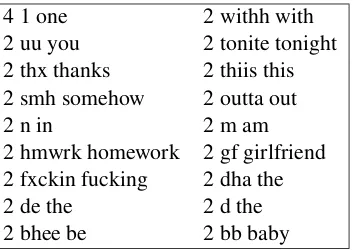
Table 5 shows the non-unique normalizations which were missed by the best model: they are a mixture of relatively standard variations which happen to be infrequent in our data, liketoniteor
gf, and a few idiosyncratic respellings like uu or
bhee. Our supervised approach makes it easy to address the first type of failure by simply annotat-ing additional trainannotat-ing examples.
4 1 one 2 withh with 2 uu you 2 tonite tonight 2 thx thanks 2 thiis this 2 smh somehow 2 outta out
2 n in 2 m am
2 hmwrk homework 2 gf girlfriend 2 fxckin fucking 2 dha the
2 de the 2 d the
2 bhee be 2 bb baby Table 5: Missed transformations.
Method WER (%)
NO-OP 11.2
HB-dict 6.6
GHM-dict 7.6
S-dict 9.7
Dict-combo 4.9
Dict-combo+HB-norm 7.9
[image:5.595.96.273.61.186.2]OOV-ONLY NGRAM+SRN(test) 4.8
Table 6: WERs compared to previous work.
Gouws et al. (2011); S-dict is the automatically constructed dictionary from (Han et al., 2012); Dict-combo are all the dictionaries combined and Dict-combo+HB-norm are all dictionaries com-bined with approach ofHan and Baldwin(2011). The WER reported for OOV-ONLY NGRAM+SRN is on the test folds only. The score on the full dataset is a bit better: 4.66%. As can be seen our approach it the best performing approach overall and in particular it does much better than all of the single dictionary-based methods. Only the combi-nation of all the dictionaries comes close in per-formance.
5 Related work
In the field of tweet normalization the approach ofLiu et al.(2011,2012) shows some similarities to ours: they gather a collection of OOV words together with their canonical forms from the web and train a character-level CRF sequence labeler on the edit sequences computed from these pairs. They use this as the error model in a noisy-channel setup combined with a unigram language model. In addition to character n-gram features they use phoneme and syllable features, while we rely on the SRN embeddings to provide generalized rep-resentations of input strings.
Kaufmann and Kalita (2010) trained a phrase-based statistical translation model on a parallel
text message corpus and applied it to tweet nor-malization. In comparison to our first-order linear-chain CRF, an MT model with reordering is more flexible but for this reason needs more training data. It also suffers from language model mis-match mentioned in Section 2: optimal results were obtained by using a low weight for the lan-guage model trained on a balanced text corpus.
Many other approaches to tweet normalization are more unsupervised in nature (e.g. Han and Baldwin, 2011; Gouws et al., 2011; Xue et al.,
2011; Han et al., 2012). They still require an-notated development data for tuning parameters and a variety of heuristics. Our approach works well with similar-sized training data, and unlike unsupervised approaches can easily benefit from more if it becomes available. Further afield, our work has connections to research on mor-phological analysis: for example Chrupała et al.
(2008) use edit scripts to learn lemmatization rules while Dreyer et al. (2008) propose a discrimina-tive model for string transductions and apply it to morphological tasks. While Chrupała (2013) andEvang et al. (2013) use character-level SRN text embeddings for learning segmentation, and recurrent nets themselves have been used for se-quence transduction (Graves,2012), to our knowl-edgeneural text embeddingshave not been previ-ously applied to string transduction.
6 Conclusion
Learning sequences of edit operations from exam-ples while incorporating unlabeled data via neu-ral text embeddings constitutes a compelling ap-proach to tweet normalization. Our results are es-pecially interesting considering that we trained on only a small annotated data set and did not use any other manually created resources such as dic-tionaries. We want to push performance further by expanding the training data and incorporating existing lexical resources. It will also be impor-tant to check how our method generalizes to other language and datasets (e.g.de Clercq et al.,2013;
Alegria et al.,2013).
References
I˜naki Alegria, Nora Aranberri, V´ıctor Fresno, Pablo Gamallo, Lluis Padr´o, I˜naki San Vicente, Jordi Turmo, and Arkaitz Zubiaga. 2013. Introducci´on a la tarea compartida Tweet-Norm 2013: Normalizaci´on l´exica de tuits en espa˜nol. In Workshop on Tweet Normalization at SEPLN (Tweet-Norm), pages 36– 45.
Monojit Choudhury, Rahul Saraf, Vijit Jain, Animesh Mukherjee, Sudeshna Sarkar, and Anupam Basu. 2007. Investigation and modeling of the struc-ture of texting language. International Journal of Document Analysis and Recognition (IJDAR), 10(3-4):157–174.
Grzegorz Chrupała. 2013. Text segmentation with character-level text embeddings. InICML Workshop on Deep Learning for Audio, Speech and Language Processing.
Grzegorz Chrupała, Georgiana Dinu, and Josef Van Genabith. 2008. Learning morphology with Morfette. In Proceedings of the 6th edition of the Language Resources and Evaluation Conference. Orph´ee de Clercq, Bart Desmet, Sarah Schulz, Els
Lefever, and V´eronique Hoste. 2013. Normaliza-tion of Dutch user-generated content. In 9th Inter-national Conference on Recent Advances in Natural Language Processing (RANLP-2013), pages 179– 188. INCOMA Ltd.
Markus Dreyer, Jason R Smith, and Jason Eisner. 2008. Latent-variable modeling of string transduc-tions with finite-state methods. In Proceedings of the conference on empirical methods in natural lan-guage processing, pages 1080–1089. Association for Computational Linguistics.
Jeffrey L Elman. 1990. Finding structure in time. Cog-nitive science, 14(2):179–211.
Jeffrey L Elman. 1991. Distributed representations, simple recurrent networks, and grammatical struc-ture. Machine learning, 7(2-3):195–225.
Kilian Evang, Valerio Basile, Grzegorz Chrupała, and Johan Bos. 2013. Elephant: Sequence labeling for word and sentence segmentation. In Empirical Methods in Natural Language Processing.
Stephan Gouws, Dirk Hovy, and Donald Metzler. 2011. Unsupervised mining of lexical variants from noisy text. InProceedings of the First workshop on Unsu-pervised Learning in NLP, pages 82–90. Association for Computational Linguistics.
Alex Graves. 2012. Sequence transduction with recur-rent neural networks. arXiv:1211.3711.
Bo Han and Timothy Baldwin. 2011. Lexical normali-sation of short text messages: Makn sens a# twitter. In Proceedings of the 49th Annual Meeting of the Association for Computational Linguistics: Human
Language Technologies-Volume 1, pages 368–378. Association for Computational Linguistics.
Bo Han, Paul Cook, and Timothy Baldwin. 2012. Au-tomatically constructing a normalisation dictionary for microblogs. In Proceedings of the 2012 Joint Conference on Empirical Methods in Natural guage Processing and Computational Natural Lan-guage Learning, pages 421–432. Association for Computational Linguistics.
Max Kaufmann and Jugal Kalita. 2010. Syntactic normalization of Twitter messages. In Interna-tional conference on natural language processing, Kharagpur, India.
John D. Lafferty, Andrew McCallum, and Fernando C. N. Pereira. 2001. Conditional Random Fields: Probabilistic models for segmenting and labeling se-quence data. InProceedings of the Eighteenth Inter-national Conference on Machine Learning, ICML ’01, pages 282–289. Morgan Kaufmann Publishers Inc., San Francisco, CA, USA.
Thomas Lavergne, Olivier Capp´e, and Franc¸ois Yvon. 2010. Practical very large scale CRFs. In Proceed-ings of the 48th Annual Meeting of the Association for Computational Linguistics, pages 504–513. As-sociation for Computational Linguistics.
Fei Liu, Fuliang Weng, and Xiao Jiang. 2012. A broad-coverage normalization system for social media lan-guage. In Proceedings of the 50th Annual Meet-ing of the Association for Computational LMeet-inguis- Linguis-tics: Long Papers-Volume 1, pages 1035–1044. As-sociation for Computational Linguistics.
Fei Liu, Fuliang Weng, Bingqing Wang, and Yang Liu. 2011. Insertion, deletion, or substitution?: normaliz-ing text messages without pre-categorization nor su-pervision. InProceedings of the 49th Annual Meet-ing of the Association for Computational LMeet-inguis- Linguis-tics: Human Language Technologies: short papers-Volume 2, pages 71–76. Association for Computa-tional Linguistics.
Tom´aˇs Mikolov. 2012a. Recurrent neural network lan-guage models. http://rnnlm.org.
Tom´aˇs Mikolov. 2012b. Statistical language models based on neural networks. Ph.D. thesis, Brno Uni-versity of Technology.
Tom´aˇs Mikolov, Martin Karafi´at, Luk´aˇs Burget, Jan ˇCernock´y, and Sanjeev Khudanpur. 2010. Recur-rent neural network based language model. In Inter-speech, pages 1045–1048.
Webb Miller and Eugene W Myers. 1985. A file com-parison program. Software: Practice and Experi-ence, 15(11):1025–1040.
Ilya Sutskever, James Martens, and Geoffrey E Hin-ton. 2011. Generating text with recurrent neural networks. InProceedings of the 28th International Conference on Machine Learning (ICML-11), pages 1017–1024.