A Two Level Model for Context Sensitive Inference Rules
Oren Melamud§, Jonathan Berant†, Ido Dagan§, Jacob Goldberger♦, Idan Szpektor‡ § Computer Science Department, Bar-Ilan University
† Computer Science Department, Stanford University ♦ Faculty of Engineering, Bar-Ilan University
‡ Yahoo! Research Israel
{melamuo,dagan,goldbej}@{cs,cs,eng}.biu.ac.il [email protected]
Abstract
Automatic acquisition of inference rules for predicates has been commonly ad-dressed by computing distributional simi-larity between vectors of argument words, operating at the word space level. A re-cent line of work, which addresses context sensitivity of rules, represented contexts in a latent topic space and computed similar-ity over topic vectors. We propose a novel two-level model, which computes simi-larities between word-level vectors that are biased by topic-level context repre-sentations. Evaluations on a naturally-distributed dataset show that our model significantly outperforms prior word-level and topic-level models. We also release a first context-sensitive inference rule set.
1 Introduction
Inference rules for predicates have been identi-fied as an important component in semantic ap-plications, such as Question Answering (QA) (Ravichandran and Hovy, 2002) and Information Extraction (IE) (Shinyama and Sekine, 2006). For example, the inference rule ‘X treat Y→X relieve Y’ can be useful to extract pairs of drugs and the illnesses which they relieve, or to answer a ques-tion like “Which drugs relieve headache?”. Along this vein, such inference rules constitute a crucial component in generic modeling of textual infer-ence, under the Textual Entailment paradigm (Da-gan et al., 2006; Dinu and Wang, 2009).
Motivated by these needs, substantial research was devoted to automatic learning of inference rules from corpora, mostly in an unsupervised dis-tributional setting. This research line was mainly initiated by the highly-cited DIRT algorithm (Lin and Pantel, 2001), which learns inference for bi-nary predicates with two argument slots (like the
rule in the example above). DIRT represents a predicate by two vectors, one for each of the ar-gument slots, where the vector entries correspond to the argument words that occurred with the pred-icate in the corpus. Inference rules between pairs of predicates are then identified by measuring the similarity between their corresponding argument vectors. This general scheme was further en-hanced in several directions, e.g. directional sim-ilarity (Bhagat et al., 2007; Szpektor and Dagan, 2008) and meta-classification over similarity val-ues (Berant et al., 2011). Consequently, several knowledge resources of inference rules were re-leased, containing the top scoring rules for each predicate (Schoenmackers et al., 2010; Berant et al., 2011; Nakashole et al., 2012).
The above mentioned methods provide a sin-gle confidence score for each rule, which is based on the obtained degree of argument-vector sim-ilarities. Thus, a system that applies an infer-ence rule to a text may estimate the validity of the rule application based on the pre-specified rule score. However, the validity of an inference rule may depend on the context in which it is applied, such as the context specified by the given predi-cate’s arguments. For example, ‘AT&T acquire T-Mobile → AT&T purchase T-Mobile’, is a valid
application of the rule ‘X acquire Y → X pur-chase Y’, while ‘Children acquire skills → Chil-dren purchase skills’ is not. To address this issue, a line of works emerged which computes a context-sensitivereliability score for each ruleapplication, based on the given context.
The major trend in context-sensitive inference models utilizes latent or class-based methods for context modeling (Pantel et al., 2007; Szpektor et al., 2008; Ritter et al., 2010; Dinu and Lapata, 2010b). In particular, the more recent methods (Ritter et al., 2010; Dinu and Lapata, 2010b) mod-eled predicates in context as a probability distribu-tion over topics learned by a Latent Dirichlet
cation (LDA) model. Then, similarity is measured between the two topic distribution vectors corre-sponding to the two sides of the rule in the given context, yielding a context-sensitive score for each particular rule application.
We notice at this point that while context-insensitive methods represent predicates by ar-gument vectors in the original fine-grained word space, context-sensitive methods represent them as vectors at the level of latent topics. This raises the question of whether such coarse-grained topic vectors might be less informative in determining the semantic similarity between the two predi-cates.
To address this hypothesized caveat of prior context-sensitive rule scoring methods, we pro-pose a novel generic scheme that integrates word-level and topic-word-level representations. Our scheme can be applied on top of any context-insensitive “base” similarity measure for rule learning, which operates at the word level, such as Cosine or Lin (Lin, 1998). Rather than computing a single context-insensitive rule score, we compute a dis-tinct word-level similarity score for each topic in an LDA model. Then, when applying a rule in a given context, these different scores are weighed together based on the specific topic distribution under the given context. This way, we calculate similarity over vectors in the original word space, while biasing them towards the given context via a topic model.
In order to promote replicability and equal-term comparison with our results, we based our experi-ments on publicly available datasets, both for un-supervised learning of the evaluated models and for testing them over a random sample of rule ap-plications. We apply our two-level scheme over three state-of-the-art context-insensitive similar-ity measures. The evaluation compares perfor-mances both with the original context-insensitive measures and with recent LDA-based context-sensitive methods, showing consistent and robust advantages of our scheme. Finally, we release a context-sensitive rule resource comprising over 2,000 frequent verbs and one million rules.
2 Background and Model Setting
This section presents components of prior work which are included in our model and experiments, setting the technical preliminaries for the rest of the paper. We first present context-insensitive rule
learning, based on distributional similarity at the word level, and then context-sensitive scoring for rule applications, based on topic-level similarity. Some further discussion of related work appears in Section 6.
2.1 Context-insensitive Rule Learning
A predicate inference rule ‘LHS → RHS’, such as ‘X acquire Y → X purchase Y’, specifies a
directional inference relation between two predi-cates. Each rule side consists of a lexical pred-icate and (two) variable slots for its arguments.1 Different representations have been used to spec-ify predicates and their argument slots, such as word lemma sequences, regular expressions and dependency parse fragments. A rule can be ap-plied when its LHS matches a predicate with a pair of arguments in a text, allowing us to infer its RHS, with the corresponding instantiations for the argument variables. For example, given the text “AT&T acquires T-Mobile”, the above rule infers “AT&T purchases T-Mobile”.
The DIRT algorithm (Lin and Pantel, 2001) follows the distributional similarity paradigm to learn predicate inference rules. For each predi-cate, DIRT represents each of its argument slots by anargument vector. We denote the two vectors of theXandY slots of a predicatepred byvx
pred
andvpredy , respectively. Each entry of a vectorv corresponds to a particular word (or term)w that instantiated the argument slot in a learning corpus, with a valuev(w) = P M I(pred, w) (with PMI
standing for point-wise mutual information). To learn inference rules, DIRT considers (in principle) each pair of binary predicates that occurred in the corpus for a candidate rule, ‘LHS → RHS’. Then, DIRT computes a reliabil-ity scorefor the rule by combining the measured similarities between the corresponding argument vectors of the two rule sides. Concretely, denot-ing bylandr the predicates appearing in the two rule sides, DIRT’s reliability score is defined as follows:
(1)
scoreDIRT(LHS → RHS)
=
q
sim(vx
l, vrx)·sim(vyl, v y r)
where sim(v, v0) is a vector similarity measure. Specifically, DIRT employs the Lin similarity 1We follow most of the inference-rule learning literature,
measure from (Lin, 1998), defined as follows:
(2) Lin(v, v0) =
P
w∈v∩v0[v(w) +v0(w)]
P
w∈v∪v0[v(w) +v0(w)]
We note that the general DIRT scheme may be used while employing other “base” vector similar-ity measures. For example, the Lin measure is symmetric, and thus using it would yield the same reliability score when swapping the two sides of a rule. This issue has been addressed in a sepa-rate line of research which introduced directional similarity measures suitable for inference rela-tions (Bhagat et al., 2007; Szpektor and Dagan, 2008; Kotlerman et al., 2010). In our experiments we apply our proposed context-sensitive similarity scheme over three different base similarity mea-sures.
DIRT and similar context-insensitive inference methods provide a single reliability score for a learned inference rule, which aims to predict the validity of the rule’s applications. However, as exemplified in the Introduction, an inference rule may be valid in some contexts but invalid in oth-ers (e.g. acquiring entailspurchasing forgoods, but not forskills). Since vector similarity in DIRT is computed over the single aggregate argument vector, the obtained reliability score tends to be biased towards the dominant contexts of the in-volved predicates. For example, we may expect a higher score for ‘acquire →purchase’ than for ‘acquire → learn’, since the former matches a
more frequent sense ofacquirein a typical corpus. Following this observation, it is desired to obtain a context-sensitive reliability score for each rule application in a given context, as described next.
2.2 Context-sensitive Rule Applications To assess the reliability of applying an inference rule in a given context we need some model for context representation, that should affect the rule reliability score. A major trend in past work is to represent contexts in a reduced-dimensionality latent or class-based model. A couple of earlier works utilized a cluster-based model (Pantel et al., 2007) and an LSA-based model (Szpektor et al., 2008), in a selectional-preferences style approach. Several more recent works utilize a Latent Dirich-let Allocation (LDA) (Blei et al., 2003) frame-work. We now present an underlying unified view of the topic-level models in (Ritter et al., 2010; Dinu and Lapata, 2010b), which we follow in our
own model and in comparative model evaluations. We note that a similar LDA model construction was employed also in (S´eaghdha, 2010), for esti-mating predicate-argument likelihood.
First, an LDA model is constructed, as follows. Similar to the construction of argument vectors in the distributional model (described above in subsection 2.1), all arguments instantiating each predicate slot are extracted from a large learning corpus. Then, for each slot of each predicate, a pseudo-document is constructed containing the set of all argument words that instantiated this slot in the corpus. We denote the two documents con-structed for theXandY slots of a predicatepred bydxpredanddypred, respectively. In comparison to the distributional model, these two documents cor-respond to the analogous argument vectors vxpred andvypred, both containing exactly the same set of words.
Next, an LDA model is learned from the set of all pseudo-documents, extracted for all predi-cates.2 The learning process results in the con-struction of K latent topics, where each topic t specifies a distribution over all words, denoted by p(w|t), and a topic distribution for each
pseudo-documentd, denoted byp(t|d).
Within the LDA model we can derive the a-posteriori topic distribution conditioned on a particular word within a document, denoted by p(t|d, w) ∝ p(w|t) ·p(t|d). In the topic-level model,dcorresponds to a predicate slot andwto a particular argument word instantiating this slot. Hence,p(t|d, w)is viewed as specifying the rele-vance (or likelihood) of the topictfor the predi-cate slot in the context of the given argument in-stantiation. For example, for the predicate slot ‘ac-quireY’ in the context of the argument‘IBM’, we expect high relevance for a topic about companies, while in the context of the argument‘knowledge’
we expect high relevance for a topic about abstract concepts. Accordingly, the distribution p(t|d, w)
over all topics provides a topic-level representa-tion for a predicate slot in the context of a particu-lar argumentw. This representation is used by the topic-level model to compute a context-sensitive score for inference rule applications, as follows.
2We note that there are variants in the type of LDA model
Consider the application of an inference rule ‘LHS → RHS’ in the context of a particular pair of arguments for the X andY slots, denoted by wxandwy, respectively. Denoting bylandrthe
predicates appearing in the two rule sides, the reli-ability score of the topic-level model is defined as follows (we present a geometric mean formulation for consistency with DIRT):
(3)
scoreTopic(LHS → RHS, wx, wy)
=
q
sim(dxl, dx
r, wx)·sim(dyl, dyr, wy)
wheresim(d, d0, w)is a topic-distribution
similar-ity measure conditioned on a given context word. Specifically, Ritter et al. (2010) utilized the dot product form for their similarity measure:
(4)
simDC(d, d0, w) = Σt[p(t|d, w)·p(t|d0, w)]
(the subscript DC stands for double-conditioning, as both distributions are conditioned on the argu-ment word, unlike the measure below).
Dinu and Lapata (2010b) presented a slightly different similarity measure for topic distributions that performed better in their setting as well as in a related later paper on context-sensitive scoring of lexical similarity (Dinu and Lapata, 2010a). In this measure, the topic distribution for the right hand side of the rule is not conditioned onw:
(5)
simSC(d, d0, w) = Σt[p(t|d, w)·p(t|d0)]
(the subscript SC stands for single-conditioning, as only the left distribution is conditioned on the argument word). They also experimented with a few variants for the structure of the similarity mea-sure and assessed that best results are obtained with the dot product form. In our experiments, we employ these two similarity measures for topic distributions as baselines representing topic-level models.
Comparing the insensitive and context-sensitive models, we see that both of them mea-sure similarity between vector representations of corresponding predicate slots. However, while DIRT computes sim(v, v0) over vectors in the
original word-level space, topic-level models com-putesim(d, d0, w)by measuring similarity of
vec-tors in a reduced-dimensionality latent space. As conjectured in the introduction, such coarse-grain representation might lead to loss of information. Hence, in the next section we propose a com-bined two-level model, which represents predicate
slots in the original word-level space while biasing the similarity measure through topic-level context models.
3 Two-level Context-sensitive Inference
Our model follows the general DIRT scheme while extending it to handle context-sensitive scor-ing of rule applications, addressscor-ing the scenario dealt by the context-sensitive topic models. In particular, we define the context-sensitive score
scoreWT, where W T stands for the combination of the Word/Topic levels:
(6)
scoreWT(LHS → RHS, wx, wy)
=
q
sim(vx
l, vxr, wx)·sim(vly, vry, wy)
Thus, our model computes similarity over word-level (rather than topic-word-level) argument vectors, while biasing it according to the specific argu-ment words in the given rule application con-text. The core of our contribution is thus defining the context-sensitive word-level vector similarity measuresim(v, v0, w), as described in the remain-der of this section.
Following the methods in Section 2, for each predicate pred we construct, from the learning corpus, its argument vectors vpredx and vypred as well as its argument pseudo-documentsdxpred and dypred. For convenience, when referring to an ar-gument vector v, we will denote the correspond-ing pseudo-document bydv. Based on all
pseudo-documents we learn an LDA model and obtain its associated probability distributions.
The calculation ofsim(v, v0, w)is composed of
two steps. At learning time, we compute for each candidate rule a separate, topic-biased, similarity score per each of the topics in the LDA model. Then, at rule application time, we compute an overall reliability score for the rule by combining the per-topic similarity scores, while biasing the score combination according to the given context ofw. These two steps are described in the follow-ing two subsections.
3.1 Topic-biased Word-vector Similarities Given a pair of word vectors v and v0, and any desired “base” vector similarity measuresim
(e.g. simLin), we compute a topic-biased
sim-ilarity score for each LDA topic t, denoted by
the original similarity measure over topic-biased versions ofvandv0, denoted byvtandv0t:
simt(v, v0) = sim(vt, vt0)
where
vt(w) =v(w)·p(t|dv, w)
That is, each value in the biased vector, vt(w),
is obtained by weighing the original value v(w)
by the relevance of the topic t to the argument word w withindv. This way, rather than
replac-ing altogether the word-level valuesv(w) by the
topic probabilitiesp(t|dv, w), as done in the
topic-level models, we use the latter to only bias the for-mer while preserving fine-grained word-level rep-resentations. The notation Lintdenotes thesimt
measure when applied usingLinas the base
simi-larity measuresim.
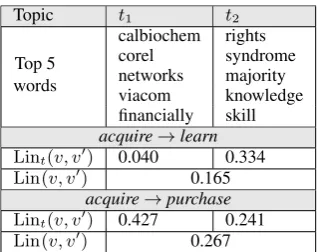
This learning process results in K different topic-biased similarity scores for each candidate rule, whereK is the number of LDA topics. Ta-ble 1 illustrates topic-biased similarities for theY slot of two rules involving the predicate ‘acquire’. As can be seen, the topic-biased scoreLintfor ‘
ac-quire→learn’ fort2is higher than theLinscore, since this topic is characterized by arguments that commonly appear with both predicates of the rule. Consequently, the two predicates are found to be distributionally similar when biased for this topic. On the other hand, the topic-biased similarity for t1 is substantially lower, since prominent words in this topic are likely to occur with ‘acquire’ but not with ‘learn’, yielding low distributional simi-larity. Opposite behavior is exhibited for the rule ‘acquire→purchase’.
3.2 Context-sensitive Similarity
When applying an inference rule, we compute for each slot its context-sensitive similarity score
simWT(v, v0, w), wherevandv0 are the slot’s ar-gument vectors for the two rule sides andwis the word instantiating the slot in the given rule appli-cation. This score is computed as a weighted aver-age of the rule’sK topic-biased similarity scores
simt. In this average, each topic is weighed by
its “relevance” for the context in which the rule is applied, which consists of the left-hand-side pred-icatevand the argumentw. This relevance is
cap-Topic t1 t2
Top 5 words
calbiochem rights corel syndrome networks majority viacom knowledge financially skill acquire→learn
Lint(v, v0) 0.040 0.334
Lin(v, v0) 0.165
acquire→purchase
Lint(v, v0) 0.427 0.241
[image:5.595.337.496.60.186.2]Lin(v, v0) 0.267
Table 1: Two characteristic topics for theY slot of ‘acquire’, along with their topic-biased Lin sim-ilarities scores Lint, compared with the original
Linsimilarity, for two rules. The relevance of each
topic to different arguments of ‘acquire’ is illus-trated by showing the top 5 words in the argument vectorvacquirey for which the illustrated topic is the most likely one.
tured byp(t|dv, w):
simWT(v, v0, w) = X
t
[p(t|dv, w)·simt(v, v0)]
(7)
This way, a rule application would obtain a high score only if the current context fits those topics for which the rule is indeed likely to be valid, as captured by a high topic-biased similarity. The no-tationLinW T denotes thesimWT measure, when usingLintas the topic-biased similarity measure.
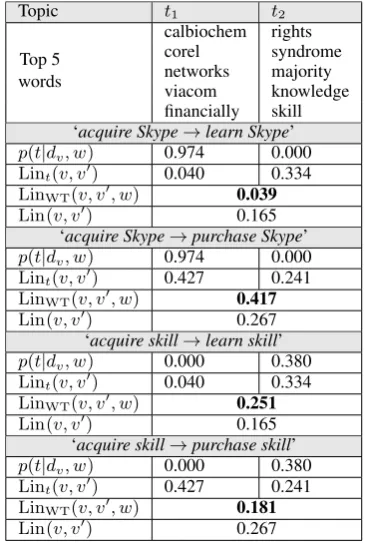
Table 2 illustrates the calculation of context-sensitive similarity scores in four rule applica-tions, involving the Y slot of the predicate ‘
ac-quire’. We observe that relative to the fixed context-insensitive Lin score, the score of ‘ ac-quire → learn’ is substantially promoted for the argument ‘skill’ while being demoted for ‘Skype’. The opposite behavior is observed for ‘acquire → purchase’, altogether demonstrating how our model successfully biases the similarity score according to rule validity in context.
4 Experimental Settings
Topic t1 t2
Top 5 words
calbiochem rights corel syndrome networks majority viacom knowledge financially skill ‘acquire Skype→learn Skype’
p(t|dv, w) 0.974 0.000
Lint(v, v0) 0.040 0.334
LinWT(v, v0, w) 0.039
Lin(v, v0) 0.165
‘acquire Skype→purchase Skype’
p(t|dv, w) 0.974 0.000
Lint(v, v0) 0.427 0.241
LinWT(v, v0, w) 0.417
Lin(v, v0) 0.267
‘acquire skill→learn skill’
p(t|dv, w) 0.000 0.380
Lint(v, v0) 0.040 0.334
LinWT(v, v0, w) 0.251
Lin(v, v0) 0.165
‘acquire skill→purchase skill’
p(t|dv, w) 0.000 0.380
Lint(v, v0) 0.427 0.241
LinWT(v, v0, w) 0.181
[image:6.595.89.272.62.334.2]Lin(v, v0) 0.267
Table 2: Context-sensitive similarity scores (in bold) for theY slots of four rule applications. The components of the score calculation are shown for the topics of Table 1. For each rule application, the table shows a couple of the topic-biased scores
Lintof the rule (as in Table 1), along with the topic
relevance for the given contextp(t|dv, w), which
weighs the topic-biased scores in theLinW T
cal-culation. The context-insensitive Lin score is
shown for comparison.
4.1 Evaluated Rule Application Methods We evaluated the following rule application meth-ods: the original context-insensitive word model, following DIRT (Lin and Pantel, 2001), as de-scribed in Equation 1, denoted by CI; our own topic-word context-sensitive model, as described in Equation 6, denoted by WT. In addition, we evaluated two variants of the topic-level context-sensitive model, denoted DC and SC. DC follows the double conditioned contextualized similarity measure according to Equation 4, as implemented by (Ritter et al., 2010), while SC follows the sin-gle conditioned one at Equation 5, as implemented by (Dinu and Lapata, 2010b; Dinu and Lapata, 2010a).
Since our model can contextualize various dis-tributional similarity measures, we evaluated the performance of all the above methods on several base similarity measures and their learned
rule-sets, namely Lin (Lin, 1998), BInc (Szpektor and Dagan, 2008) and vector Cosine similarity. The Lin similarity measure is described in Equation 2. Binc (Szpektor and Dagan, 2008) is a directional similarity measure between word vectors, which outperformed Lin for predicate inference (Szpek-tor and Dagan, 2008).
To build the rule-sets and models for the tested approaches we utilized the ReVerb corpus (Fader et al., 2011), a large scale publicly available web-based open extractions data set, containing about 15 million unique template extractions.3 ReVerb template extractions/instantiations are in the form of a tuple (x, pred, y), containing pred, a verb predicate,x, the argument instantiation of the tem-plate’s slotX, andy, the instantiation of the tem-plate’s slotY.
ReVerb includes over 600,000 different tem-plates that comprise a verb but may also include other words, for example ‘Xcan accommodate up toY’. Yet, many of these templates share a similar meaning, e.g. ‘X accommodate up toY’, ‘X can accommodate up toY’, ‘X will accommodate up toY’, etc. Following Sekine (2005), we clustered templates that share their main verb predicate in order to scale down the number of different pred-icates in the corpus and collect richer word co-occurrence statistics per predicate.
Next, we applied some clean-up preprocessing to the ReVerb extractions. This includes discard-ing stop words, rare words and non-alphabetical words instantiating either the X or the Y argu-ments. In addition, we discarded all predicates that co-occur with less than 100 unique argument words in each slot. The remaining corpus consists of 7 million unique extractions and 2,155 verb predicates.
Finally, we trained an LDA model, as described in Section 2, using Mallet (McCallum, 2002). Then, for each original context-insensitive simi-larity measure, we learned from ReVerb a rule-set comprised of the top 500 rules for every identi-fied predicate. To complete the learning, we cal-culated the topic-biased similarity score for each learned rule under each LDA topic, as specified in our context-sensitive model. We release a rule set comprising the top 500 context-sensitive rules that we learned for each of the verb predicates in our learning corpus, along with our trained LDA
Method Lin BInc Cosine Valid 266 254 272 Invalid 545 523 539 Total 811 777 811
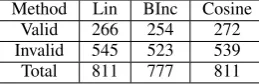
Table 3: Sizes of rule application test set for each learned rule-set.
model.4
4.2 Evaluation Task
To evaluate the performance of the different meth-ods we chose the dataset constructed by Zeich-ner et al. (2012). 5 This publicly available dataset contains about 6,500 manually annotated predi-cate template rule applications, each one labeled as correct or incorrect. For example, ‘Jack agree with Jill 9 Jack feel sorry for Jill’ is a rule ap-plication in this dataset, labeled as incorrect, and ‘Registration open this month→Registration be-gin this month’ is another rule application, labeled as correct. Rule applications were generated by randomly sampling extractions from ReVerb, such as (‘Jack’,‘agree with’,‘Jill’) and then sampling possible rules for each, such as ‘agree with→feel sorry for’. Hence, this dataset provides naturally distributed rule inferences with respect to ReVerb. Whenever we evaluated a distributional similar-ity measure (namely Lin, BInc, or Cosine), we discarded instances from Zeichner et al.’s dataset in which the assessed rule is not in the context-insensitive rule-set learned for this measure or the argument instantiation of the rule is not in the LDA lexicon. We refer to the remaining instances as the
test set per measure, e.g. Lin’s test set. Table 3 details the size of each such test set in our experi-ment.
Finally, the task under which we assessed the tested models is to rank all rule applications in each test set, aiming to rank the valid rule appli-cations above the invalid ones.
5 Results
We evaluated the performance of each tested method by measuring Mean Average Precision (MAP) (Manning et al., 2008) of the rule appli-cation ranking computed by this method. In order
4Our resource is available at:http://www.cs.biu. ac.il/˜nlp/downloads/wt-rules.html
5The dataset is available at: http:// www.cs.biu.ac.il/˜nlp/downloads/
annotation-rule-application.htm
Method Lin BInc Cosine
CI 0.503 0.513 0.513
DC 0.451 (1200) 0.455 (1200) 0.455 (1200) SC 0.443 (1200) 0.458 (1200) 0.452 (1200)
WT 0.562 (100) 0.584 (50) 0.565 (25)
Table 4: MAP values on corresponding test set ob-tained by each method. Figures in parentheses in-dicate optimal number of LDA topics.
to compute MAP values and corresponding statis-tical significance, we randomly split each test set into 30 subsets. For each method we computed Average Precision on every subset and then took the average over all subsets as the MAP value.
Since all tested context-sensitive approaches are based on LDA topics, we varied for each method the number of LDA topics K that optimizes its performance, ranging from 25 to 1600 topics. We used LDA hyperparametersβ = 0.01andα= 0.1
[image:7.595.115.245.63.105.2]forK <600andα= 50K forK >= 600.
Table 4 presents the optimal MAP performance of each tested measure. Our main result is that our model outperforms all other methods, both context-insensitive and context-sensitive, by a rel-ative increase of more than 10% for all three sim-ilarity measures that we tested. This improvement is statistically significant atp <0.01for BInc and Lin, and p < 0.015 for Cosine, using paired
t-test. This shows that our model indeed success-fully leverages contextual information beyond the basic context-agnostic rule scores and is robust across measures.
Surprisingly, both baseline topic-level context-sensitive methods, namely DC and SC, underper-formed compared to their context-insensitive base-lines. While Dinu and Lapata (Dinu and Lap-ata, 2010b) did show improvement over context-insensitive DIRT, this result was obtained on the verbs of the Lexical Substitution Task in SemEval (McCarthy and Navigli, 2007), which was manu-ally created with a bias for context-sensitive sub-stitutions. However, our result suggests that topic-level models might not be robust enough when ap-plied to a random sample of inferences.
The need for this rather small number of topics is due to the nature of utilization of topics in WT. Specifically, topics are leveraged for high-level domain disambiguation, while fine grained word-level distributional similarity is computed for each rule under each such domain. This works best for a relatively low number of topics. However, in higher numbers, topics relate to narrower domains and then topic biased word level similarity may become less effective due to potential sparseness. On the other hand, DC and SC rely on topics as a surrogate to predicate-argument co-occurrence features, and thus require a relatively large num-ber of them to be effective.
Delving deeper into our test-set, Zeichner et al. provided a more detailed annotation for each in-valid rule application. Specifically, they annotated whether the context under which the rule is ap-plied is valid. For example, in ‘John bought my car9 John sold my car’ the inference is invalid due to an inherently incorrect rule, but the con-text is valid. On the other hand in ‘my boss raised my salary9 my boss constructed my salary’ the context {‘my boss’, ‘my salary’} for applying ‘raise→construct’ is invalid. Following, we split
the set for the base Lin measure into two test-sets: (a) test-setvc, which includes all correct rule applications and incorrect ones only under valid contexts, and (b) test-setivc, which includes again all correct rule applications but incorrect ones only under invalid contexts.
Table 5 presents the performance of each com-pared method on the two test sets. On test-setivc, where context mismatches are abundant, our model outperformed all other baselines (sta-tistically significant at p < 0.01). In addition,
this time DC slightly outperformed CI. This re-sult more explicitly shows the advantages of in-tegrating word-level and context-sensitive topic-level similarities for differentiating valid and valid contexts for rule applications. Yet, many in-valid rule applications occur under in-valid contexts due to inherently incorrect rules, and we want to make sure that also in this scenario our model does not fall behind the context-insensitive mea-sure. Indeed, on test-setvc, in which context mis-matches are rare, our algorithm is still better than the original measure, indicating that WT can be safely applied to distributional similarity measures without concerns of reduced performance in dif-ferent context scenarios.
test-setivc test-setvc Size
(valid:invalid) (266:166)432 (266:379)645
CI 0.780 0.587
DC 0.796 0.498
SC 0.779 0.512
[image:8.595.337.497.62.136.2]WT 0.854 0.621
Table 5: MAP results for the two split Lin test-sets.
6 Discussion and Future Work
This paper addressed the problem of computing context-sensitive reliability scores for predicate in-ference rules. In particular, we proposed a novel scheme that applies over any base distributional similarity measure which operates at the word level, and computes a single context-insensitive score for a rule. Based on such a measure, our scheme constructs a context-sensitive similarity measure that computes a reliability score for pred-icate inference rules applications in the context of given arguments.
The contextualization of the base similarity score was obtained using a topic-level LDA model, which was used in a novel way. First, it provides a topic bias for learning separate per-topic word-level similarity scores between predi-cates. Then, given a specific candidate rule ap-plication, the LDA model is used to infer the topic distribution relevant to the context speci-fied by the given arguments. Finally, the context-sensitive rule application score is computed as a weighted average of the per-topic word-level sim-ilarity scores, which are weighed according to the inferred topic distribution.
where context sensitivity is rare, while topic-level models tend to underperform in such cases com-pared to the base context-insensitive methods.
Our work is closely related to another research line that addresses lexical similarity and substi-tution scenarios in context. While we focus on lexical-syntactic predicate templates and instanti-ations of their argument slots as context, lexical similarity methods consider various lexical units that are not necessarily predicates, with their con-text typically being the collection of words in a window around them.
Various approaches have been proposed to ad-dress lexical similarity. A number of works are based on a compositional semantics approach, where a prior representation of a target lexical unit is composed with the representations of words in its given context (Mitchell and Lapata, 2008; Erk and Pad´o, 2008; Thater et al., 2010). Other works (Erk and Pad´o, 2010; Reisinger and Mooney, 2010) use a rather large word window around tar-get words and compute similarities between clus-ters comprising instances of word windows. In ad-dition, (Dinu and Lapata, 2010a) adapted the pred-icate inference topic model from (Dinu and Lap-ata, 2010b) to compute lexical similarity in con-text.
A natural extension of our work would be to ex-tend our two level model to accommodate context-sensitive lexical similarity. For this purpose we will need to redefine the scope of context in our model, and adapt our method to compute context-biased lexical similarities accordingly. Then we will also be able to evaluate our model on the Lexical Substitution Task (McCarthy and Navigli, 2007), which has been commonly used in recent years as a benchmark for context-sensitive lexical similarity models.
In a different NLP task, Eidelman et al. (2012) utilize a similar approach to ours for improving the performance of statistical machine translation (SMT). They learn an LDA model on the source language side of the training corpus with the pur-pose of identifying implicit sub-domains. Then they utilize the distribution over topics inferred for each document in their corpus to compute sepa-rate per-topic translation probability tables. Fi-nally, they train a classifier to translate a given target word based on these tables and the inferred topic distribution of the given document in which the target word appears. A notable difference
be-tween our approach and theirs is that we use predi-cate pseudo-documents consisting of argument in-stantiations to learn our LDA model, while Eidel-man et al. use the real documents in a corpus. We believe that combining these two approaches may improve performance for both textual infer-ence and SMT and plan to experiment with this direction in future work.
Acknowledgments
This work was partially supported by the Israeli Ministry of Science and Technology grant 3-8705, the Israel Science Foundation grant 880/12, and the European Community’s Seventh Framework Programme (FP7/2007-2013) under grant agree-ment no. 287923 (EXCITEMENT).
References
Jonathan Berant, Ido Dagan, and Jacob Goldberger. 2011. Global learning of typed entailment rules. In ACL.
Rahul Bhagat, Patrick Pantel, Eduard Hovy, and Ma-rina Rey. 2007. Ledir: An unsupervised algorithm for learning directionality of inference rules. In Pro-ceedings of EMNLP-CoNLL.
David M Blei, Andrew Y Ng, and Michael I Jordan. 2003. Latent dirichlet allocation. the Journal of ma-chine Learning research, 3:993–1022.
Ido Dagan, Oren Glickman, and Bernardo Magnini. 2006. The pascal recognising textual entailment challenge. In Lecture Notes in Computer Science, volume 3944, pages 177–190.
Georgiana Dinu and Mirella Lapata. 2010a. Measur-ing distributional similarity in context. In Proceed-ings of EMNLP.
Georgiana Dinu and Mirella Lapata. 2010b. Topic models for meaning similarity in context. In Pro-ceedings of COLING: Posters.
Georgiana Dinu and Rui Wang. 2009. Inference rules and their application to recognizing textual entail-ment. InProceedings EACL.
Vladimir Eidelman, Jordan Boyd-Graber, and Philip Resnik. 2012. Topic models for dynamic transla-tion model adaptatransla-tion. In Proceedings of the ACL conference short papers.
Katrin Erk and Sebastian Pad´o. 2008. A structured vector space model for word meaning in context. In Proceedings of EMNLP.
Anthony Fader, Stephen Soderland, and Oren Etzioni. 2011. Identifying relations for open information ex-traction. InProceedings of EMNLP.
Lili Kotlerman, Ido Dagan, Idan Szpektor, and Maayan Zhitomirsky-Geffet. 2010. Directional distribu-tional similarity for lexical inference. Natural Lan-guage Engineering, 16(4):359–389.
Dekang Lin and Patrick Pantel. 2001. DIRT – discov-ery of inference rules from text. InProceedings of ACM SIGKDD Conference on Knowledge Discovery and Data Mining 2001.
Dekang Lin. 1998. Automatic retrieval and clustering of similar words. InProceedings of COLING-ACL.
Christopher D Manning, Prabhakar Raghavan, and Hinrich Sch¨utze. 2008. Introduction to information retrieval, volume 1. Cambridge University Press Cambridge.
Andrew Kachites McCallum. 2002. Mal-let: A machine learning for language toolkit. http://mallet.cs.umass.edu.
Diana McCarthy and Roberto Navigli. 2007. Semeval-2007 task 10: English lexical substitution task. In Proceedings of SemEval.
Jeff Mitchell and Mirella Lapata. 2008. Vector-based models of semantic composition. InProceedings of ACL-08: HLT.
Ndapandula Nakashole, Gerhard Weikum, and Fabian Suchanek. 2012. Patty: A taxonomy of relational patterns with semantic types. EMNLP12.
Patrick Pantel, Rahul Bhagat, Bonaventura Coppola, Timothy Chklovski, and Eduard Hovy. 2007. ISP: Learning inferential selectional preferences. In Hu-man Language Technologies 2007: The Conference of the North American Chapter of the Association for Computational Linguistics.
Deepak Ravichandran and Eduard Hovy. 2002. Learn-ing surface text patterns for a question answerLearn-ing system. InProceedings of ACL.
Joseph Reisinger and Raymond J Mooney. 2010. Multi-prototype vector-space models of word mean-ing. InHuman Language Technologies: The 2010 Annual Conference of the North American Chapter of the Association for Computational Linguistics.
Alan Ritter, Oren Etzioni, et al. 2010. A latent dirich-let allocation method for selectional preferences. In Proceedings of ACL.
Stefan Schoenmackers, Jesse Davis, Oren Etzioni, and Daniel Weld. 2010. Learning first-order horn clauses from web text. InProceedings of EMNLP.
Diarmuid O S´eaghdha. 2010. Latent variable models of selectional preference. InProceedings of ACL.
Satoshi Sekine. 2005. Automatic paraphrase discovery based on context and keywords between ne pairs. In Proceedings of the Third International Workshop on Paraphrasing (IWP2005).
Yusuke Shinyama and Satoshi Sekine. 2006. Preemp-tive information extraction using unrestricted rela-tion discovery. InProceedings of the Human Lan-guage Technology Conference of the NAACL, Main Conference.
Idan Szpektor and Ido Dagan. 2008. Learning entail-ment rules for unary templates. InProceedings of COLING.
Idan Szpektor, Ido Dagan, Roy Bar-Haim, and Jacob Goldberger. 2008. Contextual preferences. In Pro-ceedings of ACL-08: HLT.
Stefan Thater, Hagen F¨urstenau, and Manfred Pinkal. 2010. Contextualizing semantic representations us-ing syntactically enriched vector models. In Pro-ceedings of ACL.