Why-Question Answering
using Intra- and Inter-Sentential Causal Relations
Jong-Hoon Oh∗ Kentaro Torisawa† Chikara Hashimoto‡ Motoki Sano§ Stijn De Saeger¶ Kiyonori Ohtakek
Information Analysis Laboratory Universal Communication Research Institute
National Institute of Information and Communications Technology (NICT)
{∗rovellia,†torisawa,‡ch,§msano,¶stijn,kkiyonori.ohtake}@nict.go.jp
Abstract
In this paper, we explore the utility of
intra-andinter-sentential causal relations
between terms or clauses as evidence for answering why-questions. To the best of our knowledge, this is the first work that uses both intra- and inter-sentential causal relations for why-QA. We also propose a method for assessing the appropriate-ness of causal relations as answers to a given question using the semantic orienta-tion ofexcitationproposed by Hashimoto et al. (2012). By applying these ideas to Japanese why-QA, we improved preci-sion by 4.4% against all the questions in our test set over the current state-of-the-art system for Japanese why-QA. In addi-tion, unlike the state-of-the-art system, our system could achieve very high precision (83.2%) for 25% of all the questions in the test set by restricting its output to the con-fident answers only.
1 Introduction
“Why-question answering” (why-QA) is a task to retrieve answers from a given text archive for a why-question, such as “Why are tsunamis gen-erated?” The answers are usually text fragments consisting of one or more sentences. Although much research exists on this task (Girju, 2003; Higashinaka and Isozaki, 2008; Verberne et al., 2008; Verberne et al., 2011; Oh et al., 2012), its performance remains much lower than that of the state-of-the-art factoid QA systems, such as IBM’s Watson (Ferrucci et al., 2010).
In this work, we propose a quite
straightfor-ward but novel approach for such difficult
why-QA task. Consider the sentence A1 in Table 1, which represents the causal relation between the cause, “the ocean’s water mass ..., waves are
gen-A1 [Tsunamis that can cause large coastal inundation are generated]ef f ect because [the ocean’s water
mass is displaced and, much like throwing a stone into a pond, waves are generated.]cause
A2 [Earthquake causes seismic waves which set up the water in motion with a large force.]cause
This causes [a tsunami.]ef f ect
A3 [Tsunamis]ef f ect are caused by [the sudden
dis-placement of huge volumes of water.]cause
A4 [Tsunamis weaken as they pass through forests]ef f ectbecause [the hydraulic resistance of
the trees diminish their energy.]cause
A5 [Automakers in Japan suspended production for an array of vehicles]ef f ectbecause [the magnitude 9
earthquake and tsunami hit their country on Friday, March 11, 2011.]cause
Table 1: Examples of intra/inter-sentential causal relations. Cause and effect parts of each causal re-lation, marked with [..]causeand [..]ef f ect, are
con-nected by the underlined cue phrases for causality, such asbecause,this causes, andare caused by.
erated,” and its effect, “Tsunamis ... are gener-ated.” This is a good answer to the question, “Why are tsunamis generated?”, since the effect part is more or less equivalent to the (propositional) con-tent of the question. Our method finds text frag-ments that include such causal relations with an effect part that resembles a given question and pro-vides them as answers.
Since this idea looks quite intuitive, many peo-ple would probably consider it as a solution to why-QA. However, to our surprise, we could not find any previous work on why-QA that took this approach. Some methods utilized the causal re-lations between terms as evidence for finding an-swers (i.e., matching a cause term with an answer text and its effect term with a question) (Girju, 2003; Higashinaka and Isozaki, 2008). Other ap-proaches utilized such clue terms for causality as “because” as evidence for finding answers (Mu-rata et al., 2007). However, these algorithms did not check whether an answer candidate, i.e., a text fragment that may be provided as an answer, ex-plicitly contains a complex causal relation
tence with the effect part that resembles a ques-tion. For example,A5in Table 1 is an incorrect an-swer to “Why are tsunamis generated?”, but these previous approaches would probably choose it as a proper answer due to “because” and “earthquake” (i.e., a cause of tsunamis). At least in our exper-imental setting, our approach outperformed these simpler causality-based QA systems.
Perhaps this approach was previously deemed infeasible due to two non-trivial technical chal-lenges. The first challenge is to accurately iden-tify a wide range of causal relations like those in Table 1 in answer candidates. To meet this chal-lenge, we developed a sequence labeling method that identifies not onlyintra-sentential causal
re-lations, i.e., the causal relations between two
terms/phrases/clauses expressed in a single sen-tence (e.g., A1 in Table 1), but also the
inter-sentential causal relations, which are the causal
relations between two terms/phrases/clauses ex-pressed in two adjacent sentences (e.g., A2) in a given text fragment.
The second challenge is assessing the appropri-ateness of each identified causal relation as an an-swer to a given question. This is important since the causal relations identified in the answer candi-dates may have nothing to do with a given ques-tion. In this case, we have to reject these causal relations because they are inappropriate as an an-swer to the question. When a single anan-swer candi-date contains many causal relations, we also have to select the appropriate ones. Consider the causal relations inA1–A4. Those in A1–A3are appro-priate answers to “Why are tsunamis generated?”, but not the one in A4. To assess the appropri-ateness, the system must recognizetextual entail-ment, i.e., “tsunamis (are) generated” in the ques-tion is entailed by all “tsunamis are generated” in
A1, “cause a tsunami” in A2 and “tsunamis are caused” in A3 but not by “tsunamis weaken” in
A4. This quite difficult task is currently being studied by many researchers in the RTE field (An-droutsopoulos and Malakasiotis, 2010; Dagan et al., 2010; Shima et al., 2011; Bentivogli et al., 2011). To meet this challenge, we developed a relatively simple method that can be seen as a lightweight approximation for this difficult RTE task, using excitation polarities (Hashimoto et al., 2012).
Through our experiments on Japanese why-QA, we show that a combination of the above methods
can improve why-QA accuracy. In addition, our proposed method can be successfully combined with other approaches to why-QA and can con-tribute to higher accuracy. As a final result, we im-proved the precision by 4.4% against all the ques-tions in our test set over the current state-of-the-art system of Japanese why-QA (Oh et al., 2012). The difference in the performance became much larger when we only compared the highly confident an-swers of each system. When we made our sys-tem provide only its confident answers according to their confidence score given by our system, the precision of these confident answers was 83.2% for 25% of all the questions in our test set. In the same setting, the precision of the state-of-the-art system (Oh et al., 2012) was only 62.4%.
2 Related Work
Although there were many previous works on the acquisition of intra- and inter-sentential causal re-lations from texts (Khoo et al., 2000; Girju, 2003; Inui and Okumura, 2005; Chang and Choi, 2006; Torisawa, 2006; Blanco et al., 2008; De Saeger et al., 2009; De Saeger et al., 2011; Riaz and Girju, 2010; Do et al., 2011; Radinsky et al., 2012), their application to why-QA was limited to causal re-lations between terms (Girju, 2003; Higashinaka and Isozaki, 2008).
Document retrieval from Japanese web texts
Answer candidate extrac8on
Answer candidate extrac8on from the retrieved documents
Answer re-‐ranker
Answer re-‐ranking
top-n answer candidates by answer
re-‐ranking
Training data for answer re-‐ranking Training data for causal rela8on
recogni8on
Causal rela8on recogni8on model
top-n answer candidates
training
training Why-‐ques8on
recogni8on
[image:3.595.89.271.60.246.2]recogni8on
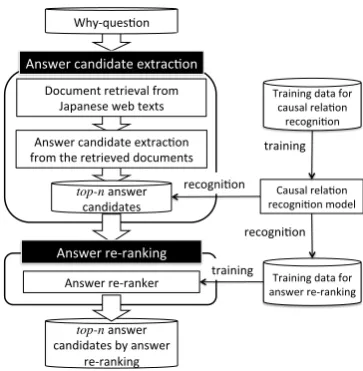
Figure 1: System architecture
2012).
3 System Architecture
We first describe the system architecture of our QA system before describing our proposed method. It is composed of two components: an-swer candidate extraction and anan-swer re-ranking (Fig. 1). This architecture is basically the same as that used in our previous work (Oh et al., 2012). We extended our previous work by introducing causal relations recognized from answer candi-dates to the answer re-ranking. The features used in our previous work are very different from those in this work, and we found that combining both improves accuracy.
Answer candidate extraction: In our previous
work, we implemented the method of Murata et al. (2007) for our answer candidate extractor. We retrieved documents from Japanese web texts
us-ingBoolean ANDandORqueries generated from
the content words in why-questions. Then we ex-tracted passages of five sentences from these re-trieved documents and ranked them with the rank-ing function proposed by Murata et al. (2007). This method ranks a passage higher when it con-tains more query terms that are closer to each other in the passage. We used a set of clue terms, includ-ing the Japanese counterparts ofcauseandreason, as query terms for the ranking. The top ranked passages are regarded asanswer candidatesin the answer re-ranking. See Murata et al. (2007) for more details.
Answer re-ranking: Re-ranking the answer
candidates is done by a supervised classifier (SVMs) (Vapnik, 1995). In our previous work, we
employed three types of features for training the re-ranker: morphosyntactic features (n-grams of
morphemes and syntactic dependency chains), se-mantic word class features (sese-mantic word classes obtained by automatic word clustering (Kazama and Torisawa, 2008)) and sentiment polarity fea-tures (word and phrase polarities). Here, we used semantic word classes and sentiment polarities for identifying such semantic associations between a why-question and its answer as “if a disease’s name appears in a question, then answers that in-clude nutrient names are more likely to be correct” by semantic word classes and “if something un-desirable happens, the reason is often also some-thing undesirable” by sentiment polarities. In this work, we propose causal relation features gener-ated from intra- and inter-sentential causal rela-tions in answer candidates and use them along with the features proposed in our previous work for training our re-ranker.
4 Causal Relations for Why-QA
We describe causal relation recognition in Sec-tion 4.1 and describe the features (of our re-ranker) generated from causal relations in Section 4.2.
4.1 Causal Relation Recognition
We restrict causal relations to those expressed by such cue phrases for causality as (the Japanese counterparts of) because and as a result like in the previous work (Khoo et al., 2000; Inui and Okumura, 2005) and recognize them in the fol-lowing two steps: extracting causal relation candi-dates and recognizing causal relations from these candidates.
4.1.1 Extracting Causal Relation Candidates
Regular expressions Examples
(D|の)?ためP? ため(for),のため(for),そのため (as a result),のために(for) ので ので(since or because of) こと(から|で) ことから(from the fact that),こと
で(by the fact that)
(から|ため) C からだ(because),ためだ(It is be-cause)
D? RCT (P|C)+ 理由は (the reason is), 原因だ (is the cause),この理由から(from this reason)
Table 2: Regular expressions for identifying cue phrases for causality. D, P and C represent demonstratives (e.g.,この(this) andその(that)),
postpositions (including case markers such asが
(nominative), の (genitive)), and copula (e.g.,で す(is) andである(is)) in Japanese, respectively.
RCT, which represents Japanese terms meaning
reason, cause, or thanks to, is defined as
fol-lows: RCT = {理由 (reason), 原因 (cause), 要
因 (cause), 引き金 (cause), おかげ (thanks to), せい(thanks to),わけ(reason) }.
4.1.2 Recognizing Causal Relations
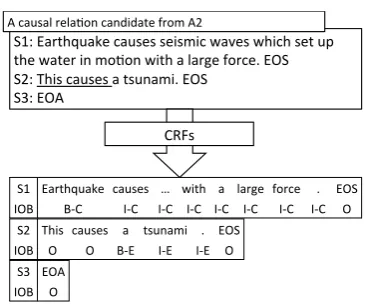
Next, we recognize the spans of the cause and ef-fect parts of a causal relation linked to a c-marker. We regard this task as a sequence labeling problem and use Conditional Random Fields (CRFs) (Laf-ferty et al., 2001) as a machine learning frame-work. In our task, CRFs take three sentences of a causal relation candidate as input and gen-erate their cause-effect annotations with a set of possible cause-effect IOB labels, including Begin-Cause C), Inside-Begin-Cause (I-C), Begin-Effect (B-E), Inside-Effect (I-(B-E), and Outside (O). Fig 2 shows an example of such sequence labeling. Al-though this example is about sequential labeling shown on English sentences for ease of explana-tion, it was actually done on Japanese sentences.
We used the three types of feature sets in Table 3 for training the CRFs, where j is in the range of i−4≤j≤i+ 4for current positioniin a causal
relation candidate.
Type Features
Morphological feature mj,mjj+1,posj,posjj+1
Syntactic feature sj,sjj+1,bj,bjj+1
C-marker feature (mj, cm), (mjj+1, cm)
(sj, cm), (sjj+1, cm)
Table 3: Features for training CRFs, where
xjj+1 =xjxj+1
Morphological features: mj andposj in
Ta-ble 3 represent thejthmorpheme and the POS tag.
S1: Earthquake causes seismic waves which set up the water in mo7on with a large force. EOS S2: This causes a tsunami. EOS
S3: EOA
S1 Earthquake causes … with a large force . EOS IOB B-‐C I-‐C I-‐C I-‐C I-‐C I-‐C I-‐C I-‐C O
S2 This causes a tsunami . EOS IOB O O B-‐E I-‐E I-‐E O
S3 EOA IOB O
CRFs
A causal rela7on candidate from A2
Figure 2: Recognizing causal relations by se-quence labeling: Underlined textThis causes rep-resents a c-marker, and EOS and EOA represent
end-of-sentenceandend-of-answer candidates.
水が 氷に なると 体積が 増加するため、 氷山は 水に 浮くことができる water ice if (it)
becomes volume its because (it) increases iceberg an water float on (water) Subtree informa�on used for syntac�c features
subtree subtree child child c-‐marker subtree -‐of-‐ parent
subtree -‐of-‐ parent
parent 増加するため、
なると
[水が氷になると体積が増加する]causeため、[氷山は水に浮くことができる]effect
(Because [the volume of the water increases if it becomes ice]cause, [an iceberg floats
on water]effect.)
浮くことができる root
[image:4.595.325.508.58.211.2]c-‐marker node
Figure 3: Example of syntactic information related to a c-marker used for syntactic features
We use JUMAN1, a Japanese morphological ana-lyzer, for generating our morphological features.
Syntactic features:The span of the causal
rela-tions in a given causal relation candidate strongly depends on the c-marker in the candidate. Es-pecially for intra-sentential causal relations, their cause and effect parts often appear in the subtrees of the c-marker’s node or those of the c-marker’s parent node in a syntactic dependency tree struc-ture. Fig. 3 shows an example that follows this ob-servation, where the c-marker node is represented in a hexagon and the other nodes are in a rectan-gle. Note that each node in Fig. 3 is a word phrase (calleda bunsetsu), which is the smallest unit of syntactic analysis in Japanese. A bunsetsu is a syntactic constituent composed of a content word and several function words such as postpositions and case markers. Syntactic dependency is repre-sented by an arrow in Fig. 3. For example, there is syntactic dependency from word phrase 水が
[image:4.595.71.297.61.193.2] [image:4.595.309.526.280.404.2](water) toなると(if (it) becomes), i.e.,水が−−→dep
なると. We encode this subtree information into
sj, which is the syntactic information of a word
phrase to which the jth morpheme belongs. s j
only has one of six values: 1) the c-marker’s node
(c-marker), 2) the c-marker’s child node (child),
3) the c-marker’s parent node (parent), 4) in the c-marker’s subtree but not the c-c-marker’s child node
(subtree), 5) in the subtree of the c-marker’s
par-ent node but not the c-marker’s node (
subtree-of-parent) and 6) the others (others). bj is the word
phrase information of thejthmorpheme (mj) that
represents whether mj is in the beginning or
in-side a word phrase. For generating our syntactic features, we use KNP2, a Japanese syntactic de-pendency parser.
C-marker features: As our c-marker features,
we use a pair composed of c-markercm and one
of the following:mj,mjj+1,sj, orsjj+1.
4.2 Causal Relation Features
We use terms, partial trees (in a syntactic depen-dency tree structure), and the semantic orienta-tion of excitaorienta-tion (Hashimoto et al., 2012) to as-sess the appropriateness of each causal relation ob-tained by our causal relation recognizer as an an-swer to a given question. Finding anan-swers with term matching and partial tree matching has been used in the literature of question answering (Girju, 2003; Narayanan and Harabagiu, 2004; Moschitti et al., 2007; Higashinaka and Isozaki, 2008; Ver-berne et al., 2008; Surdeanu et al., 2011; VerVer-berne et al., 2011; Oh et al., 2012), while that with the excitation polarity is proposed in this work.
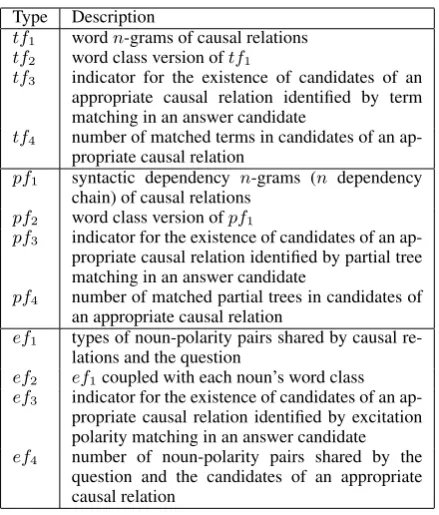
We use three types of features. Each fea-ture type expresses the causal relations in an an-swer candidate that are determined to be appro-priate as answers to a given question by term matching (tf1–tf4), partial tree matching (pf1–
pf4) and excitation polarity matching (ef1–ef4).
We call these causal relations used for generating our causal relation features candidates of an
ap-propriate causal relationin this section. Note that
if one answer candidate has more than one candi-date of an appropriate causal relation found by one matching method, we generated features for each appropriate candidate and merged all of them for the answer candidate.
2http://nlp.ist.i.kyoto-u.ac.jp/EN/index.php?KNP
Type Description
tf1 wordn-grams of causal relations
tf2 word class version oftf1
tf3 indicator for the existence of candidates of an
appropriate causal relation identified by term matching in an answer candidate
tf4 number of matched terms in candidates of an
ap-propriate causal relation
pf1 syntactic dependency n-grams (n dependency
chain) of causal relations pf2 word class version ofpf1
pf3 indicator for the existence of candidates of an
ap-propriate causal relation identified by partial tree matching in an answer candidate
pf4 number of matched partial trees in candidates of
an appropriate causal relation
ef1 types of noun-polarity pairs shared by causal
re-lations and the question
ef2 ef1coupled with each noun’s word class
ef3 indicator for the existence of candidates of an
ap-propriate causal relation identified by excitation polarity matching in an answer candidate ef4 number of noun-polarity pairs shared by the
[image:5.595.307.527.59.317.2]question and the candidates of an appropriate causal relation
Table 4: Causal relation features: n in n-grams is n = {2,3} andn-grams in an effect part are
distinguished from those in a cause part.
4.2.1 Term Matching
Our term matching method judges that a causal re-lation is a candidate of an appropriate causal rela-tion if its effect part contains at least one content word (nouns, verbs, and adjectives) in the ques-tion. For example, all the causal relations ofA1– A4 in Table 1 are candidates of an appropriate causal relation to the question, “Why is a tsunami generated?”, by term matching with question term
tsunami.
tf1–tf4are generated from candidates of an
ap-propriate causal relation identified by term match-ing. The n-grams of tf1 and tf2 are restricted
to those containing at least one content word in a question. We distinguish this matched word from the other words by replacing it with QW, a special symbol representing a word in the ques-tion. For example, word 3-gram “this/cause/QW” is extracted from This causes tsunamisinA2for “Why is a tsunami generated?” Further, we cre-ate a word class version of wordn-grams by
con-verting the words in these wordn-grams into their
“this/cause/QW” is “this/cause/QW,WCtsunami”,
where WCtsunami represents the word class of
a tsunami. tf3 is a binary feature that
indi-cates the existence of candidates of an appropri-ate causal relation identified by term matching in an answer candidate. tf4 represents the degree
of the relevance of the candidates of an appro-priate causal relation measured by the number of matched terms: one, two, and more than two.
4.2.2 Partial Tree Matching
Our partial tree matching method judges a causal relation as a candidate of an appropriate causal re-lation if its effect part contains at least one par-tial tree in a question, where the parpar-tial tree covers more than one content word. For example, only the causal relation A1 among A1–A4 is a can-didate of an appropriate causal relation for ques-tion “Why are tsunamis generated?” by partial tree matching because only its effect part contains partial tree “tsunamis−−→dep (are) generated” of the question.
pf1–pf4 are generated from candidates of an
appropriate causal relation identified by the par-tial tree matching. The syntactic dependency n
-grams in pf1 and pf2 are restricted to those that
contain at least one content word in a question. We distinguish this matched content word from the other content words in the n-gram by converting it to QW, which represents a content word in the question. For example, syntactic dependency 2-gram “QW−−→dep cause” and its word class version
“QW,WCtsunami −−→dep cause” are extracted from
Tsunamis that can cause in A1. pf3 is a binary
feature that indicates whether an answer candidate contains candidates of an appropriate causal rela-tion identified by partial tree matching. pf4
rep-resents the degree of the relevance of the candi-date of an appropriate causal relation measured by the number of matched partial trees: one, two, and more than two.
4.2.3 Excitation Polarity Matching
Hashimoto et al. (2012) proposed a semantic ori-entation called excitation polarities. It classifies predicates with their argument position (called
templates) into excitatory, inhibitory and
neu-tral. In the following, we denote a template as “[argument position,predicate].” According to Hashimoto’s definition, excitatory templates im-ply that the function, effect, purpose, or the role of
an entity filling an argument position in the tem-plates is activated/enhanced. On the contrary, in-hibitory templates imply that the effect, purpose or the role of an entity is deactivated/suppressed. Neutral templates are those that neither activate nor suppress the function of an argument.
We assume that the meanings of a text can
be roughly captured by checking whether each
noun in the text isactivated orsuppressedin the sense of the excitation polarity framework, where the activation and suppression of each entity (or noun) can be detected by looking at the excita-tion polarities of the templates that are filled by the entity. For instance, effect part “tsunamis that can cause large coastal inundation are gen-erated” ofA1roughly means that “tsunamis” are
activated and “inundation” is (or can be)
acti-vated. This activation/suppression configuration of the nouns isconsistentwith sentence “tsunamis are caused” in which “tsunamis” are activated. This consistency suggests that A1 is a good an-swer to question “Why are tsunamis caused?”, al-though the “tsunamis” are modified by different predicates; “cause” and “generate.” On the other hand, effect part “tsunamis weaken as they pass through forests” of A4 implies that “tsunamis” are suppressed. This suggests that A4 is not a good answer to “Why are tsunamis caused?” Note that the consistency checking between ac-tivation/suppression configurations of nouns3 in texts can be seen as a rough but lightweight ap-proximation of the recognition of textual entail-ments or paraphrases.
Following the definition of excitation polarity in Hashimoto et al. (2012), we manually classi-fied templates4to each polarity type and obtained 8,464 excitatory templates, such as [が,増える] ([subject, increase]) and [が, 向上す る] ([sub-ject, improve]), 2,262 inhibitory templates, such as [を, 防ぐ] ([object, prevent]) and [が, 死ぬ] ([subject, die]), and 7,230 neutral templates such as [を, 考える] ([object, consider]). With these
templates, we obtain activation/suppression con-figurations (including neutral) for the nouns in the causal relations in the answer candidates and
tions.
Next, we assume that a causal relation is ap-propriate as an answer to a question if the effect part of the causal relation and the question share at least one common noun with the same polarity. More detailed information concerning the config-urations of all the nouns in all the candidates of an
appropriate causal relation (including their cause
parts) and the question are encoded into our fea-ture setef1–ef4in Table 4 and the final judgment
is done by our re-ranker.
For generatingef1andef2, we classified all the
nouns coupled with activation/suppression/neutral polarities in a causal relation into three types: SAME (the question contains the same noun with the same polarity), DiffPOL (the question con-tains the same noun with different polarity), and OTHER (the others). ef1 indicates whether each
type of noun-polarity pair exists in a causal rela-tion. Note that the types for the effect and cause parts are represented in distinct features.ef2is the
same asef1 except that the types are augmented
with the word classes of the corresponding nouns. In other words, ef2 indicates whether each type
of noun-polarity pair exists in the causal relation for each word class.ef3 indicates the existence of
candidates of an appropriate causal relation iden-tified by this matching scheme, and ef4
repre-sents the number of noun-polarity pairs shared by the question and the candidates of an appropriate causal relations (one, two, and more than two).
5 Experiments
We experimented with causal relation recognition and why-QA with our causal relation features.
5.1 Data Set for Why-Question Answering
For our experiments, we used the same why-QA data set as the one used in our previous work (Oh et al., 2012). This why-QA data set is composed of 850 Japanese why-questions and their top-20 answer candidates obtained by answer candidate extraction from 600 million Japanese web pages. Three annotators checked the top-20 answer can-didates of these 850 questions and the final judg-ment was made by their majority vote. Their inter-rater agreement by Fleiss’ kappa reported in Oh et al. (2012) was substantial (κ= 0.634). Among the
850 questions, 250 why-questions were extracted from the Japanese version of Yahoo! Answers, and another 250 were created by annotators. In
our previous work, we evaluated the system with these 500 questions and their answer candidates as training and test data in 10-fold cross-validation. The other 350 why-questions were manually built from passages describing the causes or reasons of events/phenomena. These questions and their an-swer candidates were used as additional training data for testing subsamples in each fold during the 10-fold cross-validation. In our why-QA experi-ments, we evaluated our why-QA system with the same settings.
5.2 Data Set for Causal Relation Recognition
We built a data set composed of manually anno-tated causal relations for evaluating our causal re-lation recognition. As source data for this data set, we used the same 10-fold data that we used for evaluating our why-QA (500 questions and their answer candidates). We extracted the causal re-lation candidates from the answer candidates in each fold, and then our annotator (not an author) manually marked the span of the cause and effect parts of a causal relation for each causal relation candidate, keeping in mind that the causal rela-tion must be expressed in terms of a c-marker in a given causal relation candidate. Finally, we had a data set made of 16,051 causal relation candi-dates, 8,117 of which had a true causal relation; the number of intra- and inter-sentential causal re-lations were 7,120 and 997, respectively.
Note that this data set can be partitioned into ten folds by using the 10-fold partition of its source data. We performed 10-fold cross validation to evaluate our causal relation recognition with this 10-fold data.
5.3 Causal Relation Recognition
We used CRF++5 for training our causal relation recognizer. In our evaluation, we judged a sys-tem’s output as correct if both spans of the cause and effect parts overlapped those in the gold stan-dard. Evaluation was done by precision, recall, andF1.
Precision Recall F1
BASELINE 41.9 61.0 49.7 INTRA-SENT 84.5 75.4 79.7 INTER-SENT 80.2 52.6 63.6
[image:7.595.324.505.650.704.2]ALL 83.8 71.1 77.0
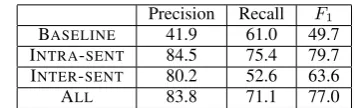
Table 5: Results of causal relation recognition (%)
the result for our baseline system that recognizes a causal relation by simply taking the two phrases adjacent to a c-marker (i.e., before and after) as cause and effect parts of the causal relation. We assumed that the system had an oracle for judging correctly whether each phrase is a cause part or an effect part. In other words, we judged that a causal relation recognized by BASELINEis correct if both
cause and effect parts in the gold standard are adja-cent to a c-marker. INTRA-SENTand INTER-SENT
represent the results for intra- and inter-sentential causal relations and ALLrepresents the result for
the both causal relations by our method. From these results, we confirmed that our method rec-ognized both intra- and inter-sentential causal rela-tions with over 80% precision, and it significantly outperformed our baseline system in both preci-sion and recall rates.
Precision Recall F1
ALL-“MORPH” 80.8 66.4 72.9 ALL-“SYNTACTIC” 82.9 67.0 74.1 ALL-“C-MARKER” 76.3 51.4 61.4
[image:8.595.80.281.312.366.2]ALL 83.8 71.1 77.0
Table 6: Ablation test results for causal relation recognition (%)
We also investigated the contribution of the three types of features used in our causal rela-tion recognirela-tion to the performance. We evalu-ated the performance when we removed one of the three types of features (ALL-“MORPH”, ALL
-“SYNTACTIC” and ALL-“C-MARKER”) and
com-pared the results in these settings with the one when all the feature sets were used (ALL).
Ta-ble 6 shows the result. We confirmed that all the feature sets improved the performance, and we got the best performance when using all of them. We used the causal relations obtained from the 10-fold cross validation for our why-QA experiments.
5.4 Why-Question Answering
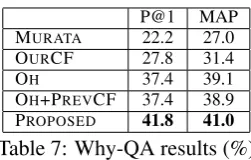
We performed why-QA experiments to confirm the effectiveness of intra- and inter-sentential causal relations in a why-QA task. In this experiment, we compared five systems: four baseline systems (MURATA, OURCF, OH
and OH+PREVCF) and our proposed method
(PROPOSED).
MURATA corresponds to our answer candidate
extraction.
OURCF uses a re-ranker trained with only our
causal relation features.
OH, which represents our previous work (Oh et
al., 2012), has a re-ranker trained with mor-phosyntactic, semantic word class, and senti-ment polarity features.
OH+PREVCF is a system with a re-ranker
trained with the features used in OHand with
the causal relation feature proposed in Hi-gashinaka and Isozaki (2008). The causal re-lation feature includes an indicator that deter-mines whether the causal relations between two terms appear in a question-answer pair; cause in an answer and its effect in a question. We acquired the causal relation instances (be-tween terms) from 600 million Japanese web pages using the method of De Saeger et al. (2009) and exploited thetop-100,000 causal
relation instances in this system.
PROPOSED has a re-ranker trained with our
causal relation features as well as the three types of features proposed in Oh et al. (2012). Comparison between OHand PROPOSED
re-veals the contribution of our causal relation features to why-QA.
We used TinySVM6 with a linear kernel for training the re-rankers in OURCF, OH,
OH+PREVCF and PROPOSED. Evaluation was
done by P@1 (Precision of the top-answer) and Mean Average Precision (MAP); they are the same measures used in Oh et al. (2012). P@1 measures how many questions have a correct top-answer candidate. MAP measures the overall quality of the top-20 answer candidates. As mentioned in Section 5.1, we used 10-fold cross-validation with the same setting as the one used in Oh et al. (2012) for our experiments.
P@1 MAP
MURATA 22.2 27.0 OURCF 27.8 31.4
OH 37.4 39.1
[image:8.595.353.479.597.677.2]OH+PREVCF 37.4 38.9 PROPOSED 41.8 41.0
Table 7: Why-QA results (%)
Table 7 shows the evaluation results. Our pro-posed method outperformed the other four sys-tems and improved P@1 by 4.4% over OH, which
is the-state-of-the-art system for Japanese
why-6http://chasen.org/
QA. OURCF showed the performance
improve-ment over MURATA. Although this suggests the
effectiveness of our causal relation features, the overall performance of OURCF was lower than
that of OH. OH+PREVCF outperformed neither
OH nor PROPOSED. This suggests that our
ap-proach is more effective than previous causality-based approaches (Girju, 2003; Higashinaka and Isozaki, 2008), at least in our setting.
20 30 40 50 60 70 80 90 100
10 20 30 40 50 60 70 80 90 100
Precision (%)
% of questions PROPOSED
OH OurCF
Figure 4: Effect of causal relation features on the top-answers
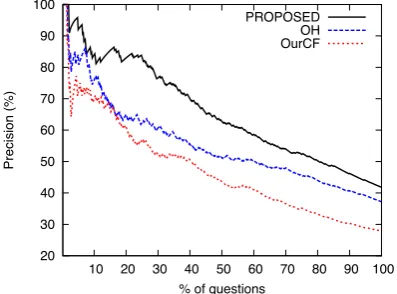
We also compared confident answers of OURCF, OH, and PROPOSEDby making each
sys-tem provide only thekconfident top-answers (for
k questions) selected by their SVM scores given
by each system’s re-ranker. This reduces the num-ber of questions that can be answered by a system, but the top-answers become more reliable ask
de-creases. Fig. 4 shows this result, where thexaxis
represents the percentage of questions (against all the questions in our test set) whose top-answers are given by each system, and the y axis
repre-sents the precision of the top-answers at a certain point on thexaxis. When both systems provided
top-answers for 25% of all the questions in our test set, our method achieved 83.2% precision, which is much higher than OH’s (62.4%). This
exper-iment confirmed that our causal relation features were also effective in improving the quality of the highly confident answers.
However, the high precision by our method was bound to confident answers for a small number of questions, and the difference in the precision between OH and PROPOSED in Fig. 4 became
smaller as we considered more answers with lower confidence. We think that one of the reasons is the relatively small coverage of the excitation polarity lexicon, a core resource in our excitation polarity
matching. We are planning to enlarge the lexicon to deal with this problem.
Next, we investigated the contribution of the intra- and inter-sentential causal relations to the performance of our method. We used only one of the two types of causal relations for generating causal relation features (INTRA-SENTand INTER -SENT) for training our re-ranker and compared the
results in these settings with the one when both were used (ALL (PROPOSED)). Table 8 shows
the result. Both intra- and inter-sentential causal relations contributed to the performance improve-ment.
P@1 MAP
[image:9.595.80.279.198.345.2]INTER-SENT 39.0 39.7 INTRA-SENT 40.4 40.5 ALL(PROPOSED) 41.8 41.0
Table 8: Results with/without intra- and inter-sentential causal relations (%)
We also investigated the contributions of the three types of causal relation features by ablation tests (Table 9). When we do not use the fea-tures by excitation polarity matching (ALL-{ef1–
ef4}), the performance is the worst. This implies
that the contribution of excitation polarity match-ing exceeds the other two.
P@1 MAP
ALL-{tf1–tf4} 40.8 40.7
ALL-{pf1–pf4} 41.0 40.9
ALL-{ef1–ef4} 39.6 40.5
ALL(PROPOSED) 41.8 41.0
Table 9: Ablation test results for why-QA (%)
6 Conclusion
[image:9.595.346.486.247.289.2]References
Ion Androutsopoulos and Prodromos Malakasiotis. 2010. A survey of paraphrasing and textual entail-ment methods. Journal of Artificial Intelligence Re-search (JAIR), 38(1):135–187.
Luisa Bentivogli, Peter Clark, Ido Dagan, Hoa Dang, and Danilo Giampiccolo. 2011. The seventh pascal recognizing textual entailment challenge. In Pro-ceedings of TAC.
E. Blanco, N. Castell, and Dan I. Moldovan. 2008. Causal relation extraction. In Proceedings of LREC’08.
Du-Seong Chang and Key-Sun Choi. 2006. Incremen-tal cue phrase learning and bootstrapping method for causality extraction using cue phrase and word pair probabilities. Information Processing and Manage-ment, 42(3):662–678.
Ido Dagan, Bill Dolan, Bernardo Magnini, and Dan Roth. 2010. Recognizing textual entailment: Ratio-nal, evaluation and approaches. Natural Language Engineering, 16(1):1–17.
Stijn De Saeger, Kentaro Torisawa, Jun’ichi Kazama, Kow Kuroda, and Masaki Murata. 2009. Large scale relation acquisition using class dependent pat-terns. InProceedings of ICDM ’09, pages 764–769.
Stijn De Saeger, Kentaro Torisawa, Masaaki Tsuchida, Jun’ichi Kazama, Chikara Hashimoto, Ichiro Ya-mada, Jong Hoon Oh, István Varga, and Yulan Yan. 2011. Relation acquisition using word classes and partial patterns. In Proceedings of EMNLP ’11, pages 825–835.
Quang Xuan Do, Yee Seng Chan, and Dan Roth. 2011. Minimally supervised event causality identification. InProceedings of EMNLP ’11, pages 294–303.
David A. Ferrucci, Eric W. Brown, Jennifer Chu-Carroll, James Fan, David Gondek, Aditya Kalyan-pur, Adam Lally, J. William Murdock, Eric Nyberg, John M. Prager, Nico Schlaefer, and Christopher A. Welty. 2010. Building Watson: An overview of the DeepQA project. AI Magazine, 31(3):59–79.
Roxana Girju. 2003. Automatic detection of causal relations for question answering. InProceedings of the ACL 2003 workshop on Multilingual summariza-tion and quessummariza-tion answering, pages 76–83.
Chikara Hashimoto, Kentaro Torisawa, Stijn De Saeger, Jong-Hoon Oh, and Jun’ichi Kazama. 2012. Excitatory or inhibitory: A new semantic orientation extracts contradiction and causality from the web. In Proceedings of EMNLP-CoNLL ’12.
Ryuichiro Higashinaka and Hideki Isozaki. 2008. Corpus-based question answering for why-questions. In Proceedings of IJCNLP ’08, pages 418–425.
Takashi Inui and Manabu Okumura. 2005. Investigat-ing the characteristics of causal relations in Japanese text. In In Annual Meeting of the Association for Computational Linguistics (ACL) Workshop on Frontiers in Corpus Annotations II: Pie in the Sky.
Jun’ichi Kazama and Kentaro Torisawa. 2008. In-ducing gazetteers for named entity recognition by large-scale clustering of dependency relations. In Proceedings of ACL-08: HLT, pages 407–415.
Christopher S. G. Khoo, Syin Chan, and Yun Niu. 2000. Extracting causal knowledge from a medical database using graphical patterns. InProceedings of ACL ’00, pages 336–343.
John Lafferty, Andrew McCallum, and Fernando Pereira. 2001. Conditional random fields: Prob-abilistic models for segmenting and labeling se-quence data. In Proceedings of ICML ’01, pages 282–289.
Alessandro Moschitti, Silvia Quarteroni, Roberto Basili, and Suresh Manandhar. 2007. Exploiting syntactic and shallow semantic kernels for question answer classification. In Proceedings of ACL ’07, pages 776–783.
Masaki Murata, Sachiyo Tsukawaki, Toshiyuki Kana-maru, Qing Ma, and Hitoshi Isahara. 2007. A sys-tem for answering non-factoid Japanese questions by using passage retrieval weighted based on type of answer. InProceedings of NTCIR-6.
Srini Narayanan and Sanda Harabagiu. 2004. Ques-tion answering based on semantic structures. In Pro-ceedings of COLING ’04, pages 693–701.
Jong-Hoon Oh, Kentaro Torisawa, Chikara Hashimoto, Takuya Kawada, Stijn De Saeger, Jun’ichi Kazama, and Yiou Wang. 2012. Why question answering using sentiment analysis and word classes. In Pro-ceedings of EMNLP-CoNLL ’12, pages 368–378.
Kira Radinsky, Sagie Davidovich, and Shaul Markovitch. 2012. Learning causality for news events prediction. In Proceedings of WWW ’12, pages 909–918.
Mehwish Riaz and Roxana Girju. 2010. Another look at causality: Discovering scenario-specific contin-gency relationships with no supervision. In ICSC ’10, pages 361–368.
Hideki Shima, Hiroshi Kanayama, Cheng wei Lee, Chuan jie Lin, Teruko Mitamura, Yusuke Miyao, Shuming Shi, and Koichi Takeda. 2011. Overview of NTCIR-9 RITE: Recognizing Inference in TExt. InProceedings of NTCIR-9.
Kentaro Torisawa. 2006. Acquiring inference rules with temporal constraints by using japanese coordi-nated sentences and noun-verb co-occurrences. In Proceedings of HLT-NAACL ’06, pages 57–64.
Vladimir N. Vapnik. 1995. The nature of statistical learning theory. Springer-Verlag New York, Inc., New York, NY, USA.
Istvan Varga, Motoki Sano, Kentaro Torisawa, Chikara Hashimoto, Kiyonori Ohtake, Takao Kawai, Jong-Hoon Oh, and Stijn De Saeger. 2013. Aid is out there: Looking for help from tweets during a large scale disaster. InProceedings of ACL ’13.
Suzan Verberne, Lou Boves, Nelleke Oostdijk, and Peter-Arno Coppen. 2008. Using syntactic infor-mation for improving why-question answering. In Proceedings of COLING ’08, pages 953–960.