A Bayesian Method for Robust Estimation of Distributional Similarities
Jun’ichi Kazama Stijn De Saeger Kow Kuroda Masaki Murata† Kentaro Torisawa
Language Infrastructure Group, MASTAR Project
National Institute of Information and Communications Technology (NICT) 3-5 Hikaridai, Seika-cho, Soraku-gun, Kyoto, 619-0289 Japan
{kazama, stijn, kuroda, torisawa}@nict.go.jp
†Department of Information and Knowledge Engineering
Faculty/Graduate School of Engineering, Tottori University
4-101 Koyama-Minami, Tottori, 680-8550 Japan∗
Abstract
Existing word similarity measures are not robust to data sparseness since they rely only on the point estimation of words’ context profiles obtained from a limited amount of data. This paper proposes a Bayesian method for robust distributional word similarities. The method uses a dis-tribution of context profiles obtained by Bayesian estimation and takes the expec-tation of a base similarity measure under that distribution. When the context pro-files are multinomial distributions, the pri-ors are Dirichlet, and the base measure is the Bhattacharyya coefficient, we can de-rive an analytical form that allows efficient calculation. For the task of word similar-ity estimation using a large amount of Web data in Japanese, we show that the pro-posed measure gives better accuracies than other well-known similarity measures.
1 Introduction
The semantic similarity of words is a long-standing topic in computational linguistics be-cause it is theoretically intriguing and has many applications in the field. Many researchers have conducted studies based on the distributional hy-pothesis (Harris, 1954), which states that words that occur in the same contexts tend to have similar meanings. A number of semantic similarity mea-sures have been proposed based on this hypothesis (Hindle, 1990; Grefenstette, 1994; Dagan et al., 1994; Dagan et al., 1995; Lin, 1998; Dagan et al., 1999).
∗The work was done while the author was at NICT.
In general, most semantic similarity measures have the following form:
sim(w1, w2) =g(v(w1), v(w2)), (1)
where v(wi) is a vector that represents the con-texts in whichwiappears, which we call acontext
profileofwi. The functiongis a function on these context profiles that is expected to produce good similarities. Each dimension of the vector corre-sponds to a context,fk, which is typically a neigh-boring word or a word having dependency rela-tions withwiin a corpus. Its value,vk(wi), is typ-ically a co-occurrence frequencyc(wi, fk), a con-ditional probability p(fk|wi), or point-wise mu-tual information (PMI) betweenwiandfk, which are all calculated from a corpus. For g, various works have used the cosine, the Jaccard coeffi-cient, or the Jensen-Shannon divergence is uti-lized, to name only a few measures.
Previous studies have focused on how to de-vise good contexts and a good function g for se-mantic similarities. On the other hand, our ap-proach in this paper is to estimate context profiles (v(wi)) robustly and thus to estimate the similarity robustly. The problem here is thatv(wi) is com-puted from a corpus of limited size, and thus in-evitably contains uncertainty and sparseness. The guiding intuition behind our method is as follows.
All other things being equal, the similarity with a more frequent word should be larger, since it would be more reliable. For example, ifp(fk|w1) andp(fk|w2)for two given wordsw1 andw2 are equal, butw1 is more frequent, we would expect thatsim(w0, w1)> sim(w0, w2).
In the NLP field, data sparseness has been rec-ognized as a serious problem and tackled in the context of language modeling and supervised ma-chine learning. However, to our knowledge, there
has been no study that seriously dealt with data sparseness in the context of semantic similarity calculation. The data sparseness problem is usu-ally solved by smoothing, regularization, margin maximization and so on (Chen and Goodman, 1998; Chen and Rosenfeld, 2000; Cortes and Vap-nik, 1995). Recently, the Bayesian approach has emerged and achieved promising results with a clearer formulation (Teh, 2006; Mochihashi et al., 2009).
In this paper, we apply the Bayesian framework to the calculation of distributional similarity. The method is straightforward: Instead of using the point estimation of v(wi), we first estimate the distribution of the context profile, p(v(wi)), by Bayesian estimation and then take the expectation of the original similarity under this distribution as follows:
simb(w1, w2) (2)
=E[sim(w1, w2)]{p(v(w1)),p(v(w2))}
=E[g(v(w1), v(w2))]{p(v(w1)),p(v(w2))}.
The uncertainty due to data sparseness is repre-sented byp(v(wi)), and taking the expectation en-ables us to take this into account. The Bayesian estimation usually gives diverging distributions for infrequent observations and thus decreases the ex-pectation value as expected.
The Bayesian estimation and the expectation calculation in Eq. 2 are generally difficult and usually require computationally expensive proce-dures. Since our motivation for this research is to calculate good semantic similarities for a large set of words (e.g., one million nouns) and apply them to a wide range of NLP tasks, such costs must be minimized.
Our technical contribution in this paper is to show that in the case where the context profiles are multinomial distributions, the priors are Dirich-let, and the base similarity measure is the Bhat-tacharyya coefficient (BhatBhat-tacharyya, 1943), we can derive an analytical form for Eq. 2, that en-ables efficient calculation (with some implemen-tation tricks).
In experiments, we estimate semantic similari-ties using a large amount of Web data in Japanese and show that the proposed measure gives bet-ter word similarities than a non-Bayesian Bhat-tacharyya coefficient or other well-known similar-ity measures such as Jensen-Shannon divergence and the cosine with PMI weights.
The rest of the paper is organized as follows. In Section 2, we briefly introduce the Bayesian esti-mation and the Bhattacharyya coefficient. Section 3 proposes our new Bayesian Bhattacharyya coef-ficient for robust similarity calculation. Section 4 mentions some implementation issues and the so-lutions. Then, Section 5 reports the experimental results.
2 Background
2.1 Bayesian estimation with Dirichlet prior
Assume that we estimate a probabilistic model for the observed data D, p(D|φ), which is parame-terized with parametersφ. In the maximum like-lihood estimation (MLE), we find the point esti-mationφ∗ = argmaxφp(D|φ). For example, we estimatep(fk|wi)as follows with MLE:
p(fk|wi) =c(wi, fk)/ X
k
c(wi, fk). (3)
On the other hand, the objective of the Bayesian estimation is to find the distribution of φ given the observed data D, i.e., p(φ|D), and use it in later processes. Using Bayes’ rule, this can also be viewed as:
p(φ|D) = p(D|φ)pprior(φ)
p(D) . (4)
pprior(φ)is a prior distribution that represents the plausibility of each φbased on the prior knowl-edge. In this paper, we consider the case where
φis a multinomial distribution, i.e., ∑kφk = 1, that models the process of choosing one out ofK
choices. Estimating a conditional probability dis-tribution φk = p(fk|wi) as a context profile for eachwi falls into this case. In this paper, we also assume that the prior is the Dirichlet distribution,
Dir(α). The Dirichlet distribution is defined as follows.
Dir(φ|α) =Γ(
PK
k=1αk)
QK
k=1Γ(αk)
K Y
k=1
φαk−1
k . (5)
Γ(.)is the Gamma function. The Dirichlet distri-bution is parametrized by hyperparametersαk(>
0).
It is known thatp(φ|D)is also a Dirichlet dis-tribution for this simplest case, and it can be ana-lytically calculated as follows.
p(φ|D) =Dir(φ|{αk+c(k)}), (6)
2.2 Bhattacharyya coefficient
When the context profiles are probability distribu-tions, we usually utilize the measures on probabil-ity distributions such as the Jensen-Shannon (JS) divergence to calculate similarities (Dagan et al., 1994; Dagan et al., 1997). The JS divergence is defined as follows.
J S(p1||p2) =
1
2(KL(p1||pavg) +KL(p2||pavg)),
wherepavg = p1+2p2 is a point-wise average ofp1 andp2 and KL(.) is the Kullback-Leibler diver-gence. Although we found that the JS divergence is a good measure, it is difficult to derive an ef-ficient calculation of Eq. 2, even in the Dirichlet prior case.1
In this study, we employ the Bhattacharyya co-efficient (Bhattacharyya, 1943) (BC for short), which is defined as follows:
BC(p1, p2) =
K X
k=1 √
p1k×p2k.
The BC is also a similarity measure on probabil-ity distributions and is suitable for our purposes as we describe in the next section. Although BC has not been explored well in the literature on distribu-tional word similarities, it is also a good similarity measure as the experiments show.
3 Method
In this section, we show that if our base similarity measure is BC and the distributions under which we take the expectation are Dirichlet distributions, then Eq. 2 also has an analytical form, allowing efficient calculation.
Here, we calculate the following value given two Dirichlet distributions:
BCb(p1, p2) =E[BC(p1, p2)]{Dir(p1|α′),Dir(p2|β′)}
=
ZZ
△×△
Dir(p1|α′)Dir(p2|β′)BC(p1, p2)dp1dp2.
After several derivation steps (see Appendix A), we obtain the following analytical solution for the above:
1A naive but general way might be to draw samples of
v(wi)fromp(v(wi))and approximate the expectation using
these samples. However, such a method will be slow.
= Γ(α
′ 0)Γ(β
′ 0)
Γ(α′0+ 1 2)Γ(β
′ 0+
1 2)
K X
k=1
Γ(α′k+12)Γ(β ′
k+12)
Γ(α′k)Γ(βk′) , (7)
whereα′0 = ∑kα′k andβ0′ = ∑kβk′. Note that with the Dirichlet prior,α′k=αk+c(w1, fk)and
βk′ = βk +c(w2, fk), whereαk andβk are the hyperparameters of the priors of w1 and w2, re-spectively.
To put it all together, we can obtain a new Bayesian similarity measure on words, which can be calculated only from the hyperparameters for the Dirichlet prior, α and β, and the observed countsc(wi, fk). It is written as follows.
BCb(w1, w2) = (8)
Γ(α0+a0)Γ(β0+b0)
Γ(α0+a0+12)Γ(β0+b0+12) ×
K X
k=1
Γ(αk+c(w1, fk) +12)Γ(βk+c(w2, fk) +12)
Γ(αk+c(w1, fk))Γ(βk+c(w2, fk))
,
where a0 = ∑
kc(w1, fk) and b0 = ∑
kc(w2, fk). We call this new measure the
Bayesian Bhattacharyya coefficient (BCb for short). For simplicity, we assumeαk=βk=αin this paper.
We can see thatBCbactually encodes our guid-ing intuition. Consider four words, w0, w1, w2, and w4, for which we have c(w0, f1) = 10,
c(w1, f1) = 2, c(w2, f1) = 10, and c(w3, f1) =
20. They have counts only for the first dimen-sion, i.e., they have the same context profile:
p(f1|wi) = 1.0, when we employ MLE. When
K = 10,000andαk = 1.0, the Bayesian similar-ity between these words is calculated as
BCb(w0, w1) = 0.785368
BCb(w0, w2) = 0.785421
BCb(w0, w3) = 0.785463
We can see that similarities are different ac-cording to the number of observations, as ex-pected. Note that the non-Bayesian BC will re-turn the same value, 1.0, for all cases. Note also that BCb(w0, w0) = 0.78542if we use Eq. 8, meaning that the self-similarity might not be the maximum. This is conceptually strange, al-though not a serious problem since we hardly use
sim(wi, wi) in practice. If we want to fix this, we can use the special definition: BCb(wi, wi) ≡
1. This is equivalent to using simb(wi, wi) =
4 Implementation Issues
Although we have derived the analytical form (Eq. 8), there are several problems in implement-ing robust and efficient calculations.
First, the Gamma function in Eq. 8 overflows when the argument is larger than 170. In such cases, a commonly used way is to work in the log-arithmic space. In this study, we utilize the “log Gamma” function: lnΓ(x), which returns the log-arithm of the Gamma function directly without the overflow problem.2
Second, the calculation of the log Gamma func-tion is heavier than operafunc-tions such as simple mul-tiplication, which is used in existing measures. In fact, the log Gamma function is implemented using an iterative algorithm such as the Lanczos method. In addition, according to Eq. 8, it seems that we have to sum up the values for all k, be-cause even ifc(wi, fk)is zero the value inside the summation will not be zero. In the existing mea-sures, it is often the case that we only need to sum up forkwherec(wi, fk) > 0. Becausec(wi, fk) is usually sparse, that technique speeds up the cal-culation of the existing measures drastically and makes it practical.
In this study, the above problem is solved by pre-computing the required log Gamma values, as-suming that we calculate similarities for a large set of words, and pre-computing default values for cases wherec(wi, fk) = 0. The following values are pre-computed once at the start-up time.
For each word:
(A) lnΓ(α0+a0)−lnΓ(α0+a0+12)
(B) lnΓ(αk+c(wi, fk))−lnΓ(αk+c(wi, fk)+12) for allkwherec(wi, fk)>0
(C) −exp(2(lnΓ(αk+12)−lnΓ(αk)))) +
exp(lnΓ(αk+c(wi, fk))−lnΓ(αk+
c(wi, fk) +12) +lnΓ(αk+12)−lnΓ(αk)) for allkwherec(wi, fk)>0;
For eachk:
(D):exp(2(lnΓ(αk+12)).
In the calculation of BCb(w1, w2), we first as-sume that all c(wi, fk) = 0 and set the output variable to the default value. Then, we iterate over the sparse vectorsc(w1, fk)andc(w2, fk). If
2We used the GNU Scientific Library (GSL)
(www.gnu.org/software/gsl/), which implements this function.
c(w1, fk)>0andc(w2, fk) = 0(and vice versa), we update the output variable just by adding (C). If c(w1, fk) > 0 andc(w2, fk) > 0, we update the output value using (B), (D) and one additional
exp(.) operation. With this implementation, we can make the computation of BCb practically as fast as using other measures.
5 Experiments
5.1 Evaluation setting
We evaluated our method in the calculation of sim-ilarities between nouns in Japanese.
Because human evaluation of word similari-ties is very difficult and costly, we conducted au-tomatic evaluation in the set expansion setting, following previous studies such as Pantel et al. (2009).
Given a word set, which is expected to con-tain similar words, we assume that a good simi-larity measure should output, for each word in the set, the other words in the set as similar words. For given word sets, we can construct input-and-answers pairs, where the input-and-answers for each word are the other words in the set the word appears in. We output a ranked list of 500 similar words for each word using a given similarity measure and checked whether they are included in the an-swers. This setting could be seen as document re-trieval, and we can use an evaluation measure such as the mean of the precision at topT (MP@T) or the mean average precision (MAP). For each input word, P@T (precision at top T) and AP (average precision) are defined as follows.
P@T = 1
T
T X
i=1
δ(wi∈ans),
AP = 1
R
N X
i=1
δ(wi∈ans)P@i.
δ(wi ∈ ans) returns 1 if the output word wi is in the answers, and 0 otherwise. N is the number of outputs and R is the number of the answers. MP@T and MAP are the averages of these values over all input words.
5.2 Collecting context profiles
documents), where each sentence has a depen-dency parse, we extracted verb and noun-noun dependencies with relation types and then calculated their frequencies in the corpus. If a noun, n, depends on a word, w, with a relation,
r, we collect a dependency pair,(n,〈w, r〉). That is, a contextfk, is〈w, r〉here.
For noun-verb dependencies, postpositions in Japanese represent relation types. For example, we extract a dependency relation
(ワイン,〈 買う,を〉) from the sentence below, where a postposition “を (wo)” is used to mark the verb object.
ワイン(wine)を(wo)買う(buy) (≈buy a wine)
Note that we leave various auxiliary verb suf-fixes, such as “れる(reru),” which is for passiviza-tion, as a part ofw, since these greatly change the type ofnin the dependent position.
As for noun-noun dependencies, we considered expressions of type “n1 のn2” (≈“n2ofn1”) as dependencies(n1,〈n2,の〉).
We extracted about 470 million unique depen-dencies from the corpus, containing 31 million unique nouns (including compound nouns as de-termined by our filters) and 22 million unique con-texts, fk. We sorted the nouns according to the number of unique co-occurring contexts and the contexts according to the number of unique co-occurring nouns, and then we selected the top one million nouns and 100,000 contexts. We used only 260 million dependency pairs that contained both the selected nouns and the selected contexts.
5.3 Test sets
We prepared three test sets as follows.
Set “A” and “B”: Thesaurus siblings We considered that words having a common hypernym (i.e., siblings) in a manually constructed thesaurus could constitute a similar word set. We extracted such sets from a Japanese dictionary, EDR (V3.0) (CRL, 2002), which contains concept hier-archies and the mapping between words and concepts. The dictionary contains 304,884 nouns. In all, 6,703 noun sibling sets were extracted with the average set size of45.96. We randomly chose 200 sets each for sets “A” and “B.” Set “A” is a development set to tune the value of the hyperparameters and
“B” is for the validation of the parameter tuning.
Set “C”: Closed sets Murata et al. (2004) con-structed a dataset that contains several closed word sets such as the names of countries, rivers, sumo wrestlers, etc. We used all of the 45 sets that are marked as “complete” in the data, containing 12,827 unique words in total.
Note that we do not deal with ambiguities in the construction of these sets as well as in the calcu-lation of similarities. That is, a word can be con-tained in several sets, and the answers for such a word is the union of the words in the sets it belongs to (excluding the word itself).
In addition, note that the words in these test sets are different from those of our one-million-word vocabulary. We filtered out the words that are not included in our vocabulary and removed the sets with size less than 2 after the filtering.
Set “A” contained 3,740 words that are actually evaluated, with about 115 answers on average, and “B” contained 3,657 words with about 65 answers on average. Set “C” contained 8,853 words with about 1,700 answers on average.
5.4 Compared similarity measures
We compared our Bayesian Bhattacharyya simi-larity measure, BCb, with the following similarity measures.
JS Jensen-Shannon divergence betweenp(fk|w1) andp(fk|w2) (Dagan et al., 1994; Dagan et al., 1999).
PMI-cos The cosine of the context profile vec-tors, where thek-th dimension is the point-wise mutual information (PMI) between
wi and fk defined as: P M I(wi, fk) =
log p(wi,fk)
p(wi)p(fk) (Pantel and Lin, 2002; Pantel
et al., 2009).3
Cls-JS Kazama et al. (2009) proposed using the Jensen-Shannon divergence between hid-den class distributions,p(c|w1)andp(c|w2), which are obtained by using an EM-based clustering of dependency relations with a model p(wi, fk) =
∑
cp(wi|c)p(fk|c)p(c) (Kazama and Torisawa, 2008). In order to
3We did not use the discounting of the PMI values
alleviate the effect of local minima of the EM clustering, they proposed averaging the simi-larities by several different clustering results, which can be obtained by using different ini-tial parameters. In this study, we combined two clustering results (denoted as “s1+s2” in the results), each of which (“s1” and “s2”) has 2,000 hidden classes.4 We included this method since clustering can be regarded as another way of treating data sparseness.
BC The Bhattacharyya coefficient (Bhat-tacharyya, 1943) between p(fk|w1) and
p(fk|w2). This is the baseline for BCb.
BCa The Bhattacharyya coefficient with absolute discounting. In calculatingp(fk|wi), we sub-tract the discounting value,α, fromc(wi, fk) and equally distribute the residual probabil-ity mass to the contexts whose frequency is zero. This is included as an example of naive smoothing methods.
Since it is very costly to calculate the sim-ilarities with all of the other words (one mil-lion in our case), we used the following approx-imation method that exploits the sparseness of
c(wi, fk). Similar methods were used in Pantel and Lin (2002), Kazama et al. (2009), and Pan-tel et al. (2009) as well. For a given word, wi, we sort the contexts in descending order accord-ing to c(wi, fk) and retrieve the top-Lcontexts.5 For each selected context, we sort the words in de-scending order according toc(wi, fk)and retrieve the top-M words (L = M = 1600).6 We merge all of the words above as candidate words and cal-culate the similarity only for the candidate words. Finally, the top 500 similar words are output.
Note also that we used modified counts,
log(c(wi, fk)) + 1, instead of raw counts,
c(wi, fk), with the intention of alleviating the ef-fect of strangely frequent dependencies, which can be found in the Web data. In preliminary ex-periments, we observed that this modification im-proves the quality of the top 500 similar words as reported in Terada et al. (2004) and Kazama et al. (2009).
4
In the case of EM clustering, the number of unique con-texts,fk, was also set to one million instead of 100,000,
fol-lowing Kazama et al. (2009).
5
It is possible that the number of contexts with non-zero counts is less thanL. In that case, all of the contexts with non-zero counts are used.
[image:6.595.307.536.78.275.2]6Sorting is performed only once in the initialization step.
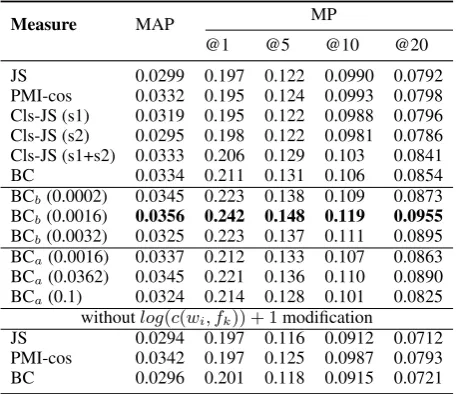
Table 1: Performance on siblings (Set A).
Measure MAP MP
@1 @5 @10 @20
JS 0.0299 0.197 0.122 0.0990 0.0792
PMI-cos 0.0332 0.195 0.124 0.0993 0.0798 Cls-JS (s1) 0.0319 0.195 0.122 0.0988 0.0796 Cls-JS (s2) 0.0295 0.198 0.122 0.0981 0.0786 Cls-JS (s1+s2) 0.0333 0.206 0.129 0.103 0.0841
BC 0.0334 0.211 0.131 0.106 0.0854
BCb(0.0002) 0.0345 0.223 0.138 0.109 0.0873
BCb(0.0016) 0.0356 0.242 0.148 0.119 0.0955
BCb(0.0032) 0.0325 0.223 0.137 0.111 0.0895
BCa(0.0016) 0.0337 0.212 0.133 0.107 0.0863
BCa(0.0362) 0.0345 0.221 0.136 0.110 0.0890
BCa(0.1) 0.0324 0.214 0.128 0.101 0.0825
withoutlog(c(wi, fk)) + 1modification
JS 0.0294 0.197 0.116 0.0912 0.0712
PMI-cos 0.0342 0.197 0.125 0.0987 0.0793
BC 0.0296 0.201 0.118 0.0915 0.0721
As for BCb, we assumed that all of the hyper-parameters had the same value, i.e., αk = α. It is apparent that an excessively largeα is not ap-propriate because it means ignoring observations. Therefore,αmust be tuned. The discounting value of BCais also tuned.
5.5 Results
Table 1 shows the results for Set A. The MAP and the MPs at the top 1, 5, 10, and 20 are shown for each similarity measure. As for BCband BCa, the results for the tuned and several other values forα
are shown. Figure 1 shows the parameter tuning for BCb with MAP as the y-axis (results for BCa are shown as well). Figure 2 shows the same re-sults with MPs as the y-axis. The MAP and MPs showed a correlation here. From these results, we can see that BCb surely improves upon BC, with 6.6% improvement in MAP and 14.7% improve-ment in MP@1 whenα = 0.0016. BCb achieved the best performance among the compared mea-sures with this setting. The absolute discounting, BCa, improved upon BC as well, but the improve-ment was smaller than with BCb. Table 1 also shows the results for the case where we did not use the log-modified counts. We can see that this modification gives improvements (though slight or unclear for PMI-cos).
0.02 0.022 0.024 0.026 0.028 0.03 0.032 0.034 0.036
1e-06 1e-05 0.0001 0.001 0.01 0.1 1
MAP
[image:7.595.92.265.65.190.2]α (log-scale) Bayes Absolute Discounting
Figure 1: Tuning of α (MAP). The dashed hori-zontal line indicates the score of BC.
0.04 0.06 0.08 0.1 0.12 0.14 0.16 0.18 0.2 0.22 0.24 0.26
1e-06 1e-05 0.0001 0.001 0.01
MP
α (log-scale) MP@1
[image:7.595.308.535.78.215.2]MP@5 MP@10 MP@20 MP@30 MP@40
Figure 2: Tuning ofα(MP).
practice because it seems that we can tune it ro-bustly using a small subset of the vocabulary as shown by this experiment.
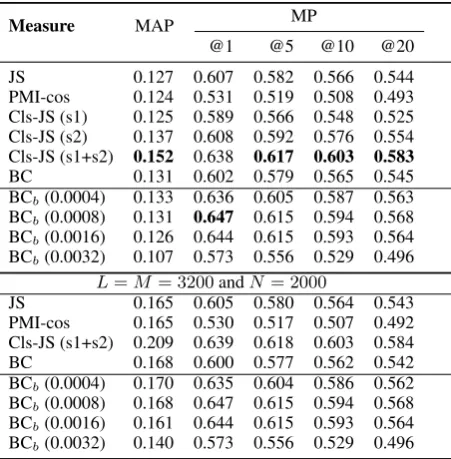
Next, we evaluated the measures on Set C, i.e., the closed set data. The results are shown in Ta-ble 3. For this set, we observed a tendency that is different from Sets A and B. Cls-JS showed a particularly good performance. BCb surely im-proves upon BC. For example, the improvement was 7.5% for MP@1. However, the improvement in MAP was slight, and MAP did not correlate well with MPs, unlike in the case of Sets A and B.
We thought one possible reason is that the num-ber of outputs, 500, for each word was not large enough to assess MAP values correctly because the average number of answers is 1,700 for this dataset. In fact, we could output more than 500 words if we ignored the cost of storage. Therefore, we also included the results for the case where
L = M = 3600 and N = 2,000. Even with this setting, however, MAP did not correlate well with MPs.
[image:7.595.89.275.223.358.2]Although Cls-JS showed very good perfor-mance for Set C, note that the EM clustering is very time-consuming (Kazama and Torisawa, 2008), and it took about one week with 24 CPU cores to get one clustering result in our computing environment. On the other hand, the preparation
Table 2: Performance on siblings (Set B).
Measure MAP MP
@1 @5 @10 @20
JS 0.0265 0.208 0.116 0.0855 0.0627
PMI-cos 0.0283 0.203 0.116 0.0871 0.0660 Cls-JS (s1+s2) 0.0274 0.194 0.115 0.0859 0.0643
BC 0.0295 0.223 0.124 0.0922 0.0693
BCb(0.0002) 0.0301 0.225 0.128 0.0958 0.0718
BCb(0.0016) 0.0313 0.246 0.135 0.103 0.0758
BCb(0.0032) 0.0279 0.228 0.127 0.0938 0.0698
BCa(0.0016) 0.0297 0.223 0.125 0.0934 0.0700
BCa(0.0362) 0.0298 0.223 0.125 0.0934 0.0705
BCa(0.01) 0.0300 0.224 0.126 0.0949 0.0710
Table 3: Performance on closed-sets (Set C).
Measure MAP MP
@1 @5 @10 @20
JS 0.127 0.607 0.582 0.566 0.544
PMI-cos 0.124 0.531 0.519 0.508 0.493 Cls-JS (s1) 0.125 0.589 0.566 0.548 0.525 Cls-JS (s2) 0.137 0.608 0.592 0.576 0.554 Cls-JS (s1+s2) 0.152 0.638 0.617 0.603 0.583
BC 0.131 0.602 0.579 0.565 0.545
BCb(0.0004) 0.133 0.636 0.605 0.587 0.563
BCb(0.0008) 0.131 0.647 0.615 0.594 0.568
BCb(0.0016) 0.126 0.644 0.615 0.593 0.564
BCb(0.0032) 0.107 0.573 0.556 0.529 0.496
L=M = 3200andN= 2000
JS 0.165 0.605 0.580 0.564 0.543
PMI-cos 0.165 0.530 0.517 0.507 0.492 Cls-JS (s1+s2) 0.209 0.639 0.618 0.603 0.584
BC 0.168 0.600 0.577 0.562 0.542
BCb(0.0004) 0.170 0.635 0.604 0.586 0.562
BCb(0.0008) 0.168 0.647 0.615 0.594 0.568
BCb(0.0016) 0.161 0.644 0.615 0.593 0.564
BCb(0.0032) 0.140 0.573 0.556 0.529 0.496
for our method requires just an hour with a single core.
6 Discussion
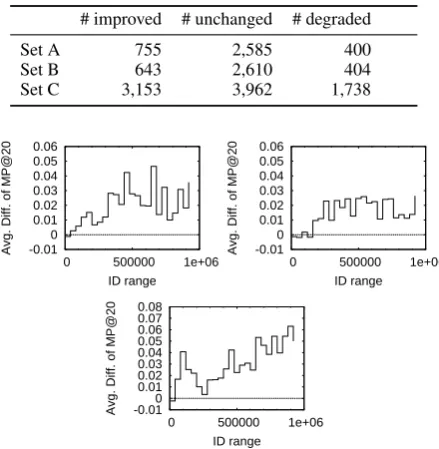
We should note that the improvement by using our method is just “on average,” as in many other NLP tasks, and observing clear qualitative change is rel-atively difficult, for example, by just showing ex-amples of similar word lists here. Comparing the results of BCb and BC, Table 4 lists the numbers of improved, unchanged, and degraded words in terms of MP@20 for each evaluation set. As can be seen, there are a number of degraded words, al-though they are fewer than the improved words. Next, Figure 3 shows the averaged differences of MP@20 in each 40,000 word-ID range.7 We can observe that the advantage of BCb is lessened
es-7Word IDs are assigned in ascending order when we chose
[image:7.595.308.534.240.470.2]Table 4: The numbers of improved, unchanged, and degraded words in terms of MP@20 for each evaluation set.
# improved # unchanged # degraded
Set A 755 2,585 400
Set B 643 2,610 404
Set C 3,153 3,962 1,738
-0.01 0 0.01 0.02 0.03 0.04 0.05 0.06
0 500000 1e+06
Avg. Diff. of MP@20
ID range
-0.01 0 0.01 0.02 0.03 0.04 0.05 0.06
0 500000 1e+06
Avg. Diff. of MP@20
ID range
-0.01 0 0.01 0.02 0.03 0.04 0.05 0.06 0.07 0.08
0 500000 1e+06
Avg. Diff. of MP@20
ID range
Figure 3: Averaged Differences of MP@20 be-tween BCb (0.0016) and BC within each 40,000 ID range (Left: Set A. Right: Set B. Bottom: Set C).
pecially for low-ID words (as expected) with on-average degradation.8The improvement is “on av-erage” in this sense as well.
One might suspect that the answer words tended to be low-ID words, and the proposed method is simply biased towards low-ID words because of its nature. Then, the observed improvement is a trivial consequence. Table 5 lists some interest-ing statistics about the IDs. We can see that BCb surely outputs more low-ID words than BC, and BC more than Cls-JS and JS.9 However, the av-erage ID of the outputs of BC is already lower than the average ID of the answer words. There-fore, even if BCb preferred lower-ID words than BC, it should not have the effect of improving the accuracy. That is, the improvement by BCb is not superficial. From BC/BCb, we can also see that the IDs of the correct outputs did not become smaller compared to the IDs of the system outputs. Clearly, we need more analysis on what caused the improvement by the proposed method and how that affects the efficacy in real applications of sim-ilarity measures.
The proposed Bayesian similarity measure out-performed the baseline Bhattacharyya coefficient
8
This suggests the use of differentαs depending on ID ranges (e.g., smallerαfor low-ID words) in practice.
[image:8.595.309.525.103.209.2]9The outputs of Cls-JS are well-balanced in the ID space.
Table 5: Statistics on IDs. (A): Avg. ID of an-swers. (B): Avg. ID of system outputs. (C): Avg. ID of correct system outputs.
Set A Set C
(A) 238,483 255,248
(B) (C) (B) (C)
Cls-JS (s1+s2) 282,098 176,706 273,768 232,796
JS 183,054 11,3442 211,671 201,214
BC 162,758 98,433 193,508 189,345
BCb(0.0016) 55,915 54,786 90,472 127,877
BC/BCb 2.91 1.80 2.14 1.48
and other well-known similarity measures. As a smoothing method, it also outperformed a naive absolute discounting. Of course, we can-not say that the proposed method is better than any other sophisticated smoothing method at this point. However, as noted above, there has been no serious attempt to assess the effect of smoothing in the context of word similarity cal-culation. Recent studies have pointed out that the Bayesian framework derives state-of-the-art smoothing methods such as Kneser-Ney smooth-ing as a special case (Teh, 2006; Mochihashi et al., 2009). Consequently, it is reasonable to re-sort to the Bayesian framework. Conceptually, our method is equivalent to modifying p(fk|wi)
asp(fk|wi) = {Γ(α
0+a0)Γ(αk+c(wi,fk)+12)
Γ(α0+a0+12)Γ(αk+c(wi,fk))
}2 and
taking the Bhattacharyya coefficient. However, the implication of this form has not yet been in-vestigated, and so we leave it for future research.
Our method is the simplest one as a Bayesian method. We did not employ any numerical opti-mization or sampling iterations, as in a more com-plete use of the Bayesian framework (Teh, 2006; Mochihashi et al., 2009). Instead, we used the ob-tained analytical form directly with the assump-tion thatαk = α andαcan be tuned directly by using a simple grid search with a small subset of the vocabulary as the development set. If substan-tial additional costs are allowed, we can fine-tune eachαk using more complete Bayesian methods. We also leave this for future research.
top 500 similar nouns for all of the one million nouns (using 16 CPU cores), while JS took about 57 hours. We think this is an acceptable additional cost.
The limitation of our method is that it can-not be used efficiently with similarity measures other than the Bhattacharyya coefficient, although that choice seems good as shown in the experi-ments. For example, it seems difficult to use the Jensen-Shannon divergence as the base similar-ity because the analytical form cannot be derived. One way we are considering to give more flexi-bility to our method is to adjustαk depending on external knowledge such as the importance of a context (e.g., PMIs). In another direction, we will be able to use a “weighted” Bhattacharyya coeffi-cient: ∑kµ(w1, fk)µ(w2, fk)√p1k×p2k, where the weights, µ(wi, fk), do not depend on pik, as the base similarity measure. The analytical form for it will be a weighted version ofBCb.
BCb can also be generalized to the case where the base similarity isBCd(p1, p2) =
∑K
k=1pd1k×
pd2k, where d > 0. The Bayesian analytical form becomes as follows.
BCbd(w1, w2) =
Γ(α0+a0)Γ(β0+b0)
Γ(α0+a0+d)Γ(β0+b0+d) ×
K X
k=1
Γ(αk+c(w1, fk) +d)Γ(βk+c(w2, fk) +d)
Γ(αk+c(w1, fk))Γ(βk+c(w2, fk))
.
See Appendix A for the derivation. However, we restricted ourselves to the case of d = 12 in this study.
Finally, note that our BCb is different from the Bhattacharyya distance measure on Dirichlet distributions of the following form described in Rauber et al. (2008) in its motivation and analyti-cal form:
p
Γ(α′0)Γ(β0′)
kΓ(α
′
k) qQ
kΓ(β
′
k)
×
Q
kΓ((α
′
k+β
′
k)/2)
Γ(1 2
PK
k(α
′
k+β
′
k))
. (9)
Empirical and theoretical comparisons with this measure also form one of the future directions.10
7 Conclusion
We proposed a Bayesian method for robust distri-butional word similarities. Our method uses a dis-tribution of context profiles obtained by Bayesian
10Our preliminary experiments show that calculating
sim-ilarity using Eq. 9 for the Dirichlet distributions obtained by Eq. 6 does not produce meaningful similarity (i.e., the accu-racy is very low).
estimation and takes the expectation of a base sim-ilarity measure under that distribution. We showed that, in the case where the context profiles are multinomial distributions, the priors are Dirichlet, and the base measure is the Bhattacharyya coeffi-cient, we can derive an analytical form, permitting efficient calculation. Experimental results show that the proposed measure gives better word simi-larities than a non-Bayesian Bhattacharyya coeffi-cient, other well-known similarity measures such as Jensen-Shannon divergence and the cosine with PMI weights, and the Bhattacharyya coefficient with absolute discounting.
Appendix A
Here, we give the analytical form for the general-ized case (BCbd) in Section 6. Recall the following relation, which is used to derive the normalization factor of the Dirichlet distribution:
Z △ Y k φα ′
k−1
k dφ=
Q
kΓ(α
′
k)
Γ(α′0) =Z(α
′
)−1. (10)
Then,BCbd(w1, w2)
=
ZZ
△×△
Dir(φ1|α′)Dir(φ2|β′)X
k
φd1kφ d
2kdφ1dφ2
=Z(α′)Z(β′)×
ZZ △×△ Y l φα ′
l−1
1l Y
m
φβ
′
m−1
2m X
k
φd1kφ d
2kdφ1dφ2
| {z }
A
.
Using Eq. 10,Ain the above can be calculated as follows: = Z △ Y m φβ ′
m−1
2m 2
4X
k
φd2k Z
△
φα
′
k+d−1
1k
Y
l̸=k
φα
′
l−1
1l dφ1
3
5dφ2
= Z △ Y m φβ ′
m−1
2m "
X
k
φd2k
Γ(α′k+d) Q
l̸=kΓ(α
′
l)
Γ(α′0+d)
#
dφ2
=X
k
Γ(α′k+d) Q
l̸=kΓ(α
′
l)
Γ(α′0+d)
Z
△
φβ
′
k+d−1
2k
Y
m̸=k
φβ
′
m−1
2m dφ2
=X
k
Γ(α′k+d) Q
l̸=kΓ(α
′
l)
Γ(α′0+d)
Γ(βk′ +d) Q
m̸=kΓ(β
′
m)
Γ(β0′ +d)
=
Q
Γ(α′l) Q
Γ(β′m)
Γ(α′0+d)Γ(β0′+d)
X
k
Γ(α′k+d)
Γ(α′k)
Γ(βk′ +d)
Γ(βk′) .
This will give:
BCbd(w1, w2) =
Γ(α′0)Γ(β ′ 0)
Γ(α′0+d)Γ(β0′ +d)
K X
k=1
Γ(α′k+d)Γ(β
′
k+d)
References
A. Bhattacharyya. 1943. On a measure of divergence between two statistical populations defined by their probability distributions. Bull. Calcutta Math. Soc., 49:214–224.
Stanley F. Chen and Joshua Goodman. 1998. An em-pirical study of smoothing techniques for language modeling. TR-10-98, Computer Science Group, Harvard University.
Stanley F. Chen and Ronald Rosenfeld. 2000. A survey of smoothing techniques for ME models.
IEEE Transactions on Speech and Audio Process-ing, 8(1):37–50.
Corinna Cortes and Vladimir Vapnik. 1995. Support vector networks. Machine Learning, 20:273–297.
CRL. 2002. EDR electronic dictionary version 2.0 technical guide. Communications Research Labo-ratory (CRL).
Ido Dagan, Fernando Pereira, and Lillian Lee. 1994. Similarity-based estimation of word cooccurrence probabilities. InProceedings of ACL 94.
Ido Dagan, Shaul Marcus, and Shaul Markovitch. 1995. Contextual word similarity and estimation from sparse data. Computer, Speech and Language, 9:123–152.
Ido Dagan, Lillian Lee, and Fernando Pereira. 1997. Similarity-based methods for word sense disam-biguation. InProceedings of ACL 97.
Ido Dagan, Lillian Lee, and Fernando Pereira. 1999. Similarity-based models of word cooccurrence probabilities. Machine Learning, 34(1-3):43–69.
Gregory Grefenstette. 1994. Explorations In Auto-matic Thesaurus Discovery. Kluwer Academic Pub-lishers.
Zellig Harris. 1954. Distributional structure. Word, pages 146–142.
Donald Hindle. 1990. Noun classification from predicate-argument structures. In Proceedings of ACL-90, pages 268–275.
Jun’ichi Kazama and Kentaro Torisawa. 2008. In-ducing gazetteers for named entity recognition by large-scale clustering of dependency relations. In
Proceedings of ACL-08: HLT.
Jun’ichi Kazama, Stijn De Saeger, Kentaro Torisawa, and Masaki Murata. 2009. Generating a large-scale analogy list using a probabilistic clustering based on noun-verb dependency profiles. InProceedings of 15th Annual Meeting of The Association for Natural Language Processing (in Japanese).
Dekang Lin. 1998. Automatic retrieval and clustering of similar words. InProceedings of COLING/ACL-98, pages 768–774.
Daichi Mochihashi, Takeshi Yamada, and Naonori Ueda. 2009. Bayesian unsupervised word segmen-tation with nested Pitman-Yor language modeling. In Proceedings of ACL-IJCNLP 2009, pages 100– 108.
Masaki Murata, Qing Ma, Tamotsu Shirado, and Hi-toshi Isahara. 2004. Database for evaluating ex-tracted terms and tool for visualizing the terms. In
Proceedings of LREC 2004 Workshop: Computa-tional and Computer-Assisted Terminology, pages 6–9.
Patrick Pantel and Dekang Lin. 2002. Discovering word senses from text. InProceedings of the eighth ACM SIGKDD international conference on Knowl-edge discovery and data mining, pages 613–619.
Patrick Pantel, Eric Crestan, Arkady Borkovsky, Ana-Maria Popescu, and Vishnu Vyas. 2009. Web-scale distributional similarity and entity set expansion. In
Proceedings of EMNLP 2009, pages 938–947.
T. W. Rauber, T. Braun, and K. Berns. 2008. Proba-bilistic distance measures of the Dirichlet and Beta distributions. Pattern Recognition, 41:637–645.
Keiji Shinzato, Tomohide Shibata, Daisuke Kawahara, Chikara Hashimoto, and Sadao Kurohashi. 2008. Tsubaki: An open search engine infrastructure for developing new information access. InProceedings of IJCNLP 2008.
Yee Whye Teh. 2006. A hierarchical Bayesian lan-guage model based on Pitman-Yor processes. In
Proceedings of COLING-ACL 2006, pages 985–992.