Munich Personal RePEc Archive
Looking for efficient qml estimation of
conditional value-at-risk at multiple risk
levels
Francq, Christian and Zakoian, Jean-Michel
CREST, Université Lille 3
October 2015
Online at
https://mpra.ub.uni-muenchen.de/67195/
Looking for efficient QML estimation of conditional VaRs at
multiple risk levels
Christian Francq∗and Jean-Michel Zakoïan†
Abstract
We consider joint estimation of conditional Value-at-Risk (VaR) at several levels, in the framework of general GARCH-type models. The conditional VaR at level α is expressed as the product of the volatility and the opposite of the α-quantile of the innovation. A standard method is to estimate the volatility parameter by Gaussian Quasi-Maximum Likelihood (QML) in a first step, and to use the residuals for estimating the innovations quantiles in a second step. We argue that the Gaussian QML may be inefficient with respect to more general QML and can even be in failure for heavy tailed conditional distributions. We therefore study, for a vector of risk levels, a two-step procedure based on a generalized QML. For a portfolio of VaR’s at different levels, confidence intervals accounting for both market and estimation risks are deduced. An empirical study based on stock indices illustrates the theoretical results.
JEL Classification: C13, C22 and C58.
Keywords: Asymmetric Power GARCH, Distortion Risk Measures, Estimation risk, Non-Gaussian Quasi-Maximum Likelihood, Value-at-Risk.
1
Introduction
In July 2009, the Basel Committee issued a directive requiring that financial institutions quantify
"model risk". The Committee states that "Banks must explicitly assess the need for valuation
ad-justments to reflect two forms of model risk: the model risk associated with using a possibly incorrect
valuation methodology; and the risk associated with using unobservable (and possibly incorrect)
cal-ibration parameters in the valuation model." For instance, an important issue in determining the reserves of a financial institution is whether risk estimates remain reliable in very turbulent periods.
To this aim, the recent econometric literature on risk has focused on the concept of estimation risk. Whatever the risk measure, it depends on unknown characteristics of the loss distribution
∗CREST and University Lille 3, BP 60149, 59653 Villeneuve d’Ascq cedex, France. E-Mail:
†Corresponding author: Jean-Michel Zakoïan, University Lille 3 and CREST, 15 boulevard Gabriel Péri, 92245
which, for practical use, have to be estimated. For instance, the Value-at-Risk (VaR) at a given
level α, can be defined as the opposite of the α-quantile of the loss distribution. In advanced approaches of risk measurement, the statistical framework is complicated by the dynamic nature of the loss variables. The corresponding risk measures have to be considered conditional on the past
losses, and are therefore called conditional risk measures.
In recent research, different approaches were proposed to account for the presence of estimation
risk in conditional risk measurement. Chan, Deng, Peng, Xia (2007) constructed confidence intervals
for conditional VaRs under the assumption that the errors have heavy tails, using the Extreme-Value Theory, while Spierdijk (2013) proposed a residual subsample bootstrap approach. A bootstrap
testing procedure, for the equality of conditional VaRs in a multivariate setting, was recently studied by Hurlin, Laurent, Quaedvlieg and Smeekes (2013). Francq and Zakoïan (2015) showed that the problem of estimating a conditional risk measure, for instance a VaR at a given level, in
GARCH-type models reduced to the estimation of a parameter, called risk parameter. They derive an asymptotic theory for a Gaussian Quasi-Maximum Likelihood (QML) of this parameter. For the
same problem, a more general approach based on non-Gaussian QMLs was studied by El Ghourabi, Francq and Telmoudi (2015). Gouriéroux and Zakoïan (2013) investigated the bias induced by
estimation in the coverage probabilities associated with VaR. Escanciano and Olmo (2010) studied the effect of estimation on backtesting VaR.
In the inference of GARCH-type models, recent articles underlined the possible efficiency loss of the QML estimator (QMLE) due the use of an inappropriate Gaussian error distribution (see Berkes
and Horváth (2004), Francq, Lepage and Zakoïan (2011), Francq and Zakoïan (2013), Fan, Qi and Xiu (2014)). In the present paper, we study the estimation of a vector of conditional VaRs based on
generalized QMLEs of the volatility. We extend the article by Francq and Zakoïan (2014) devoted to the Gaussian QML by considering QML criteria based on "instrumental densities" which, in general,
will not coincide with the errors distribution. We consider a general GARCH-type framework which does not impose a specific form for the volatility. Our approach is aimed at, not only providing VaR
estimates, but also confidence intervals based on asymptotic results. The introduction of several risk levels provides a better account of the tail properties of the conditional loss distribution. The VaRs
is the main aim of the paper. We also show how efficiency gains can be reached by selecting an
appropriate instrumental density.
This paper is structured as follows. In Section 2, we derive the asymptotic joint distribution of the generalized QMLE of the volatility parameter, and a vector of empirical quantiles of the
residuals. In Section 3, we deduce asymptotic confidence intervals for the VaR portfolios. The choice of an optimal criterion is also discussed. An empirical illustration based on major stock
indices is proposed in Section 4. Section 5 concludes.
2
Non-Gaussian QMLE of vectors of VaRs
2.1 Conditional VaR in a general model
GARCH-type models are arguably the most widely used discrete-time volatility models. Most of them can be written under the form
ǫt=σtηt
σt=σ(ǫt−1, ǫt−2, . . .;θ0)
(2.1)
where (ηt) is a sequence of iid random variables, ηt is independent of {ǫu, u < t}, θ0 ∈ Rd is a
parameter belonging to a parameter space Θ, and σ : R∞×Θ→(0,∞). A standard assumption
is thatEηt2 = 1but, unless otherwise stated, we do not make this assumption in the present article. An example of widely used specification is the Asymmetric Power GARCH (APARCH) model
introduced by Ding, Granger and Engle (1993). Letting x+= max(x,0) andx−= max(−x,0), the APARCH(p, q) model is defined by
ǫt=σtηt
σtδ=ω0+Pqi=1
α0i+(ǫ+t−i)δ+α0i−(ǫ−t−i)δ +
Pp
j=1β0jσδt−j
(2.2)
where the coefficients satisfyα0i+ ≥0,α0i−≥0,β0j ≥0,ω0>0andδ >0. The standard GARCH
model is obtained forδ= 2andα0i− =α0i+. Whenα0i−> α0i+, negative returns have more impact
on future volatilities than positive returns of the same magnitude, which is the well-documented
"leverage effect".
The conditionalVaR of a process (ǫt) at risk levelα∈(0,1), denoted by VaRt(α), is defined by
where Pt−1 denotes the historical distribution conditional on{ǫu, u < t}. When (ǫt) satisfies (2.1),
the conditional VaR is then given by
VaRt(α) =−σ(ǫt−1, ǫt−2, . . .;θ0)ξα (2.3)
where ξα is theα-quantile of ηt.
Remark 2.1 It can be noted that in the PARCH(p, q) model, the conditional VaR at level α
satisfies the stochastic recurrence equation
VaRδt(α) = ω0(−ξα)δ+ q
X
i=1
n
α0i+(ǫ+t−i)δ+α0i−(ǫ−t−i)δ
o
(−ξα)δ
+
p
X
j=1
β0jVaRδt−j(α). (2.4)
Direct modelling of the conditional VaR has been proposed in several papers, for instance Engle and Manganelli (2004), Koenker and Xiao (2006), Gouriéroux and Jasiak (2008). A difficulty with
conditional VaR dynamic models is to constrain the model so as to guarantee the monotonicity of the conditional VaR as a function of the risk level. Monotonicity is automatically satisfied in (2.4).
It will be convenient to assume that the parametric form of the volatility is stable by scaling.
A0: There exists a continuous function H such that for any θ ∈ Θ, for any K > 0, and any
sequence(xi)i
Kσ(x1, x2, . . .;θ) =σ(x1, x2, . . .;H(θ, K)).
This assumption is clearly satisfied for all commonly used GARCH models (see Section 2.3 for the
APARCH model).
When ξα<0,A0 and (2.3) entail
VaRt(α) =σ(ǫt−1, ǫt−2, . . .;θ(0α)), θ (α)
0 =H(θ0,−ξα). (2.5)
This parameterθ(0α), introduced by Francq and Zakoïan (2015) for more general risk measures, can
2.2 Asymptotic properties of a vector of conditional VaR estimators
A two-step standard method for evaluating the VaR at different levels αi ∈(0,1), for i= 1, . . . , m
consists in estimating the volatility parameterθ0 by Gaussian QMLE, and then estimating the ξαi
by the corresponding empirical quantiles of the residuals; see, for instance, Chapter 2 in McNeil,
Frey and Embrechts (2005). For a comparison of alternative strategies based on residuals following a preliminary volatility estimation, see Kuester, Mittnik and Paolella (2006). El Ghourabi, Francq
and Telmoudi (2015) showed that, in this two-step procedure, the Gaussian QML can be replaced by any non-Gaussian QML. We now extend this approach to a vector of VaRs at different risk levels.
Given observations ǫ1, . . . , ǫn, and arbitrary initial valueseǫi for i≤0, we define
e
σt(θ) =σ(ǫt−1, . . . , ǫ1,eǫ0,eǫ−1, . . .;θ),
which is used to approximate σt(θ) =σ(ǫt−1, . . . , ǫ1, ǫ0, ǫ−1, . . .;θ).
Given an instrumental density h >0, consider the QML criterion
e
Qn(θ) =
1
n
n
X
t=1
g(ǫt,σet(θ)), g(x, σ) = log
1
σh
x
σ
, (2.6)
and the (generalized) QMLE
ˆ
θn,h= arg max
θ∈ΘQen(θ). (2.7)
This estimator is the standard Gaussian QMLE if h is the standard Gaussian density φ. We emphasize that the parametric form ofσt(·)is assumed to be correctly specified, but we do not make
precise assumptions on the distribution of ηt. In particular, we do not assume that Var(ηt) = 1. 1
Consequently, bθn,hwill be a consistent estimator of some pseudo-value (to be defined below) θ0,h. The following assumptions will be used to derive the asymptotic properties of the QMLE bθn,h.
A1: (ǫt) is a strictly stationary and ergodic solution of Model (2.1). Moreover, E|ǫ0|s < ∞ for
some s >0.
A2: Almost surely, σt(θ) ∈ (ω,∞] for any θ ∈ Θ and for some ω > 0. For θ1,θ2 ∈Θ, we have
σt(θ1) =σt(θ2)a.s.if and only if θ1 =θ2.
Note that
g(ǫt, σt(θ)) =g
ηt,
σt(θ)
σt(θ0)
−logσt(θ0). (2.8)
1
A3: The function σ → Eg(η0, σ) takes its values in [−∞,+∞) and has a unique maximum at
some pointσh∈(0,∞).
A4: The instrumental densityhis twice continuously differentiable onR, except possibly in 0, and there exist constants r≥0and C0>0such that, for all u∈R\ {0},
maxuh
′(u)
h(u)
, u2
h′(u)
h(u)
′
≤C0(1 +|u|r), with E|η0|2r <∞.
A5: The functionθ7→σ(x1, x2, . . .;θ) has continuous second-order derivatives, and
sup
θ∈Θ
|σt(θ)−σet(θ)|+
∂σt(θ)
∂θ −
∂eσt(θ)
∂θ +
∂2σt(θ)
∂θ∂θ′ −
∂2eσt(θ)
∂θ∂θ′
≤C1ρt,
where C1 is a random variable which is measurable with respect to {ǫu, u <0} andρ∈(0,1)
is a constant.
A6: θ0,h=H(θ0, σh) belongs to the interior ofΘ.
A7: There exist no non-zero x∈Rdsuch that x′∂σt(θ0,h)
∂θ = 0, a.s.
A8: There exists a neighborhood V(θ0,h) of θ0,h such that the following variables have finite expectation:
sup
θ∈V(θ0,h)
1
σt(θ)
∂σt(θ)
∂θ 4 , sup
θ∈V(θ0,h)
1
σt(θ)
∂2σ
t(θ)
∂θ∂θ′
2 , sup
θ∈V(θ0,h)
σt(θ0,h)
σt(θ)
2r .
Remark 2.2 AssumptionA3reduces toE|η0|r <∞, and AssumptionA4reduces toE|η0|2r<∞
for instrumental densities of the formh(u) =K1|u|λexp{K2|u|r}, for some constantsλ, K1, K2.
Remark 2.3 The numberσhinvolved in AssumptionA3depends on both the density ofηtand the
instrumental densityh. It can be made explicit for classes of densityh(see El Ghourabi, Francq and Telmoudi (2015)). For instance, whenh belongs to the class of the Generalized Error Distributions with shape parameter κ >0, defined by
hκ(x) =
κ
Γ(1/κ)21+1/κe
−|x2|κ,
we have
σhκ =
κ
2E|η1|
Now letηt,h= σ1hηt and letξα,h= σ1hξα theα-quantile ofηt,h. Noting that
ǫt=σ(ǫt−1, ǫt−2, . . .;θ0)ηt=σ(ǫt−1, ǫt−2, . . .;θ0,h)ηt,h,
we have, by (2.5) andA3,
VaRt(α) =σ(ǫt−1, ǫt−2, . . .;θ(0α)), θ (α)
0 =H(θ0,−ξα) =H(θ0,h,−ξα,h). (2.9)
In view of the last equality, a strategy for consistently estimating θ(0α) is thus to estimate θ0,h by generalized QML in the first step, and to estimate the quantile ξα,h in the second step. Let the
residuals of the QML estimation
ˆ
ηt,h =
ǫt
e
σt(bθn,h)
, t= 1, . . . , n,
and let ξn,αi,h denote the empirical αi-quantile of ηˆ1,h, . . . ,ηˆn,h. Let α = (α1, . . . , αm)
′, ξ
n,α,h =
(ξn,α1,h, . . . , ξn,αm,h)
′ and letξ
α,h= (ξα1,h, . . . , ξαm,h)
′ denote the vector of population quantiles.
The next result gives the joint asymptotic distributions of (bθ′n,h,ξn,′ α). Let Dt(θ) =
σt−1(θ)∂σ∂t(θθ), g1(x, σ) = ∂g(∂σx,σ) and g2(x, σ) = ∂g1∂σ(x,σ).
Theorem 2.1 Assume ξαi,h < 0, for i = 1, . . . , m. Suppose η0,h admits a density fh which is
continuous and strictly positive in a neighborhood ofξαi,h, fori= 1, . . . , m. Assume Eg2(η0,h,1)6=
0. Let A0-A8 hold, with r >1 in A4 and A8. Then
√
nbθn,h−θ0,h
√
n(ξn,α,h−ξα,h)
→ NL (0,Σα,h), Σα,h=
τhJ
−1
h λ′α,h⊗J−h1Ωh
λα,h⊗Ω′hJ−h1 ζα,h
,
where
τh=
4Eg21(η0,h,1)
{Eg2(η0,h,1)}2
, Ωh =EDt(θ0,h), Jh= 4EDt(θ0,h)D′
t(θ0,h),
λα,h= (λα1,h, . . . , λαm,h)
′,ζ
α,h= (ζij,h)1≤i,j≤m and
λαi,h = −ξαi,hτh+
4pαi,h
fh(ξαi,h)Eg2(η0,h,1)
,
ζij,h = ξαi,hξαj,h
τh
4 −
1
Eg2(η0,h,1)
ξ
αi,hpαj,h
fh(ξαj,h)
+ξαj,hpαi,h
fh(ξαi,h)
+ αi∧αj−αiαj
fh(ξαi,h)fh(ξαj,h)
,
withpα,h=Cov
n 1{η
0,h<ξα,h}, g1(η0,h,1)
o
Proof. In view of El Ghourabi, Francq and Telmoudi (Proof of Theorem 1, 2015), we have, for
i= 1, . . . , m,
√
n(ξαi,h−ξn,αi,h) = ξαi,hΩ
′ h
√
n(θbn,h−θ0,h)
+ 1
fh(ξαi,h)
1 √ n n X t=1
(1{η
t,h<ξαi,h}−αi) +oP(1),
and
√
n(bθn,h−θ0,h) = −
4
Eg2(η0,h,1)
J−h1√1
n
n
X
t=1
g1(ηt,h,1)Dt(θ0,h) +oP(1).
Hence
Covas √n(bθn,h−θ0,h),
1 √ n n X t=1
(1{η
t,h<ξαi,h}−αi)
!
= −4pαi,h
Eg2(η0,h,1)
J−h1Ωh.
It follows that, for i≤j,
Covas{√n(ξαi,h−ξn,αi,h),
√
n(ξαj,h−ξn,αj,h)}
=
ξαi,hξαj,hτh−
4
Eg2(η0,h,1)
ξ
αi,hpαj,h
fh(ξαj,h)
+ξαj,hpαi,h
fh(ξαi,h)
Ω′
hJ−h1Ωh
+ αi(1−αj)
fh(ξαi,h)fh(ξαj,h)
,
Covas
√
n(bθn,h−θ0,h),√n(ξαi,h−ξn,αi,h)
= λαi,hJ
−1
h Ωh.
We have Ω′
hJ−h1Ωh= 1/4 (see Remark 3.1 in Francq and Zakoïan, 2013) and thus we obtain
Covas{√n(ξαi,h−ξn,αi,h),
√
n(ξαj,h−ξn,αj,h)} = ζij.
By the CLT for martingale differences, we get the announced result. ✷
LetVaRt(α) = (VaRt(α1), . . . ,VaRt(αm))′, the vector of conditional VaRs at levelsαi. In view
of
VaRt(α) =−σ(ǫt−1, ǫt−2, . . .;θ0,h)ξα,h, (2.10)
the vector of conditional VaRs can be estimated by
[
Remark 2.4 In classical quantile regression, a serious problem is that the estimated quantile curves can cross, leading to an invalid inference at multiple percentiles (see Koenker (2005)). It is thus worth noting that our estimation procedure does not face this problem. By construction, the estimated conditional VaR are monotonous functions of the α’s.
Remark 2.5 The coefficientτh can be made explicit for different classes of density functionsh. For
instance, for the GED distribution of Remark 2.3, simple computation shows that for the density
hκ,
τh=
4
κ2
E|η1|2κ
(E|η1|κ)2
−1
!
.
In other cases, such as the class of the Student densities, coefficients τh and σh do not have an
explicit expression but can be obtained numerically.
Remark 2.6 It should be noted that the coefficient τh appearing in the asymptotic distribution
only depends on i) the distributional properties of the variable η0 and ii) the choice of the QML
density h. For a given h, the coefficient τh can be estimated using the residualsηˆt,h by
ˆ
τh = 4
n−1Pnt=1g12(ˆηt,h,1)
{n−1Pn
t=1g2(ˆηt,h,1)}2
. (2.12)
The residualsηˆt,h can be used to estimate the density fh, as well as all other quantities involved in
the asymptotic distribution.
2.3 Application to the APARCH model
For the APARCH(p, q) model with δ fixed2, we have θ = (ω, α1+, . . . , αq−, β1, . . . , βp)′ and A0
is satisfied with H(θ, K) = (Kδω, Kδα1+, . . . , Kδαq−, β1, . . . , βp)′. The parameter is assumed to
belong to a compact set Θ ⊂]0,+∞[×[0,+∞[p+2q. Let Aθ+(z) = Pqi=1αi+zi and Aθ−(z) =
Pq
i=1αi−zi Bθ(z) = 1 −
Pp
j=1βjzj with, by convention, Aθ+(z) = Aθ−(z) = 0 if q = 0 and
Bθ(z) = 1 if p= 0. Let γ denote the Lyapunov coefficient of the sequence (At) associated with the
vector representation of the model. Hamadeh and Zakoïan (2011) showed the CAN of the Gaussian
QMLE of θ0 under the assumption:
2
Hamadeh and Zakoïan (2011) showed that estimating the powerδ is feasible though complicated. We therefore
considerδ as fixed. In most applications,δ is either equal to 1 (as in the TARCH of Zakoïan (1994)) or to 2 (as in
D(θ0): γ < 0; the true parameter value θ0 belongs to the interior of Θ; there exists ω > 0 such
that,∀θ∈Θ, ω > ω andPp
j=1βj <1 ; the support of the distribution ofη0 contains at least
3 points;P[ηt>0]∈(0,1); ifp >0,Bθ0(z) has no common root withAθ0+(z) and Aθ0−(z);
Aθ0+(1) +Aθ0−(1)6= 0 and α0q,++α0q,−+β0p 6= 0
and under the identifiability condition Eη12 = 1(which we do not assume in our framework). For any θ ∈Θ, letθ′ = (ω, α1+, . . . , αq−,0, . . . ,0). We have,
θ′∂σ
δ t(θ)
∂θ = ω+
q
X
i=1
n
αi+(ǫ+t−i)δ+αi−(ǫ−t−i)δ
o
+
p
X
j=1
βjθ
′∂σδt−j(θ)
∂θ
= Bθ−1(L) ω+
q
X
i=1
n
αi+(ǫ+t−i)δ+αi−(ǫ−t−i)δ
o!
=σδt(θ),
where L denotes the usual lag operator. Therefore,
θ′ 1
σt
∂σδ t(θ)
∂θ = 1
δ,
and thus
θ′0,hΩh = 1
δ, J
−1
h Ωh =
δ
4θ0,h.
It follows that Theorem 2.1 can be simplified as follows in the case of the APARCH model.
Corollary 2.1 Consider the APARCH(p, q) model (2.2) under Assumption D(θ0,h). Assume
ξαi,h < 0, for i = 1, . . . , m. Suppose η0,h admits a density fh which is continuous and strictly
positive in a neighborhood of ξαi,h, fori= 1, . . . , m. If the instrumental densityh satisfies A3, A4,
and ifEg2(η0,h,1)6= 0, then
√
nbθn,h−θ0,h
√
n(ξn,α,h−ξα,h)
L
→ N(0,Σα,h), Σα,h=
τhJ
−1
h λ′α,h⊗4δθ0,h
λα,h⊗ δ4θ ′
0,h ζα,h
.
2.4 Optimal choice of the density h
El Ghourabi, Francq and Telmoudi (2015) showed that, for the VaR estimation at a single level, an optimal choice of the densityhis obtained by minimizing (within a class of densities) the coefficient
τh. For such an optimal density h∗, the accuracy of the VaR estimation is maximal. Interestingly,
For instance, when the density h is chosen among the GED densities, in view of Remark 2.5 an optimal value for κcan be estimated by taking
ˆ
κ= arg min
κ∈K
1
κ2
µˆ
2κ
ˆ
µ2
κ −
1
, µˆr=
1
n
n
X
t=1
|ηˆt,h|r, (2.13)
for some compact set K ⊂R+.Practical implementation, for any given classH of densitiesh, thus
involves the following steps:
1. For any h0 ∈ H, compute θˆn,h0 by solving (2.7) (forh=h0).
2. Using the residuals ηˆt,h0 of the first step, compute the coefficients
ˆ
τh= 4
n−1Pnt=1g21(ˆηt,h0,1)
{n−1Pn
t=1g2(ˆηt,h0,1)}
2, (2.14)
where g1, g2 are defined before Theorem 2.1. Solveh∗ = arg maxh∈Hτˆh.
3. Computeθˆn,h∗ and deduce the conditional VaR from (2.11) (with h∗ instead of h).
3
Portfolios of VaR’s
Risk measurement based on a single VaR at a given level can be misleading since it gives a limited view of the loss distribution. To circumvent this problem, DRMs have been introduced in the insurance literature, in a series of papers by Wang and coauthors [see Wang (2000) and the references
therein]. General conditional DRMs take the form
DRMt=
Z 1
0
VaRt(u)dG(u), (3.1)
where the distortion function,G, is a given cumulative distribution function (cdf) on[0,1]. It follows from (2.3) that, for Model (2.1),
DRMt=−σ(ǫt−1, ǫt−2, . . .;θ0)
Z 1
0
ξudG(u). (3.2)
3.1 Estimating the discrete DRM parameter
If−R01ξudG(u)>0, the DRM in (3.2) can be written as
where θG0 defined by
θG0 =H
θ0,−
Z 1
0
ξudG(u)
(3.4)
is called DRM-parameter (similarly to the VaR parameter in (2.5)).
In the spirit of DRM, a risque measure which can be interpreted as a portfolio of VaR’s at
different levels is defined by
p′VaRt(α) = m
X
i=1
piVaRt(αi), (3.5)
where p = (p1, . . . , pm) with pi ≥ 0 for i = 1, . . . , m and Pmi=1pi = 1. This risk measure can be
interpreted as adiscrete DRMwith associated distortion function corresponding to Dirac masses at the points αi. By (2.3) we have
p′VaRt(α) = −σ(ǫt−1, ǫt−2, . . .;θ0)
m
X
i=1
piξα
= σ(ǫt−1, ǫt−2, . . .;θDRM0 ), where θDRM0 =H θ0,−p′ξα
(3.6)
can be calleddiscrete DRM-parameter. In view of (2.9), we also have, for any instrumental density
h,
θDRM0 =H θ0,h,−p′ξα,h,
from which we deduce an estimator of the discrete DRM-parameter given by
b
θDRMn,h =Hbθn,h,−p′ξn,α,h
,
whose asymptotic distribution is a straightforward consequence of Theorem 2.1. Denoting by(θ, x) the generic arguments of the function H, let the d×dmatrix A0,h = ∂H∂θ′ θ0,h,−p
′ξ α,h
and the
d×1 vector b0,h= ∂H∂x θ0,h,−p′ξα,h.
Corollary 3.1 Under the assumptions of Theorem 2.1,
√
nbθDRMn,h −θDRM0,h → NL (0,ΣDRMα,h ),
ΣDRMα,h = [A0,h −b0,hp′]Σα,h A
′
0,h
−pb′0,h
.
Proof. We have, by a Taylor expansion of the function H(θ, x)around (θ0,h,−p′ξα,h),
√
and the conclusion follows. ✷
It follows from (3.6) that the discrete DRM can be estimated by
p′VaR[t(α) = σet(θb DRM n,h ).
3.2 Constructing confidence intervals for the portfolio of VaR’s
LetΣbα,h denote a consistent estimator of the asymptotic variance Σα,h. Such an estimator can be
constructed by i) replacing Jh by Jbn,h =n−1Pnt=1Dt(bθn,h)Dt(bθn,h)′; ii) using the residuals bηt,h
to construct an estimator fbh of the density function fh of the innovation ηt,h, and to replace the
theoretical moments of the process (ηt,h)by their empirical counterpart.
Let also Abn,h= ∂H∂θ′
b
θn,h,−p′ξn,α,h,bbn,h= ∂H∂x bθn,h,−p′ξn,α,h and let
b
ΣDRMn,α,h = [Abn,h −bbn,hp′]Σbn,α,h
Ab
′ n,h
−pbb′n,h
.
Corollary 3.1 and the delta method thus suggests a (1 −α0)% confidence interval (CI) for
p′VaRt(α)whose bounds are
p′VaR[t(α)±
Φ−1−α1 0/2
√
n
∂eσt
∂θ′(bθ
DRM n,h )Σb
DRM
α,h
∂σet
∂θ (bθ
DRM n,h )
1/2
, (3.7)
where Φ−α01 denotes the α0-quantile of the standard Gaussian distribution. It should be noted α0 (the risk estimation level) can be chosen independently from the αi’s (the financial risk levels).
Drawing such CIs allows to underline the importance of the estimation risk for VaR evaluation. In particular, a (1−α0)%confidence interval (CI) for theVaRt(αi) is given by
−eσt(bθn,h)ξn,αi±
Φ−1−α1
0/2
√
n
n b
∆t,α,hΣbα,h∆b′
t,α,h
ii
o1/2
,
where
b
∆t,α,h = ξn,α,h
∂σet(θbn,h)
∂θ′ ,eσt(bθn,h)Im
!
, (3.8)
where Im denotes the m×m identity matrix
3.3 On the moment assumptions
important to note that the moments assumptions on the iid process required for the validity of the
asymptotic results depend on the choice ofh. Such moments assumptions appear in Assumptions A3 andA4 through the conditions
Eg(η0, σ)<∞ and E|η0|2r<∞,
where ther >0is determined, in the first part of A4, by the choice ofh.
To be more specific, consider instrumental densities of the formh(u) =K1|u|λexp{K2|u|r}, for
some constants λ, K1, K2. By Remark 2.2, the moment assumptions reduce to E|η0|2r <∞.
For instance, consider the usual Gaussian QMLE (r= 2andλ= 0). IfE|η0|4 <∞, the two-step
VaR and discrete DRM parameter estimators are consistent and asymptotically normal. In view of Corollary 3.1, valid confidence intervals for the portfolio of VaR’s can be constructed. Now suppose
thatE|η0|2 = 1butE|η0|4 =∞. Then, under appropriate assumptions, the Gaussian QMLE of the
volatility parameter is well known to be consistent, and it could probably be established that the
discrete DRM parameter is also consistent. Hall and Yao (2003) derived a non standard asymptotic distribution for the estimator of the volatility parameter. However, establishing the analogous of
Theorem 2.1 in this situation would a formidable task. Finally, ifE|η0|2 =∞, the Gaussian QML
estimator of the volatility parameter is probably not even consistent.
If, instead, an instrumental density of the form h(u) = K1|u|λexp{K2|u|r} with r < 2 such
that E|η0|2r < ∞ is chosen, then the estimator of the discrete DRM parameter has a standard
asymptotic distribution given by Corollary 3.1. In particular, our theory allows to handle GARCH models with Lévy alpha-stable conditional distributions.
To conclude this section, it is worth noting that estimating a portfolio of VaRs with a non-Gaussian instrumental density is not more demanding, in terms of computational burden, than
with the usual QMLE.
4
Empirical illustration
We now illustrate our theoretical results by considering a set of daily returns of 9 world stock
market indices: CAC (Paris), DAX (Frankfurt), FTSE (London), Nikkei (Tokyo), NSE (Bombay), SMI (Switzerland), SP500 (New York), SPTSX (Toronto), and SSE (Shanghai), collected from early
We compared two estimators of the discrete DRM (3.5), in which the m levels are equally spaced fromα1= 0.01 to αm= 0.10, and the weights are defined, for some r >0, by
p1=
αr
1
αr m
, pi=
αr
i −αri−1
αr m
, i= 2, . . . , m.
Note that the weights are derived from the so-called "proportional hazard" DRM. In particular
the weights decrease with i when r < 1 (which reflects risk aversion). The results presented in Table 1 correspond to r = 1/2 and m = 5, but the outputs are qualitatively similar for other choices of these coefficients. For the volatility specification we used a standard GARCH(1,1). The estimator displayed in the columns "Gaussian QMLE" is simply obtained with the usual Gaussian
instrumental density h = φ. For the estimator displayed in the columns "GED QMLE", we used an instrumental density within the GED(κ) class. We applied the three steps of Section 2.4 using the Gaussian QML in the first step.
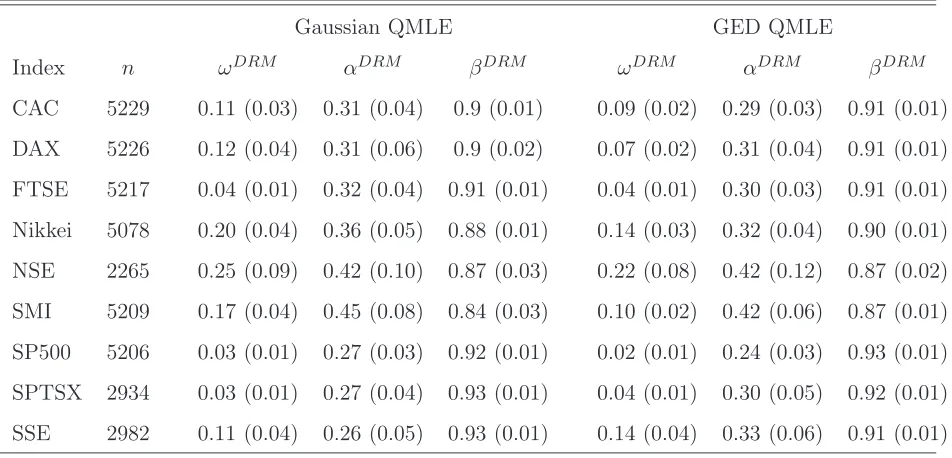
Table 1 shows that the estimates of the DRM parameters produced by the two methods are
sim-ilar, with non empty intersections for confidence bounds whose widths are two estimated standard deviations. The estimated standard deviations are however systematically larger with the method
based on the Gaussian QMLE than with that based on the optimal GED instrumental density, which leads us to think that the second method is preferable.
Although the estimated VaR parameters appear similar for all indices, some differences can be underlined. For instance, let us compare the VaR parameters estimated by the GED QML for the
DAX and the SMI. By (3.6), the conditional risk of the portfolio, p′VaRt(α) is estimated by
e
σt(bθ DRM
n,h ) = b
ωn
1−βbn
+
t−1
X
i=1
b
αnβbniǫ2t−i,
!1/2
, (4.1)
where bθDRMn,h = (bωn,αbn,βbn)′. It is seen from Table 2 that the effect of a shock at time t−1 on
the estimated VaR of the portfolio will be much larger for the SMI than for the DAX. At longer horizons, however, the effects are reversed. It is worthnoting that this kind of interpretation is made
possible by the notion of VaR parameter, which jointly incorporates the effects of volatility and the tails of the conditional distribution.
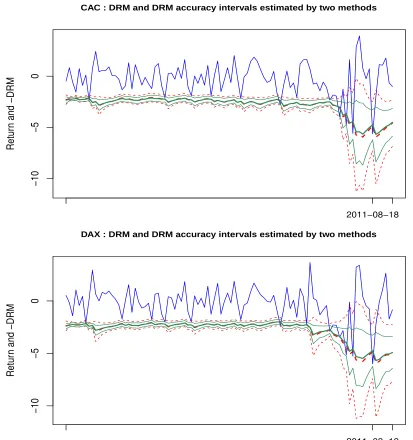
Figure 1 displays, for the CAC and DAX indices, the conditional DRM and its estimated 95%
Table 1: Estimation of the conditional discrete DRM parameter for 9 stock market indices. The estimated standard deviations are displayed into brackets.
Gaussian QMLE GED QMLE
Index n ωDRM αDRM βDRM ωDRM αDRM βDRM
CAC 5229 0.11 (0.03) 0.31 (0.04) 0.9 (0.01) 0.09 (0.02) 0.29 (0.03) 0.91 (0.01) DAX 5226 0.12 (0.04) 0.31 (0.06) 0.9 (0.02) 0.07 (0.02) 0.31 (0.04) 0.91 (0.01) FTSE 5217 0.04 (0.01) 0.32 (0.04) 0.91 (0.01) 0.04 (0.01) 0.30 (0.03) 0.91 (0.01)
Nikkei 5078 0.20 (0.04) 0.36 (0.05) 0.88 (0.01) 0.14 (0.03) 0.32 (0.04) 0.90 (0.01) NSE 2265 0.25 (0.09) 0.42 (0.10) 0.87 (0.03) 0.22 (0.08) 0.42 (0.12) 0.87 (0.02)
SMI 5209 0.17 (0.04) 0.45 (0.08) 0.84 (0.03) 0.10 (0.02) 0.42 (0.06) 0.87 (0.01) SP500 5206 0.03 (0.01) 0.27 (0.03) 0.92 (0.01) 0.02 (0.01) 0.24 (0.03) 0.93 (0.01)
SPTSX 2934 0.03 (0.01) 0.27 (0.04) 0.93 (0.01) 0.04 (0.01) 0.30 (0.05) 0.92 (0.01) SSE 2982 0.11 (0.04) 0.26 (0.05) 0.93 (0.01) 0.14 (0.04) 0.33 (0.06) 0.91 (0.01)
8, 2011 to August, 26, 2011 for the DAX index. The estimation of the DRM parameters is based
on the 1000 previous values. It can be seen that the estimated DRM’s are very close, but the CI’s
can be quite different. This is not surprising because we know from the asymptotic theory that the two methods are consistent, but that the method based on the optimal GED can be more efficient than that based on the Gaussian instrumental density (with corresponds to the particular GED
of parameter τ = 2). The difference is particularly important during turbulent periods (near the August 2011 stock markets fall).
It can be noted that in turbulent periods, both the market risk and the estimation risk increase. This is due to the fact that, as can be seen from (3.8), the derivatives of the VaR, with respect to
θ and to the quantiles of the innovations, increase with volatility. Participants of financial markets are well aware that the reserves should be increased in turbulent periods, but our conclusion is that
CAC : DRM and DRM accuracy intervals estimated by two methods
Retur
n and −DRM
−10
−5
0
2011−08−18
DAX : DRM and DRM accuracy intervals estimated by two methods
Retur
n and −DRM
−10
−5
0
[image:18.595.73.486.126.566.2]2011−08−18
Figure 1: Returns (in blue) and (opposite of the) estimated discrete DRM and its 95% CI, with the Gaussian
Table 2: Coefficients of theǫ2
t−i in the estimated discrete DRM displayed in (4.1), for two indices.
Index ǫ2t−1 ǫ2t−2 ǫ2t−3 ǫ2t−4 ǫ2t−5 ǫ2t−6 ǫ2t−7 ǫ2t−8 ǫ2t−9
SMI 0.42 0.37 0.32 0.28 0.24 0.21 0.18 0.16 0.14 DAX 0.31 0.28 0.26 0.23 0.21 0.19 0.18 0.16 0.15
5
Conclusion
In this paper, we considered the joint estimation of conditional VaRs at different levels, in the framework of conditionally heteroskedastic models. By considering a QML approach, we avoided
strong distributional assumptions on the noise sequence. The asymptotic results were established for a general class of QMLEs, including the usual Gaussian QMLE. The generalized QMLE converges to a volatility parameter which is specific to the chosen instrumental densityh. The true conditional VaR is obviously independent of the chosen parameterization and, interestingly, it can be estimated by any QML contrary to the volatility parameter. The VaR estimator and its asymptotic accuracy
depend on the specific QML, however. We showed how the choice ofh can be optimized, based on a preliminary QML estimation of the model, to gain in asymptotic accuracy.
We also introduced discrete DRM based on a finite number of VaRs. Our empirical analysis showed that confidence intervals for portfolios of VaRs crucially depend on the chosen density h.
In particular, we have seen that, for heavy tailed error distributions, the Gaussian QML may not be reliable for estimating the conditional VaR, or at least for determining its confidence intervals.
An estimator based on an alternative instrumental density may be reliable in such situations. Even for error distributions with finite fourth moments, non Gaussian QML estimators of portfolios of
VaRs can provide important efficiency gains without cost in terms of computational time.
References
Berkes, I. and L. Horváth (2004) The efficiency of the estimators of the parameters in GARCH processes. The Annals of Statistics32, 633–655.
Chan, N.H., Deng, S.J., Peng, L. and Z. Xia (2007) Interval estimation of value-at-risk based on GARCH models with heavy-tailed innovations. Journal of Econometrics 137, 556–
Ding, Z., Granger C. et R.F. Engle (1993) A long memory property of stock market returns and a new model. Journal of Empirical Finance 1, 83–106.
El Ghourabi, M., Francq, C. and F. Telmoudi (2015) Consistent estimation of the Value-at-Risk when the error distribution of the volatility model is misspecified. Journal of Time Series
Analysis, forthcoming.
Engle, R.F. and S. Manganelli (2004) CAViaR: Conditional Value-at-Risk by quantile regres-sion. Journal of Business and Economic Statistics22, 367–381.
Escancianio, J.C. and J. Olmo (2010) Backtesting parametric Value-at-Risk with estimation risk. Journal of Business and Economic Statistics 28, 36–51.
Fan, J., Qi, L. and D. Xiu (2014) Quasi-maximum likelihood estimation of GARCH Models with heavy-tailed likelihoods. Journal of Business and Economic Statistics32, 178–191.
Francq, C., Lepage, G. and J-M. Zakoïan (2011) Two-stage non Gaussian QML estimation of GARCH Models and testing the efficiency of the Gaussian QMLE. Journal of Econometrics
165, 246–257.
Francq, C. and J.M. Zakoïan (2013) Optimal predictions of powers of conditionally het-eroskedastic processes. Journal of the Royal Statistical Society - Series B 75, 345–367.
Francq, C. and J-M. Zakoïan (2014) Multi-level conditional VaR estimation in dynamic mod-els. InModeling Dependence in Econometrics. Advances in Intelligent Systems and Computing Volume 251. Edts: V-N. Huynh et al., Springer.
Francq, C. and J-M. Zakoïan (2015) Risk-parameter estimation in volatility models. Journal of Econometrics 184, 158–173.
Glosten, L.R., Jaganathan, R. and D. Runkle (1993) On the relation between the expected values and the volatility of the nominal excess return on stocks. Journal of Finance 48, 1779–1801.
Gouriéroux, C. and J.M. Zakoïan (2013) Estimation adjusted VaR. Econometric Theory 29, 735–770.
Hall, P. and Q. Yao (2003) Inference in ARCH and GARCH models with heavy-tailed errors.
Econometrica 71, 285–317.
Hamadeh, T. and J-M. Zakoïan (2011)Asymptotic properties of LS and QML estimators for a class of nonlinear GARCH Processes. Journal of Statistical Planning and Inference 141,
488-507.
Hurlin, C., Laurent, S., Quaedvlieg, R., and S. Smeekes (2013) Risk measure inference. Available at SSRN 2345299.
Koenker, R. (2005)Quantile Regression. Cambridge: Cambridge University Press.
Koenker, R. and Z. Xiao (2006) Quantile autoregression. Journal of the American Statistical Association 101, 980–990.
Kuester, K., Mittnik, S. and M.S. Paolella (2006) Value-at-Risk predictions: A comparison of alternative strategies. Journal of Financial Econometrics4, 53–89.
McNeil, A. J., Frey, R. and P. Embrechts (2005) Quantitative Risk Management. Princeton University Press.
Spierdijk, L. (2013) Confidence intervals for ARMA-GARCH Value-at-Risk. Working paper, Uni-versity of Groningen.
Wang, S. (2000) A class of distortion operators for pricing financial and insurance risks. Journal of Risk and Insurance 67, 15–36.