SYNTACTIC AND SEMANTIC PARSABILITY
Geoffrey K. Pullum
Syntax Research Center, Cowell College, UCSC, Santa Cruz, CA 95064 and
Center for the Study of Language and Information, Stanford, CA 94305
ABSTRACT
This paper surveys some issues that arise in the
study of the syntax and semantics of natural
languages (NL's) and have potential relevance to
the automatic recognition, parsing, and translation
of NL's. A n attempt is made to take into account
the fact that parsing is scarcely ever thought
about with reference to syntax alone; semantic
ulterior motives always underly the assignment of a
syntactic structure to a sentence. First I con-
sider the state of the art with respect to argu-
ments about the language-theoretic complexity of
NL's: whether NL's are regular sets, deterministic
CFL's, CFL's, or whatever. While English still
appears to be a CFL as far as I can tell, n e w argu-
ments (some not yet published) appear to show for
the first time that some languages are not CFL's.
Next I consider the question of how semantic
filtering affects the power of grammars. Then I
turn to a brief consideration of some syntactic
proposals that employ more or less modest exten-
sions of the power of context-free gr-mm-rs.
I. INTRODUCTION
Parsing as standardly defined is a purely syn-
tactic matter. Dictionaries describe parsing as
analysing a sentence into its elements, or exhibit- ing the parts of speech composing the sentence and their relation to each other in terms of government
and agreement. But in practice, as soon as parsing
a natural language (NL) is under discussion, people
ask for m u c h more than that. Let us distinguish
three kinds of algorithm operating on strings of
words:
r e c o g n i t i o n
output: a decision concerning whether the
string is a member of the language or not parsing
output: a syntactic analysis of the string
(or an error message if the string is not in the language)
translation
output: a translation (or set of transla-
tions) of the string into some language of
semantic representation (or an error mes- sage if the string is not in the language)
Much potential confusion will be avoided if we are
careful to use these terms as defined. However,
further refinement is needed. What constitutes a
"syntactic analysis of the string" in the defin-
ition of parsing? In applications development work
and when modeling the whole of the native speaker's
knowledge of the relevant part of the language, we
want ambiguous sentences to be repesented as such,
and we want Time flies like an arrow to be mapped
onto a whole list of different structures. For
rapid access to a database or other back-end system
in an actual application, or for modeling a
speaker's performance in a conversational context,
we will prefer a program that yields one syntactic description in response to a given string presenta-
tion. Thus we need to refer to two kinds of algo-
rithm:
all-paths parser
output: a list of all structural descriptions
of the string that the grammar defines (or
an error message if the string is not in
the language) one-path parser
output: one structural description that the
grammar defines for the string (or an error
message if the string is not in the
language)
By a n a l o g y , we w i l l o c c a s i o n a l l y want t o t a l k o f a l l - p a t h s o r o n e - p a t h r e c o g n i z e r s and t r a n s l a t o r s a s w e l l .
T h e r e i s a c r u c i a l c o n n e c t i o n b e t w e e n t h e t h e o r y
of parsing and the theory of languages. There is
no parsing without a definition of the language to
be p a r s e d . T h i s s h o u l d be c l e a r e n o u g h from t h e l i t e r a t u r e on t h e d e f i n i t i o n and p a r s i n g o f p r o - gramming languages, but for some reason it is occa-
sionally denied in the context of the m u c h larger
and richer multi-purpose languages spoken by
humans. I frankly cannot discern a sensible
interpretation of the claims made by some artifi-
cial intelligence researchers about parsing a NL
without having a defined syntax for it. Assume
that some program P produces finite, meaningful
responses to sentences from some NL ~ over some
terminal vocabulary T, producing error messages of
some sort in response to nonsentences. It seems to
me that automatically we have a generative grammar
for 2. Moreover, since ~ is clearly recursive, we
can even enumerate the sentences of L in canonical
order. One algorithm to do this simply enumerates
the strings over the terminal vocabulary in order
of increasing length and in alphabetical order
within a given string-length, and for each one,
tests it for grammaticality using P, and adds it to the output if no error message is returned.
Given that parsability is thus connected to
definability, it has become standard not only for
parser-designers to pay attention to the grammar
for linguists to give some thought to the parsabil-
ity claims entailed by their linguistic theory.
This is all to the good, since it would hardly be
sensible for the study of NL's to proceed for ever
in isolation from the study of ways in which they can be used by finite organisms.
Since 1978, following suggestions by Stanley
Peters, Aravind Joshi, and others, developed most
n o t a b l y i n t h e work o f G e r a l d G a z d a r , t h e r e has been a strong resurgence of the idea that context- free phrase structure grammars could be used for the description of NL's. A significant motivation
for the original suggestions was the existence of
already known high-efficiency algorithms (recogni- tion in deterministic time proportional to the cube of the string length) for recognizing and parsing context-free languages (CFL's).
This was not, however, the motivation for the
interest that signficant numbers of linguists began
to show in context-free phrase structure grammars
(CF-PSG's) from early 1979. Their motivation was
in nearly all cases an interest sparked by the
e l e g a n t s o l u t i o n s t o p u r e l y l i n g u i s t i c p r o b l e m s
that Gazdar and others began to put forward in
various articles, initially unpublished working
papers. We have now seen nearly half a decade of
work using CF-PSG to successfully tackle problems in linguistic description (the Coordinate Structure
Constraint (Gazdar 1981e), the English auxiliary
system (Gazdar et al. 1982), etc.) that had proved
somewhat recalcitrant even for the grossly more
powerful t r a n s f o r m a t i o n a l t h e o r i e s of grn~---r that
had formerly dominated linguistics. The influence
of the parsing argument on linguists has probably
been overestimated. It seems to me that when Gaz-
d a r (1981b, 267) s a y s
o u r grammars can be shown t o be f o r m a l l y e q u i v a l e n t t o what a r e known a s t h e c o n t e x t - f r e e p h r a s e s t r u c t u r e grammars [which] has t h e e f f e c t
of making potentially relevant to natural
language grammars a whole literature of
mathematical
results on the parsability andlearnability of context-free
phrase structure grammarshe is making a point exactly analogous to the one made by Robert Nozick in his book Anarchy, State and U t o n i a , when he s a y s o f a p r o p o s e d s o c i a l organization (1974, 302):
We seem to have e realization of the economists"
model of a competitive market. This is most
welcome, for it gives us immediate access to a
powerful, e l a b o r a t e , and s o p h i s t i c a t e d body of t h e o r y and a n a l y s i s .
We are surely not to conclude from this remark of
Nozick's that his libertarian utopia of interest
groups competing for members is motivated solely by a desire to have a society that functions like a
competitive market. The point is one of serendi-
pity: if a useful theory turns out to be equivalent
to one that enjoys a rich technical literature,
that is very
fortunate, because we may be able to
make use of some of the results therein.
The idea of returning to CF-PSC as e theory of NL's l o o k s r e t r o g r e s s i v e u n t i l one r e a l i z e s t h a t
t h e a r g u m e n t s t h a t had l e d l i n g u i s t s t o c o n s i g n
CF-PSG's t o t h e s c r a p - h e a p o f h i s t o r y can be shown t o be f a l l a c i o u s ( c f . e s p e c i a l l y Pullom and Gazdar ( 1 9 8 2 ) ) . I n view o f t h a t d e v e l o p m e n t , I t h i n k i t would be r e a s o n a b l e f o r someone t o a s k w h e t h e r we c o u l d n o t r e t u r n a l l t h e way t o f i n i t e - s t a t e g r a m - mars, w h i c h w o u l d give us even more efficient pars-
ing (guaranteed deterministic linear time). It may
therefore be useful if I briefly reconsider this
question, first dealt with by Chomsky nearly thirty y e a r s a g o .
2. COULD NL'S BE REGULAR SETS?
Chomsky's negative answer to this question was the
correct one. Although his original argument in
Syntactic Structures (1957) for the non-regular
character of English was not given in anything like a valid form (cf. Daly 1974 for a critique), others
can be given. Consider the following, patterned
a f t e r a s u g g e s t i o n by B r a n d t C o r s t i u s ( s e e L e v e l t 1974, 2 5 - 2 6 ) . The s e t ( 1 ) :
(I) {a white male (whom a white male) n (hired) n
hired another white male I n ~ 0}
i s t h e i n t e r s e c t i o n o f E n g l i s h w i t h t h e r e g u l a r s e t & w h i ; e male (.whom a w h i t e m a l e ) * h i r e d * a n o t h e r w h i t e m a l e . But (1) i s n o t r e g u l a r , y e t t h e r e g u - l a r s e t s a r e c l o s e d u n d e r i n t e r s e c t i o n ; h e n c e E n g l i s h i s n o t r e g u l a r . Q.E.D.
I t i s p e r f e c t l y p o s s i b l e t h a t some NL's happen n o t t o p r e s e n t t h e i n h e r e n t l y s e l f - e m b e d d i n g c o n f i - g u r a t i o n s t h a t make a l a n g u a g e n o n - r e g u l a r . Languages i n which p a r a t a x i s i s u s e d much more t h a n h y p o t a x i s ( i . e . l a n g u a g e s i n w h i c h s e p a r a t e c l a u s e s a r e s t r u n g o u t l i n e a r l y r a t h e r t h a n embedded) a r e n o t a t a l l uncommon. However, i t s h o u l d n o t be t h o u g h t t h a t n o n - r e g u l a r c o n f i g u r a t i o n s w i l l be found t o be r a r e i n l a n g u a g e s o f t h e w o r l d . T h e r e a r e l i k e l y t o be many l a n g u a g e s t h a t f u r n i s h b e t t e r a r g u m e n t s f o r n o n - r e g u l a r c h a r a c t e r t h a n E n g l i s h d o e s ; f o r e x a m p l e , a c c o r d i n g t o Bag~ge ( 1 9 7 6 ) , c e n t e r - e m b e d d i n g seems t o be commoner and more a c c e p t a b l e i n s e v e r a l C e n t r a l S u d a n i c l a n g u a g e s t h a n i t i s i n E n g l i s h . I n Moru, we f i n d e x a m p l e s s u c h as t h i s ( s l i g h t l y s i m p l i f i e d from Ha~ege (1976, 2 0 0 ) ; X i i s t h e p o s s e s s i o n m a r k e r f o r n o n h u - man n o u n s , and r o i s t h e e q u i v a l e n t f o r human n o u n s ) :
(2) kokyE [ t o k o [ o d r u p i [ma r o ] r o ] r i ] d r a t e
1 2 3 3 2 1
dog wife b r o t h e r me o f o f o f i s - d e a d "My brother's chief wife's black dog is dead." The center-embedding word order here is the only one allowed; the alternative right-branching order
("dog chief-wife-of brother-of me-of"), which a
r e g u l a r grammar c o u l d h a n d l e , i s u n g r a m m a t i c a l . P r e s u m a b l y , t h e i n t e r s e c t i o n o f o d r u p i * ma t o * d r a t e w i t h Moru i s
n n
{ o d r u p i ma r o d r a t e [ n > 0}
The f a c t t h a t N L ' s a r e n o t r e g u l a r d o e s n o t n e c e s s a r i l y mean t h a t t e c h n i q u e s f o r p a r s i n g r e g u - l a r l a n g u a g e s a r e i r r e l e v a n t t o NL p a r s i n g . L a n g e n d o e n (1975) and C h u r c h (1980) h a v e b o t h , i n r a t h e r d i f f e r e n t w a y s , p r o p o s e d t h a t h e a r e r s p r o - c e s s s e n t e n c e s a s i f t h e y were f i n i t e a u t o m a t a ( o r a s i f t h e y were pushdown a u t o m a t a w i t h a f i n i t e s t a c k d e p t h l i m i t , w h i c h i s w e a k l y e q u i v a l e n t ) r a t h e r t h a n s h o w i n g t h e b e h a v i o r t h a t would be c h a r a c t e r i s t i c o f a more p o w e r f u l d e v i c e . To t h e e x t e n t t h a t p r o g r e s s a l o n g t h e s e l i n e s c a s t s l i g h t on t h e human p a r s i n g a b i l i t y , t h e t h e o r y o f r e g u l a r
grammars and finite automata will continue to be
important in the study of natural languages even
though they are not regular sets.
The fact that NL's are not regular sets is b o t h surprising and disappointing from the standpoint of
parsahility. It is surprising because there is no
simpler w a y to obtain infinite languages than to
admit union, concatenation, and Kleene closure on
finite vocabularies, and there is no apparent
priori reason why humans could not have been well
served by regular languages. Expressibility con-
siderations, for example, do not appear to be
relevant: there is no reason why a regular language could not express any proposition expressible by a
sentence of any finite-string-length language.
Indeed, m a n y languages provide ways of expressing
sentences w i t h self-ambedding structure in non-
self-embedding ways as well. In an SOV language
like Korean, for example, sentences w i t h the tree-
structure (3a) are also expressible with left-
branching tree-structure as shown in (3b).
(3)a. S b. S
/I\
/J\
I I \
I I \
I I
\
I
I
\
NP S V S NP V
/ 1 \
/ 1 \
/ I \
/ I \
/
I
\
/
I
\
NP S V S NP V
zlx
C l e a r l y s u c h s t r u c t u r a l r e a r r a n g e m e n t w i l l n o t a l t e r t h e c a p a c i t y o f a l a n g u a g e t o e x p r e s s p r o p o - s i t i o n s , any more than an optimizing compiler makes
certain programs inexpressible when it irons out
true recursion into tail recursion wherever possi-
ble.
If NL's were regular sets, we know we could
recognize them in deterministic linear time using
the fastest and simplest abstract computing devices
of all, finite state machines. However, there are
m u c h larger classes of languages that have linear
time recognition. One such class is the deter-
ministic context-free languages (DCFL's). It might
be reasonable, therefore~ to raise the question
dealt with in the following section.
3. COULD NL'S BE DCFL'S?
To t h e b e s t o f my k n o w l e d g e , t h i s q u e s t i o n h a s n e v e r p r e v i o u s l y b e e n r a i s e d , much l e s s a n s w e r e d ,
in the literature of linguistics or computer sci-
ence. Rich (1983) is not atypical in dismissing
the entire literature on DCFL's without a glance on the basis of an invalid argument which is supposed
to show that English is not even a CFL, hence
fortiori not a DCFL.
I should make it clear that the DCFL's are not
just those CFL's for which someone has written a
parser that is in some way deterministic. They are
the CFL's that are accepted by some deterministic
pushdown stack automaton. The term "deterministic
parsing" is used in many different ways (cf. Marcus
(1980) for an attempt to motivate a definition of
determinism specifically for the parsing of NL's).
For example, a translator system with a post-
processor to rank quantifier-scope ambiguities for
plausibility and output only the highest-ranked
translation might be described as deterministic,
but there is no reason why the language it recog-
nizes should he a DCFL; it might be any recursive
language. The parser currently being implemented
by the natural language team at H P Labs (in partic-
ular, by Derek Proudian and Dan Flickinger) intro-
duces an interesting compromise between determinism
and nondeterminism in that it ranks paths through
the rule system so as to make some structural pos-
sibilities highly unlikely ones, and there is a
toggle that can be set to force the output to con-
tain only likely parses. W h e n this option is
selected, the parser runs faster, but can still
show ambiguities when both readings are defined as
likely. This is an intriguing development, but
again is irrelevant to the language-theoretic ques- tion about DCFL status that I am raising.
It would be an easy slip to assume that NL's
cannot be DCFL's on the grounds that English is
well known to be ambiguous. We need to distinguish
carefully between ambiguity and inherent ambiguity.
A n inherently ambiguous language is one such that
all of the g r a ~ m r s that weakly generate it are
ambiguous. LR gr---rs are never ambiguous; but
the L R grammars characterize exactly the set of
DCFL's, hence no inherently ambiguous language is a
DCFL. But it has never been argued, as far as I
know, that English as a stringset is inherently
ambiguous. Rather, it has been argued that a
descriptively adequate grammar for it should, to
account for semantic intuitions, be ambiguous. But
obviously, a DCFL can have an ambiguous grammar.
In fact, all languages have ambiguous grazmnars.
(The proof is trivial. Let w be a string in a
language ~ generated by a grannnar G with initial
symbol S and production set P. Let B be a nonter-
minal not used by G. Construct a new grammar G "
with production set P" = E U {S --> B, B --> w}.
G" is an ambiguous grannuar that assigns two struc-
tural descriptions to w.)
The relevance of this becomes clear when we
observe that in natural language processing appli-
cations it is often taken to be desirable that a
parser or translator should yield just a single
analysis of an input sentence. One can imagine an
impemented natural language processing system in
which the language accepted is described by an
ambiguous CF-PSG but is nonetheless (weakly) a
DCFL. When access to all possible analyses of an
input is desired (say, in development work, or when
o n e wants to take no risks in using a database
front end), an all-paths
parser~translator
is used,but when quick-and-dirty responses are required, at
ambiguous strings, this is replaced by a deter- ministic one-path parser. Despite the difference in results, the language analyzed and the grammar used could be the same.
The idea of a deterministic parser with an ambi- guous grammar, which arises directly out of what
has been done for programming languages in, for
example, the Yacc system (Johnson 1978), is
explored for natural languages in work by Fernando
Pereira and Stuart Shieber. Shieber (1983)
describes an implementation of a parser which uses an ambiguous grammar but parses deterministically. The parser uses shift-reduce scheduling in the
manner proposed by Pereira (1984). Shieber (1983,
i16) gives two rules for resolving conflicts
between parsing actions:
(I) Resolve shift-reduce conflicts by shifting. (If) Resolve reduce-reduce conflicts by performing
the longer reduction.
The first of these is exactly the same as the one given for Yacc by Johnson (1978, 13). The second is more principled than the corresponding Yacc rule, which simply says that a rule listed earlier in the grammar should take precedence over a rule
listed later to resolve a reduce-reduce conflict:
But it is particularly interesting that the two are in practice equivalent in all sensible cases, for reasons I will briefly explain.
A reduce-reduce conflict arises when a string of categories on the stack appears on the right hand
side of two different rules in the grammar. If one
of the reducible sequences is longer than the
other, it must properly include the other. But in that case the prior application of the properly including rule is mandated by an extension into parsing theory of the familiar rule interaction principle of Proper Inclusion Precedence, due ori- ginally to the ancient Indian grammarian Panini
(see Pullum 1979, 81-86 for discussion and refer-
ences). Thus, if a rule N_~P --> NP PP were ordered
before a rule VP --> V NP PP in the list accessed
by the parser, it would be impossible for the
sequence "NP PP" ever to appear in a VP, since it would always be reduced to NP by the earlier rule; the VP rule is useless, and could have been left out of the grammar. But if the rule with the prop- erly including expansion "V NP PP" is ordered first, the NP rule is not useless. A string "V NP PP PP", for example, could in principle be reduced to "V NP PP" by the NP rule and then to "VP" by the VP rule. Under a principle of rule interaction made explicit in the practice of linguists, there- fore, the proposal made by Pereira and Shieber can be seen to be largely equivalent to the cruder Yacc
resolution procedure for deterministic parsing with
ambiguous grammars.
Techniques straight out of programming language
and compiler design may, therefore, be of consider-
able interest in the context of natural language
processing applications. Indeed, Shieber goes so far as to suggest psycholinguistic implications. He considers the,class of "garden-path sentences"
such as those in (4).
(4) The diners hurried through their meal were
annoyed.
That shaggy-looking sheep should be sheared is important.
On these, his parser fails. Strictly speaking,
therefore, they indicate that the language parsed
is not the same under the one-path and the all- paths parsers. But interestingly, human beings are prone to fail just as badly as Shieber's parser on
sentences such as these. The trouble with these
cases is that they lack the prefix property---that is, they have an initial proper substring which is
a sentence. (From this we know that English does
not have an LR(0) grammar, incidentally.) English
speakers tend to mis-parse the prefix as a sen- tence, and baulk at the remaining portion of the
string. We might think o f characterizing the
notion "garden-path sentence" in a rigorous and non-psychological way in terms of an all-paths parser and a deterministic one-path parser for the
given language: the garden path sentences are just
those that parse under the former but fail under the latter.
To say that there might be an appropriate deter- ministic parser for English that fails on certain sentences, thus defining them as garden-path sen-
tences, is not to deny the existence of a deter-
ministic pushdown automaton that accepts the whole
of English, garden-path sentences included, it is
an open question, as far as I can see, whether English as a whole is weakly a DCFL. The likeli- hood that the answer is positive is increased by
the results of Bermudez (1984) concerning the
remarkable power and richness of many classes of deterministic parsers for subsets of the CFL's.
If the answer were indeed positive, we would
have some interesting corollaries. To take just one example, the intersection between two dialects of English that were both DCFL's would itself be a DCFL (since the DCFL's are closed under intersec-
tion). This seems right: if your dialect and mine
share enough for us to communicate without hin-
drance, and both our dialects are DCFL's, it would
be peculiar indeed if our shared set of mutually
agreed-upon sentences was not a DCFL. Yet with the CFL's in general we do not have such a result. Claiming merely that English dialects are CFL's would not rule out the strange situation of having a p a i r o f d i a l e c t s , b o t h C F L ' s , such t h a t t h e intersection is not a CFL.
4. ARE ALL NL'S CFL'S?
More than a quarter-century of mistaken efforts have attempted to show that not all NL's are CFL's. This history is carefully reviewed by Pullum and
Gazdar (1982). But there is no reason why future attempts should continue this record Of failure. It is perfectly clear what sorts of data from a NL
would show it to be outside the class of CFL's. For
example, an infinite intersection with a regular
set having the form of a triple-counting language
or a string matching language (Pullum 1983) would
context-freeness of English that have appeared between 1982 and the present all seem to be quite wide of t h e mark.
Manaster-Ramer (1983) points to the contemptuous
reduplication pattern of Yiddish-influenced
English, and suggests that it instantiates an
infinite string matching language. But does our ability to construct phrases like Manaster-Ramer
Schmanaster-Ramer (and analogously for any other
word or phrase) really indicate that the syntax of English constrains the process? I do not think so. Manaster-Ramer is missihg the distinction between the structure of a language and the culture of ver- bal play associated with it. I can speak in rhym- ing couplets, or with adjacent word-pairs deli- berately Spoonerized, or solely in sentences having an even number of words, if I wish. The structure of my language allows for such games, but does not legislate regarding them.
Higginbotham (1984) presents a complex pumping- lemma argument on the basis of the alleged fact that sentences containing the construction a N such that S always contain an anaphoric pronoun within the clause S that is in syntactic agreement with
the noun N. But his claim is false. Consider a
phrase like any society such that more people get divorced than get married in an average 7ear. This is perfectly grammmtical, but h a s no overt ana-
phoric pronoun in the such that clause. (A similar
ex-mple is concealed elsewhere in the text of this p a p e r . )
L a n g e n d o e n and P o s t a l (1984) c o n s i d e r s e n t e n c e s l i k e Joe was t a l k i n g a b o u t some b o u r b o n - l o v e r , b u t WHICH b o u r b o n - l o v e r i s unknown, and a r g u e t h a t a compound n o u n o f any l e n g t h c a n r e p l a c e t h e f i r s t o c c u r r e n c e o f b o u r b o n - l o v e r p r o v i d e d t h e same s t r i n g i s s u b s t i t u t e d f o r t h e s e c o n d o c c u r r e n c e a s w e l l . They c l a i m t h a t t h i s y i e l d s a n i n f i n i t e
s t r i n g m a t c h i n g l a n g u a g e e x t r a c t a b l e f r o m E n g l i s h t h r o u g h i n t e r s e c t i o n w i t h a r e g u l a r s e t . g u t t h i s a r g u m e n t p r e s u p p o s e s t h a t t h e e l l i p s i s i n WHICH b o u r b o n - l o v e r [ J o e was t a l k i n g a b o u t ] m u s t f i n d i t s a n t e c e d e n t i n t h e c u r r e n t s e n t e n c e . T h i s i s n o t s o . L i n g u i s t i c a c c o u n t s o f a n a p h o r a h a v e o f t e n b e e n o v e r l y f i x a t e d on t h e i n t r a s e n t e n t i a l s y n t a c - t i c c o n d i t i o n s on a n t e c e d e n t - a n a p h o r p a i r i n g s . A r t i f i c i a l i n t e l l i g e n c e r e s e a r c h e r s , on t h e o t h e r h a n d , h a v e c o n c e n t r a t e d more on t h e r e s o l u t i o n o f
anaphora within the larger context of the
discourse. The latter emphasis is more likely to
bring to our attention that ellipsis in one sen- tence can have its resolution through material in a preceding one. Consider the following exchange:
(5)A:
It looks like they're going to appointanother bourbon-hater as Chair of the Liquor Purchasing Committee.
B: Yes--even though Joe nominated some
b o u r b o n - l o v e r s ; but WHICH bourbon-hater is still unknown.
It is possible for the expression WHICH bourbon- hater in B's utterance to be understood as WHICH
bourbon-hater [they're ~oinR to appoint] despite
the presence in the same sentence of a mention of
bourbon-lovers. There is thus no reason to believe that Langendoen and Postal's crucial example type is syntactically constrained to take its antecedent
from within its own sentence, even though that is the only interpretation that would occur to the reader when judging the sentence in isolation.
Nothing known to me so far, therefore, suggests
that English is syntactically other than a CFL;
indeed, I know of no reason to think it is not a
deterministic CFL. As far as engineering is con-
cerned, this means that workers in natural language processing and artificial intelligence should not
overlook (as they generally do at the moment) the
possibilities inherent in the technology that has
been independently developed for the computer pro- cessing of CFL's, or the mathematical results con- cerning their structures and properties.
From the theoretical standpoint, however, a dif-
ferent issue arises: is the oontext-free-ness of
E n g l i s h j u s t a n a c c i d e n t , much l i k e t h e a c c i d e n t i t w o u l d be i f we f o u n d t h a t C h i n e s e was r e g u l a r ? Are t h e r e o t h e r l a n g u a g e s t h a t g e n u i n e l y show n o n - c o n t e x t - f r e e p r o p e r t i e s ? I d e v o t e t h e n e x t s e c t i o n t o t h i s q u e s t i o n , b e c a u s e some v e r y i m p o r t a n t r e s u l t s b e a r i n g o n i t h a v e b e e n r e p o r t e d r e c e n t l y . S i n c e t h e s e r e s u l t s h a v e n o t y e t b e e n p u b l i s h e d , l w i l l h a v e t o s t ~ a n a r i z e t h e m r a t h e r a b s t r a c t l y , a n d
cite forthcoming or in-preparation papers- for
further d e t a i l s .
5. NON-CONTEXT-FREENESS IN NATURAL LANGUAGES
Some remarkable facts recently reported by
Christopher Culy suggest that the African language Bambara (Mande family, spoken in Senegal, Mali, and Upper Volta by over a million speakers) may be a
non-CYL. Culy notes that Bambara forms from noun
stems compound words of the form '~oun-~-Noun" with the meaning "whatever N". Thus, given that wulu means "dog", wulu-o-wulu means "whatever dog." He then observes that Bambara also forms compound noun stems of arbitrary length; wulu-filela means "dog-
watcher," wulu-nyinila means "dog-hunter," wulu-
filela-nyinila means "dog-watcher-hunter," and so
on. From this it is clear that arbitrarily long
words like wulu-filela-nyinila-o-wulu-filela-
nyinila "whatever dog-watcher-hunter '~ will be in the language. This is a realization of a hypothet-
ical situation sketched by Langendoen (1981), in
which reduplication applies to a class of stems
that have no upper length bound. Culy (forthcom-
ing) attempts to provide a formal demonstration
that this phenomenon renders Bambara non-context- free.
If gambara turns out to have a reduplication
rule defined on strings of potentially unbounded
length, then so might other languages. It would be
reasonable, therefore, to investigate the case of
Engenni (another African language, in the Kwa fam-
ily, spoken in Rivers State, Nigeria by about
12,000 people). Carlson (1983), citing Thomas
(1978), notes that Engenni is reported to have a
phrasal reduplication construction: the final
phrase of the clause is reduplicated to indicate
"secondary aspect." Carlson is correct in noting
that if there is no grammatical upper bound to the
length of a phrase that may be reduplicated, there
But it is not only African languages in which
relevant evidence is being turned up. Swiss German
may be another case. In Swiss German, there is
evidence of a pattern of word order in subordinate infinitival clauses that is very similar to that
observed in Dutch. Dutch shows a pattern in which
an arbitrary number of noun phrases (NP's) may be followed by a finite verb and an arbitrary number of nonfinite verbs, and the semantic relations
between them exhibit a crossed serial pattern---
i.e. v e r b s further to the right in the string of
verbs take as their objects NP's further to the
right in the string of NP's. Bresnan et al. (1982)
have shown that a CF-PSG could not assign such a set of dependencies syntactically, but as Pull,-,
and Gazdar (1982, section 5) show, this does not
make the stringset non-context-free. It is a
semantic problem rather than a syntactic one. In
Swiss German, however, there is a wrinkle that
renders the phenomenon syntactic: certain verbs
demand dative rather than accusative case on their objects, as a matter of pure syntax. This pattern will in general not be one that a CF-PSC can
describe. For example, if there are two verbs
and ~" and two nouns ~ and n', the set
{xv I ~ is in (n, n')* and ~ is in (v, v')* and for all ~, if the i'th member of x is n the i'th member of y is ~}
is not a CFL. Shieber (1984) has gathered data
from Swiss German t o support a rigorously formu-
lated argument along these lines that the language is indeed not a CFL because of this construction.
It is possible that other languages will have
properties that render them non-context-free. One
case discussed in 1981 in unpublished work by
Elisabet Eugdahl and Annie Zaenen concerns Swedish. In Swedish, there are three grammatical genders, and adjectives agree in gender with the noun they
describe. Consider the possibility of a
"respectively"-sentence with a meaning like '~he NI, N2, and N3 are respectively AI, A2, and A3," where NI, N2, and N3 have different genders end AI, A2, and A3 are required to agree with their
corresponding nouns in gender. If the gender
a g r e e m e n t were t r u l y a s y n t a c t i c m a t t e r ( c ~ n t r a Pullum and Gazdar (1982, 500-501, n o t e 1 2 ) ) , t h e r e c o u l d be an argument t o be made t h a t Swedish ( o r any l a n g u a g e w i t h t h e s e s o r t o f f a c t s ) was n o t a CFL.
It is worth noting that arguments based on the above sets of facts have not yet been published for g e n e r a l s c h o l a r l y s c r u t i n y . N o n e t h e l e s s , what I
have seen convinces me that i t is now very likely
that we shall soon see a sound published demonstra-
tion that some natural language is non-context-
f r e e . I t i s t i m e t o c o n s i d e r c a r e f u l l y what t h e implications are if this is true.
6. CONTEXT-FREE GRAMMARS AND SEMANTIC FILTERING What sort of expressive power do we obtain by
allowing the definition of a language t o be given
jointly by the syntax and the semantics rather than just by the syntax, so that the syntactic rules can generate strings judged ill-formed by native speak- ers provided that the semantic rules are unable to assign interpretations to them?
This idea may seem to have a long history, in
view of the fact that generative gr-mmsrians
engaged in much feuding in the seventies over the r i v a l m e r i t s o f g r - - , - a r s t h a t l e t " s e m a n t i c " f a c - t o r s c o n s t r a i n s y n t a c t i c r u l e s and grammars t h a t d i s a l l o w e d t h i s but a l l o w e d " i n t e r p r e t i v e r u l e s " t o f i l t e r t h e o u t p u t o f t h e s y n t a x . But i n f a c t , t h e s t e r i l e d i s p u t e s o f t h o s e days were b a s e d on a u s e of the term "semantic" that bore little relation to
its original or current senses. Rules that
operated purely on representations of sentence structure were called "semantic" virtually at whim, despite matching perfectly the normal definition of "syntactic" in that they concerned relations hold-
ing among linguistic signs. The disputes were
really about differently ornamented models of syn- tax.
What I mean by semantic filtering my be illus- trated by reference to the analysis of expletive
NP's like there in Sag (1982). It is generally
taken to be a matter of syntax that the dummy pro-
noun subject there can appear as the subject in
sentences like There are some knives in the drawer
but not in strings like *There broke all existin2
records. Sag simply allows the syntax to generate
structures for strings like the latter. He charac-
terizes them as deviant by assigning to there a denotation (namely, an identity function on propo-
sitions) that does not allow it to combine with the
t r a n s l a t i o n o f o r d i n a r y V P ' s l i k e b r o k e a l l e x ~ s t - in~ r e c o r d s . The VP aye ~pme k n i v e s i n t h e d r a w e r i s a s s i g n e d by t h e s e m a n t i c r u l e s a d e n o t a t i o n t h e same as t h a t o f t h e s e n t e n c e Some ~ p i v e s a r e i n t h e d r a w e r , so t h e r e combines w i t h i t and a s e n t e n c e
meaning is obtained. But br~ke all existinz
r e c o r d s t r a n s l a t e s a s a p r o p e r t y , and no s e n t e n c e
meaning is obtained if it is given ~here as its
subject. This is the sort of move that I will refer to as semantic filtering.
A q u e s t i o n t h a t seems n e v e r t o have b e e n c o n - s i d e r e d c a r e f u l l y b e f o r e i s what k i n d o f l a n g u a g e s
can be defined by providing a CF-PSG plus a set of
semantic rules that leave some syntactically gen- erated sentences without a sentence meaning as their denotation. For instance, in a system with a CF-PSG and a d e n o t a t i o n a l s e m a n t i c s , c a n t h e s e t o f s e n t e n c e s t h a t g e t a s s i g n e d s e n t e n c e d e n o t a t i o n s be non-CF?
I am g r a t e f u l t o Len S c h u b e r t f o r p o i n t i n g o u t t o me t h a t t h e a n s w e r i s y e s , and p r o v i d i n g t h e f o l l o w i n g e x a m p l e ; C o n s i d e r t h e f o l l o w i n g gra~mmr, composed o f s y n t a c t i c r u l e s p a i r e d w i t h s e m a n t i c t r a n s l a t i o n s c h e m a t a .
(6) S --> L R F(L:(R'))
L --> C C"
R --> C C"
C --> a a"
C --> b b"
C - - > aC G(C')
c - - > bC SCC')
c a t e g o r y o f f u n c t i o n s f r o m B - t y p e t h i n g s t o X - t y p e t h i n g s . G i v e n t h e s e m a n t i c t r a n s l a t i o n s c h e m a t a , e v e r y d i f f e r e n t X c o n s t i t u e n t h a s a u n i q u e s e m a n t i c c a t e g o r y ; t h e s t r u c t u r e o f t h e s t r i n g i s coded i n t o the structure of its translation. But the first rule only yields a meaning for the S constituent if L" and ~" are of the same category. Whatever semantic category may have been built up for an instance of ~', the F operator applies to produce a function from things of that type to things of type B, and the rule says that this function must be
applied to the translation of ~'. Clearly, if R"
h a s e x a c t l y t h e same s e m a n t i c c a t e g o r y a s L" t h i s w i l l s u c c e e d i n y i e l d i n g a B - t y p e d e n o t a t i o n f o r S, and u n d e r a l l o t h e r c i r c u m s t a n c e s S w i l l f a i l t o be a s s i g n e d a d e n o t a t i o n .
The s e t o f s t r i n g s o f c a t e g o r y S t h a t a r e a s s i g n e d d e n o t a t i o n s u n d e r t h e s e r u l e s i s t h u s
{xx
I ~in (A,
~)+}
which is a non-CF language. We know, therefore,
that it is p o s s i b l e for s e m a n t i c filtering of a set of syutactic rules to alter expressive power signi-
ficantly. We know, in fact, that it would be pos-
sible to handle Bambara noun stems in this way and design a set of translation principles that would only allow a string '~oun-~-Noun" to be assigned a denotation if the two instances of N were string- wise identical. What we do not know is how to for-
mulate with clarity a principle of linguistic
theory that adjudicates on the question of whether the resultant description, with its infinite number
of distinct semantic categories, is permissible.
Despite the efforts of Barbara Hall Partee and other scholars who have written on constraining the
Moutague semantics framework over the past ten
y e a r s , q u e s t i o n s a b o u t p e r m i s s i b l e power i n
semantic apparatus are still not very well
e x p l o r e d .
One t h i n g t h a t i s c l e a r i s t h a t G a z d a r and o t h - e r s who h a v e c l a i m e d o r a s s u m e d t h a t N L ' s a r e c o n t e x t - f r e e n e v e r i n t e n d e d t o s u g g e s t t h a t t h e e n t i r e m e c h a n i s m o f a s s o c i a t i n g a s e n t e n c e w i t h a m e a n i n g c o u l d be c a r r i e d o u t by a s y s t e m e q u i v a l e n t t o a pushdown a u t o m a t o n . Even i f we t a k e t h e n o t i o n " a s s o c i a t i n g a s e n t e n c e w i t h a m e a n i n g " t o be fully clear, which is g r a n t i n g a lot in the way of separating out pragmatic and discourse-related
factors, it is obvious that operations beyond the
power of a CY-PSG to define are involved. Things
like identifying representations to which lambda- conversion can apply, determining whether ali vari- ables are bound, checking that every indexed ana- phoric element has an antecedent with the same index, verifying that a structure contains no vacu-
ous quantification, and so on, are obviously of
non-CF character when regarded as language recogni-
tion problems. Indeed, in one case, that of disal-
lowing vacuous quantifiers, it has been conjectured
(Partee and Marsh 1984), though not yet proved,
that even an indexed grammar does not have the requisite power.
It therefore should not be regarded as surpris- ing that mechanisms devised to handle the sort of
tasks involved in assigning meanings to sentences
can come to the rescue in cases where a given syn-
tactic framework h a s insufficient expressive power.
Nor should i t be surprising that t h o s e syntactic
theories that build into the syntax a power that amply suffices to achieve a suitable syntax-to-
semantics mapping have no trouble accommodating all
new sets of facts that turn up. The moment we
adopt any mechanisms with greater than, say,
context-free power, our problem is that we are faced with a multiplicity of ways to handle almost any descriptive problem.
7. GRAMMARS WITH INFINITE NONTERMINAL VOCABULARIES S u p p o s e we d e c i d e we w a n t t o r e j e c t t h e i d e a o f a l l o w i n g a s o u p e d - u p s e m a n t i c r u l e s y s t e m do p a r t of the job of defining the membership of the l a n g u a g e . What s y n t a c t i c o p t i o n s a r e r e a s o n a b l e o n e s , g i v e n t h e k i n d o f n o n - c o n t e x t - f r e e l a n g u a g e s we think we might have to describe?
T h e r e i s a l a r g e r a n g e o f t h e o r i e s o f grammar d e f i n a b l e i f we r e l a x t h e s t a n d a r d r e q u i r e m e n t t h a t t h e s e t N o f n o n t e r m i n a l v o c a b u l a r y o f t h e g r - - - , = r
should be finite. Since a finite parser for such a
gr,mm-r cannot contain an infinite list of nonter-
minals, if the infinite majority of the nontermi-
naIs are not to be useless symbols, the parser must be equipped with some way of parsing representa-
tions of nonterminals, i.e. to test arbitrary
objects for membership in N. If the tests do not
guarantee results in finite time, then clearly the device may be of Turing-machine power, and may d e f i n e a n u n d e c i d a b l e l a n g u a g e . Two p a r t i c u l a r l y interesting types of grammar that do not have this property are the following:
Indexed 2rammars. If members of N are built up
using sequences of indices affixed to a members of a finite set of basic nonterminals, and rules i n P a r e a b l e t o add o r remove s e q u e n c e - i n i t i a l i n d i c e s , a t t a c h e d t o a g i v e n b a s i c n o n t e r m i n a l , t h e e x p r e s s i v e power a c h i e v e d i s t h a t o f t h e i n d e x e d g r a m m a r s o f Aho ( 1 9 6 8 ) . T h e s e h a v e a n a u t o m a t a - t h e o r e t i c c h a r a c t e r i z a t i o n i n t e r m s o f a s t a c k a u t o m a t o n t h a t c a n b u i l d s t a c k s i n s i d e o t h e r s t a c k s b u t c a n o n l y empty a s t a c k a f t e r a l l t h e s t a c k s w i t h i n i t h a v e b e e n e m p t i e d . The
time complexity of the parsing problem is
exponential.
Unification Krannaars. If members of N have
internal hierarchical structure and parsing
operations are permitted to match hierarchical representations one with another globally to
determine whether they unify (roughly, whether
there is a minimal consistent representation
that includes the distinctive properties of
both), and if the number of parses for a given sentence is kept to a finite number by requiring that we do not have
A ==> A
for any A, then the expressive power seems to be
weakly equivalent to the grammars that Joan
Bresnan and Ron Kaplan have developed under the
name lexical-functional ~ r a m a r (LF___GG; se___fie
Bresnan, e__dd., 1982; c__ff, also the work of Martin
Kay on unification grammars). The LFG languages include some non-indexed languages (Kelly Roach,
unpublished work), and apparently have an NP-
complete parsing problem (Ron Kaplan, personal
Systems of this s o r t h a v e an undeniable interest in connection with the study of natural language. Both theories of language structure and comput- ational implementations of grammars can be usefully
explored in such terms. My criticism of them would
be that it seems to me that the expressive power of these systems is too extreme. Linguistically they are insufficiently restrictive, and computationally
they are implausibly wasteful of resources. How-
ever, rather than attempt to support this vague prejudice with specific criticisms, I would prefer to use my space here to outline an alternative that seems to me extremely promising.
8. READ GRAMMARS AND NATURAL LANGUAGES
In his recent doctoral dissertation, Carl Pol-
lard (1984) has given a detailed exposition and
motivation for a class of grammars he terms head
K~ammars. Roach (1984) has proved that the
languages generated by head grammars constitute a full AFL, showing all the significant closure pro- perties t h a t c h a r a c t e r i z e t h e c l a s s o f C F L ' s . H e a d grammars have a greater expressive power, in terms
of weak and strong generative capacity, than the
CF-PSG's, but only to a very limited extent, as shown by some subtle and suprising results due to
Roach (1984). For example, there is a h e a d grammar
for
{ a n b n c n a n I n 2 0} but not for
{anbncndna n [ n 2 O}
and there is a head grammar for {ww I w is in (a, b)*} but not for
{ w w J w is in ( a , b)*}.
The time complexity of the recognition problem for head grammars is also known: a time bound pro- portional to the seventh power of the length of the input is sufficient to allow for recognition in the
worst case on a deterministic Turing machine (Pol-
lard 1984). This clearly places head grammars in
the realm of tractable linguistic formalisms. The extension Pollard makes in CF-PSG to obtain the head gra--,ars is in essence fairly simple. First, he treats the notion '*head" as a primitive. The strings of terminals his syntactic rules define are headed s~rings, which means they are associated with an indication of a designated element to be
known as the head. Second, he adds eight new
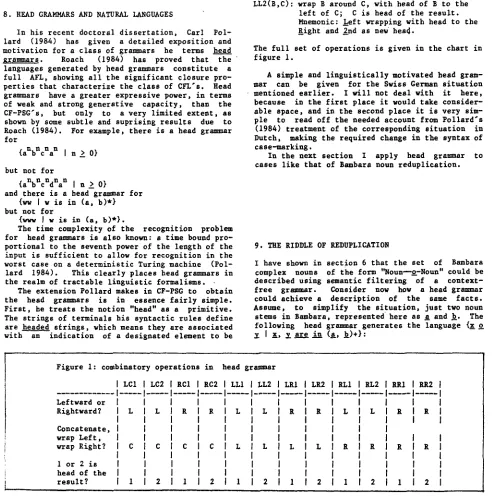
'~rapping" operations to the standard concatenation operation on strings that a CF-PSG can define. For a given ordered pair <B,C> of headed strings there are twelve ways in which strings B and C can be
combined to make a constituent A. I give here the
descriptions of just two of them which I will use below:
LCI(B,C): concatenate C onto end of B; first
argument (B) is head of the result.
Mnemonic: Left Concatenation with ist a s
n e w h e a d .
LL2(B,C): wrap B around C, with head of B to the left of C; C is head of the result.
Mnemonic: Left wrapping with head t o the
Right and ~nd as new head.
The full set of operations is given in the chart in figure I.
A simple and linguistically motivated head gram- mar can be given for the Swiss German situation
mentioned earlier. I will not deal with it here,
because in the first place it would take consider- able space, and in the second place it is very sim- ple to read off the needed account from Pollard's (1984) treatment of the corresponding situation in Dutch, making the required change in the syntax of c a s e - m a r k i n g .
In the next section I apply head grammar t o
cases like that of Bambara noun reduplication.
9. THE RIDDLE OF REDUPLICATION
I have shown in section 6 that the set of Bambara complex nouns of the form '~oun--~-Noun" could be described using semantic filtering of a context-
free grammar. Consider now how a head grammar
could achieve a description of the s a m e facts.
Assume, to simplify the situation, just two noun
stems in Bambara, represented here as ~ and b. The following head grammar generates the language {x
F i g u r e 1 : c o m b i n a t o r y o p e r a t i o n s i n h e a d g r a ~ a r
[ LC1 [ LC2 [ RC1 [ RC2 [ LL1 I LL2 ] LR1 [ LR2 [ RL1 [ RL2 . . . I . . . [ . . . I . . . I . . . I . . . I . . . I . . . I . . . I . . . I . . . . i
Leftward or Rightward? Concatenate, wrap Left, wrap Right?
1 or 2 is head of the result?
L
I
L J R
1 I I
C I C
I I I
2 I 1
L L
R
L
R L
R R
RR1 [ R R 2 I ... I ... I I I S I R I I I
R R
[image:8.612.46.539.178.674.2](7)
S y n t a x LexiconS ---> LCI(M, A)
S ---> LCI(N, B)
M ---> LL2(X, O) N ---> LL2(Y, O) X ---> LL2(Z, A)
Y ---> LL2(Z, B)
Z ---> LCI(X, A)
Z ---> LCI(Y, B)
A - - - > a
B ---> b 0 ---> o Z ---> e
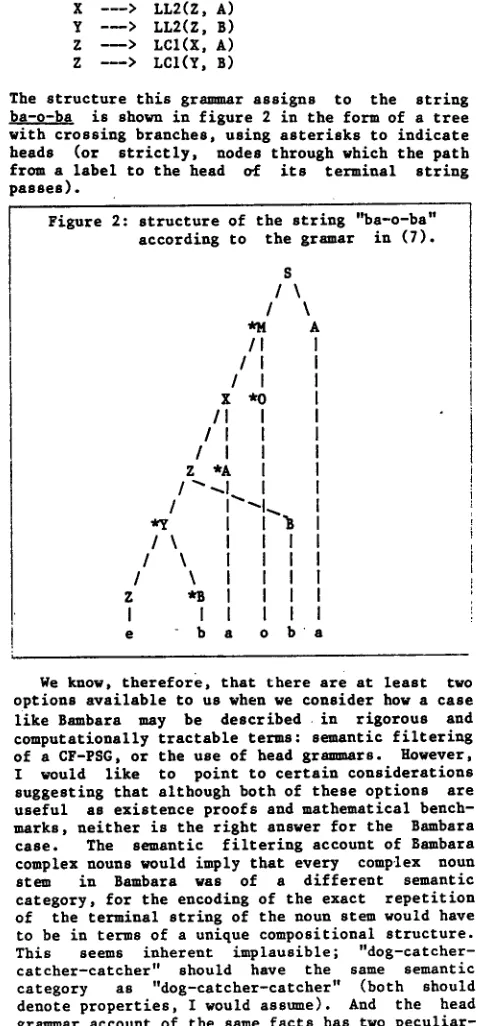
The structure this gr---,-r assigns to the string
ba-o-ba is shown in figure 2 in the form of a tree
with crossing branches, using asterisks to indicate h e a d s ( o r s t r i c t l y , n o d e s t h r o u g h which t h e p a t h from a l a b e l t o t h e head o f i t s t e r m i n a l s t r i n g
)asses).
F i g u r e 2: s t r u c t u r e o f t h e s t r i n g " b a - o - b a " a c c o r d i n g t o t h e gramar i n ( 7 ) .
S
/ \
/
\
I I / I
1 I
x *o
/ I
I
/ I
I
/
I
I
z
*AI
/ ~-.I I/ \
I
/
\
I
/
\
I
z *B
1
l
l
l
• b a o b a
We know, therefore, that there are at least two
options available to us w h e n we consider how a case
like Bambara m a y be described in rigorous and
computationally tractable terms: semantic filtering
of a CF-PSG, or the use of head gr---rs. However,
I would like to point to certain considerations
suggesting that although both of these options are
useful as existence proofs and mathematical bench-
marks, neither is the right answer for the Bembara
case. The semantic filtering account of Bembara
complex nouns would imply that every complex noun
stem in Bambara was of a different semantic
category, for the encoding of the exact repetition
of the terminal string of the noun stem would have
to be in terms of a unique compositional structure.
This seems inherent implausible; "dog-catcher-
catcher-catcher" should have the same semantic
category as "dog-catcher-catcher" (both should
denote properties, I would assume). And the head
grammar account of the same facts has two peculiar-
ities. First, it predicts a peculiar structure of
word-internal crossing syntactic dependencies (for
example, that in dog-catcher-~-dog-catcher, one
constituent is dog-dog and another is doK-catcher-
~-doR) that seem unmotivated and counter-intuitive.
S e c o n d , t h e grammar f o r t h e s e t o f complex nouns i s p r o f l i g a t e i n t h e s e n s e o f Pullmn ( 1 9 8 3 ) : t h e r e a r e i n h e r e n t l y and n e c e s s a r i l y more n o n t e r m i n a l s i n v o l v e d t h a n t e r m i n a l s - - - a n d t h u s more d i f f e r e n t ad hoc s y n t a c t i c c a t e g o r i e s t h a n t h e r e a r e noun s t e m s . A g a i n , t h i s seems a b h o r r e n t .
What i s t h e c o r r e c t d e s c r i p t i o n ? My a n a l y t i c a l i n t u i t i o n ( w h i c h o f c o u r s e , I do n o t a s k o t h e r s t o a c c e p t u n q u e s t i o n i n g l y ) i s t h a t we n e e d a d i r e c t r e f e r e n c e t o t h e r e d u p l i c a t i o n o f t h e s u r f a c e s t r i n g , and t h i s i s m i s s i n g i n b o t h a c c o u n t s . Somehow I t h i n k t h e g r a m m a t i c a l r u l e s s h o u l d r e f l e c t t h e n o t i o n " r e p e a t t h e m o r p h e m e - s t r i n g " d i r e c t l y , and by t h e same t o k e n t h e p a r s i n g p r o c e s s s h o u l d d i r e c t l y r e c o g n i z e t h e r e d u p l i c a t i o n o f t h e noun s t e m r a t h e r t h a n h a p p e n i n d i r e c t l y t o g u a r a n - t e e i t .
I e v e n t h i n k t h e r e i s e v i d e n c e from E n g l i s h t h a t o f f e r s s u p p o r t f o r s u c h an i d e a . T h e r e i s a c o n - s t r u c t i o n i l l u s t r a t e d by p h r a s e s l i k e Trac 7 h i t i t and h i t i t and h i t i t . t h a t was d i s c u s s e d by Browne ( 1 9 6 4 ) , an u n p u b l i s h e d p a p e r t h a t i s summar- i z e d by L a k o f f and P e t e r s (1969, 121-122, n o t e 8 ) . I t i n v o l v e s r e d u p l i c a t i o n o f a c o n s t i t u e n t ( h e r e , a v e r b p h r a s e ) . One o f t h e c u r i o u s f e a t u r e s o f t h i s c o n s t r u c t i o n i s t h a t i f t h e r e d u p l i c a t e d p h r a s e i s an a d j e c t i v e p h r a s e i n t h e c o m p a r a t i v e d e g r e e , t h e e x p r e s s i o n o f t h e c o m p a r a t i v e d e g r e e must be i d e n t - i c a l t h r o u g h o u t , down t o t h e m o r p h o l o g i c a l and p h o - n o l o g i c a l l e v e l :
( 8 ) a . K i m g o t l o n e l i e r and l o n e l i e r and l o n e l i e r . b . Kim g o t more and more and more l o n e l y . c . *Kim g o t l o n e l i e r and more l o n e l y and
l o n e l i e r .
T h i s i s a p r o b l e m e v e n u n d e r t r a n s f o r m a t i o n a l c o n - c e p t i o n s of gr---r, since at the levels w h e r e syn-
tactic transformations apply, lonelier and m o r e
lonely are generally agreed to be indistinguish-
able. The symmetry must be preserved at the phono-
logical level. I suggest that again a primitive
s y n t a c t i c operation "repeat t h e morpheme-string" is
called for. I have no idea at this stage how it
would be appropriate to formalize such an operation and give it a place in syntactic theory.
10. CONCLUSION
The arguments originally given at the start of the
era of generative grammar were correct in their
conclusion that NL's cannot be treated as simply
regular sets of strings, as some early
information-theoretic models of language users
would have had it. However, questions of whether
NL's were CFL's were dismissed rather too hastily; English was never shown to be outside the class of CFL's or even the DCFL's (the latter question never
even having been raised), and for other languages
the first apparently valid arguments for non-CFL
status are only now being framed. If we are going
to employ supra-CFL mechanisms in the characteriz-
ing and processing of NL's, there are a host of
items in the catalog for us to choose among. I
have shown that semantic filtering is capable of
enhancing the power of a CF-PSG, and so, in many
different ways, is relaxing the finiteness condi-
[image:9.612.76.315.97.610.2]moves are likely to inflate expressive power quite dramatically, it seams to me. One of the most mod- est extensions of CF-PSG being explored is Pollard's head grannnar, which has enough expressive powe# to handle the cases that seem likely to
a r i s e , but I have suggested t h a t even so, i t does
not seem to be the r i g h t formalism to cover the
case of the complex nouns in the l e x i c o n of Sam-
bare. Something different is needed, and it is not q u i t e c l e a r what.
This is a familiar situation in linguistics. Description of facts gets easier as the expressive power of one's mechanisms is enhanced, hut choosing among alternatives, of course, get harder. What I would offer as a closing suggestion is that until we are able to encode different theoretical propo- sals (head grammar, string transformations, LFG, unification grammar, definite clause grammar, indexed grammars, semantic filtering) in a single, implemented, well-understood formalism, our efforts to be sure we have shown one proposal to be better than another will be, in Gerald Gazdar's scathing phrase, "about as sensible as claims to the effect that Turing machines which employ narrow grey tape are less powerful than ones employing wide orange tape" (1982, 131). In this connection, the aims of the PATE project at SRI International seem particu- larly helpful. If the designers of PATE can demon- strate.that it has enough flexibility to encode rival descriptions of NL's like English, Bambara, Engenni, Dutch, Swedish, and Swiss German, and to do this in a neutral way, there may be some hope in the future (as there has not been in the past, as far as I can see) of evaluating alternative linguistic theories and descriptions as rigorously as computer scientists evaluate alternative sorting algorithms or LISP implementations.
REFERENCES
Bermudez, Manuel (1984) Retular .Lookahead an__dd Look- balk in LR Parsers. PhD thesis, University of California, Santa Cruz.
Bresnan, Joan W., ed. (1982) The Mental Renresenta- tion o f Grammatical Rel@tions. MIT Press, Cam- bridge, MA.
Browne, Wayles (1964) "On adjectival comparison and reduplication in English." Unpublished paper.
Carlson, Creg (1983) "Marking c o n s t i t u e n t s , " in
Prank Heny, e d . , L i n g u i s t i c C a t e g o r i e s : Auxi-
l i a r i e ~ an___~dd Related P u z z l e s ; vo__!. ~: C a t e g o r i e s ,
69-98. D. R e i d e l , Dordrecht.
Chomsky, Noam (1957) S y n t a c t i c S t r u c t u r e s . Mouton,
The Hague.
Church, Kenneth (1980) On Memory L i m i t a t i o n s i._nn
Natura~ Lan~uaRe Processing. M.Sc. thesis, MIT. Published by Indiana University Linguistics Club, Bloomington IN.
Culy, Christopher (forthcoming) '~he complexity of the vocabulary of Bombers."
Daly, R. T. (1974) Avvlications of th_.fie Mathematical Theory o f Linguistics. Mouton, The Hague.
" Gazdar, Gerald (1981a) '~nbounded dependencies and coordinate structure. Linguistic Inquiry 12, 155-184.
Cazdar, Gerald (1981b) "On syntactic categories." Philosophical Transactions o f the Ro¥al Society (Series B) 295, 267-283.
Gazdar, Gerald (1982) "Phrase structure graluuar," in Jacobson and Pullum, e d s . , 131-186.
Gazdar, Gerald; Pullum, Geoffrey K.; and Sag, Ivan
A. (1982) ' ~ u x i l i a r i e s and r e l a t e d phenomena in
a restrictive theory of gramnmr," Language 58, 591-638.
Hag~ge, Claude (1976) "Relative clause center- embedding and comprehensibility," Linguistic In, uir~ 7, 198-201.
Higginbotham, James (1984) "English is not a context-free language." Linguistic Inquiry 15, 225-234.
Jacobsen, Pauline, and Pullum, Geoffrey K., eds. (1982) Th_._ee Nature o f Syntactic Representation. D. Reidel, Dordrecht, Holland.
Lakoff, George, and Peters, Stanley (1969) 'Thrasal conjunction and symmetric predicates," in David
A. R e i b e l and Sanford A. Schane, e d s . ,
Studies _~ E n g l i s h . P r e n t i c e - H a l l , Englewood
Cliffs.
Langendoen, D. Terence (1975) "Finite-state parsing of phrase-structure languages and the status of
r e a d j u s t m e n t r u l e s in grammar,"
Inouir7 5, 533-554.
Langendoen, D. Terence (1981) '~he generative capa- city of word-formation components," Linguistic In,uirv 12, 320-322.
Langendoen, D. Terence, and Postal, Paul M. (1984) "English and the class of context-free languages," unpublished paper.
Levelt, W. J. M. (1974) Formal GrR-,,-rs i _ _ n n ~
~ i c s an__j P s v c h o l i n ~ u i s t i c s ( v o l . I I ) : A p p l i c a -
t i o n s in L i n g u i s t i c Theory. Mouton, The Hague.
Marcus, M i t c h e l l (1980) A Theor¥ of S y n t a c t i c
R e c o g n i t i o n f o r N a t u r a l Langua2e. MI_~TPress,
Cambridge MA.
Manaster-Ramer, A l e x i s (1983) '~he s o f t formal
u n d e r b e l l y of t h e o r e t i c a l s y n t a x , " in Pavers
~!om the N i n e t e e n t h Regional Meeting, Chicago
L i n g u i s t i c S o c i e t y , Chicago IL.
Nozick, Robert (1974) Anarchy, S t a t e , and Utonia.
Basic Books, New York.
Partee, Barbara, and William Marsh (1984) '~ow non-context-free is v a r i a b l e binding?" Presented at the Third Nest Coast Conference on
Formal L i n g u i s t i c s , U n i v e r s i t y of C a l i f o r n i a ,
Santa Cruz.
P e r e i r a , Fernando (1984) ' ~ new c h a r a c t e r i z a t i o n of
attachment p r e f e r e n c e s , " i n D. R. Dowry, L.
Karttunen, and A. M. Zwicky, a d s . , Natural
Language P r o c e s s i n g : P s ¥ c h o l i n ~ u i s t i c , Comput-
a t i o n a l an_.dd T h e o r e t i c a l P e r s p e c t i y e s . Cambridge
U n i v e r s i t y P r e s s , New York NY.
P o l l a r d , Carl J . (1984) G e n e r a l i z e d phrase S t r u c -
t u r e Grammars, Head G~a----rs, and N a t u r a l
Languaees. Ph.D. t h e s i s , Stanford U n i v e r s i t y .
Pullum, Geoffrey K. (1979) Rule I n t e r a c t i o n and th_._.ee Organization o_~f~ Grammar. Garland, New York. Pullam, Geoffrey K. (1983) "Context-freeness and
the computer processing of human languages," in 21st Annual Meetin~ o f the Assocation f_.q/_ Computational Ling,istics: Proceedings of the
Pullum, Geoffrey K., and Gerald Gazdar (1982) "Natural languages and context-free languages," Linguistics an__~dPhilosoph¥ 4, 471-504.
Rich, Elaine (1983) Artificial Intelligence. McGraw-Hill, New York NY.
Roach, Kelly (1984) "Formal properties of head gr,--,=rs." Unpublished paper, Xerox Palo Alto Research Center, Palo Alto CA.
Sag, Ivan A. (1982) '% semantic analysis of "NP- movement" dependencies in English." In Jacobson and Pull,--, eds., 427-466.
Shieber, Stuart (1983) "Evidence against the
context-freeness of natural language." Unpub- lished paper. SRI International, Menlo Park CA, and Center for the Study of Language and Infor- mation, Stanford CA.
Shieber, Stuart (1983) "Sentence disambiguation by a shift-reduce parsing technique," in 21st Annual Meeting of the Assocation fo__E Comput- ational Linguistics: Proceedings of the Confer- ence, 113-118. ACL, Menlo Park CA.