An Algorithm for Simultaneously Bracketing Parallel Texts
by Aligning Words
D e k a i W u H K U S T
D e p a r t m e n t o f C o m p u t e r S c i e n c e U n i v e r s i t y o f S c i e n c e & T e c h n o l o g y
C l e a r W a t e r Bay, H o n g K o n g d e k a i @ c s , ust. h k
Abstract
We describe a grammarless method for simul- taneously bracketing both halves of a paral- lel text and giving word alignments, assum- ing only a translation lexicon for the language pair. We introduce inversion-invariant trans- duction grammars which serve as generative models for parallel bilingual sentences with weak order constraints. Focusing on Wans- duction grammars for bracketing, we formu- late a normal form, and a stochastic version amenable to a maximum-likelihood bracketing algorithm. Several extensions and experiments are discussed.
1 I n t r o d u c t i o n
Parallel corpora have been shown to provide an extremely rich source of constraints for statistical analysis (e.g., Brown et al. 1990; Gale & Church 1991; Gale et al. 1992; Church 1993; Brown et al. 1993; Dagan et al. 1993; Dagan & Church 1994; Fung & Church 1994; Wu & Xia 1994; Fung & McKeown 1994). Our thesis in this paper is that the lexical information actually gives suffi- cient information to extract not merely word alignments, but also bracketing constraints for both parallel texts. Aside from purely linguistic interest, bracket structure has been empirically shown to be highly effective at con- straining subsequent training of, for example, stochas- tic context-free grammars (Pereira & ~ 1992; Black et al. 1993). Previous algorithms for automatic bracketing operate on monolingual texts and hence re- quire more grammatical constraints; for example, tac- tics employing mutual information have been applied to tagged text (Magerumn & Marcus 1990).
Algorithms for word alignment attempt to find the matching words between parallel sentences. 1 Although word alignments are of little use by themselves, they provide potential anchor points for other applications, or for subsequent learning stages to acquire more inter- esting structures. Our technique views word alignment 1 Wordmatching is a more accurate term than word alignment since the matchings may cross, but we follow the literature.
and bracket annotation for both parallel texts as an inte- grated problem. Although the examples and experiments herein are on Chinese and English, we believe the model is equally applicable to other language pairs, especially those within the same family (say Indo-European).
Our bracketing method is based on a new formalism called an inversion.invariant transduction grammar. By their nature inversion-invariant transduction grammars overgenerate, because they permit too much constituent- ordering freedom. Nonetheless, they turn out to be very useful for recognition when the true grammar is not fully known. Their purpose is not to flag ungrammatical in- pots; instead they assume that the inputs are grammatical, the aim being to extract structure from the input data, in kindred spirit with robust parsing.
2 Inversion-Invariant Transduction
Grammars
A Wansduction grammar is a bilingual model that gen- erates two output streams, one for each language. The usual view of transducers as having one input stream and one output stream is more appropriate for restricted or deterministic finite-state machines. Although finite-state transducers have been well studied, they are insufficiently powerful for bilingual models. The models we consider here are non-deterministic models where the two lan- guages' role is symmetric.
We begin by generalizing transduction to context-free form. In a context-free transduction grammar, terminal symbols come in pairs that~ are emitted to separate output streams. It follows that each rewrite rule emits not one but two streams, and that every non-terminal stands for a class of derivable substring pairs. For example, in the rewrite rule
A ~ B x / y C z / e
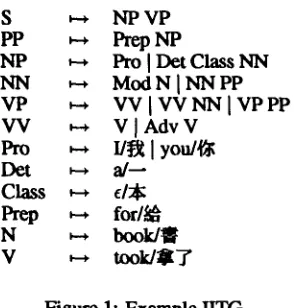
S PP NP NN VP W Pro Det Class
Prep
N V
NP VP
Prep NP
Pro I Det Class NN M o d N [ N N P P VV [ VV NN I VP PP V ] Adv V
I/~ I you/f$
~-* f o r / ~
~. book/n
Figure 1: Example IITG.
token is generated. We call a symbol pair such as x / e an Ll-singleton, and ely an L2-singleton.
We can employ context-free transduction grammars in simple attempts at generative models for bilingual sen- tence pairs. For example, pretend for the moment that the simple ttansduetion grammar shown in Figure 1 is a context-free transduction grammar, ignoring the ~ sym- bols that are in place of the usual ~ symbols. This gram- mar generates the following example pair of English and Chinese sentences in translation:
(1) a. [I [[took [a book]so ]vp [for y o n ] ~ ]vp ]s
b. [~i [ [ ~ T [--*W]so ]w [ ~ ] ~
]vt, ]s
Each instance of a non-terminal here actually derives two subsltings, one in each of the sentences; these two substrings are translation counterparts. This suggests writing the parse trees together:(2) ~ [[took/~Y [ a / ~ d ~ : book/1[]so ]vp [for/~[~
you/~]pp ]vv ]s
The problem with context-free transduction granunars is that, just as with finite-state transducers, both sentences in a translation pair must share exactly the same gram- matic~d structure (except for optional words that can be handled with lexical singletons). For example, the fol- lowing sentence pair with a perfectly valid, alternative Chinese translation cannot be generated:
(3) a. [I [[took [a book]so ]vp [for you]v~ ]vP ]s
b.
[~ [[~¢~]~
[ ~ T [ - - ~ ] s o
]vt, ]vP ]s
We introduce the device of an inversion-invafiant trans- duction grammar (IITG) to get around the inflexibility of context-free txansduction grammars. Productions are in- terpreted as rewrite rules just as with context-free trans- duction grammars, with one additional proviso: when generating output for stream 2, the constituents on a rule's right-hand side may be emitted either left-to-right (as usual) or right-to-left (in inverted order). We use instead of --~ to indicate this. Note that inversion is permitted at any level of rule expansion.With this simple proviso, the transduction grammar of Figure 1 straightforwardly generates sentence-pair (3). However, the IITG's weakened ordering constraints now
also permit the following sentence pairs, where some constituents have been reversed:
(4) & *[I [[for youlpp [[a bookl~p tooklvp ]vp ]s
b. [ ~ [[~¢~]1~ [~tT [--:*:It]so ]w ]vp ]s
(5) a. *[[[yon for]re [[a book]so took]w ]vp I]sb. * [ ~
[ [ ~ ] r p
[[tl[:~--]so ~ T ] v P ]VP ]S As a bilingual generative linguistic theory, therefore, IITGs are not well-motivated (at least for most natural language pairs), since the majority of constructs do not have freely revexsable constituents.We refer to the direction of a production's L2 con- stituent ordering as an orientation. It is sometimes useful to explicitly designate one of the two possible orienta- tions when writing productions. We do this by dis- tinguishing two varieties of concatenation operators on string-pairs, depending on tim odeatation. Tim operator [] performs the "usual" paitwise concatenation so that [ A B] yields the string-pair ( Cx , C2 ) where Cx = A1Bx and (52 = A2B2. But the operator 0 concatema~ con- stituents on output stream 1 while reversing them on stream 2, so that Ci = AxBx but C2 = B2A2. For example, the NP .-. Det Class NN rule in the transduc- tion grammar above actually expands to two standard rewrite rules:
- .
[Bet
NN]
(DetClass NN)
Before turning to bracketing, we take note of three lemmas for IITGs (proofs omitted):
Lemma l For any inversion-invariant transduction grammar G, there exists an equivalent inversion- invariant transduction grammar G' where T ( G ) = T ( G'), such that:
1. l f e E LI(G) and e E L2(G), then G' contains a single production of the form S' --~ e / c, where S' is the start symbol of G' and does not appear on the right-hand side of any production of G' ;
2. otherwise G' contains no productions of the form
A ~ e/e.
L e m m a 2 For any inversion-invariant transduction grammar G, there exists an equivalent inversion- invariant transduction gratrm~r G' where T ( G ) = T(G'), T ( G ) = T(G'), such that the right-hand side of any production of G' contains either a single terminal- pair or a list of nonterminals.
L e m m a 3 For any inversion-invariant transduction grammar G, there exists an equivalent inversion trans- duction grammar G' where T ( G) = T ( G'), such that G' does not contain any productions of the form A --, B.
3
B r a c k e t i n g T r a n s d u c t i o n G r a m m a r s
For the remainder of this paper, we focus our attention on pure bracketing. We confine ourselves to bracketing
[image:2.612.105.252.50.204.2]transduction grammars (BTGs), which are IITGs where constituent categories ate not differentiated. Aside from the start symbol S, BTGs contain only one non-terminal symbol, A, which rewrites either recursively as a string of A's or as a single terminal-pair. In the former case, the productions has the form A ~-, A ! where we use A ! to ab- breviate A . . . A, where thefanout f denotes the number of A's. Each A corresponds to a level of bracketing and can be thought of as demarcating some unspecified kind of syntactic category. (This same "repetitive expansion" restriction used with standard context-free grammars and transduetion grammars yields bracketing grammars with- out orientation invariauce.)
A full bracketing transduction grammar of degree f contains A productions of every fanout between 2 and f , thus allowing constituents of any length up to f . In principle, a full BTG of high degree is preferable, hav- ing the greatest flexibility to acx~mmdate arbitrarily long matching sequences. However, the following theorem simplifies our algorithms by allowing us to get away with degree-2 BTGs. I ~ t ~ we will see how postprocessing restores the fanout flexibility (Section 5.2).
Theorem 1 For any full bracketing transduction gram- mar T, there exists an equivalent bracketing transduction grammar T ' in normal form where every production takes one of the followingforms:
S ~ e / e
S ~ A
A ~ A A A ~ z / y A ~ ~:/e A ~ ely
Proof By Lemmas 1, 2, and 3, we may assume T contains only productions of the form S ~-* e/e, A z / y , A ~ z / e , A ~-* e/y, and A ,--* A A . . . A. For proof by induction, we need only show that any full BTG T of degree f > 2 is equivalent to a full BTG T' of degree f - 1. It suffices to show that the production A ~-, A ! call be removed without any loss to the generated language, i.e., tha! the remaining productions in T' can still derive any string-pair derivable by T (removing a production cannot increase the set of derivable string-pairs). Let (E, C) be any siring-pair derivable from A ~ A 1, where E is output on stream 1 and C on stream 2. Define E i as the substring of E derived from the ith A of the production, and similarly define C i. There are two cases depending on the concatenation orientation, but (E, C) is derivable by T ' in either case.
In the first case, if the derivation used was A ..-, [A!], t h e n E = E 1 . . . E l a n d C = C 1 . . . C 1. L e t ( E ' , C ' ) = ( E 1 . . . E ! - x , C 1 . . . C1-1). Then (E', C') is derivable from A --~ [A!-I], and thus (E, C) = (E~E 1, C~C ! ) is derivable from A ~ [A A]: In the second case, the derivation used was A ---. {A ! ) , and we still have E = E 1 . . . E ! but now C -- C Y . . . C 1. Now let (E', C " ) =
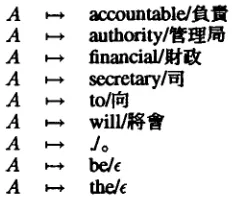
A ~ accountable/~tJ[ A ,---+ a n t h o r i t y / ~ t ~ A ~ finauciaYl[#l~ A .-* secretary/~ A ~ t o / ~ A ~-, w f l l ] ~
A ~ Jo
A ,-, beJe A ~ thele
Figure 2: Some relevant lexical productions.
. . E 1 - 1 , C 1 - 1 . . . C 1 ) . ~ ( E ' , C " ) i s d e r i v a b l e
( ~ A --* ( A ! - I ) , and thus (E, e ) - ( E ' E ! , C ! C ") is derivable from A ---, (A A). [ 7
4 Stochastic Bracketing Transduction
G r a m m a r sIn a stochastic BTG (SBTG), each rewrite rule has a prob- ability. Let a! denote the probability of the A-production with fanout degree f . For the remaining (lexical) pro- dnctions, we use b(z, y) to denote P [ A ~ z/vlA]. The probabiliti~ obey the constraint that
E a !
+ Eb(z'Y)=
1 l ~¢,YFor our experiments we employed a normal form trans- duction grammar, so a! = 0 for all f # 2. The A- productions used were:
A ~-* A A
A b(&~) z/v
A b~O x/e A ~%~) e/Vfor all z, y lexical translations for all z English vocabulary for all y Chinese vocabulary
The b(z, y) distribution actually encodes the English- Chinese translation lexicon. As discussed below, the lexicon we employed was automatically learned from a parallel corpus, giving us the b(z, y) probabilities di- rectly. The latter two singleton forms permit any word in either sentence to be unmatched. A small e-constant is chosen for the probabilities b(z, e) and b(e, y), so that the optimal bracketing resorts to these productions only when it is otherwise impossible to match words.
With BTGs, to parse means to build matched bracket- ings for senmnce-pairs rather than sentences. Tiffs means that the adjacency constraints given by the nested levels must be obeyed in the bracketings of both languages. The result of the parse gives bracketings for both input sen- tences, as well as a bracket alignment indicating the cor- responding brackets between the sentences. The bracket alignment includes a word alignment as a byproduct.
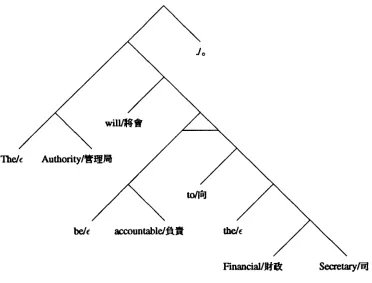
[image:3.612.382.499.50.150.2]Jo
will/~[#~
The/c A u t h o r i t y / ~ t ~
belt a c c o u n t a b l ~ theJ~
Financh~tt~
Figure 3: Bracketing tree.
Secretary/--~
(6) a. The Authority will be accountable to the Finan- cial Secretary.
b. I f t ~ l ~ t ' ~ l ~ t ~ t ~ o
Assume we have the productions in Figure 2, which is a fragment excerpted from our actual BTG. Ignoring cap- italization, an example of a valid parse that is consistent with our linguistic ideas is:
(7) [[[ The/e A u t h o r i t y / ~ t ~ ] [ w i l l / ~ ([ be& accountable/~t~ ] [ t o / ~ [ the/¢ [[ Financial/~l~
Secretary/~
]]]])]]
J.
]
Figure 3 shows a graphic representation of the same brac&eting, where the 0 level of lrac, keting is marked by the horizontal line. The English is read in the usual depth-first left-to-right order, but for the Chinese, a hori- zontal line means the right subtree is traversed before the left.
The
()
notation concisely displays the common struc- ture of the two sentences. However, the bracketing is clearer if we view the sentences monolingually, which allows us to invert the Chinese constituents within the 0 so that only [] brackets need to appear..(8) a. [[[ The Authority ] [ will [[ be accountable ] [ to [ the [[ Financial Secretary ]]]]]]1. ]
k
[[[[ " ~ , ' ~
] [ ~t'
[[ I~
[[ ~
~] ]]]]
[ ~.l
]]]]
o ]
In the monolingual view, extra brackets appear in one lan- guage whenever there is a singleton in the other language.
If the goal is just to obtain ~ for monolingual sen- tences, the extra brackets can be discarded a f t ~ parsing:
(9)
[[[ ~ , ~
] [ ~R [ ~ [ Igil~ ~ ]] [ ~ttt ]]] o ]
The basis of the bracketing strategy can be seen as choosing the bracketing that maximizes the (probabilis- tically weighted) number of words matched, subject to the BTG representational constraint, which has the ef- fect of limiting the possible crossing patterns in the word alignment. A simpler, related idea of penalizing dis- tortion from some ideal matching pattern can be found in the statistical translation (Brown et al. 1990; Brown
et al. 1993) and word alignment (Dagan et al. 1993; Dagan & Church 1994) models. Unlike these mod- els, however, the BTG aims m model constituent struc- ture when determining distortion penalties. In particu- lar, crossings that are consistent with the constituent tree structure are not penalized. The implicit assumption is that core arguments of frames remain similar across lan- guages, and tha! core arguments of the same frame will surface adjacently. The accuracy of the method on a particular language pair will therefore depend upon the extent to which this language universals hypothesis holds. However, the approach is robust because if the assump- tion is violated, damage will be limited to dropping the fewest possible crossed word matchings.
We now describe how a dynzmic-programming parser can compute an optimal bxackcting given a sentence-pair and a stochastic BTG. In bilingual parsing, just as with or- dinary monolingual parsing, probabilizing the grammar
[image:4.612.125.497.50.333.2]permits ambiguities to be resolved by choosing the max- imum likelihood parse. Our algorithm is similar in spirit to the recognition algorithm for HMMs (Viterbi 1967).
Denote the input English sentence by el, • • . , e r and the corresponding input Chinese sentence by e l , . . . , cv. As an abbreviation we write co.., for the sequence of words e o + l , e , + 2 , . . . ,e~, and similarly for c~..~. Let 6.tu~ = maxP[e,..t/e~..~] be the maximum probability of any derivation from A that__ successfully parses both substrings es..t and ¢u..v. The best parse of the sentence pair is that with probability 60,T,0y.
The algorithm computes 6o,T,0,V following the recur- fences below. 2 The time complexity of this algorithm is O ( T a V a) where T and V are the lengths of the two s e n ~ .
1. Initialization
6 t - - l , t , v - - l , v "-
2. Recursion 6 t t u v "--
O t t u u --"
where
l < t < T b ( e , / ~ ), 1 < v < V
maxr/~[] t s t u v ~ 60 s t u v J 1
. , 6 [ ] 611
s~ s t u v ~ s t u v
6[]uv = m a x a2 6,suu 6stuv s < S < ~
u<V<v a[l
stuv "- axg s m a x 6sSut.r 6$tUv s < S < t
u<U<v
v [] sgut~ -- arg U m a x 6 , s u u 6 s t u v s < S < t
u<U<v
6J~uv -- m a x a 2 6sSU~ 6StuU s < $ < t
u<U<v
*r!~uv = arg s m a x 6,SV~ 6Stuff s < S < t
u<U<v
V~uv = arg U m a x 6,su~ 6S,uV
s < S < t
u<V<v
3. Reconstrm:tion Using 4-tuples to name each node of the parse tree, initially set qx = (0, T, 0, V) to be the root. The remaining descendants in the optimal parse tree are then given recursively for any q = (s, t, u, v) by:
LEFT' " "s ~r[] u v [] ~ /
~q) = ( ' [~ '"~' '[] ''"~) f i f 0 , t ~ = [] mGHT(q) = t,
LEFr' " "s o "0 v 0 v"
RIGHT(q) = ( a ! ~ u v , t , u , v ~ u ~ ) ) ifO, tuv = 0 Several additional extensions on this algorithm were found to be useful, and are briefly described below. De- tails are given in Wu (1995).
2We are gene~!izing argmax as to allow arg to specify the index of interest.
4.1 Simultaneous segmentation
We often find the same concept realized using different numbers of words in the two languages, creating potential difficulties for word alignment; what is a single word in English may be realized as a compound in Chinese. Since Chinese text is not orthographically separated into words, the standard methodology is to first preproce~ input texts through a segmentation module (Chiang et al. 1992; L i n e t al. 1992; Chang & Chert 1993; L i n e t al. 1993; Wu & Tseng 1993; Sproat et al. 1994). However, this se- rionsly degrades our algorithm's performance, since the the segmenter may encounter ambiguities that are un- resolvable monolingually and thereby introduce errors. Even if the Chinese segmentation is acceptable moaolin- gually, it may not agree with the division of words present in the English sentence. Moreover, conventional com- pounds are frequently and unlmxlictably missing from translation lexicons, and this can furllu~ degrade perfor- Inane.
To avoid such problems we have extended the algo- rithm to optimize the segmentation of the Chinese sen- tence in parallel with the ~ t i n g lm~:ess. Note that this treatment of segmentation does not attempt to ad- dress the open linguistic question o f what constitutes a Chinese "word". Our definition of a correct "segmenta- tion" is purely task-driven: longer segments are desirable if and only ff no compositional translation is possible.
4.2 Pre/post-positional biases
Many of the bracketing errors are caused by singletons. With singletons, there is no cross-lingual discrimination to increase the certainty between alternative brackeaings. A heuristic to deal with this is to specify for each of the two languages whether prepositions or postpositions more common, where "preposition" here is meant not in the usual part-of-speech sense, but rather in a broad sense of the tendency of function words to attach left or right. This simple swategcm is effective because the majority of unmatched singletons are function words that counterparts in the other language. This observation holds assuming that the translation lexicon's coverage is reasonably good. For both English and Chinese, we specify a prepositional bias, which means that singletons are attached to the right whenever possible.
4.3 Punctuation constraints
5 P o s t p r o c e s s i n g
5.1 A Singleton-Rebalancing Algorithm
We now introduce an algorithm for further improving the bracketing accuracy in cases of singletons. Consider the following bracketing produced by the algorithm of the previous section:
(10) [tThe/~ [ [ A u t h o r i t y / ~ f ~ [wilg~ad ([be/~
accountable/~t~] [to the/~ [~/~ [Financial/~i~Seaetary/-nl ]]])]ll] Jo ]
The prepositional bias has already correctly restricted the singleton "Tbe/d' to attach to the right, but of course "The" does not belong outside the rest of the sentence, but rather with "Authority". The problem is that single- tons have no discriminative power between alternative bracket matchings--they only contribute to the ambigu- ity. However, we can minimize the impact by moving singletons as deep as possible, closer to the individual word they precede or succeed, by widening the scope of the brackets immediately following the singleton. In general this improves precision since wide-scope brack- ets are less constraining.
The algorithm employs a rebalancing strategy rem- niscent of balanced-tree structures using left and right rotations. A left rotation changes a (A(BC)) structure to a ((AB)C) structure, and vice versa for a right rotation. The task is complicated by the presence of both [] and 0 brackets with both LI- and L2-singletons, since each combination presents different interactions. To be legal, a rotation must preserve symbol order on both output streams. However, the following lemma shows that any subtree can always be rebalanced at its root if either of its children is a singleton of either language.
Lenuna 4 Let x be a L1 singleton, y be a L2 singleton, and A, B, C be arbitrary constituent subtrees. Then the following properties hold for the [] and 0 operators:
(Associativity)
[A[BC]] =
[[AB]C]
(A(BC)) = ((AB)C)
(L, -singleton bidirectionality)
lax]
~-- (A~)
[,A] : (xA) (L2-singleton flipping commutativity)
[Av]
=(vA)
[uA]
=(Av)
(L 1-singleton rotation properties)
[z(AB)] ~- (x(AB)) ~-- ((zA)B) ~- ([xA]B) (x[aB]) ~--- [x[AB]] ~--- [[zA]B] .~ [(xA)B]
[(AB)x] = ((AB)~) = (A(B~)) = (A[B~])
(lAB]x) ~- [[AB]x] = [A[Bx]] ~--- [A(Bx)]
(L~-singleton rotation properties)
[v(AB)] =
((AB)v) = (A(Bv)) = (AtvB])
(y[AB]) ~-- [[AB]y] ~ [A[By]] ~-- [A(yB)] [(AB)v] ,~ (y(AB)) ~ ((vA)B) ~- (My]B)
([AB]v) ~ [v[AB]] =
ttvA]B]
= [(Av)B]
The method of Figure 4 modifies the input tree to attach singletons as closely as possible to couples, but remain- ing consistent with the input tree in the following sense: singletons cannot "escape" their inmmdiately surround- ing brackets. The key is that for any given subtree, if the outermost bracket involves a singleton that should be rotated into a subtree, then exactly one of the single- ton rotation properties will apply. The method proceeds depth-first, sinking each singleton as deeply as possible. For example, after rebalm~cing, sentence (10) is bracketed as follows:(11) [[[[The/e A u t h o r i t y / ~ ] [witV~1t' ([be/e accountable/~tft] [to the/~ [dFBJ [Fhumciai/ll~'i~
Secretary/--~ 111)111
Jo]
5.2 Flattening the Bracketing
Because the BTG is in normal form, each bracket can only hold two constituents. This improves parsing ef- ficiency, but requires overcommiUnent since the algo- rithm is always forced to choose between (A(BC)) and ((AB)C) statures even when no choice is clearly bet- ter. In the worst case, both senteau:~ might have perfectly aligned words, lending no discriminative leverage what- soever to the bfac~ter. This leaves a very large number of choices: if both sentences are of length i = m, then thel~ ~ (21) 1 possible lracJw~ngs with fanout 2, none of which is better justitied than any other. Thus to improve accuracy, we should reduce the specificity of the bracketing's commitment in such cases.
We implement this with another postprocessing stage. The algorithm proceeds bottom-up, elimiDming as malay brackets as possible, by making use of the associafiv-
ity
equivalences [ABel = [A[BC]] = [lAB]C] and
SINK-SINGLETON(node) 1 ffnode is not aleaf
2 if a rotation property applies at node 3 apply the rotation to node
4 ch//d ~-- the child into which the singleton
5 was rotated
6 SINK-SINGLETON(chi/d)
RE~AL~CE-aXEE(node)
1 if node is not a leaf2 REBALANCE-TREE(left-child[node]) 3 REeALANCE-TREE(right-child[node]) 4 S ~K-SXNGI.,E'ro~(node)
Figure 4: The singleton rebalancing schema.
[ T h e s e / ~ a r r a n g e m e n t s / ~ will/e e f ~ enhance/~q~ o u r / ~ ([d~J ability/~;0] [tok dEt ~ maintain/~t~ m o n e t a r y / ~ t s t a b i l i t y / ~ in the years to come/e]) do ]
[The/e A u t h o r i t y / ~ ] ~ w i l l / ~ ([be/e accountable/gt~] [to the/e elm Financial/l~i~ Secretary/~]) Jo ] [They/~t!l~J ( are/e right/iE~ d-l-Jff tok d o / ~ e / ~ so/e ) io ]
[([ Evenk m o r e ~ i m p o r t a n t / l ~ ] [Je however/~_ ]) [Je e/~, i s / ~ to make the very best of our/e e / ~ f f l ~ own/~ $~ e/~J talent/X~ ] J . ]
hope/e e/o!~l employers/{l[~l~ will/~ make full/e d g ~ r j ' ~ use/~ [offe those/]Jl~a~__] (([dJfJ-V who/&] [have aequired/e e / $ ~ new/~i skills/tS~l~
])
[through/L~i~t t h i s J ~ l programme/~l'|~])J. ]
have/~ o at/e
length/~l ( on/e how/~g~ w e / ~ e/~ll~) [canFaJJ)~
boostk d~ilt our/~:~ e/~ prosperity/$~
]Jo]
Figure 5: Bracketing/alignment output examples. ( ~ = unrecognized input token.)
(ABC) = (A(BC)) = ((AB)C). Tim singletonbidi- rectionality and flipping eommutativity equivalences (see Lemma 4) are also applied, whenever they render the as- sociativity equivalences applicable.
The final result after flattening sentence (11) is as fol- lows:
(12) [ The/e A u t h o r i t y / ~ ] ~ w i l l / g ~ ' ([ be/e accountable/J~tJ![ ] [ to tl~/e elm F i n a n c i a l / l ~
Secretary/--~ 1)
j o ]6
Experiments
Evaluation methodology for bracketing is controversial because of varying perspectives on what the "gold stan- dard" should be. We identify two prototypical positions, and give results for both. One position uses a linguistic evaluation criterion, where accuracy is measured against some theoretic notion of constituent structure. The other position uses a functional evaluation criterion, where the "correctness" of a bracketing depends on its utility with respect to the application task at hand. For example, here we consider a bracket-pair functionally useful if it cor- rectly identifies phrasal translations---especially where the phrases in the two languages are not compositionally derivable solely from obvious word translations. Notice that in contrast, the linguistic evaluation criterion is in- sensitive to whether the bracketings of the two sentences match each other in any semantic way, as long as the monolingual bracketings
in each sentence are
correct. In either case, the bracket precision gives the proportion of found br~&ets that agree with the chosen correctness criterion.All experiments reported in this paper were performed on sentence-pairs from the HKUST English-Chinese Par- allel Bilingual Corpus, which consists of governmental transcripts (Wu 1994). The translation lexicon was au- tomatically learned from the same corpus via statisti- cal sentence alignment (Wu 1994) and statistical Chi- nese word and collocation extraction (Fung & Wu 1994; Wu & Fung 1994), followed by an EM word-translation learning procedure (Wu & Xia 1994). The translation
lexicon contains an English vocabulary of approximately 6,500 words and a Chinese vocabulary of approximately 5,500 words. The mapping is many-to-many, with an average of 2.25 Chinese translations per English word. The translation accuracy is imperfect (about 86% percent weighted precision), which turns out to cause many of the bracketing errors.
Approximately 2,000 sentence-pairs with both English and Chinese lengths of 30 words or less were extracted from our corpus and bracketed using the algorithm de- scribed. Several additional criteria were used to filter out unsuitable sentence-pairs. If the lengths of the pair of sentences differed by more thml a 2:1 ratio, the pair was rejected; such a difference usually arises as the re- sult of an earlier error in automatic sentence alignment. Sentences containing more than one word absent from the translation lexicon were also rejected; the bracketing method is not intended to be robust against lexicon inade- quacies. We also
rejected
sentence pairs with fewer than two matching words, since this gives the bracketing al- gorithm no diso'iminative leverage; such pairs ~c~ounted for less than 2% of the input data. A random sample of the b ~ k e t e d sentence pairs was then drawn, and the bracket precision was computed under each criterion for correctness. Additional examples are shown in Figure 5.Under the linguistic criterion, the monolingual bracket precision was 80.4% for the English sentences, and 78.4%
for the Chinese sentences. Of course, monolinguai
7 C o n c l u s i o n
We have proposed a new tool for the corpus linguist's arsenal: a method for simultaneously bracketing both halves o f a parallel bilingual corpus, using only a word translation lexicon. The method can also be seen as a word alignment algorithm that employs a realistic dis- tortion model and aligns consituents as well as words. The basis o f the approach is a new inversion-invariant transduction grammar formalism.
Various extension strategies for simultaneous segmen- tation, positional biases, punctuation constraints, single- ton rebalancing, and bracket flattening have been intro- duced. Parallel bracketing exploits a relatively untapped source o f constraints, in that parallel bilingual sentences are used to mutually analyze each other. The model nonetheless retains a high degree o f compatibility with more conventional monolingual formalisms and methods. The bracketing and alignment o f parallel corpora can be fully automatized with zero initial knowledge re- sources, with the aid o f automatic procedures for learning word translation lexicons. This is particularly valuable for work on languages for which online knowledge re- sources are relatively scarce compared with English.
A c k n o w l e d g e m e n t
I would like to thank Xuanyin Xia, E v a Wai-Man Foug, Pascale Fung, and Derick Wood.
R e f e r e n c e s
BLACK, EZRA, ROGER GARSIDE, & GEoF~EY I ~ (eds.). 1993. Statistically-driven computer grammars of En- glish: The I B ~ a s t e r approach. Amsterdam: Edi-
tions Rodopi.
BROWN, Pt~reR F., JOHN COCKE, STEPHEN A. D~1APt~rgA, VINCENT J. ~ t ~ r t t A , FR~ERICK J~LnqWK, JOHN D. ~ , ROBERT L. MERCER, & PAUL S. RoossiN. 1990. A statistical approach to machine translation. Com- putational Linguistics, 16(2):29-85.
BROWN, PETER E, STEPHEN A. DIKLAPmTxA, VINCENT J. DEL- LAPteTgA, & ROBERT L. M~CER. 1993. The mathematics of statistical machine translation: Parameter estimation.
Computational Linguistics, 19(2):263-311.
CHANG, CHAO-HUANG & CHE~G-DER CHEN. 1993. HMM- based part-of-speech tagging for Chinese corpora. In Pro- ceedings of the Workshop on Very Large Corpora, 40-47, Columbus, Ohio.
CHIANG, TUNG-HUI, JING-SHIN CHANG, MING-YU LIN, & KEH- YIH Su. 1992. Statistical models for word segmentation and unknown resolution. In Proceedings of ROCLING-92, 1 2 1 - 1 4 6 .
CHURCH, ~ W. 1993. Char-align: A program for align- ing parallel texts at the character level. In Proceedings of the 31st Annual Conference of the Association for Com- putational Linguistics, 1-8, Columbus, OH.
DAGAN, IDO & KENNETH W. CHURCH. 1994. Termight: Iden- tifying and translating technical terminology. In Proceed- ings of the Fourth Conference on Applied Natural Lan- guage Processing, 34-40, Stuttgart.
DAGAN, IDO, KENNETH W. CHURCH, & W [ ] [ J J ~ A. GAL~. 1993. Robust bilingual word alignment for machine aided
translation. In Proceedings of the Wor~hop on Very Large Corpora, 1-8, Columbus, OH.
FUNO, PASCALE & KENNETH W. CHURCH. 1994. K-vec: A new approach for aligning parallel texts. In Proceedings of the Fifteenth International Conference on Computational Linguistics, 1096-1102, Kyoto.
FUNG, PASCALE & K A T I ~ J ~ McKEoWN. 1994. Aligning noisy parallel corpora across language groups: Word pair feature matching by dynamic time warping. In AMTA-
94, Association for Machine Translation in the Americas,
81-88, Columbia, Maryland.
FUNO, PASCALE & DEKAI Wu. 1994. Statistical augmentation
o f a Chinese machine-readable dictionary. In Proceedings of the Second Annual Workshop on Very Large Corpora,
69-85, Kyoto.
GALE, WnH~M A. & ~ W. CHURCH. 1991. Aprogram for aligning sentences in bilingual corpora. In Proceed- ings of the 29th Annual Conference of the Association for Computational Linguistics, 177-184, Berkeley.
GALE, WnHAM A., KENNETH W. CHURCH, & DAVID YAROWSKY. 1992. Using bilingual materials to develop word sense disambiguatlon methods. In Fourth Inter- national Conference on Theoretical and Methodological Issues in Machine Translation, 101-112, Montreal. I ~ , M~o-Yu, Tt~o-Hta ~ o , & K ~ - Y m Su. 1993.
A preliminary study on unknown word problem in Chi- nese word segmentation. In Proceedings ofROCLING-93,
119-141.
LIN, YI-CHUNG, TUNG-HUI CHIANG, & KEH-Ym SU. 1992. Discrimination oriented pmbabilistic tagging. In Proceed- ings of ROCLING-92, 85-96.
MAGERMAN, DAVID M. & ~ L p. MARCUS. 1990. Parsing a natural language using mutual information statistics. In
Proceedings of AAAI-90, Eighth National Conference on Artificial Intelligence, 984--989.
PEREIRA, FEXNANDO & YVES SCHABES. 1992. Inside-outside re, estimation from partially bracketed corpora. In Proceed- ings of the 30th Annual Conference of the Association for Computational Linguistic:, 128-135, Newark, DE. SPROAT, RICHARD, CHn JN SHItl, Wn I JAM GALE, & N. CHANG.
1994. A stochastic word segmentation algorithm for a Mandarin text-to-speech system. In Proceedings of the 32nd Annual Conference of the Association for Computa- tional Linguistics, Lag Cruces, New Mexico. To appear. VITERBI, ANDREW J. 1967. Error bounds for convolutional
codes and an asymptotically optimal decoding algorithm.
IEEE Transactions on Information Theory, 13:260-269. WU, DEKAL 1994. Aligning a parallel English-Chinese corpus
statistically with lexical criteria. In Proceedings of the 32ndAnnual Conference of the Association for Computa- tional Linguistics, 80-87, [,as Cruces, New Mexico. WU, DEKAI, 1995. Stochastic inversion transduction grammars
and bilingual parsing of parallel corpora. In preparation. WU, DEKAI & PASCALE FUNG. 1994. Improving Chinese tok-
enization with linguistic filters on statistical lexical acqui- sition. In Proceedings of the Fourth Conference on@plied Natural Language Processing, 180-181, Stuttgart. Wu, D~,AI & XUANTIN XIA. 1994. Learning an English-
Chinese lexicon from a parallel corpus. In AMTA-94, As- sociation for Machine Translation in the Americas, 206-
213, Columbia, Maryland.
Wu, ZIMIN & GWYI~TH TSI~G. 1993. Chinese text seg- mentation for text retrieval: Achievements and problems.
Journal of The American Society for Information Science,
44(9):532-542.