Improving Name Tagging by
Reference Resolution and Relation Detection
Heng Ji Ralph Grishman
Department of Computer Science New York University New York, NY, 10003, USA
[email protected] [email protected]
Abstract
Information extraction systems incorpo-rate multiple stages of linguistic analysis. Although errors are typically compounded from stage to stage, it is possible to re-duce the errors in one stage by harnessing the results of the other stages. We dem-onstrate this by using the results of coreference analysis and relation extrac-tion to reduce the errors produced by a Chinese name tagger. We use an N-best approach to generate multiple hypotheses and have them re-ranked by subsequent stages of processing. We obtained thereby a reduction of 24% in spurious and incorrect name tags, and a reduction of 14% in missed tags.
1 Introduction
Systems which extract relations or events from a document typically perform a number of types of linguistic analysis in preparation for information extraction. These include name identification and classification, parsing (or partial parsing), semantic classification of noun phrases, and coreference analysis. These tasks are reflected in the evalua-tion tasks introduced for MUC-6 (named entity, coreference, template element) and MUC-7 (tem-plate relation).
In most extraction systems, these stages of analysis are arranged sequentially, with each stage using the results of prior stages and generating a
single analysis that gets enriched by each stage. This provides a simple modular organization for the extraction system.
Unfortunately, each stage also introduces a cer-tain level of error into the analysis. Furthermore, these errors are compounded – for example, errors in name recognition may lead to errors in parsing. The net result is that the final output (relations or events) may be quite inaccurate.
This paper considers how interactions between the stages can be exploited to reduce the error rate. For example, the results of coreference analysis or relation identification may be helpful in name clas-sification, and the results of relation or event ex-traction may be helpful in coreference.
Such interactions are not easily exploited in a simple sequential model … if name classification is performed at the beginning of the pipeline, it cannot make use of the results of subsequent stages. It may even be difficult to use this information im-plicitly, by using features which are also used in later stages, because the representation used in the initial stages is too limited.
In order to capture these interactions more ex-plicitly, we have employed a sequential design in which multiple hypotheses are forwarded from each stage to the next, with hypotheses being rer-anked and pruned using the information from later stages. We shall apply this design to show how named entity classification can be improved by ‘feedback’ from coreference analysis and relation extraction. We shall show that this approach can capture these interactions in a natural and efficient manner, yielding a substantial improvement in name identification and classification.
2 Prior Work
A wide variety of trainable models have been ap-plied to the name tagging task, including HMMs (Bikel et al., 1997), maximum entropy models (Borthwick, 1999), support vector machines (SVMs), and conditional random fields. People have spent considerable effort in engineering ap-propriate features to improve performance; most of these involve internal name structure or the imme-diate local context of the name.
Some other named entity systems have explored global information for name tagging. (Borthwick, 1999) made a second tagging pass which uses in-formation on token sequences tagged in the first pass; (Chieu and Ng, 2002) used as features infor-mation about features assigned to other instances of the same token.
Recently, in (Ji and Grishman, 2004) we pro-posed a name tagging method which applied an SVM based on coreference information to filter the names with low confidence, and used coreference rules to correct and recover some names. One limi-tation of this method is that in the process of dis-carding many incorrect names, it also discarded some correct names. We attempted to recover some of these names by heuristic rules which are quite language specific. In addition, this single-hypothesis method placed an upper bound on recall.
Traditional statistical name tagging methods have generated a single name hypothesis. BBN proposed the N-Best algorithm for speech recogni-tion in (Chow and Schwartz, 1989). Since then N-Best methods have been widely used by other re-searchers (Collins, 2002; Zhai et al., 2004).
In this paper, we tried to combine the advan-tages of the prior work, and incorporate broader knowledge into a more general re-ranking model.
3 Task and Terminology
Our experiments were conducted in the context of the ACE Information Extraction evaluations, and we will use the terminology of these evaluations:
entity: an object or a set of objects in one of the semantic categories of interest
mention: a reference to an entity (typically, a noun phrase)
namemention: a reference by name to an entity
nominalmention: a reference by a common noun or noun phrase to an entity
relation: one of a specified set of relationships be-tween a pair of entities
The 2004 ACE evaluation had 7 types of entities, of which the most common were PER (persons), ORG (organizations), and GPE (‘geo-political enti-ties’ – locations which are also political units, such as countries, counties, and cities). There were 7 types of relations, with 23 subtypes. Examples of these relations are “the CEO of Microsoft” (an em-ploy-exec relation), “Fred’s wife” (a family rela-tion), and “a military base in Germany” (a located relation).
In this paper we look at the problem of identify-ing name mentions in Chinese text and classifyidentify-ing them as persons, organizations, or GPEs. Because Chinese has neither capitalization nor overt word boundaries, it poses particular problems for name identification.
4 Baseline System
4.1 Baseline Name Tagger
Our baseline name tagger consists of a HMM tag-ger augmented with a set of post-processing rules. The HMM tagger generally follows the Nymble model (Bikel et al, 1997), but with multiple hy-potheses as output and a larger number of states (12) to handle name prefixes and suffixes, and transliterated foreign names separately. It operates on the output of a word segmenter from Tsinghua University.
seen in a corpus, “back-off models” are used to reflect the strength of support for a given statistic, as for the Nymble system.
We also add post-processing rules to correct some omissions and systematic errors using name lists (for example, a list of all Chinese last names; lists of organization and location suffixes) and par-ticular contextual patterns (for example, verbs oc-curring with people’s names). They also deal with abbreviations and nested organization names.
The HMM tagger also computes the margin – the difference between the log probabilities of the top two hypotheses. This is used as a rough meas-ure of confidence in the top hypothesis (see sec-tions 5.3 and 6.2, below).
The name tagger used for these experiments identifies the three main ACE entity types: Person (PER), Organization (ORG), and GPE (names of the other ACE types are identified by a separate component of our system, not involved in the ex-periments reported here).
4.2 Nominal Mention Tagger
Our nominal mention tagger (noun group recog-nizer) is a maximum entropy tagger trained on the Chinese TreeBank from the University of Pennsyl-vania, supplemented by list matching.
4.3 Reference Resolver
Our baseline reference resolver goes through two successive stages: first, coreference rules will iden-tify some high-confidence positive and negative mention pairs, in training data and test data; then the remaining samples will be used as input of a maximum entropy tagger. The features used in this tagger involve distance, string matching, lexical information, position, semantics, etc. We separate the task into different classifiers for different men-tion types (name / noun / pronoun). Then we in-corporate the results from the relation tagger to adjust the probabilities from the classifiers. Finally we apply a clustering algorithm to combine them into entities (sets of coreferring mentions).
4.4 Relation Tagger
The relation tagger uses a k-nearest-neighbor algo-rithm. For both training and test, we consider all pairs of entity mentions where there is at most one other mention between the heads of the two
men-tions of interest1. Each training / test example con-sists of the pair of mentions and the sequence of intervening words. Associated with each training example is either one of the ACE relation types or no relation at all. We defined a distance metric be-tween two examples based on
whether the heads of the mentions match
whether the ACE types of the heads of the mentions match (for example, both are people or both are or-ganizations)
whether the intervening words match
To tag a test example, we find the k nearest training examples (where k = 3) and use the dis-tance to weight each neighbor, then select the most common class in the weighted neighbor set.
To provide a crude measure of the confidence of our relation tagger, we define two thresholds, Dnear and Dfar. If the average distance d to the nearest neighbors d < Dnear, we consider this a definite re-lation. If Dnear < d < Dfar, we consider this a possi-ble relation. If d > Dfar, the tagger assumes that no relation exists (regardless of the class of the nearest neighbor).
5 Information from Coreference and Re-lations
Our system is processing a document consisting of multiple sentences. For each sentence, the name recognizer generates multiple hypotheses, each of which is an NE tagging of the entire sentence. The names in the hypothesis, plus the nouns in the categories of interest constitute the mention set for that hypothesis. Coreference resolution links these mentions, assigning each to an entity. In symbols:
Si is the i-th sentence in the document.
Hi is the hypotheses set for Si
hij is the j-th hypothesis in Si
Mij is the mention set for hij
mijk is the k-th mention in Mij
eijk is the entity which mijkbelongs to according to
the current reference resolution results
5.1 Coreference Features
For each mention we compute seven quantities based on the results of name tagging and reference resolution:
1
CorefNumijk is the number of mentions in eijk
WeightSumijk is the sum of all the link weights
be-tween mijkand other mentions in eijk, 0.8 for
name-name coreference; 0.5 for apposition; 0.3 for other name-nominal coreference
FirstMentionijk is 1 if mijkis the first name mention
in the entity; otherwise 0
Headijk is 1 if mijkincludes the head word of name;
otherwise 0
Withoutidiomijk is 1 if mijkis not part of an idiom;
otherwise 0
PERContextijk is the number of PER context words around a PER name such as a title or an ac-tion verb involving a PER
ORGSuffixijk is 1 if ORGmijkincludes a suffix word;
otherwise 0
The first three capture evidence of the correct-ness of a name provided by reference resolution; for example, a name which is coreferenced with more other mentions is more likely to be correct. The last four capture local or name-internal evi-dence; for instance, that an organization name in-cludes an explicit, organization-indicating suffix.
We then compute, for each of these seven quan-tities, the sum over all mentions k in a sentence, obtaining values for CorefNumij, WeightSumij, etc.:
CorefNumij CorefNumijk k
=
∑
etc.Finally, we determine, for a given sentence and hypothesis, for each of these seven quantities, whether this quantity achieves the maximum of its values for this hypothesis:
BestCorefNumij≡
CorefNumij = maxq CorefNumiq etc. We will use these properties of the hypothesis as features in assessing the quality of a hypothesis.
5.2 Relation Word Clusters
In addition to using relation information for reranking name hypotheses, we used the relation training corpus to build word clusters which could more directly improve name tagging. Name tag-gers rely heavily on words in the immediate con-text to identify and classify names; for example, specific job titles, occupations, or family relations can be used to identify people names. Such words are learned individually from the name tagger’s training corpus. If we can provide the name tagger with clusters of related words, the tagger will be
able to generalize from the examples in the training corpus to other words in the cluster.
The set of ACE relations includes several in-volving employment, social, and family relations. We gathered the words appearing as an argument of one of these relations in the training corpus, eliminated low-frequency terms and manually ed-ited the ten resulting clusters to remove inappro-priate terms. These were then combined with lists (of titles, organization name suffixes, location suf-fixes) used in the baseline tagger.
5.3 Relation Features
Because the performance of our relation tagger is not as good as our coreference resolver, we have used the results of relation detection in a relatively simple way to enhance name detection. The basic intuition is that a name which has been correctly identified is more likely to participate in a relation than one which has been erroneously identified.
For a given range of margins (from the HMM), the probability that a name in the first hypothesis is correct is shown in the following table, for names participating and not participating in a relation:
Margin In Relation(%) Not in Relation(%)
<4 90.7 55.3
<3 89.0 50.1
<2 86.9 42.2
<1.5 81.3 28.9
<1.2 78.8 23.1
<1 75.7 19.0
[image:4.612.316.532.378.485.2]<0.5 66.5 14.3
Table 1 Probability of a name being correct
Table 1 confirms that names participating in re-lations are much more likely to be correct than names that do not participate in relations. We also see, not surprisingly, that these probabilities are strongly affected by the HMM hypothesis margin (the difference in log probabilities) between the first hypothesis and the second hypothesis. So it is natural to use participation in a relation (coupled with a margin value) as a valuable feature for re-ranking name hypotheses.
Let mijkbe the k-th name mention for
Inrelationijk = 1 if mijk is in a definite relation
= 0 if mijk is in a possible relation
= -1 if mijk is not in a relation Inrelationij Inrelationijk
k
=
∑
Mostrelatedij ≡(Inrelationij =maxqInrelationiq) Finally, to capture the interaction with the margin, we let zi = the margin for sentence Si and divide the range of values of ziinto six intervals Mar1, … Mar6. And we define the hypothesis ranking in-formation: FirstHypothesisij= 1 if j =1; otherwise 0.
We will use as features for ranking hij the con-junction of Mostrelatedij, zi∈ Marp (p = 1, …, 6), andFirstHypothesisij.
6 Using the Information from Corefer-ence and Relations
6.1 Word Clustering based on Relations
As we described in section 5.2, we can generate word clusters based on relation information. If a word is not part of a relation cluster, we consider it an independent (1-word) cluster.
The Nymble name tagger (Bikel et al., 1999) re-lies on a multi-level linear interpolation model for backoff. We extended this model by adding a level from word to cluster, so as to estimate more reli-able probabilities for words in these clusters. Treli-able 2 shows the extended backoff model for each of the three probabilities used by Nymble.
Transition Probability
First-Word Emission Probability
Non-First-Word Emission Probability P(NC2|NC1,
<w1, f1>)
P(<w2,f2>|
NC1, NC2)
P(<w2,f2>|
<w1,f1>, NC2)
P(<Cluster2,f2>|
NC1, NC2)
P(<Cluster2,f2>|
<w1,f1>, NC2)
P(NC2|NC1,
<Cluster1,
f1>)
P(<Cluster2,f2>|
<+begin+, other>, NC2)
P(<Cluster2,f2>|
<Cluster1,f1>,
NC2)
P(NC2|NC1) P(<Cluster2, f2>|NC2)
P(NC2) P(Cluster2|NC2) * P(f2|NC2)
1/#(name classes)
1/#(cluster) * 1/#(word features)
Table2 Extended Backoff Model
6.2 Pre-pruning by Margin
The HMM tagger produces the N best hypotheses for each sentence.2 In order to decide when we need to rely on global (coreference and relation) information for name tagging, we want to have some assessment of the confidence that the name tagger has in the first hypothesis. In this paper, we use the margin for this purpose. A large margin indicates greater confidence that the first hypothe-sis is correct.3 So if the margin of a sentence is above a threshold, we select the first hypothesis, dropping the others and by-passing the reranking.
6.3 Re-ranking based on Coreference
We described in section 5.1, above, the coreference features which will be used for reranking the hy-potheses after pre-pruning. A maximum entropy model for re-ranking these hypotheses is then trained and applied as follows:
Training
1. Use K-fold cross-validation to generate multi-ple name tagging hypotheses for each docu-ment in the training data Dtrain (in each of the K iterations, we use K-1 subsets to train the HMM and then generate hypotheses from the Kth subset).
2. For each document d in Dtrain, where d includes n sentences S1…Sn
For i = 1…n, let m = the number of hy-potheses for Si
(1) Pre-prune the candidate hypotheses us-ing the HMM margin
(2) For each hypothesis hij, j = 1…m (a) Compare hij with the key, set the
prediction Valueij “Best” or “Not Best”
(b) Run the Coreference Resolver on hij and the best hypothesis for each of the other sentences, generate entity results for each candidate name in hij
(c) Generate a coreference feature vec-tor Vij for hij
(d) Output Vij and Valueij
2 We set different N = 5, 10, 20 or 30 for different margin ranges, by cross-validation checking the training data about the ranking position of the best hypothesis for each sentence. With this N, optimal reranking (selecting the best hypothesis among the N best) would yield Precision = 96.9 Recall = 94.5 F = 95.7 on our test corpus.
3. Train Maxent Re-ranking system on all Vij and Valueij
Test
1. Run the baseline name tagger to generate mul-tiple name tagging hypotheses for each docu-ment in the test data Dtest
2. For each document d in Dtest, where d includes n sentences S1…Sn
(1) Initialize: Dynamic input of coreference re-solver H = {hi-best | i = 1…n, hi-best is the current best hypothesis for Si}
(2) For i = 1…n, assume m = the number of hypotheses for Si
(a) Pre-prune the candidate hypotheses us-ing the HMM margin
(b) For each hypothesis hij, j = 1…m • hi-best = hij
• Run the Coreference Resolver on H, generate entity results for each name candidate in hij
• Generate a coreference feature vec-tor Vij for hij
• Run Maxent Re-ranking system on Vij, produce Probij of “Best” value (c) hi-best = the hypothesis with highest
Probij of “Best” value, update H and output hi-best
6.4 Re-ranking based on Relations
From the above first-stage re-ranking by corefer-ence, for each hypothesis we got the probability of its being the best one. By using these results and relation information we proceed to a second-stage re-ranking. As we described in section 5.3, the in-formation of “in relation or not” can be used to-gether with margin as another important measure of confidence.
In addition, we apply the mechanism of weighted voting among hypotheses (Zhai et al., 2004) as an additional feature in this second-stage re-ranking. This approach allows all hypotheses to vote on a possible name output. A recognized name is con-sidered correct only when it occurs in more than 30 percent of the hypotheses (weighted by their prob-ability).
In our experiments we use the probability pro-duced by the HMM, probij, for hypothesishij. We
normalize this probability weight as:
W prob
prob
ij
ij
iq q
=
∑
exp( )
exp( )
For each name mention mijkinhij, we define:
Occur mq( ijk) = 1 if mijk occurs in hq
= 0 otherwise
Then we count its voting value as follows: Votingijk is 1 if W Occur m
iq q ijk q
×
∑
( ) >0.3;otherwise 0.
The voting value of hijis:
Votingij Votingijk k
=
∑
Finally we define the following voting feature: BestVotingij ≡(Votingij =maxqVotingiq)
This feature is used, together with the features described at the end of section 5.3 and the prob-ability score from the first stage, for the second-stage maxent re-ranking model.
One appeal of the above two re-ranking algo-rithms is its flexibility in incorporating features into a learning model: essentially any coreference or relation features which might be useful in dis-criminating good from bad structures can be in-cluded.
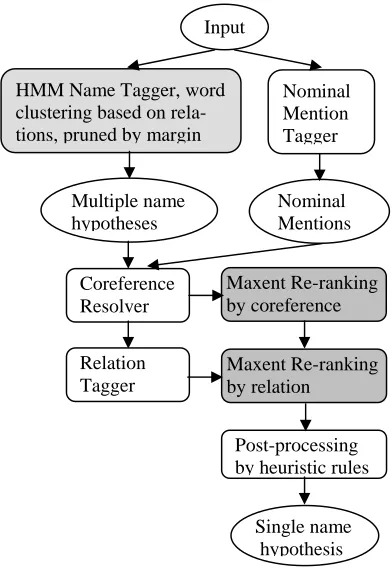
7 System Pipeline
Combining all the methods presented above, the flow of our final system is shown in figure 1.
8 Evaluation Results
8.1 Training and Test Data
Figure 1 System Flow
8.2 Overall Performance Comparison
Table 3 shows the performance of the baseline sys-tem; Table 4 is the system with relation word clus-ters; Table 5 is the system with both relation clusters and re-ranking based on coreference fea-tures; and Table 6 is the whole system with sec-ond-stage re-ranking using relations.
The results indicate that relation word clusters help to improve the precision and recall of most name types. Although the overall gain in F-score is small (0.7%), we believe further gain can be achieved if the relation corpus is enlarged in the future. The re-ranking using the coreference fea-tures had the largest impact, improving precision and recall consistently for all types. Compared to our system in (Ji and Grishman, 2004), it helps to distinguish the good and bad hypotheses without any loss of recall. The second-stage re-ranking us-ing the relation participation feature yielded a small further gain in F score for each type, improv-ing precision at a slight cost in recall.
The overall system achieves a 24.1% relative re-duction on the spurious and incorrect tags, and 14.3% reduction in the missing rate over a
state-of-the-art baseline HMM trained on the same material. Furthermore, it helps to disambiguate many name type errors: the number of cases of type confusion in name classification was reduced from 191 to 102.
Name Precision Recall F
PER 88.6 89.2 88.9
GPE 88.1 84.9 86.5
ORG 88.8 87.3 88.0
ALL 88.4 86.7 87.5
Table 3 Baseline Name Tagger
Name Precision Recall F
PER 89.4 90.1 89.7
GPE 88.9 85.8 89.4
ORG 88.7 87.4 88.0
[image:7.612.311.534.125.527.2]ALL 89.0 87.4 88.2
Table 4 Baseline + Word Clustering by Relation
Name Precision Recall F
PER 90.1 91.2 90.5
GPE 89.7 86.8 88.2
ORG 90.6 89.8 90.2
ALL 90.0 88.8 89.4
Table 5 Baseline + Word Clustering by Relation + Re-ranking by Coreference
Name Precision Recall F
PER 90.7 91.0 90.8
GPE 91.2 86.9 89.0
ORG 91.7 89.1 90.4
[image:7.612.312.535.136.295.2]ALL 91.2 88.6 89.9
Table 6 Baseline + Word Clustering by Relation + Re-ranking by Coreference +
Re-ranking by Relation
In order to check how robust these methods are, we conducted significance testing (sign test) on the 346 documents. We split them into 5 folders, 70 documents in each of the first four folders and 66 in the fifth folder. We found that each enhance-ment (word clusters, coreference reranking, rela-tion reranking) produced an improvement in F score for each folder, allowing us to reject the hy-pothesis that these improvements were random at a 95% confidence level. The overall F-measure im-provements (using all enhancements) for the 5 folders were: 2.3%, 1.6%, 2.1%, 3.5%, and 2.1%.
HMM Name Tagger, word clustering based on rela-tions, pruned by margin
Multiple name hypotheses
Maxent Re-ranking by coreference
Single name hypothesis Post-processing by heuristic rules Input
Nominal Mention Tagger
Nominal Mentions
Relation Tagger
Maxent Re-ranking by relation Coreference
[image:7.612.313.533.415.521.2]9 Conclusion
This paper explored methods for exploiting the interaction of analysis components in an informa-tion extracinforma-tion system to reduce the error rate of individual components. The ACE task hierarchy provided a good opportunity to explore these inter-actions, including the one presented here between reference resolution/relation detection and name tagging. We demonstrated its effectiveness for Chinese name tagging, obtaining an absolute im-provement of 2.4% in F-measure (a reduction of 19% in the (1 – F) error rate). These methods are quite low-cost because we don’t need any extra resources or components compared to the baseline information extraction system.
Because no language-specific rules are involved and no additional training resources are required, we expect that the approach described here can be straightforwardly applied to other languages. It should also be possible to extend this re-ranking framework to other levels of analysis in informa-tion extracinforma-tion –- for example, to use event detec-tion to improve name tagging; to incorporate subtype tagging results to improve name tagging; and to combine name tagging, reference resolution and relation detection to improve nominal mention tagging. For Chinese (and other languages without overt word segmentation) it could also be extended to do character-based name tagging, keeping mul-tiple segmentations among the N-Best hypotheses. Also, as information extraction is extended to cap-ture cross-document information, we should expect further improvements in performance of the earlier stages of analysis, including in particular name identification.
For some levels of analysis, such as name tag-ging, it will be natural to apply lattice techniques to organize the multiple hypotheses, at some gain in efficiency.
Acknowledgements
This research was supported by the Defense Ad-vanced Research Projects Agency under Grant N66001-04-1-8920 from SPAWAR San Diego, and by the National Science Foundation under Grant 03-25657. This paper does not necessarily reflect the position or the policy of the U.S. Gov-ernment.
References
Daniel M. Bikel, Scott Miller, Richard Schwartz, and
Ralph Weischedel. 1997. Nymble: a
high-performance Learning Name-finder. Proc. Fifth Conf. on Applied Natural Language Processing, Washington, D.C.
Andrew Borthwick. 1999. A Maximum Entropy Ap-proach to Named Entity Recognition. Ph.D. Disser-tation, Dept. of Computer Science, New York University.
Hai Leong Chieu and Hwee Tou Ng. 2002. Named En-tity Recognition: A Maximum Entropy Approach Us-ing Global Information. Proc.: 17th Int’l Conf. on Computational Linguistics (COLING 2002), Taipei, Taiwan.
Yen-Lu Chow and Richard Schwartz. 1989. The N-Best Algorithm: An efficient Procedure for Finding Top N Sentence Hypotheses. Proc. DARPA Speech and Natural Language Workshop
Michael Collins. 2002. Ranking Algorithms for Named-Entity Extraction: Boosting and the Voted Percep-tron. Proc. ACL 2002
Heng Ji and Ralph Grishman. 2004. Applying Corefer-ence to Improve Name Recognition. Proc. ACL 2004 Workshop on Reference Resolution and Its Applica-tions, Barcelona, Spain
N. Kambhatla. 2004. Combining Lexical, Syntactic, and Semantic Features with Maximum Entropy Models for Extracting Relations. Proc. ACL 2004.
Tobias Scheffer, Christian Decomain, and Stefan Wrobel. 2001. Active Hidden Markov Models for In-formation Extraction. Proc. Int’l Symposium on In-telligent Data Analysis (IDA-2001).
Dmitry Zelenko, Chinatsu Aone, and Jason Tibbets. 2004. Binary Integer Programming for Information Extraction. ACE Evaluation Meeting, September 2004, Alexandria, VA.