Proceedings of the 45th Annual Meeting of the Association of Computational Linguistics, pages 160–167,
Mildly Context-Sensitive Dependency Languages
Marco Kuhlmann Programming Systems Lab
Saarland University Saarbrücken, Germany [email protected]
Mathias Möhl Programming Systems Lab
Saarland University Saarbrücken, Germany [email protected]
Abstract
Dependency-based representations of natu-ral language syntax require a fine balance between structural flexibility and computa-tional complexity. In previous work, several constraints have been proposed to identify classes of dependency structures that are well-balanced in this sense; the best-known but also most restrictive of these is projectivity. Most constraints are formulated on fully spec-ified structures, which makes them hard to in-tegrate into models where structures are com-posed from lexical information. In this paper, we show how two empirically relevant relax-ations of projectivity can be lexicalized, and how combining the resulting lexicons with a regular means of syntactic composition gives rise to a hierarchy of mildly context-sensitive dependency languages.
1 Introduction
Syntactic representations based on word-to-word de-pendencies have a long tradition in descriptive lin-guistics. Lately, they have also been used in many computational tasks, such as relation extraction (Cu-lotta and Sorensen, 2004), parsing (McDonald et al., 2005), and machine translation (Quirk et al., 2005).
Especially in recent work on parsing, there is a par-ticular interest innon-projectivedependency struc-tures, in which a word and its dependents may be spread out over a discontinuous region of the sen-tence. These structures naturally arise in the syntactic analysis of languages with flexible word order, such
as Czech (Veselá et al., 2004). Unfortunately, most formal results on non-projectivity are discouraging: While grammar-driven dependency parsers that are restricted to projective structures can be as efficient as parsers for lexicalized context-free grammar (Eis-ner and Satta, 1999), parsing is prohibitively expen-sive when unrestricted forms of non-projectivity are permitted (Neuhaus and Bröker, 1997). Data-driven dependency parsing with non-projective structures is quadratic when all attachment decisions are assumed to be independent of one another (McDonald et al., 2005), but becomes intractable when this assumption is abandoned (McDonald and Pereira, 2006).
In search of a balance between structural flexibility and computational complexity, several authors have proposed constraints to identify classes of non-projec-tive dependency structures that are computationally well-behaved (Bodirsky et al., 2005; Nivre, 2006). In this paper, we focus on two of these proposals: the gap-degree restriction, which puts a bound on the number of discontinuities in the region of a sen-tence covered by a word and its dependents, and the well-nestedness condition, which constrains the ar-rangement of dependency subtrees. Both constraints have been shown to be in very good fit with data from dependency treebanks (Kuhlmann and Nivre, 2006). However, like all other such proposals, they are for-mulated on fully specified structures, which makes it hard to integrate them into a generative model, where dependency structures are composed from elemen-tary units of lexicalized information. Consequently, little is known about the generative capacity and com-putational complexity oflanguages over restricted non-projective dependency structures.
Contents of the paper In this paper, we show how the gap-degree restriction and the well-nestedness condition can be captured in dependency lexicons, and how combining such lexicons with a regular means of syntactic composition gives rise to an infi-nite hierarchy of mildly context-sensitive languages. The technical key to these results is a procedure to encode arbitrary, even non-projective dependency structures into trees (terms) over a signature of local order-annotations. The constructors of these trees can be read as lexical entries, and both the gap-de-gree restriction and the well-nestedness condition can be couched as syntactic properties of these en-tries. Sets of gap-restricted dependency structures can be described using regular tree grammars. This gives rise to a notion of regular dependency lan-guages, and allows us to establish a formal relation between the structural constraints and mildly con-text-sensitive grammar formalisms (Joshi, 1985): We show that regular dependency languages correspond to the sets of derivations of lexicalized Linear Con-text-Free Rewriting Systems (lcfrs) (Vijay-Shanker
et al., 1987), and that the gap-degree measure is the structural correspondent of the concept of ‘fan-out’ in this formalism (Satta, 1992). We also show that adding the well-nestedness condition corresponds to the restriction oflcfrsto Coupled Context-Free
Grammars (Hotz and Pitsch, 1996), and that regu-lar sets of well-nested structures with a gap-degree of at most1are exactly the class of sets of deriva-tions of Lexicalized Tree Adjoining Grammar (ltag).
This result generalizes previous work on the relation betweenltagand dependency representations
(Ram-bow and Joshi, 1997; Bodirsky et al., 2005).
Structure of the paper The remainder of this pa-per is structured as follows. Section 2 contains some basic notions related to trees and dependency struc-tures. In Section 3 we present the encoding of depen-dency structures as order-annotated trees, and show how this encoding allows us to give a lexicalized re-formulation of both the gap-degree restriction and the well-nestedness condition. Section 4 introduces the notion of regular dependency languages. In Section 5 we show how different combinations of restrictions on non-projectivity in these languages correspond to different mildly context-sensitive grammar for-malisms. Section 6 concludes the paper.
2 Preliminaries
Throughout the paper, we writeŒnfor the set of all positive natural numbers up to and includingn. The set of all strings over a setAis denoted byA, the empty string is denoted by", and the concatenation of two stringsx andy is denoted either byxy, or, where this is ambiguous, byxy.
2.1 Trees
In this paper, we regard trees as terms. We expect the reader to be familiar with the basic concepts related to this framework, and only introduce our particular notation. Let˙be a set of labels. The set of (finite, unranked)treesover˙ is defined recursively by the equationT˙ ´ f .x/j 2 ˙; x 2T˙g. The set
ofnodesof a treet 2T˙is defined as
N. .t1 tn//´ f"g [ fi uji 2Œn; u2N.ti/g:
For two nodesu; v2N.t /, we say thatugovernsv, and writeuEv, ifvcan be written asv Dux, for some sequencex 2 N. Note that the governance relation is both reflexive and transitive. The converse of government is calleddependency, souEv can also be read as ‘v depends on u’. The yield of a nodeu2N.t /,buc, is the set of all dependents ofu int:buc ´ fv 2 N.t /juEvg. We also use the notationst .u/for the label at the node uoft, and t =ufor the subtree oft rooted atu. Atree language over˙ is a subset ofT˙.
2.2 Dependency structures
For the purposes of this paper, adependency structure over˙ is a paird D.t; x/, wheret 2 T˙ is a tree,
andx is a list of the nodes int. We writeD˙ to
refer to the set of all dependency structures over˙. Independently of the governance relation ind, the list x defines a total order on the nodes in t; we writeuvto denote thatuprecedesvin this order. Note that, like governance, the precedence relation is both reflexive and transitive. Adependency language over˙ is a subset ofD˙.
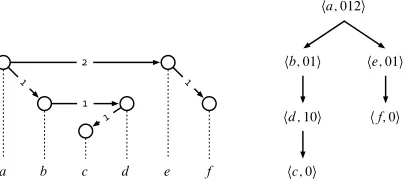
Example. The left half of Figure 1 shows how we
a b c d e f 2
1 1
1
1 hf; 0i
he; 01i ha; 012i
[image:3.612.85.292.76.174.2]hc; 0i hd; 10i hb; 01i
Figure 1: A projective dependency structure
3 Lexicalizing the precedence relation
In this section, we show how the precedence relation of dependency structures can be encoded as, and decoded from, a collection of node-specific order annotations. Under the assumption that the nodes of a dependency structure correspond to lexemic units, this result demonstrates how word-order information can be captured in a dependency lexicon.
3.1 Projective structures
Lexicalizing the precedence relation of a dependency structure is particularly easy if the structure under consideration meets the condition ofprojectivity. A dependency structure is projective, if each of its yields forms an interval with respect to the prece-dence order (Kuhlmann and Nivre, 2006).
In a projective structure, the interval that corre-sponds to a yieldbucdecomposes into the singleton intervalŒu; u, and the collection of the intervals that correspond to the yields of the immediate dependents ofu. To reconstruct the global precedence relation, it suffices to annotate each nodeuwith the relative precedences among the constituent parts of its yield. We represent this ‘local’ order as a string over the alphabetN0, where the symbol0represents the
sin-gleton intervalŒu; u, and a symboli ¤0represents the interval that corresponds to the yield of theith direct dependent ofu. Anorder-annotated treeis a tree labelled with pairsh; !i, where is the label proper, and! is a local order annotation. In what follows, we will use the functional notations .u/ and!.u/to refer to the label and order annotation ofu, respectively.
Example. Figure 1 shows a projective dependency
structure together with its representation as an
order-annotated tree.
We now present procedures for encoding projec-tive dependency structures into order-annotated trees, and for reversing this encoding.
Encoding The representation of a projective depen-dency structure.t; x/as an order-annotated tree can be computed in a single left-to-right sweep overx. Starting with a copy of the tree t in which every node is annotated with the empty string, for each new node uin x, we update the order annotation ofu through the assignment !.u/´!.u/0. IfuDvi for somei 2 N (that is, ifuis an inner node), we also update the order annotation of the parentvofu through the assignment!.v/´!.v/i.
Decoding To decode an order-annotated treet, we first linearize the nodes oft into a sequencex, and then remove all order annotations. Linearization pro-ceeds in a way that is very close to a pre-order traver-sal of the tree, except that the relative position of the root node of a subtree is explicitly specified in the order annotation. Specifically, to linearize an or-der-annotated tree, we look into the local order!.u/ annotated at the root node of the tree, and concatenate the linearizations of its constituent parts. A symboli in!.u/represents either the singleton intervalŒu; u (i D0), or the interval corresponding to some direct dependentui of u(i ¤ 0), in which case we pro-ceed recursively. Formally, the linearization ofuis captured by the following three equations:
lin.u/ D lin0.u; !.u//
lin0.u; i1 in/ D lin00.u; i1/ lin00.u; in/
lin00.u; i / D ifi D0thenuelselin.ui /
Both encoding and decoding can be done in time linear in the number of nodes of the dependency structure or order-annotated tree.
3.2 Non-projective structures
a b c e d f 1
2
1 1
1
ha;h01212ii
hc;h0ii
he;h0; 1ii
hf;h0ii hb;h01; 1ii
[image:4.612.82.293.75.174.2]hd;h1; 0ii
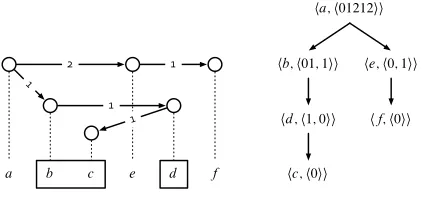
Figure 2: A non-projective dependency structure
Blocks In a non-projective dependency structure, the yield of a node may be spread out over more than one interval; we will refer to these intervals asblocks. Two nodesv; wbelong to the same block of a nodeu, if all nodes betweenvandware governed byu.
Example. Consider the nodes b; c; d in the
struc-tures depicted in Figures 1 and 2. In Figure 1, these nodes belong to the same block ofb. In Figure 2, the three nodes are spread out over two blocks ofb (marked by the boxes): c andd are separated by a node (e) not governed byb.
Blocks have a recursive structure that is closely re-lated to the recursive structure of yields: the blocks of a nodeucan be decomposed into the singletonŒu; u, and the blocks of the direct dependents ofu. Just as a projective dependency structure can be represented by annotating each yield with an order on its con-stituents, an unrestricted structure can be represented by annotating each block.
Extended order annotations To represent orders on blocks, we extend our annotation scheme as fol-lows. First, instead of a single string, an annotation !.u/now is a tuple of strings, where thekth com-ponent specifies the order among the constituents of thekth block ofu. Second, instead of one, the an-notation may now contain multiple occurrences of the same dependent; thekth occurrence ofiin!.u/ represents thekth block of the nodeui.
We write!.u/k to refer to thekth component of
the order annotation ofu. We also use the notation .i#k/uto refer to thekth occurrence ofi in!.u/,
and omit the subscript when the nodeuis implicit.
Example. In the annotated tree shown in Figure 2,
!.b/1D.0#1/.1#1/, and!.b/2D.1#2/.
Encoding To encode a dependency structure.t; x/ as an extended order-annotated tree, we do a post-order traversal oftas follows. For a given nodeu, let us represent a constituent of a block ofuas a triple i WŒvl; vr, wherei denotes the node that contributes
the constituent, andvl andvrdenote the constituent’s
leftmost and rightmost elements. At each nodeu, we have access to the singleton block0WŒu; u, and the constituent blocks of the immediate dependents ofu. We say that two blocksi W Œvl; vr; j WŒwl; wrcan
bemerged, if the nodevrimmediately precedes the
nodewl. The result of the merger is a new blockij W
Œvl; wrthat represents the information that the two
merged constituents belong to the same block ofu. By exhaustive merging, we obtain the constituent structure of all blocks ofu. From this structure, we can read off the order annotation!.u/.
Example. The yield of the nodeb in Figure 2
de-composes into 0 W Œb; b, 1 W Œc; c, and 1 W Œd; d . Sincebandc are adjacent, the first two of these con-stituents can be merged into a new block01WŒb; c; the third constituent remains unchanged. This gives rise to the order annotationh01; 1iforb.
When using a global data-structure to keep track of the constituent blocks, the encoding procedure can be implemented to run in time linear in the number of blocks in the dependency structure. In particular, for projective dependency structures, it still runs in time linear in the number of nodes.
Decoding To linearize thekth block of a nodeu, we look into thekth component of the order anno-tated atu, and concatenate the linearizations of its constituent parts. Each occurrence.i#k/in a com-ponent of !.u/ represents either the nodeu itself (i D0), or thekth block of some direct dependentui ofu(i ¤0), in which case we proceed recursively:
lin.u; k/ D lin0.u; !.u/k/
lin0.u; i1 in/ D lin00.u; i1/ lin00.u; in/
lin00.u; .i#k/u/ D ifi D0thenuelselin.ui; k/
Consistent order annotations Every dependency structure over˙can be encoded as a tree over the set ˙˝, where˝is the set of all order annotations. The converse of this statement does not hold: to be interpretable as a dependency structure, tree structure and order annotation in an order-annotated tree must beconsistent, in the following sense.
PropertyC1: Every annotation!.u/in a treet
contains all and only the symbols in the collection
f0g [ fi jui 2 N.t /g, i.e., one symbol foru, and one symbol for every direct dependent ofu.
PropertyC2: The number of occurrences of a
symboli ¤0in!.u/is identical to the number of components in the annotation of the nodeui. Further-more, the number of components in the annotation of the root node is1.
With this notion of consistency, we can prove the following technical result about the relation between dependency structures and annotated trees. We write ˙.s/for the tree obtained from a trees 2 T˙˝
by re-labelling every nodeuwith .u/.
Proposition1. For every dependency structure
.t; x/over˙, there exists a treesover˙˝such that ˙.s/ D t and lin.s/ D x. Conversely, for
every consistently order-annotated trees 2 T˙˝,
there exists a uniquely determined dependency struc-ture.t; x/with these properties.
3.3 Local versions of structural constraints
The encoding of dependency structures as order-an-notated trees allows us to reformulate two constraints on non-projectivity originally defined on fully speci-fied dependency structures (Bodirsky et al., 2005) in terms of syntactic properties of the order annotations that they induce:
Gap-degree The gap-degree of a dependency structure is the maximum over the number of dis-continuities in any yield of that structure.
Example. The structure depicted in Figure 2 has
gap-degree1: the yield of b has one discontinuity, marked by the nodee, and this is the maximal number of discontinuities in any yield of the structure.
Since a discontinuity in a yield is delimited by two blocks, and since the number of blocks of a nodeu equals the number of components in the order anno-tation ofu, the following result is obvious:
Proposition2. A dependency structure has
gap-de-greekif and only if the maximal number of compo-nents among the annotations!.u/iskC1.
In particular, a dependency structure is projective iff all of its annotations consist of just one component.
Well-nestedness The well-nestedness condition constrains the arrangement of subtrees in a depen-dency structure. Two subtreest =u1; t =u2interleave,
if there are nodesv1l; v1r 2 t =u1andvl2; vr2 2t =u2
such thatvl1vl2v1r vr2. A dependency struc-ture iswell-nested, if no two of its disjoint subtrees interleave. We can prove the following result:
Proposition3. A dependency structure is
well-nested if and only if no annotation!.u/ contains a substringi j i j, fori; j 2N.
Example. The dependency structure in Figure 1 is
well-nested, the structure depicted in Figure 2 is not: the subtrees rooted at the nodesb andeinterleave. To see this, notice thatb ed f. Also notice that!.a/contains the substring1212.
4 Regular dependency languages
The encoding of dependency structures as order-an-notated trees gives rise to an encoding of dependency languages as tree languages. More specifically, de-pendency languages over a set ˙ can be encoded as tree languages over the set˙ ˝, where˝ is the set of all order annotations. Via this encoding, we can study dependency languages using the tools and results of the well-developed formal theory of tree languages. In this section, we discuss depen-dency languages that can be encoded as regular tree languages.
4.1 Regular tree grammars
Formally, a(normalized) regular tree grammaris a constructG D .NG; ˙G; SG; PG/, in whichNG
and ˙G are finite sets of non-terminal and
termi-nal symbols, respectively,SG 2 NG is a dedicated
start symbol, andPG is a finite set of productions
of the form A ! .A1 An/, where 2 ˙G,
A2 NG, andAi 2NG, for everyi 2Œn. The
(di-rect) derivation relationassociated toG is the binary relation)G on the setT˙G[NG defined as follows:
t 2T˙G[NG t =uDA .A!s/2PG
t )G t Œu7!s
Informally, each step in a derivation replaces a non-terminal-labelled leaf by the right-hand side of a matching production. Thetree languagegenerated byG is the set of all terminal trees that can eventu-ally be derived from the trivial tree formed by its start symbol: L.G/D ft2T˙G jSG )G tg.
4.2 Regular dependency grammars
We call a dependency languageregular, if its encod-ing as a set of trees over˙˝forms a regular tree language, and write REGD for the class of all regular dependency languages. For every regular dependency languageL, there is a regular tree grammar with ter-minal alphabet˙˝that generates the encoding ofL. Similar to the situation with individual struc-tures, the converse of this statement does not hold: the consistency properties mentioned above impose corresponding syntactic restrictions on the rules of grammarsGthat generate the encoding ofL.
PropertyC10: The!-component of every
pro-ductionA! h; !i.A1 An/inGcontains all and
only symbols in the setf0g [ fi ji 2Œng.
PropertyC20: For every non-terminalX 2NG,
there is a uniquely determined integerdX such that
for every productionA ! h; !i.A1 An/in G,
dAi gives the number of occurrences of i in!,dA
gives the number of components in!, anddSG D1.
It turns out that these properties are in fact sufficient to characterize the class of regular tree grammars that generate encodings of dependency languages. In but slight abuse of terminology, we will refer to such grammars asregular dependency grammars.
Example. Figure 3 shows a regular tree grammar
that generates a set of non-projective dependency structures with string languagefanbnjn1g.
a b b b
a a
B
B B S
A
A
S ! ha;h01ii.B/j ha;h0121ii.A; B/ A ! ha;h0; 1ii.B/j ha;h01; 21ii.A; B/ B ! hb;h0ii
Figure 3: A grammar for a language in REGD.1/
5 Structural constraints and formal power
In this section, we present our results on the genera-tive capacity of regular dependency languages, link-ing them to a large class of mildly context-sensitive grammar formalisms.
5.1 Gap-restricted dependency languages
A dependency languageLis calledgap-restricted, if there is a constantcL0such that no structure inL
has a gap-degree higher thancL. It is plain to see that
every regular dependency language is gap-restricted: the gap-degree of a structure is directly reflected in the number of components of its order annotations, and every regular dependency grammar makes use of only a finite number of these annotations. We write REGD.k/to refer to the class of regular dependency languages with a gap-degree bounded byk.
Linear Context-Free Rewriting Systems Gap-re-stricted dependency languages are closely related to Linear Context-Free Rewriting Systems (lcfrs)
(Vijay-Shanker et al., 1987), a class of formal sys-tems that generalizes several mildly context-sensitive grammar formalisms. Anlcfrsconsists of a regular
tree grammarG and an interpretation of the terminal symbols of this grammar as linear, non-erasing func-tions into tuples of strings. By these funcfunc-tions, each tree inL.G/can be evaluated to a string.
Example. Here is an example for a function:
f .hx11; x12i;hx21i/ D hax11; x21x12i
of the root node (hx11; x21i) and the single string cor-responding to the second child (hx21i), and then con-catenate the individual components in the specified order, preceded by the terminal symbola.
We call a functionlexicalized, if it contributes ex-actly one terminal symbol. In anlcfrsin which all
functions are lexicalized, there is a one-to-one cor-respondence between the nodes in an evaluated tree and the positions in the string that the tree evaluates to. Therefore, tree and string implicitly form a depen-dency structure, and we can speak of thedependency languagegenerated by a lexicalizedlcfrs.
Equivalence We can prove that every regular de-pendency grammar can be transformed into a lexi-calized lcfrsthat generates the same dependency
language, and vice versa. The basic insight in this proof is that every order annotation in a regular de-pendency grammar can be interpreted as a compact description of a function in the correspondinglcfrs.
The number of components in the order-annotation, and hence, the gap-degree of the resulting depen-dency language, corresponds to thefan-out of the function: the highest number of components among the arguments of the function (Satta, 1992).1 A tech-nical difficulty is caused by the fact thatlcfrscan
swap components: f .hx11; x12i/ D hax12; x11i. This commutativity needs to be compiled out during the translation into a regular dependency grammar.
We write LLCFRL.k/for the class of all depen-dency languages generated by lexicalizedlcfrswith
a fan-out of at mostk.
Proposition4. REGD.k/DLLCFRL.kC1/
In particular, the class REGD.0/ of regular depen-dency languages over projective structures is exactly the class of dependency languages generated by lexi-calized context-free grammars.
Example. The gap-degree of the language generated
by the grammar in Figure 3 is bounded by1. The rules for the non-terminalAcan be translated into the following functions of an equivalentlcfrs:
fha;h0;1ii.hx11i/ D ha; x11i
fha;h01;21ii.hx11; x12i;hx21i/ D hax11; x21x12i
The fan-out of these functions is2.
1More precisely, gap-degreeDfan-out 1.
5.2 Well-nested dependency languages
The absence of the substringi j i j in the order annotations of well-nested dependency struc-tures corresponds to a restriction to ‘well-bracketed’ compositions of sub-structures. This restriction is central to the formalism of Coupled-Context-Free Grammar (ccfg) (Hotz and Pitsch, 1996).
It is straightforward to see that every ccfg can
be translated into an equivalentlcfrs. We can also
prove that everylcfrsobtained from a regular
depen-dency grammar with well-nested order annotations can be translated back into an equivalentccfg. We
write REGDwn.k/ for the well-nested subclass of
REGD.k/, and LCCFL.k/for the class of all depen-dency languages generated by lexicalizedccfgs with
a fan-out of at mostk.
Proposition5. REGDwn.k/DLCCFL.kC1/
As a special case, Coupled-Context-Free Grammars with fan-out2are equivalent to Tree Adjoining Gram-mars (tags) (Hotz and Pitsch, 1996). This enables
us to generalize a previous result on the class of de-pendency structures generated by lexicalizedtags
(Bodirsky et al., 2005) to the class of generated de-pendency languages, LTAL.
Proposition6. REGDwn.1/DLTAL
6 Conclusion
In this paper, we have presented a lexicalized refor-mulation of two structural constraints on non-pro-jective dependency representations, and shown that combining dependency lexicons that satisfy these constraints with a regular means of syntactic com-position yields classes of mildly context-sensitive dependency languages. Our results make a signif-icant contribution to a better understanding of the relation between the phenomenon of non-projectivity and notions of formal power.
frame-work of grammar-driven parsing. This may even-tually lead to a better trade-off between structural flexibility and computational efficiency than that ob-tained with current systems. On a more theoretical level, our results provide a basis for comparing a va-riety of formally rather distinct grammar formalisms with respect to the sets of dependency structures that they can generate. Such a comparison may be empir-ically more adequate than one based on traditional notions of generative capacity (Kallmeyer, 2006).
Acknowledgements We thank Guido Tack, Stefan Thater, and the anonymous reviewers of this paper for their detailed comments. The work of the authors is funded by the German Research Foundation.
References
Manuel Bodirsky, Marco Kuhlmann, and Mathias Möhl. 2005. Well-nested drawings as models of syntactic structure. InTenth Conference on Formal Grammar and Ninth Meeting on Mathematics of Language, Edin-burgh, Scotland, UK.
Aron Culotta and Jeffrey Sorensen. 2004. Dependency tree kernels for relation extraction. In 42nd Annual Meeting of the Association for Computational Linguis-tics (ACL), pages 423–429, Barcelona, Spain.
Jason Eisner and Giorgio Satta. 1999. Efficient parsing for bilexical context-free grammars and head automa-ton grammars. In37th Annual Meeting of the Asso-ciation for Computational Linguistics (ACL), pages 457–464, College Park, Maryland, USA.
Ferenc Gécseg and Magnus Steinby. 1997. Tree lan-guages. In Grzegorz Rozenberg and Arto Salomaa, editors, Handbook of Formal Languages, volume 3, pages 1–68. Springer-Verlag, New York, USA.
Günter Hotz and Gisela Pitsch. 1996. On parsing coupled-context-free languages.Theoretical Computer Science, 161:205–233.
Aravind K. Joshi. 1985. Tree adjoining grammars: How much context-sensitivity is required to provide reason-able structural descriptions? In David R. Dowty, Lauri Karttunen, and Arnold M. Zwicky, editors,Natural Lan-guage Parsing, pages 206–250. Cambridge University Press, Cambridge, UK.
Laura Kallmeyer. 2006. Comparing lexicalized grammar formalisms in an empirically adequate way: The notion of generative attachment capacity. In International Conference on Linguistic Evidence, pages 154–156, Tübingen, Germany.
Marco Kuhlmann and Joakim Nivre. 2006. Mildly non-projective dependency structures. In21st International Conference on Computational Linguistics and 44th An-nual Meeting of the Association for Computational Lin-guistics (COLING-ACL) Main Conference Poster Ses-sions, pages 507–514, Sydney, Australia.
Ryan McDonald and Fernando Pereira. 2006. On-line learning of approximate dependency parsing al-gorithms. In Eleventh Conference of the European Chapter of the Association for Computational Linguis-tics (EACL), pages 81–88, Trento, Italy.
Ryan McDonald, Fernando Pereira, Kiril Ribarov, and Jan Hajiˇc. 2005. Non-projective dependency parsing using spanning tree algorithms. InHuman Language Technol-ogy Conference (HLT) and Conference on Empirical Methods in Natural Language Processing (EMNLP), pages 523–530, Vancouver, British Columbia, Canada.
Peter Neuhaus and Norbert Bröker. 1997. The complexity of recognition of linguistically adequate dependency grammars. In35th Annual Meeting of the Association for Computational Linguistics (ACL), pages 337–343, Madrid, Spain.
Joakim Nivre. 2006. Constraints on non-projective depen-dency parsing. InEleventh Conference of the European Chapter of the Association for Computational Linguis-tics (EACL), pages 73–80, Trento, Italy.
Chris Quirk, Arul Menezes, and Colin Cherry. 2005. Dependency treelet translation: Syntactically informed phrasal smt. In43rd Annual Meeting of the Association for Computational Linguistics (ACL), pages 271–279, Ann Arbor, USA.
Owen Rambow and Aravind K. Joshi. 1997. A for-mal look at dependency grammars and phrase-structure grammars. In Leo Wanner, editor, Recent Trends in Meaning-Text Theory, volume 39 ofStudies in Lan-guage, Companion Series, pages 167–190. John Ben-jamins, Amsterdam, The Netherlands.
Giorgio Satta. 1992. Recognition of linear context-free rewriting systems. In30th Annual Meeting of the As-sociation for Computational Linguistics (ACL), pages 89–95, Newark, Delaware, USA.
Katerina Veselá, Jiˇri Havelka, and Eva Hajiˇcova. 2004. Condition of projectivity in the underlying depen-dency structures. In20th International Conference on Computational Linguistics (COLING), pages 289–295, Geneva, Switzerland.