Microgrid cost optimization: a case study on Abu Dhabi
NINAN, J., OTHMAN, Y., ALDHUHOORI, S., MEEGAHAPOLA, L. and
AKMAL, Muhammad <http://orcid.org/0000-0002-3498-4146>
Available from Sheffield Hallam University Research Archive (SHURA) at:
http://shura.shu.ac.uk/24890/
This document is the author deposited version. You are advised to consult the
publisher's version if you wish to cite from it.
Published version
NINAN, J., OTHMAN, Y., ALDHUHOORI, S., MEEGAHAPOLA, L. and AKMAL,
Muhammad (2019). Microgrid cost optimization: a case study on Abu Dhabi. 2018
8th International Conference on Intelligent Systems, Modelling and Simulation
(ISMS), 2018, 120-125.
Copyright and re-use policy
See
http://shura.shu.ac.uk/information.html
Sheffield Hallam University Research Archive
Microgrid Cost Optimization:
A case study on Abu Dhabi
Jolu Ninan, Yaser Othman, Sulaiman Aldhuhoori
and Muhammad Akmal
Department of Electrical and Computer Engineering Abu Dhabi University
Abu Dhabi, UAE
Email: [email protected]
Lasantha Meegahapola
Electrical and Biomedical Engineering RMIT University
Melbourne Australia
Email: [email protected]
Abstract– This paper presents a microgrid cost optimization study specifically focused on the United Arab Emirates (UAE) based on the Genetic and Ant-Bee Colony algorithms. The main objective of the paper is to identify size and amount of power supply sources in Microgrids that result in minimum cost. Specific parameters pertaining to the UAE were employed within the new objective function and constraints. Two different scenarios were tested, and their results have been discussed. During this study, it was evident that solar-PV systems were the second most cost-effective way to reduce cost of microgrids preceded by micro-turbines.
Keywords- Genetic algorithms; microgrids; optimization; power-generation dispatch; power systems.
I. INTRODUCTION
The increasing consumer demand for clean energy has resulted in a global shift towards harvest of renewable energy; smart grids have become a focal concern for power distribution companies. Renewable sources depend on environmental factors such as weather, making them unreliable as compared to non renewable sources of energy. Solar cells and batteries used should ensure continuous power supply while maintaining a long lifespan. The disadvantages of batteries are its high initial cost and short lifespan. Solar cells help charge the batteries during the day and are later discharged during the night. Therefore, optimization techniques must be applied to increase efficiency while decreasing cost of smart grids which will help toward better energy management in the region. [1]
Integration of the latest innovation and research into existing infrastructure will help the community grow. Several farms (known locally as "Ezba") and minor communities in the UAE are ready to be transformed using microgrids. The power grid infrastructure and weather conditions are unique in the region and are different as compared to other parts of the world in several ways such as reliable grid supply that exceeds demand, temperature conditions that shorten equipment life, sunlight is strong, day time is long, and weather is mostly clear, sandstorms and dust accumulation (sand movement) are also critical factors. The possible power load demands in such a country are as follows: air
conditioners are considered the main loads in the UAE, followed by refrigerators, lighting, and TV's. For the farms, water pumps along with purifiers, to control the salt percentage in the water, are important. There are two types of lighting scenarios: the regular one allows workers to work at night, and special lights which are used for controlled plantation conditions. Environmental conditions, such as humidity might also need to be controlled. However, during the winter, electric heaters are a huge contributor to the loads, especially in the desert camps. Power demand by the community is mainly for cooling and heating systems. In the desert, the temperature is extremely high during the day, and cold at night. Therefore, it is common to have an almost constant power consumption during the day for cooling and heating systems. Farm equipment, timers, and other equipment also consumer power and add to the overall power demand. Additionally, the demand on electrical vehicles is growing dramatically. With the availability of electrical charging stations, electric vehicles are mostly promoted in remote areas such as the western Al Dhafrah region of the UAE. These loads follow specific pattern during the day, month, and the year. To simplify the analysis, we will be dealing with the averaged value of these parameters.
Hence, parameters used in existing researches conducted in Europe and eastern countries needs to be changed to match the Abu Dhabi data and constraints. Therefore, the objective function and constraint equations also needs to be changed to fit the UAE conditions. In this research paper, we present advanced algorithms to help optimize power sources in future microgrids in the UAE resulting in reduction of instantaneous costs and giving an insight into selecting the correct equipment to purchase for in case of an expansion.
II. LITERATURE REVIEW
few countries have become almost completely reliable on clean energy. Within the clean energy sector, smart microgrids can help improve reliability and cost of microgrids. The idea is to have a clean energy generation coupled with smart distribution of power supply based on consumer side demands. Smart microgrids may be integrated to be a part of the community or part of the power generation grid [3]. The use of a hybrid systems was concluded to be the best to provide power to remote areas and to cut down on cost and power transmission loss without polluting the environment. Microgrids are a hybrid energy system usually combining power grids with wind and solar or other various combinations to provide continuous and reliable power. The basic idea is to use the strength of one to overcome the weakness of the other [4, 5]. According to S. M. Dawoud et al, both wind and solar systems are nonreliable if there are insufficient capacity storage units like storage batteries or backup units like diesel generators. Thus, the reliability of the microgrids increases when both systems (wind turbine and photovoltaic) are combined with the storage devices. So, optimizing the system not only decides the required power generation by each device, but also the required parts and components associated with achieving this optimal value [6]. A microgrid is a hybrid system that usually consists of solar panels, wind turbines, charge controller, battery bank, and an inverter. The charge controller helps in controlling the power generation when needed and it is necessary to prevent overcharging the batteries. While, the inverter helps convert DC to AC for the AC loads [4, 7]. Renewable sources, batteries, and diesel generators are parts of a microgrid. The modern electric vehicle can act as both a source or end product that requires charging [1].
Microgrids have a huge impact on today’s power grids. This is mainly due to their flexibility and scalability that have become a huge contributor towards smart grids. The distribution complexity in the case of smart grids is handled by considering them as Virtual Power Plants (VPP). Micro grids operate both as a connected grid mode or as islanded mode. The microgrids as VPP can be controlled using software and hence become smart grids. In the grid connected mode the microgrid is controlled using current, while in the islanded mode, the VPP is controlled using voltage. The VPP may consist of several microgrids to help with communication and computation [8]. We can calculate reduced cost efficiency for power grids by using various metaheuristic algorithms. Various algorithms developed throughout the decades since power optimization has been recognized as a potential problem that will only keep growing with time due to demand [1]. Various population sizes: 25, 50, 100, and 200 were run for 500 iterations in various optimization techniques to generate and compare best results [1].
Novel ideas of using flexible microgrids to increase power grid reliability is explored in [9]. Genetic Algorithm is used to control when the switches are thrown and the grid size to match the demand response. Although, reliability and cost
has been improved in the study, power loss and power quality are neglected. Depending on the demand response, various microgrids can be formed to minimize cost and increase reliability [9].
Artificial Bee Colony (ABC) [10] is an evolutionary algorithm based on the Fibonacci sequence. It is interesting to note that it can be closely related to bees, wherein there are two types of bees, male and female. The male is the worker bee and the female are the queen. ABC assigns one queen for every food source while the worker bees scout for new food sources. The queen bee is responsible to make trips between the hive and the food source and to recognize the neighborhood of food sources and to calculate the food nutrition value. Food sources represent a possible solution, the nutrition value represents the quality of the food source. When a new food source is identified, a queen is allocated to it. The queen is responsible for bringing back the food. The scouts are responsible for finding every possible food source. Once the food source is depleted, the queen returns to the hive. If a better food source is found, the queen from a weaker food source will be reallocated else the queen with remain [10].
Optimization techniques has many applications in Power Engineering. Researchers in [11] developed an algorithm to minimize the cost to find the best size of PVWind Biomass Gridconnected power system. Total cost of renewable energy’s life cycle was compared to the expected revenue using Genetic Algorithm [11]. Other researchers [12] used both GA and PSO optimization algorithms to reconfigure shipboard microgrid power system. Reconfiguring the SMPS after the fault is very important to isolate the faulty part and maintain the power on the remaining system [12]. Furthermore, another group researched the problem of reactive power sharing in networked microgrid and proposed a virtual impedance optimization method [13]. The objective function is solved using GA in finding optimal parameters for virtual impedance controller [13].
This work covers microgrids and the design parameters and constraints specifically for the Abu Dhabi region. The design and implementation of the system is covered in Section III. Section IV includes the analysis and discussion of the results obtained. Finally, the conclusions are drawn in Section V.
III. DESIGN AND IMPLEMENTATION
The total cost per hour for system power generation is written as follows:
𝐶𝐶𝑇𝑇 =𝑐𝑐𝐺𝐺+𝐹𝐹𝐹𝐹𝐷𝐷𝐺𝐺+𝐶𝐶𝑓𝑓(𝑎𝑎𝑃𝑃2𝐷𝐷𝐷𝐷𝐺𝐺+𝑏𝑏𝑃𝑃𝐷𝐷𝐷𝐷𝐺𝐺+𝑐𝑐) (1)
where 𝐶𝐶𝑇𝑇 is the total cost, 𝐹𝐹𝐹𝐹𝐷𝐷𝐺𝐺 is the fixed and
maintenance cost of the diesel generator, 𝐶𝐶𝑓𝑓 is the diesel
Finally, a, b, c are constants with values 0.246, 0.0815, and 0.4333 respectively.
The generation cost for various power generation equipment is:
𝑐𝑐𝐺𝐺=𝐶𝐶𝐶𝐶𝐶𝐶𝐶𝐶𝑔𝑔𝑔𝑔𝐷𝐷𝑔𝑔+𝐶𝐶𝐶𝐶𝐶𝐶𝐶𝐶𝐷𝐷𝐺𝐺+𝐶𝐶𝐶𝐶𝐶𝐶𝐶𝐶𝐵𝐵𝐵𝐵𝐵𝐵+𝑆𝑆𝑆𝑆𝐶𝐶𝑀𝑀𝑇𝑇 (2)
where 𝑐𝑐𝐺𝐺is the summation of the cost of power grid supply,
distributed generators, battery energy storage, and the start up cost of the Micro Turbine. The grid supply cost is assumed to be consumed in the smart power grid.
If the power consumed from the grid is less than or equal to 200 kW, then:
𝐶𝐶𝐶𝐶𝐶𝐶𝐶𝐶𝑔𝑔𝑔𝑔𝐷𝐷𝑔𝑔=𝐵𝐵𝐵𝐵𝐵𝐵𝑔𝑔𝑔𝑔𝐷𝐷𝑔𝑔𝑔𝑔𝑔𝑔𝑔𝑔𝑃𝑃𝑔𝑔𝑔𝑔𝐷𝐷𝑔𝑔 (3)
where 𝐵𝐵𝐵𝐵𝐵𝐵𝑔𝑔𝑔𝑔𝐷𝐷𝑔𝑔𝑔𝑔𝑔𝑔𝑔𝑔 is the minimum or lowest fixed trade rate
for consumption of 𝑃𝑃𝑔𝑔𝑔𝑔𝐷𝐷𝑔𝑔 – supply power from the grid. The
rate is fixed by the power distribution company from whom the consumer purchases power as required.
If the power consumed from the grid is greater than 200 kW, then:
𝐶𝐶𝐶𝐶𝐶𝐶𝐶𝐶𝑔𝑔𝑔𝑔𝐷𝐷𝑔𝑔=𝐵𝐵𝐵𝐵𝐵𝐵𝑔𝑔𝑔𝑔𝐷𝐷𝑔𝑔𝑔𝑔𝑔𝑔𝑔𝑔𝑃𝑃𝑔𝑔𝑔𝑔𝐷𝐷𝑔𝑔+𝐵𝐵𝐵𝐵𝐵𝐵𝑔𝑔𝑔𝑔𝐷𝐷𝑔𝑔𝑔𝑔𝑔𝑔𝐺𝐺𝑔𝑔(𝑃𝑃𝑔𝑔𝑔𝑔𝐷𝐷𝑔𝑔−200)
(4) where 𝐵𝐵𝐵𝐵𝐵𝐵𝑔𝑔𝑔𝑔𝐷𝐷𝑔𝑔𝑔𝑔𝑔𝑔𝐺𝐺𝑔𝑔 is the maximum or highest fixed rate for
consumption of 𝑃𝑃𝑔𝑔𝑔𝑔𝐷𝐷𝑔𝑔 above 200 kW, as set by the power
distribution company.
The cost of other distributed generators is given as:
𝐶𝐶𝐶𝐶𝐶𝐶𝐶𝐶𝐷𝐷𝐺𝐺 =𝐵𝐵𝐵𝐵𝐵𝐵𝑀𝑀𝑇𝑇𝑃𝑃𝑀𝑀𝑇𝑇𝑢𝑢𝑀𝑀𝑇𝑇+𝐵𝐵𝐵𝐵𝐵𝐵𝑃𝑃𝑃𝑃𝑃𝑃𝑃𝑃𝑃𝑃+𝐵𝐵𝐵𝐵𝐵𝐵𝑔𝑔𝑇𝑇𝑃𝑃𝑔𝑔𝑇𝑇 (5)
where 𝐵𝐵𝐵𝐵𝐵𝐵𝑀𝑀𝑇𝑇 is the bid of the Micro Turbine, 𝑃𝑃𝑀𝑀𝑇𝑇 is the
Power generated by the Micro Turbine, 𝑢𝑢𝑀𝑀𝑇𝑇 depicts the
status of the Micro Turbine, either on or off, 𝑢𝑢𝑀𝑀𝑇𝑇is taken as
1unit value. 𝐵𝐵𝐵𝐵𝐵𝐵𝑃𝑃𝑃𝑃 is the bid of the Photovoltaic, and 𝑃𝑃𝑃𝑃𝑃𝑃 is
the power generated by the Photovoltaic. 𝐵𝐵𝐵𝐵𝐵𝐵𝑔𝑔𝑇𝑇 is the bid of
the Wind Turbine, and 𝑃𝑃𝑔𝑔𝑇𝑇 is the power generated by the
Wind Turbine.
The cost for battery storage is assumed a constant that includes the fixed and maintenance cost of a 500 kWh battery that has been reduced to an hourly rate to suit the total cost per hour criteria, as introduced in [1].
𝐶𝐶𝐶𝐶𝐶𝐶𝐶𝐶𝐵𝐵𝐵𝐵= (𝐹𝐹𝐹𝐹𝐵𝐵𝐵𝐵)/(24 ∗ 365 ∗ 𝐸𝐸𝐸𝐸𝑙𝑙𝐷𝐷𝑓𝑓𝑙𝑙) (6)
where 𝐸𝐸𝐸𝐸𝑙𝑙𝐷𝐷𝑓𝑓𝑙𝑙 is the expected life of battery storage in years,
and the constants are used to convert it into hours. The startup cost for the Micro Turbine is a constant as well where
𝑆𝑆𝐶𝐶𝑎𝑎𝑆𝑆𝐶𝐶𝑀𝑀𝑇𝑇 is the startup charge of the Micro Turbine.
𝑆𝑆𝑆𝑆𝐶𝐶𝑀𝑀𝑇𝑇=𝑆𝑆𝐶𝐶𝑎𝑎𝑆𝑆𝐶𝐶𝑀𝑀𝑇𝑇 (7)
𝐹𝐹𝐹𝐹𝐷𝐷𝐺𝐺 =𝑁𝑁𝑇𝑇(𝐹𝐹𝐹𝐹𝑀𝑀𝑇𝑇+𝐹𝐹𝐹𝐹𝑃𝑃𝑃𝑃+𝐹𝐹𝐹𝐹𝑔𝑔𝑇𝑇) (8)
The fixed and maintenance cost for the distributed generators include the Micro Turbine, Photovoltaic and Wind Turbines. 𝑁𝑁𝑇𝑇 is the operation duration in days. The layout of system structure under study is illustrated in Figure 1. Grid is considered as twoway component since it can be power source or power sink.
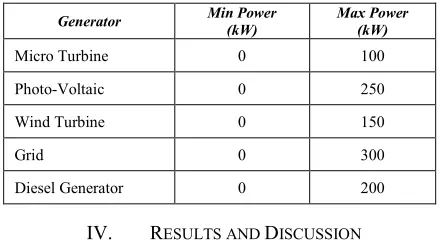
[image:4.612.329.550.374.495.2]Genetic algorithm helps optimize the cost of a system depending on the load connected to the system. This helps to ensure minimized cost of operation of the smart grid. The equations mentioned in the previous section are used as the objective function in the fitness function of the genetic algorithm. The load power was assumed as 500 kW per day. In this paper, we present two scenarios. We identify the minimum constraint for all the source to be zero. Moreover, the maximum power supplied from Grid and Diesel Generator is set at 300 kW and 200 kW respectively. The first scenario allows high power supply from the remaining sources; Micro Turbine, Photovoltaic and Wind Turbine at 100 kW, 250 kW and 150 kW respectively. On the other hand, second scenario set low power supply for these sources at 10 kW each. The constraints are shown in the Table I for first scenario and Table II for the second one.
TABLE I. GENERATOR POWER CONSTRAINTS:SCENARIO 1
Generator Min Power (kW) Max Power (kW)
Micro Turbine 0 100
PhotoVoltaic 0 250
Wind Turbine 0 150
Grid 0 300
Diesel Generator 0 200
IV. RESULTS AND DISCUSSION
In this section, we tackle the results for both scenarios as follows:
A. Scenario 1
The optimized solution produced by the algorithm for a power demand of 500 kW per day was 11.43 AED/hour.
TABLE II. GENERATOR POWER CONSTRAINTS:SCENARIO 2
Generator Min Power (kW) Max Power (kW)
Micro Turbine 0 10
PhotoVoltaic 0 10
Wind Turbine 0 10
Grid 0 300
Figure 1: Layout of microgrid structure under study
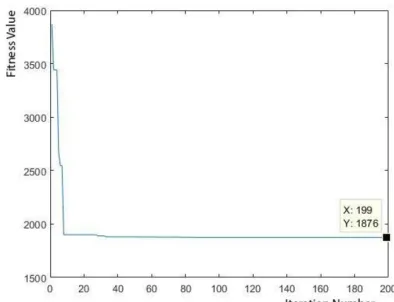
The grid cost was taken as 26.8 fils/kWh and 30.5 fils/kWh if power consumption is below or above 200 kWh respectively on a monthly consumption basis. The optimized power generated by various generators is shown in Table III, where both optimization algorithms resulted in equal value. Among various possible supplied power variations, this was the most optimized power generation to acquire the minimum cost of power generation. We can see from Table III that Micro Turbine alone is very economical in this case. However, the two algorithms vary in terms of convergence, iteration and populations. These parameters are shown in Table IV. While fixing the population size of both algorithms at 500, GA finishes 15 iterations in 13.7 seconds, whereas ABC completes 200 iterations in only 10.8 seconds. Figures 2 and 3 present the convergence of the algorithms toward optimal value over the iterations. Since ABC has much more iteration number, we can see that the convergence curve smoothens and converges faster than GA.
TABLE III. RESULT OF OPTIMIZATION ALGORITHMS:SCENARIO 1
Power Component Optimized Power Generation (kWh)
Micro Turbine 20.8333
PhotoVoltaic 0
Wind Turbine 0
Grid 0
Diesel Generator 0
TABLE IV. COMPARE RESULTS OF OPTIMIZATION ALGORITHMS:
SCENARIO 1
GA ABC
Time (Sec) 13.6975 10.8285
Iterations 15 200
Population 500 500
Best value (AED) 11.4391 11.4278
Figure 2. Convergence curve of GA for scenario 1
Figure 3. Convergence curve of ABC for scenario 1
B. Scenario 2
[image:5.612.327.527.76.247.2] [image:5.612.75.283.80.216.2]power contribution by sources other than grid as in scenario 2 will result savings exceeding 126 AED.
TABLE V. RESULT OF OPTIMIZATION ALGORITHMS:SCENARIO 2
Power Component Optimized Power Generation (kWh)
Micro Turbine 10.000 PhotoVoltaic 10.000
Wind Turbine 0. 8333
Grid 0
Diesel Generator 0
TABLE VI. COMPARE RESULTS OF OPTIMIZATION ALGORITHMS:
SCENARIO 2
GA ABC
Time (Sec) 12.7014 10.1302
Iterations 15 200
Population 500 500
[image:6.612.67.287.101.550.2]Best value (AED) 18.7641 18.7639
[image:6.612.65.275.313.545.2]Figure 4: Convergence curve of GA for scenario 2
TABLE I. SAVINGS ANALYSIS FROM UTILIZING SOURCES
WITHOUT GRID
Cost (AED) Savings (AED)
Grid only 145.1000 0
Scenario 1 11.43 133.67
Scenario 2 18.76 126.34
Figure 5: Convergence curve of ABC for scenario 2
V. CONCLUSION AND FUTURE WORK
The simulation results show that the use of micro turbines is the most costeffective way to reduce cost of microgrids followed by solar panels. The other types of generators build up cost and is therefore not suited for microgrids. In scenario 2, an upper bound is set to the micro turbine to make use of the solar panels for power generation. The most costeffective generators in descending order are as follows: MicroTurbines, Solar Panels, Wind Turbines, Grid and Diesel Generator.
However, the cost can be further reduced if the generators can naturally generate power; solar panels and wind turbines; and the excess power is later sold back to the government. By allowing negative lower limit for grid power, the simulation yields a profit when power is traded at the same rate as it was purchased. Moreover, even with a vastly reduced sale rate by applying taxes up to 70%, the use of microgrids can be made quite profitable to sell to grid.
Utilization of different power sources and optimization method to find the best combination helps reduce the cost of microgrids. Genetic algorithm is the most commonly used algorithm. However, ABC algorithm is much faster and guarantees reliable results in a short period of time. The work was optimized for the United Arab Emirates, Abu Dhabi region using regional pricing for various generators and utility. UAE has a great scope for microgrids and can also become a future factor in contributing to the power grid of the region.
ACKNOWLEDGMENT
[image:6.612.71.285.611.676.2]REFERENCES
[1] B. Khan and P. Singh. Selecting a metaheuristic technique for smart microgrid optimization problem: A comprehensive analysis. IEEE Access, 5:13951–13977, 2017.
[2] Ramananda Paul Gagari Deb and Sudip Das. Hybridpower generation system. International Journal of Computer and Electrical Engineering, 4(2):141–144, 2012.
[3] Chao Wei ; Zubair Md. Fadlullah ; Nei Kato ; Ivan Stojmenovic. On optimally reducing power loss in microgrids with power storage devices. IEEE Journal onSelected Areas in Communications, 32(7):1361 – 1370,2014.
[4] P.Yadav Swapneel kaurav. Hybrid power system usingwind energy and solar energy.International Journal ofInnovative Research in Science, Engineering and Technology, 5(1):54–58, 2016
[5] Ch.Kasi Ramakrishna Reddy N. Sivaramakrishna. Hybridpower generation through combined solar wind powerand modified solar panel.International Journal of Engineering Trends and Technology (IJETT), 4(5):1414 –1417, 2013.
[6] Samir Mohammed Dawoud, Xiang Ning Lin, Jin WenSun, Merfat Ibrahim Okba, Muhammad Shoaib Khalid,and Asad Waqar. Feasibility study of isolated pvwindhybrid system in egypt. In Sustainable Energy and Environmental Engineering III, volume 1092 of Advanced Materials Research, pages 145–151. Trans Tech Publications, 4 2015.
[7] F. G. Akinboro & M.B. Olajide I.A. Adejumobi, S.G. Oyagbinrin. Hybrid power generation through combinedsolar wind power and modified solar panel. IJRRAS, 9(1):130–138, 2011.
[8] J. De Kooning B. Meersman T. Vandoorn, B. Zwaenepoeland L. Vandevelde. Smart microgrids and virtual powerplants in a hierarchical control structure.2nd IEEE PESInternational Conference and Exhibition on InnovativeSmart Grid Technologies, 5(1), 2011.
[9] C. Pang A. Mohsenzadeh and M. Haghifam. Determining optimal forming of flexible microgrids in the presenceof demand response in smart distribution systems. IEEE Systems Journal, pages 1–9, 2017 [10] D. Karaboga. An idea based on honey bee swarm for numerical
optimization. Tech. Rep. TR06, Erciyes University, Engineering Faculty, Computer Engineering Department, 2005.
[11] M. Rosen A. Maleki and F. Pourfayaz. Optimal operationof a grid connected hybrid renewable energy system forresidential applications. Sustainability, 9(8):1314, 2017.
[12] Farshid Shariatzadeh ; Nikhil Kumar ; Anurag K. Srivastava. Optimal control algorithms for reconfiguration of shipboard microgrid distribution system using intelligenttechniques. IEEE Transactions on Industry Applications, 52(1):474 – 482, 2017. [13] Yixin Zhu ; Fang Zhuo ; Feng Wang ; Baoquan Liu; Ruifeng