applications to case studies
RUDDOCK, Alan <http://orcid.org/0000-0002-7001-9845>, BOYD, Craig, WINTER, Edward and RANCHORDAS, Mayur <http://orcid.org/0000-0001-7995-9115>
Available from Sheffield Hallam University Research Archive (SHURA) at:
http://shura.shu.ac.uk/23182/
This document is the author deposited version. You are advised to consult the publisher's version if you wish to cite from it.
Published version
RUDDOCK, Alan, BOYD, Craig, WINTER, Edward and RANCHORDAS, Mayur (2018). Considerations for the scientific support process and applications to case studies. International Journal of Sports Physiology and Performance.
Copyright and re-use policy
See http://shura.shu.ac.uk/information.html
Abstract 1
Case studies are vehicle to bridge the gap between science and practice because they provide
2
opportunities to blend observations and interventions that have taken place in real-world
3
environments with scientific rigour. The purpose of this invited commentary is to present
4
considerations for those providing applied sport science support to athletes with the intention
5
of broadcasting this information to the scientific community. We present a four phased
6
approach (1: Athlete overview; 2: Needs analysis; 3: Intervention planning; 4: Results,
7
evaluation and conclusion) for scientific support to assist practitioners in the development
8
and implementation of scientific support. These considerations are presented in the form of
9
‘performance questions’ designed to guide and critically evaluate the scientific support
10
process and aid the transfer of this knowledge via case studies.
11
12
Key words: sport science, single subject design, exercise, health, performance
Introduction 14
In a recent volume of this journal, Halperin (2018)1 discussed the merits of case
15
studies as a means to bridge the gap between science and practice. It has been suggested that
16
traditional forms of scientific study are not 'user friendly' for coaches because they rely upon
17
group-based statistical analyses that do not fully account for individual differences and are
18
often undertaken in controlled studies with limited ecological validity 2,3. Halperin (2018) 1
19
highlighted that case studies can make scientific findings accessible to coaches to aid
20
relationships between the coach and sport scientist. A combination of qualitative and
21
quantitative study may also be useful in assisting in the effective broadcasting of important
22
findings 4.
23
Scientific support for athletes provides abundant opportunities to present case studies
24
from observations and interventions that have taken place in training or competitive
25
environments as opposed to a relatively artificial laboratory setting. The merits of reporting
26
methods and data involving specific athletic populations in their natural environment could
27
be invaluable to the advancement of human performance. Publications of case studies
28
therefore might provide the most meaningful representation of the impact of scientific
29
support on human performance by complimenting findings from traditional controlled
30
studies.
31
However, these environments present numerous challenges to the application of standardised
32
approaches to experimental design and inferential statistics. Sport scientists will often
33
encounter issues with sample size, randomisation, absence of control groups and conflicting
34
priorities in the holistic development of the athletes. Nevertheless, this should not detract
35
from the application of scientific rigour to scientific support and the reporting of this work as
36
case studies in peer reviewed publications.
37
Science is characterised by: research-questions, hypothesis-testing, transparency of methods
38
and assumptions; and precision and accuracy in measurement 5 More simply thought of as a
39
systematic way of working. This is particularly important in the context of case studies, as the
40
House of Lords select committee on Science and Technology (2012; p.4)6 reported "research
41
on elite athletes is generally observational and anecdotal; at best it describes what, but does
42
not explain why". The way in which the work was conducted is arguably as important to the
43
advancement of knowledge and practice as the intervention and outcome itself, since it is a
44
transferable feature across populations and domains of exercise science.
45
Practical Applications 46
A case study publication maybe different from other types of research design such as
47
randomised- or quasi-randomised control trials, however, it should be planned and
48
implemented with no-less scientific rigour. Unravelling the complexities of training,
49
adaptation and performance requires formulation of simple and complex questions at each
50
stage of the support process. Without a systematic approach at this stage, case study
51
publications would lack validity and merit.
52
Hence, the quality of scientific support is linked to how well the scientist: develops
53
questions; formulates a plan or plans; acquires, analyses and evaluates appropriate data;
54
provides feedback; integrates new insights into training and performance and reflects on this
55
process. In order to implement scientific support effectively, this commentary outlines the
56
various phases that practitioners might consider when supporting athletes which might lead to
57
scientifically credible, robust case study publications.
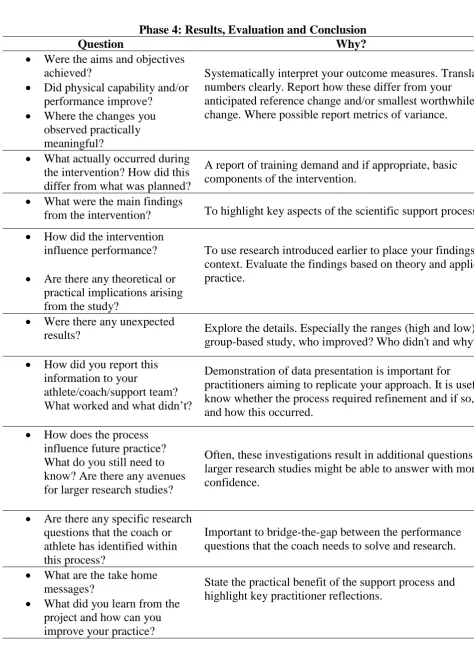
An overview of the scientific support process is depicted in figure 1. Information detailed in
59
table 1 provides guidance for practitioners to acquire pertinent information about the
60
athlete/client so their specific needs are focused appropriately. The needs analysis (table 2) is
61
a key aspect of scientific support that directly informs the planning of an intervention
62
therefore; we have outlined numerous questions that might be taken into consideration when
63
conducting this aspect of support (table 3). Although presentation of the intervention results
64
are important (table 4) rather than attempting to 'prove' the intervention has been successful
65
or simply describing what happened within the intervention, does not fully present the
66
'richness' of the scientific support process underpinning the case study. Therefore,
67
accompanying previous sections with a comprehensive evaluation and conclusion section that
68
includes honest and insightful reflections can be helpful to other practitioners. Finally,
69
authors should conclude the period of support with clear implications and recommendations
70
for future practice.
71
72
INSERT figure 1 HERE
74
Conclusion 75
In this commentary we have presented considerations for practitioners who are
76
providing applied sport science support to athletes with the intention of translating this
77
knowledge to the scientific community. There are various evidence-based approaches to
78
achieve a desired outcome; the processes outlined herein enables a systematic approach as
79
well as an opportunity to provide honest and insightful reflections that will be helpful to
80
fellow practitioners. The detail required for scientific support requires scientific rigour and a
81
clear explanation of why decisions were made. This is in contrast to a simple presentation of
82
results in an attempt to 'prove' an intervention has been successful. Scientific support staff
83
might consider this framework to showcase the process of scientific support. Such reporting
84
is essential to the advancement of knowledge and practice in sport science since 'ways of
85
working' are transferrable features across populations and domains of exercise science.
86
87
Acknowledgements: We would like to thank Dell Wong, Gary Brickley and Carlos
88
Gonzalez for their initial contributions to the formation of this manuscript.
89
Figure 1. An overview of the four phases of scientific support.
90
91
92
93
94
95
96
97
98
99
100
101
102
104
References 105
106
1. Halperin I. Case Studies in Exercise and Sport Sciences: A Powerful Tool to Bridge
107
the Science-Practice Gap. Int J Sports Physiol Perform. 2018;(March):1-9.
108
doi:10.1123/ijspp.2017-0185.
109
2. Hecksteden A, Kraushaar J, Scharhag-Rosenberger F, Theisen D, Senn S, Meyer T.
110
Individual response to exercise training - a statistical perspective. J Appl Physiol.
111
2015;118(12):1450-1459. doi:10.1152/japplphysiol.00714.2014.
112
3. Hopkins WG. Individual responses made easy. J Appl Physiol. 2015;118:144-1446.
113
doi:10.1152/japplphysiol.00098.2015.
114
4. Harper LD, McCunn R. “Hand in glove”: Using qualitative methods to connect
115
research and practice. Int J Sports Physiol Perform. 2017;12(7):990-993.
116
doi:10.1123/ijspp.2017-0081.
117
5. Winter EM, Fowler N. Exercise defined and quantified according to the Systeme
118
International d’Unites. J Sports Sci. 2009;27(5):447-460.
119
doi:10.1080/02640410802658461.
120
6. Sport and Exercise Science and Medicine: Building on the Olympic Legacy to Improve 121
the Nation’s Health. London: Authority of the House of Lords; 2012.
122
123
124
125
126
127
128
129
130
131
132
133
134
135
Table 1: Example questions designed to gain an insight into the clients proposed challenge(s)
137 138
Phase 1: Athlete overview
Question Why?
What are the athlete's short, medium and long-term goals?
Are their goals SMART? (specific, measureable, adjustable, realistic, time-orientated)
How far away are they from achieving their goal?
To understand how the athlete has structured their attention towards the goal, what motivates them and what strategies they already have in place to meet the goal. Determining how far away from achieving each short, medium and long-term goal is also helpful to understand what changes need to be made. For example, a junior athlete might be 8 years away from their goal of becoming an Olympic champion or an Olympian might be 8 hours away.
Why seek scientific support?
What are their expectations of support?
What support have they had previously?
To identify what the athlete thinks of sport sciences and to understand their expectations of scientific support.
What do they think they need to improve?
Is the coaching team involved?
Is there a multi-disciplinary sport science and medicine team?
To guide the athlete thorough the training process. This information helps triangulate information in the needs analysis.
What are the athlete's lifestyle
demands? To tailor recommendations around the athlete to help build rapport and good working relationships. Enables estimation of the demands on their time and energy.
Are there any financial or logistical constraints?
To understand the material needs. Typically a cost associated with professional scientific support. It is important that all parties understand financial and logistical limitations.
What is the athlete's training history?
Are there any injuries you should be aware of?
Understanding how the athlete has trained in the past will provide a good indication of how they might train in the future.
How does the athlete/coach structure a typical long-term training cycle?
How does the athlete/coach structure typical weekly training?
How does the athlete/coach
structure a typical day?
Does the athlete assess training load?
Can you assess training load?
Important to quantify the physical and psychological demands of training and competition objectively.
What basic/foundational good practices are in place?
To assess the quality and provision of basic practices that support training and performance before
implementing complex scientific support strategies it is appropriate to assess the quality and provision of basic practices that support training and performance.
139
Table 2: Example questions designed to identify the needs of the client
141 142
Phase 2: Needs analysis
Question Why?
What are the rules of the sport? To understand how the rules of the sport influence the physiological demands.
What are the ranges of environmental conditions or what will be the typical environmental conditions?
To understand how the biophysical properties of the environment influence physiological demands.
How does protective clothing or equipment influence performance?
To understand how restrictive, cumbersome or heavy equipment influence movement and physiological demands.
Do the rules, environment or equipment influence the risk to the athlete?
To understand that some challenges might be associated with high risks is an important consideration for all parties.
What are the physiological/nutritional demands of the sport?
What are the external (speed/distance), internal (V̇O2/blood lactate) and perceptual
(RPE/thermal perception) demands of the sport?
Are there supporting data in the scientific literature? If not, can you obtain this information from primary
research/unpublished data?
What are the physiological characteristics of performers in the sport? If these are reported in the literature can you assess and report these for comparison?
Are there any strong predictors of performance?
Are there any other sources of evidence that appear to be important factors in success/failure? Can you integrate these into your support process?
What is the quality of the evidence you have available? Consider internal, external and ecological validity.
To understand how the physiological demands of the sport will inform the scientist of the principle stressors placed on substrate use, cardiovascular, neuromuscular and perceptual systems. This knowledge will inform testing procedures and training recommendations.
Based on the needs analysis, what tests have you chosen to profile your athlete?
Is the test valid, reproducible and sensitive?
Provide sound scientific rationale for your choice of test. Report reliability statistics as best practice.
How will you analyse the results of the tests?
How will this information be reported
Appropriate statistical analysis is required for
comparisons, usually between pre-and post-intervention. Consider how your data will be assessed in the long-term. Structure your database appropriately. Consider data protection and storage.
improvement?
From the tests can you deduce what mechanisms are well developed and what need improving?
process
143
Table 3: Example questions designed to assist in intervention planning
145 146
Phase 3: Intervention planning
Question Why?
How do you intend to target, when and why?
A key consideration in scientific support. A good scientist is able to identify:
1) what type and;
2) where in a training plan;
support strategies to aid performance goals to have the most impact.
What are the
primary/secondary/tertiary outcome assessments that are indicative of the adaptations you intend to target?
When will you assess these outcomes measures, relating to meso/macro and micro-cycles and performance goals?
A clear understanding of key data is essential to interpret the success of the intervention. Assessments should be linked to key training phases to capture the magnitude of potential adaptations.
Can you state the smallest worthwhile change a priori?
The scientist needs to understand what effects, resulting from the intervention are detrimental, trivial or beneficial to performance. This does not have to be based on
conventional statistical analysis and could be determined by a strong practical rationale based on experience.
What research has supported the adaptations you desire?
How confident are you that the results will transfer to your intervention?
Interventions that are supported by high quality evidence have a better chance of making a positive impact although there may be instances where practice-based evidence can be useful.
What types of training were identified as appropriate but were rejected? Why were they rejected?
This information is useful for the author and practitioners wishing to replicate or identify interventions more suitable to their environment.
How will you integrate research findings from the literature into your intervention?
What's ideal?
What's practical?
What's the minimum effective training dose?
The link between evidence base and practice is crucial. Practitioners may wish to explore these questions.
How much recovery is needed to induce the desired adaptations?
To explain the magnitude of recovery. For example, do you want your athlete to fully or partially recover from a training session, series or set? What is the rationale for this?
Are there any special techniques or variables that you can manipulate?
This might include training with low muscle glycogen, training in the heat or simulated altitude.
How will you integrate your intervention taking into account technical and tactical training of the sport?
Many sports have fixed technical and tactical demands. Recognise how additional or integrated training demands might influence these factors.
interact with other areas of support? e.g., nutrition and psychology.
areas of sport. For example, training with low muscle glycogen has a direct impact on nutrition and might
influence mood and consequently psychological aspects of training and performance.
How will you communicate with members of the sport science and medicine team?
When athletes use multiple support personnel it is important that all parties are aware of factors that impact upon their own work.
How will you present the training programme to the athlete and coach?
A crucial aspect of scientific support. Informing readers about this aspect of scientific support will help practitioners to develop simple and effective methods to help the coach and athlete understand the rationale for the training programme.
What are the likely
barriers/limiters/how will you overcome them?
Do you have a plan B or C?
Being aware of potential barriers for coach/athlete agreement and adherence can improve the impact of the support process by encouraging the practitioner to develop strategies to avoid conflict.
Table 4: Example questions designed to assist the results and evaluation of the case study
148
149
Phase 4: Results, Evaluation and Conclusion
Question Why?
Were the aims and objectives achieved?
Did physical capability and/or performance improve?
Where the changes you observed practically meaningful?
Systematically interpret your outcome measures. Translate numbers clearly. Report how these differ from your
anticipated reference change and/or smallest worthwhile change. Where possible report metrics of variance.
What actually occurred during the intervention? How did this differ from what was planned?
A report of training demand and if appropriate, basic components of the intervention.
What were the main findings
from the intervention? To highlight key aspects of the scientific support process.
How did the intervention influence performance?
Are there any theoretical or practical implications arising from the study?
To use research introduced earlier to place your findings in context. Evaluate the findings based on theory and applied practice.
Were there any unexpected
results? Explore the details. Especially the ranges (high and low). If group-based study, who improved? Who didn't and why?
How did you report this information to your
athlete/coach/support team? What worked and what didn’t?
Demonstration of data presentation is important for
practitioners aiming to replicate your approach. It is useful to know whether the process required refinement and if so, why and how this occurred.
How does the process influence future practice? What do you still need to know? Are there any avenues for larger research studies?
Often, these investigations result in additional questions that larger research studies might be able to answer with more confidence.
Are there any specific research questions that the coach or athlete has identified within this process?
Important to bridge-the-gap between the performance questions that the coach needs to solve and research.
What are the take home messages?
What did you learn from the project and how can you improve your practice?
State the practical benefit of the support process and highlight key practitioner reflections.