organic papers
o138
Wanget al. C21H19N doi:10.1107/S1600536805040195 Acta Cryst.(2006). E62, o138–o139
Acta Crystallographica Section E Structure Reports
Online
ISSN 1600-5368
9-(4-Ethylbenzyl)-9
H
-carbazole
Lei Wang,a* Jiang-Sheng Li,a Guang-Le Zhao,bPeng-Mian Huangaand Tao Zenga
aSchool of Chemical Engineering & Technology,
Tianjin University, Tianjin 300072, People’s Republic of China, andbCollege of
Pharmaceuticals & Biotechnology, Tianjin University, Tianjin 300072, People’s Republic of China
Correspondence e-mail: [email protected]
Key indicators
Single-crystal X-ray study
T= 294 K
Mean(C–C) = 0.006 A˚ Disorder in main residue
Rfactor = 0.045
wRfactor = 0.129 Data-to-parameter ratio = 7.6
For details of how these key indicators were automatically derived from the article, see http://journals.iucr.org/e.
#2006 International Union of Crystallography Printed in Great Britain – all rights reserved
In the title compound, C21H19N, the carbazole ring system is
essentially planar. The structure is stabilized by both–and C—H interactions. The ethylbenzene ring was found to be disordered.
Comment
Carbazole derivatives possess valuable therapeutic properties. In some cases they are able to potentiate the analgesic effect of, for example, morphine, without substantially influencing the blood pressure and the vegetative nervous system (Chemische Fabrik Promonla GmbH, 1959).N-alkylation is an important process for the construction of carbazole deriva-tives (Duanet al., 2004). The structure of the title compound, C21H19N, 9-(4-ethylbenzyl)-9H-carbazole, (I), is reported
here; it was synthesized by N-alkylation of carbazole with 1-(chloromethyl)-4-ethylbenzene.
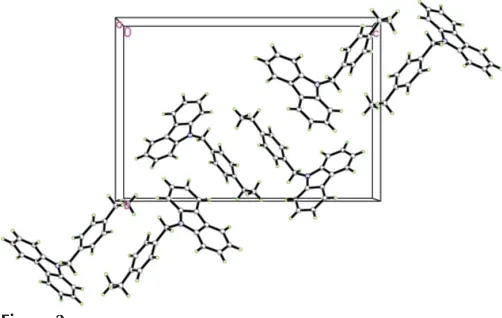
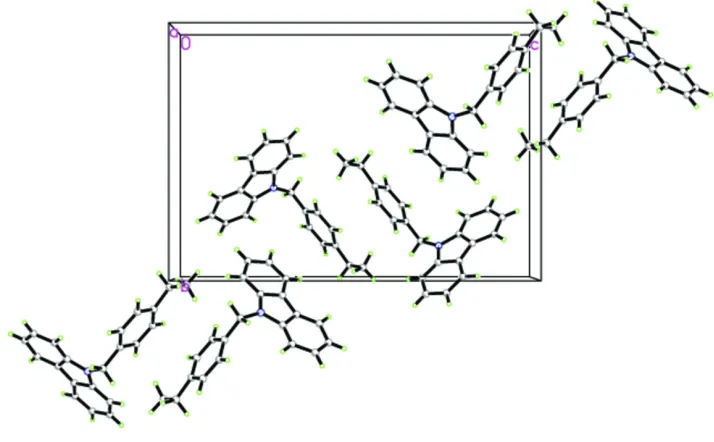
The molecular structure of (I) is illustrated in Fig. 1. The carbazole ring system is essentially planar, with a mean deviation of 0.003 A˚ . The dihedral angle between the carba-zole plane and that of the major component of the disordered ethylbenzene ring is 72.3 (5). Bond lengths and angles are in
agreement with reported literature values (Allenet al., 1987). In the crystal structure, there are weak – stacking inter-actions between the ethylbenzene rings at (x1
2,y+ 1 2,z)
and (x+1 2,y+
1
2,z); the distance between ring centroids is
5.271 (8) A˚ . Additional strong C—H interactions are observed, the distance between H10aand the centroid of the C1/C2/C3/C4/C5/C6 plane at (1 x, 1
2 + y, 1
2 z) being
2.98 A˚ and that between H13band the centroid of the C7/C8/ C9/C10/C11/C12 plane at (1 +x,y,z) plane being 2.84 A˚ .
Experimental
A solution of potassium hydroxide (7.0 g) in DMF (50 ml) was stirred at room temperature for 20 min. Carbazole (3.3 g, 20 mmol) was added and the mixture was stirred for a further 40 min. A solution of
1-(chloromethyl)-4-ethylbenzene (8.5 g, 30 mmol) in DMF (50 ml) was added dropwise with stirring. The resulting mixture was stirred at room temperature for 12 h and poured into 500 ml water to give a white solid product. This was filtered, washed with water and recrystallized from EtOH to give (I). Yield: 4.90 g (85.9%); m.p.: 392.5–393.8 K; 20 mg of (I) was dissolved in 6 ml chloroform, and the solution was kept at room temperature for 10 d. Natural evaporation gave colorless single crystals of (I), suitable for X-ray analysis.
Crystal data
C21H19N
Mr= 285.37
Orthorhombic,P212121
a= 5.6074 (14) A˚ b= 13.943 (3) A˚ c= 20.124 (5) A˚ V= 1573.4 (7) A˚3
Z= 4
Dx= 1.205 Mg m
3
MoKradiation Cell parameters from 1424
reflections
= 2.5–20.7
= 0.07 mm1
T= 294 (2) K Block, colorless 0.220.160.14 mm
Data collection
Bruker SMART CCD area-detector diffractometer
’and!scans
Absorption correction: multi-scan (SADABS; Bruker, 1997) Tmin= 0.977,Tmax= 0.990 8829 measured reflections
1883 independent reflections 1028 reflections withI> 2(I) Rint= 0.067
max= 26.5
h=6!6 k=17!10 l=25!24
Refinement
Refinement onF2
R[F2> 2(F2)] = 0.045 wR(F2) = 0.129
S= 1.00 1883 reflections 249 parameters
H-atom parameters constrained
w= 1/[2(F
o2) + (0.0672P)2] whereP= (Fo
2 + 2Fc
2 )/3 (/)max= 0.002
max= 0.22 e A˚ 3 min=0.12 e A˚ 3
Extinction correction:SHELXL97 Extinction coefficient: 0.020 (4)
H atoms were included in calculated positions and treated as riding atoms [C—H distances are 0.93 A˚ for CH and 0.97 A˚ for CH2groups,
withUiso(H) = 1.2Ueq(C), and C—H =0.96 A˚ for methyl groups, with
Uiso(H) = 1.5 Ueq(C). In the absence of significant anomalous
dispersion effects, Freidel pairs were merged. The ethylbenzene ring was found to be disordered and refined as a regular hexagon with the C—C distances of 1.39 A˚ . Site occupancies of the two disorder components, which included the atoms of the benzene ring and its ethyl substituent, refined to 0.521 (12) and 0.479 (12).
Data collection:SMART(Bruker, 1997); cell refinement:SAINT (Bruker, 1997); data reduction:SAINT; program(s) used to solve structure:SHELXS97(Sheldrick, 1997); program(s) used to refine structure: SHELXL97 (Sheldrick, 1997); molecular graphics: SHELXTL (Bruker, 1997); software used to prepare material for publication:SHELXTL.
References
Allen, F. H., Kennard, O., Watson, D. G., Brammer, L. Orpen, A. G. & Taylor, R. (1987).J. Chem. Soc. Perkin Trans. 2, pp. S1–S19.
Bruker (1997).SADABS,SMART,SAINTandSHELXTL. Bruker AXS Inc., Madison, Wisconsin, USA.
Chemische Fabrik Promonla GmbH (1959)Carbazole derivatives and process for the production thereof. Patent No. GB822592, pp. 10–28.
Duan, X. M., Chen, L. G., Xu, Y. J., Li, Y., Hana, J. & Lia L. P. (2004).Acta Cryst.E60, o1931–1932.
[image:2.610.48.295.67.251.2]Sheldrick, G. M. (1997). SHELXS97 and SHELXL97. University of Go¨ttingen, Germany.
Figure 1
[image:2.610.45.296.324.483.2]A view of the molecular structure of (I). Displacement ellipsoids are drawn at the 30% probability level and H atoms are shown as small spheres of arbitrary radii. Only the major component of the disordered ethylbenzene group is shown.
Figure 2
supporting information
sup-1
Acta Cryst. (2006). E62, o138–o139
supporting information
Acta Cryst. (2006). E62, o138–o139 [doi:10.1107/S1600536805040195]
9-(4-Ethylbenzyl)-9
H
-carbazole
Lei Wang, Jiang-Sheng Li, Guang-Le Zhao, Peng-Mian Huang and Tao Zeng
S1. Comment
Carbazole derivatives possess valuable therapeutic properties. In some cases they are able to potentiate the analgesic effect of for example morphine, without substantially influencing the blood pressure and the vegetative nervous system (Chemische Fabrik Promonla GmbH, 1959). N-alkylation is an important process for the construction of carbazole derivatives (Duan et al., 2004). The structure of the title compound, C21H19N, 9-(4-ethylbenzyl)-9H-carbazole, (I), is
reported here; it was synthesized by N-alkylation of carbazole with 1-(chloromethyl)-4-ethylbenzene.
The molecular structure of (I) is illustrated in Fig. 1. The carbazole ring is essentially planar, with a mean deviation of 0.003 Å. The dihedral angle between the carbazole plane and that of the major component of the disordered ethyl benzene ring is 72.3 (5)°. Bond lengths and angles are in agreement with reported literature values (Allen et al., 1987). In the crystal structure, there are weak π–π stacking interactions between the ethylbenzene rings at (x − 1/2, −y + 1/2, −z) and (x
+ 1/2, −y + 1/2, −z); the distance between ring centroids is 5.271 (8). Additional strong C—H···π interactions are
observed, the distance between H10a and the centroid of the C1/C2/C3/C4/C5/C6 plane at (1 − x, −1/2 + y, 1/2 − z) being 2.98 Å and that between H13b and the centroid of the C7/C8/C9/C10/C11/C12 plane at (1 + x, y, z) plane being 2.84 Å.
S2. Experimental
A solution of potassium hydroxide (7.0 g) in DMF (50 ml) was stirred at room temperature for 20 min. Carbazol (3.3 g, 20 mmol) was added and stirred for further 40 min. A solution of 1-(chloromethyl)-4-ethylbenzene (8.5 g, 30 mmol) in DMF (50 ml) was added dropwise with stirring. The resulting mixture was stirred at room temperature for 12 h and poured into 500 ml water to give a white solid product. This was filtered, washed with water and recrystallized from EtOH to give (I). Yield: 4.90 g (85.9%); m.p.: 392.5–393.8 K; 20 mg of (I) was dissolved in 6 ml chloroform, and the solution was kept at room temperature for 10 d. Natural evaporation gave colorless single crystals of (I), suitable for X-ray analysis.
S3. Refinement
H atoms were included in calculated positions and treated as riding atoms [C—H distances are 0.93 Å for CH and 0.97 Å for CH2 groups, with Uiso(H) = 1.2 Ueq(C), and C—H =0.96 Å for methyl groups, with Uiso(H) = 1.5 Ueq(C). As the
Figure 1
A view of the molecular of (I). Displacement ellipsoids are drawn at the 30% probability level and H atoms are shown as small spheres of arbitrary radii. Only the major component of the disordered ethylbenzene group is shown.
Figure 2
[image:4.610.125.482.389.610.2]supporting information
sup-3
Acta Cryst. (2006). E62, o138–o139 9-(4-Ethylbenzyl)-9H-carbazole
Crystal data
C21H19N
Mr = 285.37
Orthorhombic, P212121
Hall symbol: P 2ac 2ab
a = 5.6074 (14) Å
b = 13.943 (3) Å
c = 20.124 (5) Å
V = 1573.4 (7) Å3
Z = 4
F(000) = 608
Dx = 1.205 Mg m−3
Melting point = 392.5–393.8 K Mo Kα radiation, λ = 0.71073 Å Cell parameters from 1424 reflections
θ = 2.5–20.7°
µ = 0.07 mm−1
T = 294 K Block, colorless 0.22 × 0.16 × 0.14 mm
Data collection
Bruker SMART CCD area-detector diffractometer
Radiation source: fine-focus sealed tube Graphite monochromator
φ and ω scans
Absorption correction: multi-scan (SADABS; Bruker, 1997)
Tmin = 0.977, Tmax = 0.990
8829 measured reflections 1883 independent reflections 1028 reflections with I > 2σ(I)
Rint = 0.067
θmax = 26.5°, θmin = 1.8°
h = −6→6
k = −17→10
l = −25→24
Refinement
Refinement on F2
Least-squares matrix: full
R[F2 > 2σ(F2)] = 0.045
wR(F2) = 0.129
S = 1.00 1883 reflections 249 parameters 60 restraints
Primary atom site location: structure-invariant direct methods
Secondary atom site location: difference Fourier map
Hydrogen site location: inferred from neighbouring sites
H-atom parameters constrained
w = 1/[σ2(F
o2) + (0.0672P)2]
where P = (Fo2 + 2Fc2)/3
(Δ/σ)max = 0.002
Δρmax = 0.22 e Å−3
Δρmin = −0.12 e Å−3
Extinction correction: SHELXL97, Fc*=kFc[1+0.001xFc2λ3/sin(2θ)]-1/4
Extinction coefficient: 0.020 (4)
Special details
Geometry. All e.s.d.'s (except the e.s.d. in the dihedral angle between two l.s. planes) are estimated using the full covariance matrix. The cell e.s.d.'s are taken into account individually in the estimation of e.s.d.'s in distances, angles and torsion angles; correlations between e.s.d.'s in cell parameters are only used when they are defined by crystal symmetry. An approximate (isotropic) treatment of cell e.s.d.'s is used for estimating e.s.d.'s involving l.s. planes.
Refinement. Refinement of F2 against ALL reflections. The weighted R-factor wR and goodness of fit S are based on F2,
conventional R-factors R are based on F, with F set to zero for negative F2. The threshold expression of F2 > σ(F2) is used
only for calculating R-factors(gt) etc. and is not relevant to the choice of reflections for refinement. R-factors based on F2
are statistically about twice as large as those based on F, and R- factors based on ALL data will be even larger.
Fractional atomic coordinates and isotropic or equivalent isotropic displacement parameters (Å2)
x y z Uiso*/Ueq Occ. (<1)
H2A −0.1626 0.7677 0.1918 0.082* C3 0.0256 (8) 0.7793 (3) 0.1066 (2) 0.0781 (12) H3A −0.0700 0.8265 0.0878 0.094* C4 0.2202 (9) 0.7461 (3) 0.07156 (19) 0.0828 (12) H4A 0.2538 0.7714 0.0299 0.099* C5 0.3653 (8) 0.6758 (3) 0.09757 (18) 0.0710 (11) H5A 0.4960 0.6536 0.0736 0.085* C6 0.3142 (6) 0.6384 (3) 0.16013 (17) 0.0554 (9) C7 0.4180 (6) 0.5647 (2) 0.20019 (18) 0.0563 (9) C8 0.6108 (7) 0.5028 (3) 0.1927 (2) 0.0710 (11) H8A 0.7065 0.5066 0.1551 0.085* C9 0.6591 (8) 0.4363 (3) 0.2407 (2) 0.0807 (12) H9A 0.7877 0.3949 0.2354 0.097* C10 0.5195 (9) 0.4300 (3) 0.2970 (2) 0.0816 (13) H10A 0.5554 0.3842 0.3290 0.098* C11 0.3259 (8) 0.4909 (3) 0.3066 (2) 0.0729 (11) H11A 0.2324 0.4867 0.3446 0.087* C12 0.2770 (6) 0.5576 (3) 0.25812 (19) 0.0560 (9) C13 −0.0853 (7) 0.6440 (3) 0.30498 (18) 0.0678 (10) H13A −0.1036 0.5869 0.3320 0.081* H13B −0.2363 0.6555 0.2829 0.081*
supporting information
sup-5
Acta Cryst. (2006). E62, o138–o139
C20′ 0.152 (3) 0.9315 (9) 0.5030 (7) 0.114 (5) 0.479 (12) H20C 0.1338 0.8947 0.5436 0.137* 0.479 (12) H20D 0.3167 0.9523 0.5006 0.137* 0.479 (12) C21′ 0.001 (3) 1.0165 (9) 0.5077 (8) 0.184 (8) 0.479 (12) H21D 0.0603 1.0581 0.5419 0.276* 0.479 (12) H21E −0.1595 0.9975 0.5183 0.276* 0.479 (12) H21F 0.0015 1.0499 0.4660 0.276* 0.479 (12)
Atomic displacement parameters (Å2)
U11 U22 U33 U12 U13 U23
N1 0.0544 (18) 0.0651 (19) 0.0605 (18) −0.0075 (18) 0.0052 (17) −0.0063 (17) C1 0.049 (2) 0.055 (2) 0.057 (2) −0.0078 (19) −0.0073 (19) −0.010 (2) C2 0.061 (2) 0.071 (2) 0.073 (2) 0.006 (2) −0.007 (2) −0.009 (2) C3 0.084 (3) 0.075 (3) 0.075 (3) 0.009 (3) −0.014 (2) 0.000 (2) C4 0.097 (3) 0.089 (3) 0.062 (2) 0.003 (3) −0.011 (3) 0.002 (2) C5 0.074 (3) 0.075 (3) 0.064 (2) 0.003 (3) 0.002 (2) −0.012 (2) C6 0.055 (2) 0.055 (2) 0.056 (2) −0.0040 (19) −0.0053 (19) −0.0119 (18) C7 0.051 (2) 0.052 (2) 0.066 (2) −0.002 (2) −0.005 (2) −0.011 (2) C8 0.067 (2) 0.066 (2) 0.080 (3) 0.005 (2) −0.008 (2) −0.017 (2) C9 0.082 (3) 0.061 (3) 0.099 (3) 0.013 (2) −0.012 (3) −0.017 (3) C10 0.092 (3) 0.057 (3) 0.097 (3) −0.002 (3) −0.027 (3) 0.005 (3) C11 0.082 (3) 0.060 (2) 0.076 (2) −0.012 (3) −0.001 (2) 0.008 (2) C12 0.050 (2) 0.048 (2) 0.071 (2) −0.0063 (19) −0.004 (2) −0.006 (2) C13 0.052 (2) 0.081 (3) 0.071 (2) −0.014 (2) 0.009 (2) −0.009 (2) C14 0.035 (11) 0.092 (16) 0.048 (11) −0.026 (9) −0.012 (8) 0.016 (10) C15 0.043 (6) 0.091 (10) 0.085 (9) 0.000 (6) 0.010 (6) −0.008 (7) C16 0.043 (8) 0.092 (9) 0.090 (8) 0.008 (6) 0.013 (6) −0.006 (7) C17 0.058 (9) 0.069 (8) 0.083 (11) 0.009 (6) 0.007 (6) −0.007 (8) C18 0.049 (6) 0.064 (9) 0.072 (7) 0.000 (6) −0.015 (6) 0.011 (7) C19 0.048 (7) 0.043 (6) 0.086 (8) 0.009 (5) −0.014 (7) 0.014 (6) C20 0.129 (9) 0.119 (9) 0.110 (8) 0.036 (8) −0.028 (7) −0.026 (7) C21 0.172 (10) 0.126 (9) 0.181 (9) 0.009 (8) −0.036 (8) −0.061 (7) C14′ 0.068 (16) 0.040 (10) 0.055 (13) 0.015 (10) 0.020 (11) −0.007 (9) C15′ 0.036 (6) 0.079 (10) 0.059 (8) 0.000 (6) −0.014 (5) 0.001 (8) C16′ 0.027 (8) 0.076 (8) 0.092 (9) 0.011 (6) 0.004 (7) −0.015 (7) C17′ 0.059 (8) 0.090 (13) 0.065 (9) 0.008 (8) −0.017 (7) −0.016 (8) C18′ 0.115 (11) 0.056 (8) 0.084 (10) 0.000 (7) −0.032 (8) 0.011 (8) C19′ 0.077 (10) 0.070 (9) 0.069 (8) −0.012 (7) −0.004 (7) 0.010 (8) C20′ 0.106 (8) 0.109 (8) 0.129 (9) 0.020 (7) −0.059 (7) −0.022 (7) C21′ 0.199 (12) 0.170 (11) 0.184 (11) 0.003 (9) −0.010 (9) −0.055 (9)
Geometric parameters (Å, º)
C1—C6 1.407 (5) C17—C20 1.514 (8) C2—C3 1.372 (5) C18—C19 1.3900 C2—H2A 0.9300 C18—H18A 0.9300 C3—C4 1.380 (5) C19—H19A 0.9300 C3—H3A 0.9300 C20—C21 1.420 (9) C4—C5 1.377 (5) C20—H20A 0.9700 C4—H4A 0.9300 C20—H20B 0.9700 C5—C6 1.392 (5) C21—H21A 0.9600 C5—H5A 0.9300 C21—H21B 0.9600 C6—C7 1.430 (5) C21—H21C 0.9600 C7—C8 1.392 (5) C14′—C15′ 1.3900 C7—C12 1.412 (5) C14′—C19′ 1.3900 C8—C9 1.365 (5) C15′—C16′ 1.3900 C8—H8A 0.9300 C15′—H15B 0.9300 C9—C10 1.380 (6) C16′—C17′ 1.3900 C9—H9A 0.9300 C16′—H16B 0.9300 C10—C11 1.392 (6) C17′—C18′ 1.3900 C10—H10A 0.9300 C17′—C20′ 1.527 (8) C11—C12 1.375 (5) C18′—C19′ 1.3900 C11—H11A 0.9300 C18′—H18B 0.9300 C13—C14 1.514 (6) C19′—H19B 0.9300 C13—C14′ 1.518 (6) C20′—C21′ 1.460 (10) C13—H13A 0.9700 C20′—H20C 0.9700 C13—H13B 0.9700 C20′—H20D 0.9700 C14—C15 1.3900 C21′—H21D 0.9600 C14—C19 1.3900 C21′—H21E 0.9600 C15—C16 1.3900 C21′—H21F 0.9600
supporting information
sup-7
Acta Cryst. (2006). E62, o138–o139
C1—C6—C7 107.4 (3) H21A—C21—H21B 109.5 C8—C7—C12 118.7 (3) C20—C21—H21C 109.5 C8—C7—C6 134.5 (4) H21A—C21—H21C 109.5 C12—C7—C6 106.7 (3) H21B—C21—H21C 109.5 C9—C8—C7 119.9 (4) C15′—C14′—C19′ 120.0 C9—C8—H8A 120.0 C15′—C14′—C13 120.6 (6) C7—C8—H8A 120.0 C19′—C14′—C13 119.4 (6) C8—C9—C10 120.8 (4) C16′—C15′—C14′ 120.0 C8—C9—H9A 119.6 C16′—C15′—H15B 120.0 C10—C9—H9A 119.6 C14′—C15′—H15B 120.0 C9—C10—C11 121.2 (4) C15′—C16′—C17′ 120.0 C9—C10—H10A 119.4 C15′—C16′—H16B 120.0 C11—C10—H10A 119.4 C17′—C16′—H16B 120.0 C12—C11—C10 118.0 (4) C18′—C17′—C16′ 120.0 C12—C11—H11A 121.0 C18′—C17′—C20′ 116.6 (7) C10—C11—H11A 121.0 C16′—C17′—C20′ 122.5 (7) C11—C12—N1 130.0 (4) C19′—C18′—C17′ 120.0 C11—C12—C7 121.4 (3) C19′—C18′—H18B 120.0 N1—C12—C7 108.5 (3) C17′—C18′—H18B 120.0 N1—C13—C14 114.9 (7) C18′—C19′—C14′ 120.0 N1—C13—C14′ 114.1 (8) C18′—C19′—H19B 120.0 C14—C13—C14′ 4.7 (9) C14′—C19′—H19B 120.0 N1—C13—H13A 108.6 C21′—C20′—C17′ 115.9 (9) C14—C13—H13A 108.6 C21′—C20′—H20C 108.3 C14′—C13—H13A 104.9 C17′—C20′—H20C 108.3 N1—C13—H13B 108.6 C21′—C20′—H20D 108.3 C14—C13—H13B 108.6 C17′—C20′—H20D 108.3 C14′—C13—H13B 112.8 H20C—C20′—H20D 107.4 H13A—C13—H13B 107.5 C20′—C21′—H21D 109.5 C15—C14—C19 120.0 C20′—C21′—H21E 109.5 C15—C14—C13 118.6 (6) H21D—C21′—H21E 109.5 C19—C14—C13 121.2 (6) C20′—C21′—H21F 109.5 C16—C15—C14 120.0 H21D—C21′—H21F 109.5 C16—C15—H15A 120.0 H21E—C21′—H21F 109.5 C14—C15—H15A 120.0
C2—C1—C6—C5 0.8 (5) C16—C17—C18—C19 0.0
N1—C1—C6—C7 0.1 (3) C20—C17—C18—C19 −173.8 (16) C2—C1—C6—C7 −177.5 (3) C17—C18—C19—C14 0.0
C5—C6—C7—C8 0.9 (7) C15—C14—C19—C18 0.0
C1—C6—C7—C8 178.8 (4) C13—C14—C19—C18 −175.2 (15) C5—C6—C7—C12 −177.4 (4) C16—C17—C20—C21 176.7 (13) C1—C6—C7—C12 0.5 (4) C18—C17—C20—C21 −9 (2) C12—C7—C8—C9 0.5 (5) N1—C13—C14′—C15′ 115.4 (9) C6—C7—C8—C9 −177.6 (4) C14—C13—C14′—C15′ 15 (16) C7—C8—C9—C10 −0.3 (6) N1—C13—C14′—C19′ −65.2 (12) C8—C9—C10—C11 −0.1 (6) C14—C13—C14′—C19′ −165 (18) C9—C10—C11—C12 0.3 (5) C19′—C14′—C15′—C16′ 0.0 C10—C11—C12—N1 179.1 (3) C13—C14′—C15′—C16′ 179.5 (16) C10—C11—C12—C7 −0.1 (5) C14′—C15′—C16′—C17′ 0.0 C1—N1—C12—C11 −178.1 (4) C15′—C16′—C17′—C18′ 0.0
C13—N1—C12—C11 2.6 (5) C15′—C16′—C17′—C20′ −168.6 (18) C1—N1—C12—C7 1.1 (3) C16′—C17′—C18′—C19′ 0.0
C13—N1—C12—C7 −178.1 (3) C20′—C17′—C18′—C19′ 169.2 (17) C8—C7—C12—C11 −0.3 (5) C17′—C18′—C19′—C14′ 0.0 C6—C7—C12—C11 178.3 (3) C15′—C14′—C19′—C18′ 0.0