Talking about torque : measuring pack accessibility - a
review
YOXALL, Alaster <http://orcid.org/0000-0002-0954-2725> and ROWSON, J. Available from Sheffield Hallam University Research Archive (SHURA) at: http://shura.shu.ac.uk/9128/
This document is the author deposited version. You are advised to consult the publisher's version if you wish to cite from it.
Published version
YOXALL, Alaster and ROWSON, J. (2015). Talking about torque : measuring pack accessibility - a review. Packaging Technology and Science, 28 (1), 1-14.
Copyright and re-use policy
See http://shura.shu.ac.uk/information.html
Talking about Torque: Measuring pack accessibility a review
A. Yoxall*
Art and Design Research Centre, Sheffield Hallam University, Sheffield, Uk S1 2NU
J. Rowson
Department of Mechanical Engineering, The University of Sheffield, Sheffield, UK S1 3JD
* Corresponding author
Tel: 01142256754
Fax: 01142252718
ABSTRACT
Vacuum Lug Closures (VLCs) are a simple, reliable and low cost packaging option used for the protection and promotion of jams, pickles and sauces. Several surveys and anecdotal evidence suggest that packaging of this type can be notoriously difficult to open. Given the difficulty which packaging of this type may pose there has been significant academic research in understanding the difficulties associated with accessing packaging of this type. In response to the qualitative data gathered in these surveys research teams have attempted to quantify the forces that users can apply. What emerges from the approaches taken is a complex picture. Researchers do make comparisons with previous work but numbers of people tested, materials used, diameter and posture differ between research groups as does the information and style of the dissemination of results.
1 INTRODUCTION
Packaging has many different roles, it has to protect and preserve the product; inform the customer of its contents and allow access to those contents. Changes in life expectancy have produced significant demographic change [1]. As people age their strength, dexterity and aspects of a person's cognitive ability are seen to decline. Clearly a society in which a significant proportion of the population have reduced strength or dexterity creates a significant challenge. In response to these demographic changes there has been the development of the concepts of 'inclusive design' or 'universal design'.
Inclusive design has been promoted by various organisations, notably the Royal College of Art, in the UK. The British Standards Institute [2] defines inclusive design as "The design of mainstream products and/or services that are accessible to, and usable by, as many people as reasonably possible....without the need for special adaptation." Central to the concept of 'inclusive design' are seven principals, namely [3]:
Equitable Use Flexibility in Use
Simple and Intuitive Use Perceptible Information Tolerance for Error Low Physical Effort
Size and Space for Approach and Use
To understand the users' needs against these principals, it can readily be seen that to facilitate the optimum design of the products or services it is necessary to undertake some form of data collection process.
There are of course many and varied methodologies for the collection of data within the social research sphere. In general terms, they can however, be described as either qualitative or quantitative approaches and there has been much debate as to which approach is the most appropriate [4].
These data collection methods have been described as;
quantitative research is empirical research where the data are in the form of numbers.
qualitative research is empirical research where the data are not in the form of numbers.
approach in situations whereby there is a need for systematic comparisons to be made.
Qualitative research methods is an umbrella term for a diverse set of practices. Several types of data collection might well be used in a qualitative project: interview, observation, participant observation and documentary evidence. Interviews can exist in varying forms (structured, semi-structured and unstructured) [5-6] although other terms are used [7] and can be applied to both groups and individuals, such as focus group. In essence the differences can be summarised by the degree of structure of the interview, i.e. pre-planned interview questions through say a formalised questionnaire; and the depth of the interview, in which the interviewer can ask more probing questions depending on the response. Observation is used to understand people and their context, often in modern research methodology this is combined with video technology to record and analyse the participant’s behaviour, termed video ethnography.
In a survey by McConnell for the magazine 'Yours' [8] a series of items were listed as difficult to open (see Figure 2). Bleach bottles and jars ranked first and second in their perceived difficulty by aged consumers followed by shrink wrapped cheese, ring-pulls and tins.
Work by Duizer et al., [9] undertook interviews with older participants along with focus group work to examine requirements for packaging from the ageing consumer's perspective. Whilst glass bottles and jars were well liked by respondents when asked about problems, over half of those surveyed found lug closures (those found on jars) problematic.
Given that low physical effort is one of the central tenets of 'inclusive design' it is of little surprise that a significant amount of research effort on 'inclusive design' of packaging has looked at the issue of accessibility of vacuum lug closures (VLCs) which are commonly used for packaging pickles, sauces and jams. Closures of this type have been used for nearly a century. They are cheap, robust and the technology used to apply them is similarly cheap and robust and can be used by small scale packer-fillers or large multi-nationals brand owners. Typical closure and jars are shown in Figure 3.
This paper reviews the work undertaken to date on understanding issues surrounding the quantitative measurement of people to aid in the access of packaging and VLCs in particular. The review aims to contrast and compare the approaches undertaken and makes observations for the future direction of packaging related inclusive design research when undertaking measurement of users.
Most of the work undertaken has been for the medium sized devices representing jars and closures between 66 and 75mm in diameter (as shown in Figure 3). These diameter closures are used on a wide range of products such as jams, honey and pickles and represent the most common diameter used for this type of pack format.
2 PREVIOUS RESEARCH
Nine separate studies are detailed within this paper from seven different research teams based in the UK, China, the US, and the Netherlands. Research is described in chronological order indicating, the number and gender of participants, anthropological data measured, posture, apparatus and peak mean torque for males and females where described.
2.1 Rohles et al (1983)
The earliest work reviewed is by Rohles et al., undertaken in 1983 [10]. In this study the researchers measured the wrist twisting strength of 200 participants evenly split between males and females. The mean age of men was 72.8 years and for women 74.1 years. The researchers also measured participant's height, weight, and hand dimensions along with grip strength. The researchers used a standard off the shelf torque meter fixed in place to a horizontal surface by a rectangular steel plate. No diagram of the apparatus as set-up was provided.
Onto this torque meter various lids of differing diameters were placed and participants asked to rotate the lid both clockwise and counter clockwise. Mean torque is presented for both males and females. Lids (or closures) from real products were chosen. For the 67 mm diameter lid peak mean torque for males was found to be 6.50 Nm and for females 3.62 Nm. The researchers then go on to estimate the percentage of older people able to access containers given real nominal removal torques although this data is only discussed for the 27 mm and 85 mm diameter closures. The authors concluded that body weight and what the researchers call 'grasp' (grip force) affect the ability to produce torque. No difference was found between twisting clockwise or counter clockwise.
2.2 Imrhan et al (1988)
2.3 DTI (2000)
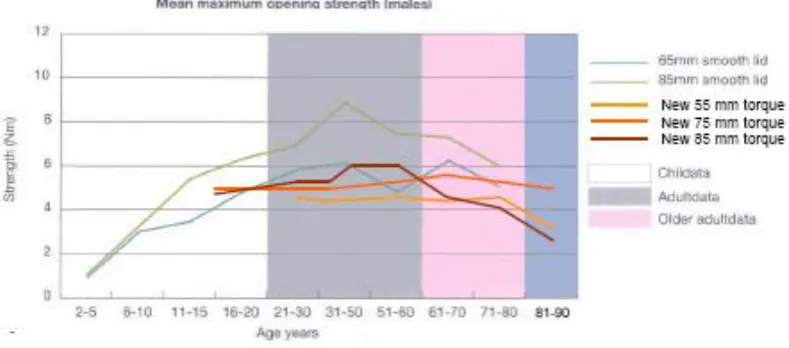
This study was undertaken by Nottingham University on behalf of the Consumer Affairs Directorate of the Department of Trade and Industry (DTI) [12], a UK government department which has undergone several manifestations and is at the time of writing the Department of Business Innovation and Skills (BIS). The work was undertaken at that time the DTI had produced a series of publications containing ergonomics data for which they felt there were important 'gaps' in information. The study looked at a series of measurements, including finger push strength, hand grip strength, pinch-pull strength and wrist-twisting strength and 'opening strength'. Here the term 'opening strength' is comparable to that measured in the previous studies in that it was concerned with the ability to access jars. For the purposes of the study three bespoke measurement devices were built (see Figure 5). These devices consisted of aluminium 'jars' and 'closures'. Different closures were produced with either a smooth or 'knurled' surface. One hundred and forty four participants were tested of which 85 were female. A breakdown of numbers of participants against age in five year bands is provided but no mean age is provided. Data was also recorded on height, weight and hand dimensions. For the 65 mm lid the mean peak torque was found to be 7.94 Nm (knurled), 6.32 Nm (smooth) for males and 5.00 Nm and 4.51 Nm respectively for females. Unlike the previous two studies where the device was mounted on a desk in this study participants were able to grasp the ‘jar’ whilst applying an opening grip.
2.4 Voorbij and Steenbekkers (2001)
This study was undertaken on a large cohort of 750 individuals aged between 20 and 80 + years old by Dutch researchers Voorbij and Steenbekkers, [13]. Results are presented in deciles for men and women but no average age is given for the total cohort. Stature and body mass are also measured but no indication is made as to whether hand size is measured. As with the previous study a bespoke jar shaped measuring device was made from aluminium although only one diameter was tested (as shown in Figure 6). The device had a lid (closure) diameter of 66mm and a base diameter of 75mm. The highest level of mean torque was 8.6 Nm for males and 5.6 Nm for females.
2.5 Langley et al., (2005)
but tabulated data is not given. Peak mean torque for males was found to be 7.0 Nm and 4.8 Nm for females. Mention is also made of a subsequent test where the device is fixed and one hand used to open it. The details of this test are not provided other than they predict lower torques, 11% for men and 23% for women (6.23 Nm and 3.7 Nm respectively).
2.6 Su et al., (2009)
Figure 8 shows the device built by Su et al., the device is based on a jar of 66mm diameter built from a steel cylinder with embedded torque sensor and force cell to analyse both the torque and simultaneous grip force [15]. This paper details the design and build of the device along with its calibration. The calibration is undertaken with a series of known weights from 1kg through to 5kg. Peak torque for a 5kg load was measured was found to be 1.907 Nm.
2.7 Kuo et al., (2009)
Twenty subjects were measured in this study, of which ten were female [16]. Body mass, height and hand dimensions were measured. Subjects were seated and asked to twist the device using firstly a power grip and a subsequent precision grip (as shown in Figure 9). No total moment or torque is given and results are not separated for males and females. However total forces are given for the precision grip (248.6 N) and for the power grip (232.8 N). It is possible to use equations presented by Imrham et al and Yoxall et al., to convert these forces to nominal torque values using measured coefficients of diameter and the radius of the instrument. Tomlinson et al., [17] quotes the finger friction coefficient on steel for the finger as 0.97. Work by Lewis et al., [18] quotes the coefficients as 0.26 for lacquered aluminium. Given that the radius of the instrument is 33mm a simple calculation using equation (1) would give the range of predicted torque as 2.13 Nm-7.95 Nm for the precision grip and 2.00 Nm-7.45 Nm for the power grip.
Tm = hc NAre (1)
2.8 Yoxall et al., (2010)
Using the same equipment as described in section 2.1.4 above, the researchers undertook a series of measurements on different diameters of closure including repeating measurement on the 75mm closure [19]. The total number of tests undertaken was approximately 1100 with 317 participants being measured for the 75 mm closure (161 male, 156 female). Age ranges of the participants were produced and tabulated in a similar manner to the DTI (2000) study but no mean age of participants is provided. However, as with the study by Langley et al., no other anthropological data was measured by the team in terms of hand size, body mass or height and no details were given as to the posture of the participants. Peak mean torque for males for the 75mm closure was found to be 5.8 Nm and 4.2 Nm for females.
2.9 Carse et al., (2010)
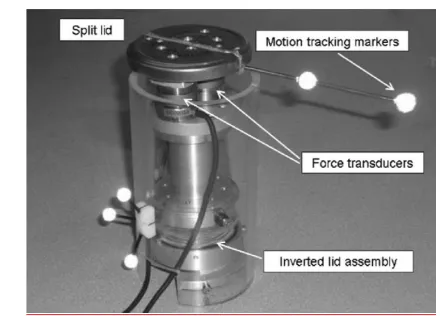
In another UK study 21 subjects were tested with a specialist device (see Figure 10). [20]. The lid diameter was 73mm with a body diameter of 80mm. Mean age, hand dimensions, weight and height were measured along with grip strength (using a Jamar dynamometer and dexterity using a Purdue pegboard. In this test all users were able to choose whether they could sit or stand (all participants chose to stand) and could hold the device freely in any orientation. The device was designed to have a torque limit set to approximately that of 3 Nm but allow the measurement of squeeze force during twisting. The speed of rotation was measured using motion capture markers attached to the device. Mean force for a release torque of 2.88 Nm was found to be 95.4 N for younger adults and 86.1 N for older adults, whilst older adults used higher compressive forces and lower speeds. The results indicated that older users used a higher proportion of their maximal grip strength than younger users (40% vs. 27%) when undertaking the opening task.
2.10 Rowson and Yoxall (2010)
3 DISCUSSION
As discussed quantitative data gathering is in effect assigning numbers to things, whether that is events, artefacts or people. Figure 11 shows some quantitative data gathering with regard to accessibility of packaging using the device used by both Langley et al., and Yoxall et al., in their studies. The device was able to produce a measured torque for each participant. Hence, from this data set mean torque against age could be plotted. Figure 12 shows typical output for one diameter jar using the device shown in Figure11 with mean male and female torque versus age being shown along with the nominal torque to open a jar of that diameter.
Clearly then it is not the numbers of people tested that effect the predicted outcome but the break down of who is actually tested, i.e. gender and age, which will in turn effect body mass and hand size. This raises the question of what is the most effective way of determining what variables need to be measured. Voorbij and Steenbekkers in their work suggest that the nominal range of opening torque for jars is 2.9 Nm to 5.5 Nm and suggest a torque of 2Nm would alleviate the bulk of opening issues for older people, but make no recommendation on how this could or should be achieved. Similarly Carse et al., quote a limit of 3 Nm (derived from a PhD thesis [22]) which is used for their device which effectively uses a torque limiter to understand grip forces and differences in twist speeds between younger and older uses. Of significant interest in this work is that Carse et al., predict their older users subjects to produce the 3Nm torque at 40% of their maximum measured grip strength. This would suggest a maximum torque at 100% of grip strength of 7.2 Nm which is comparable to maximum peak torque produced by other groups (detailed below).
Measurement also has to be repeatable and valid if it is to be useful. In undertaking measurements we would expect for example that if we handed our instrumented jar to the same people in the same circumstances we would get similar if not the same scores as we measured previously. We would want it to be producing repeatable results that then allow us to estimate error. A well designed test with accurate equipment would enable reliable assessment of the differences between the people measured. The second part of this aspect is that of validity, i.e. do we measure what we want to measure.
On repeatability, it can readily be seen that in some instances insufficient data is given to be able to compare or repeat the results. In their early work, Langley et al., and Yoxall et al., do not measure any anthropometric data other than age and gender despite Imrhan et al,, indicating that body mass has an influences on torque result. They are similarly sketchy on posture and other experimental details. Similarly each study presents the work in a different manner, for example in tabulated form in deciles, tabulated in five year ages, graphically against age, peak torque for a mean age group and so on. Being able to compare one result to another becomes increasingly difficult. Only in their later work Rowson et al., undertake a study using differing grips, does this research group measure hand size. However results are not presented in relation to hand size in any detail other than the fact that male participants are described as being able to use a larger range of grips styles and generate higher torque values.
We can where possible compare peak mean torque by using equation (1) multiplying measured torque by the ratio of the diameters. What then becomes apparent is the variability between peak mean male torque (to pick an example) produced by the different research groups. Imrhan et al., and Yoxall et al., predict low torque values of 4.26 Nm and 5.8 Nm whilst adjusted values (due to diameter) of 7.27 Nm, 7.29 Nm and 7.0 Nm are predicted by Rohles et al., and the DTI.
Voorbij and Steenbekkers of 4.44 Nm, a value as large as that measured by Imrhan in the first place. It is important to note that Imrhan used an industry standard torque meter used widely in packaging plants across the world whereby the jar is supported on the desk and opened with one hand. This review suggests that this method will significantly under predict the torque that users can apply. Therefore the 2 Nm that Voorbij and Steenbekkers suggest for a factory measured value would be significantly lower than needed. The issue of controlling opening torque becomes significant with the variability of the process noted by Voorbij and Steenbekkers of 2.6 Nm. The issue of controlling the opening torque arises in that the of capping a VLC is a relatively simple, but difficult to control process, using a steam hood to create the vacuum and an offset belt drive to apply the cap.
So then how well can we predict the limits that will enable more people to access jars and is it worthwhile given that we can assume that setting a low torque limit will be beneficial anyway? Making changes to a production line or a closure can require significant investment. Producing accurate and useful information for manufactures and designers can enable the production of a business case to facilitate efficient product development. It is obvious given the review above that in predicting users ability to open jars, the user tests must do several things. Firstly, given the difference between the desktop and freely held devices the devices should be freely held. Secondly given that Tomlinson et al., show significant variability in finger friction coefficient which will in turn affect grip force which will then in turn affect wrist twisting strength it is important to use real materials. The question then arises how many people should we test? The review indicates that researchers should be more efficient and effective in who we test. It doesn't matter how many people we test but whom. So for example 20 short, small handed, older women between 70 and 80 would enable us to pin down the design limits better rather than measuring 100's of individuals across and age range.
4 CONCLUSIONS
Mathiowetz et al., [23] in their seminal 1985 work on grip and pinch strength undertook a study on 628 participants to establish data norms for grip strength. Their aim was to produce more reliable and valid data than had been previously produced by other researchers. Previous work was difficult to repeat by using obsolete and non standard equipment and insufficient experimental data.
and hence associated comfort is well understood by ergonomists studying work related posture [24,25]. Work by Rowson and Yoxall [21] showed that female users consistently used their strongest grip to twist a jar closure and hence it is likely that users will choose muscle postures that optimize their opportunity to produce the maximum force. What is apparent from the literature related to packaging is that measuring these postures and relating them to users ability has to date been limited. Further, it is also apparent is due to insufficient experimental description and differing ways of presenting the data it is very difficult to compare results between research groups and estimate the sources of error within any one set of data or against another set. This poses an inherent problem for researchers in determining best practice for measuring activities of daily living (ADLs) in that it is difficult to assess what is the variation in the population sample and what is the experimental error.
REFERENCES
1. Office for National Statistics (2013), Population Projections.
http://www.ons.gov.uk/ons/rel/npp/national-population-projections/2010-based-projections/sum-2010-based-national-population-projections.html (Accessed, 5th of May 2013)
2. British Standards Institute, 2005, BS 7000-6: Guide to Managing Inclusive Design, London.
3. Principles of Universal Design: Centre for Excellence in Universal Design http://universaldesign.ie/exploreampdiscover/the7principles (Accessed, 5th of May 2013)
4. Punch K.F., Introduction to Social research: Quantitative and Qualitative Approaches, London, Sage, 1998.
5. Fontana, A., and Frey J.H., interviewing: the art of science', in N.K. Denzin and Y.S. Lincoln (eds), Handbook of Qualitative Research, Thousand Oaks, USA: Sage pp. 361-376, 1994
6. McCracken G., The Long Interview, Qualitative research methods, Volume 13, London, Sage, 1998
7. Fielding N., Qualitative interviewing, in N. Gilbert (ed.), Researching Social Life. London: Sage, pp. 135-153.
8. McConnell, V. (editor)., 2004. Pack It In! Just Say No To Impossible Packaging, Yours Magazine, 30th January - 27th February, 16-18.
9. Duizer et al., 2009, Requirements for packaging from an Ageing Consumer's perspective, Packaging Technology and Science, 22, 187-197
10. Rohles, F H, Moldrup K L and Laviana, J E., 1983. Opening Jars: An
Anthropometric Study of the Wrist Twisting Strength in Elderly, Proceedings of the Human Factors Society, 27th Annual Meeting, 112-116, Oct 1983
11. Imrhan, S.N. and Chong, H.L., (1988), Modelling wrist-twisting strength of the elderly, Ergonomics, 31:12, 1807-1819
12. Department of Trade and Industry. 1999. Assessment of Problems Related to Package Size. UK DTI: London.
13. Voorbij A.I.M and Steenbekkers L.P.A. 2002. The Twisting Force of Aged Consumers When Opening a Jar, Applied Ergonomics. 33, 105-109,
15. Su, F.C., Chiu, H.Y., Chang, J.H., Lin C.F., Hong, R.F., Kuo. L.C., (2009), Jar- opening challenges. Part 1: an apparatus for assessing hand and finger torques and forces in a jar-opening activity. Institution of Mechanical Engineers, Part H., Journal of Mechanical Engineering in Medicine. 223, 1-131.
16. Kuo, L.C., Chang, J.H., Lin, C.F., Hsu, H.Y., Ho, K.Y., Su, F.C.,, (2009), Jar-Opening Challenges. Part 2: Estimating the Force-Generating Capacity Of Thumb Muscles In Healthy Young Adults During Jar-Opening Tasks. Proceedings of Institution of Mechanical Engineers, Part H., Journal of Mechanical Engineering in Medicine. 223, 577-588.
17. Tomlinson S.E., Lewis R., Carre M.J., Franklin, S.E., (2012), Human finger friction in contacts with ridged surfaces, Wear, article in press
18. Lewis R., Menardi, C., Yoxall, A., Langley J., (2007), Finger friction and opening packaging, Wear, 263, 1124-1132.
19. Yoxall, A., Langley, J., Janson, R., Lewis, R., Wearn, J., Hayes, S.A., Bix, L. How wide do you want the Jar?: The effect on diameter for ease of opening for wide-mouth closures (2010) Packaging Technology and Science, 23 (1), pp. 11-18.
20. Carse, B., Thomson, A., Stansfield, B., (2011), A novel device for evaluating forces during the dynamic jar opening action-Do older and younger adults do things differently?
21. Rowson, J., Yoxall, A. (2011), Hold, grasp, clutch or grab: Consumer grip choices during food container opening, Applied Ergonomics, 42 (5), pp. 627-633
22. Janson R.G., Openability of vacuum lug closures. (2007) PhD Thesis. Department of Mechanical Engineering, University of Sheffield, Sheffield, 2007.
23. Mathiowetz, M.S., Kashman, N., Volland G., Weber, K., Dowe, M. and Rogers S., (1985), Grip and Pinch Strength: Normative data for adults
24. Di Domizio J., Keir P.J., Forearm posture and grip effects during push and pull tasks, (2010), Ergonomics, 53(3), pp. 336-343
25. Eksioglu. M., Endurance time of grip-force as a function of grip-span, posture and anthropometric variables, (2011), International Journal of Industrial
FIGURES
Figure 2: List of items from the 'Yours' survey people had difficult accessing
[image:17.595.102.496.451.633.2]Figure 4: typical apparatus used by Imrhan et al. 1983
[image:18.595.73.497.333.656.2]Figure 7: Device used by Langley et al. Yoxall at et al., and Rowson and Yoxall.,
[image:20.595.247.349.462.715.2]Figure 9: Precision grips and power grip as described by Kuo et al.,
[image:21.595.66.507.350.666.2]Figure 11: Quantitative Data Gathering
Figure 12: Output from quantitative data gathering showing torque vs age for male and female participants and the average measured torque for a standard off-the
shelf jar
0 10 20 30 40 50 60 70 80 90 100
0 1 2 3 4 5 6 7 8
Male
Female
Average Torque strength for opening off-the-shelf jars of the same size
Age
Torque Strength (Nm)
[image:22.595.115.455.420.670.2]Researcher Date Published
Number of participants
Mean Age Of Participants Lid/Jar Diameter Maximum Mean Torque (Male) Maxim Mean Force/Torque (Female)
Mean Torque For a woman at 75
Rohles et al [10] 1983 200 67 6.50 Nm 3.62 Nm 3.62Nm
Imrhan et al., [11] 1988 42 74 4.26 Nm N/A N/A
DTI [12] 2000 144 N/A 65 smooth 6.32 Nm 4.51 Nm 3.04 Nm
DTI [12] 2000 144 N/A 65 knurled 7.94 Nm 5.0 Nm 3.55 Nm
Voorbij and Steenbekkers
[13]
2001 750 75 8.7 Nm 5.6 Nm 6.2 Nm
Langley et al., [14]
2005 235 N/A 75 7.0 Nm 4.8 Nm 3.2 Nm
Yoxall et al., [19] 2009 361 N/A 75 5.8 Nm 4.2 Nm 2.2 Nm
Su et al., [15] 2009 N/A N/A 66* 1.97 Nm N/A N/A
Kuo et al., [16] 2009 10 66* 7.95 Nm N/A N/A
Carse et al., [20] 2010 21 26 younger /77 older
73/80 2.88 Nm N/A N/A
Rowson and Yoxall [21]
2011 34 110 9.50 3.85 N/A