Scaling up co-design
DEARDEN, Andrew <http://orcid.org/0000-0002-5706-5978>, LIGHT, Ann,
ZAMENOPOULOS, Theodore, GRAHAM, Paula, PLOUVIEZ, Emma and DE
SOUSA, Sophia
Available from Sheffield Hallam University Research Archive (SHURA) at:
http://shura.shu.ac.uk/11177/
This document is the author deposited version. You are advised to consult the
publisher's version if you wish to cite from it.
Published version
DEARDEN, Andrew, LIGHT, Ann, ZAMENOPOULOS, Theodore, GRAHAM, Paula,
PLOUVIEZ, Emma and DE SOUSA, Sophia (2014). Scaling up co-design. In:
WINSCHIERS-THEOPHILUS, Heike, D'ANDREA, Vincenzo and IVERSEN, Ole
Sejer, (eds.) PDC 2014 : Reflecting connectedness : proceedings of the 13th
Participatory Design Conference. New York, ACM Press, 67-70.
Copyright and re-use policy
See
http://shura.shu.ac.uk/information.html
Scaling Up Co-Design:
Research Projects as Design Things
Andy Dearden
Sheffield Hallam University
Sheffield, S1 2NU, UK
[email protected]
Ann Light
Northumbria University
Newcastle-upon-Tyne,
NE1 8ST, UK
[email protected]
Theodore Zamenopoulos
Open University
Milton Keynes, MK7 6AA, UK
theodore.zamenopoulos
@open.ac.uk
Paula Graham
Fossbox CIC
59 Matilda House
St Katharine's Way,
London E1W 1LG, UK
[email protected]
Emma Plouviez
One Westminster
37 Chapel Street,
London NW1 5DP, UK
[email protected]
Sophia de Sousa
The Glass-House
64 Paul Street, London
EC2A 4NG, UK
[email protected]
ABSTRACT
In this paper we reflect on our experiences in a project where academic researchers and social change organizations are working together to explore how participatory and co-design practices can be disseminated and spread within the ‘third sector’. The research project is itself co-designed and co-produced, but within various constraints arising from research funding models. We explore both our immediate outputs and our learning about successful co-research models for this challenge. Author Keywords
Social change, scaling, participatory research, design Thing
ACM Classification Keywords
Social and professional topics → Project management techniques.
INTRODUCTION
This paper reviews our experiences in developing participatory research, bringing together social change organisations and design researchers to explore how participatory design (PD) practice can support social change. This work has been developed across multiple projects over more than a decade, with successful practices being transferred between successive projects. The concepts are illustrated through a co-research project called "Scaling up co-design ..." (henceforth, Scaling-up), which we use as the primary subject matter for this paper. PD, particularly within the Scandinavian tradition, is rooted in critical and emancipatory traditions. Hence, alliances between PD researchers and (certain types of) social change organisation, including voluntary and community groups, should be a natural fit (Dearden, Walker & Watts, 2005). However, whilst there is often shared orientation, a recent study inthe UK revealed that the day-to-day usage of PD methods by voluntary
organisations is still the exception rather than the rule (Lam et al., 2012). This presents both a challenge and an opportunity. How should we create a collaboration model, or a design Thing in the sense of Ehn (2008) and Björgvinsson, Ehn &Hillgren (2012), to stimulate and enable the wider spread and uptake of PD in this sector? In the UK, the global financial crash of 2008 has been followed by a period of public sector ‘austerity’, with a policy narrative emphasising voluntary and community groups and social enterprises delivering services. Austerity compounds the challenges arising from an ‘ageing society’, and there is growing interest from policy makers in the potential of co-production models (Leadbeater, 2008; Boyle, 2013), where organisations and individuals collaborate to configure and deliver services, tailored to individuals. Participatory and co- design approaches are gaining prominence in policy debates.
Scaling up is one of nine projects funded by the Arts & Humanities Research Council (AHRC) in an initiative to support community-academic co-produced research. To allow communities to engage, the programme was funded in two phases. In Phase 1, academics and community organisations were funded to co-create a research agenda. If a viable research programme was jointly agreed, phase 2 was separately funded (after a rapid and ‘light touch’ peer-review) to co-deliver that research. An important principle was that community co-researchers should be financially compensated for time on the research project. A DESIGN THING PERSPECTIVE
Björgvinsson et al. (2012) draw on the Nordic and Germanic etymology of the term Thing, to discuss the role of PD and meta-design as means for underpinning the democratic shaping of possible futures. Historically, a
Thing refers to a form of public assembly for decision making, such as the Icelandic parliament or Althing. Björgvinsson et al. explain that this use of the word Thing
connotes not only a particular social arrangement, but also material elements. A Thing is thus a socio-material assemblage. PD is concerned with staging such Things, to allow for democratic and inclusive exploration of contentious issues during designing. Staging Things, involves attention to both the social roles and practices of participants and the roles and the form of material
Permission to make digital or hard copies of all or part of this work for personal or classroom use is granted without fee provided that copies are not made or distributed for profit or commercial advantage and that copies bear this notice and the full citation on the first page. To copy otherwise, or republish, to post on servers or to redistribute to lists, requires prior specific permission and/or a fee.
PDC’14, 06-OCT-2014, Windhoek, Namibia.
artefacts, enabling designers and stakeholders together to explore use-before-use. PD explicitly seeks to stage
Things in ways that empower people who might otherwise be marginalized. Meta-design where new artefacts are designed with openness built in, allowing users to reshape the tools during use, can also be interpreted as creating new Things (i.e. socio-material assemblages) to enable design-after-design (Ehn 2008). In both cases, the Thing perspective considers not only the form of material assemblage, nor simply the structure of social processes, but the interplay between the two. ABOUT THE PROJECT
The overarching objective of Scaling-up is to unleash and build upon the intrinsic capacities of academic and social change organizations, who already share commitments to user engagement, to identify processes and conditions to promote the spread and reach of their co-design practices. The project is multi-disciplinary with academic researchers from architecture, psychology, HCI, design management and PD. The social change groups are also diverse, including: a social enterprise applying (open source) information technology in the voluntary sector (Fossbox); a network of women promoting open-source software for social innovation (Flossie); a charity supporting communities in planning and design of the built environment (The Glass House); a foundation (The Blackwood Foundation) supporting a distributed network of people with disabilities exploring design for independent living (www.bespoken.me); and a social enterprise developing creative engagements using digital media so that people who are isolated and disadvantaged can flourish (Silent Cities). During phase 2, a further member joined the team from an organization providing support to small voluntary groups (One Westminster). PHASE 1
During phase 1, the negotiation and development of the research plan was conducted in two, full day face-to-face workshops, a series of on-line video conferences (via Skype and Google Hangouts) and through interactions on a prototype on-line collaboration platform called cohere. The first workshop adapted a technique called “Design by Consensus” that was developed by The Glass House. This process begins with a role-playing exercise where stakeholders explore a fictional1 development project (or site), adopting the role of stakeholders different from their own. Participants explore aims and aspirations in the project from their allocated stakeholder’s standpoint, and then classify the objectives as ‘individual’, ‘shared’ between stakeholders, or ‘conflicting’. Typically, the exercise is conducted with at least 2 breakout groups so that diverse outcomes, visions, potential alignments and possible controversies are identified. Using an unnamed site and adopting unfamiliar roles helps stakeholders to release their personal emotional investments, whilst role-playing helps participants develop some empathic understanding of other stakeholders. Multiple groups demonstrate that outcomes are not predetermined and can
1
Of course such fictions are often informed by the previous experiences of the facilitators
vary substantially. Stakeholders are then better able to engage in open dialogues around their own project. In
Scaling-up, we adapted the technique, using a collaborative research project as the problem, and adopting stakeholder personas created by the facilitator. Following this orientation, we worked to develop an understanding and shared vision of what it would mean to ‘scale-up’ co-design, and how research activities could support this aim. This examination had two components: a theoretical discussion and a practical enquiry.
The theoretical discussion identified multiple conceptions of what ‘scaling-up’ might mean, namely:
• extending out (reaching more people); • extending up (reaching policy makers);
• spreading out (cascading co-design practices); and • connecting (connecting people and practices) to
improve effectiveness.
The pragmatic discussion examined the organisations’ goals for scaling up, and produced a second set of conceptions, only loosely mapped to the first. The result was an understanding of scaling-up as a means by which these organisations might:
1) Address issues that could not be addressed before (or address issues more holistically);
2) Deliver the same or more outputs with less resource; 3) Reach more people and communities;
4) Cascade co-design practice to wider society; 5) Diversify their offering to communities. These objectives underpinned the design of phase 2. Writing a collaborative research plan
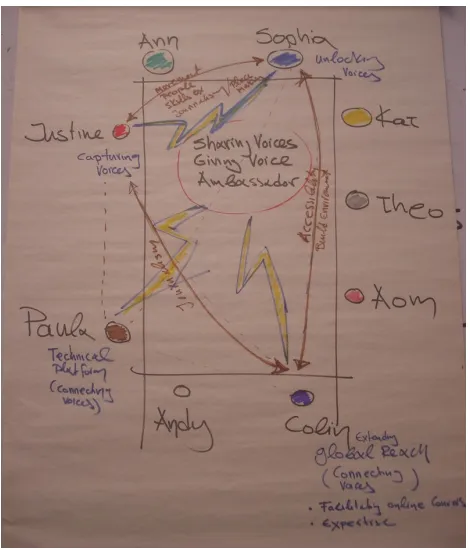
One challenging aspect of the project was the need to reaffirm funding after 4 months with a collaboratively-produced research question. Light & Luckin (2008) discuss the ‘benign imposition’ possible when applicants responding to funding calls are required to give a detailed plan at submission, in advance of establishing conditions on the ground or engaging key stakeholders in project design. The funding model for these co-design projects sought to overcome this tendency. However, the fixed timeframe imposed its own constraints: instead of allowing for gradual evolution toward a common vision, the timescale demanded rapid resolution of decisions. A further funding rule allowed community partners to be paid for time spent in novel activities, but not for their existing core actions. Noting this, the steering group (involving all partners) chose to seed the next stage of collaboration with pairings of organisations, rather than exploring each organisation’s activity independently. The group sketched arcs between partners and wrote a plan around spaces, links and learning between, rather than
co-design practices. Enriching connections between the hubs through cross-pollination activities, and cascading their practices to new partners via ‘ambassadors’ suggested two primary interventions to drive scaling up.
In what follows, we describe some of the collaborations and consider how the interactions promoted ‘scaling-up’, reflecting or modifying the understandings above. Scaling up by spreading
Our first example is perhaps the simplest. As part of their annual conference, Flossie was planning a hacklab aiming to diversify perspectives in the discourse around the Internet of Things (IoT). Given the opportunity to link with the bespoken network, Flossie decided to focus the hacklab on IoT and disability. Sadly, due to technical problems, the planned video chats between hacklab participants and bespoken members never took place. However, the theme of disability led the group to explore aspects of their own lives where they experienced their capabilities as constrained, addressing concepts to enhance security for women in public places. The hacklab was so successful that one participant chose to organise a similar event around IoT technology for families, with mentoring provided by the research project. The event organisers are also preparing a video about the activity as a way of prompting others to consider this approach. This illustrates perhaps the simplest conception of scaling up, in which a practice is spread by the enthusiasm of individuals who copy materials, then cascade and modify practices for their own context of use.
Scaling up by connecting
The second example involved an exchange between The Glass House and Silent Cities. Silent Cities were already planning a series of workshops and training exercises for people who were socially isolated or excluded, to develop
skills as ‘community journalists’. Representatives from The Glass House helped deliver one of these workshops, supporting the trainee journalists to develop sensitivities to built environment themes. The exchange was reciprocated with staff and trainees from Silent Cities conducting two workshops to train school pupils in community journalism in a district where major urban re-development is being planned. This enabled the young people to become community researchers and explore themes, meanings and priorities for themselves and for other community members. They were then able to inform debates and discussions with the commercial developers, architects and local authorities.
In the opinion of the facilitators at The Glass House, this approach allowed insights to be brought to the discussion that would otherwise have remained hidden using their previous methods. The work also revealed that the term ‘journalist’, even when qualified by ‘community’, raised fears for the land developer and local authority stakeholders. ‘Community researcher’ was easier to present to these stakeholders.
Here scaling-up went beyond the value of this one project by enabling The Glass House to extend its repertoire: appropriating and adapting new practices. The charity is now able to promote and sell new facilitation and co-design services in other locations. Silent Cities also extended its offering, giving participants the opportunity to lead media skills training for the first time.
Scaling up by extending
In our third example, the material components of the design Thing are more apparent. Initially, a cross-pollination workshop between Fossbox and One Westminster delivered training on using on-line collaborative tools to prepare funding applications. The first workshop explored distributed document editing. The workshop simulated developing a bid in a distributed organisation by placing the participants in separate rooms and asking them to collaborate on-line and communicate via Skype. A third tool, briefly introduced was the agile project management platform Trello (www.trello.com). Although participants were positive about the tools, there was no evidence of the groups adopting them.
[image:4.595.55.290.51.326.2]Following this disappointment, the representative from One Westminster devised a novel way of using Trello to support bidding. A Trello account allows the user to access a series of boards. One board is used per project and can be shared with other users. Within a board, a project is made up of cards. Cards are arranged in three (or more) columns: To do, doing and done; and are moved between columns as the project progresses. Cards can have deadlines and can be assigned to one or more individuals. Within a card, tasks can be described, checklists can be added and documents can be attached. Finally, any of these levels (board, card or part of a card) can be copied if required. The innovation was to define the steps that are needed in preparing a funding application as a board of Trello cards (see fig 2). This can then be copied and shared as a template with a partner group.
Checklists of stages for developing a bid are common this domain, but by embedding the checklist into a collaborative platform, it becomes possible to
co-production service where One Westminster monitor work and provide guidance. A workshop demonstrating the tool to five two have already adopted the platform and a third is considering it.
This example shows the possibility of scaling
design by providing a socio-material infrastructure that is tailored to a specific need. This particular solution is being offered to groups that are already in contact with One Westminster, but radically enriches the quality of their offering, and perhaps enables one person to offer effective support to a larger number of partners.
SCALING-UP DESIGN THINGS
Recognising that each example involves a design Thing questions arise about how these Things are
and what factors affect their scaling-up. Accounts of the diffusion of innovations (Rogers, 1983
of perceived benefit, compatibility, complexity, trialability and observability. The Trello
provides an easily perceived benefit for the community groups, is compatible with existing practice,
trialled directly in a training session
immediate concerns (making a funding application). benefit is provided as a service from
assemblage of both the on-line artefact and the interactions with the advisor mediated through the artefact. In contrast, the generic platforms
Skype) in the original workshop provide
benefit, and did not directly address an immediate goal In the case of engaging pupils as community reporters or researchers, this Thing was compatible with an exercise that The Glass House had already planned, and was made trialable when the project donated skills and equipment an exchange. Mentoring from Silent Cities helped to manage complexities, and the educational setting offered openness for trials. As the CEO of The
[image:5.595.55.288.51.245.2]explained, labelling activities as ‘research’ ‘consultancy’ permits experimentation.
Figure 2: Trello board for funding applications
bid are common in embedding the checklist into a it becomes possible to provide a where One Westminster can and provide guidance. After a single five organisations, two have already adopted the platform to develop a bid,
example shows the possibility of scaling-up co-material infrastructure that is
This particular solution is being offered to groups that are already in contact with , but radically enriches the quality of offering, and perhaps enables one person to offer effective support to a larger number of partners.
involves a design Thing, how these Things are propagated up. Accounts of the Rogers, 1983) highlight issues , compatibility, complexity,
Trello-supported tool benefit for the community groups, is compatible with existing practice, and can be trialled directly in a training session related to their a funding application). The a socio-material line artefact and the mediated through the eric platforms (GoogleDocs, provided less direct an immediate goal. pupils as community reporters or was compatible with an exercise had already planned, and was made skills and equipment as Mentoring from Silent Cities helped to educational setting offered The Glass House explained, labelling activities as ‘research’ rather than
Finally, the example of cascading
an ‘ambassador’ demonstrates that some may have sufficient perceived benef
scaled-up via direct efforts at replication involving significant costs and effort
In each of these cases, however, the co being demonstrated was not only perceived as a large benefit with limited
practice was open to appropriation and adaption in use which helps to achieve compatibility
template is easily copied and
journalists became community researchers; and t hacklab was re-interpreted for
These principles also apply
research collaboration between community organisations and academic researchers. Throughout our work multiple projects, it has been important to
aligning activities with immediate goals of organisations that are very resource limited.
(e.g. fig 1) and aligning activities with the existing priorities has allowed us
projects that permit adaptation
support compatibility. We then use research funding to enable trialability and observability in the context of co research, thus identifying perceivable benefits for resource-limited organisations
ACKNOWLEDGMENTS
This research was supported by the UK Arts & Humanities Research Council grant number AH/K006711/1 Scaling-up co
acknowledge the valuable contributions of all the partners & the participants in Scaling up co
REFERENCES
Dearden, A., Walker, S. & Watts, L. (2005). Choosing friends carefully: allies for critical computing. In
Procs. of Critical computing: between sense and sensibility (pp. 133-136). ACM Press.
Björgvinsson, E., Ehn, P., & Hillgren, P.
Design Things and Design Thinking: Contemporary Participatory Design Challenges.
101–116.
Boyle, D. (2013). The Barriers to Choice Review
Cabinet Office.
Ehn, P. Participation in design things, 92-101.
Lam, B., Dearden, A., William
(2012). Exploring co-design in the voluntary sector.
Presented at: VSSN / NCVO Annual Conference, University of Birmingham, 10/09/2012
Available at: http://shura.shu.ac.uk/7811/ Leadbeater, C. (2008) We Think
Light and Luckin (2008) Social Justice and User
Design for Technology-Enhanced Learning. Bristol: Futurelab.
Rogers, Everett M. (1983). Diffusion of Inno
York: Free Press Figure 2: Trello board for funding applications
cascading the hacklab practice via ‘ambassador’ demonstrates that sometimes a Thing ient perceived benefit that it can be direct efforts at replication, despite
s and effort for the adopter. In each of these cases, however, the co-design practice being demonstrated was not only perceived as delivering limited barriers to adoption. The practice was open to appropriation and adaption in use which helps to achieve compatibility. Thus the Trello
template is easily copied and adapted; the community journalists became community researchers; and the
a new topic.
These principles also apply in our experiences of co-between community organisations and academic researchers. Throughout our work in it has been important to find ways of aligning activities with immediate goals of organisations . Using fluid representations and aligning activities with the partners' existing priorities has allowed us to create Things within adaptation and appropriation to . We then use research funding to trialability and observability in the context of
co-perceivable benefits for other and furnishing evidence.
This research was supported by the UK Arts & Humanities Research Council grant number up co-design. We also acknowledge the valuable contributions of all the partners
the participants in Scaling up co-design.
& Watts, L. (2005). Choosing friends carefully: allies for critical computing. In
Procs. of Critical computing: between sense and
136). ACM Press.
on, E., Ehn, P., & Hillgren, P.-A. (2012). Design Things and Design Thinking: Contemporary Participatory Design Challenges. Design Issues, 28(3),
The Barriers to Choice Review. UK
Participation in design things, Procs. PDC 2008:
, William-Powlett, K. & Brodie, E.
design in the voluntary sector.
: VSSN / NCVO Annual Conference, University of Birmingham, 10/09/2012 - 11/09/2012.
http://shura.shu.ac.uk/7811/
We Think. Profile Books.
Social Justice and User-Centred Enhanced Learning. Bristol: