Dealing with inconsistent and incomplete data
in a semantic technology setting
Nwagwu Honour Chika
A thesis submitted in partial fulfilment of the
requirements of
Sheffield Hallam University
for the degree of Doctor of Philosophy
i
Abstract
Semantic and traditional databases are vulnerable to Inconsistent or Incomplete Data (IID). A data set stored in a traditional or semantic database is queried to retrieve record(s) in a tabular format. Such retrieved records can consist of many rows where each row contains an object and the associated fields (columns). However, a large set of records retrieved from a noisy data set may be wrongly analysed. For example, a data analyst may ascribe inconsistent data as consistent or incomplete data as complete where he did not identify the inconsistency or incompleteness in the data. Analysis on a large set of data can be undermined by the presence of IID in that data set. Reliance as a result is placed on the data analyst to identify and visualise the IID in the data set.
The IID issues are heightened in open world assumptions as evident in semantic or Resource Description Framework (RDF) databases. Unlike the closed world assumption in traditional databases where data are assumed to be complete with its own issues, in the open world assumption the data might be assumed to be unknown and IID has to be tolerated at the outset. Formal Concept Analysis (FCA) can be used to deal with IID in such databases. That is because FCA is a mathematical method that uses a lattice structure to reveal the associations among objects and attributes in a data set.
The existing FCA approaches that can be used in dealing with IID in RDF databases include fault tolerance, Dau's approach, and CUBIST approaches. The new FCA approaches include association rules, semi-automated and automated methods in FcaBedrock. These new FCA approaches were developed in the course of this study. To underpin this work, a series of empirical studies were carried out based on the single case study methodology. The case study, namely the Edinburgh Mouse Atlas Gene Expression Database (EMAGE) provided the real-life context according to that methodology. The existing and the new FCA approaches were used in identifying and visualising the IID in the EMAGE RDF data set.
The empirical studies revealed that the existing approaches used in dealing with IID in EMAGE are tedious and do not allow the IID to be easily visualised in the database. It also revealed that existing FCA approaches for dealing with IID do not exclusively visualise the IID in a data set. This is unlike the new FCA approaches, notably the semi-automated and automated FcaBedrock that can separate out and thus exclusively visualise IID in objects associated with the many value attributes that characterise such data sets. The exclusive visualisation of IID in a data set enables the data analyst to identify holistically the IID in his or her investigated data set thereby avoiding mistaken conclusions.
ii
Acknowledgements
I am grateful to Dr. Simon Andrews and Dr. Simon Polovina for the guidance and support they have given me. I am also thankful to Mr. Constantinos Orphanides for his assistance and directions. Also, I thank the CUBIST project team particularly Dr. Frithjof Dau for all the assistance which I received in the course of this study.
iii
Dedication
iv
Table of Contents
Chapter 1: Introduction ... 1
1.1
Background to the Research ... 1
1.2
Rationale for the Research ... 2
1.3
Research Objectives ... 4
1.4
Overview of this Thesis ... 4
Chapter 2: Inconsistent and Incomplete Data (IID) Issues in Traditional
Databases ... 6
2.1
Introduction ... 6
2.2
Types of Inconsistent or Incomplete Data (IID) ... 7
2.3
Close World Assumption (CWA) and Inconsistent or Incomplete Data
(IID) 7
2.3.1
Data Exchange ... 9
2.3.2
Data Fusion ... 9
2.3.3
Data Warehousing ... 10
2.4
Sources of IID in Traditional Databases ... 11
2.4.1
Nulls ... 11
2.4.2
Integrity constraints ... 11
2.4.3
Optional fields in data entry forms ... 12
2.5
Approaches used to Deal with IID in Traditional Databases ... 13
2.5.1
Resolving/Repairing IID ... 13
2.5.2
Preventing IID ... 13
2.6
Key Messages and Findings ... 14
Chapter 3: Inconsistent and Incomplete Data (IID) in Semantic Technology (ST)
Setting ... 16
3.1
Background ... 16
3.2
Open World Assumption and IID ... 17
3.2.1
Resource Description Framework (RDF) Data ... 17
3.2.2
Entailment ... 20
3.3
Existing Approaches to IID in ST Setting ... 22
3.3.1
Rule Based Approach used to Deal with IID in RDF Data ... 22
3.3.2
Query Based Approach used to Deal with IID in RDF Data ... 23
v
3.4
Key Messages and Findings ... 26
Chapter 4: Formal Concept Analysis (FCA) ... 27
4.1
Introduction ... 27
4.2
The Classical FCA Approach ... 28
4.2.1
Building a Concept Lattice from a Formal Context ... 30
4.2.2
Conceptual Scaling and Visualisation Challenges ... 31
4.3
Key Messages and Findings ... 33
Chapter 5: Research Methodology ... 35
5.1
Introduction ... 35
5.2
The Single Case Study Research Approach ... 36
5.2.1
Case Study Research Methods ... 38
5.3
Formal Concept Analysis (FCA) Research Approaches ... 39
5.3.1
Data Analysis and Visualisation Techniques in FCA ... 39
5.4
Alternative Approaches, Challenges and Ethical Considerations ... 43
5.4.1
Alternative Approaches ... 43
5.4.2
Challenges ... 43
5.4.3
Ethical Considerations ... 43
5.5
Key Messages and Findings ... 44
Chapter 6: The Edinburgh Mouse Atlas Gene Expression Database (EMAGE) 45
6.1 Introduction ... 45
6.2 The EMAP ... 46
6.2.1
Visualisation of Gene Expression ... 46
6.2.2
Annotation of Gene Expression ... 48
6.2.3
Propagation of Gene expression ... 50
6.3
Causes of IID in EMAGE Gene Expression Database ... 51
6.3.1
Data integration ... 51
6.3.2
Propagation ... 52
6.3.3
Textual Annotation ... 52
6.3.4
Data Processing Technologies ... 53
6.4
The EMAGE Search Options ... 54
6.5
EMAGE RDF Data Set ... 56
vi
Chapter 7: FCA Approaches for dealing with IID in RDF Data ... 58
7.1
Introduction ... 58
7.2
Retrieving IID with SPARQL ... 58
7.3
Existing FCA approaches for dealing with IID in RDF data set ... 59
7.3.1
Dau’s Approach-SPARQL2context creator ... 59
7.3.2
CUBIST Approaches ... 61
7.3.3
Fault tolerance ... 62
7.3.4
Attribute Exploration ... 65
7.4
New FCA approaches used to deal with IID in RDF data ... 66
7.4.1
Association Rule ... 66
7.4.2
Semi-automated and automated FcaBedrock Approach ... 68
7.5
Key Messages and Findings ... 78
Chapter 8: Experiments ... 79
8.1
Introduction ... 79
8.2
Dau’s Approach- SPARQL2context Creator ... 79
8.2.1
Introduction ... 79
8.2.2
Application ... 80
8.2.3
Queries and experimental results ... 80
8.2.4
Summary ... 85
8.3
CUBIST Approach ... 85
8.3.1
Introduction ... 85
8.3.2
Application ... 85
8.3.3
Queries and Experimental Results ... 85
8.3.4
Summary ... 88
8.4
Semi-automated FcaBedrock Approach ... 88
8.4.1
Introduction ... 88
8.4.2
Application ... 92
8.4.3
Queries and experimental results ... 92
8.4.4
Summary ... 98
8.5
Automated FcaBedrock approach ... 98
8.5.1
Introduction ... 98
vii
8.5.3
Queries and experimental results ... 100
8.5.4
Summary ... 101
Chapter 9: Evaluation of IID Approaches ... 102
9.1
Introduction ... 102
9.2
Essential Features for Approaches that Enable the Visual Identification
of IID 103
9.3
An Assessment of FCA Approaches used in Dealing with IID in RDF
Data 103
9.3.2
An Assessment of Dau’s Approach ... 103
9.3.1
An assessment of CUBIST approaches ... 104
9.3.3
An Assessment of Semi-automated FcaBedrock Approach ... 105
9.3.2
An Assessment of Automated FcaBedrock Approach ... 105
9.4
Key Messages and Findings ... 106
Chapter 10: Conclusion and Future work ... 108
10.1
A Review of the Various Chapters in this Thesis ... 109
10.3
Contributions of the Research to Knowledge ... 112
10.4
Challenges of this Work ... 113
10.5
Future Work ... 113
References ... 115
APPENDIX A ... 123
APPENDIX B ... 139
APPENDIX C ... 147
APPENDIX D ... 152
viii
TablesTable 1: Triples of the graph in Figure 1 ... 18
Table 2: Triples of the graph in Figure 2 ... 19
Table 3: A Triple illustrating how RDFS may be used... 19
Table 4: An example of RDFS entailment rule ... 21
Table 5: Owlim consistency check ... 23
Table 6: Formal context of gene expressions in tissues ... 28
Table 7: Causes and examples of IID in EMAGE ... 53
Table 8: Transforming SPAQRL-query-results to formal contexts as evident in Dau
(2013a) ... 60
Table 9: An illustration of a formal context in binary format as adapted from Andrews
and McLeod (2013) ... 62
Table 10: Example of a global object-based measurement (Gobj) incidence measure
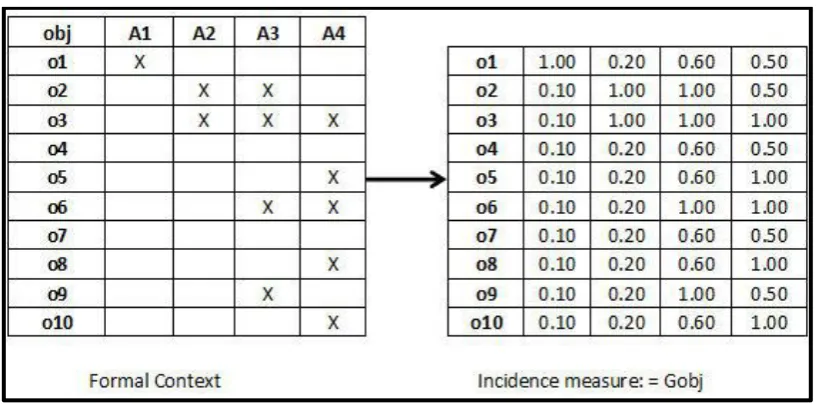
(right) from a formal context (left) as adapted from Dau (2013b) ... 63
Table 11: A reproduction of the query in Table 4 of (Dau 2013a) showing how the
union keyword is used in identifying IID ... 80
Table 12: A reproduction of the query in Table 7 from Dau (2013a) designed to retrieve
contradictory data from EMAGE RDF data set ... 82
Table 13: A reproduction of the query in Table 8 of (Dau 2013a) showing how the use
of the union keyword ... 84
Table 14: SPARQL query for retrieving Objects with binary gene expression from
EMAGE dataset ... 92
Table 15: SPARQL query for retrieving Objects with analogue gene expression from
EMAGE dataset ... 93
Table 16: SPARQL query for negatively propagating and retrieving gene expressions
from EMAGE dataset ... 95
Table 17: SPARQL query for positively propagating and retrieving analogue expressions
... 96
Table 18: SPARQL query for evaluating Objects with binary gene expression from
EMAGE dataset ... 98
ix
Figuresx
Figure 24: Concept lattice in the ConExp application ... 77
Figure 25: Pseudocode for the Inconsistency Mode in FcaBedrock ... 78
Figure 26: Concept lattice of results retrieved by the query in Table 16 as depicted in
Figure 5 in (Dau 2013a) ... 81
Figure 27: Concept lattice showing incomplete data in Tissues and associated gene
expressions as depicted in Figure 6 in (Dau 2013a) ... 81
Figure 28: Concept lattice showing Tissues with contradicting textual annotations as
depicted in Figure 7 of (Dau 2013a) ... 82
Figure 29: Tissues with contradicting textual annotations including genes as depicted in
Figure 8 and 9 in (Dau 2013a) ... 83
Figure 30: A reproduction of the query in Figure 10 of (Dau 2013a) showing concept
lattice containing contradicting pairs of tissues where genes, tissues, and TS are
included in the diagram ... 84
Figure 31: Genes, tissues and level of expression in Theiler Stage 9 as depicted in Figure
1 in (Melo et al. 2013) ... 86
Figure 32: CUBIST user interface displaying the concept lattice for genes, tissues and
level of expression in Theiler Stage 9 as depicted in Figure 2 in (Melo et al. 2013). Its
main components: 1) Toolbar; 2) Visualisation canvas; 3) Dashboard; and 4) Selection
... 87
Figure 33: Example of a retrieved query result from Owlim-SE ... 90
Figure 34: A semi-automated processing of EMAGE data in FcaBedrock ... 90
Figure 35: Visualising the output file of the FcaBedrock application in ConExp ... 91
Figure 36: Binary inconsistency in non-propagated data set in TS 11 ... 92
Figure 37: Analogue inconsistency in non-propagated data set in TS 11 ... 93
Figure 38: Binary inconsistency in negatively propagated data set in TS 11 ... 94
Figure 39: Analogue inconsistency in positively propagated data set in TS 11 ... 96
Figure 40: Concept lattice diagrams showing Amount of binary inconsistency of the
negatively propagated data set in TS 08 ... 97
Figure 41: Automated processing of EMAGE data in FcaBedrock ... 99
Figure 42: Visualising the output file of the extended FcaBedrock application in ConExp
... 100
Figure 43: Binary inconsistency in negatively propagated data set ... 101
Figure 44: A part of the EMAP Anatomy Ontology of Theiler Stage 10 available in
http://www.eMouseatlas.org/emap/ema/DAOAnatomyJSP/anatomy.html?stage=TS10
Last viewed on 12
thMay 2015 ... 154
Figure 46: Analogue IID in positively propagated data set in TS 10 ... 155
Figure 45: Analogue incompleteness in non-propagated data set in TS 11 ... 155
Figure 47: Binary IID in positively propagated data set in TS 10 ... 156
xi
Candidate Statementxii
AbbreviationsCUBIST Combining and Uniting Business Intelligence with Semantic Technologies
CWA Closed World Assumption
CAEX Computer Aided Engineering Exchange DBMS Database Management System
EMAGE The Edinburgh Mouse Atlas Gene Expression Database EMAP The e-Mouse Atlas Project
ETL Extract Transform and Load FCA Formal Concept Analysis HTML HyperText Mark-up Language IID Inconsistent or Incomplete Data OWA Open World Assumption OWL Web Ontology Language
RDF Resource Description Framework
RDFS Resource Description Framework Schema ST Semantic technology
TS Theiler Stage
URI Universal Resource Identifier W3C World Wide Consortium XML Extended Mark-up Language
1
Chapter 1: Introduction
1.1 Background to the Research
This chapter introduces the rationale and objectives of this research. This section presents a brief technical background to the research which is focused on the need to explore novel ways for dealing with the problem of inconsistent and incomplete data in semantic databases. Section 1.2 of the chapter presents the rationale for the research. Section 1.3 states the research objectives and section 1.4 concludes with an overview of this thesis.
Semantic technologies are becoming popular and increasingly important for storing and processing data. A semantic technology (ST) uses techniques that support and exploit the semantics of information, as opposed to syntax and structural/schematic issues, to enhance existing information systems (Sheth 2005). The semantics of information refers to the meaning associated with information, whilst syntax and structural/schematic issues refer to the heterogeneity challenges existing in traditional data processing systems. STs allow the meanings of and associations between objects and attributes which constitute information in a knowledge base to be known and processed at execution time (Sheth and Ramakrishnan 2003). Resource Description Framework (RDF) data, for example, are processed in ST setting. The RDF is a framework for representing information on the Web. Unlike relational data which are stored and processed in a traditional database such as Oracle and MySQL, RDF data are stored and processed in a semantic database. The processing of RDF in ST setting is explained in details in chapter 3 of this thesis.
RDF database tolerates IID. It adopts Open World Assumption (OWA) principles which implicitly assume that a knowledge base may always be incomplete (Hitzler et al., 2011 p.131). For example, consider the following statement about Philip in an OWA database: "Philip passed an English test." Under the OWA database, there is incomplete knowledge about stored data. Statements such as "Philip failed an English test" or "Philip did not take an English test" are allowed to exist in the same database. Consequently, contradictory (inconsistent) data can exist in such databases.
2
Consequently, an OWA framework is much more likely to generate new statements or accommodate new meanings based on the facts in the framework.
Since RDF adopts OWA principles, it does not prevent anyone from making assertions that are nonsensical or inconsistent with other statements or the world as people see it (Klyne et al. 2004). Hence, RDF data may always be inconsistent or incomplete. Unlike an RDF triple store1, a traditional database can adopt CWA principles, which imply that the associated knowledge base is complete. Even so, traditional databases may contain IID. CWA and OWA are discussed in details in Chapters 2 and 3, respectively.
As explained further below, this research explores novel ways for dealing with Inconsistent or Incomplete Data (IID) in RDF (hence semantic) databases, for which there is relatively fewer works compared to research on IID in traditional database settings.
1.2 Rationale for the Research
The presence of IID in semantic or traditional databases can lead to inaccurate inferences or inaccurate conclusions. This results to enormous cost on enterprises. Polovina (2013) notes that many enterprises risk business transactions based on information systems that are incomplete or misleading, given that 80-85% of all corporate information remains outside of the processing scope of such systems. Also, the Bloomberg Trading Solutions (undated) note that the complete cost of inconsistency is unquantifiable and it can include cost of accounting errors, cost of multiple feeds and all required labour to address the inconsistency.
In traditional databases, missing data is represented by the null and this remains a controversial issue as evident in (Lano 2014; Waraporn and Porkaew 2008; Zimányi and Pirotte 1997). The use of null to represent missing attribute values from various sources can lead to inconsistencies when the data are integrated. An integrated data set is evident in databases such as data warehousing, data fusion and data exchange systems. Bleiholder and Naumann (2008) identify IID as a problem in an integrated data set. Also, Decker and Martinenghi (2011) demonstrate how inconsistencies can emerge in a traditional database as a result of violations of integrity constraints. Integrity constraints and null are discussed in greater details in chapter 2.
Data set stored in a traditional or semantic database is queried to retrieve record(s) in a tabular format. Such retrieved records can contain many rows where
1
3
each row contains an object and the associated fields (columns). However, a large set of records retrieved from a noisy data set may be wrongly analysed by a data analyst. For example, a data analyst may ascribe inconsistent data as consistent or incomplete data as complete where he did not identify the inconsistency or incompleteness in the data. The data analyst needs to visually identify the IID in such retrieved record set as to properly analyse the data. But visually identifying the IID in a large tabular record set can be difficult. This is because a record set displayed in a tabular format does not enable an easy visualisation of the IID. The data analyst visually compares the different rows in the record set to fine contradictory records or records without particular fields. There is therefore a need for an easier means to exclusively visualise the IID in a large and noisy record set.
There is a wide body of work on dealing with IIDs in traditional database settings. Among these works are (Decker and Martinenghi 2011; Grant and Hunter 2011; Bleiholder and Naumann 2008; Cortés-Calabuig et al. 2005; Hunter and Konieczny 2005; Ma et al. 2007). However, in semantic database settings there is not so much research on dealing with IIDs. Notable among the few existing works are (Dau 2013a; Dau 2013b; Melo et al. 2013). There is therefore a need to research how IID in RDF data can be dealt with.
The aim of this work is to discover ways by which Formal Concept Analysis (FCA) can be used to deal with IID in a semantic technological setting. FCA is a semantic analysis technique and has been shown in a recent European Union (EU) CUBIST2 project to be useful and appropriate for the analysis of data in RDF triple store. It involves a mathematical method which uses a lattice structure to reveal the associations among objects and attributes in a data set. It uses the lattice as a visualisation framework to explore correlations, similarities, and anomalies in a data set (Carpineto and Romano 2004, p.15). Therefore, it can be used to explore IID in RDF data sets. Hence, this work uses an indicative case study to answer the research key question:
“How can FCA tools and techniques be used to identify and visualise IID in RDF data?”
The research uses an RDF triple store (Owlim3) and FCA analysis tools such as FcaBedrock4, Concept Explorer5 and In-Close6 as its semantic technological setting. It
2
www.cubist-project.eu 3
4
builds on works of Dau (2013a, 2013b) and Melo et al., (2013) which deal with IID in RDF data set, in order to develop novel FCA approaches that improve upon some inadequacies in the existing ones. In other words, the research explores existing and additional approaches in which FCA tools and techniques can be used to deal with IID existing in RDF data. The research uses a single case study to evaluate the performance of the identified FCA approaches.
1.3 Research Objectives
The specific objectives of the research are as follows:
1. To understand IID issues and how they are dealt with in a traditional technology setting.
2. To understand IID issues in ST setting
3. To investigate existing approaches in dealing with IID in ST setting.
4. To propose FCA as an appropriate and effective technique for dealing with IID in ST setting.
5. To build on existing FCA approaches and develop better novel approaches. 6. To apply existing and new FCA approaches to an indicative case study
7. To compare and evaluate the usefulness and effectiveness of the different FCA approaches.
1.4 Overview of this Thesis
This thesis is presented in 10 chapters. Chapter 1 presents the rationale and objectives of the research as stated above.
Chapter 2 explains what IID is. It describes in more details, the concept of CWA and the different types of IID. Null and integrity constraints are among the identified sources of IID in traditional database. Also, the use of optional fields in data entry forms is
4
http://sourceforge.net/projects/FcaBedrock/ 5
http://sourceforge.net/projects/conexp/ 6
5
identified as a source of incomplete data. The various approaches used in addressing IID in traditional databases are described in this chapter.
Chapter 3 provides an overview of ST, semantic database, RDF and the concept of OWA. IID in semantic database are explained. The chapter also identifies and explains existing approaches that are used in dealing with IID in a semantic database setting.
Chapter 4 describes the classical FCA approach. It explains how formal concepts are derived from formal context and how they are displayed in a lattice structure. The challenges of classical FCA approach in identifying and visualisation IID are also explained.
Chapter 5 explains the research methodology, including how FCA is used to address the issues of IID in an indicative case study - the Edinburgh Mouse Atlas Gene Expression Database (EMAGE). The chapter explains case study research with emphasis on single case study. The suitability of EMAGE as a case study is explained. The chapter also identifies FCA as a research method. The criteria used in selecting EMAGE as a case study are also explained.
Chapter 6 explains in detail the EMAGE, a database of gene expression data in the developing mouse embryo, and an accompanying suite of tools to search and analyse the data. The chapter particularly explains how the e-Mouse Atlas Project (EMAP) is used in EMAGE. In addition, it describes the EMAGE RDF data set. The causes of IID in the EMAGE data set are also identified and explained.
Chapter 7 explains how the RDF query language (SPARQL) can be used to retrieve IID from a semantic database. It provides comprehensive details about existing and new FCA approaches to IID in RDF data set. Examples are also used to illustrate how these approaches are applied. This prepares the ground for applying the approaches to the case study.
Chapter 8 therefore explains how these FCA approaches are used to identify IID existing in an EMAGE data set.
Chapter 9 compares and evaluates the effectiveness of the FCA approaches.
6
Chapter 2: Inconsistent and Incomplete Data (IID) Issues in
Traditional Databases
2.1 Introduction
This chapter explains what IID in a database is. It specifically discusses IID in traditional database. Section 2.2 explains the different types of IID in traditional databases. Section 2.3 discusses IID in traditional databases in which CWA is adopted. The sources of IID in traditional databases are explained in section 2.4 and the various ways of dealing with the IID in a traditional database are explained in section 2.5. Section 2.6 concludes the chapter by outlining the key messages and findings.
IID exists in a database when data do not conform to the rules governing its design. A data set in a traditional database can contain objects (G) and associated attributes (M) which have many values (W). Consequently, an object (g G) that is associated with an attribute (m M), can be inconsistent or incomplete in a traditional database. An object can be inconsistent when there is a contradiction in the values of the attribute such that w ⊆ W is associated with A and ¬A. An object is incomplete when it has some but not all of its required values.
7
2.2 Types of Inconsistent or Incomplete Data (IID)
IID can occur in traditional database for different reasons; for example, it can occur because a value of an attribute is not available or because the value is integrated from a data source with a different schema. In this section, the various classifications of IID are explained.
There are different classifications of IID; for example, Codd (1986) classifies missing data in a traditional database as either ‘missing and applicable’ or ‘missing and inapplicable’. Kim and Seo (1991) classify data conflict in multidimensional databases as ‘wrong data’ and ‘different representations for the same data’. Bleiholder and Naumann (2008) explain that a data conflict is present in a data set if for the same real-world object e.g. a student, semantically equivalent attributes from one or more sources do not agree on its attribute value; for example source 1 reporting “23” as the student’s age, and source 2 reporting “25”. They describe two kinds of data conflict: (a) uncertainty about the attribute value, caused by missing information and (b) contradictions, caused by different attribute values. Other classifications of missing data in traditional databases are presented in works such as (Waraporn and Porkaew 2008; Zimányi and Pirotte 1997; Codd 1979; Gottlob and Zicari 1988).
In this work, IID are classified as either binary or analogue. A binary form of IID exists when the same object is associated with attribute values that have opposite meanings. An example of attribute values that have opposite meanings is a gene which is ‘detected’ and ‘not detected’. An analogue type of IID exists when an object is associated with attribute values that are slightly contradictory. An example of attribute values that are slightly contradictory is a gene which is associated with weak and medium expression levels. Finkelstein (2000) explains that “In many cases inconsistencies reflect slips and minor errors or possibly delayed commitments which are relatively easy to resolve. Some inconsistencies however reflect serious conflicts with substantial knock-on consequences and may involve substantial negotiation.”
Such minor errors can be attributed to analogue IIDs while serious conflicts can be attributed to binary IIDs. Inconsistency in gene expression data is also classified as either binary or analogue in McLeod and Burger (2011).
2.3 Close World Assumption (CWA) and Inconsistent or Incomplete Data
(IID)
8
traditional databases and the consequences of such implementation on the stored data.
The CWA expresses the communication agreement that an atom that does not appear in the database is false (Cortés-Calabuig et al., 2005, Denecker et al. 2010). It works on the principles that a knowledge base has complete information about every data in the domain. Even where there is no proof of a positive ground literal, the negation of that literal is assumed true (Reiter 1982).
Traditional databases adhere to the principles of CWA by representing unknown or missing values with null and resisting non-conforming data through the use of integrity constraints. The works of (Codd 1979) provides a formal treatment of missing values by null under the unknown semantics (Gottlob and Zicari 1988). Zimányi and Pirotte (1997) explain that null have been most widely used to model incomplete information under CWA. But the null is an ambiguous representation of a missing value. This is because a missing value can be unknown, not available, not existing, or not applicable. The use of the null to represent all these instances in a data set causes indefiniteness in the set of data. Consequently, inaccurate results can be drawn from a set of data in which nulls are used in representing missing attribute values.
Null cannot explicitly represent missing values where data from different sources are integrated into a data set. Its use in traditional database may result into IID when data are integrated from multiple sources. For example, an attribute value of an object from source ‘A’ can be assigned the null value. Also, a different value can be assigned to the same attribute of the same object in source ‘B’. This will result into an uncertainty when these data are integrated into a single database. Such uncertainty in traditional database is described in Bleiholder and Naumann (2008) as the conflict between a non-null value and one or more null values that are all used to describe the same property of an object. This type of conflict can be assessed as analogue IID (see section 2.2). Moreover, some partial knowledge available to the data user such as the inapplicability of a value in an attribute will be lost when such knowledge is represented by null (Gottlob and Zicari 1988). The works of (Waraporn and Porkaew 2008; Gottlob and Zicari 1988; Zimányi and Pirotte 1997) explain the lapses in representing missing values with null.
non-9
conforming data from entering into the database. These restrictions imply that the traditional database does not guarantee the full correctness or completeness of its data with respect to the part of the real world that it models (Grefen 1993; Motro 1998). More so, the adoption of CWA and the use of integrity constraints do not efficiently apply to all domains. Cortés-Calabuig et al., (2005) explain that in a context of integrated data sources, CWA is inherently inappropriate since the consideration of a certain data source as a single and complete representation of the world either completely discards the other sources of information or causes contradictions among them. Consequently, IID can thrive in databases such as data exchange, data fusion, and data warehousing. These databases are briefly described below:
2.3.1 Data Exchange
Data exchange is the problem of taking data structured under a schema called the source schema, and transforming it into data structured under another schema, called the target schema (Kolaitis 2005; Fagin and Kolaitis 2005). It involves materialising the source data in a target data set. The importance of data exchange is evident in a circumstance where the transfer of data between independently created applications is required. Such independently created applications are likely to have different schemas, integrity constraints, and data format.
IID can thrive in data exchange databases. For example, in data exchange the null may be used to represent missing values of source data in the target data set. This practice as described in this chapter is likely to lead to IID. Hernich et al. (2011) and Libkin (2006) note that when the presence of incomplete information in the target source of data exchange setting is ignored then certain answers from the data exchange will be wrong. Also, certain answers from the data exchange will be wrong where CWA is not enforced (Afrati and Pavlaki 2008; Hernich et al. 2011; Libkin 2006).
2.3.2 Data Fusion
10
detection of equivalent schema elements in different sources (schema matching) and the detection of equivalent object descriptions (duplicate detection) in different sources to integrate data into one single and consistent representation.
Data fusion systems are widely used in various areas such as sensor networks, robotics, video and image processing, and intelligent system design (Khaleghi et al. 2013). IID are identified in data fusion in works such as in (Khaleghi et al. 2013; Bleiholder and Naumann 2008; Kumar et al. 2007).
2.3.3 Data Warehousing
A Data Warehouse is a set of materialized views over the operational information sources of an organization, designed to provide support for data analysis and management's decisions (Calvanese et al. 2001). A data warehouse can include data from an organisation’s operational information sources which may span over a long period. It can involve integrating data from different sources into a database. Such database can be subject to changes where new sources are integrated and old sources may be deleted.
Basically, data warehousing involves the Extract, Transform and Load (ETL) processes. Data are extracted from identified operational information sources (internally or externally), transformed and loaded into the end target file. These extracted data can be dirty or noisy such that they are inconsistent, have missing values or other anomalies. Consequently, they will be transformed to meet the data warehouse requirements such as the integrity constraints in the data warehouse. Also, not all the extracted data might be needed for a particular managerial decision, so only the required data will be loaded into the target file for a particular analysis.
Issues of IID are obvious in ETL processes. For instance, data cleaning is an important activity in the ETL processes of a data warehouse and it deals with detecting and removing errors, missing data and inconsistencies in the data set (Kimball and Caserta 2004; Calvanese et al. 2001). Data cleaning in ETL processes aims at ensuring that the data in the data warehouse are correct, consistent and complete. For example, Kimball and Joe (2004 p. 166) point out that during the loading phase of the ETL processes, it is important to recognise the same dimensional entity across multiple source systems and resolve the conflicts in overlapping descriptions. Works such as (Kimball and Caserta 2004; Calvanese et al. 2001; Rahm and Do 2000; Chaudhuri and Dayal 1997) identified IID as a challenge in data warehouses.
11
2.4 Sources of IID in Traditional Databases
This section discusses null, integrity constraints, and optional fields in data entry forms as some of the sources of IID in a traditional database. These sources of IID in traditional databases are explained as follows:
2.4.1 Nulls
Incomplete data contain missing attribute value(s). The null is used in traditional databases to represent missing attribute values as explained above. A missing attribute value can be unknown, unavailable, not existing or not applicable. The representation of these values with null can be problematic in an integrated data set. Lano (2014) explains how the explicit use of nulls complicates system specification and verification by introducing indefiniteness into expressions, encouraging the use of hard-to-verify specification styles and complicating the logic used for reasoning about systems and models. This is because null can misrepresent the meanings of missing attribute values. It can also cause inconsistency in the meaning of missing value when an attribute value in a source data is compared to the represented value in an integrated data set.
2.4.2 Integrity constraints
Integrity constraints are statements that must always be true for the stored data and for any update to the database. Integrity constraints are usually provided by the Database Management System (DBMS). A DBMS can be defined as a program that helps to manage your database. A check for null in a primary key is an example of an integrity constraint which a DBMS provides. In some instances, third party software applications provide such integrity constraints where the constraints are not supported by the DBMS (Decker and Martinenghi 2011).
An application of integrity constraint introduces incompleteness into the traditional database. The database is left with only partial information to answer user’s queries. Calì et al., (2013) explain that in a global schema containing integrity constraints, the query processing is intimately connected to the notion of querying incomplete databases. They note that “when the global schema is expressed in the relational model with integrity constraints, even of simple types, the problem of incomplete information implicitly arises”. A global schema provides an integrated and virtual view
12
Furthermore, inconsistencies in a traditional database may emerge as a result of violations of integrity constraints. Decker and Martinenghi (2011) explain that integrity constraints may be violated when new constraints are added without being checked for violations by legacy data. Integrity control of a database may be turned off temporarily such as when uploading a backup for which a total check would last too long. The integrity of the data in a database may also deteriorate by migrating to the DBMS of a different vendor, since the semantics of integrity constraints tends to be proprietary. When an integrity constraint in a DBMS is violated, inconsistency prevails in the database. Also, properly designed constraints introduce incompleteness in the database by not allowing data that may violate it. IID will always exist in a traditional database when integrity constraints are applied.
2.4.3 Optional fields in data entry forms
A data entry form with an optional field can cause IID in a traditional database. Chaudhuri and Dayal (1997) identify optional fields in data entry forms as significant sources of inconsistent data. A data entry form may contain optional or mandatory fields. The asterisk ‘*’ by the side of a field in a data entry form is often used as a distinction between optional and mandatory fields where the later is indicated by the asterisk.
An optional field enables the capture of non-mandatory data from a form user. There are issues of IID when a data entry form contains optional fields. This is because the form user may enter contradictory or even nonsensical values through an optional field. He may also leave the optional field blank which will result to missing data at the backend of the data entry form.
There are other possible causes of IID in traditional databases. For example, the lack of a consistent vocabulary in traditional database can cause IID in the database. Berners-Lee et al. (2001) explain that traditional knowledge representation systems are typically centralized, requiring everyone to share exactly the same definition of common concepts such as "parent" or "vehicle." A representation system whose data are from different sources that do not abide by a common vocabulary is likely to house inconsistent data. Also, Denecker et al. (2010) note that ignorance about the domain, lack of proper maintenance, incomplete migration, and accidental deletions of tuples are some of the reasons for the presence of incomplete knowledge in a database.
13
to process both the single sourced and the integrated data sets. Section 2.5 explains how IID are dealt with, in such traditional database.
2.5 Approaches used to Deal with IID in Traditional Databases
There are several approaches that can be used to deal with the IID in traditional databases. These approaches can be classified as follows:
2.5.1 Resolving/Repairing IID
Resolving IID involves identifying the IID and replacing or repairing the IID. It involves applying some minimal change to IID as explained in Wijsen (2006). In data warehouse for example, data cleaning provides an avenue to detect and remove errors and inconsistencies in a data set (Rahm and Do 2000). Some of the approaches used in data cleaning are documented in (Kimball and Caserta 2004; Rahm and Do 2000).
There are also tools developed for detecting and repairing data which violate integrity constraints (Fan et al. 2008; Fazzinga et al., 2006; Raman and Hellerstein 2001). In addition, the works of (Flesca et al., 2010; Bertossi et al., 2008; Cong et al. 2007; Bravo and Bertossi 2006) demonstrate how inconsistent data can be identified and resolved through the use of relational data queries. Missing attribute values in incomplete data are resolved in relational database by either replacing them with null or with other meaningful representations. The works of (Waraporn and Porkaew 2008; Zimányi and Pirotte 1997; Gottlob and Zicari 1988; Codd 1979) demonstrate how missing values in relational databases can be replaced.
2.5.2 Preventing IID
14
2.5.3 Reasoning with IIDSometimes, it is necessary to allow IID into a database. For example, IID should be allowed into a tax database to identify fraudulent data. On such note, Decker and Martinenghi (2011) suggest that inconsistencies are often unavoidable or even useful such as in diagnosis or mining fraudulent data. They propose ways by which some inconsistencies can be tolerated through integrity tolerance check. Hunter and Konieczny (2005) explain the importance of tolerating inconsistent data to include the avoidance of losing information about some facts in a database. It is therefore important to have good reasoning methods for dealing with a database which contains IID. An example of a good reasoning technique for retrieving information from a noisy database is consistent query answering as evident in (Fuxman et al., 2005; Chomicki et al., 2004; and Arenas et al., 1999).
2.6 Key Messages and Findings
IID may not mainly be resolved, prevented, evaluated or reasoned with. They should be managed in accordance with the requirements of the domain7 in which they occur. For example, in circumstances in which IID is tolerated, the IID should be reasoned with rather than repaired or replaced. Also, it may not be beneficial to use traditional database as a data processing engine. A database that adheres to OWA can be more effective in dealing with IID. For example, it is acknowledged in (Bonifati et al. 2008; Halevy et al. 2003) that designing a database which can adhere to CWA is difficult or even impossible to achieve in a Peer to Peer (P2P) database system. Thus, the integrated data sets may more effectively be processed by a database system which is based on the OWA. Chapter 3 explores the semantic database, its adherence to OWA, IID in RDF data, and related concepts.
This chapter has explained the meanings and types of IID and how the integrity constraints and null in traditional databases are used, among others. It also explained the sources of IID in traditional database and the ways by which it can be dealt with. Related concepts which underpin this study such as CWA versus OWA frameworks were reviewed. The chapter noted particularly that IID is an important and challenging
7Some approaches, for example [Denecker et al. 2010] have different assumptions on
15
16
Chapter 3: Inconsistent and Incomplete Data (IID) in Semantic
Technology (ST) Setting
3.1 Background
This chapter describes how IID in Resource Description Framework (RDF) data are processed in a semantic technology (ST) setting. It begins by describing what ST is. Section 3.2 explains the OWA principles and IID in RDF triple store. It also explains the RDF data and entailment rules. Section 3.3 identifies and explains the different ways by which IID in RDF triple store are dealt with in ST settings. The chapter is concluded by outlining the key messages and findings in section 3.4.
The ST plays a huge role in the processing and analysis of RDF data. Hendler (2009) describes web 3.0 as semantic web technologies integrated into or powering large-scale web applications. He characterised the features of semantic technological applications to include applications that can integrate web data resources and have increased use of and support for the languages developed in the World Wide Consortium (W3C) Semantic Web Activity8. The RDF provides a base for semantic web technologies9. In this work, the Owlim RDF triple store, and the FCA tools and techniques namely the FcaBedrock, ConExp, and In-Close are considered.
When an RDF data set containing IID is processed in an RDF triple store, the IIDs are not prohibited from the data store unlike in a traditional database (see chapter 2). This is because an RDF triple store adheres to OWA principles. Also IID can be inferred in a triple store through the application of RDF entailment rules. Unlike the traditional data representation, RDF enables data from multiple sources to be integrated into a data set without jeopardising their meaning. Consequently, IID can be meaningfully represented, stored, and processed in RDF database. The use of RDF enables the representation of the meaning and associations in resources10. Section 3.2 below explains the principles behind RDF representations.
8www.w3.org/2001/sw
9http://semanticweb.org/wiki/Tool
17
3.2 Open World Assumption and IID
A database which does not assume that its data is complete and which does not use integrity constraints to exclude data that do not conform to its schema is said to adhere to OWA. This section explores OWA and IID in RDF triple store.
In OWA, the absence of information is an indication of lack of knowledge. Also, a statement cannot be inferred to be false in OWA, even when there is a failure to prove it (Sirin and Tao 2009). For example, the storing of the statement "Philip passed an English test” does not mean that “Philip failed an English test” is false. This is because Philip may have written the English test several times.
An RDF data can be inconsistent or incomplete. Unlike the traditional database where constraints might ensure the consistency of its data, RDF triple store do not prohibit IID as recommended by (Klyne et al., 2004). In addition, RDF data set may have issues such as missing schema, and evolving data, as identified in (Scheglmann et al. 2013). Nevertheless, IID can be inferred through RDF entailment rules in an RDF triple store. The application of entailment rules in a triple store may enable new knowledge to be inferred from existing knowledge. Even so, not all the missing data in a data set can be inferred by a triple store. A proper understanding of RDF data and entailment rules is needed to understand the issues of IID in an RDF triple store. RDF data and entailment rules are therefore explained in sections 3.2.1 and 3.2.2 respectively.
3.2.1 Resource Description Framework (RDF) Data
RDF is a framework for representing information in the web. Its data (RDF data) are statements made about resources in the form of triples. A triple (an RDF statement) consists of a subject, predicate (attribute) and an object. Figure 1 shows a graphical representation of 2 triples as outlined in Table 1 below.
18
In Figure 1, a resource such as textual_annotation_6960 and its predicate such as
in_tissue are depicted. Ideally, a resource in a triple is uniquely represented by the Universal Resource Identifier (URI). For example, the resource
Textual_annotation_6960 can be uniquely identified within the project
http://www.cubist-project.eu/HWU#. However, this work uses plain words to depict resources in a triple.
Table 1: Triples of the graph in Figure 1
RDF data can contain more than 2 triples. Figure 2 shows an example of an RDF data that contains 4 triples. This is depicted in Table 2 below.
Figure 2: RDF Graph illustrating RDF data with more than 2 triples
Subject Predicate Object
19
Table 2: Triples of the graph in Figure 2
A comparison of Table 1 and Table 2 reveals that the RDF data in Table 1 is incomplete. It can be seen that the object tissue_EMAP_987 is only associated to 1 attribute (predicate) value in Table 1 such that the attribute ‘is_part_of’ is associated to the value ‘tissue_EMAP_990’. This is unlike in Table 2 where the attribute ‘is_part_of’
of the object tissue_EMAP_987 is associated to tissue_EMAP_990 and
tissue_EMAP_989. These observations are easier to identify in the associated figures. Also it is possible to have an RDF data which has contradictory attribute values such as detected and not detected. These are examples of instances of IID in an RDF data set.
RDF is a framework which can be used as a modelling language and also as a data representation format. It uses Resource Description Schema (RDFS)11 or Web Ontology Language (OWL)12 as its modelling languages. RDFS, for example, provides data-modelling vocabulary such as rdfs:Class, rdfs:subClassOf, rdfs:label, and
rdfs:domain which are used to describe the properties of a subject or an object of a triple. Both the RDF data and its metadata (such as RDFS data) can be stored as triples in the same data set. An example of how a modelling language can be used in an RDF data set is illustrated in Table 3 below.
Table 3: A Triple illustrating how RDFS may be used
Subject Predicate Object
Textual_annotation_6960 rdfs:label assay no 6960
In Table 3, the description of textual_annotation_6960 is achieved through the use of RDFS construct such as rdfs:label (see Table 3 above). More descriptions can be
11 http://www.w3.org/TR/rdf-schema/ 12 http://www.w3.org/TR/owl-semantics/
Subject Predicate Object
20
added to the data where necessary. This may be achieved through the use of
rdfs:Class or rdfs:subClassOf constructs in RDFS.
The use of RDF and its modelling languages (RDFS or OWL) in data representation enhances data integration (combining data from different sources). This is because RDF uses URI which retains the uniqueness and semantics of the represented data even when they are integrated with other data. Also, the use of RDF does not result in issues of interoperability of data as evident in Extended Mark-up Language (XML), Hyper Text Mark-up Language (HTML) or relational data format (Berners-Lee et al., 2001; Bizer et al., 2009). Consequently, RDF data from various sources can be integrated into a single data set without losing the semantics.
RDF is used in representing web data as evident in projects such as DBpedia13 and CUBIST. However, a fundamental issue with RDF data is its tolerance of IID. An object in RDF data can be associated with many attribute values; this can result in IID in the data. For instance, there is inconsistency in an object which is associated with contradictory attribute values. On the other hand, incompleteness will exist in an object which does not have a required value. Nevertheless, RDF triple stores can use the entailment rules to infer missing attribute values or deduce inconsistency as a means of addressing its IID challenges. Entailment and entailment rules are explained in section 3.2.2 below.
3.2.2 Entailment
A triple store is a semantic technological setting that stores RDF data (triples) and also reasons over the stored triples. It can also infer new triples into its RDF data set through entailment rule(s). Entailment describes two graphs which are equal in all aspects in that every assertion made about one RDF graph may be made with equal truth about the other graph (Powers 2003). As explained in Hayes and McBride (2004)
If A entails B, then any interpretation that makes A true also makes B true, so that an assertion of A already contains the same "meaning" as an assertion of B; one could say that the meaning of B is somehow contained in, or subsumed by, that of A. If A and B entail each other, then they both "mean" the same thing, in the sense that asserting either of them makes the same claim about the world.
21
Table 4 shows an example of an RDFS entailment rule “rdfs11” as outlined in Hayes and McBride (2004).
Table 4: An example of RDFS entailment rule
Rule Name If E contains: then add:
rdfs11 uuu rdfs:subClassOf vvv vvv rdfs:subClassOf xxx
uuu rdfs:subClassOf xxx
A triple store adds an entailed triple to a graph when the graph entails any larger graph. This is because a graph entails any larger graph that is obtained by applying entailment rule(s) to the original graph. In Table 4, the presence of a graph whose pattern is “uuu rdfs:subClassOf vvv” and “vvv rdfs:subClassOf xxx” results to the addition of the triple
“uuu rdfs:subClassOf xxx” to the graph. This provides a rule by which graphs of this
pattern are entitled. The W3C RDF* recommendations include a list of standard entailment rules. For example Hayes and McBride (2004) outline a standard set of simple entailment rules for RDFS. Also, a standard set of entailment rules in OWL is outlined in W3C website14.
RDF triple stores such as Owlim, Jena15, Oracle Semantic database and Sesame adhere to OWA. A semantic database provides the semantic technological setting that can process the inconsistent or incomplete information in an RDF data set. As explained in Klyne et al. (2004), “RDF does not prevent anyone from making assertions that are nonsensical or inconsistent with other statements or the world as people see it. Designers of applications that use RDF should be aware of this and may design their applications to tolerate incomplete or inconsistent sources of information”. Unlike in
traditional databases (see chapter 2), where data are accepted only if they do not violate the integrity constraints, RDF triple stores do not resist IID. Also, the entailment rules can be used to tolerate, infer or even identify the IID in RDF database as explained in section 3.3 below. Even so, there is still a need to identify other means of dealing with the tolerated IID in a triple store. Section 3.3 explores the existing approaches for dealing with the IID in a semantic technological setting.
22
3.3 Existing Approaches to IID in ST Setting
The existing approaches for dealing with IID in an RDF triple store can involve identifying, evaluating, visualising, analysing or reasoning with the IID. These measures will empower the information analyst with the accurate knowledge about the nature of the IID. This knowledge will enable the information user to avoid inaccurate conclusions.
IID can be identified and measured in an investigated data set. The works of (Fürber and Hepp 2010; Melo et al., 2013; Péron et al., 2011; Drumond et al., 2012; Sertkaya 2009) explain different ways of using SPARQL to identify IID in RDF data set. Also Nwagwu (2013) explains how inconsistent data in RDF data set can be evaluated through the use of SPARQL queries. But the identification of IID through SPARQL queries involves presenting the results in a table and such presentations may be difficult to analyse. In fact, voluminous tables can be difficult to perceive or visualise. Nevertheless, Dau 2013a; Dau 2013b; and Andrews and McLeod 2013 present approaches that enable the visual analysis of the IIDs in RDF triple store. These works uses FCA techniques as a means of dealing with IID in a data set.
Another means of dealing with IID in a triple store is through the use of rules. Hayes and McBride (2004) explain entailment rules as a means of inferring RDF data and also identifying its inconsistencies. RDF processing engine such as Owlim uses rule based approach to deal with IID (Stoilov and Bishop 2012).
This section identifies the rule based approach, the query based approach, and the combination of the query based approach with FCA techniques as three main documented approaches for dealing with IID existing in RDF data. The section below, explains these approaches.
3.3.1 Rule Based Approach used to Deal with IID in RDF Data
A triple store adds an entailed triple to a graph when the graph entails any larger graph. RDF data processing engines use entailment rules to deal with IID existing in its data set. Stoilov and Bishop (2012) explain how Owlim-SE infers missing data and how it identifies inconsistent data through entailment rules.
23
consistency checking rule, an error message is sent to a standard output such as a log file (Stoilov and Bishop 2012). Table 5 below, shows a rule that is designed to identify inconsistent data.
Table 5: Owlim consistency check
Rule Name If Entailment rule
contains:
Standard output:
consistency Check x owl:sameAs y x owl:differentFrom y
Error message
As depicted in Table 5, whenever the reasoner identifies a graph that contains the triples “x owl:sameAs y” and “x owl:differentFrom y”, an error message is sent to a
standard output notably an error file.
Rule based detection approach to IID automatically identifies IID existing in an RDF data set but the following lapses can be associated with the approach:
The error file will be difficult to visualise where there are many errors.
Analysing the IID in the error messages can be difficult especially since the identified inconsistent data are mostly stored as log (text) files as explained in (Stoilov and Bishop 2012).
There are semantic and syntactic differences among data in different data sets. As a result, differences exist in the rules of the different data sets for identifying their IID. It will be impossible to articulate and stipulate all the rules of all data sets as entailment rules in a reasoner.
The IID approach in Owlim triple stores demands that inferred data are integrated automatically into the data set. Also, inconsistent data are generated as error messages in a log file (Stoilov and Bishop 2012). This approach makes the identification, visualisation, evaluation and analysis of IID difficult to achieve.
3.3.2 Query Based Approach used to Deal with IID in RDF Data
24
The query based approach used in dealing with IID provides a means by which the information analyst can interact with the data set and address issues of IID such as identifying and evaluating the IID in a data set. This approach enables the information analyst to creatively analyse the data through SPARQL features and display results in a tabular format.
Abele et al. (2013) explain how SPARQL queries can be used to validate Computer Aided Engineering Exchange (CAEX) data set. This validation process involves using SPARQL queries to check for inconsistent data in CAEX data set. Quilitz and Leser (2008) and Dau (2013a) explain how the optional and the union keywords can be used to retrieve IID from an RDF data set. Fürber and Hepp (2010) explain how to identify data quality problems in single source scenarios through SPARQL queries. Their focus is on syntactic errors, missing values, unique value violation, out of range values and functional dependency violations. Also, Nwagwu (2013) shows how SPARQL queries can be used in evaluating the data from an RDF triple store.
But there are challenges with visually analysing the query results displayed in a table, especially where there are many rows and columns. One of such challenges is the inability to visualise at a glance, the relationships existing in IID across many rows of a table. As a result, identifying and visualising objects with similar contradictions or similar incompleteness becomes a difficult task. Also, voluminous tables may be difficult to perceive.
3.3.3 Combining Query Based approach with FCA Techniques
FCA techniques such as fault tolerance and interactive exploration enable the analysis and visualisation of the data in a database. These data are retrieved through the use of SPARQL queries from the RDF database. However, such data must first be transformed into a formal context and subsequently into a formal concept, to visualise the inconsistency or incompleteness in it. Formal context and the concept lattice are explained in chapter 4.
25
Also, the CUBIST project developed many FCA techniques for dealing with IID. CUBIST is an acronym for Combining and Uniting Business Intelligence with Semantic Technologies. This project was funded by the European Commission under the 7th Framework Programme of ICT, Topic 4.3: Intelligent Information Management. It ran from 1st October 2010 to 31st September 2013. Among CUBIST’s achievements are the development of a tool (CUBIST) and approaches for dealing with inconsistent and incomplete RDF data. The CUBIST approach is based on “the querying of ontology data which is then converted to a formal context in a process transparent to the user” (Melo et al. 2013). Melo et al. (2013) explain the IID processing capabilities of CUBIST. CUBIST applies fault tolerance, and interactive exploration techniques when dealing with IID in an RDF data set.
Another FCA technique for identifying incomplete data is attribute exploration. Attribute exploration has been ingeniously applied in distinctive areas such as ontology completion, security checks, and web data. For example, through attribute exploration, the missing data of an incomplete ontology can be deduced by querying the domain expert. Sertkaya (2009) explains how attribute exploration is applied by OntoComp application to complete ontology attributes. However, Baader et al. (2007) note that attribute exploration does not adhere to the semantics of the OWA. Chapter 7 of this work examines the attribute exploration in greater details.
26
3.4 Key Messages and Findings
RDF is a semantic framework whose data are processed in ST setting. It adopts the OWA principles. Unlike traditional data model, RDF preserves the meaning associated with its represented data even when the data are integrated from multiple data sources. Similar to traditional database, RDF database faces IID challenges.
This chapter has explored issues of IID in RDF data and how it is presently dealt with in a semantic technological setting. It identified the lapses in the current approaches used in dealing with IID in ST setting. It identifies that the rule base, query based, and the combination of the rule based with FCA approaches are the existing methods of dealing with IID in RDF database. It further recognises that combining query based approach with FCA techniques provides a more robust approach that can be used to deal with IID in RDF database than the rule or query based approaches. Nevertheless, combining query based approach with FCA techniques does not exclusively identify or visualise the IID in a large and noisy data set.
27
Chapter 4: Formal Concept Analysis (FCA)
4.1 Introduction
This chapter introduces Formal Concept Analysis (FCA) which underpins this research. Following this introduction, section 4.2 examines the classical FCA approach and its challenges in dealing with IID. Examples are used to illustrate the classical FCA approach.
Formal Concept Analysis (FCA) was introduced by Rudolf Wille in (Wille 1982). It is a mathematical method which uses the concept lattice as a formalism to explore correlations, similarities, refinements, anomalies, or even inconsistencies (Carpineto and Romano 2004). It provides a data processing approach by which data are analysed by conceptually clustering objects with respect to a given set of attributes and visualising the set of clusters in a lattice structure.
FCA is used in this work to analyse and visualise IID in RDF data. It provides better analysis and visualisation approaches than traditional data analysis techniques such as (x, y) plots, linear and bar-charts, histogram, and pie charts. For instance, traditional data analysis and visualisation techniques are rendered ineffective when a data set contains tens, hundreds or thousands of dimensions and when the data set does not have natural mapping to the display space (Keim et al. 2008; Keim 2001). This is unlike in FCA which provides data analysis and visualisation approaches for exploring correlations, similarities, refinements, anomalies, and inconsistencies.
FCA presents more advanced data analysis and visualisation techniques which have been shown in the CUBIST project to be useful and appropriate for the analysis of data in RDF triple store. Also, its tools and techniques can be used to analyse large data set. For example, Andrews and Orphanides (2010) describe how the FcaBedrock and the In-Close can be used to analyse a formal context which contains more than 220,000 formal concepts. Stumme et al. (2002) show how the algorithm ‘tatanic’ is
28
4.2 The Classical FCA Approach
FCA begins with a formal context. A formal context can be described as a single-valued context (G, M, I). G represents a set of objects represented along the rows of a table, M is a set of attributes represented along the columns of the same table and I is a binary relation between G and M (I ⊆ G × M) represented by a cross on the cell intersecting a particular object with its corresponding attribute. The symbols G, M, and I
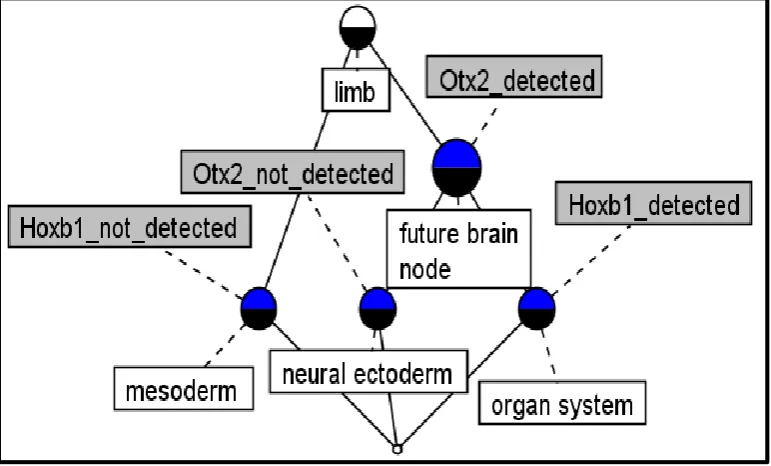
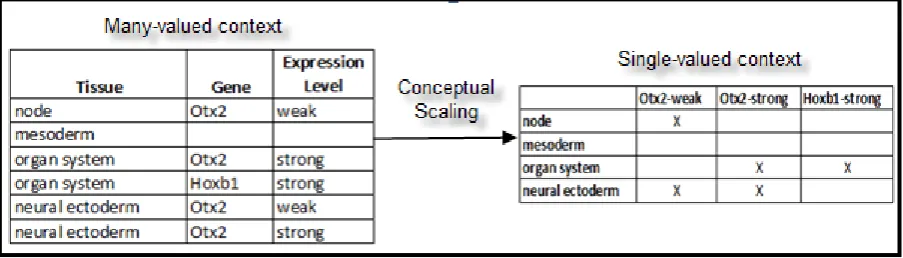
are used in this work in accordance with how it is used by Rudolf Wille in (Wille 1982) where F