www.impactjournals.com/oncotarget/ Oncotarget, Vol. 7, No. 18
The prognosis after contraindicated surgery of NSCLC patients
with malignant pleural effusion (M1a) may be better than
expected
Yijiu Ren1,*, Chenyang Dai1,*, Jianfei Shen2,*, Yang Liu2, Dong Xie1, Hui Zheng1, Jiaxi He2, Wenhua Liang2, Gening Jiang1, Ke Fei1, Ping Yang3, Jianxing He2, Chang
Chen1
1 Department of Thoracic Surgery, Shanghai Pulmonary Hospital, Tongji University School of Medicine, Shanghai, People’s Republic of China
2DepartmentofThoracicSurgery,FirstAffiliatedHospitalofGuangzhouMedicalUniversity&GuangzhouResearchInstitute ofRespiratoryDisease,Guangzhou,People’sRepublicofChina
3Division of Epidemiology, Department of Health Sciences Research, Mayo Clinic, Rochester, MN, USA *These authors have contributed equally to this work
Correspondence to: Chang Chen, e-mail: [email protected] Jianxing He, e-mail: [email protected]
Keywords: lung cancer, surgery, malignant pleural effusion, prognosis, surveillance epidemiology and end-results database
Received: November 03, 2015 Accepted: March 11, 2016 Published: April 4, 2016
ABSTRACT
Although non-small cell lung cancer (NSCLC) with malignant pleural effusion (M1a) is generally contraindicated for surgery, several reports have demonstrated favorable prognosis. This study aimed to describe the results of surgical intervention in this disease. In this retrospective study, we evaluated NSCLC patients with ipsilateral malignant pleural effusion selected from Surveillance Epidemiology and End-Results database (SEER). Primary tumor resection was compared to no tumor resection in the
overall survival (OS) and lung cancer-specific survival (LCSS). Multivariate analyses and
propensity score matching were applied to compare the two groups. The study included
2,217 eligible patients. Primary tumor resection group was significantly associated with
better OS and LCSS compared to no tumor resection group (the median survival time (MST), 20 vs 7 months; OS, p<0.001; LCSS, p<0.001). Multivariable analyses indicated that no primary tumor resection was associated with decreased OS (Hazard Ratio (HR), 2.136; p<0.001) and LCSS (HR, 2.053; p<0.001). In propensity score-matched pairs, better OS and LCSS were further validated in patients with ipsilateral malignant pleural effusion who underwent primary tumor resection compared to no tumor resection (MST, 20 vs 6 months; OS, p<0.001; LCSS, p<0.001). Similarly, multivariable analyses also indicated that no primary tumor resection was associated with decreased OS (HR, 2.309; p<0.001) and LCSS (HR, 2.301; p<0.001) for patients with ipsilateral malignant pleural effusion. In conclusion, the prognosis after contraindicated surgery of NSCLC patients with malignant pleural effusion (M1a) may be better than expected. Thus,
subsequent studies should aim to identify patients who could benefit from surgery.
INTRODUCTION
Malignant pleural effusion, as one kind of non-small-cell lung cancer (NSCLC) with pleural dissemination, has been proved to have poor outcomes, and it is generally contraindicated for operations [1–3]. The International Association for the Study of Lung Cancer (IASLC) Staging Project had stated that the
median survival time (MST) and the 5-year survival rate of patients with pleural dissemination were 8 months and 2%, respectively [3]. Therefore, NSCLC with malignant pleural effusion was staged as IV (M1a) in the new staging system of the Union for International Cancer Control [4].
of NSCLC patients with a resectable-stage tumor [5]. Ryu and colleagues founded that prognostic impact effect of minimal pleural effusion was higher in early rather than advanced stages of NSCLC [6]. However, recently, many surgeons have reported that the postoperative prognosis of patients diagnosed with malignant pleural disease at thoracotomy is relatively favorable [7–12].
Hence, in the present study, we used the Surveillance, Epidemiology, and End Results (SEER) database to identify the large cohort of NSCLC patients with ipsilateral malignant pleural effusion reported up to date, and evaluated the prognostic correlates of overall
survival (OS) and lung cancer-specific survival (LCSS) in
this population.
RESULTS
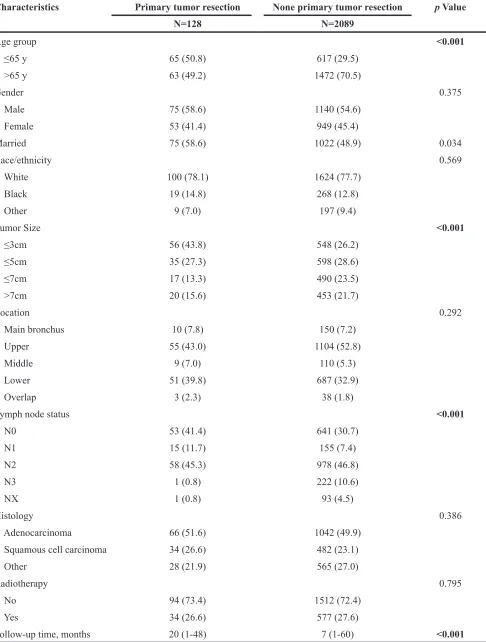
This study included 2,217 patients with ipsilateral malignant pleural effusion from SEER registry patients diagnosed with NSCLC between 2004 and 2012 with no prior history of malignancy. Of these patients, 128 had primary tumor resection and 2,089 did not have primary
tumor resection. The distribution of specific patient and
tumor characteristics among patients with ipsilateral malignant pleural effusion is shown in Table 1. Surgeons seem more inclined to perform primary tumor resection in younger M1a patients with malignant pleural effusion and tumor size of less than 7cm.
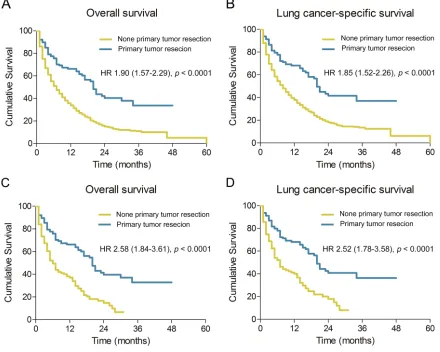
Kaplan-Meier analysis showed that for patients with ipsilateral malignant pleural effusion, primary tumor
resection group showed significantly better OS and LCSS
compared to no tumor resection group (MST, 20 vs 7 months; OS, p <0.001; LCSS, p <0.001) (Figure 1A, 1B).
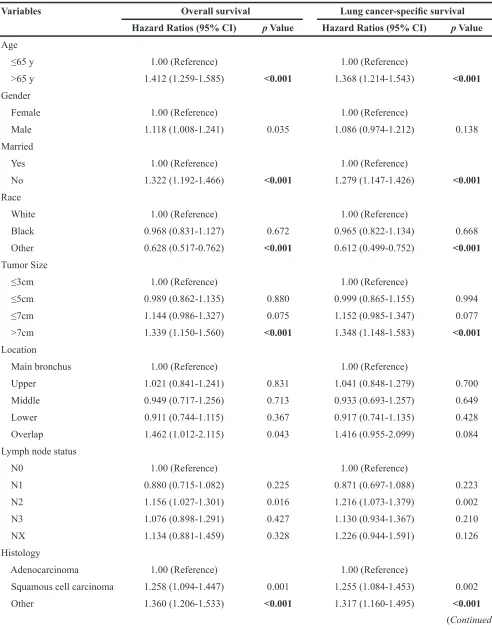
Multivariable analyses suggested that among patients with ipsilateral malignant pleural effusion, decreased OS and LCSS is associated with age > 65 years, unmarried, white or black race, and non-radiotherapy (Table 2). Notably, multivariable analyses results indicated that no primary tumor resection was associated with decreased OS (Hazard Ratio (HR), 2.136; 95% CI, 1.645-2.772; p <0.001) and LCSS (HR, 2.053; 95% CI, 1.568-2.690; p <0.001) for patients with ipsilateral malignant pleural effusion (Table 2).
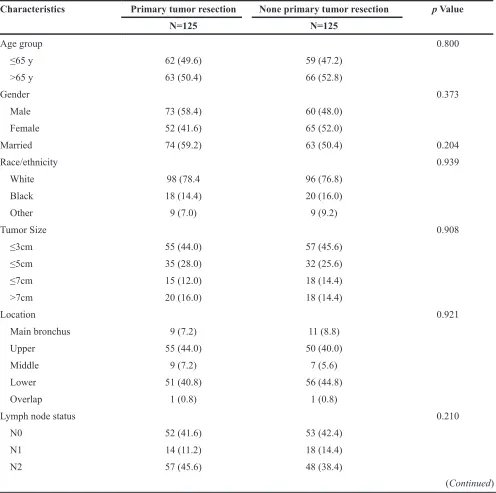
Following the propensity score matching, all variables, including patient characteristics, tumor features, and therapeutic managements, were calculated. Patients with ipsilateral malignant pleural effusion were
classified into well matched groups, specifically, 125
patients were assigned to primary tumor resection group and 125 patients to no primary tumor resection group.
Table 3 shows no significant difference in demographic,
pathologic, and therapeutic variables between two groups. Consistent with the prior analyses, better OS and LCSS were observed among patients with ipsilateral malignant pleural effusion who underwent primary tumor resection when compared to those who did not (MST, 20 vs 6
months; OS, p <0.001; LCSS, p <0.001) (Figure 1C, 1D). Similarly, multivariable analyses also indicated that no primary tumor resection was associated with decreased OS (HR, 2.309; 95% CI, 1.636-3.259; p <0.001) and LCSS (HR, 2.301; 95% CI, 1.610-3.287; p <0.001) for patients with ipsilateral malignant pleural effusion (Table 4).
DISCUSSION
In the seventh version of TNM staging for NSCLC,
malignant pleural effusion is defined as M1a [13];
therefore, it is generally contraindicated for surgery. However, malignant pleural effusion can be unexpectedly
identified during operations when primary tumor removal
seems feasible and does not add overloaded pressure to the patients. Dr. Ohta and colleagues reported that for 42
surgically resected cases with confirmed malignant pleural
dissemination, 5-year survivals and MST were 13.1% and 17 months, respectively [10]. Dr. Iid and colleagues found that 5-year survival rate and MST of 313 pleural dissemination patients were 29.3% and 34.0 months, respectively. Primary tumor resection was performed in 256 (81.8%) patients, and 152 (48.6%) patients underwent macroscopic complete resection with 5-year survival rates of 33.1% and 37.1%, respectively [12]. In addition, prior results of surgical interventions treating this special disease category provided additional evidence for tumor resection [11, 14]. Therefore, it remains controversial whether attempts should be made to resect the primary tumor when confronting an unexpected malignant pleural effusion case.
Using the SEER database, we analyzed the largest cohort of NSCLC patients with malignant pleural effusion (n = 2,217) reported to date, although the incidence was slightly lower compared to that in previous studies [12, 15]. Also, the analyses of treatment modalities and survival were performed with patients without other M1a and/or M1b disease and with only one primary tumor.
We observed that patients who underwent primary tumor resection, especially NSCLC patients with ipsilateral malignant pleural effusion, collectively exhibited greater OS and LCCS compared to those with no tumor resection (Figure 1). The multivariable analyses showed that primary tumor resection group
had a significantly more favorable prognosis compared
to no primary tumor resection group (Tables 2, 4). The underlying reason included possible reduction of the tumor burden. Clinical support might be found in a study by Dr. Iid and his colleagues. Considering pleural dissemination patients, they found that 5-year survival rate of macroscopic complete resection group (37.1%) was
significantly better compared to macroscopic incomplete
Table 1: Baseline characteristics of M1a NSCLC patients only due to ipsilateral malignant pleural effusion Characteristics Primary tumor resection None primary tumor resection p Value
N=128 N=2089
Age group <0.001
≤65 y 65 (50.8) 617 (29.5)
>65 y 63 (49.2) 1472 (70.5)
Gender 0.375
Male 75 (58.6) 1140 (54.6)
Female 53 (41.4) 949 (45.4)
Married 75 (58.6) 1022 (48.9) 0.034
Race/ethnicity 0.569
White 100 (78.1) 1624 (77.7)
Black 19 (14.8) 268 (12.8)
Other 9 (7.0) 197 (9.4)
Tumor Size <0.001
≤3cm 56 (43.8) 548 (26.2)
≤5cm 35 (27.3) 598 (28.6)
≤7cm 17 (13.3) 490 (23.5)
>7cm 20 (15.6) 453 (21.7)
Location 0.292
Main bronchus 10 (7.8) 150 (7.2)
Upper 55 (43.0) 1104 (52.8)
Middle 9 (7.0) 110 (5.3)
Lower 51 (39.8) 687 (32.9)
Overlap 3 (2.3) 38 (1.8)
Lymph node status <0.001
N0 53 (41.4) 641 (30.7)
N1 15 (11.7) 155 (7.4)
N2 58 (45.3) 978 (46.8)
N3 1 (0.8) 222 (10.6)
NX 1 (0.8) 93 (4.5)
Histology 0.386
Adenocarcinoma 66 (51.6) 1042 (49.9)
Squamous cell carcinoma 34 (26.6) 482 (23.1)
Other 28 (21.9) 565 (27.0)
Radiotherapy 0.795
No 94 (73.4) 1512 (72.4)
Yes 34 (26.6) 577 (27.6)
Follow-up time, months 20 (1-48) 7 (1-60) <0.001
effusion (<300ml), primary tumor resection had better survival rate compared to biopsy (MST, 27 vs 7 months, p = 0.003). Theoretical support might be found in Dr. Rashid and his colleagues’ study on metastatic breast cancer resection. The authors utilized biotechnology to monitor overall breast cancer load under direct vision mouse model [16] from which they found that only primary tumor
resection significantly reduced tumor burden.
Moreover, a relevant published study from Shanghai Pulmonary Hospital also suggested that M1a NSCLC patients with pleural dissemination might not be entirely excluded from the surgery [17]. All surgical NSCLC cases (9,576) of Shanghai Pulmonary Hospital between January 2005 and December 2013 were reviewed. Among
them, 83 cases (0.9%) met the definition of “unexpected”
macroscopic malignant pleural dissemination, despite routine preoperative evaluations for tumor metastasis.
Patients with primary tumor resection had significantly
better outcome compared to biopsy (MST: respectively, 35 vs. 17 months, p=0.001). Also, multivariate analysis showed that primary tumor resection (HR: 3.678,
p=0.014) were favorable prognostic factors in patients with malignant pleural dissemination.
This study has some limitations. First, the SEER database was generated retrospectively, and inevitably,
our analyses of this data are subject to the influence of
patient and treatment selection bias. We have attempted to control for this by using some advanced statistical methods to balance the variables between arms. Second, the SEER database set was not integrated for malignant pleural effusion, important factors, such as the pre-operation TNM stage, the amount of pleural effusion, lung function, symptoms, and perhaps the tumor burden. The prognosis for surgery for NSCLC patients with malignant pleural effusion may depend on the factors mentioned above. Because of these limitations, a more complete prospective cohort
study is warranted to confirm the role of primary tumor
[image:4.612.89.529.331.683.2]resection in NSCLCs patients, especially in those with intra-operatively proven malignant pleural effusion. Notably, SEER does not provide information about chemotherapy treatment, which is a very fundamental issue in the survival of NSCLC patients with malignant pleural effusion.
Table 2: Multivariate analysis of overall survival and lung cancer-specific survival in M1a NSCLC patients only due to ipsilateral malignant pleural effusion
Variables Overall survival Lung cancer-specific survival Hazard Ratios (95% CI) p Value Hazard Ratios (95% CI) p Value Age
≤65 y 1.00 (Reference) 1.00 (Reference)
>65 y 1.412 (1.259-1.585) <0.001 1.368 (1.214-1.543) <0.001 Gender
Female 1.00 (Reference) 1.00 (Reference)
Male 1.118 (1.008-1.241) 0.035 1.086 (0.974-1.212) 0.138 Married
Yes 1.00 (Reference) 1.00 (Reference)
No 1.322 (1.192-1.466) <0.001 1.279 (1.147-1.426) <0.001 Race
White 1.00 (Reference) 1.00 (Reference)
Black 0.968 (0.831-1.127) 0.672 0.965 (0.822-1.134) 0.668 Other 0.628 (0.517-0.762) <0.001 0.612 (0.499-0.752) <0.001 Tumor Size
≤3cm 1.00 (Reference) 1.00 (Reference)
≤5cm 0.989 (0.862-1.135) 0.880 0.999 (0.865-1.155) 0.994
≤7cm 1.144 (0.986-1.327) 0.075 1.152 (0.985-1.347) 0.077
>7cm 1.339 (1.150-1.560) <0.001 1.348 (1.148-1.583) <0.001 Location
Main bronchus 1.00 (Reference) 1.00 (Reference)
Upper 1.021 (0.841-1.241) 0.831 1.041 (0.848-1.279) 0.700 Middle 0.949 (0.717-1.256) 0.713 0.933 (0.693-1.257) 0.649 Lower 0.911 (0.744-1.115) 0.367 0.917 (0.741-1.135) 0.428 Overlap 1.462 (1.012-2.115) 0.043 1.416 (0.955-2.099) 0.084 Lymph node status
N0 1.00 (Reference) 1.00 (Reference)
N1 0.880 (0.715-1.082) 0.225 0.871 (0.697-1.088) 0.223 N2 1.156 (1.027-1.301) 0.016 1.216 (1.073-1.379) 0.002 N3 1.076 (0.898-1.291) 0.427 1.130 (0.934-1.367) 0.210 NX 1.134 (0.881-1.459) 0.328 1.226 (0.944-1.591) 0.126 Histology
Adenocarcinoma 1.00 (Reference) 1.00 (Reference)
Squamous cell carcinoma 1.258 (1.094-1.447) 0.001 1.255 (1.084-1.453) 0.002 Other 1.360 (1.206-1.533) <0.001 1.317 (1.160-1.495) <0.001
Table 3: Baseline characteristics of M1a NSCLC patients only due to ipsilateral malignant pleural effusion after propensity score matching
Characteristics Primary tumor resection None primary tumor resection p Value
N=125 N=125
Age group 0.800
≤65 y 62 (49.6) 59 (47.2)
>65 y 63 (50.4) 66 (52.8)
Gender 0.373
Male 73 (58.4) 60 (48.0)
Female 52 (41.6) 65 (52.0)
Married 74 (59.2) 63 (50.4) 0.204
Race/ethnicity 0.939
White 98 (78.4 96 (76.8)
Black 18 (14.4) 20 (16.0)
Other 9 (7.0) 9 (9.2)
Tumor Size 0.908
≤3cm 55 (44.0) 57 (45.6)
≤5cm 35 (28.0) 32 (25.6)
≤7cm 15 (12.0) 18 (14.4)
>7cm 20 (16.0) 18 (14.4)
Location 0.921
Main bronchus 9 (7.2) 11 (8.8)
Upper 55 (44.0) 50 (40.0)
Middle 9 (7.2) 7 (5.6)
Lower 51 (40.8) 56 (44.8)
Overlap 1 (0.8) 1 (0.8)
Lymph node status 0.210
N0 52 (41.6) 53 (42.4)
N1 14 (11.2) 18 (14.4)
N2 57 (45.6) 48 (38.4)
Variables Overall survival Lung cancer-specific survival Hazard Ratios (95% CI) p Value Hazard Ratios (95% CI) p Value Primary tumor resection
Yes 1.00 (Reference) 1.00 (Reference)
No 2.136 (1.645-2.772) <0.001 2.053 (1.568-2.690) <0.001 Radiotherapy
Yes 1.00 (Reference) 1.00 (Reference)
No 1.639 (1.447-1.856) <0.001 1.612 (1.415-1.836) <0.001 Bold values corresponds to the comparisons with P < 0.001.
Table 4: Multivariate analysis of overall survival and lung cancer-specific survival in M1a NSCLC patients only due to ipsilateral malignant pleural effusion after propensity score matching
Variables Overall survival Lung cancer-specific survival Hazard Ratios (95% CI) p Value Hazard Ratios (95% CI) p Value Age
≤65 y 1.00 (Reference) 1.00 (Reference)
>65 y 1.063 (0.746-1.515) 0.735 1.013 (0.700-1.465) 0.947 Gender
Female 1.00 (Reference) 1.00 (Reference)
Male 1.233 (0.871-1.745) 0.237 1.226 (0.855-1.758) 0.268 Married
Yes 1.00 (Reference) 1.00 (Reference)
No 1.353 (0.946-1.936) 0.098 1.261 (0.870-1.827) 0.220 Race
White 1.00 (Reference) 1.00 (Reference)
Black 1.056 (0.643-1.733) 0.831 1.087 (0.652-1.812) 0.748 Other 1.254 (0.632-2.488) 0.517 1.187 (0.583-2.419) 0.636 Tumor Size
≤3cm 1.00 (Reference) 1.00 (Reference)
≤5cm 0.670 (0.438-1.024) 0.064 0.622 (0.400-0.968) 0.035
≤7cm 1.157 (0.667-2.007) 0.603 1.048 (0.591-1.856) 0.873
>7cm 0.891 (0.508-1.562) 0.687 0.798 (0.439-1.449) 0.458 Location
Main bronchus 1.00 (Reference) 1.00 (Reference)
Upper 0.706 (0.373-1.339) 0.286 0.724 (0.372-1.407) 0.340 Middle 1.012 (0.440-2.328) 0.977 1.012 (0.425-2.419) 0.976 Characteristics Primary tumor resection None primary tumor resection p Value
N=125 N=125
N3 1 (0.8) 6 (4.8)
NX 1 (0.8) 0 (0)
Histology 0.662
Adenocarcinoma 65 (52.0) 68 (54.4)
Squamous cell carcinoma 33 (26.4) 27 (21.6)
Other 27 (21.6) 30 (24.0)
Radiotherapy 0.377
No 91 (72.8) 98 (78.4)
Yes 34 (27.2) 27 (21.6)
Follow-up time, months 20 (1-48) 6 (1-31) <0.001
Bold values corresponds to the comparisons with P < 0.001.
Briefly, the results of this study revealed that the
prognosis after contraindicated surgery of NSCLC patients with malignant pleural effusion (M1a) may be better than expected. Thus, subsequent studies should aim to identify
patients who could benefit from surgery.
METHODS
Study population
SEER-18 registry data were used to identify patients that met the inclusion criteria (site = lung and bronchus, behavior = malignant, age = 25-84, and year of diagnosis = 2004-2012) [18]. In addition, we included the patients
who had (1) pathologically confirmed NSCLC, (2) M1a
disease with ipsilateral malignant pleural effusion (SEER
code: CS mets at dx “15”), and (3) only one malignant
primary tumor.
We collected the demographic characteristics of patients (age, gender, marriage, and race), pathological features of tumors (size, location, histological type, and lymph node status, location of malignant pleural effusion), and types of therapeutic management (surgical type, and radiotherapy) from SEER database. In this study,
pathological types were classified as adenocarcinoma
(SEER codes 8140, 8230, 8255, 8260, 8310, 8333, 8470, 8480, 8481, 8490 and 8550), squamous cell carcinoma (SEER codes 8052, 8070, 8071, 8072, 8073, 8083 and 8084), and other histological types with low incidence rate (large cell carcinoma and etc.). Since OS and LCSS were also included in SEER database, both of them were regarded as the outcomes of interest. Patient outcomes
were obtained until December 31, 2012. OS was defined as
the survival time from diagnosis until death for any reason or until the last follow-up, and LCSS from diagnosis until
cause-specific death with lung cancer or until the last
follow-up.
Statistical analysis
The data were presented as frequencies (percent) or median (range) deviation. The comparison of demographic, pathologic, and therapeutic features between patients who underwent primary tumor resection or those who did not was performed using unpaired t
test for continuous variables and Pearson χ2 test for
categorical variables. The OS and LCSS were estimated using the Kaplan-Meier method and the log-rank test Variables Overall survival Lung cancer-specific survival
Hazard Ratios (95% CI) p Value Hazard Ratios (95% CI) p Value Lower 0.935 (0.485-1.801) 0.840 0.915 (0.461-1.817) 0.801 Overlap 6.215 (1.159-33.325) 0.033 7.041 (1.279-38.772) 0.025 Lymph node status
N0 1.00 (Reference) 1.00 (Reference)
N1 1.238 (0.726-2.111) 0.434 1.211 (0.686-2.137) 0.510 N2 1.697 (1.144-2.517) 0.009 1.844 (1.225-2.774) 0.003 N3 2.235 (0.871-5.734) 0.094 2.577 (0.991-6.698) 0.052
NX <0.001 0.966 <0.001 0.968
Histology
Adenocarcinoma 1.00 (Reference) 1.00 (Reference)
Squamous cell carcinoma 0.924 (0.566-1.509) 0.752 1.014 (0.609-1.688) 0.959 Other 1.121 (0.738-1.704) 0.592 1.128 (0.728-1.748) 0.589 Primary tumor resection
Yes 1.00 (Reference) 1.00 (Reference)
No 2.309 (1.636-3.259) <0.001 2.301 (1.610-3.287) <0.001 Radiotherapy
Yes 1.00 (Reference) 1.00 (Reference)
comparing survival in two or more groups. Multivariate Cox proportional hazard analyses were applied to adjust the potential confounders related to patients, tumors, and therapies in the survival analysis. For both Kaplan-Meier and Cox analyses, patients were censored using the SEER.
We used propensity score matching method to balance the differences in the basic clinical characteristics of patients with ipsilateral malignant pleural effusion who underwent primary tumor resection group and those who did not. As an alternative method to compare survival outcomes among surgical procedures, propensity score matching was performed with one-to-three nearest-neighbor matching without replacement to identify matched cohorts representing the two treatment
modalities. Specifically, to control the potential difference
in the basic clinical characteristics of patients and tumors (variables in the propensity score matching including age, gender, race/ethnical group, lesion site and pathological
classification), we made a comparative examination of
survival between primary tumor resection group and those who did not to verify better prognosis for patients who underwent primary tumor resection. Covariate balance was evaluated by using standardized differences in means. Finally, OS and LCSS were compared in matched patients with ipsilateral malignant pleural effusion who underwent primary tumor resection group and those who did not by log-rank test.
In this study, a two-sided p value < 0.05 was
regarded statistically significant. All analyses were
conducted using SPSS 23.0 (SPSS Inc. Chicago, IL), and survival curve was drawn using GraphPad Prism 6.0 (GraphPad Software, San Diego, CA).
ACKNOWLEDGMENTS
We would like to thank to all the staff members of the National Cancer Institute, who have been involved with the Surveillance, Epidemiology and End Results (SEER) Program.
CONFLICTS OF INTEREST
No conflict of interest exits in the submission of
this manuscript, and all authors for publication approve manuscript. I would like to declare on behalf of my co-authors that the work described presents an original research that has not been published previously, and it is not under consideration for publication elsewhere, in whole or in part. All the authors listed have approved the manuscript that is enclosed.
GRANT SUPPORT
The Shanghai Municipal Commission of health and family planning, special emphasis, 2013ZYJB0003, and by the Science and Technology Commission of Shanghai
Municipality, 15411968400, supported the work. This publication’s contents are the sole responsibility of the
authors and do not necessarily represent the official
views of the Shanghai Municipal Commission of health and family planning or the Science and Technology Commission of Shanghai Municipality. The funders had no role in study design, data collection and analysis, decision to publish, or preparation of the manuscript.
REFERENCES
1. Sugiura S, Ando Y, Minami H, Ando M, Sakai S and Shimokata K. Prognostic value of pleural effusion in patients with non-small cell lung cancer. Clinical cancer research. 1997; 3:47-50.
2. Jett JR, Scott WJ, Rivera MP and Sause WT. Guidelines on treatment of stage IIIB non-small cell lung cancer. Chest. 2003; 123:221s-225s.
3. Goldstraw P, Crowley J, Chansky K, Giroux DJ, Groome PA, Rami-Porta R, Postmus PE, Rusch V and Sobin L. The IASLC Lung Cancer Staging Project: proposals for the revision of the TNM stage groupings in the forthcoming
(seventh) edition of the TNM Classification of malignant
tumours. Journal of thoracic oncology. 2007; 2:706-714. 4. Webber C, Gospodarowicz M, Sobin LH, Wittekind C,
Greene FL, Mason MD, Compton C, Brierley J and Groome
PA. Improving the TNM classification: findings from a
10-year continuous literature review. International journal of cancer. 2014; 135:371-378.
5. Lim E, Clough R, Goldstraw P, Edmonds L, Aokage K, Yoshida J, Nagai K, Shintani Y, Ohta M, Okumura M, Iwasaki T, Yasumitsu T, Okada M, Mimura T, Tsubota N, Nakagawa T, et al. Impact of positive pleural lavage cytology on survival in patients having lung resection for non-small-cell lung cancer: An international individual patient data meta-analysis. The Journal of thoracic and cardiovascular surgery. 2010; 139:1441-1446.
6. Ryu JS, Ryu HJ, Lee SN, Memon A, Lee SK, Nam HS, Kim HJ, Lee KH, Cho JH and Hwang SS. Prognostic impact of minimal pleural effusion in non-small-cell lung cancer. Journal of clinical oncology. 2014; 32:960-967. 7. Ichinose Y, Tsuchiya R, Koike T, Kuwahara O, Nakagawa
K, Yamato Y, Kobayashi K, Watanabe Y, Kase M and Yokoi K. The prognosis of patients with non-small cell lung cancer found to have carcinomatous pleuritis at thoracotomy. Surgery today. 2000; 30:1062-1066.
8. Fukuse T, Hirata T, Tanaka F and Wada H. The prognostic
significance of malignant pleural effusion at the time of
thoracotomy in patients with non-small cell lung cancer. Lung cancer. 2001; 34:75-81.
10. Ohta Y, Shimizu Y, Matsumoto I, Tamura M, Oda M and Watanabe G. Retrospective review of lung cancer patients with pleural dissemination after limited operations combined with parietal pleurectomy. Journal of surgical oncology. 2005; 91:237-242.
11. Sawabata N, Matsumura A, Motohiro A, Osaka Y, Gennga K, Fukai S and Mori T. Malignant minor pleural effusion detected on thoracotomy for patients with
non-small cell lung cancer: is tumor resection beneficial
for prognosis? The Annals of thoracic surgery. 2002; 73:412-415.
12. Iida T, Shiba M, Yoshino I, Miyaoka E, Asamura H, Date H, Okumura M, Tada H, Nakanishi Y and Dosaka-Akita H. Surgical Intervention for Non–Small-Cell Lung Cancer Patients with Pleural Carcinomatosis: Results From the Japanese Lung Cancer Registry in 2004. Journal of Thoracic Oncology. 2015; 10:1076-1082.
13. Detterbeck FC, Boffa DJ, Tanoue LT and Wilson LD.
Details and difficulties regarding the new lung cancer
staging system. Chest. 2010; 137:1172-1180.
14. Bernard A, de Dompsure RB, Hagry O and Favre JP. Early and late mortality after pleurodesis for malignant pleural effusion. The Annals of thoracic surgery. 2002; 74:213-217. 15. Tönnies M, Kollmeier J, Bauer T, Griff S and Kaiser D.
Curative surgical treatment options for patients with non-small cell lung cancer (NSCLC) and solitary pulmonary metastasis [Article in German]. Pneumologie. 2012; 66:218-223. 16. Rashid OM, Nagahashi M, Ramachandran S, Graham L,
Yamada A, Spiegel S, Bear HD and Takabe K. Resection of the primary tumor improves survival in metastatic breast cancer by reducing overall tumor burden. Surgery. 2013; 153:771-778. 17. Ren YJ, She YL, Dai CY, Jiang GN, Fei K and Chen C.
Primary tumour resection showed survival benefits for
non-small-cell lung cancers with unexpected malignant pleural dissemination. Interactive cardiovascular and thoracic surgery. 2016; 22:321-326.