Table 1 World production of commercially important edible fats and oils
Fat/oil source World production (MMT)
1935 1955 1975 1995
Soybean 0.5 2 8.5 16
Palm 0.5 1 2 14.5
Rapeseed (canola) 1.3 1.5 2 9.5
Butter 4 3.5 5.3 8
Sunflower 0.4 1.5 3.5 7.5
Tallow 1.7 3 5.5 7
Lard 3 3.5 4.2 5.5
Cottonseed 1.5 1.8 2.8 4.8
Peanut 1.8 2 3.2 3.9
Coconut 1.7 2 2.5 3.3
Sesame 0.8 1 1.7 1.9
Fish 0.5 0.5 1.2 1.5
Olive 0.6 0.6 0.7 0.8
Total 18.3 23.9 43.1 84.2
MMT, million metric tons.
Extraction by Solvent Based Methods
E. J. Birch, University of Otago, Dunedin, New Zealand
Copyright^ 2000 Academic Press
Along with proteins and carbohydrates, fats and oils make up the major classes of food components. Ed-ible fat and oil usage falls into four major product categories: cooking and salad oils, shortenings, mar-garines and specialty products. Tissues from animals liberate oils on being boiled and oils can be pressed from fruits, vegetables and seeds, such as olives, soybean and sesame. Solvent extraction is a viable alternative to pressing and can recover nearly all the oil from the seeds. Figures for world production of fats and oils have only been kept since 1942 and, although growth in the use of fats and oils since then has outstripped population increases, there has been a signiRcant shift from animal to vegetable fats.
Table 1shows the relative changes in world produc-tion Rgures for selected major fats and oils since 1935.
Traditional methods employing liquid extraction rely on the use of simple processing equipment and low pressure applications. They fall into two main categories of water Sotation and traditional pestle and mortar extraction procedures. The water S ota-tion method involves heating in water followed by size reduction (pestle and mortar-type equipment) and skimming off of the oil followed by heating to remove the moisture. Coconut and palm oil extrac-tion efRciencies range from 40 to 60%, though free fatty acid contents are high. The Ghani mill (typically powered by animals) has been used in India for 3000 years and at the beginning of this century approxim-ately 97% of oilseeds were processed this way, utiliz-ing over half a million ghanis. ThisRgure has dropped to 4% in modern times, owing to the introduction of screw and hydraulic presses, and solvent extraction. The hydraulic press was invented by Joseph Bramah in 1795 and continued to be used in the American oilseed crushing industry until the 1940s. By then, new options were replacing the labour-intensive batch-processing presses, with expellers (continuous screw presses) and direct solvent extraction with the two unit operations often occurring together as a two-stage process. Mechanical expression can only reduce oilseed oil content to 2}3% whereas solvent extraction will reduce thisRgure to about 0.5%. Low temperatures during solvent extraction can produce a higher quality oil than higher temperature screw pressing but may also extract nontriglyceride mater-ial, making the oil inferior to pressed oil.
Solvent extraction of fats and oils from seeds be-came possible from the middle of the 19th century. In 1948 the Rrst commercial solvent extraction plant was built. Since then, over 200 extractors have been supplied worldwide for capacities up to 6000 tons per day. Solvent processes found favour in the vegetable oilseed reRning industry, with continuous miscella (solvent plus pressed cake) reRning and continuous solvent fractionation (e.g. winterization) becoming commercial reality in the early 1950s.
Solvent Extraction Methodology
Extraction Theory
Fats and oils are hydrophobic and hence insoluble in polar solvents. Use is made of their afRnity for nonpolar media in oil extraction, separation of oil from bleaching earths and oil-reRning technology. Fatty acids accompanying oil extraction are also sol-uble in polar solvents and use can be made of this in reRning methods to separate the two groups. How-ever, difRculty is experienced in that fatty acids and other liquids may be more soluble in the oils themsel-ves than in the selected separation solvent. Solubility covers a wide range and is inSuenced by a rise in temperature (which increases solubility) and an in-crease in chain length (lower solubility) of fatty acids making up the triglycerides.
Choice of Solvent
The ideal solvent for oil extraction must possess sev-eral features that are impossible to Rnd in any one solvent. These properties include the ability to solubilize the oil at low temperatures, selectivity to-wards triglycerides, chemical inertness, immiscibility with water, nonSammable, low viscosity and surface tension, nonexplosive, noncaustic, low boiling point, nonirritant and nonpoisonous.
Hexane is the almost exclusively chosen solvent due to its solvent power, volatility, low and nontoxic residue levels and immiscibility with water. However, care in handling is required due to highSammability. Before hexane, carbon disulRde and trichloroethylene were used; however, the former has since been ban-ned and the latter declared undesirable for preparing animal feeds. The greater solvency and nonS amma-bility of trichloromethane renders it of use for extrac-tion of tallow from meat and bone but, due to desol-ventizing problems, it is not used with oilseeds. Re-placement with dichloromethane is an option but not favoured due to the risk of hydrochloric acid forma-tion and the use of ethanol, either as a solvent or as an azeotrope with hexane, has been studied but not commercialized.
Recovery of solvent from the extraction of fats is a major consideration in solvent choice. The accept-able recovery standard is 99.92%, which can be represented by a loss of 1.135 litres of hexane per processed tonne of soya. Losses may occur from desolventizing the meal, from stripping the Rnal oil product and from air and water discharges to waste. In the US the Environmental Protection Agency is charged with controlling emission levels with respect to hexane, although required levels are still to be set under the Federal Clean Air Act. A likely example for soybean processing is 0.2}0.25 kg for every 100 kg of beans processed. To date, the industry relies on self-regulation, required because of the high cost of lost solvent.
Supercritical Suids have been investigated since the last century, with the strongest commercial inter-est initially focusing on the use of supercritical toluene in petroleum and shale oil reRning during the 1970s and latterly supercritical carbon dioxide for fats and oils. Carbon dioxide cannot be used as a simple substitute for organic solvents, however. Phosphatides (e.g. lecithin) are selected against compared with hexane when extracting vegetable and Rsh oils, for example. As a solvent, dense carbon dioxide tends to be selective for lower molecu-lar weight lipophilic compounds. This can be utilized for partial fractionation of free fatty acids from triglycerides, decreasing cholesterol levels and in-creasing -carotene content by selective control of solvent temperature and pressure to exploit differ-ences in solubility, vapour pressure and molecular weight.
General Processes
The main disadvantage of solvent extraction is the high equipment cost and plants tend to be large, processing hundreds to thousands of tons per day. The extracted miscella (solution of solvent plus oil) containsRnes, which need to be separated and well washed. Solvent and oil will also be held up in the solids (marc).
Pretreatment Before oil can be extracted from fruits and vegetables, the seeds must be prepared. Seed preparation for extraction involves cleaning, dehull-ing, cooking to denature proteins, adjusting moisture content to the right level and then crushing or rolling into particles orSakes of uniform size and thickness. For solvent extraction, the optimum moisture level allowsSaking of the seeds whilst minimizing crum-bling. Ready penetration of the solvent is enhanced without blocking the extractor so that the miscella which forms can be easily separated from the cake.
Improving pretreatment of press-cakes allows a re-duction in solvent-to-solids ratios and a rere-duction in solvent hold-up in the desolventization process. The French Enhanser Press is an extruder used to pelletize oil-bearing seeds or pre-press cake to provide an ideal medium for solvent extraction. As pellets discharge from the die plate of the Enhanser Press, they expand andSash off moisture. This creates dense pellets with a vast matrix of open-structured, internal solvent passages. These pellets yield much better extraction results than Sakes or pre-press cake. This results in savings in distillation energy (steam required).
Figure 1 Oil solvent extraction apparatus (immersion type). Courtesy of Europa Crown Ltd., Hessle, UK.
miscella, which meets the oil-rich Sakes at high oil concentration. The Sakes are sequentially extracted with solvent of lesser oil content through the different stages until the almost entirely extracted meal is
Rnally met with pure solvent to complete the extrac-tion efRciently. The Rrst miscella wash leaves the system for distillation and oil recovery while theRnal extractedSakes go to a desolventizing process.
Batch extractors. The process involves sequential washing of oil-bearing material with progressively leaner miscellas until the Rnal wash is with solvent alone. The vessels are loaded one at a time and are no longer used for any other than specialty runs.
Total immersion extractors. The material to be pro-cessed travels through a pool of solvent. These are early designs (1930}1950s) and suffered from excess
Rnes carried along in the solvent.
Percolation extractors. These may be either batch or continuous and differ from the immersion extrac-tor in that the solvent passes through the solids, dissolving out the oil. Five main types are in use: basket, rotary, perforated belt, sliding-bed and rec-tangular loop extractors.
Combined plants. Percolation and immersion ex-traction may be combined sequentially to advantage (e.g. C.M.B. Percolimm). Flaked seed, which has been percolation-extracted, is immersion-extracted and then desolventized. The immersion miscella is used as a solvent in the percolation extractor for the original seed Sakes. The extractors are of two main types: deep- or shallow-bed. The deep-bed-type (or rotary extractor) is semi-continuous with a number of bask-ets supported on a drainage screen, designed to allow the miscella to pass. The screens can be rotating or
Rxed, as can the baskets and washing manifolds. The extractor moves slowly and miscella drains through the screen until the basket reaches theRnal position when the solids are released, the screen reclosed and a fresh load of solids deposited. The shallow-bed-type
works similarly for drainage of miscella and operates in continuous mode where theSakes meet solvent in a countercurrent direction in different zones of the extractor. The percolation extractor employs solvent being pumped over and percolating down through a bed ofSakes or a cake and leaving via a perforated plate at the bottom. Immersion extractors are claimed to allow better extraction from Rne cake particles, which may block the bed of a percolation extractor. Examples of immersion and percolation extractors are shown inFigures 1and2.
Desolventizing The extracted Sake material may contain 25}35% residual solvent. In the desolven-tizer/toaster, steam is used to evaporate the volatile solvent countercurrently. The vapour phase is con-densed and collected. The meal is toasted in steam-jacketed trays, then dried and cooled. For edible
Sour, the process may be replaced with aSash desol-ventizing system.
Solvent stripping of the extracted oil is carried out by evaporation. Removal of Savour components is likely at this stage also. The miscella is normally separated into oil and vapour through a series of falling Rlm evaporators and stills with the miscella on the tube side and the vapours on the shell side. The Rrst-effect evaporator uses steam and solvent vapour from the desolventizer/toaster to concentrate the miscella to about 80% oil content. The second stage operates atmospherically or under vacuum to bring the concentration up to 95}98% oil, and the remaining volatiles are stripped in the still operating under vacuum. ReRnements to the process are used depending on the oil being extracted. For cottonseed oil, caustic may be added during theRrst- and second-effect evaporators and the mix centrifuged to remove colour bodies before they set during distillation.
Figure 2 Oil solvent extraction apparatus (percolation type). Courtesy of Europa Crown Ltd., Hessle, UK.
the advent of percolation extractors, the desolven-tizer/toaster appeared in the 1950s. This consists of an upright cylinder divided into horizontal sections or trays. Material is agitated via a sweep arm which also opens a door, allowing product to fall to the tray below. Heat is supplied to vaporize the solvent, which is Sashed off the topmost trays with sparge steam, which also partially cooks (toasts) the solids. The sparge steam can be absorbed by the solids on con-densing, which prevents carry-over of dust to the condenser. A variation to the basic models allows
Sash desolventizing, where recirculating steam under high velocity strips the solvent at low temperature to avoid denaturing the protein. Another variation is countercurrent desolventizer/toasters, where the steam is introduced at the bottom and travels through to the top to a steam-jacketed desolventizing tray, where indirect steamSashes off surface solvent. Flash desolventizers are used to prepare high nitrogen soy protein for meat analogues and the desolventizer/ toasters recover solids as animal feed. In the solvent extraction industry, the term DTDC stands for desol-ventizing}toasting}drying}cooling. These four opera-tions can be performed in a single DTDC machine, or split between two separate DT and DC machines. Both types of conRgurations have speciRc advant-ages which may make one or the other preferable in certain applications. Figure 3 shows a DTDC system.
Solvent reVning of fats and oils Fractionation using solvents involves forming a miscella of oil in the solvent, which is then cooled to produce crystalliza-tion. Filtration of the stearin fraction follows and both fractions are then heated to recover the solvent. The Bernardini process uses hexane as solvent and produces two stearin and one olein fractions. Acetone and 2-nitropropane have also been utilized as sol-vents. The process for palm oil involves cooling an equal mixture of oil and hexane to 30}333C and pumping to the chiller where the mixture is held at 203C, when crystallization begins. The cooled mass is
passed to a second vessel and the temperature reduced to 103C. Filtration using rotary drums separates out the Rrst stearin fraction and the oil plus solvent is carried through a further series of cooling steps at 73C, 43C and 23C respectively. The second stearin fraction is then removed through drum
Rlters. All three fractions are freed from solvent by distillation.
Beef tallow and hydrogenated vegetable oils can also be similarly doubly fractionated. TheRrst stearin fraction can be used for shortenings, the second for confectionery butters and the third (or olein fraction) as a frying oil which is liquid at room temperature. Without solvent, the conventional dry fractionation yields a stearin fraction which contains too much entrained oil to be of use as a confectioner’s hard butter.
Winterization is beneRcial for rice bran oil where the oil is frequently cloudy at room temperature. Solvent winterization separates the high and low melting triglycerides. Solvents used include hexane, acetone and isopropyl acetate. Although fractional crystallization from miscella has had limited accept-ance, it is potentially less labour-intensive than the conventional batch winterizing process with faster throughput and yields greater quantities of winterized oil. In addition, manufacturers could produce
modi-Red fats without the formation of trans isomers by fractionally crystallizing mixtures of vegetable and animal oils from miscella. Other options involve ad-aptation of the technology for continuous miscella hydrogenation and miscella bleaching employing sil-ica gel to remove colour.
Figure 3 A desolventizing}toasting}drying}cooling system. Courtesy of Europa Crown Ltd., Hessle, UK.
Selected Applications in the Fats
and Oils Processing Industry
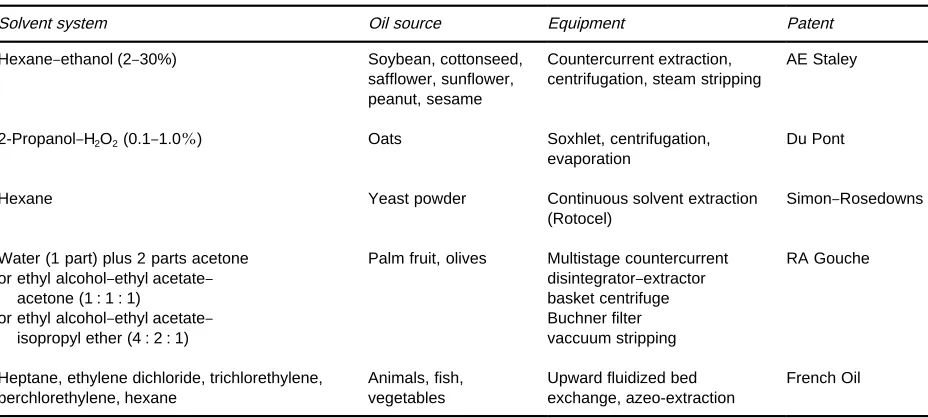
Table 2 shows a range of applications arising from patents during the 1970s. Other examples include separation of fat-free protein and oil from peanuts, rice bran and soybean (hexane), cottonseed (hexane plus acetic acid), starch plus oil from corn grits, germ, hulls and gluten (hexane or isopropyl alcohol) and separation of beef tallow intoRve fractions with dis-tinctive thermal characteristics by multistep crystalli-zation. Direct solvent extraction is used for low con-tent ((20%) oilseeds such as soya, rice bran and milled corn germ. Pre-pressing followed by solvent extraction is utilized with high oil content seeds, although some manufacturers claim high efRciency with direct methods.
Using water as a solvent for oil extraction has commercial applications for palm, olive and coconut oils but not for oilseeds due to high residual oil in the extracted meal and extra energy needed in the separ-ation and drying steps. Adding enzymes to the aque-ous medium to digest cell walls can be advantageaque-ous,
as in the development of processes to extract olive, canola and coconut oils. Hexane may also be added to aid the separation.
Isopropanol and ethanol were used to extract cot-tonseed oil since the combination made it possible to extract the gossypol and render the solids more suit-able as animal feed. However the oil needs more reRning due to phosphatides and carbohydrates which are also extracted.
Two-phase extraction employing polar and non-polar solvents has been successfully used in rapemeal processing. An extraction with methanol followed by washing with hexane and phase separation lowers the glucosinate content.
Soybeans
Soybean oil had very rapid growth to become the dominant edible oil in the world, partly due to the versatility of the oil which enables it to be used in a wide variety of products and applications.
Table 2 Patents issued for solvent extraction applications from 1973 to 1977
Solvent system Oil source Equipment Patent
Hexane}ethanol (2}30%) Soybean, cottonseed, safflower, sunflower, peanut, sesame
Countercurrent extraction, centrifugation, steam stripping
AE Staley
2-Propanol}H2O2(0.1}1.0%) Oats Soxhlet, centrifugation,
evaporation
Du Pont
Hexane Yeast powder Continuous solvent extraction
(Rotocel)
Simon}Rosedowns
Water (1 part) plus 2 parts acetone or ethyl alcohol}ethyl acetate}
Palm fruit, olives Multistage countercurrent disintegrator}extractor
RA Gouche acetone (1 : 1 : 1)
or ethyl alcohol}ethyl acetate}
basket centrifuge Buchner filter
isopropyl ether (4 : 2 : 1) vaccuum stripping
Heptane, ethylene dichloride, trichlorethylene, perchlorethylene, hexane
Animals, fish, vegetables
Upward fluidized bed exchange, azeo-extraction
French Oil
unlike cottonseed, peanut and other high oil-bearing seeds, where meals need to be processed through slotted wall extruders before being solvent-extracted.
Palm
For extraction of palm oil it is common practice to use screw presses and not employ wet methods. Sim-ilarly, solvent fractionation processes are available for fractionation but the comparative operational cost of miscella crystallization andRltration restricts the process to production of 2-oleodipalmitin-rich fractions for use in cocoa butter substitutes. Yield of olein from the miscella is about 80%.
Canola (Rapeseed) and Sun]ower
Canola and sunSower are high oil content seeds and are generally processed by a pre-press solvent extrac-tion. This removes the oil from the seed in two steps, which maximizes oil yields while minimizing residual oil in the meal. The canola presscake, which yields approximately 60% oil, may be mechanically ex-truded to improve the solvent extraction process. The industry increasingly relies on DTDC equipment for desolventizing.
Animal Fats
Screw presses are the method of choice for most renderers, although some animal fats are solvent-extracted. Use of solvents such as acetone to remove unwanted components such as cholesterol from milk fat has proven effective. The potential for solvent residues in the product does not meet with regulatory or consumer approval, however, hence the solvent
extraction process is only applied for technical purposes.
Using an immersion system (e.g. Kurd), raw mate-rial from animal processing isRrst heated and broken into small pieces before being mixed with the solvent (usually perchlorethylene) in an autoclave. The mis-cella is drained and may be used again for a second extraction, when the solvent is evaporated and the solids returned to the extractor for desolventizing with steam. The solids, free of solvent, contain 40}60% water and are then dried and milled for meal. Continuous percolation plants may also be util-ized (De Smet extractors). The raw material is broken up in a cooking step and excess tallow drips through a perforated plate, leaving the residue with 30}35% fat. This is ground and extracted (usually with hexane) in a similar fashion to the system described for immersion extractors earlier and the solvent sep-arated from the miscella by evaporation. The solids are toasted to desolventize them.
Solvent extraction may be combined with press extraction, either by using solvent techniques for fur-ther oil recovery after pressing or by pressing miscella out of the solid residue rather than recovery by de-cantation. These options reduce the amount of sol-vent that has to be removed, lowering cost and saving energy.
Fish Oils
carbon dioxide extraction is considered safe but, al-though the product is of good quality, possible removal of antioxidants, such as tocopherols and phospholipids, and the retention of residual trace components is of concern.
Cottonseed
Cottonseeds contain about 30% oil. Screw pressing is commonly used for cottonseed oil pressing, but direct solvent (hexane) extraction yields 11.5% more oil, leaving less than 1% in the meal. Pre-pressing fol-lowed by solvent extraction is the most economical alternative due to the cost of solvent. ReRning is necessary to remove the gossypol and related pigments.
Saf]ower
Oil extraction in the safSower industry has shifted from a largely screw press expeller base to less costly expander-extruders which are capable of extracting two-thirds of the oil and preparing collets ideal for solvent extraction. Solvent is able to move naturally through theRbre channels and the bed acts as a natu-ralRlter medium.
Coconut
Copra is processed using a dry process com-prising crushing or expelling and optional further solvent extraction to recover the residual oil. This contrasts with the wet method for the fresh kernel which separates oil from the coconut milk by centri-fugation.
Olives
Solvent recovery of oil from olives is limited to po-mace processing. Superior olive oil is produced by pressing. The solvent extracts minor components at higher levels than physical methods and requires
re-Rning before use.
Cocoa Butter
Cocoa beans possess a chocolate aroma which devel-ops during roasting of the beans. However, this aroma is lost if solvent extraction is employed during processing. The yield of cocoa butter is higher but the value may be less if the odour is desired.
The major triglyceride found in cocoa butter is 2-oleopalmitostearin. Cocoa butter substitutes can be manufactured using solvent systems based on meth-anol and hexane to prepare this triglyceride via isola-tion of saturated 1,3-diglycerides from the reacisola-tion of palm oil (hydrogenated soybean or cottonseed oils have also been employed) and glycerine using sodium methoxide catalysts. The isolated diglycerides are
then reacted with oleic anhydride to give the 2-oleo-disaturated product.
Recent Developments
Advances in solvent extraction technology have in-volved the areas of energy conservation, inSuences of increasing size of extraction plants, adaptation of conventional extraction plants to produce edible meals, percolation versus immersion extractors and direct solvent extraction versus pre-pressing followed by solvent extraction.
Commercial developments are attractive for alter-native or specialty oils compared with traditional oil products and for overcoming the costs and con-straints of traditional solvent extraction systems for minimizing industrial wastes. Utilization of va-pour contactors to conserve heat during process-ing and dual-stage strippprocess-ing columns in removprocess-ing the last traces of solvent from the oil also contribute to efRciency.
The biggest interest in the last decade has been the applications of supercritical carbon dioxide, because it has a near-ambient critical temperature (313C), thus biological materials can be processed at temper-atures around 353C. The density of the supercritical CO2 at around 200 bar pressure is close to that of
hexane, and the solvation characteristics are also sim-ilar to hexane, thus it acts as a nonpolar solvent. Around the supercritical region, CO2 can dissolve
triglycerides at concentrations up to 1% mass. The major advantage is that a small reduction in temper-ature, or a slightly larger reduction in pressure, will result in almost all of the solute precipitating out as the supercritical conditions are changed or made sub-critical. Supercritical Suids can produce a product with no solvent residues. A wide range of fats and oils have been extracted employing supercriticalSuid ex-traction from sources includingRsh, vegetable oils, nuts, cereals, citrus peel, egg yolk, wormwood and yeast extract. Examples of pilot and production-scale products include decaffeinated coffee, choles-terol-free butter, low fat meat, evening primrose oil and squalene from shark liver oil.
Processes for the selective extraction of fats and oils employing propane and a mixture of propane with up to 50% carbon dioxide in the subcritical state have been described (European patents 0-591-981, 1993 and 0-721-980, 1995) for the extraction of fats and oils from vegetable, animal and microbial materials. The low pressures involved allow milder extraction conditions than conventional processing, providing a good yield of high grade products.
Further Reading
Achaya KT (1994) Ghani: a traditional method of oil pro-cessing in India.Food,Nutrition and Agriculture4(11): 23.
Bockisch M (1998) Fats and Oils Handbook. Illinois: AOCS Press.
Cavanagh GC (1997) Looking back: AOCS and vegetable oil processing.Inform8(7): 762.
Davie J and Vincent L (1980) Extraction of vegetable oils and fats. In: Hamilton RJ and Bhati A (eds) Fats and Oils:Chemistry and Technology,p. 217. London: Ap-plied Science Publishers.
Gunstone FD (ed.) (1987) Palm Oil. Critical Reports in Applied Chemistry, vol. 15. New York: Society of Chemical Industry/Wiley.
Gutcho M (ed.) (1979)Edible Oils and Fats:Recent Devel-opments.Food Technology Review No. 49. New Jersey: Noyes Data Corporation.
Head S and Sweeten T (1999) Traditional methods for processing oilseeds.Inform10(2): 151.
Keeper TG (1996) Minimising solvent loss. Grasas-y-Aceites6(24): 373.
Palmer MV and Ting SST (1995) Applications for super-criticalSuid technology in food processing.Food Chem-istry52: 345.
Uh YH (ed.) (1996)Bailey’s Industrial Oil and Fat Prod-ucts, 5th edn, vols 1}5. New York: Wiley.
Weiss TJ (ed.) (1983)Food Oils and their Uses, 2nd edn. Westport, CT: AVI.
SUPERCRITICAL FLUID CHROMATOGRAPHY
See III / OILS, FATS AND WAXES: SUPERCRITICAL FLUID CHROMATOGRAPHY
FATTY ACIDS: GAS CHROMATOGRAPHY
See III / LIPIDS: Gas Chromatography
FLAME IONIZATION DETECTION:
THIN-LAYER (PLANAR)
CHROMATOGRAPHY
R. G. Ackman, Canadian Institute of Fisheries, Halifax, Nova Scotia, Canada
Copyright^ 2000 Academic Press
The Iatroscan is a British invention brought to fru-ition in Japan by Iatron Laboratories of Tokyo, which is basically a hospital equipment company. It has become unexpectedly popular in such diverse analyti-cal areas as marine lipids and heavy petroleum frac-tions. The combination of the resolving power of thin-layer chromatography (TLC), itself only some-what more than 40 years old, with the simplicity and sensitivity of the hydrogenSame ionization detector (FID), developed about that time as a superb detector for gas}liquid chromatography (GC), was a happy marriage, usually summarized as TLC-FID. The basic separation technology of the Chromarod-SIII is con-ducted on a quartz rod 0.9 mm in diameter and 152 mm in length, coated with 75m thickness of
silica gel (10m particles) held in place by a soft glass frit. Ten Chromarods are conveniently held in a stain-less steel rack for application of samples and sub-sequent development in a covered solvent tank, exact-ly as for planar TLC. The removal of solvent takes only a few minutes and the rack can then be dropped into a holding frame in the Iatroscan proper for scanning. This process can be controlled for max-imum sensitivity but usually takes less than 10 min.