Acknowledgement
CONTENTS
The project team 5
Section 1 - CONTEXT OF THE EVALUATION 6
Introduction 6
Background to the evaluation 8
Section 2 - METHOD 11
Project objectives 11
Project design 11
Data collection 11
Data analysis 1
Ethical considerations 1
Section 3 - ESTABLISHING INSTRUMENTS FOR THE PROJECT 14
Background 14
Family recruitment 14
Construction of Instruments 14
Iteration and Refinement 17
Section 4 - BENEFITS FOR THE FAMILIES 18
Introduction 18
Overview of findings 19
Demographic information 19
Achievement of SLA Targets 1
- Health 1
- Criminal Behaviour
- Antisocial Behaviour
- Domestic Violence 7
- Missing from Home 9
- Children Placed in Care 9
- Relationship Breakdown 9
- Housing and Accommodation 0
- Employment 0
- Education 0
Service User Experience
4
CONTENTS....continued
Section 5 - CHANGE IN WAYS OF WORKING 36
Introduction 6
Interviews with Operational/Strategic Management Group Members 6
Outcomes of the Interviews 7
- Planning / Organisational Stage 7
- Springboard Process - Family Work 41
- Outcomes for Families 46
- Rolling Out the Process 47
Summary 51
Section 6 - BENEFITS FOR THE COUNCIL 52
Introduction 5
Economic benefits of the Springboard project 5
Framework for Costing Case Studies 5
- Family 1 5
- Family 56
Summary 59
Section 7 - THE WIDER IMPACT OF SPRINGBOARD 60
The Impact of Springboard on Services in Blackpool 60
Remaining Challenges 61
Conclusion 6
REFERENCES 63
APPENDICES
Appendix A: Participant Information Sheet 65
Appendix B: Manager Interview Schedule 67
5
THE PROJECT TEAM
CYP@Salford
The project was undertaken by a team with wide expertise and experience of both practice and research in health and social care with children, young people and families. All members of the research team had current CRB clearance.
Mike Ravey is Senior Lecturer in Learning Disabilities. He is experienced in family work in relation to both children and adults. He specialises in working with men who have a learning disability, and men from that group who sexually abuse others, and he has published in this field. He researches in the field of new ways of working with families.
Michael Murphy is Senior Lecturer in Social Work. A qualified social worker and counsellor, he has wide experience in dealing with substance misuse, looked after children, chaotic families, and safeguarding children, and has published widely in these areas. He acts as a training consultant to several training organisations (DATA, NWIAT, Right from the Start, Bolton HSCB). He is the chair of Bolton Substance Misuse Research Group and was an executive member of PIAT (the promotion of interagency training in childcare).
Dr Tony Long is Professor of Child and Family Health and leads on research with children and families in the research institute. His personal research programmes are in evaluation of health and social care services for children and families, safeguarding children, excessive infant crying, and clinical studies in paediatric neurological rehabilitation.
Dr Debbie Fallon is Senior Lecturer in Child Health and has a clinical background in children’s nursing, working particularly children with disabilities and their families. She has an academic interest in issues on the boundary of health and social care for children and families. In addition to other projects that involved the evaluation of services for children and families, her work in the field of teenage pregnancy and adolescent risk behaviour has led to international conference presentations and publications.
Joan Livesley is published in the field of children in hospital and evidence-based practice, and undertakes research into improving safety in hospital in partnership with children. Qualified in adult and children’s nursing, she leads a postgraduate programme of advanced practice in health and social care, and has a clinical background in services for children in hospital and the community, and links with a sexual health clinic.
Research With Children and Families
CYP@Salford
This research group includes child health nurses, social workers, midwives, public health nurses and other health and social care professionals whose focus is on children & families.
6
Section 1 Context of the Evaluation
Introduction
Since the early 1800s Blackpool has been a popular coastal resort not only for the people of the Northwest of England but for the United Kingdom as a whole. Its beaches, bright lights and amusements continue to be a magnet for both holidaymakers and those individuals and families who perceive it as a possible source of income, with the ‘Golden Mile’ carrying different connotations for both groups.
The development of Blackpool’s role as an entertainment centre and holiday resort has brought with it a set of unique social problems. These are not always obvious to the casual observer who often perceives Blackpool as an affluent town free from problems. However, a short walk from the sparkle of the promenade leads into areas of the town that have such a high social need that Blackpool has the 1th highest Index of Multiple Deprivation in England. This presents Blackpool’s services with significant challenges, which are compounded by high levels of population movement and by the significant number of the families which move into Blackpool originating from socially and economically deprived backgrounds. These form a pool of hard to reach families that have complex needs, placing considerable demands on services.
Blackpool Council has responded to this challenge by adopting a proactive stance in developing a raft of services that offers these families efficient and effective support ranging from proactive, preventative services to complex multi-disciplinary interventions. This report presents the findings of an evaluation of an approach aimed at changing the nature of interagency collaboration and service delivery in the town.
The Springboard Pilot Project
Springboard was the result of a strong, three-year partnership at senior management level that attempted to change the culture of interagency collaboration in Blackpool. The partnership was driven by and through the local strategic partnership and corporate plan, and at each stage of development that partnership was successful in drawing down more resources to ensure the development of the service. Thus the project benefited from funding for parenting support in 007, and in 008 from the Challenge and Support Pilot and the Family Pathfinder Pilot. The project also benefited from a external consultancy that worked on cultural collaborative change across the partnership.
In April 006 a virtual team was established and began to accept referrals. The project aimed to offer an intensive service to 60 families at a high threshold of need. The team itself was constructed by the local strategic partnership to work over a year period with a group of 60
families which were of particular concern to the Council and its partners as being “chaotic” or difficult to support effectively. This was a determined attempt to break the cycle of dependency and the pattern of intervention, closure, and reopening of cases. The project was designed to contribute towards the achievement of key PSA targets. Information-sharing, co-ordination of effort across agencies (including joint strategies), and continued support after crisis management were also key features. Springboard was a cross agency project that delivered specific support to the most marginalised families and young people that placed the highest demands upon support networks. These were some of the families which, in the view of the Social Exclusion Task Force (007), were the “small proportion of families with multiple problems who are still struggling to break the cycle of disadvantage” (p4). The need to evaluate progress of these families on an ongoing basis and on completion of the project was recognised, and this led to the research evaluation reported here.
Springboard Referral Criteria
1) Family in contact with a range of services
7
8 In January 007 Blackpool became a Respect Action Area and drew further resources from that initiative. As part of this initiative Springboard became a Family Intervention Project (FIP) and moved from January to September 007 into new locality bases with key workers (who could be drawn from any practice group), family support workers and police officers staffing locality teams. The locality teams were working in family homes on a 65-day basis. These teams still related to specialist practitioners including education, substance misuse and mental health practitioners all contained in the central team.
It is important to note that Springboard did not develop and operate on it own, but was part of a wider effort to promote better collaboration at all stages of the family work process. Thus in August 006 the Budget Holding Lead Professional (BHLP) pilot project was initiated, which assisted the development of the Common Assessment Framework (CAF) and the Team around the Family (TAF) model. In 007 the parenting team was established seeking to offer intensive parenting input to families which were experiencing difficulty. This is accomplished through the Positive Parenting Programme, Webster-Stratton and Oxford-Brookes programmes. Training on helping parents to develop their parenting skills is now being offered to a wider staff group for which parenting is not normally a core part of the service.
This attempt to sponsor a new collaborative agenda in Blackpool did not include only child care staff, but specifically attempted to include practitioners from the police service and from adult mental health and substance services. At the end of this process, and supported by the Children’s Trust, four mandates were established to drive this cultural collaborative change even further forward.
Background to the evaluation
The desire for greater interagency collaboration in child care has been a consistent theme in the British Government’s social policy agenda since the early 1970s. This theme has largely been driven by government initiatives, some of which have been influenced by child death inquiries (DH 1991a), some by research (DH 1995), but always assisted by what is seen to be ‘good practice’.
At its most basic level, because the lives and needs of children and families span many different practice fields and include many different agencies and practice groups, interagency collaboration is seen to be key in getting these agencies and practitioners to work collectively and in harmony, thus better addressing issues of vulnerability, neglect and abuse, and preventing social exclusion.
In 1974, following the death of Maria Colwell from a combination of neglect and physical abuse (DHSS 1974), the government issued a series of circulars that heralded the birth of the modern child protection system. This included the establishment of child protection registers, conferences and the first attempt to enforce interagency collaboration at a local level with Area Review Committees (later to be renamed Area Child Protection Committees). The benefits of this interagency collaboration had been recognised before, but it was the evidence of the exaggerated lack of collaboration and communication concerning the Colwell/Kepple family in Sussex that led the government to develop a compulsory system to promote and ensure a basic level of interagency collaboration at a local level.
This need to collaborate has been further emphasised by the publication of increasingly complex government guidance to inspire interagency collaboration in child protection and child in need work (DHSS 1988, DH 1991b, DH 1999, DfES 006a). In the most recent Working Together to Safeguard Children (DH 1999 p) the justification for collaboration is stated
as:-Safeguarding and promoting the welfare of children – and in particular protecting them from significant harm – depends on effective joint working between agencies and professionals that have different roles and expertise. Individual children, especially some of the most vulnerable children and those at greatest risk of social exclusion, will need coordinated help from health, education, children’s social care and quite possibly the voluntary sector and other agencies.
9
Current developments in child care policy
The developments in child care policy that followed the Victoria Climbié Inquiry (Laming, 00) include a series of government publications and initiatives which include Every Child Matters(DfES 2003a);
Every Child Matters - Change for Children(DfES 2004a);Every Child Matters - Next Steps (DfES 2004b);
The National Service Framework for Children Young People and Maternity Services (DH 2004) and the
Common Assessment Framework(DfES 2005a). Far from merely being a response to the Laming Inquiry, the Labour administration had decided to re-launch its whole child care agenda, and the central plank of this agenda was interagency collaboration at all levels of accountability: “Radical reform is needed to break down organisational boundaries”(DfES 2003b p9).
Rather than relying on agencies and practitioners to collaborate across agency divisions, the government has developed initiatives that remove or reduce some of the obstacles to collaboration. One key element in this new agenda was a renewed insistence on a seamless, collaborative child care service with clear lines of accountability to government. This included Children’s Trusts; new statutory grounded Safeguarding Children’s Boards, the introduction of a new concept of lead professional, and new information-sharing mechanisms (Information, Referral and Tracking systems, Integrated Children’s Systems and CAF). The government has also encouraged pilot projects where practitioners are encouraged to come together in real or ‘virtual’ integrated teams.
Integrated teams
The thinking behind integrated teams that would bring practitioners from different backgrounds together to collaborate more effectively is not new. In 197 the first specialist child protection unit in the northwest employed a health visitor, social workers, nursery nurses, and volunteers, and had active inputs from health consultants (Pickett and Maton 1979). In 1988 the Cleveland Inquiry considered the possibility of setting up interagency specialist assessment teams (SATs) in all areas (Butler-Sloss 1988), but this development was not widely followed (Murphy, 1996).
It is also the case that in the areas of child and adolescent mental health (CAMHS) and juvenile delinquency (Young Offenders Teams), the concept of collaborative teams is well established. However, these teams were seen as essentially specialist, and the services offered were to meet the needs of a relatively small percentage of children and adolescents. It is also the case that these integrated teams have received some reviews that have been not wholly positive (Pitts 001, Taylor 00).
In the longer term, the government intends to break down or significantly reduce the differences in education, training and qualification of those who work with children:
“We are looking to overcome the restrictive impact that professional and organisational boundaries can have so that increasingly professionals and practitioners from different sectors work better in multi-disciplinary teams around the needs of children and young people and share an increasingly common language and understanding” (DfES 2005b p3).
10
National levels of need and associated Blackpool initiatives
National Standards Blackpool Framework Blackpool Initiatives
Level 4
Child Protection
Level 4
Targeted Services
Level 3
Child in Need
Level 3b Level 3a Level 2 Vulnerable Children Targeted Services Level 2 Vulnerable Children Level 1 Universal Services Level 1 Universal Services
BHLP Budget Holding Lead Practitioner TAF Team Around the Family CAF Common Assessment Framework EAF Early Action Forum
Springboar
d
P
arenting Pr
ogrammes
BHLP CAF TAF
EAF
The evidence concerning other integrated teams comes mainly from two different sources. Manby (006) offers a mainly qualitative overview of children’s and parents’ experiences of an integrated team, whereas the MATCH project offers an overview of integrated working from practitioners’ and managers’ points of views (Frost and Robinson 004, Robinson et al 005, Frost et al 005, Frost and Robinson 007).
Manby (006) detailed the largely positive response from users of an integrated team’s service. This included families’ perception of being listened to and experiencing the team as being “honest, reliable and fair” (p5). Eight of the twelve families interviewed believed that their situation had improved, and ten families felt hopeful about the future. This study emphasised that the team’s involvement had been challenging as well as supportive – a third of families had been involved in child protection processes and four families had experienced the team’s involvement as a “jolt”.
Frost et al’s (004-7) contributions considered the experience of partnership working from a practitioner and managerial point of view. They discovered that some factors seemed to be key to a positive partnership experience. These included space for planning and including staff in the partnership process; shared and agreed aims; information-sharing protocols; clear lines of accountability; support and supervision; and motivated staff and leaders who can work across
agency and practice divides. This research also concluded that partnership does not do away with differences of culture and status. These differences remain and need to be worked with. It also claimed that co-location is not an instant solution to the challenges that new teams face, since, for example, some members of the team may feel peripheral and excluded from the process.
Members of the newly integrated teams felt that they were being asked to take on a new identity as well as to engage in new work tasks. “For teams to develop, tensions arising from team members adopting new roles and reconstructing professional identities had to be addressed…However individuals within teams spoke of the creative energy released by forging enhanced identities within multi-agency teams”(Frost and Robinson 2007 p196).
11
Section 2 Method
Project Objectives
Study Aim
To measure the outcomes of the pilot project and the benefits of working in this way, not only for the Council but also for the families receiving the services.
Objectives
The study objectives were interpreted by the research team as:
1) To establish baseline targets for each of the families which can then be monitored, and to implement the recording and analysis of this monitoring. ) To identify change in practice amongst practitioners and the benefits to the
Council and the families involved.
Project Design
It was planned originally that the study would be conducted over 8 months in phases, each corresponding to the recruitment of a tranche of 0 families to the Springboard project. Following identification of the first tranche of families to be involved in the project and assessment by the project team of baseline targets specific to each family, the research team planned to hold a focus group with project team members to establish which targets could be monitored or measured both on an on-going basis and on completion of the project.
However, as the pilot project developed, it became apparent that such clearly delineated recruitment phases were not to reflect the reality of implementation of such an ambitious and complex project. After an initial delay, families were recruited into the project through the monthly Operational Management Group meeting. A small comparison group was also established, selected from families which met the criteria for inclusion in the Springboard initiative, but which for various reasons (often the family’s inability or unwillingness to participate) were not recruited.
Further change to the plan was brought about as the Local Strategic Partnership engaged in additional initiatives, and as national strategy moved on. As Blackpool became a Respect Action Area, the Springboard Project moved on, in keeping with the requirements of a Family Intervention Project, from being based in a virtual team to a system of key workers based in localities. The context in which Springboard operated changed, too, with the introduction, for example, of the Budget-holding Lead Practitioner Project. This complicated issues in some ways, and the original data collection plan was supplemented with additional interviews to identify the wider impact of Springboard on cultural change.
Data Collection
Family baseline data
1 Comparison Group
A small comparison group was formed of families which met the criteria for recruitment to Springboard but which had not been included in the pilot project. Because of the small numbers in the comparison group statistical comparisons are difficult. However the families’ experience and the data from the wider Blackpool sources offer a useful comparison with the Springboard data.
Views of families receiving services
A sample of 9 families (representing the breadth of service use involved in the project) was followed on a case-study basis to explore their experience of involvement on the project. Tape-recorded group interviews were held with each family to elicit their perspectives and reflections. The outcomes of these cases are detailed in Section 4.
Cultural change in teams
Events were held at which cultural change within teams was explored. These included an “Open Space” meeting (in which the delegates set the agenda of issues which require to be addressed and then meetings were held to negotiate recommendations for change or objectives to be met), or of simple individual or group interviews. Senior managers were also interviewed at the end of the evaluation to elicit views on the wider impact of the Springboard project on ways of working and provision of services.
Cost-effectiveness analysis
Two cases were analysed to establish the cost effectiveness of the intervention.
Data Analysis
Quantitative data from the baseline documents was collated and compared directly with corresponding data from the comparison group, Blackpool as a whole and national statistics where available.
The mechanisms involved in the Springboard pilot project were complex. A modified framework-analysis process (Spencer and Ritchie 1994) was applied in order to store and manipulate the varied qualitative data and to derive the required conclusions. The framework-analysis process involved the analysts…
becoming familiar with the data in order to gain an initial notion of key ideas, identifying a thematic framework and using this to index or label the data charting the data to allow for comparison across themes
interpreting and arranging the data to provide answers to the research questions.
Cost-effectiveness of the selected cases was undertaken using the 4-stage model developed by the Office of Public Management (OPM 007) for Blackpool (detailed in section 6).
Ethical Considerations
The main ethical issues associated with this study were the risk of breach of confidentiality and the potential for perceived coercion.
Confidentiality
The usual ethical standards relating to research with vulnerable populations and the use of potentially sensitive data were pursued by the study team. In particular, data was stored securely, with access restricted to members of the project team. Such personal information as was essential to the project relating to respondents (whether service users or service providers) remained confidential and was moved to secure storage in the university where required, destroyed by the project team, or returned to the Springboard team on completion of the evaluation.
1 Consent
Families which were invited to be interviewed were first informed of the evaluation by a member of the Springboard team who introduced the research team. Additional printed information was provided by the interviewers who answered any additional questions from family members before commencement of the interview.
Written consent from some populations and for some research topics is notoriously difficult, since this is associated with regulatory authorities and elements of the welfare system. True signatures are rarely offered if at all. For this reason verbal consent (rather than written consent) was sought from service-user participants. However, the researchers ensured that individuals who might wish to disengage from a discussion could do so without embarrassment or fear of untoward consequences.
Springboard team members and managers involved in the pilot project were informed of the evaluation and had the option of declining to be interviewed by the research team.
Research Ethics Guidance and Formal Approval
The research team abided by the research ethics guidance offered by the British Sociological Association 00 and the Royal College of Nursing 007. Guidelines provided by INVOLVE for the involvement of service users and children in research projects were followed.1
The project team did not seek to identify individuals as NHS patients (past or present), but rather as members of a community served by a local resource, and the project did not fall within the realm of COREC approval (now National Research Ethics Service). Formal approval was secured from the University of Salford Research Governance and Ethics Committee.
14
Section 3 Establishing project instruments
Background
The constituent parts of social exclusion and family disadvantage are complex and varied, and this in turn meant that both the Springboard project and its evaluation would also be complex. At the outset of this project it was felt that there were two issues that needed to be addressed; the first related to which families should be recruited for the project, while the second focused on how improvements in the quality of life would be measured. This section of the report presents the journey taken by the research team and the service providers in the production of the two instruments. An interactive approach with all levels of service provision was adopted to resolve these problems. The initial input from the research team was in relation to development of the documentation needed to support the Springboard project in addressing these varied elements and to assist in its evaluation. These documents included an assessment matrix and a baseline document. The research team, with the co-operation of service providers, developed an assessment matrix that attempted to capture and measure the most obvious signs of disadvantage and exclusion, and a baselines document for on-going reporting of activity and progress.
Family Recruitment
Through initial discussion with the Strategic Management Group it was clear to the research team that the main issues for recruitment was the overwhelming number of families which were chaotic to the level that met the thresholds for inclusion on to the Springboard Project. This led to the conclusion that Springboard needed a document that not only provided a clear assessment of the families, drawing together all the information from the different services involved in the their lives, but which also enabled a quantifiable justification for the inclusion of some families and the rejection of others. Although the Springboard entry criteria remained constant over the three years2 how these criteria were perceived
was subject to some fluctuations. As the researchers had no knowledge of the needs of these potential service users or what services were available and how they worked. They initiated this process by interviewing every member of the senior management group.
Construction of instruments
The Family Assessment Matrix
This was seen as an appropriate starting point for the research team’s involvement. At this stage of the project, the research team had no knowledge of the services within Blackpool or what was perceived as the priority needs for the families within the Borough. The document was developed through a number of interviews with the members of the strategic management team aimed at establishing what the managers believed should be included within the assessment document. The results of this initial consultation were then developed further at two team away-days facilitated by the research team to derive the first full version of the instrument.
This first iteration resulted in the production of a document that was not only cumbersome but also lacked any possibility to produce threshold measurements. The document was then amended to increase its relevance and usability. This process resulted in the identification of a number of themes that formed the domains for the assessment.
2 Family in contact with a range of services; Family lived in Blackpool for over 12 months; Family had
15
A process of refinement followed that involved drawing the strategic managers together in a conference format to explore the strengths and problems with the document. The final document was then used by the operational managers to identify which families were to receive the additional support. However, there remained a problem in relation to how the operational managers used the form. Once the matrix has been live for a number of months, interviews were conducted to explore the operational managers’ experiences of using the document, with the intention of refining the document further. In due course the matrix will be developed for wider dissemination.
The Family Baseline Document
The evidence required to evaluate the outcomes of the pilot project was drawn from a document that reflected the core activity of the Springboard team’s input in relation to supporting the families. The Baselines document was developed with support from members of both the strategic and operational management teams. The starting point of the document was the Public Service Agreement (PSA) and Local Area Agreement (LAA) targets set for Blackpool. These targets were then developed into eleven domains that reflected the activities of the services involved in Springboard.
1 Sexual Health
This focused on issues around the sexual health of the family, in particular the young people within the family, and specifically:
Conception rates within the 15-17 years age group. Uptake of contraception in the under 5s.
A reduction in the number of sexually transmitted diseases.
2 Physical/Mental Health
This examined access to community services and, in particular, screening and preventative services.
Increased access to smoking cessation services.
Increase in the number of families registered with a local general practitioner. Increase in the number of adults using screening services.
3 Health Behaviour
This focused on reducing addictive behaviours and the misuse of drugs and alcohol.
Increase the compliance of family members undergoing treatment for alcohol dependency. Increase the number of planned discharges from structured drug treatment programmes. Increase the number of people receiving treatment for drug dependency.
4 Offending Behaviour
This explored issues relating to criminality within the families.
Reduce the number of arrests from within the families.
Reduce the level of crime in relation to Best Value Performance Indicators (BVPI). Reduce the number of PSA crimes, relating to:
- Minor damage. - Violent crime. - Arson.
• • •
• • •
• • •
16
5 Anti-Social Behaviour
This standard focused on those behaviours that impact on the community living in the same area as the family and reducing the number of…
Nuisance incidents at the family address. Police call-outs to the family address
Youth referrals to other agencies from the police.
Acceptable Behaviour Contracts (ABC) associated with the family. Interim orders associated with the family.
Anti-Social Behaviour Orders (ASBO) associated with the family.
6 Supervision and Vulnerability (Domestic Violence)
This domain examined issues relating to improving the safety and security of both adults and children and reducing the number of:
Recorded incidents of domestic violence. Offences/arrest linked to domestic violence.
7 Supervision and Vulnerability
This element explored issues that work towards improving the safety of the children within Springboard project families by reducing the number of:
Missing from home incidents. Children entering care. Family breakdowns.
Re-referrals to child protection services within 6 months.
8 Accommodation
This standard focused the practitioner’s attention on the housing issues associated with the family and reducing the number of:
Families with rent arrears
Family homes classed as non-decent.
Households living in temporary accommodation.
9 Employment
This domain focused on the team’s success in supporting adults in gaining employment by increasing:
The number of ‘voluntary’ participants in Pathways to Work.
The number of people who have been helped into employment of at least 16 hours per week for 1 consecutive weeks.
Those who are classed as economically inactive into employment of at least 16 hours per week for a period of at least 1 consecutive weeks.
10 Education
This identifies the level of the children’s attendance at school and also youth employment and engagement with post-16 learning, by increasing:
The number of pupils in NEET group. The number of young people linked to YOT.
The proportion of “tier ” children in NEET for less than 1 weeks. Rate of school attendance.
17
11 Education
This focused on attainment by increasing:
The number of pupils at key stage .
The average point score for all pupils at key stage . The levels of attainment by ‘transient’ pupils at Key stage .
Completion of the Matrix
Each domain was also broken down into key elements to aid completion by the Springboard team members.
Standard Statements
…which identified the main criteria for the standard.
Performance Measures
…which broke the Standard Statement down in to specific issues to be considered.
Trigger Questions
…that prompted the team member to make a decision relating to if the Standard Statement is relevant to the family.
Baseline Statements
These were developed during the early stages of the intervention from the Springboard team. They were developed by a team member if the Standard statement is relevant to the family. They are descriptions of the behaviour displayed by the family or family member during the twelve months prior to their involvement with Springboard.
Targets
…which were specific goals for the team and family to focus on to identify improvement in the quality of the family members’ lives. The team reviewed these targets every six weeks, and decisions are made as to whether or not the target has been achieved. If it has not been achieved the target is either continued to the next review or re-written as a new target.
Iteration and Refinement
The draft of this baseline document was then developed further through a series of consultation and approval events, including face-to-face interviews with the team leader and a “World Café” event that enabled the management team to make changes and establish the quality of the document.
18
Section 4 Benefits for the families
Introduction
This section of the report presents both quantitative and qualitative evidence that examines the impact of interventions through the Springboard project on the lives of the families that were associated with the Springboard pilot study. Springboard was established to provide a multi-disciplinary, integrated service to families which were in crisis. The expectation of this service was that the family’s needs would be met in a seamless way by practitioners who were not constrained by the traditional professional boundaries. This novel service was planned to be provided in addition to existing services rather than to replace or exclude access to these. The Springboard team practitioners not only had the opportunity to step beyond these possible constraints but were supported by relevant professionals within the team. The new approach exerted a co-ordinating effect on aspects of work which was already in operation.
This level of blurring of professional boundaries is reflected in this report, in that it should be recognised that the successes and failures of the service are the result of integrated working: not owned by any individual discipline but by all those involved in supporting the families. For example, reduction of a family’s anti-social behaviour would not be achieved only as a result of police intervention but would emanate from a team that had engaged with family members, gaining their trust and working with them to achieve a more stable lifestyle. It is important to recognise this, as the results in this section are presented in a way that highlights specific service targets. So, progress in the reduction in chaos should be seen as achievement by the team as a whole, along with the host services.
The Jones Family
The Jones family lived in a three bedroom council house that was in a district of Blackpool that could be classed as an area of high social need. The family consisted of Sally and James, who were not married, and five children under twelve: four of whom were from two of Jane’s previous relationships. Within the 12 months prior to accepting support from Springboard all of the children had been placed in foster care due to inadequate housing, and although the family was together at the point of referral, all the children were on the child protection register. This position was exacerbated by the fact that they were over £2,000 in rent arrears, and court proceedings were imminent. The house they were in had reached a point of being described as non-decent, as it was in a state of disrepair with no carpets, soiled damaged furniture, and infestations of cockroach and lice. The initial input was from the housing officer in the Springboard team, and his work focused on supporting the family to establish regular payments in relation to the rent arrears and to remove and replace the infested furniture. A small amount of funding was provided to aid in this process for the provision of new carpets and both Sally and James were supported to start decorating the house.
The children appeared unkempt, as they were un-washed, with no shoes and soiled, dirty clothing. Their behaviour was difficult for both James and Sally, and they had few boundaries. The oldest boy generated most issues for the couple as he had a diagnosis of ADHD. The family support workers with the team became involved and started working with the family in relation to parenting skills and the introduction into Sure Start and education. This aspect of the family’s life was assessed as such a priority that more intensive support was deemed necessary, and they were offered a short term placement in Springboard’s supported housing. One of the outcomes of this placement was that the adults thought that they could best support their children if they separated, and Sally took the three older children and returned to their original home, while John looked after the other two in a new housing association property.
19
Overview of Findings
The baselines identified a number of dramatic changes that had positive outcomes for both the families and for the Council and its partners within the areas of criminal and anti-social behaviour, housing and accommodation, and education. There were a number of more subtle changes within the health and social care facets of the families’ lives and in the acquisition of gainful employment.
The reasons for these differences between the domains of criminal behaviour, housing and education and those of health and employment are complex but there are a number of factors that may have had some influence on this disparity. The first of these may rest in the notion that the first three of these domains are obvious measures of chaos that attract statutory service and their associated levels of enforcement in to the lives of the families. The latter two reside much more within the locus of control of the families, and in relation to the crises caused by a chaotic life style may feature as a lower priority. Alongside the locus of control rests the fact that the negative impact of a number of health related behaviours occur slowly over time, and, as such, do not present as a priority in relation to the other more dynamic domains. There is also the fact that people can cope with and sustain only a certain amount of change at any one time, and as the vast majority of these families had made significant changes in the more chaotic domains, there may be elements within the health and employment domains that have acted as ‘crutches’. Change within these may occur when the other shifts in behaviour have consolidated.
Alongside the quantifiable data, eight families were interviewed - four while receiving interventions from the Springboard Team and four post intervention. The thematic analysis of this data produced overwhelming evidence of the positive effect Springboard had had on the families’ lives. The families expressed eloquently how the team’s positive value base influenced the families’ own self esteem and willingness to make significant changes in their lives. The families welcomed the ‘can do’ mentality held by the team members and the way in which they were willing to move beyond professional boundaries to evoke change.
Demographic Information
The Springboard pilot project had been involved in the lives of a total of 60 families. However, because of the time needed to identify any significant changes in the families as a result of the intervention from the Springboard team, this report is based on the data from 4 of these families. The included families consisted of 74 adults and 151 children and young people. Seventeen of the families were supported by a sole adult; fifteen of these being supported by a female parent and two by a sole male parent.
A number of the families had a complex structure in relation to the number of family members living under one roof. This complexity did not relate simply to the immediate family of parents and children, but a number of the families contained not only members of the extended family but also their partners. This structure was demonstrated in the case of the Simpson family. This family consisted of 1 people in total all living together.
The Simpson Family
0
All the families receiving a service from Springboard had at least one child and two of the families had ten children. The most common number of children was between 1 and , representing 50% (19) of the total number of children. However, a significant proportion of the families were large, with 4.1% (1) having between 4 and 6 children, and 15.79% (6) containing 7 or more, with the largest family consisting of 10 children. Figure 1 displays a breakdown of the gender of the children and young people within each of the families. The majority of the children and young people were male (84).
[image:20.595.73.467.220.489.2]Figure displays the frequency of the number of children within the families. The most frequent number of children was , with 9 of the families containing this number. However, this figure is closely followed by families of and 4 with each frequency having eight families.
Fig 1: Gender of children in families
0 1 2 3 4 5 6 7 8
Families
Number of childre
n
N um ber of M ale C hildren
N um ber of Fem ale C hildren
Fig 2: Number of children in families
0 1 2 3 4 5 6 7 8 9 10
1 2 3 4 5 6 7 8 9 10
Number of children
Number of familie
[image:20.595.69.487.225.744.2] [image:20.595.71.506.520.765.2]1
Achievement of SLA targets
Health
Registration with a GP
An important element of health care is access to the services offered through general practitioners (GP). Six of the families were not registered before they engaged with Springboard. For significantly excluded families it is not unusual for parents (and consequently their children) to miss out on the most basic access to health provision (Elliott & Watson 1998). All the members of these families were registered with a GP during the period of receiving support.
Sexual Health
Sexual health and appropriate contraception are important issues for every family, including those associated with Springboard. Within the population served by Springboard, teenage pregnancy was a recurring issue, so this was an important measure in relation to the health aspect of the Springboard project. Teenage pregnancy3 in Blackpool rose from 64.8 per 1000 in 1998 to 80. per 1000 in 00.
The target for 006 was 46.4 per 1000, and for 007 4.1 per 1000. Within the Springboard group there were 1 young women between the ages of 15 to 17. The borough target translated to a “Springboard target” of no more than 0.88 pregnancies per 1 young women. The team engaged with 11 of these young women, supporting 8 via Connect and choices courses, 1 through advice from the team’s YOT worker, and through access to a residential programme with life-like baby-simulator experience.
Only 1 of these young women became pregnant while their family was linked with Springboard. The target for Blackpool was, therefore, met in the Springboard group, while in the borough overall the target was not met, with the rate at 66.4 per 1000 in 2006.
The teenage pregnancy strategy (DfES 006b) identified a number of key risk factors for teenage pregnancy:
Poverty
Children in care
Children of teenage mothers
Being a “non-participant” (truanting, early exit from education, NEET category individuals) Sexual abuse
Mental health problems Criminal behaviour
Not only was Springboard participation associated with the absence of pregnancies in this high-risk group of young women, but the evidence of success in dealing with several of the key risk factors demonstrates that Springboard intervention (for example, reducing or preventing care episodes, achieving re-engagement with education and training) undoubtedly reduced the on-going overall risk burden for the young women involved.
Smoking, alcohol and substance misuse
Regarding the provision of smoking cessation, the reduction of alcohol and drug misuse, and the access to service, more work is need in relation to gathering more detailed information. The baseline documents clearly identify that all those individuals at risk through sexual activity or substance misuse were sign posted to information and appropriate services. Further work is needed in relation to uptake. Change in these areas can usually be achieved only over a significant period of sustained intervention, and is often characterised by multiple relapses.
3 under 18 years conceptions
Furthermore, given the multiple challenges faced by families included in the Springboard pilot project, it might be recognised that cessation of smoking would be a low priority for many families. Indeed, the stress induced by smoking cessation might well form the final barrier to achievement and improvement in other areas such as school attendance, anti-social behaviour, and parenting. The Springboard effort to support those family members who smoked nevertheless met with a measure of success. Three individuals stopped smoking completely as a result of the support from the Springboard team. One was referred to a structured support programme, while 35 were sign posted to appropriate services and provided with information relating to smoking cessation. This latter is a major achievement given the generally low level of motivation to stop smoking.
Substance misuse can be the largely hidden companion of many other social problems. It is also the underlying problem that can be the most resistant to change (Harris 006 007). The project team worked hard to identify substance problems in families and to encourage the uptake of advice and assistance. This process was greatly helped by the collaboration of the specialist substance worker, who could offer detailed and accurate sign posting to services. This specialist substance worker quickly became a key member of staff offering advice and input to families and other members of staff with such effect that one senior manager affirmed that ‘We would be lost without her now”. As Murphy and Oulds [000] point out, a bridging role between child care and substance services can make a real difference to the quality and integration of the service on offer.
In relation to the use of illegal drugs, 14 people were known to use drugs before their family accepted support from Springboard. Through the intervention of the staff team, a further 2 substance misusing individuals were identified, and 20 individuals were identified who required advice, support or referral to specialist drug services. Out of this group of people 1 young person stopped using cannabis, 7 accepted support from the team to engage in treatment, and 2 received supervision in pursuing abstinence. 3 continued on treatment programmes that they had commenced prior to engaging with Springboard but received additional support from the team. One young person received a detailed assessment for support regarding drug misuse. Another individual commenced a treatment
programme but then stepped off. In the timeframe of the project it was unlikely that significant progress would be noted in cessation of such misusing behaviour. Success should be gauged by identification of the individuals in need of help and by effective referral to sources of therapy or support. Substantial progress was, therefore, made by the Springboard project in addressing the problems of smoking and substance misuse.
Criminal Behaviour
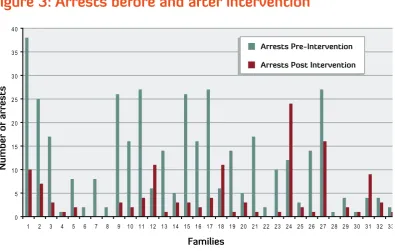
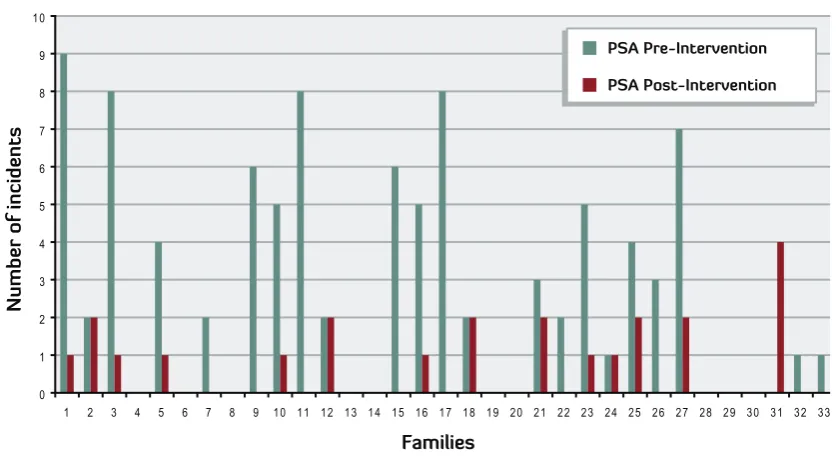
Criminality was an important domain for the families and the communities in which they lived. Twenty-seven of the 4 families had members within them who committed at least one criminal offence during the 1 months prior to their acceptance into Springboard. Figures , 4 and 5 identify the criminal activity for each family in relation to the number of arrests, BVPI and PSA crimes. The chart clearly demonstrates the significant impact that Springboard exerted on criminal activity. Every one of the families showed reductions in criminal activity during the time they received support from Springboard. 9% of the families displayed a significant reduction in the three areas of activity, with only families displaying an increase in activity, (one from 6 to 11 arrests and to 7 BVPIs, and the other with 4 to 9 arrest, 0 to 4 BVPIs and 0 to 4 PSAs). This dramatic reduction in behaviour was not always in a downward direction. Indeed, there were a few situations in which the behaviour escalated. One family’s offending behaviour almost doubled their number of arrests from 1 to within the first six week cycle, but subsequent measures saw a significant reduction to .
In relation to the first level PSA target relating to criminal behaviour, which required a reduction of 15% by 2007-08, Springboard significantly exceeded this objective by a staggering 53%. When the number of crimes committed by individuals receiving support from Springboard was compared with those in the comparison group, the positive effect of Springboard was reinforced by the fact that there was no significant difference within the behaviour displayed by the comparison group. The PSA relating to youth re-offending was also exceeded at the higher threshold, which expected a reduction of 4.% in the re-offending rate. The significant reduction in this activity also impacted on other targets established for the council. For example it reduced the number of young people entering the youth justice system, with the subsequent cost savings within the justice system, Children’s and Young People’s Services, Police, Probation and YOT. Anti-Social Behaviour
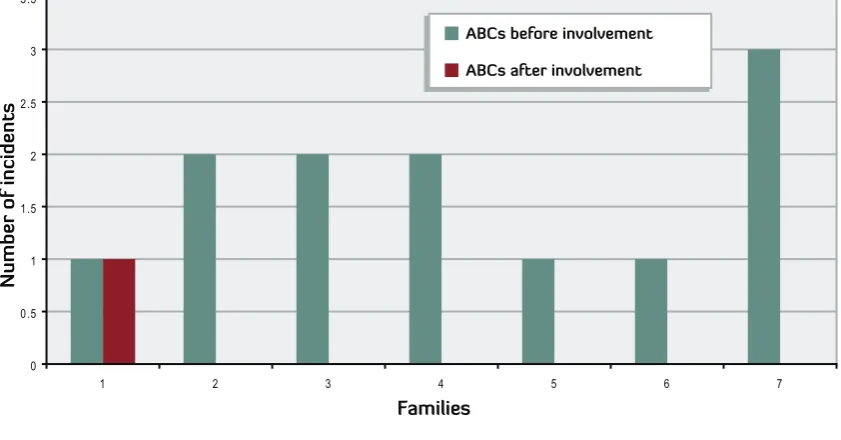
Alongside criminal activity, anti-social behaviour represents a significant source of chaos for both families and their community at large. In relation to Springboard, almost half of the families were associated with at least one form of anti-social behaviour in that 6 of the families were identified with this behaviour within the twelve months prior to their inclusion in the project. It would appear that Springboard also impacted on this activity in a significant manner.
The Kelly Family
The Kellys were a large family, with 7 children (5 boys and 2 girls) ranging in age from 5 to 17 years. All of the children lived at home with their mother and father. Five members of the family were persistent offenders, with 26 arrests between them in the previous 12 months. They had 23 BVPI offences focused on burglary and vehicle crime, and 6 arrests labelled as PSA activity. Within the time Springboard was involved these reduced to 3 arrests for one individual and no BVPI or PSA activity.
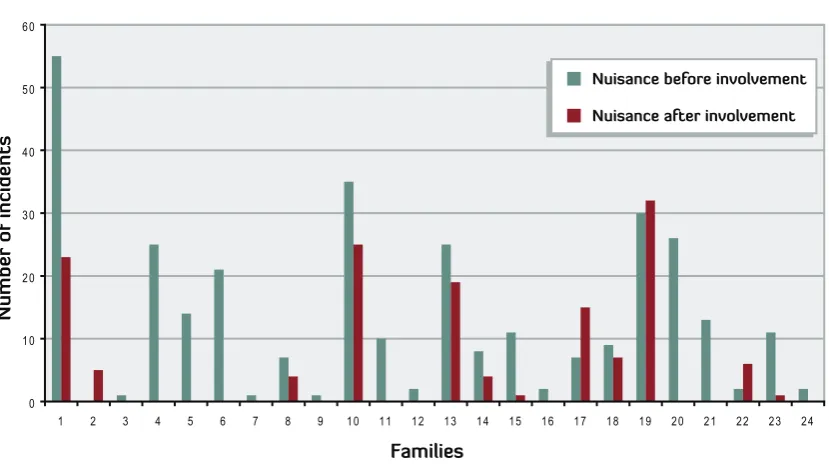
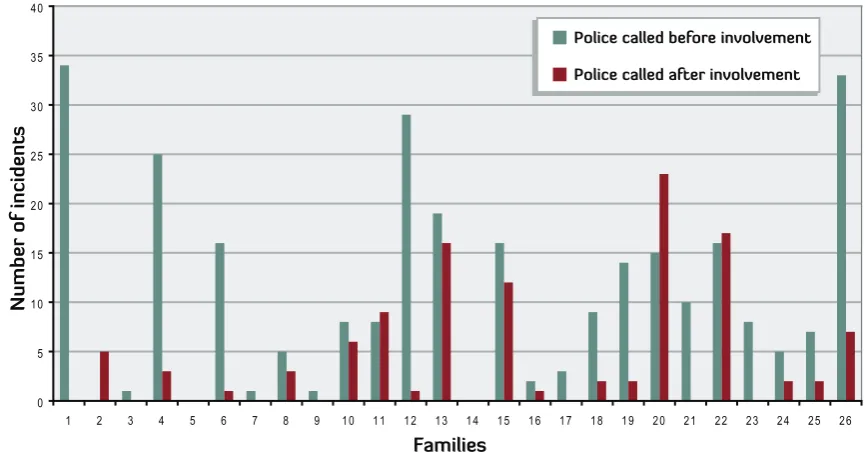
[image:23.595.78.474.212.463.2]In relation to nuisance behaviour there was a 66.8% reduction from 401 incidents to 1. Police call-outs reduced from 49 to 7, which represents an overall 85% fall. Referrals to other agencies saw a similar drop from 8 incidents by an impressive 95.4%. ABC’s reduced by 95% from 1 to 1. No ASBOs were imposed on any individual while they were associated with Springboard.
Figure 3: Arrests before and after intervention
0 5 10 15 20 25 30 35 40
1 2 3 4 5 6 7 8 9 10 11 12 13 14 15 16 17 18 19 20 21 22 23 24 25 26 27 28 29 30 31 32 33
Families
N
um
be
r
of
a
rr
es
ts
Arrests Pre-Intervention
4
Figure 6: Cumulative Number of Offending Behaviour Incidents
Criminal Activity Number before involvement
Number since
involvement Reduction
Percentage reduction
Arrests 46 78 169 68.%
BVPIs 70 47 67.%
[image:24.595.72.491.363.593.2]PSAs 90 67 74.5%
Fig 4: BVPI before and after intervention
0 5 10 15 20 25
1 2 3 4 5 6 7 8 9 10 11 12 13 14 15 16 17 18 19 20 21 22 23 24 25 26 27 28 29 30 31 32 33
Families
N
um
be
r
of
in
ci
de
nt
s
BVPI Pre-Intervention
BVPI Post-Intervention
Fig 5: PSA before and after intervention
0 1 2 3 4 5 6 7 8 9 10
1 2 3 4 5 6 7 8 9 10 11 12 13 14 15 16 17 18 19 20 21 22 23 24 25 26 27 28 29 30 31 32 33
Families
Number of incident
s
PSA Pre-Intervention
[image:24.595.72.526.647.773.2]5
Figure 7: Total Changes in Anti-Social Behaviour
Anti-Social Activity
Number before involvement
Number since
involvement Reduction
Percentage reduction Nuisance
behaviour 401 1 68 66.8%
Police called 49 7 1 85%
Referrals to
other agencies 87 4 8 95.4%
ABCs 1 1 0 95%
ASBOs 1 0 1 100%
Figures 8 to 11 represent a breakdown of the pattern of anti-social behaviour for each family. This data mirrors that in Figure 7, displaying significant reductions in behaviour and service involvement. Figure 8, relating to referrals to other agencies, is a prime example of this, and it emphasises the impact of the multi-disciplinary approach adopted by the Springboard team which made only 4 referral to another agency throughout the Springboards project.
Fig 8: Nuisance before and after intervention
0 10 20 30 40 50 60
1 2 3 4 5 6 7 8 9 10 11 12 13 14 15 16 17 18 19 20 21 22 23 24
Families
Number of incident
s
Nuisance before involvement
[image:25.595.76.491.391.626.2]6
The complexity of intervention
with Springboard families
The complexity of addressing the multiple problems faced by Springboard families could be intensified: fixing one problem sometimes revealed or provoked the development of another. For example, one notoriously anti-social family was rehoused as part of the Springboard intervention but then became the target of persistent harassment and scapegoating by other local residents.
All manner of local problems were routinely attributed to this family despite clear evidence that the family members were not involved in any way. There was no increase in crime as a result of the family’s relocation, but there arose a strong perception to the contrary among neighbours. Despite major success by the Springboard workers with the individual family, there remained an ongoing need for intervention in response to the neighbourhood reaction.
Against these dramatic reductions, the comparison group and the wider relevant population displayed no significant change in anti-social behaviour. Although there was no direct PSA target that related specifically to the reduction in this behaviour, there was a target that focused on reducing the community’s experiences of anti-social behaviour. Springboard intervention played a significant part in reducing the number of residents who considered anti-social behaviour to be a problem in their area.
[image:26.595.70.503.435.669.2]Viewing this behaviour as criminal activity brings it into the realms of the Youth Justice Board KPI D1 standard. This seeks a year-on-year reduction in the number of entrants to the youth justice system. As the number of Police call outs, referrals to other agencies, ABCs and ASBOs saw significant reductions, then Springboard achieved this objective.
Fig 9: Police called before and after involvement
0 5 10 15 20 25 30 35 40
1 2 3 4 5 6 7 8 9 10 11 12 13 14 15 16 17 18 19 20 21 22 23 24 25 26
Families
N
um
be
r
of
in
ci
de
nt
s
Police called before involvement
7
Domestic Violence
[image:27.595.76.504.92.326.2]Domestic violence occurred within 10 of the families within the 1 months prior to their inclusion in Springboard, with 7 incidents being recorded. This reduced to 7 while the families received support, representing a 74% reduction. In relation to the number of arrests associated with domestic violence, a 50% reduction occurred, with the number of incidents falling from 4 to . As with substance misuse, domestic violence can be the key family predictor of children’s emotional disharmony and parental unavailability (Cleaver et al 1999, 007). Any significant reduction in domestic abuse will always result in considerable improvements in the quality and safety of family life for children.
Fig 10: Referrals before and after involvement
0 5 10 15 20 25 30 35 40 45
1 2 3 4 5 6 7 8 9 10 11 12 13 14 15 16 17
Families
N
um
be
r
of
in
ci
de
nt
s
Referrals before involvement
Referrals after involvment
Fig 11: Anti-social behaviour before and after involvement
0 0.5 1 1.5 2 2.5 3 3.5
1 2 3 4 5 6 7
Families
N
um
be
r
of
in
ci
de
nt
s
ABCs before involvement
[image:27.595.81.502.400.620.2]8
Family W
Presentation of family problems
This was a two parent family with three older children. The family problems concerned both parents and all three children. The W parents struggled to offer any boundaries or guidance to their children.
The two older children had a long history of involvement with the YOT. This was due to acquisitive crime, anti-social behaviour, bullying and intimidation. It was believed that the older girl was vulnerable to sexual exploitation or early pregnancy.
Mr W’s emotional wellbeing was poor and he had recently attempted suicide. Mrs W had been involved in anti-social behaviour and had bullied her husband. The youngest child was disabled and emotionally vulnerable.
The family was about to be evicted.
The implications of these issues
This was a most appropriate referral with internal parental conflict and distress having a significant impact on the development, safety, offending behaviour, and emotional wellbeing of all four children.
Springboard Interventions
1) The project began the long process of re-housing, beginning with temporary accommodation and moving towards a permanent home.
) Significant input was given to parents and children about boundaries to behaviour inside and outside the family home.
) Mr and Mrs W were encouraged to engage with the positive parenting process. 4) The needs of the youngest, disabled child were assessed.
5) Individual work was undertaken with the oldest girl to attempt to reduce her vulnerability to sexual exploitation and early pregnancy.
Outcomes
Stability of the family’s housing slowly improved, as did their anti-social behaviour in the tenancy. Work on parenting & boundaries slowly encouraged more appropriate behaviour within the family. The older girl returned to live in the family home and was judged to be sexually less vulnerable. Compliance around anti-social behaviour was much improved .
Ongoing
More work was needed on Mr W’s emotional health and his parenting and boundary role. The youngest, disabled child remained very emotionally vulnerable.
•
• • • •
• • • •
• •
Fig12: Domestic violence & arrests before & after intervention
0 5 10 15 20 25 30
12 months prior to referral After referral to Springboard
N
um
be
r
of
in
ci
de
nt
s
Domestic violence
9
Missing from Home
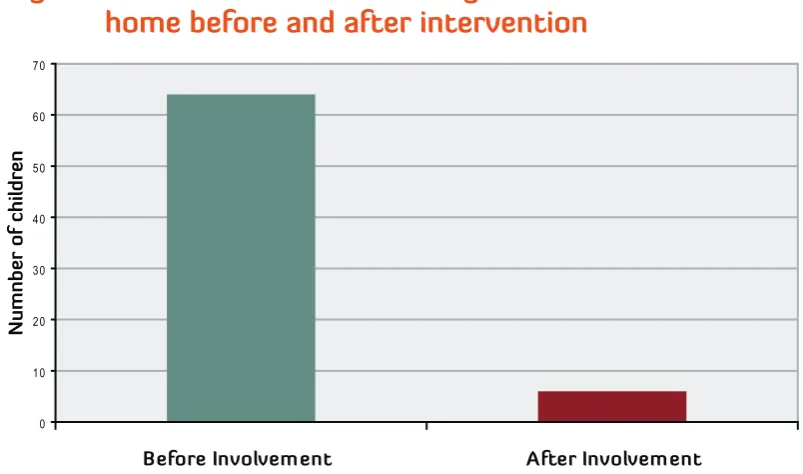
The number of children and young people reported as missing from home dropped by 86% to 9 incidents from 64.
Children Placed in Care
Family involvement with care or protection services can be a significant predictor of family disharmony and social exclusion. Following referral, only children from Springboard families were identified as receiving an episode of residential care. This was compared to 5 incidents of residential support in the last 1 months before the families commenced with Springboard. This represented an 88% reduction. The baseline documents are unclear as to whether the three placements were continuations of placements from before the families commenced with Springboard or placements that were instigated by the Springboard team. Family involvement with services that support families in relation to child protection services significantly reduced by 80%. Some preventative interventions will stop some children coming into care or into the safeguarding system. However some children will still need to come into the care or the safeguarding system. What Springboard can show in relation to these families is that all supportive/ preventative involvement has been already tried and that the decision to go into the protection or care process is the right one for those children.
Relationship Breakdown
[image:29.595.76.478.150.387.2]This had a significant impact on a number of the families before they received support, with 10 experiencing a breakdown. While the families were linked with Springboard, only families had the same experience. However, the outcome of these breakdowns was positive rather than negative, instigating stability rather than chaos. There was a reduction of 80% in family breakdown.
Fig 13: Number of children missing from
home before and after intervention
0 10 20 30 40 50 60 70
Before Involvement After Involvement
N
um
nb
er
o
f
ch
ild
re
0
Housing and Accommodation
This also represented a success story for Springboard. Families maintaining a tenancy have to avoid the accumulation of arrears. Ten families were recruited to Springboard with significant arrears. After involvement in the project, all of these families were addressing their arrears by making regular, affordable payments. 100% of Springboard participants previously in arrears had achieved acceptable, sustainable repayment arrangements. There was a 50% reduction in the number of families classed as living in non-decent accommodation, from 14 to 7. In relation to families living in temporary accommodation, 7 were residing in this type of accommodation before they became linked with Springboard. This number was reduced by 4 to families remaining in temporary accommodation while they were receiving a service. While this was a significant improvement, further work was needed to address the remaining issues.
Employment
In this domain the team adopted a proactive approach, drawing on other initiatives and services in an attempt to instigate a shift in family members’ perceptions of themselves in relation to gainful employment, training or education. Some success was achieved, which while not, perhaps, so evidently dramatic as in other domains, was still of great importance. The impact of the achievement on the quality of life for those who achieved the stability to move on in this area was significant. Two adults were supported into paid employment, and a further two commenced voluntary work at a local volunteering centre. With the support of the Springboard team, six individuals commenced training or full-time adult education, and
one undertook a part-time college course. Three more clients commenced college courses but subsequently dropped out while still being supported by Springboard. This represented a more positive picture than that presented by the comparison group, which saw no apparent shift in this area at all.
Education
This aspect of the support package for the families on Springboard displayed significant improvements in the quality of the families’ lives.
There was a reduction of 33% in children and young people being classed as being in the NEET group, with numbers reducing from 18 to 1.
This was mirrored in a reduction of 27% from to 16 in young people being linked with YOT. The proportion of children judged as being in tier 2 also reduced by 33% from 9 to 6.
Attendance
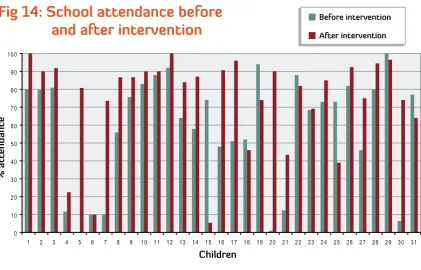
A marked move forward related to those children and young people who had attendance issues. of the children and young people who were supported by Springboard had issues relating to attendance at the outset of their family’s inclusion in the project. Figure 14 identifies the individual attendance records for the young people in percentages. 66% of these young people improved their level of attendance as a result of Springboard intervention. Two increased their attendance to 100%, and a further 4 increased their attendance to above 90%. Six of the young people showed a decline in their attendance level. However, one of these displayed a significant improvement to 90% but then returned to the original level of 50%. At this stage it was not practical to identify changes in the level of attainment since this would require a longer timescale than allowed for in the Springboard pilot project.
•
• •
Small intervention:
huge impact
1
Exclusion
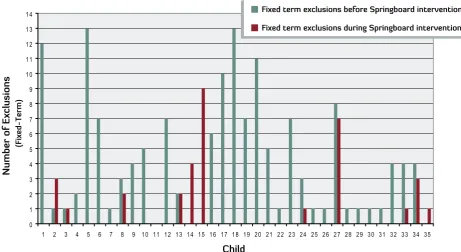
In the area of reducing school exclusions the Springboard interventions proved to be remarkably successful. While the problems faced by many families were substantial in both number and intensity, significant improvements in school exclusion were achieved.
Permanent Exclusions
At the time of the Springboard pilot project, there was a major effort in Blackpool to reduce school exclusion, especially through close work between schools and the Inclusion Support Team. This resulted in a remarkable overall reduction of permanent exclusions from 17 in 006-07 to 7 in 007-08. Within this, however, the Springboard team was working with the families whose children were most at risk of exclusion and which had multiple problems impacting on individual and family behaviour. Children in the families currently engaged with Springboard at the time of the evaluation had sustained a total of permanent exclusions before engagement with Springboard, while children in the families exited after engagement with Springboard had sustained a total of 6 permanent exclusions. However,
no permanent exclusions at all were incurred during engagement with Springboard.
Permanent exclusions before and during engagement with Springboard Current Springboard
Families
Families Exited from Springboard
Before engagement 6
During engagement 0 0
Befor