At the Lexicon-Grammar Interface: The Case of Complex Predicates in
the Functional Generative Description
V´aclava Kettnerov´a and Mark´eta Lopatkov´a Charles University in Prague
Faculty of Mathematics and Physics Czech Republic
{kettnerova,lopatkova}@ufal.mff.cuni.cz
Abstract
Complex predicates with light verbs have proven to be very challenging for syntactic theories, particularly due to the tricky dis-tribution of valency complementations of light verbs and predicative nouns (or other predicative units) in their syntactic struc-ture. We propose a theoretically adequate and economical representation of complex predicates with Czech light verbs based on a division of their description between thelexiconand thegrammar. We demon-strate that a close interplay between these two components makes the analysis of the deep and surface syntactic structures of complex predicates reliable and efficient.
1 Introduction
Description of a language system is usually di-vided into two basic components – a grammar and a lexicon. Thegrammar consists of general pat-terns of a natural language rendered, in the form of formal rules which are applicable to whole classes of language units. Thelexicon, on the other hand, represents an inventory of language units with their specific properties. Nevertheless, linguistic theories can substantially differ from each other in the distribution of information between the gram-mar and the lexicon.
Valency, which forms the core of a dependency structure of a sentence, constitutes a fundamen-tal example of a phenomenon bridging between the grammar and the lexicon. Valency struc-ture of verbs is so varied that it cannot be de-scribed by rules; it must be listed in lexical entries in a lexicon, see the highly elaborated lexicons, e.g., (Mel’ˇcuk and Zholkovsky, 1984), (Apresjan, 2011). However, if a verb is a part of a com-plex predicate, its valency structure is involved in a complex structure the formation of which is
typ-ically regular enough to be described by rules in the grammar.
In this paper, we focus on lexicalized co-occurrence relations, namely on complex pred-icates composed of light verbs and predicative nouns (CPs) where two syntactic elements serve as a single predicate, e.g., ‘to make a request’, ‘to give a presentation’, ‘to get support’, ‘to take a shower’.1 We demonstrate that an adequate and
economical description ofCPs requires a close co-operation of the grammar and the lexicon: On the basis of the lexical representation ofCPs, gram-matical rules generate well-formed (both deep and surface)dependency structures.
The objective of this contribution is to further elaborate and modify – in light of recent inves-tigations – the theoretical results given in (Ket-tnerov´a and Lopatkov´a, 2013). Namely, the lex-ical information provided by the VALLEX lexi-con (Lopatkov´a et al., 2008) on diatheses and the grammatical rules in the grammatical component are applied to the description ofCPs in marked structures of diatheses (e.g., passive structures) with the aim to gain allsurface syntactic manifes-tationsof theCPs.
The paper is structured as follows: first we discuss related work on CPs (Sect. 2); then we briefly introduce the Functional Generative De-scription (FGD) (Sgall et al., 1986) used as the theoretical background and the VALLEX lexicon (Sect. 3) and describe the lexical representation of CPs (Sect. 4); finally, we provide the enhancement of the grammatical component of FGD with for-mal rules for the generation of the syntactic struc-tures withCPs (Sect. 5).
2 Related Work
There is a variety of approaches tocomplex pred-icates with light verbs(also calledlight verb
con-1Causative constructions of the type ‘to make sb do
some-thing’ are not considered here asCPs.
structions) and their characteristics, as well as to the range of issues involved in the notion of complex predicates. Despite the diversity in the treatment of complex predicates in different the-oretical frameworks, there is a general agree-ment that the crucial issue to be resolved is that two syntactic elements function as a single pred-icate; this fact is corroborated by the presence of a single ‘Agens’/‘Bearer of action or proper-ty’/‘Experiencer’. This key characteristic of com-plex predicates of the given type is accounted for by the mechanisms called argument fusion (Butt, 1998), argument transfer (Grimshaw and Mester, 1988), or argument composition (Hinrichs and Nakazawa, 1990) formulated within different the-ories.
All these mechanisms try to account for the fact that (i) light verbs, despite being depleted of semantic participants (denoting only general se-mantic scenario), have valency complementations, and that (ii) semantic participants (contributed to CPs primarily by predicative nouns) are usu-ally expressed as complementations of light verbs (Alonso Ramos, 2007).
If a lexicographic representation aims at a de-scription of syntactic behavior of CPs (not only at compiling an inventory of collocations of pred-icative nouns and light verbs, as e.g., (Vincze and Csirik, 2010), (Paul, 2010)), the above given mechanisms should be reflected in the lexicon. To our knowledge, the most complex representation of CPs is provided in the Explanatory Combi-natorial Dictionary of Modern Russian (Mel’ˇcuk and Zholkovsky, 1984) where the collocational potential is captured by means of lexical functions (Mel’ˇcuk, 1996). The generation of well-formed syntactic structures withCPs is then based on the interplay of the lexical representation and gram-matical rules (Alonso Ramos, 2007).
In Czech theoretical linguistics, there is only a limited number of studies devoted to CPs (Mach´aˇckov´a, 1994), (Cinkov´a, 2009), (Radimsk´y, 2010), and (Kol´aˇrov´a, 2010); none of them presents a mechanism aspiring to provide a thorough explanation of syntactic behavior of CPs. Moreover, the only existing lexical resource with information on syntactic properties of light verbs – PDT-Vallex – provides only partial infor-mation that does not make it possible to establish the deep and surface syntactic structures of the re-sultingCPs (Ureˇsov´a, 2011).
3 FGD Framework
In this paper, we elaborate the representation of CPs within the Functional Generative Descrip-tion, a stratificational and dependency-oriented theoretical framework (Sgall et al., 1986). One of the core concepts of FGD is that of valency (Panevov´a, 1994): at the layer of linguistically structured meaning (called the tectogrammatical layer), valency provides the structure of a depen-dency tree. The valency theory of FGD has been applied in several valency lexicons. The most elaborate one of these is the VALLEX, Valency Lexicon of Czech Verbs, which forms a solid basis for the lexical component of FGD.
VALLEX lexicon
The VALLEX lexicon2 has resulted from an
at-tempt to document valency behavior of Czech verbs (Lopatkov´a et al., 2008). Over time, VALLEX has undergone many quantitative and qualitative extensions. Recent developments have focused on the linguistic phenomena that – despite representing productive grammatical processes in-volving changes in the valency structure of verbs – are lexically conditioned, esp.diatheses.
For the purposes of the representation of phenomena at the lexicon-grammar interface, VALLEX is divided into a lexical part and a gram-matical part. The lexical part provides lexical representation of individual lexical units of verbs whereas the grammatical part represents formal representation of rules of the overall grammatical component of FGD that are directly connected to the valency structure of verbs.
The central organizing concept of the lexical part of VALLEX is the concept of lexeme. The lexeme associates a set of lexical forms represent-ing the verb in an utterance, with a set oflexical unitsof a verb, corresponding to its senses.
Each lexical entry of a verb is described by a set of attributes (see Fig. 2 below). The core attribute framecontains a valency frame that is modeled as a sequence of valency slots, each corresponding to a single valency complementation of the verb; each slot consists of (i) a functor – a syntactico-semantic label reflecting the type of dependency relation of the given valency complementation, (ii) an indication of obligatoriness, and (iii) a list of possible morphemic forms specifying the usage of a lexical unit in theactive voice.
Of all the remaining attributes of lexical units currently employed in VALLEX, we shall further discuss the attributediat, the value of which is a list of all applicable diatheses (as their appli-cability is lexically conditioned and thus has to be captured in the lexical part of VALLEX). In thegrammatical part, grammatical rules describ-ing individual types of diatheses are formulated. When these rules are applied to the relevant lexi-cal units (as indicated by the attributediat), all possible surface syntactic manifestations of a lex-ical unit in the marked structures of diatheses can be obtained (Kettnerov´a et al., 2012).
4 Lexical Representation ofCPs
A CP, as a multiword lexical unit, is formed as a combination of a predicative noun with an ap-propriate light verb. It is primarily the predicative noun that contributes itssemantic participants.Its ability to select different light verbs (and thus to create different CPs) makes it possible to embed the event expressed by the predicative noun into different general semantic scenarios and thus to perspectivize it from the point of view of differ-ent semantic participants. In this process, a crucial role is played by thereferential identity of nomi-nal and verbal valency complementations within theCP(as it is demonstrated in Sect. 4.2.1).
As a consequence, CPs can be described as a combination of the information from thevalency frames of both thelight verb and thepredicative noun. Further, we propose to enhance VALLEX with three special attributeslvc,map andcaus to capture possible combinations of these two syn-tactic elements into a single predicate (Sect. 4.2).
4.1 Valency Frames
It is widely acknowledged that both predicative nouns and light verbs have their own valency potentials, i.e., they have their own sets of va-lency complementations (Alonso Ramos, 2007), (Mach´aˇckov´a, 1994). As a result, both light verbs and predicative nouns should be represented by their respective valency frames in the valency lex-icon.
4.1.1 Predicative Nouns
Valency frames of predicative nouns underlie their deep dependency structures, both in nominal structures and as the nominal components ofCPs, see examples (2) and (6) and the valency frame of
the nounpokyn‘instruction’ in (1).3
(1) pokynPN ‘instruction’:
ACTgen,pos ADDRdatPATk+dat,inf
(2) PokynPN st´atn´ıho z´astupceN:ACT:gen ˇzalob-c˚umN:ADDR:dat (posuzovat pˇr´ıpad jako kr´a-deˇz)N:PAT:infpˇriˇsel pr´avˇe vˇcas.
‘TheinstructionPN of the public prosecu-torN:ACTto the prosecutorsN:ADDR (to regard the case as a theft)N:PATcame just in time.’
Valency complementations of predicative nouns are endowed with semantic participants. For ex-ample, the nounpokyn ‘instruction’ is character-ized by the participants ‘Speaker’, ‘Recipient’, and ‘Information’, which are mapped ontoACTor, ADDRessee, andPATient, respectively.
4.1.2 Light Verbs
Valency frames of light verbs constitute the deep dependency structure of the verbal component of CPs.
Formally, valency frames of Czech light verbs are prototypically identical to the valency frames of their full verb counterparts.4 Hence we consider
them to be inherited from the latter. The only reg-ular difference between the valency frames of light verbs and their full verb counterparts is the func-torCPHR‘Compound PHRaseme’, indicating the valency position of the predicative noun.
Generally, valency complementations of a full verb correspond to its semantic participants; how-ever, light verbs are deprived of semantic partici-pants (Alonso Ramos, 2007).5
For example, the valency frame of the light verb udˇelitpf ‘to give, to grant’ (4) is identical to the
valency frame of the full verb (3), compare exam-ples (5) and (6).
(3) udˇelit ‘to give’:
ACTnom ADDRdat PATacc (4) udˇelitLV ‘to give’:
ACTnom ADDRdat CPHRacc
(5) PrezidentV:ACT:nomudˇelilumˇelc˚umV:ADDR:dat medaileV:PAT:acc.
3As the information on obligatoriness is not relevant here,
we omit it from the valency frames.
4These findings are in line with the analysis of their
mor-phological characteristics, which are also prototypically iden-tical with the properties of their full counterparts (Butt, 2010).
5The only exception – causative light verbs – is addressed
‘The PresidentV:ACT has awarded medalsV:PATto the artistsV:ADDR.’
(6) St´atn´ı z´astupceV:ACT:nom udˇelilLV ˇzalob-c˚umV:ADDR:dat pokynV:CPHR:acc posuzovat pˇr´ıpad jako kr´adeˇz.
‘The public prosecutorV:ACT has given an
instructionV:CPHR to regard the case as a theft to the prosecutorsV:ADDR.’
Despite the absence of semantic participants of light verbs, their valency complementations are not semantically depleted: they acquire their se-mantic content from the sese-mantic participants of predicative nouns via coreference with nominal valency complementations, as proposed, e.g., by (Butt, 1998), here Sect. 4.2.1. Then only seman-tically specified valency complementations are in-herited from valency frames of full verb counter-parts of light verbs (Kettnerov´a and Lopatkov´a, 2013).6
4.1.3 Linking Valency Frames: Attributelvc
For obtaining the deep dependency structure of a CP, the appropriate valency frames of the predica-tive noun and the light verb (with which the noun combines within the predicate) must be linked. In the VALLEX lexicon, the special attribute lvc, attached to individual valency frames of predica-tive nouns and (for convenience) also to those of light verbs, provides the list of references, see Fig. 1 and 2 below.
4.2 Lexical Mapping
The formation of well-formed deep and surface dependency structures withCPs requires a mech-anism to account for the distribution of nominal and verbal valency complementations in the re-sulting syntactic structures. In this section, we show that for these purposes, additional informa-tion on the coreference of valency complementa-tions (and thus on the mapping of semantic par-ticipants) has to be recorded as a part of lexical entries of predicative nouns and light verbs. This information is provided by two special attributes map(Sect. 4.2.1) andcaus(Sect. 4.2.2).
6However, the cases in which the number of valency
com-plementations in the valency frame of a light verb is reduced are rather rare in Czech (e.g., within theCPpˇrijmout zod-povˇednost‘to accept responsibility’, the valency frame of the light verb does not inherit theORIGin complementation as it lacks semantic specification).
4.2.1 Nominal Participants: Attributemap As stated above, whereas the valency complemen-tations of a predicative noun are semantically sat-urated by its semantic participants, the valency complementations of the light verb are semanti-cally unspecified. To acquire semantic content, the verbal complementations enter in coreference re-lations with the nominal complementations. Pairs of nominal and verbal valency complementations withinCPs thus exhibit referential identity (they refer to the same nominal semantic participant). This referential identity of verbal and nominal va-lency complementations represents a substantial characteristic ofCPs.
For example, theCPudˇelit pokyn‘to give an in-struction’ can be characterized by three semantic participants given by the noun: ‘Speaker’, ‘Re-cipient’, and ‘Information’. These participants are mapped onto the nominal valency complementa-tions ACTor, ADDRessee, andPATient, see (1). The valency frame of the light verb in (4) com-prises three complementations: one (CPHR) is occupied by the predicative noun and the remain-ing two (ACTor andADDRessee) represent com-plementations that are not semantically specified by the light verb; however, they gain their seman-tic capacity via coreference with nominalACTor andADDRessee, see (7) specifying the referential identity.
(7) udˇelit pokyn ‘to give an instruction’: ‘Speaker’N ⇒ ACTN ⇔ ACTV ‘Recipient’N ⇒ ADDRN ⇔ ADDRV ‘Information’N ⇒ PATN
Due to the referential identity, all the valency com-plementations within thisCPare semantically sat-urated. The event denoted by the predicative noun is perspectivized from the point of view of the ‘Speaker’, corresponding to the verbalACTor (ex-pressed in the active structure in the most promi-nent subject position, see also example (6).
Changes in the referential identity
‘to receive an instruction’ (10). Within the lat-ter, the same set of semantic participants are em-ployed, i.e., ‘Speaker’, ‘Recipient’, and ‘Informa-tion’. However, the verbal ACTor and ORIGin gain their semantic specification via coreference with the nominalADDRessee andACTor, respec-tively, see (1), (8) and (10).
(8) pˇrijmoutLV‘to receive’:
ACTnom CPHRacc ORIGod+gen
(9) ˇZalobciV:ACT:Recip pˇrijaliLV od st´atn´ıho z´astupceV:ORIG:Speak pokynV:CPHR (posuzo-vat pˇr´ıpad jako kr´adeˇz)N:PAT:Info.
‘The prosecutorsV:ACT:Recip have received
the instructionV:CPHR (to regard the case as a theft)N:PAT:Info from the public
prosecutorV:ORIG:Speak.’
(10) pˇrijmout pokyn ‘to receive an instruc-tion’:
‘Speaker’N ⇒ ACTN ⇔ ORIGV ‘Recipient’N ⇒ ADDRN ⇔ ACTV ‘Information’N ⇒ PATN
The referential identity of valency complementa-tions, provided in (10), reflects changes in the se-mantic specifications of verbal valency comple-mentations (see example (9) illustrating the map-ping) and also the change in the perspective from which the event expressed by the noun is viewed: in this case, the event is portrayed from the per-spective of the ‘Recipient’ as the participant cor-responding to the verbalACTor.
Attributemap
As referential identity has a direct influence on the syntactic structure ofCPs, see Section 5, this in-formation has to be provided in the lexical part of the language description.
As it is the predicative noun that selects an ap-propriate light verb, the attributemap – giving a list of pair(s) of referentially identical nominal and verbal valency complementations – is assigned to valency frames of predicative nouns. More than one attribute map (distinguished by numeral in-dexes) can appear in a lexical unit of a predica-tive noun to account for the possible differences in referential identity of valency complementa-tions within several CPs with the same predica-tive noun. Each attributemapis accompanied by a set of references to light verbs provided in the at-tributelvcthat comply with the given referential identity of valency complementations. The lexical
[image:5.595.311.521.103.241.2]entry is exemplified on the predicative nounpokyn ‘instruction’ in Fig. 1.
Figure 1: Simplified VALLEX lexical entry of the nounpokyn‘instruction’.
4.2.2 Verbal Participant ‘Causator’: Attributecaus
Typically, it is the predicative noun that deter-mines the number and roles of semantic par-ticipants characteristic of a CP. Light verbs of causative type, which are endowed with the se-mantic participant ‘Causator’, represent the only exception. With these verbs, ‘Causator’ is con-tributed to CPs by the verb (in addition to the semantic participants provided by the predicative nouns).
Figure 2: Simplified VALLEX lexical entry of the verbudˇelovat/ud´ıletimpf,udˇelitpf ‘to give’.
[image:5.595.314.520.472.649.2]the light verb udˇelit ‘to grant’ (with the valency frame given in (4)), is mapped onto the verbal ACTor whereas ‘Bearer’ and ‘Theme’ given by the predicative noun pr´avo ‘right’ correspond to the nominalACTor andPATient, respectively, see the valency frame of the noun in (11). As the ver-balACTor is saturated by the semantic participant ‘Causator’, onlyADDRessee is not semantically saturated; this ADDRessee acquires its semantic specification from the predicative noun via coref-erence with the nominalACTor, see their referen-tial identity in (13). As a result, all valency com-plementations are semantically specified.
(11) pr´avoPN ‘right’:
ACTgen,pos PATgen,na+acc,inf
(12) . . . kr´al Vladislav Jagellonsk´yV:ACT:Caus
udˇelilLVmˇesteˇckuV:ADDR:Bearer pr´avoV:CPHR (poˇr´adat dva v´yroˇcn´ı trhy)N:PAT:Theme.
‘. . . king Ladislaus JagiellonV:ACT:Caus
granted the rightV:CPHR (to hold two market fairs)N:PAT:Theme to the
townV:ADDR:Bearer.’
(13) udˇelit pr´avo ‘to grant a right’: ‘Causator’V ⇒ ACTV
‘Bearer’N ⇒ ACTN ⇔ ADDRV ‘Name’N ⇒ PATN
Changes in the mapping of ‘Causator’
The semantic participant ‘Causator’ may be mapped not only onto the verbal ACTor but also onto another valency position of a light verb. Then the change in the mapping of ‘Causator’ brings about further changes in the referential identity of nominal and verbal complementations.
For example, within the CPz´ıskat pr´avo ‘to ob-tain a right’, see (15), the ‘Causator’ contributed by the light verbz´ıskat‘to obtain’ maps onto the verbalORIGin, see the valency frame of this light verb in (14). In this case, it is the verbal ACT -or that gains semantic content from the nominal ACTor (16). As a consequence, all the valency complementations within theCPz´ıskat pr´avo ‘to obtain a right’ are semantically saturated.
(14) z´ıskatLV ‘to obtain’:
ACTnom CPHRacc ORIGod+gen
(15) . . . od kr´ale Vladislava
Jagellon-sk´ehoV:ORIG:Caus mˇesteˇckoN:ACT:Bearer
z´ıskaloLV pr´avoV:CPHR (poˇr´adat dva v´yroˇcn´ı trhy)N:PAT:Theme.
‘. . . from king Ladislaus
Jagiell-onV:ORIG:Caus, the townV:ACT:Bearer
ob-tainedthe rightCPHR (to hold two market fairs)N:PAT:Theme.’
(16) z´ıskat pr´avo ‘to obtain a right’: ‘Causator’V ⇒ ORIGV
‘Bearer’N ⇒ ACTN ⇔ ACTV ‘Name’N ⇒ PATN
Attributecaus
The mapping of ‘Causator’ onto valency com-plementations is relevant for both deep and sur-face structure formation, therefore it is captured by a special attribute caus assigned to valency frames of light verbs of causative type. This attribute lists the verbal valency complementa-tion onto which ‘Causator’ is mapped, see the light verbudˇelovat/ud´ıletimpf,udˇelitpf ‘to give’ in
Fig. 2.
5 Grammatical Rules forCPs
The grammatical part of the VALLEX lexicon contains meta-rules describing the formation of deep (Sect. 5.1) and surface dependency structures ofCPs (Sect. 5.2). These meta-rules are instanti-ated on the basis of the information stored in the lexical part of the lexicon.
5.1 Deep Syntactic Structure
The meta-rule for formation of the deep syntac-tic structure of a CP exploits a valency frame of a predicative noun and a valency frame of a light verb with which the noun combines (their compatibility is identified by the attribute lvc). Moreover, information on the referential identity of nominal and verbal valency complementations within aCP, given in the attributemap, as well as information on verbal ‘Causator’, given in the at-tribute caus (if applicable), is necessary for the identification of coreferences in the dependency tree of theCP.
(17)
On the other hand, the valency structure of the CPpˇrijmout pokyn‘to receive an instruction’ re-sults from the valency frames of the predicative nounpokyn‘instruction’ and that of the light verb pˇrijmout ‘receive’, given in (1) and (8), respec-tively, and from the referential identity provided in (10), see Fig. (18).
(18)
5.2 Surface Syntactic Structure
For the formation of the surface syntactic struc-ture of aCP, its deep dependency structure is used (Sect. 5.1). In addition to the mapping of indi-vidual nominal and verbal complementations pro-vided by the attributemap (Sect. 4.2.1), also the mapping of the verbal ‘Causator’, provided by the attributecaus(Sect. 4.2.2), is necessary.
Theoretical analysis has revealed that withCPs in Czech, each semantic participant is typically ex-pressed in the surface sentence just once.7Despite
the fact that semantic participants are contributed – with the exception of the verbal ‘Causator’ – by predicative nouns, Czech CPs have a strong ten-dency to express them in the surface structure as complementations of light verbs8 (Mach´aˇckov´a,
1994). We propose the following rules for the for-mation of the surface syntactic structure withCPs: All valency complementations from the valency frame of the light verbare expressed in the surface structure, namely:
(i) the valency complementation filled by the predicative noun (theCPHRfunctor); (ii) the valency complementation corresponding
to ‘Causator’ (the attributecaus);
7The only exception is represented by the semantic
partic-ipant mapped onto nominalACTor; under certain conditions, this participant can be expressed twice, both as a verbal and as a nominal complementation (e.g.,PetrV:ACT:Bearer nevedl
sv˚ujN:ACT:Bearer ˇzivot zrovna ˇst’astnˇe. ‘Peter did not lead his
life very happily.’).
8Rich morphology of Czech provides reliable clues for the
identification of surface structure via morphemic cases.
(iii) valency complementations that are referen-tially identical with a nominal complementa-tion (the attributemap).
Only the following valency complementations from thevalency frame of the predicative nounare expressed in the surface structure:
(iv) valency complementations that are not ref-erentially identical with any verbal comple-mentation (i.e., those not listed in the at-tributemap).
For example, within the CP udˇelit pokyn ‘to give an instruction’ characterized by the deep dependency tree (17) the predicative noun fills the CPHR verbal position (i); two verbal va-lency complementations are expressed in the surface structure (iii), namely the ACTV and
ADDRV (referentially identical with the ACTN
andADDRN, referring to ‘Speaker’ and
‘Recip-ient’, respectively); from the valency frame of the noun, only the PATN (referring to
‘Informa-tion’) is expressed on the surface (iv); the two re-maining nominal complementations, ACTN and
ADDRN, are unexpressed in the surface structure
(as they are referentially identical withACTV and
ADDRV), see Tab. 1 column 4.
5.2.1 Unmarked (Active) Form
Morphemic forms of valency complementations of light verbs listed in the lexical part of the lexi-con correspond to theactive form. Thus the rules given above directly establish the surface syntactic structure ofCPs in the active form.
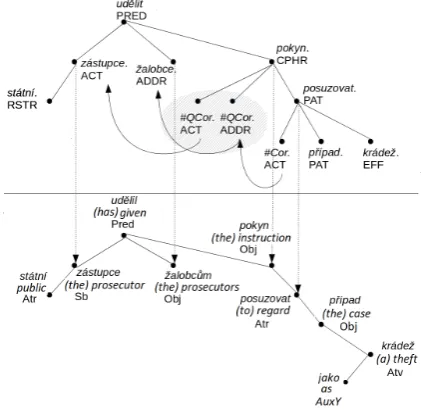
For example, the surface structure of a sentence with the CPudˇelit pokyn‘to give an instruction’ with the light verb in the active form can be ob-tained directly from morphemic forms recorded in the valency frames (1) and (4), see Tab. 1 col-umn 5, and Fig. 3, displaying the surface syntactic tree of sentence (19) in relation to its deep depen-dency tree.
(19) St´atn´ı z´astupceV:ACT:Sb udˇelilLV:active ˇzalobc˚umV:ADDR:Obj pokynV:CPHR:Obj (posu-zovat pˇr´ıpad jako kr´adeˇz)N:PAT:Atr.
‘The public prosecutorV:ACT:Sb has
given the prosecutorsV:ADDR:Obj the
CP Deep map&caus Surface active pass rcp-pass deagent
Light verb ACTV + Sb:nom Obj:instr,od+gen Obj:od+gen -∗
ADDRV + Obj:dat Obj:dat Sb:nom Obj:dat
CPHRV + Obj:acc Sb:nom Obj:acc Sb:nom
Predicat. noun ACTN ACTN⇔ACTV
-ADDRN ADDRN⇔ADDRV
[image:8.595.102.496.62.148.2]-PATN + Atr:k+dat,inf Atr:k+dat,inf Atr:k+dat,inf Atr:k+dat,inf
Table 1: The deep (left part) and surface (right part) structures of theCPudˇelit pokyn‘to give an instruc-tion’.(∗The surface expression is blocked by the deagentive diathesis.)
Figure 3: The simplified deep (above) and sur-face (below) dependency trees of sentence (19). The vertical arrows show the surface syntactic manifestations of valency complementations. The nominal valency complementations unexpressed in the surface structure (due to their referential identity with the verbal ones) are in the gray field.
5.2.2 Marked (Passive) Forms: Interplay of the Rules
The deep structure of aCPalso serves as the basis for generating marked surface structures of diathe-ses. In this case, the rules for the formation of sur-face structures ofCPs (Sect. 5.2 above) interplay with those for the formation of marked forms of diatheses (Vernerov´a et al., 2014).
In Czech, five types of diathesis (passive, resul-tative, recipient-passive, deagentive, and disposi-tional) were determined (Panevov´a et al., 2014). Diatheses are accompanied by changes in the mor-phological category of verbal voice and they are prototypically associated with shifts of valency complementations in the surface structure (while the deep structure is preserved). These shifts are
indicated by changes in morphemic forms of the involved valency complementations and are regu-lar enough to be captured by formal rules. These rules can be exemplified, e.g., by the rule for the recipient-passive diathesis:
Rcp-pass d.
verb form replace(active →
→ AuxVdostat+past participle)
ACT replace(nom → od+gen)
ADDR replace(dat → nom)
The light verb and its full verb counterpart pro-totypically enter the same type of diatheses; the applicability of individual diatheses is provided by the attributediatattached to the full verb. For example, the light verb udˇelit ‘to give, grant’ can create the following marked struc-tures (Fig. 2): passive (pass (20)), resulta-tive (res), recipient-passive (rcp-pass (21)), deagentive (deagent (22)), and dispositional (disp) diathesis.
(20) ˇZalobc˚umV:ADDR:dat byl od st´atn´ıho z´astupceV:ACT:od+gen udˇelenpass po-kynV:CPHR:nom (posuzovat pˇr´ıpad jako kr´adeˇz)N:PAT:inf.
‘The instructionV:CPHR (to regard the case as a theft)N:PAT was given to the prosecutorsV:ADDR by the public prosecutorV:ACT.’
(21) ˇZalobciV:ADDR:nom dostali od
st´atn´ı-ho z´astupceV:ACT:od+gen udˇelenrcp-pass
pokynV:CPHR:acc (posuzovat pˇr´ıpad jako
kr´adeˇz)N:PAT:inf.
‘The prosecutorsV:ADDR have been given theinstructionV:CPHR(to regard the case as a theft)N:PATby the public prosecutorV:ACT.’ (22) ˇZalobc˚umV:ADDR:dat se udˇelildeagent
po-kynV:CPHR:nom (posuzovat pˇr´ıpad jako
kr´adeˇz)N:PAT:inf.
[image:8.595.75.286.205.410.2]Valency frames describing the marked struc-tures of diatheses of a givenCPcan be generated on the basis of the rules for deriving the marked structures of diatheses (stored in the grammatical part of the VALLEX lexicon), applied to thedeep and surface active structuresof theCP. The deep dependency structure of the CP (i.e., the num-ber and the type of its verbal and nominal va-lency complementations) is preserved whereas the surface syntactic expression of the verb and its complementations is changed as prescribed by the rule describing the respective diathesis (the sur-face form of the nominal valency complementa-tions remains unchanged).
For example, the marked structure of the recipient-passive diathesis of theCPudˇelit pokyn‘to give an instruction’, as in (21), is underlain by the valency frame obtained by the application of the above given rule to the valency frame corresponding to the active form of the light verb in (4), see Tab. 1 column 7.
6 Conclusion
In this paper, we have focused on complex predi-cates consisting of a light verb and a predicative noun. We have proposed their theoretically ad-equate and economical description based on the interplay between the grammatical and the lexi-cal components of the language description. The special attributes lvc, map and caus, comply-ing with the logical structure of the VALLEX lex-icon as well as with the main tenets of the Func-tional Generative Description, were designed. The information provided in these attributes identi-fies recurrent patterns of light verb collocations (similarly as lexical functions into which it can be easily transferred), while grammatical rules in the grammatical component generate their well-formed (both deep and surface) dependency struc-tures. We have shown how the proposed rules combine with the rules describing diatheses.
At present, a large-scaled lexicographic repre-sentation of light verbs is still missing despite the fact that these phenomena are widespread in the language (Kettnerov´a et al., 2013). We expect that the lexicon enriched with the information on light verbs will form a solid basis for their future inte-gration into NLP applications which can substan-tially contribute to verifying the results of the pro-posed theoretical analysis.
Acknowledgments
The work on this project was supported by the grants of GA ˇCR No. P406/12/0557 and GA15-09979S. This work has been using language resources distributed by the LINDAT/CLARIN project of the MˇSMT No. LM2010013.
References
Margarita Alonso Ramos. 2007. Towards the Synthe-sis of Support Verb Constructions. In L. Wanner, ed-itor,Selected lexical and Grammatical issues in the Meaning–Text Theory, pages 97–137. J. Benjamins, Amsterdam.
Valentina Apresjan. 2011. Active dictionary of the Russian language: Theory and practice. In I. Bo-guslavsky and L. Wanner, editors, Meaning-Text Theory 2011, pages 13–24, Barcelona. Universitat Pompeu Fabra.
Miriam Butt. 1998. Constraining argument merger through aspect. In E. Hinrichs, A. Kathol, and T. Nakazawa, editors, Complex Predicates in Non-derivational Syntax, Syntax and Semantics, pages 73–113. Academic Press, San Diego.
Miriam Butt. 2010. The Light Verb Jungle: Still Hack-ing Away. In M. Amberber, B. Baker, and M. Har-vey, editors,Complex Predicates in Cross-Linguistic Perspective, pages 48–78. Cambridge University Press, Cambridge.
Silvie Cinkov´a. 2009. Words that Matter: Towards a Swedish-Czech Colligational Dictionary of Basic Verbs. Institute of Formal and Applied Linguistics, Prague.
Jane Grimshaw and Armin Mester. 1988. Light Verbs andΘ-Marking. Linguistic Inquiry, 19(2):205–232.
Erhard Hinrichs and Tsuneko Nakazawa. 1990. Sub-categorization and VP structure in German. In S. Hughes and J. Salmons, editors, Symposium on Germanic Linguistics, Amsterdam. J. Benjamins.
V´aclava Kettnerov´a and Mark´eta Lopatkov´a. 2013. The Representation of Czech Light Verb Construc-tions in a Valency Lexicon. In E. Hajiˇcov´a, K. Gerdes, and L. Wanner, editors, Proceedings of DepLing 2013, pages 147–156, Praha. Matfyzpress.
V´aclava Kettnerov´a, Mark´eta Lopatkov´a, and Eduard Bejˇcek. 2012. The Syntax-Semantics Interface of Czech Verbs in the Valency Lexicon. In Euralex International Congress 2012, pages 434–443, Oslo. University of Oslo.
Veronika Kol´aˇrov´a. 2010.Valence deverbativn´ıch sub-stantiv v ˇceˇstinˇe (na materi´alu subsub-stantiv s dativn´ı valenc´ı). Karolinum Press, Prague.
Mark´eta Lopatkov´a, Zdenˇek ˇZabokrtsk´y, and V´aclava Kettnerov´a et al. 2008. Valenˇcn´ı slovn´ık ˇcesk´ych sloves. Karolinum Press, Prague.
Eva Mach´aˇckov´a. 1994. Constructions with Verbs and Abstract Nouns in Czech (Analytical Predicates). In S. ˇCmejrkov´a and Fr. ˇSt´ıcha, editors, The Syntax of Sentence and Text, pages 365–375. J. Benjamins, Amsterdam.
Igor A. Mel’ˇcuk and Alexander K. Zholkovsky. 1984.
Explanatory Combinatorial Dictionary of Modern Russian. Wiener Slawistischer Almanach, Vienna.
Igor A. Mel’ˇcuk. 1996. Lexical Functions: A Tool for the description of lexical relations in a lexicon. In L. Wanner, editor,Lexical Functions in Lexicog-raphy and Natural Language Processing, pages 37– 105. J. Benjamins, Amsterdam.
Jarmila Panevov´a et al. 2014. Mluvnice souˇcasn´e ˇceˇstiny 2, Syntax na z´akladˇe anotovan´eho korpusu. Karolinum Press, Prague.
Jarmila Panevov´a. 1994. Valency Frames and the Meaning of the Sentence. In P. A. Luelsdorff, edi-tor,The Prague School of Structural and Functional Linguistics, pages 223–243. J. Benjamins, Amster-dam.
Soma Paul. 2010. Representing Compound Verbs in Indo WordNet. InGWC-2010, Mumbai. The Global Wordnet Association.
Jan Radimsk´y. 2010. Verbo-nomin´aln´ı predik´at s kat-egori´aln´ım slovesem. Editio Universitatis Bohemiae Meridionalis, ˇCesk´e Budˇejovice.
Petr Sgall, Eva Hajiˇcov´a, and Jarmila Panevov´a. 1986.
The Meaning of the Sentence in Its Semantic and Pragmatic Aspects. Reidel, Dordrecht.
Zdeˇnka Ureˇsov´a. 2011. Valence sloves v Praˇzsk´em z´avislostn´ım korpusu. ´Ustav form´aln´ı a aplikovan´e lingvistiky, Prague.
Anna Vernerov´a, V´aclava Kettnerov´a, and Mark´eta Lopatkov´a. 2014. To pay or to get paid: Enrich-ing a valency lexicon with diatheses. InLREC 2014, pages 2452–2459, Reykjav´ık. ELRA.