Semantic Tuples for Evaluation of Image to Sentence Generation
Lily D. Ellebracht1, Arnau Ramisa1, Pranava Swaroop Madhyastha2,
Jose Cordero-Rama1, Francesc Moreno-Noguer1, and Ariadna Quattoni3
1Institut de Robòtica i Informàtica Industrial, CSIC-UPC
2TALP Research Center, UPC
3Xerox Research Centre Europe
Abstract
The automatic generation of image cap-tions has received considerable attention. The problem of evaluating caption gener-ation systems, though, has not been that much explored. We propose a novel eval-uation approach based on comparing the underlying visual semantics of the candi-date and ground-truth captions. With this goal in mind we have defined a seman-tic representation for visually descriptive language and have augmented a subset of the Flickr-8K dataset with semantic anno-tations. Our evaluation metric (BAST) can be used not only to compare systems but also to do error analysis and get a better understanding of the type of mistakes a system does. To compute BAST we need to predict the semantic representation for the automatically generated captions. We use the Flickr-ST dataset to train classi-fiers that predict STs so that evaluation can be fully automated1.
1 Introduction
In recent years, the task of automatically genering image captions has received considerable at-tention. The task of evaluating such sentences, though, has not been that much explored, and mainly holds on metrics such as BLEU (Papineni et al., 2002) and ROUGE (Lin and Hovy, 2003), originally proposed for evaluating machine trans-lation systems. These metrics have been shown to poorly correlate with human evaluations (Vedan-tam et al., 2014). Their main problem comes from the fact that they uniquely consider n-grams agree-ment between the reference and candidate sen-tences, focusing thus only on the lexical informa-1System and data are made available here: https:// github.com/f00barin/semtuples
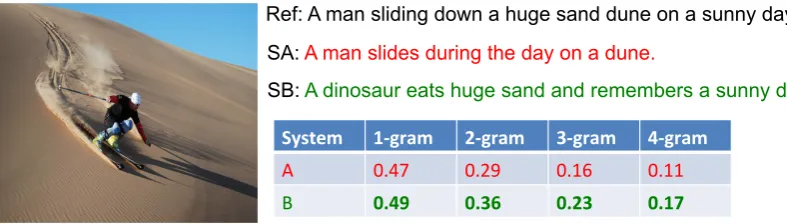
tion and obviating the agreement at the visual se-mantic level. These limitations are illustrated in Figure 1.
Vedantam et al. (2014) have proposed to ad-dress these limitations by making use of a Term Frequency Inverse Document Frequency (TF-IDF) that places higher weight on n-grams that fre-quently occur in the reference sentence describing an image, while reducing the influence of popular words that are likely to be less visually informa-tive.
In this paper, we consider a different alterna-tive to overcome the limitations of BLEU and ROUGE metrics, by introducing a novel approach specifically tailored to evaluate systems for im-age caption generation. To do this, we first define a semantic representation for visually descriptive language, that allows measuring to which extent an automatically generated caption of an image matches the underlying visual semantics of human authored captions.
To implement this idea we have augmented a subset of the Flickr-8K dataset (Nowak and Huiskes, 2010) with a visual semantic represen-tation, which we call Semantic Tuples (ST). This representation shares some similarity with the more standard PropBank (Kingsbury and Palmer, 2002) style Semantic Roles (SRL). However, SRL was designed to have high coverage of all the linguistic phenomena present in natural language sentences. In contrast, our ST representation is simpler and focuses on the aspects of the predi-cate structure that are most relevant for capturing the semantics of visually descriptive language.
This ST representation is then used to measure the agreement between the underlying semantics of an automatically generated caption and the se-mantics of the gold reference captions at differ-ent levels of granularity. We do this by aggregat-ing the STs from the gold captions and formaggregat-ing a Bag of Aggregated Semantic Tuples
Ref: A man sliding down a huge sand dune on a sunny day
SA: A man slides during the day on a dune.
SB: A dinosaur eats huge sand and remembers a sunny day.
System 1-‐gram 2-‐gram 3-‐gram 4-‐gram A 0.47 0.29 0.16 0.11
[image:2.595.95.489.65.177.2]B 0.49 0.36 0.23 0.17
Figure 1: The limitations of the BLEU evaluation metric: SAandSBare two automatically generated sentences that we wish to compare against the manually authoredRef. However, whileSBdoes not relate to the image, it obtains higher n-gram similarity thanSA, which is the basis of BLEU and ROUGE.
tation (BAST) that describes the image. We do the same for the automatically generated sentences and compute standard agreement metrics between the gold and predicted BAST. One of the appeals of the proposed metric is that it can be used not only to compare systems but also to do error anal-ysis and get a better understanding of the type of mistakes a system does.
In the experimental section we use the ST aug-mented portion of the Flickr-8K dataset (Flickr-ST) as a benchmark to evaluate two publicly avail-able pre-trained models of the Multimodal Recur-rent Neural Network proposed by (Vinyals et al., 2014) and (Karpathy and Fei-Fei, 2014) that gen-erate image captions directly from images. To compute BAST we need to predict STs for the automatically generated captions. This is sub-optimal because, ideally, we would like a metric that can be computed without human intervention. We therefore use the Flickr-ST dataset to train classifiers that predict STs from sentences. While this might add some noise to the evaluation, we show that the STs can be predicted from sentences with a reasonable accuracy and that they can be used as a good proxy for the human annotated STs.
In summary our main contributions are:
• A definition of a linguistic representation (the ST representation) that models the relevant semantics of visually descriptive language. • Using ST we propose a new approach to
eval-uate sentence generation systems that mea-sures caption-gold agreement with respect to the underlying visual semantics expressed in the reference captions.
• A new dataset (Flickr-ST) of captions aug-mented with corresponding semantic tuples.
• A new metric BAST (Bag of Aggregated Se-mantic Tuples) to compare systems. In ad-dition, this metric is useful to understand the types of errors made by the systems.
• A new fully automated metric that uses trained classifiers to predict STs for candidate sentences.
The rest of the paper is organized as follows: Section 2 presents the evaluation approach, in-cluding the proposed ST representation, the hu-man annotation process to produce a dataset of captions and STs and the proposed BAST met-ric computed over the ST representation. Sec-tion 3 describes in detail the proposed BAST met-ric. Section 4 describes the annotation process and the creation of the Flickr-ST dataset. Section 5 gives some details about the automatic sentence to ST predictors used to compute the (fully auto-matic) BAST metric. Section 6 discusses related work. Finally, Section 7 presents experiments us-ing the proposed metric to evaluate state-of-the-art Multimodal Recurrent Neural Networks for cap-tion generacap-tion.
2 Semantic Representation of Visually Descriptive Language
Participants (PA) Predicates (PR) Locatives (LO)
= {MAN} = {SLIDE} = {DUNE, DAY} <SLIDE, MAN, NULL, DUNE (Spatial)> <SLIDE, MAN, NULL, DAY (Temporal)>
Patient Agent
Predicate Locative
PA+PR PA+LO PR+LO
= {SLIDE-MAN}
= {MAN-DUNE, MAN-DAY} = {SLIDE-DUNE, SLIDE-DAY}
PA+PR+LO = {SLIDE-MAN-DUNE, SLIDE-MAN-DAY}
Arguments-Pairs
Arguments-Triplets Single-Arguments
Bag of Aggregated Semantic Tuples (BAST) Semantic Tuples (ST)
[image:3.595.73.271.68.238.2]Ref: A man sliding down a hugh sand dune on a sunny day
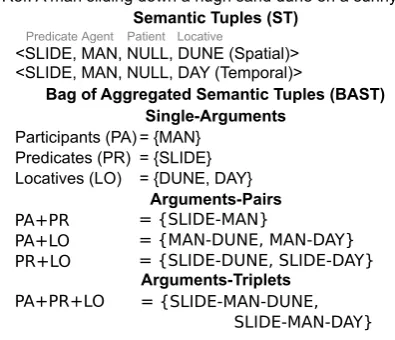
Figure 2: Bag of Aggregated Semantic Tuples.
In the second step of the evaluation we map the set of STs for the caption to a bag of arguments representation which we call BAST. Finally, we compare the BAST of the caption to that of the gold captions. The proposed metric allows us to measure the precision and recall of a system in predicting different components of the underlying visual semantics.
In order to define a useful semantic represen-tation of Visually Descriptive Language (VDL) (Gaizauskas et al., 2015) we follow a basic de-sign principle: we strive for the simplest represen-tation that can cover most of the salient informa-tion encoded in VDL and that will result in annota-tions that are not too sparse. The last requirement means that in many cases we will prefer to map two slightly different visual concepts to the same semantic argument and produce a coarser seman-tic representation.
In contrast, the PropBank representation (SRL) (Kingsbury and Palmer, 2002) is what we would call a fine-grained representation which was de-signed with the goal of covering a wide range of semantic phenomena, i.e. cover small variations in semantic content. Furthermore, the SRL represen-tation is designed so that it can represent the se-mantics of any natural language sentence whereas our representation focuses on covering the seman-tics present in VDL. Our definitions of semantic tuples are more similar to the proto-roles described by Dowty (1991).
Given an image caption we wish to generate a representation that captures the main underly-ing visual semantics in terms of the events or ac-tions (we call them predicates), who and what are
the participants (we call them agents and patients) and where or when is the action taking place (we call them locatives). For example, the caption “A brown dog is playing and holding a ball in a crowded park” would have the associated seman-tic tuple: [predicate =play; agent =dog; patient = null; locative =park] and [predicate =hold; agent = dog; patient = ball; locative = park]. We call each field of a tuple an argument; an argument consists of a semantic type and a set of values. For example the first argument of the first semantic tu-ple is a predicate with valueplay. Notice that argu-ments of type agent, patient and locative can take more than one value. For example: “A young girl and an old woman eat fruits and bread in a park on a sunny day” will have the associated semantic tu-ple: [predicate =eat; agent =girl, woman; patient =fruits, bread; locative =park, day].
Note also that we use italics to represent ar-gument values and distinguish them from vari-ables (over some well defined discrete domain) and words or phrases in the caption that we might regard as lexical evidence for that value. For ex-ample, the caption “A brown dog is playing and holding a ball in a crowded park” will have the as-sociated semantic tuple: [predicate =play; agent =dog; patient =null; locative =park]. The word associated with the predicateplayis playing, but play is a variable. In this case we are assuming that the domain for the predicate variable is the set of all lemmatized verbs.
A man sliding down a huge sand dune on a sunny day
A man slides during the day on a dune. A dinosaur eats huge sand and remembers a sunny day.
<Pr: SLIDE, Ag: MAN, Pa: NULL, Lo (S): DUNE> <Pr: SLIDE, Ag: MAN, Pa: NULL, Lo (T): DAY>
<Pr: EAT, Ag: DINOSAUR, Pa: SAND, Lo: NULL> <Pr: REMEMBER, Ag: DINOSAUR, Pa: DAY, Lo: NULL>
Participants (PA) Predicates (PR) Locatives (LO) PA+PR PA+LO PR+LO PA+PR+LO = {MAN} = {SLIDE} = {DUNE, DAY} = {SLIDE-MAN} = {MAN-DUNE, MAN-DAY} = {SLIDE-DUNE, SLIDE-DAY} = {SLIDE-MAN-DUNE, SLIDE-MAN-DAY} Participants (PA) Predicates (PR) Locatives (LO) PA+PR PA+LO PR+LO PA+PR+LO
= {DINOSAUR, SAND, DAY} = {EAT, REMEMBER} = {NULL}
= {EAT-DINOSAUR, REMEMBER-DAY, REMEMBER-DINOSAUR, EAT-SAND} = {DINOSAUR-NULL, SAND-NULL, DAY-NULL} = {EAT-NULL, DINOSAUR-NULL}
= {EAT-DINOSAUR-NULL, REMEMBER-DAY-NULL, EAT-SAND-NULL, REMEMBER-DINOSAUR-NULL} Step 1: Compute STs
Step 2: Compute BAST
Step 3: Compute Prec-Rec-F1 Metrics with respect to reference BAST
Par Pre Loc Mean
Prec Rec F1 1/1 1/1 1.0 1/1 1/1 1.0 2/2 2/2 1.0 1.0 1.0 1.0
Par Pre Loc Mean
Prec Rec F1 0/3 0/1 0.0 0/2 0/1 0.0 0/0 0/2 0.0 0.0 0.0 0.0
Par+Pre Pre+Loc Par+Loc Mean
Prec Rec F1 0/4 0/1 0.0 0/3 0/2 0.0 0/2 0/2 0.0 0.0 0.0 0.0
Par+Pre Pre+Loc Par+Loc Mean
[image:4.595.125.484.65.416.2]Prec Rec F1 1/1 1/1 1.0 2/2 2/2 1.0 2/2 2/2 1.0 1.0 1.0 1.0 Par+Pre+Loc Prec Rec F1 2/2 2/2 1.0 Par+Pre+Loc Prec Rec F1 0/4 0/2 0.0 Single-Arguments Arguments-Pairs Arguments-Triplets
Figure 3: Computation of the BAST metric.
3 The Bag of Semantic Tuples Metric
As mentioned earlier, our semantic representation is ‘coarser’ than PropBank style semantic role an-notations. Furthermore, there are two other im-portant differences: 1) We do not represent the se-mantics of atomic sentences but that of captions that might actually consist of multiple sentences, and 2) Our representation is truly semantic mean-ing that resolvmean-ing the argument value of a predi-cate might involve making logical inferences. For example we would annotate the caption: “A man is standing on the street. He is holding a camera” with [predicate = standing; agent = man; patient = null; locative = street] and [predicate = hold; agent =man; patient =null; locative =street]. This means that in contrast to the SRL representation, our semantic representation will not, in general, be ‘aligned’ with the syntax of the caption.
We now give a more detailed description of each argument type:
• ThePredicateis the main event described by
the sentence. We consider two types of pred-icates, those that describe an action and those that describe a state. Action predicates are in most cases expressed in the caption using verb-phrases. However, some action predi-cates might not be explicitly mentioned in the caption but can be naturally inferred. For ex-ample, the caption “A woman in a dark blue coat, cigarette in hand” would be annotated with the tuple: [predicate = hold; agent = woman; patient =cigarette; locative =null]. In the case that the predicate is indicating a state of being, there is typically a conjugation of the verb “to be”, i.e. is, are, was. For ex-ample: “A person is in the air on a bike near a body of water.”
as the crowds pass by” we have the predicate =sleepingwith agent =man, and predicate = passwith agent =crowd. In the case of predi-cates that describe a state of being such as “A person is in the air on a bike near a body of water”, we define the agent to be the answer to the question: Whose state is the predicate describing? Thus for the given example we would have agent =person.
• The Patient is the entity that undergoes a state of change or is affected by the agent per-forming some action. For example, the cap-tion “A woman in a dark blue coat, cigarette in hand.” would have: [patient =cigarette]. Unlike the predicate and agent, the patient is not always present, for example in “Two people run in the sand at the beach.” The patient is never present with state-of-being predicates as: “A person is in the air on a bike near a body of water”. When there is no pa-tient we say that the argument value isnull. • TheLocativeis defined as the answer to the
question: Where or When is the action tak-ing place? So there are two main types of locatives, spatial locatives such ason the wa-ter and temporal locatives such as at night. Spatial locatives in turn can be of different types, they can be scenes such as on-beach or they can express the relative location of the action with respect to a reference object such asunder-blanketin the caption “A man sleeping under the blanket”. The locatives are actually composed of two parts: a preposi-tion (if present), which expresses the tempo-ral or spatial situation, and the main object or scene. Locatives, like the patient, are not always present. Thus the locative might also take the valuenull.
We could also consider a richer semantic repre-sentation that includes modifiers of the arguments, for example for the caption: “A brown dog is play-ing and holdplay-ing a ball in a crowded park” we would have the associated semantic tuples: [pred-icate = play; agent = dog; agent-mod = brown patient = null; locative = park] and [predicate = hold; agent =dog; patient =ball; locative =park, locative-mod =crowded]. For the first version of the ST dataset, however, we opted for keeping the representation as simple as possible and decided not to annotate argument modifiers. One of the
reasons is that we observed that in most cases if we can properly identify the main arguments extract-ing their modifiers can be done automatically by looking at the syntactic structure of the sentence. For example if we can obtain a dependency parse tree for the reference caption, extracting the syn-tactic modifiers ofdogis relatively easy.
4 The Flickr-ST Dataset: Human Annotation of Semantic Tuples
We believe that one of the main reasons why most of the evaluations used to measure caption genera-tion performance involve computing surface met-rics is that until now there was no dataset anno-tated with underlying semantics.
To address this limitation we decided to create a new dataset of images annotated with semantic tuples as described in the previous section. Our dataset has the advantage that every image is an-notated with both the underlying semantics in the form of semantic tuples and natural language cap-tions that constitute different lexical realizacap-tions of the underlying visual semantics. To create our dataset we used a subset of the Flickr-8K dataset with captions, proposed in (Hodosh et al., 2013). This dataset consists of 8,000 images of people and animals performing some action taken from Flickr, with five crowd-sourced descriptive cap-tions for each one. These capcap-tions are sought to be concrete descriptions of what can be seen in the image rather than abstract or conceptual de-scriptions of non-visible elements (e.g. people or street names, or the mood of the image).
We asked human annotators to annotate 250 im-age captions, corresponding to 50 imim-ages taken from the development set of Flickr-8K. In order to ensure the alignment between the information contained in the captions and their corresponding semantic tuples, annotators were not allowed to look at the referent image while annotating every caption.
To create the STs that we use for evaluation we first need to compute the argument values. We as-sume that we can compute a function that maps spans of text to argument variables, and we call this the grounding function. Currently, we use a very simple mapping from spans to argument val-ues: they map to lowercase lemmatized forms. Given the annotated data and a grounding func-tion, we refer to the process of computing argu-ment values for arguargu-ment spans as projecting the annotations.
With our approach for decoupling surface (i.e. argument spans) from semantics (argument val-ues) we can address some common problems in caption generation evaluation. The idea is sim-ple, we can use the same annotation with different grounding functions to get useful projections of the original annotation. One clear problem when evaluating caption generation systems is how to handle synonymity, i.e. the fact that two surface forms might refer to the same semantic concept. For example, if the reference caption is: “A boy is playing in a park”, the candidate caption: “A kid playing on the park” should not be penalized for using the surface form boy instead of kid. We can address this problem by building a grounding function that maps the argument span boy and the argument span kid to the same argument variable. We could automatically build such function using a thesaurus.
Another common problem when evaluating caption generation is the fact that the same vi-sual entity can be described with different levels of specificity. For example, for the previous refer-ence caption it is clear that “A person is playing in a park” should have a higher evaluation score than “A dog playing in a park”. This is because any hu-man reading the caption would agree that person is just a ‘coarser’ way of referring to the same entity. With our approach we could handle this problem by having a coarser grounding function that maps the argument span kid and the argument span per-son to the same argument valuehuman. The im-portant thing is that for any grounding function we can project the annotations and compute the eval-uation, thus we can analyze the performance of a system in different dimensions.
Our goal is to define an evaluation metric that measures the similarity between the STs of the ground-truth captions for an image and the STs of a generated image caption. We wish to define a
metric that is useful not only to compare systems, but also that allows for error analysis and some in-sight on the types of mistakes performed by any given system.
To do this we will first use the STs correspond-ing to the ground-truth captions to compute what we call a Bag of Aggregated Semantic Tuples rep-resentation (BAST). Figure 2 shows a reference caption and its corresponding STs and BAST. No-tice that for simplicity we show a single reference caption, in reality if there arekcaptions for an im-age, we will first compute the STs corresponding to all of them. The BAST representation is com-puted in the following manner:
1. For the locatives and predicate arguments compute the union of all the corresponding argument values appearing in any ST. For the patient and agent we will compute a single set which we refer to as theparticipantsset. We call this portion of the BAST the bag of single arguments representation.
2. We compute the same representation but now we look at pairs of argument val-ues, meaning: predicate+participant, partic-ipant+locative and predicate+locative. We call these the bag of argument pairs.
3. Similarly we can also compute a bag of argument triplets for predi-cate+participant+locative
We can also compute the BAST representation of an automatically generated caption. This can be done via human annotation of the caption’s STs or using a model that predicts STs from captions (such a model is described in the next section). Now if we have the ground-truth BAST and the BAST of the candidate caption we can compute standard precision, recall and F1 metrics over the different components of the BAST. More specif-ically, for the single argument component of the BAST we compute:
• Predicate-Recall: This is the number of pre-dicted predicates present in the BAST of the ground-truth captions that were also present in the BAST of the candidate caption.
• Predicate-F1: This is the standard metric, i.e. the harmonic mean of precision and re-call.
We can compute the same metrics for other guments and for argument pairs and triplets of ar-guments. Figure 3 shows an example of comput-ing the BAST evaluation metric for two captions.
5 Automatic Prediction of Semantic Tuples from Captions
To compute the BAST metric we need to have STs for the candidate captions, one option is to perform a human annotation. The problem is that collect-ing human annotations is an expensive and time consuming task. Instead we would prefer to have a fully automated metric. In our case that means that we need an automated way of generating STs for candidate captions. We show in this section that we can use the Flickr-ST dataset to train a model that maps captions to their underlying ST representation.
We would like to point out that while this task has some similarities to semantic-role labeling, it is different enough so that the STs can not be di-rectly derived from the output of an SRL system, in fact our model uses the output of an SRL sys-tem in conjunction with other lexical and syntactic features.
Our model exploits several linguistic features of the caption extracted with state-of-the-art tools. These features range from shallow part of speech tags to dependency parsing and semantic role la-beling(SRL). More specifically, we use the FreeL-ing lemmatizer (Carreras et al., 2004), Stanford part of speech(POS) tagger (Toutanova et al., 2003), TurboParser (Martins et al., 2013) for de-pendency parsing and Senna (Collobert et al., 2011) for semantic role labeling. We also tried using state-of-the art SRL system from Roth and Woodsend (2014), but we observed that Senna per-formed better on our dataset.
We extract the predicates by looking at the words tagged as verbs by the POS tagger. Then, the extraction of arguments for each predicate is resolved as a classification problem. More specifi-cally, for each detected predicate in a sentence we
Model 1 Model 2 Participants (PA) 0.967 0.865 Predicates (PR) 0.703 0.808 Locatives (LO) 0.793 0.819
PA-PR 0.884 0.812
PR-LO 0.779 0.723
PA-LO 0.849 0.757
[image:7.595.325.510.61.172.2]PA-PR-LO 0.815 0.704
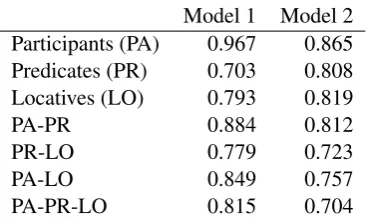
Table 1: F1 score of the automatic BAST extractor taking as reference the manually annotated tuples for the sentences generated by the two models.
regard each noun as a positive or negative training example of a given relation depending on whether the candidate noun is or is not an argument of the predicate. We use these examples to train an SVM that decides if a candidate noun is or is not an argu-ment of a given predicate in a given sentence. This classifier exploits several linguistic features com-puted over the syntactic path of the dependency tree connecting the candidate noun and the pred-icate and features of the predicted semantic roles of the predicate.
Table 1 shows the F1 of our predicted STs com-pared against manually annotated STs for the two caption generation systems that we evaluate in the experiments section.
6 Related Work
retrieval based on scene graphs (Johnson et al., 2015), where they model semantic representation of image content to retrieve semantically related images.
BLEU has been the most popular metric used for evaluation, its limitations when used in the context of evaluation of caption quality have been investigated in several works (Kulkarni et al., 2013; Elliott and Keller, 2013; Callison-Burch et al., 2006; Hodosh et al., 2013). Another com-mon metric is ROUGE which has been shown to have some weak correlation with human evalua-tions (Elliott and Keller, 2013). An alternative metric for caption evaluation is METEOR which seems to be better correlated with human evalua-tions than BLEU and ROUGE (Elliott and Keller, 2014). Recently a new consensus based metric was proposed by Vedantam et al. (2014), here, the main idea is to measure similarity of a caption to the majority of ground-truth reference captions. One of the limitations of metrics based on con-sensus is that they are better suited for cases when many ground-truth annotations exist for each im-age. We take a different approach, instead of aug-menting a dataset with more captions, we directly augment it with annotations which reflect what are the most relevant pieces of information in the available captions.
Hodosh et al. (2013) propose a different metric for evaluating image-caption ranking systems and it can not be directly applied to evaluate sentence generation systems (i.e. systems that output novel sentences).
7 Experiments
7.1 The evaluated models
The evaluated models are two instances of the Multimodal Recurrent Neural Network described in (Simonyan and Zisserman, 2014a) and (Karpa-thy and Fei-Fei, 2014), that takes an image and generates a caption. content of the image in natu-ral language).
This model addresses the caption generation task combining recent advances in Machine Trans-lation and Image Recognition: it combines a Convolutional Neural Network (CNN) initially trained to extract image features, and a Long Short Term Memory Recurrent Neural Network (RNN-LSTM), which is used as a Language Model con-ditioned by the image features to generate the cap-tions one word at a time.
Both networks can then be re-trained (or fine-tuned) together by back-propagation for the task of generating sentences. However, in this work we use the pre-trained models provided by Karpa-thy2for both the CNN and the RNN, which have
been trained sequentially. is fed by the features ex-tracted by the CNN during the training process).
The CNN used in our experiments is the 16-layer model described in (Simonyan and Zisser-man, 2014b), which achieves state-of-the-art re-sult in many image recognition tasks, provided by the authors of the paper, and we used the standard feature extraction procedure.
For the RNN-LSTM part, we have evaluated two models to generate two distinct sets of cap-tions that then could be evaluated using the BAST metric. The architecture is the same in both networks but one is trained using the Flickr-8K (LSTM-RNN-Flickr-Flickr-8K) train set, dubbed Model 1 in the rest of the paper, and the other is trained using MicrosoftCOCO (LSTM-RNN-MsCOCO) training set, dubbed Model 2. Both networks can be downloaded from the NeuralTalk project web-page. Results for the two models using the existing metrics3 can be seen in
Ta-ble 2; notice that our installation reproduces ex-actly these results (third row).
7.2 BAST Metric Results
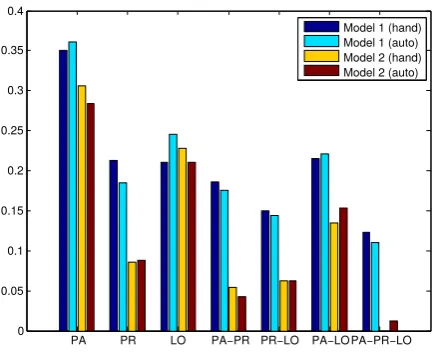
Figure 5 shows BAST scores for the two caption generation models, we show both results with the manually annotated STs and with the ones auto-matically predicted by the models. The first obser-vation is that the automatically generated STs are a good proxy for the human evaluation. For all ar-gument combinations, with the exception of loca-tives (where the differences between the two sys-tems are small) both the BAST computed from au-tomatic and manually annotated STs sort the two systems in the same way. Figure 4 shows some example images and generated captions with the extracted BAST tuples.
Another observation is that overall the numbers are quite low. Despite all the enthusiasm with the latest NN models for sentence generation the F1 of the system for locatives and predicates is quite 2We have used the open source project NeuralTalk https://github.com/karpathy/neuraltalk
which makes it easy to use different pre-trained models for each network.
3Evaluation metrics other than BAST have been
Dataset test RNN CIDEr Bleu 4 Bleu 3 Bleu 2 Bleu 1 ROUGE L METEOR MSCOCO* web ref. 0.666 0.220 0.317 0.461 0.646 0.469 0.205
MSCOCO* Model 1 0.146 0.068 0.127 0.253 0.448 0.341 0.128
MSCOCO* Model 2 0.666 0.220 0.317 0.461 0.646 0.469 0.205
[image:9.595.129.471.208.373.2]Flickr-ST Model 1 0.356 0.157 0.242 0.377 0.559 0.422 0.178 Flickr-ST Model 2 0.208 0.101 0.179 0.316 0.528 0.374 0.145
Table 2: Results with current metrics for the two models described in the text. MSCOCO* is the subset of MSCOCO used in the NeuralTalk reference experiments. The first row are the results reported in the NeuralTalk project web-site.
A dog is standing in the grass with a frisbee.
Model 1 A dog runs through the grass.<dog, run, grass> <dog, run, grass>
Manual annotation Automatic extraction Generated sentence
Model 2 <dog, stand, grass> <dog, be, {grass, frisbee}> <dog, stand, {grass, frisbee}> A dog chases a nerf ball in the grass.
A dog playing fetch in a green field.
A multicolor dog chasing after a ball across the grass. A dog chasing after a ball on the grass.
Wolf-like dog chasing white wiffle ball through a green
<{dog, ball}, chase, grass> <{dog, fetch}, play, field> <{dog, ball}, chase-after, grass> <{dog, ball}, chase-after, grass> <{dog, ball}, chase, field>
Gold captions Gold tuples
A bird is standing on a rock in the water.
Model 1 A dog jumps over a log. <dog, jump, log> <dog, jump, log>
Manual annotation Automatic extraction Generated sentence
Model 2 <bird, stand, {water, rock}>
<bird, be, {water, rock}> <bird stand, {water, rock}> A large white bird goes across the water.
A white bird is flying off the water surface.
A white bird is preparing to catch something in the water. The large white bird's reflection shows in the water. White bird walking across wet sand.
<bird, go, water> <bird, fly, water>
<{bird, something}, catch, water> <reflection, show, water> <bird, walk, sand>
Gold captions Gold tuples
Figure 4: Example results of the two caption generation systems and BAST tuples.
modest, below 25%. Of all the argument types the participants seem to be the easiest to predict for both models, followed by locatives and predicates. This is not surprising since object recognition is probably a more mature research problem in com-puter vision and state-of-the-art models perform quite well. Overall, however, it seems that caption generation is by no means a solved problem and that there is quite a lot of room for improvement.
8 Conclusion
In this paper we have studied the problem of rep-resenting the semantics of visually descriptive lan-guage. We defined a simple, yet useful, repre-sentation and a corresponding evaluation metric. With the proposed metric we can better quantify the agreement between the visual semantics ex-pressed in the gold captions and a generated cap-tion. We show that the metric can be implemented in a fully automatic manner by training models that can accurately predict the semantic represen-tation from sentences. To allow for an objective comparison of caption generation systems we cre-ated a new manually annotcre-ated dataset of images, captions and underlying visual semantics
repre-PA PR LO PA−PR PR−LO PA−LOPA−PR−LO
0 0.05 0.1 0.15 0.2 0.25 0.3 0.35 0.4
Model 1 (hand) Model 1 (auto) Model 2 (hand) Model 2 (auto)
[image:9.595.308.526.469.646.2]sentation by augmenting the widely used Flickr-8K dataset.
Our metric can be used to compare systems but, more importantly, we can use the metric to do a better error analysis. Another nice property of our approach, is that by decoupling the realization of a concept as a lexical item from the underlying vi-sual concept (i.e. the real world entity or event) our annotated corpus can be used to derive differ-ent evaluation metrics.
Acknowledgments
We thank the anonymous reviewers for their valu-able comments. This work was partly funded by the Spanish MINECO project RobInstruct TIN2014-58178-R and by the ERA-net CHIS-TERA project VISEN PCIN-2013-047.
References
Chris Callison-Burch, Miles Osborne, and Philipp Koehn. 2006. Re-evaluation the role of bleu in machine translation research. InEACL, volume 6, pages 249–256.
Xavier Carreras, Isaac Chao, Lluis Padró, and Muntsa Padró. 2004. Freeling: An open-source suite of lan-guage analyzers. InLREC.
Ronan Collobert, Jason Weston, Léon Bottou, Michael Karlen, Koray Kavukcuoglu, and Pavel Kuksa. 2011. Natural language processing (almost) from scratch. The Journal of Machine Learning Re-search, 12:2493–2537.
David Dowty. 1991. Thematic proto-roles and argu-ment selection. language, pages 547–619.
Desmond Elliott and Frank Keller. 2013. Image de-scription using visual dependency representations. InEMNLP, pages 1292–1302.
Desmond Elliott and Frank Keller. 2014. Comparing automatic evaluation measures for image descrip-tion. In Proceedings of the 52nd Annual Meeting of the Association for Computational Linguistics: Short Papers, volume 452, page 457.
Ali Farhadi, Mohsen Hejrati, Mohammad Amin Sadeghi, Peter Young, Cyrus Rashtchian, Julia Hockenmaier, and David Forsyth. 2010. Every pic-ture tells a story: Generating sentences from im-ages. InComputer Vision–ECCV 2010, pages 15– 29. Springer.
Robert Gaizauskas, Josiah Wang, and Arnau Ramisa. 2015. Defining visually descriptive language. In
Proceedings of the 2015 Workshop on Vision and Language (VL’15): Vision and Language Integra-tion Meets Cognitive Systems.
Micah Hodosh, Peter Young, and Julia Hockenmaier. 2013. Framing image description as a ranking task: Data, models and evaluation metrics.Journal of Ar-tificial Intelligence Research, pages 853–899. Justin Johnson, Ranjay Krishna, Michael Stark, Li-Jia
Li, David Shamma, Michael Bernstein, and Li Fei-Fei. 2015. Image retrieval using scene graphs. In
Proceedings of the IEEE Conference on Computer Vision and Pattern Recognition, pages 3668–3678. Andrej Karpathy and Li Fei-Fei. 2014. Deep
visual-semantic alignments for generating image descrip-tions.CoRR, abs/1412.2306.
Paul Kingsbury and Martha Palmer. 2002. From tree-bank to proptree-bank. InLREC. Citeseer.
Gaurav Kulkarni, Visruth Premraj, Vicente Ordonez, Sudipta Dhar, Siming Li, Yejin Choi, Alexander C Berg, and Tamara Berg. 2013. Babytalk: Under-standing and generating simple image descriptions.
Pattern Analysis and Machine Intelligence, IEEE Transactions on, 35(12):2891–2903.
Chin-Yew Lin and Eduard Hovy. 2003. Auto-matic evaluation of summaries using n-gram co-occurrence statistics. In Proceedings of the 2003 Conference of the North American Chapter of the Association for Computational Linguistics on Hu-man Language Technology-Volume 1, pages 71–78. Association for Computational Linguistics.
Tsung-Yi Lin, Michael Maire, Serge Belongie, James Hays, Pietro Perona, Deva Ramanan, Piotr Dollár, and C. Lawrence Zitnick. 2014. Microsoft COCO: common objects in context. CoRR, abs/1405.0312. André FT Martins, Miguel Almeida, and Noah A
Smith. 2013. Turning on the turbo: Fast third-order non-projective turbo parsers. In ACL (2), pages 617–622. Citeseer.
Stefanie Nowak and Mark J Huiskes. 2010. New strategies for image annotation: Overview of the photo annotation task at imageclef 2010. In
CLEF (Notebook Papers/LABs/Workshops), vol-ume 1, page 4. Citeseer.
Kishore Papineni, Salim Roukos, Todd Ward, and Wei-Jing Zhu. 2002. Bleu: a method for automatic evaluation of machine translation. InProceedings of the 40th annual meeting on association for compu-tational linguistics, pages 311–318. Association for Computational Linguistics.
Michael Roth and Kristian Woodsend. 2014. Com-position of word representations improves seman-tic role labelling. InProceedings of the 2014 Con-ference on Empirical Methods in Natural Language Processing (EMNLP), pages 407–413, Doha, Qatar, October.
Karen Simonyan and Andrew Zisserman. 2014b. Very deep convolutional networks for large-scale image recognition.CoRR, abs/1409.1556.
Kristina Toutanova, Dan Klein, Christopher D Man-ning, and Yoram Singer. 2003. Feature-rich part-of-speech tagging with a cyclic dependency network. InProceedings of the 2003 Conference of the North American Chapter of the Association for Computa-tional Linguistics on Human Language Technology-Volume 1, pages 173–180. Association for Compu-tational Linguistics.
Ramakrishna Vedantam, C Lawrence Zitnick, and Devi Parikh. 2014. Cider: Consensus-based image description evaluation. arXiv preprint arXiv:1411.5726.