A Regularized Compression Method To Unsupervised Word Segmentation
Ruey-Cheng Chen,Chiung-Min Tsai and Jieh Hsiang
National Taiwan University 1 Roosevelt Rd. Sec. 4
Taipei 106, Taiwan
[email protected] [email protected]
Abstract
Languages are constantly evolving through their users due to the need to communicate more efficiently. Under this hypothesis, we formulate unsupervised word segmentation as a regularized compression process. We re-duce this process to an optimization problem, and propose a greedy inclusion solution. Pre-liminary test results on the Bernstein-Ratner corpus and Bakeoff-2005 show that the our method is comparable to the state-of-the-art in terms of effectiveness and efficiency.
1 Introduction
Unsupervised word segmentation has been a popular research subject due to its close connection to lan-guage acquisition. It has attracted researchers from different communities, including linguistics, cogni-tive science, and machine learning, to investigate how human beings develop and harness their lan-guages, and, more importantly, how knowledge is acquired.
In this paper we propose a new formulation to the unsupervised word segmentation problem. Our idea is based on the observation that language evolves be-cause of the need to reduce communication efforts. For instance, new terminologies, abbreviations, and slang that carry complex semantics which cannot be efficiently expressed in the original languages are in-vented so that concepts can be conveyed. Such an evolution, we hypothesize, is limited to the extent where the evolved vocabulary exhibits similar com-plexity as the original one, in light of reducing the extra cost to pick up the new language. This process
is realized as an optimization problem called regu-larized compression, which gets this name from its analogy to text compression.
The rest of the paper is organized as follows. We briefly summarize related work on unsupervised word segmentation in Section 2. In Section 3, we in-troduce the proposed formulation. The iterative al-gorithm and other technical details for solving the optimization problem are covered in Section 4. In Section 5, we describe the evaluation procedure and discuss the experimental results. Finally, we present concluding remarks in Section 6.
2 Related Work
The past few years have seen many nonparametric Bayesian methods developed to model natural lan-guages. Many such applications were applied to word segmentation and have collectively reshaped the entire research field. Two most notable exam-ples are hierarchical Bayesian models and the min-imum description length principle. Our method fits in the latter category since we use this principle to optimize model parameters.
Hierarchical Bayesian methods were first in-troduced to complement conventional probabilistic methods to facilitate context-aware word generation. Goldwater et al. (2006) used hierarchical Dirichlet processes (HDP) to induce contextual word mod-els. Their approach was a significant improvement over conventional probabilistic methods, and has in-spired further explorations into more advanced hi-erarchical modeling techniques. Such examples in-clude the nested Pitman-Yor process (Mochihashi et al., 2009), a sophisticated installment for
cal modeling at both word and character levels, and adaptor grammars (Johnson and Goldwater, 2009), a framework that aligns HDP to probabilistic context-free grammars.
The minimum description length (MDL) princi-ple, originally developed in the context of infor-mation theory, was adopted in Bayesian statistics as a principled model selection method (Rissanen, 1978). Its connection to lexical acquisition was first uncovered in behavioral studies, and early ap-plications focused mostly on applying MDL to in-duce word segmentation that results in compact lex-icons (Kit and Wilks, 1999; Yu, 2000; Argamon et al., 2004). More recent approaches (Zhikov et al., 2010; Hewlett and Cohen, 2011) used MDL in com-bination with existing algorithms, such as branch-ing entropy (Tanaka-Ishii, 2005; Jin and Ishii, 2006) and bootstrap voting experts (Hewlett and Cohen, 2009), to determine the best segmentation parame-ters. On various benchmarks, MDL-powered algo-rithms have achieved state-of-the-art performance, sometimes even surpassing that of the most sophis-ticated hierarchical modeling methods.
3 Regularized Compression
3.1 Preliminaries
Consider that the unsegmented text consists ofK ut-terances and totally ofN characters. We denote the text as a sequence of characters c = hc1, . . . , cNi, as if conceptually concatenating all the K utter-ances into one string. The positions of all the ut-terance boundaries in c are represented as a set U = {u0 = 0, u1, . . . , uK}. In other words, the k-th utterance (k = 1, . . . , K) is stored as the sub-sequencehcuk
−1+1, . . . , cukiin
c.
A segmented text is denoted as a sequence of wordsw=hw1, w2, . . . , wMifor someM < N. It represents the same piece of text ascdoes. The word sequence w is said torespect the utterance bound-aries U if any word in the sequence does not span over two utterances. Unique elements in a charac-ter or word sequence implicitly define an alphabet set (or lexicon). Hereafter, we denote such alphabet sets forcandwasAcandAw, respectively.
3.2 Effects of Compression
Word segmentation results from compressing a se-quence of characters. By compression, we mean to replace the occurrences for some k-characters sub-sequencehc1, c2, . . . , ckiin the text with those for a new stringw =c1c2. . . ck (word). This procedure can be generalized to include more subsequences to be replaced, each with a different length. The result-ing sequence is a mixture of characters and words introduced during compression. For clarity, we use the termtoken sequenceto refer to such a mixed se-quence of characters or words.
Compression has a few effects to the token se-quence: (i) it increases the total number of tokens, (ii) it expands the alphabet set to include newly pro-duced tokens, (iii) it affects the entropy rate esti-mates. Note that, by seeing a token sequence as a series of outcomes drawn from some underlying stochastic process, we can estimate the entropy rate empirically.
Items (i) and (ii) are natural consequences of com-pression. The effort to describe the same piece of information gets reduced at the expense of ex-panding the vocabulary, and sometimes even chang-ing the usage. A real-life example for this is that language users invent new terminologies for effi-ciently conveying complex information. Item (iii) describes something more subtle. Observe that, when some n occurrences of a k-character subse-quence hc1, c2, . . . , cki get compressed, each char-acterci loses n occurrences, and totally nk occur-rences move away from the subsequence; as a result, the newly created wordwreceivesnoccurrences. It is clear that compression has this side effect of re-distributing probability masses among the observa-tions (i.e., characters), thereby causing deviation to entropy rate estimates.
3.3 Formulation
The choice of subsequences to be compressed is es-sential in the aforementioned process. We hypothe-size that a good choice has the following two prop-erties: (i) higher frequency, and (ii) low deviation in entropy rate.
collocations; compressing these subsequences re-sults in better compression rate. Second, deviation in entropy rate is reflected in vocabulary complex-ity, and we believe that it directly translates to efforts that language users pay to adapt to the new language. In this case, there seems no reason to believe that ei-ther increasing or decreasing vocabulary complexity is beneficial, since in two trivial “bad choices” that one can easily imagine, i.e., the text being fully seg-mented or unsegseg-mented, the entropy rates reach both extremes.
Motivated by these observations, we expect that the best word segmentation (i) achieves some prede-fined compression rate, and (ii) minimizes deviation in entropy rate. This idea is realized as an optimiza-tion problem, calledregularized compression. Con-ceptually, this problem is defined as:
minimize DV(c,w) subject to wrespectsU
||w|
|c| −ρ| ≤ǫ
(1)
where ρ denotes some expected compression ratio andǫdenotes the tolerance. Note that DV(c,w) =
|H˜(C) − H˜(W)| represents the deviation in en-tropy rate with respect to sequences c and w. In this definition, H˜(C) and H˜(W) denote the em-pirical entropy rates for random variables C ∈ Ac
and W ∈ Aw, estimated on the corresponding
se-quencescandw, respectively.
4 Iterative Algorithm
4.1 Ordered Ruleset
Acknowledging that exponentially many feasible word sequences need to be checked, we propose an alternative formulation in a restricted solution space. The idea is, instead of optimizing for segmentations, we search forsegmentation generators, i.e., a set of functions that generate segmentations from the in-put. The generators we consider here is theordered rulesets.
An ordered ruleset R = hr1, r2, . . . , rki is a se-quence of translation rules, each of which takes the following form:
w→c1c2. . . cn,
where the right-hand side (c1c2. . . cn) denotes the
n-token subsequence to be replaced, and the
left-hand side (w) denotes the new token to be intro-duced. Applying a translation ruler to a token se-quence has an effect of replacing all the occurrences for subsequencec1c2. . . cnwith those for tokenw.
Applying an ordered ruleset R to a token se-quence is equivalent to iteratively applying the trans-lation rules r1, r2, . . . , rk in strict order. Specifi-cally, consider that the initial token sequence is de-noted as c(0) and let the final result be denoted as c(k). By iterative application, we mean to repeat the following step fori= 1. . . k:
Apply ruleri toc(i−1) and save the result asc(i).
4.2 Alternative Formulation
This notion of ordered rulesets allows one to explore the search space efficiently using a greedy inclusion algorithm. The idea is to maintain a globally best ruleset B that covers the best translation rules we have discovered so far, and then iteratively expand Bby discovering new best rule and adding it to rule-set. The procedure repeats several times until the compression rate reaches some predefined ratioρ. In each iteration, the best translation rule is determined by solving a modified version of Equation (1), which is written as follows:
(In iterationi)
minimize α |c(i)|
|c(i−1)|+DV(
c(i−1),c(i)) subject to ris a rule
r(c(i−1)) =c(i) c(i)respectsU
(2)
Note that the alternative formulation is largely a greedy version of Equation (1) except a few minor changes. First, the compression rate constraint be-comes the termination condition in the greedy in-clusion algorithm. Second, we add an extra term
|c(i)|/|c(i−1)|to the objective to encourage early in-clusion of frequent collocations. The trade-off pa-rameterαis introduced in Equation (2) to scalarize both terms in the objective.
A brief sketch of the algorithm is given in the fol-lowing paragraphs.
2. Repeat the following steps for each i ∈ N, starting fromi= 1, until the compression rate reaches some predefined threshold.
(a) Find a rulerthat maximizes Equation (2) (b) Apply the rule r to form a new sequence
c(i)fromc(i−1). (c) Addrto the end ofB.
3. OutputB and the final sequence.
4.3 Implementation
Additional care needs to be taken in implementing Steps 2a and 2b. The simplest way to collectn-gram counts for computing the objective in Equation (2) is to run multiple scans over the entire sequence. Our experience suggests that using an indexing structure that keeps track of token positions can be more ef-ficient. This is especially important when updating the affectedn-gram counts in each iteration. Since replacing one occurrence for any subsequence af-fects only its surrounding n-grams, the total num-ber of such affected n-gram occurrences in one it-eration is linear in the number of occurrences for the replaced subsequence. Using an indexing struc-ture in this case has the advantage to reduce seek time. Note that, however, the overall running time remains in the same complexity class regardless of the deployment of an indexing structure. The time complexity for this algorithm isO(T N), whereTis the number of iterations andN is the length of the input sequence.
Although it is theoretically appealing to create an n-gram search algorithm, in this preliminary study we used a simple bigram-based implementation for efficiency. We considered only bigrams in creat-ing translation rules, expectcreat-ing that the discovered bigrams can grow into trigrams or higher-order n -grams in the subsequent iterations. To allow un-merged tokens (i.e., characters that was supposed to be in one n-gram but eventually left out due to bigram implementation) being merged into the dis-covered bigram, we also required that that one of the two participating tokens at the right-hand side of any translation rule has to be an unmerged to-ken. This has a side effect to exclude generation of collocation-based words1. It can be an issue in
cer-1
Fictional examples include “homework” or “cellphone”.
tain standards; on the test corpora we used, this kind of problems is not obvious.
Another constraint that we added to the imple-mentation is to limit the choice of bigrams to those has more frequency counts. Generally, the number of occurrence for any candidate bigram being con-sidered in the search space has to be greater or equal to some predefined threshold. In practice, we found little difference in performance for specifying any integer between 3 and 7 as the threshold; in this pa-per, we stick to 3.
5 Evaluation
5.1 Setup
We conducted a series of experiments to investi-gate the effectiveness of the proposed segmentation method under different language settings and seg-mentation standards. In the first and the second experiments, we focus on drawing comparison be-tween our method and state-of-the-art approaches. The third experiment focuses on the influence of data size to segmentation accuracy.
Segmentation performance is assessed using stan-dard metrics, such as precision, recall, and F-measure. Generally, these measures are reported only at word level; in some cases where further anal-ysis is called for, we report boundary-level and type-level measures as well. We used the evaluation script in the official HDP package to calculate these num-bers.
The reference methods we considered in the com-parative study include the following:
• Hierarchical Dirichlet process, denoted as HDP (Goldwater et al., 2009);
• Nested Pitman-Yor process, denoted as NPY (Mochihashi et al., 2009);
• Adaptor grammars, denoted as AG (Johnson and Goldwater, 2009);
• Branching entropy + MDL, denoted as Ent-MDL (Zhikov et al., 2010);
• Bootstrap voting experts + MDL, denoted as BVE-MDL (Hewlett and Cohen, 2011);
The proposed method is denoted as RC; it is also denoted as RC-MDL in a few cases where MDL is used for parameter estimation.
5.2 Parameter Estimation
There are two free parametersαandρin our model. The parameter α specifies the degree to which we favors high-frequency collocations when solving Equation (2). Experimentation suggests that α can be sensitive when set too low2. Practically, we rec-ommend optimizing α based on grid search on de-velopment data, or the MDL principle. The formula for calculating description length is not shown here; see Zhikov et al. (2010), Hewlett and Cohen (2011), and Rissanen (1978) for details.
The expected compression rate ρ determines when to stop the segmentor. It is related to the expected word length: When the compression rate
|c|/|w|reachesρand the segmentor is about to stop,
1/ρis the average word length in the segmentation. In this sense, it seemsρis somehow connected to the language of concern. We expect that optimal values learned on one data set may thus generalize on the other sets of the same language. Throughout the ex-periments, we estimated this value based on devel-opment data.
5.3 Evaluation on Bernstein-Ratner Corpus
We conducted the first experiment on the Bernstein-Ratner corpus (Bernstein-Bernstein-Ratner, 1987), a standard benchmark for English phonetic segmentation. We used the version derived by Michael Brent, which is made available in the CHILDES database (Brent and Cartwright, 1996; MacWhinney and Snow, 1990). The corpus comprises 9,790 utterances, which amount to 95,809 words in total. Its rel-atively small size allows experimentation with the most computational-intensive Bayesian models.
Parameter estimation for the proposed method has been a challenge due to the lack of appropriate de-velopment data. We first obtained a rough estimate for the compression rateρvia human inspection into the first 10 lines of the corpus (these 10 lines were later excluded in evaluation) and used that estimate to set up the termination condition. Since the first
2Informally speaking, whenα <H˜(
c). The analysis is not
covered in this preliminary study.
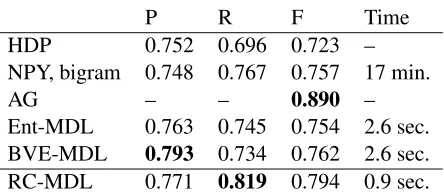
P R F Time
HDP 0.752 0.696 0.723 –
NPY, bigram 0.748 0.767 0.757 17 min.
AG – – 0.890 –
[image:5.612.317.539.58.156.2]Ent-MDL 0.763 0.745 0.754 2.6 sec. BVE-MDL 0.793 0.734 0.762 2.6 sec. RC-MDL 0.771 0.819 0.794 0.9 sec.
Table 2: Performance evaluation on the Bernstein-Ratner corpus. The reported values for each method indicate word precision, recall, F-measure and running time, re-spectively. The boldface value for each column indicates the top performer under the corresponding metric.
10 lines are too small to reveal any useful segmenta-tion cues other than the word/token rasegmenta-tion of interest, we considered this setting (“almost unsupervised”) a reasonable compromise. In this experiment, ρ is set to 0.37; the trade-off parameter α is set to 8.3, optimized using MDL principle in a two-pass grid search (the first pass over{1,2, . . . ,20}and the sec-ond over{8.0,8.1, . . . ,10.0}).
A detailed performance result for the proposed method is described in Table 1. A reference run for HDP is included for comparison. The pro-posed method achieved satisfactory result at word and boundary levels. Nevertheless, low type-level numbers (in contrast to those for HDP) together with high boundary recall suggested that we might have experienced over-segmentation.
P R F BP BR BF TP TR TF HDP, Bernstein-Ratner 0.75 0.70 0.72 0.90 0.81 0.85 0.64 0.55 0.59 RC-MDL, Bernstein-Ratner 0.77 0.82 0.79 0.85 0.92 0.89 0.57 0.48 0.50 RC, CityU training 0.75 0.79 0.77 0.89 0.93 0.91 0.63 0.35 0.45 RC, MSR training 0.73 0.82 0.77 0.86 0.96 0.91 0.70 0.26 0.38
Table 1: Performance evaluation for the proposed method across different test corpora. The first row indicates a reference HDP run (Goldwater et al., 2009); the other rows represent the proposed method tested on different test cor-pora. Columns indicates performance metrics, which correspond to precision, recall, and F-measure at word (P/R/F), boundary (BP/BR/BF), and type (TP/TR/TF) levels.
Corpus Training (W/T) Test (W/T) AS 5.45M / 141K 122K / 19K PKU 1.1M / 55K 104K / 13K CityU 1.46M / 69K 41K / 9K
MSR 2.37M / 88K 107K / 13K
Table 3: A short summary about the subsets in the Bakeoff-2005 dataset. The size of each subset is given in number of words (W) and number of unique word types (T).
5.4 Evaluation on Bakeoff-2005 Corpus
The second benchmark that we adopted is the SIGHAN Bakeoff-2005 dataset (Emerson, 2005) for Chinese word segmentation. The corpus has four separates subsets prepared by different research groups; it is among the largest word segmentation benchmarks available. Table 3 briefly summarizes the statistics regarding this dataset.
We decided to compare our algorithm with scription length gain (DLG), for that it seems to de-liver best segmentation accuracy among other un-supervised approaches ever reported on this bench-mark (Zhao and Kit, 2008). Since the reported values for DLG were obtained on another closed dataset Bakeoff-2006 (Levow, 2006), we followed a similar experimental setup as suggested in the liter-ature (Mochihashi et al., 2009): We compared both methods only on the training sets for the common subsets CityU and MSR. Note that this experimental setup departed slightly from that of Mochihashi et al. in that all the comparisons were strictly made on the training sets. The approach is more straightforward than the suggested sampling-based method.
Other baseline methods that we considered in-clude HDP, Ent-MDL, and BVE-MDL, for their representativeness in segmentation performance and
[image:6.612.92.281.204.273.2]CityU MSR RC,r = 0.65 0.770 0.774 DLG, ensemble 0.684 0.665 Ent-MDL,nmax= 3 0.798 0.795
Table 4: Performance evaluation on the common training subsets in the Bakeoff-2005 and Bakeoff-2006 datasets. The reported values are token F-measure. The boldface value in each column indicates the top performer for the corresponding set.
ease of implementation. The HDP implementation we used is a modified version of the offical HDP package3; we patched the package to make it work with Unicode-encoded Chinese characters. For Ent-MDL and BVE-Ent-MDL, we used the software pack-age4 distributed by Hewlett and Cohen (2011). We estimated the parameters using the AS training set as the development data. We setα to 6 based on a grid search. The expected compression rateρ that we learned from the development data is 0.65.
In Table 1, we give a detailed listing of vari-ous performance measures for the proposed method. Segmentation performance seems moderate at both word and boundary levels. Nevertheless, high type precision and low type recall on both CityU and MSR training corpora signaled that our algorithm failed to discover most word types. This issue, we suspect, was caused by exclusion of low-frequency candidate bigrams, as discussed in Section 4.3.
Table 4 summarizes the result for word segmen-tation conducted on the CityU and MSR subsets of Bakeoff-2005. Due to practical computational lim-its, we were not able to run HDP and BVE-MDL on any complete subset. The result shows that our
3
http://homepages.inf.ed.ac.uk/sgwater/ 4
[image:6.612.337.517.206.259.2]0.0 0.2 0.4 0.6 0.8 1.0
0.0
0.2
0.4
0.6
0.8
1.0
Data size in percentage
F−measure
[image:7.612.316.523.87.276.2]F BF TF
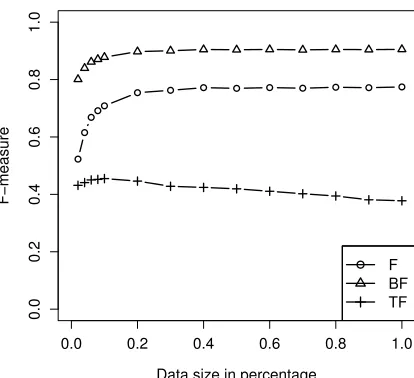
Figure 1: Performance evaluation for the proposed method on the CityU training set.
CityU-1k MSR-1k
RC,r= 0.65 0.505 0.492
HDP, 10 sample average 0.591 0.623
RC,r= 0.65/punc. 0.599 0.591
Table 5: Performance evaluation on two random samples from the common sets (CityU and MSR subsets) in the Bakeoff-2005 and Bakeoff-2006 datasets.
algorithm outperforms DLG by 8 to 10 percents in F-measure, while Ent-MDL still performs slightly better, achieving the top performance among all the experimental runs on both subsets.
To compare with HDP, we conducted another test run on top of a random sample of 1,000 lines from each subset. We chose 1,000 lines because HDP can easily consume more than 4GB of main memory on any larger sample. We adopted standard settings for HDP: α0 = 3,000, α1 = 300, and pb = 0.2. In each trial run, we ran the Gibbs sampler for 20,000 iterations using simulated annealing (Goldwater et al., 2009). We obtained 10 samples from the Gibbs sampler and used the average performance in com-parison. It took slightly more than 50 hours to col-lect one trial run on one subset.
The evaluation result is summarized in Table 5. We ran our algorithm to the desired compression ratio r = 0.65 on this small sample. The result
0.0 0.2 0.4 0.6 0.8 1.0
0.0
0.2
0.4
0.6
0.8
1.0
Data size in percentage
F−measure
[image:7.612.73.287.87.276.2]F BF TF
Figure 2: Performance evaluation for the proposed method on the MSR training set.
shows that the performance of regularized compres-sion is inferior to that of HDP by 9 to 13 percents in F-measure for both sets. To investigate why, we looked into the segmentation output. We observed that, in the regularized compression output, most of the punctuation marks were incorrectly aligned to their neighboring words, owing to the short of fre-quency counts in this small sample. The HDP, how-ever, does not seem to suffer from this issue.
We devised a simple post-processing step, in which each punctuation mark was forced segmented from the surrounding text. Another outside test was conducted to see how well the algorithm works us-ing heuristics derived from minimal domain knowl-edge. The additional run is denoted as RC/punc. The result is shown in Table 5. From the result, we found that the combined approach works slightly better than HDP in one corpus, but not in the other.
5.5 Effects of Data Size
We employed the third experiment to study the influ-ence of corpora size to segmentation accuracy. Since the proposed method relies on empirical estimates for entropy rate to decide the word boundaries, we were interested in learning about how it responds to relatively low and high volume input.
MSR training sets. On each corpus, we took the first k% of data (in terms of utterances) and tested the proposed method against that subset; this test was repeated several times with different values fork. In this experiment, we chose the value for kfrom the set {2,4,6,8,10,20,30, . . . ,90,100}. The perfor-mance is evaluated using word, boundary, and type F-measures.
Figures 1 and 2 show the experiment results. Both figures revealed similar patterns for segmentation performance at different volume levels. Word F-measures for both corpora begin at roughly 0.52, climb up rapidly to 0.73 as the volume grows from 2% to 20%, and finally settle on some value around 0.77. Boundary F-measures for both corpora show a similar trend—a less steep increase before 20% from 0.80 to 0.89 followed by a plateau at around 0.93. Here, the result seems to suggest that estimating to-ken entropy rate using less than 20% of data might be insufficient for this type of text corpora. Further-more, since performance is saturated at such an early stage, it seems feasible to split the entire dataset into a number of folds (e.g., 5, in this case) and solve each fold individually in parallel. This technique may greatly enhance the run-time efficiency of the segmentor.
The patterns we observed for type F-measure tells another story. On both corpora, type F-measures do not seem to improve as data volume increases. On CityU corpora, type F-measure gradually increased from 0.42 to 0.48 and then slowly falling back to 0.45. On MSR corpora, type F-measure peaked at 0.45 when receiving 10% of data; after that it started decreasing, going all the way down to 0.37, even lower than the number 0.43 it received at the begin-ning. Our guess is that, at some early point (20%), the proposed method started to under-segment the text. We suspect that there is some deep con-nection between performance saturation and under-segmentation, since from the result they both begin at roughly the same level. Further investigation in this respect is needed to give out definitive explana-tions.
6 Concluding Remarks
Preliminary experimental results suggest that the regularized compression method, even only with
partial evidence, seems as effective as the state-of-the-art methods in different language settings. When paired with MDL criteria, regularized compression is comparable to hierarchical Bayesian methods and MDL-based algorithms in terms of segmentation ac-curacy and computational efficiency. Furthermore, regularized compression is less memory-demanding than the other approaches; thus, it scales more easily to large corpora for carrying out certain tasks such as segmenting historical texts written in ancient lan-guages, or preprocessing a large dataset for subse-quent manual annotation.
We have identified a number of limitations of reg-ular compression. First, the choice of candidate n -grams does not cover hapax legomena, i.e., words that occur only once in the corpus. At present, pre-cluding these low-frequency n-grams seems to be a necessary compromise due to our limited under-standing about the dynamics behind regular com-pression. Second, regularized compression does not work well with low volume data, since on smaller dataset the distribution of frequency counts is less precise. Third, the algorithm may stop identifying new word types at some point. We suspect that this is related to the choice ofn-gram, since in our im-plementation no two existing “words” can be aggre-gated into one. These issues shall be addressed in our future work.
Acknowledgments
We thank the anonymous reviewers for their valu-able comments. The research efforts described in this paper are supported under the National Tai-wan University Digital Archives Project (Project No. NSC-98-2631-H-002-005), which is sponsored by National Science Council, Taiwan.
References
Shlomo Argamon, Navot Akiva, Amihood Amir, and Oren Kapah. 2004. Efficient unsupervised recursive word segmentation using minimum description length. In Proceedings of the 20th international conference on Computational Linguistics, COLING ’04, Strouds-burg, PA, USA. Association for Computational Lin-guistics.
Michael R. Brent and Timothy A. Cartwright. 1996. Dis-tributional regularity and phonotactic constraints are useful for segmentation. InCognition, pages 93–125. Thomas Emerson. 2005. The second international
chi-nese word segmentation bakeoff. In Proceedings of the Fourth SIGHAN Workshop on Chinese Language Processing, volume 133. Jeju Island, Korea.
Sharon Goldwater, Thomas L. Griffiths, and Mark John-son. 2006. Contextual dependencies in unsupervised word segmentation. In Proceedings of the 21st In-ternational Conference on Computational Linguistics and the 44th annual meeting of the Association for Computational Linguistics, ACL-44, pages 673–680, Stroudsburg, PA, USA. Association for Computational Linguistics.
Sharon Goldwater, Thomas L. Griffiths, and Mark John-son. 2009. A bayesian framework for word segmen-tation: Exploring the effects of context. Cognition, 112(1):21–54, July.
Daniel Hewlett and Paul Cohen. 2009. Bootstrap voting experts. InProceedings of the 21st international jont conference on Artifical intelligence, IJCAI’09, pages 1071–1076, San Francisco, CA, USA. Morgan Kauf-mann Publishers Inc.
Daniel Hewlett and Paul Cohen. 2011. Fully unsuper-vised word segmentation with BVE and MDL. In Proceedings of the 49th Annual Meeting of the Asso-ciation for Computational Linguistics: Human Lan-guage Technologies: short papers - Volume 2, HLT ’11, pages 540–545, Stroudsburg, PA, USA. Associ-ation for ComputAssoci-ational Linguistics.
Zhihui Jin and Kumiko T. Ishii. 2006. Unsupervised seg-mentation of chinese text by use of branching entropy. InProceedings of the COLING/ACL on Main confer-ence poster sessions, COLING-ACL ’06, pages 428– 435, Stroudsburg, PA, USA. Association for Compu-tational Linguistics.
Mark Johnson and Sharon Goldwater. 2009. Improving nonparameteric bayesian inference: experiments on unsupervised word segmentation with adaptor gram-mars. InProceedings of Human Language Technolo-gies: The 2009 Annual Conference of the North Ameri-can Chapter of the Association for Computational Lin-guistics, NAACL ’09, pages 317–325, Stroudsburg, PA, USA. Association for Computational Linguistics. Chunyu Kit and Yorick Wilks. 1999. Unsupervised
learning of word boundary with description length gain. InCoNLL-99, pages 1–6, Bergen, Norway. Gina-Anne Levow. 2006. The third international chinese
language processing bakeoff: Word segmentation and named entity recognition. InProceedings of the Fifth SIGHAN Workshop on Chinese Language Processing, volume 117. Sydney: July.
Brian MacWhinney and Catherine Snow. 1990. The child language data exchange system: an update. Journal of child language, 17(2):457–472, June. Daichi Mochihashi, Takeshi Yamada, and Naonori Ueda.
2009. Bayesian unsupervised word segmentation with nested Pitman-Yor language modeling. In Proceed-ings of the Joint Conference of the 47th Annual Meet-ing of the ACL and the 4th International Joint Confer-ence on Natural Language Processing of the AFNLP: Volume 1 - Volume 1, ACL ’09, pages 100–108, Stroudsburg, PA, USA. Association for Computational Linguistics.
Jorma Rissanen. 1978. Modeling by shortest data de-scription. Automatica, 14(5):465–471, September. Kumiko Tanaka-Ishii. 2005. Entropy as an indicator of
context boundaries: An experiment using a web search engine. In Robert Dale, Kam-Fai Wong, Jian Su, and Oi Kwong, editors, Natural Language Process-ing IJCNLP 2005, volume 3651 ofLecture Notes in Computer Science, chapter 9, pages 93–105. Springer Berlin / Heidelberg, Berlin, Heidelberg.
Hua Yu. 2000. Unsupervised word induction using MDL criterion. InProceedings of the International Sympo-sium of Chinese Spoken Language Processing, Beijin, China.
Hai Zhao and Chunyu Kit. 2008. An empirical compar-ison of goodness measures for unsupervised chinese word segmentation with a unified framework. InThe Third International Joint Conference on Natural Lan-guage Processing (IJCNLP-2008).