Abu-MaTran at WMT 2014 Translation Task:
Two-step Data Selection and RBMT-Style Synthetic Rules
Raphael Rubino?, Antonio Toral†, Victor M. S´anchez-Cartagena?‡, Jorge Ferr´andez-Tordera?, Sergio Ortiz-Rojas?, Gema Ram´ırez-S´anchez?,Felipe S´anchez-Mart´ınez‡, Andy Way†
? Prompsit Language Engineering, S.L., Elche, Spain
{rrubino,vmsanchez,jferrandez,sortiz,gramirez}@prompsit.com
†NCLT, School of Computing, Dublin City University, Ireland
{atoral,away}@computing.dcu.ie
‡Dep. Llenguatges i Sistemes Inform`atics, Universitat d’Alacant, Spain
Abstract
This paper presents the machine trans-lation systems submitted by the Abu-MaTran project to the WMT 2014 trans-lation task. The language pair concerned is English–French with a focus on French as the target language. The French to En-glish translation direction is also consid-ered, based on the word alignment com-puted in the other direction. Large lan-guage and translation models are built us-ing all the datasets provided by the shared task organisers, as well as the monolin-gual data from LDC. To build the trans-lation models, we apply a two-step data selection method based on bilingual cross-entropy difference and vocabulary satura-tion, considering each parallel corpus in-dividually. Synthetic translation rules are extracted from the development sets and used to train another translation model. We then interpolate the translation mod-els, minimising the perplexity on the de-velopment sets, to obtain our final SMT system. Our submission for the English to French translation task was ranked second amongst nine teams and a total of twenty submissions.
1 Introduction
This paper presents the systems submitted by the Abu-MaTran project (runs named DCU-Prompsit-UA) to the WMT 2014 translation task for the English–French language pair. Phrase-based sta-tistical machine translation (SMT) systems were submitted, considering the two translation direc-tions, with the focus on the English to French di-rection. Language models (LMs) and translation
models (TMs) are trained using all the data pro-vided by the shared task organisers, as well as theGigawordmonolingual corpora distributed by LDC.
To train the LMs, monolingual corpora and the target side of the parallel corpora are first used individually to train models. Then the individ-ual models are interpolated according to perplex-ity minimisation on the development sets.
To train the TMs, first a baseline is built us-ing the News Commentary parallel corpus. Sec-ond, each remaining parallel corpus is processed individually using bilingual cross-entropy differ-ence (Axelrod et al., 2011) in order to sepa-rate pseudo in-domain and out-of-domain sen-tence pairs, and filtering the pseudo out-of-domain instances with the vocabulary saturation approach (Lewis and Eetemadi, 2013). Third, synthetic translation rules are automatically ex-tracted from the development set and used to train another translation model following a novel ap-proach (S´anchez-Cartagena et al., 2014). Finally, we interpolate the four translation models (base-line, in-domain, filtered out-of-domain and rules) by minimising the perplexity obtained on the de-velopment sets and investigate the best tuning and decoding parameters.
The reminder of this paper is organised as fol-lows: the datasets and tools used in our experi-ments are described in Section 2. Then, details about the LMs and TMs are given in Section 3 and Section 4 respectively. Finally, we evaluate the performance of the final SMT system according to different tuning and decoding parameters in Sec-tion 5 before presenting conclusions in SecSec-tion 6.
2 Datasets and Tools
We use all the monolingual and parallel datasets in English and French provided by the shared task organisers, as well as the LDCGigaword for the same languages1. For each language, a true-case
model is trained using all the data, using the train-truecaser.perlscript included in the MOSES tool-kit (Koehn et al., 2007).
Punctuation marks of all the monolingual and parallel corpora are then normalised using the scriptnormalize-punctuation.perlprovided by the organisers, before being tokenised and true-cased using the scripts distributed with the MOSES tool-kit. The same pre-processing steps are applied to the development and test sets. As development sets, we used all the test sets from previous years of WMT, from2008to2013(newstest2008-2013). Finally, the training parallel corpora are cleaned using the script clean-corpus-n.perl, keeping the sentences longer than 1 word, shorter than 80
words, and with a length ratio between sentence pairs lower than4.2 The statistics about the
cor-pora used in our experiments after pre-processing are presented in Table 1.
For training LMs we use KENLM (Heafield et al., 2013) and the SRILM tool-kit (Stolcke et al., 2011). For training TMs, we use MOSES (Koehn et al., 2007) version2.1withMGIZA++ (Och and Ney, 2003; Gao and Vogel, 2008). These tools are used with default parameters for our experiments except when explicitly said.
The decoder used to generate translations is MOSES using features weights optimised with MERT (Och, 2003). As our approach relies on training individual TMs, one for each parallel cor-pus, our final TM is obtained by linearly interpo-lating the individual ones. The interpolation of TMs is performed using the scripttmcombine.py, minimising the cross-entropy between the TM and the concatenated development sets from2008
to2012 (notednewstest2008-2012), as described in Sennrich (2012). Finally, we make use of the findings from WMT 2013 brought by the win-ning team (Durrani et al., 2013) and decide to use the Operation Sequence Model (OSM), based on minimal translation units and Markov chains over sequences of operations, implemented in MOSES
1LDC2011T07 English Gigaword Fifth Edition, LDC2011T10 FrenchGigaword Third Edition
2This ratio was empirically chosen based on words fertil-ity between English and French.
Corpus Sentences (k) Words (M) Monolingual Data – English
Europarl v7 2,218.2 59.9
News Commentary v8 304.2 7.4
News Shuffled 2007 3,782.5 90.2 News Shuffled 2008 12,954.5 308.1 News Shuffled 2009 14,680.0 347.0 News Shuffled 2010 6,797.2 157.8 News Shuffled 2011 15,437.7 358.1 News Shuffled 2012 14,869.7 345.5 News Shuffled 2013 21,688.4 495.2
LDC afp 7,184.9 869.5
LDC apw 8,829.4 1,426.7
LDC cna 618.4 45.7
LDC ltw 986.9 321.1
LDC nyt 5,327.7 1,723.9
LDC wpb 108.8 20.8
LDC xin 5,121.9 423.7
Monolingual Data – French
Europarl v7 2,190.6 63.5
News Commentary v8 227.0 6.5
News Shuffled 2007 119.0 2.7
News Shuffled 2008 4,718.8 110.3 News Shuffled 2009 4,366.7 105.3 News Shuffled 2010 1,846.5 44.8 News Shuffled 2011 6,030.1 146.1 News Shuffled 2012 4,114.4 100.8 News Shuffled 2013 9,256.3 220.2
LDC afp 6,793.5 784.5
LDC apw 2,525.1 271.3
Parallel Data
109Corpus 21,327.1 549.0 (EN)
[image:2.595.317.519.63.494.2]642.5 (FR) Common Crawl 3,168.5 76.0 (EN)82.7 (FR) Europarl v7 1,965.5 52.5 (EN)56.7 (FR) News Commentary v9 181.3 4.5 (EN)5.3 (FR) UN 12,354.7 313.4 (EN)356.5 (FR)
Table 1: Data statistics after pre-processing of the monolingual and parallel corpora used in our ex-periments.
and introduced by Durrani et al. (2011).
3 Language Models
The LMs are trained in the same way for both languages. First, each monolingual and parallel corpus is considered individually (except the par-allel version of Europarl and News Commentary) and used to train a5-gram LM with the modified Kneser-Ney smoothing method. We then interpo-late the individual LMs using the script compute-best-mixavailable with the SRILM tool-kit (Stol-cke et al., 2011), based on their perplexity scores on the concatenation of the development sets from
The final LM for French contains all the word sequences from 1 to 5-grams contained in the training corpora without any pruning. However, with the computing resources at our disposal, the English LMs could not be interpolated without pruning non-frequent n-grams. Thus, n-grams
withn∈[3; 5]with a frequency lower than2were
removed. Details about the final LMs are given in Table 2.
1-gram 2-gram 3-gram 4-gram 5-gram English 13.4 198.6 381.2 776.3 1,068.7 French 6.0 75.5 353.2 850.8 1,354.0 Table 2: Statistics, in millions ofn-grams, of the interpolated LMs.
4 Translation Models
In this Section, we describe the TMs trained for the shared task. First, we present the two-step data selection process which aims to (i) separateinand
[image:3.595.306.524.441.604.2]out-of-domain parallel sentences and (ii) reduce the total amount of out-of-domain data. Second, a novel approach for the automatic extraction of translation rules and their use to enrich the phrase table is detailed.
4.1 Parallel Data Filtering and Vocabulary Saturation
Amongst the parallel corpora provided by the shared task organisers, only News Commentary can be considered as in-domain regarding the de-velopment and test sets. We use this training corpus to build our baseline SMT system. The other parallel corpora are individually filtered us-ing bilus-ingual cross-entropy difference (Moore and Lewis, 2010; Axelrod et al., 2011). This data filtering method relies on four LMs, two in the source and two in the target language, which aim to model particular features of in and out-of-domain sentences.
We build the in-domain LMs using the source and target sides of the News Commentary paral-lel corpus. Out-of-domain LMs are trained on a vocabulary-constrained subset of each remaining parallel corpus individually using theSRILM tool-kit, which leads to eight models (four in the source language and four in the target language).3
3The subsets contain the same number of sentences and the same vocabulary asNews Commentary.
Then, for each out-of-domain parallel corpus, we compute the bilingual cross-entropy difference of each sentence pair as:
[Hin(Ssrc)−Hout(Ssrc)] + [Hin(Strg)−Hout(Strg)] (1)
where Ssrc and Strg are the source and the
tar-get sides of a sentence pair, Hin and Hout are
the cross-entropies of the in and out-of-domain LMs given a sentence pair. The sentence pairs are then ranked and the lowest-scoring ones are taken to train the pseudo in-domain TMs. However, the cross-entropy difference threshold required to split a corpus in two parts (pseudoin and out-of-domain) is usually set empirically by testing sev-eral subset sizes of the top-ranked sentence pairs. This method is costly in our setup as it would lead to training and evaluating multiple SMT systems for each of thepseudoin-domain parallel corpora. In order to save time and computing power, we consider onlypseudoin-domain sentence pairs those with a bilingual cross-entropy difference be-low 0, i.e. those deemed more similar to the in-domain LMs than to the out-of-domain LMs (Hin < Hout). A sample of the distribution of
scores for the out-of-domain corpora is shown in Figure 1. The resultingpseudoin-domain corpora are used to train individual TMs, as detailed in Ta-ble 3.
-4 -2 0 2 4 6 8 10
0 2k 4k 6k 8k 10k
Bilingual Cross-Entropy Difference
Sentence Pairs Common Crawl
Europarl 10^9 UN
Figure 1: Sample of ranked sentence-pairs (10k) of each of the out-of-domain parallel corpora with bilingual cross-entropy difference
The results obtained using the pseudo in-domain data show BLEU (Papineni et al., 2002) scores superior or equal to the baseline score. Only the Europarl subset is slightly lower than the baseline, while the subset taken from the109
size of this subset which is ten times larger than the one taken fromEuroparl. The last row of Ta-ble 3 shows the BLEUscore obtained after interpo-lating the fourpseudoin-domain translation mod-els. This system outperforms the best pseudo in-domain one by 0.5 absolute points.
Corpus Sentences (k) BLEUdev
Baseline 181.3 27.76
Common Crawl 208.3 27.73
Europarl 142.0 27.63
109Corpus 1,442.4 30.29
UN 642.4 28.91
[image:4.595.324.507.62.156.2]Interpolation - 30.78
Table 3: Number of sentence pairs and BLEU scores reported by MERT on English–French new-stest2013 for the pseudo in-domain corpora ob-tained by filtering the out-of-domain corpora with bilingual cross-entropy difference. The interpola-tion of pseudo in-domain models is evaluated in the last row.
After evaluating the pseudo in-domain parallel data, the remaining sentence pairs for each cor-pora are considered out-of-domain according to our filtering approach. However, they may still contain useful information, thus we make use of these corpora by building individual TMs for each corpus (in a similar way we built the pseudo in-domain models). The total amount of remaining data (more than33million sentence pairs) makes the training process costly in terms of time and computing power. In order to reduce these costs, sentence pairs with a bilingual cross-entropy dif-ference higher than10were filtered out, as we no-ticed that most of the sentences above this thresh-old contain noise (non-alphanumeric characters, foreign languages, etc.).
[image:4.595.91.271.155.250.2]We also limit the size of the remaining data by applying the vocabulary saturation method (Lewis and Eetemadi, 2013). For the out-of-domain sub-set of each corpus, we traverse the sentence pairs in the order they are ranked by perplexity differ-ence and filter out those sentdiffer-ence pairs for which we have seen already each 1-gram at least 10 times. Each out-of-domain subset from each par-allel corpus is then used to train a TM before inter-polating them to create thepseudoout-of-domain TM. The results reported by MERT obtained on thenewstest2013 development set are detailed in Table 4.
Mainly due to the sizes of the pseudo
out-of-Corpus Sentences (k) BLEUdev
Baseline 181.3 27.76
Common Crawl 1,598.7 29.84
Europarl 461.9 28.87
109Corpus 5,153.0 30.50
UN 1,707.3 29.03
Interpolation - 31.37
Table 4: Number of sentence pairs and BLEU scores reported by MERT on English–French newstest2013 for the pseudo out-of-domain pora obtained by filtering the out-of-domain cor-pora with bilingual cross-entropy difference, keep-ing sentence pairs below an entropy score of 10
and applying vocabulary saturation. The interpo-lation of pseudo out-of-domain models is evalu-ated in the last row.
domain subsets, the reported BLEU scores are higher than the baseline for the four individual SMT systems and the interpolated one. This latter system outperforms the baseline by 3.61 absolute points. Compared to the results obtained with the pseudo in-domain data, we observe a slight im-provement of the BLEU scores using the pseudo out-of-domain data. However, despite the com-paratively larger sizes of the latter datasets, the BLEU scores reached are not that higher. For in-stance with the109corpus, thepseudoin and
out-of-domain subsets contain1.4and5.1million sen-tence pairs respectively, and the two systems reach
30.3 and30.5 BLEU. These scores indicate that thepseudo in-domain SMT systems are more ef-ficient on the English–Frenchnewstest2013 devel-opment set.
4.2 Extraction of Translation Rules
A synthetic phrase-table based on shallow-transfer MT rules and dictionaries is built as follows. First, a set of shallow-transfer rules is inferred from the concatenation of thenewstest2008-2012 develop-ment corpora exactly in the same way as in the UA-Prompsit submission to this translation shared task (S´anchez-Cartagena et al., 2014). In sum-mary, rules are obtained from a set of bilingual phrases extracted from the parallel corpus after its morphological analysis and part-of-speech dis-ambiguation with the tools in the Apertium rule-based MT platform (Forcada et al., 2011).
extracted are compatible with the bilingual dic-tionary. Then, many different rules are generated from each bilingual phrase; each of them encodes a different degree of generalisation over the partic-ular example it has been extracted from. Finally, the minimum set of rules which correctly repro-duces all the bilingual phrases is found based on integer linear programming search (Garfinkel and Nemhauser, 1972).
Once the rules have been inferred, the phrase table is built from them and the original rule-based MT dictionaries, following the method by S´anchez-Cartagena et al. (2011), which was one of winning systems4 (together with two
on-line SMT systems) in the pairwise manual evalu-ation of the WMT11 English–Spanish translevalu-ation task (Callison-Burch et al., 2011). This phrase-table is then interpolated with the baseline TM and the results are presented in Table 5. A slight im-provement over the baseline is observed, which motivates the use of synthetic rules in our final MT system. This small improvement may be related to the small coverage of the Apertium dictionar-ies: the English–French bilingual dictionary has a low number of entries compared to more mature language pairs in Apertium which have around 20 times more bilingual entries.
System BLEUdev
Baseline 27.76
Baseline+Rules 28.06
Table 5: BLEU scores reported by MERT on English–French newstest2013 for the baseline SMT system standalone and with automatically extracted translation rules.
5 Tuning and Decoding
We present in this Section a short selection of our experiments, amongst 15+ different configura-tions, conducted on the interpolation of TMs, tun-ing and decodtun-ing parameters. We first interpolate the four TMs: the baseline, thepseudoin and out-of-domain, and the translation rules, minimising the perplexity obtained on the concatenated de-velopment sets from 2008 to 2012 (newstest2008-2012). We investigate the use of OSM trained on pseudoin-domain data only or using all the paral-lel data available. Finally, we make variations of 4No other system was found statistically significantly bet-ter using the sign test atp≤0.1.
the number ofn-bests used by MERT.
Results obtained on the development set new-stest2013 are reported in Table 6. These scores show that adding OSM to the interpolated trans-lation models slightly degrades BLEU. However, by increasing the number ofn-bests considered by MERT to 200-bests, the SMT system with OSM outperforms the systems evaluated previously in our experiments. Adding the synthetic translation rules degrades BLEU(as indicated by the last row in the Table), thus we decide to submit two sys-tems to the shared task: one without and one with synthetic rules. By submitting a system without synthetic rules, we also ensure that our SMT sys-tem is constrained according to the shared task guidelines.
System BLEUdev
Baseline 27.76
+pseudoin +pseudoout 31.93
+ OSM 31.90
+ MERT200-best 32.21
+ Rules 32.10
Table 6: BLEU scores reported by MERT on English–Frenchnewstest2013development set.
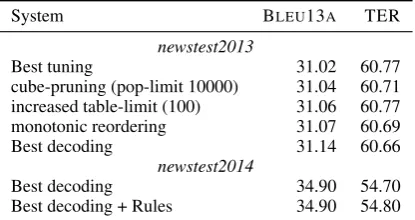
As MERT is not suitable when a large number of features are used (our system uses 19 fetures), we switch to the Margin Infused Relaxed Algo-rithm (MIRA) for our submitted systems (Watan-abe et al., 2007). The development set used is newstest2012, as we aim to select the best decod-ing parameters accorddecod-ing to the scores obtained when decoding thenewstest2013corpus, after de-truecasing and de-tokenising using the scripts dis-tributed with MOSES. This setup allowed us to compare our results with the participants of the translation shared task last year. We pick the de-coding parameters leading to the best results in terms of BLEUand decode the official test set of WMT14newstest2014. The results are reported in Table 7. Results onnewstest2013show that the de-coding parameters investigation leads to an over-all improvement of 0.1 BLEU absolute. The re-sults on newstest2014show that adding synthetic rules did not help improving BLEUand degraded slightly TER (Snover et al., 2006) scores.
[image:5.595.339.498.294.366.2]sys-System BLEU13A TER newstest2013
Best tuning 31.02 60.77
cube-pruning (pop-limit 10000) 31.04 60.71 increased table-limit (100) 31.06 60.77 monotonic reordering 31.07 60.69
Best decoding 31.14 60.66
newstest2014
Best decoding 34.90 54.70
Best decoding + Rules 34.90 54.80 Table 7: Case sensitive results obtained with our final English–French SMT system on new-stest2013 when experimenting with different de-coding parameters. The best parameters are kept to translate the WMT14 test set (newstest2014) and official results are reported in the last two rows.
tems are identical, except for the synthetic rules which are not extracted for the French→English direction. Tuning and decoding parameters for this latter translation direction are the best ones obtained in our previous experiments on this shared task. The case-sensitive scores obtained for French→English on newstest2014 are 35.0
BLEU13A and53.1 TER, which ranks us at the fifth position for this translation direction.
6 Conclusion
We have presented the MT systems developed by the Abu-MaTran project for the WMT14 trans-lation shared task. We focused on the French– English language pair and particularly on the English→French direction. We have used a two-step data selection process based on bilingual cross-entropy difference and vocabulary satura-tion, as well as a novel approach for the extraction of synthetic translation rules and their use to en-rich the phrase table. For the LMs and the TMs, we rely on training individual models per corpus before interpolating them by minimising perplex-ity according to the development set. Finally, we made use of the findings of WMT13 by including an OSM model.
Our English→French translation system was ranked second amongst nine teams and a total of twenty submissions, while our French→English submission was ranked fifth. As future work, we plan to investigate the effect of adding to the phrase table synthetic translation rules based on larger dictionaries. We also would like to study the link between OSM and the different decoding
pa-rameters implemented in MOSES, as we observed inconsistent results in our experiments.
Acknowledgments
The research leading to these results has re-ceived funding from the European Union Seventh Framework Programme FP7/2007-2013 under grant agreement PIAP-GA-2012-324414 (Abu-MaTran).
References
Amittai Axelrod, Xiaodong He, and Jianfeng Gao. 2011. Domain Adaptation Via Pseudo In-domain Data Selection. InProceedings of EMNLP, pages 355–362.
Chris Callison-Burch, Philipp Koehn, Christof Monz, and Omar Zaidan. 2011. Findings of the 2011 work-shop on statistical machine translation. In Proceed-ings of WMT, pages 22–64.
Nadir Durrani, Helmut Schmid, and Alexander Fraser. 2011. A Joint Sequence Translation Model with In-tegrated Reordering. In Proceedings of ACL/HLT, pages 1045–1054.
Nadir Durrani, Barry Haddow, Kenneth Heafield, and Philipp Koehn. 2013. Edinburgh’s Machine Trans-lation Systems for European Language Pairs. In
Proceedings of WMT, pages 112–119.
Mikel L Forcada, Mireia Ginest´ı-Rosell, Jacob Nord-falk, Jim O’Regan, Sergio Ortiz-Rojas, Juan An-tonio P´erez-Ortiz, Felipe S´anchez-Mart´ınez, Gema Ram´ırez-S´anchez, and Francis M Tyers. 2011. Apertium: A Free/Open-source Platform for Rule-based Machine Translation. Machine Translation, 25(2):127–144.
Qin Gao and Stephan Vogel. 2008. Parallel Implemen-tations of Word Alignment Tool. InSoftware Engi-neering, Testing, and Quality Assurance for Natural Language Processing, pages 49–57.
Robert S Garfinkel and George L Nemhauser. 1972.
Integer Programming, volume 4. Wiley New York.
Kenneth Heafield, Ivan Pouzyrevsky, Jonathan H. Clark, and Philipp Koehn. 2013. Scalable Mod-ified Kneser-Ney Language Model Estimation. In
Proceedings of ACL, pages 690–696.
[image:6.595.78.286.63.173.2]William D. Lewis and Sauleh Eetemadi. 2013. Dra-matically Reducing Training Data Size Through Vo-cabulary Saturation. InProceedings of WMT, pages 281–291.
Robert C. Moore and William Lewis. 2010. Intelligent Selection of Language Model Training Data. In Pro-ceedings of ACL, pages 220–224.
Franz Josef Och and Hermann Ney. 2003. A System-atic Comparison of Various Statistical Alignment Models.Computational Linguistics, 29:19–51. Franz Josef Och. 2003. Minimum Error Rate Training
in Statistical Machine Translation. InProceedings of ACL, volume 1, pages 160–167.
Kishore Papineni, Salim Roukos, Todd Ward, and Wei-Jing Zhu. 2002. BLEU: A Method for Automatic Evaluation of Machine Translation. InProceedings of ACL, pages 311–318.
V´ıctor M. Cartagena, Felipe S´anchez-Mart´ınez, and Juan Antonio P´erez-Ortiz. 2011. In-tegrating Shallow-transfer Rules into Phrase-based Statistical Machine Translation. In Proceedings of MT Summit XIII, pages 562–569.
V´ıctor M. S´anchez-Cartagena, Juan Antonio P´erez-Ortiz, and Felipe S´anchez-Mart´ınez. 2014. The UA-Prompsit Hybrid Machine Translation System for the 2014 Workshop on Statistical Machine Translation. InProceedings of WMT.
Rico Sennrich. 2012. Perplexity Minimization for Translation Model Domain Adaptation in Statisti-cal Machine Translation. InProceedings of EACL, pages 539–549.
Matthew Snover, Bonnie Dorr, Richard Schwartz, Lin-nea Micciulla, and John Makhoul. 2006. A Study of Translation Edit Rate with Targeted Human An-notation. InProceedings of AMTA, pages 223–231. Andreas Stolcke, Jing Zheng, Wen Wang, and Victor
Abrash. 2011. SRILM at Sixteen: Update and Out-look. InProceedings of ASRU.