Combining Task and Dialogue Streams in
Unsupervised Dialogue Act Models
Aysu Ezen-Can and Kristy Elizabeth Boyer Department of Computer Science
North Carolina State University aezen,[email protected]
Abstract
Unsupervised machine learning ap-proaches hold great promise for recog-nizing dialogue acts, but the performance of these models tends to be much lower than the accuracies reached by supervised models. However, some dialogues, such as task-oriented dialogues with parallel task streams, hold rich information that has not yet been leveraged within unsu-pervised dialogue act models. This paper investigates incorporating task features into an unsupervised dialogue act model trained on a corpus of human tutoring in introductory computer science. Exper-imental results show that incorporating task features and dialogue history fea-tures significantly improve unsupervised dialogue act classification, particularly within a hierarchical framework that gives prominence to dialogue history. This work constitutes a step toward building high-performing unsupervised dialogue act models that will be used in the next generation of task-oriented dialogue systems.
1 Introduction
Dialogue acts represent the underlying intent of ut-terances (Austin, 1975; Searle, 1969), and consti-tute a crucial level of representation for dialogue systems (Sridhar et al., 2009). The task of auto-matic dialogue act classification has been exten-sively studied for decades within several domains including train fares and timetables (Allen et al., 1995; Core and Allen, 1997; Crook et al., 2009; Traum, 1999), virtual personal assistants (Chen and Di Eugenio, 2013), conversational telephone speech (Stolcke et al., 2000), Wikipedia talk pages (Ferschke et al., 2012) and as in the case of this
paper, tutorial dialogue (Serafin and Di Eugenio, 2004; Forbes-Riley and Litman, 2005; Boyer et al., 2011; Dzikovska et al., 2013).
Most of the prior work on dialogue act classi-fication has depended on manually applying dia-logue act tags and then leveraging supervised ma-chine learning (Di Eugenio et al., 2010; Keizer et al., 2002; Reithinger and Klesen, 1997; Ser-afin and Di Eugenio, 2004). This process involves engineering a dialogue act taxonomy (or using an existing one, though domain-specific phenomena can be difficult to capture within multi-purpose di-alogue act taxonomies) and manually annotating each utterance in the corpus. Then, the tagged utterances are provided to a supervised machine learner. This supervised approach can achieve strong performance, in excess of 75% accuracy on manual tags, approaching the agreement level that is sometimes observed between human anno-tators (Sridhar et al., 2009; Serafin and Di Euge-nio, 2004; Chen and Di EugeEuge-nio, 2013).
However, the supervised approach has several major drawbacks, including the fact that hand-crafting dialogue act tagsets and applying them manually tend to be bottlenecks within the re-search and design process. To overcome these drawbacks, the field has recently seen growing momentum surrounding unsupervised approaches, which do not require any manual labels during model training (Crook et al., 2009; Joty et al., 2011; Lee et al., 2013). A variety of unsupervised machine learning techniques have been investi-gated for dialogue act classification, and each line of investigation has explored which features best support this goal. However, to date the best per-forming unsupervised models achieve in the range of 40% (Rus et al., 2012) to 60% (Joty et al., 2011) training set accuracy on manual tags, substantially lower than the mid-70% accuracy (Sridhar et al., 2009) often achieved on testing sets with super-vised models.
In order to close this performance gap between unsupervised and supervised techniques, we sug-gest that it is crucial to enrich the features available to unsupervised models. In particular, when a di-alogue is task-oriented and includes a rich source of information within a parallel task stream, these features may substantially boost the ability of an unsupervised model to distinguish dialogue acts. For example, in situated dialogue, features rep-resenting the state of the physical world may be highly influential for dialogue act modeling (Grosz and Sidner, 1986).
Human tutorial dialogue, which is the domain being considered in the current work, often ex-hibits this structure: the task artifact is external to the dialogue utterances themselves (in the case of our work, this artifact is a computer program that the student is constructing). Task features have already been shown beneficial for supervised di-alogue act classification in our domain (Ha et al., 2012). We hypothesize that including these task features within an unsupervised model will signif-icantly improve its performance. In addition, we hypothesize that including dialogue history as a prominent feature within an unsupervised model will provide significant improvement.
This paper represents the first investigation into combining task and dialogue features within an unsupervised dialogue act classification model. First, we discuss representation of these task fea-tures and dialogue structure feafea-tures, and compare these representations within both flat and hierar-chical clustering approaches. Second, we report on experiments that demonstrate that the inclusion of task features significantly improves dialogue act classification, and that a hierarchical cluster structure which explicitly captures dialogue his-tory performs best. Finally, we break down the model’s performance by dialogue act and investi-gate which features are most beneficial for distin-guishing particular acts. These contributions con-stitute a step toward building high-performing un-supervised dialogue act models that can be used in the next generation of task-oriented dialogue sys-tems.
2 Related Work
There is a rich body of work on dialogue act clas-sification. Supervised approaches for dialogue act classification aimed at improving performance by using several features such as dialogue structure
including position of the turn (Ferschke et al., 2012), speaker of an utterance (Tavafi et al., 2013), previous dialogue acts (Kim et al., 2010), lexical features such as words (Stolcke et al., 2000), syn-tactic features including part-of-speech tags (Ban-galore et al., 2008; Marineau et al., 2000), task-subtask structure (Boyer et al., 2010) acoustic and prosodic cues (Sridhar et al., 2009; Jurafsky et al., 1998), and body posture (Ha et al., 2012).
For the growing body of work in unsupervised dialogue act classification a subset of these fea-tures have been utilized. The words (Crook et al., 2009), topic words (Ritter et al., 2010), func-tion words (Ezen-Can and Boyer, 2013b), begin-ning portions of utterances (Rus et al., 2012), part-of-speech tags and dependency trees (Joty et al., 2011), and state transition probabilities in Markov models (Lee et al., 2013) are among the list of features investigated for unsupervised modeling of dialogue acts. However, the accuracies achieved by the best of these models are well below the ac-curacies achieved by supervised techniques. To improve performance of unsupervised models for task-oriented dialogue, utilizing a combination of task and dialogue features is a promising direction.
3 Corpus
The task-oriented dialogue corpus used in this work was collected in a computer-mediated hu-man tutorial dialogue study. Students (n = 42) and tutors interacted through textual dialogue within an online learning environment for intro-ductory Java programming (Ha et al., 2012). The students were novices, never having programmed in Java previously. The tutorial dialogue inter-face consisted of four windows, one describing the learning task, another where students wrote pro-gramming code, beneath that the output of either compiling or executing the program, and finally the textual dialogue window (Figure 1).
num-Figure 1: The tutorial dialogue interface with four windows.
ber of utterances (both tutor and student) per tutor-ing session was 116 (min = 70, max = 211). The average number of tutor utterances per session is 96 (min=44, max=156) whereas for students it is 39 (min=18, max=69) for the annotated set. The average number of words per utterance for stu-dents is 4.4 and for tutors it is 5.4. This annotated set is used in the current analysis for both training and testing where cross-validation is applied. As described later, a separate set containing 462 un-annotated utterances is used as a development set for determining the number of clusters.
The dialogue stream of this corpus was manu-ally annotated as part of previous work on super-vised dialogue act modeling which achieved 69% accuracy with Conditional Random Fields (Ha et al., 2012). A brief description of the student di-alogue act tags, which are the focus of the mod-els reported in this paper, is shown in Table 1. The most frequent dialogue act (A) constitutes the baseline chance (39.85%). In the current work, the manually applied dialogue act labels are not uti-lized during model training, but are only used for evaluation purposes as our models’ accuracies are reported for manual tags on a held-out test set.
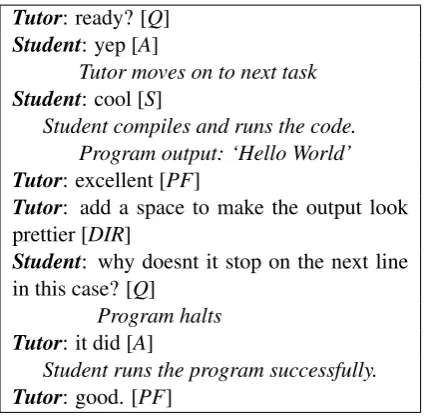
An excerpt from the corpus is shown in Table 2. Note that the current work focuses on classifying student dialogue act tags, since in an automated di-alogue system the tutor moves would be generated by the system and their dialogue acts tags would therefore be known.
4 Features
A key issue for dialogue act classification in task-oriented dialogue involves how to represent
dia-Student Dialogue Act Distribution
Answer (A) 39.85
Acknowledgement (ACK) 21.31
Statement (S) 21.20
Question (Q) 15.15
Request for Feedback (RF) 0.98
Clarification (C) 0.79
[image:3.595.74.291.60.231.2]Other (O) 0.61
Table 1: Student dialogue act tags and their fre-quencies.
Tutor: ready? [Q]
Student: yep [A]
Tutor moves on to next task
Student: cool [S]
Student compiles and runs the code. Program output: ‘Hello World’
Tutor: excellent [PF]
Tutor: add a space to make the output look prettier [DIR]
Student: why doesnt it stop on the next line in this case? [Q]
Program halts
Tutor: it did [A]
Student runs the program successfully.
[image:3.595.305.530.63.180.2]Tutor: good. [PF]
Table 2: Excerpt of dialogue from the corpus and the task action that follows utterances.
logue and task events. This section describes how features were extracted from the corpus of human tutorial dialogue.
We use three sets of features: lexical features, dialogue context features, and task features. The lexical and dialogue context features are extracted from the textual dialogue utterances within the corpus. The task features are extracted from the interaction traces within the computer-mediated learning environment and represent a keystroke-level log of events as students worked toward solv-ing the computer programmsolv-ing problems.
4.1 Lexical Features
[image:3.595.311.524.228.437.2]ad-dition to their ease of extraction, our prior work has shown that addition of part-of-speech tags and and syntax features did not significantly improve the accuracy of supervised dialogue act classifiers in this domain (Boyer et al., 2010), and these fea-tures can be time-consuming to extract in real time (Ha et al., 2012).
The choice to use word unigrams rather than higher ordern-grams is further facilitated by the fact that our clustering technique leverages the
longest common sub-sequence (LCS) metric to
measure distances between utterances. This met-ric counts shared sub-sequences of not-necessarily contiguous words (Hirschberg, 1975). In this way, the LCS metric provides a flexible way for n -grams and skip-n-grams to be treated as impor-tant units within the clustering, while the raw fea-tures themselves consist only of word unigrams. (We report on a comparison between LCS and bi-grams later in the discussion section.) Utilizing LCS, there exists a distance (1-similarity) value from each utterance to every other utterance.
4.2 Dialogue Context Features
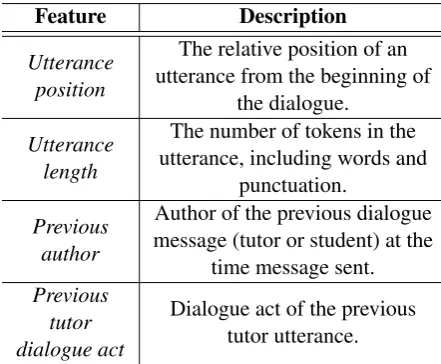
Based on previous work on a similar human tuto-rial dialogue corpus (Ha et al., 2012), we utilize four features that provide information about the di-alogue structure. These features are depicted in Table 3. Note that our goal within this work is to classifystudentdialogue moves, not tutor moves, because in a dialogue system the tutor’s moves are system-generated with associated known dialogue acts.
Feature Description
Utterance position
The relative position of an utterance from the beginning of
the dialogue. Utterance
length
The number of tokens in the utterance, including words and
punctuation. Previous
author
Author of the previous dialogue message (tutor or student) at the
time message sent. Previous
tutor dialogue act
[image:4.595.71.292.528.710.2]Dialogue act of the previous tutor utterance.
Table 3: Dialogue context features and their de-scriptions.
4.3 Task Features
As described previously, the corpus contains two channels of information: the dialogue utterances, from which the lexical and dialogue context fea-tures were extracted, and in addition, the task stream consisting of student problem-solving ac-tivities such as authoring code, compiling, and ex-ecuting the program. The programming activities of students were logged to a database along with all of the dialogue events during tutoring.
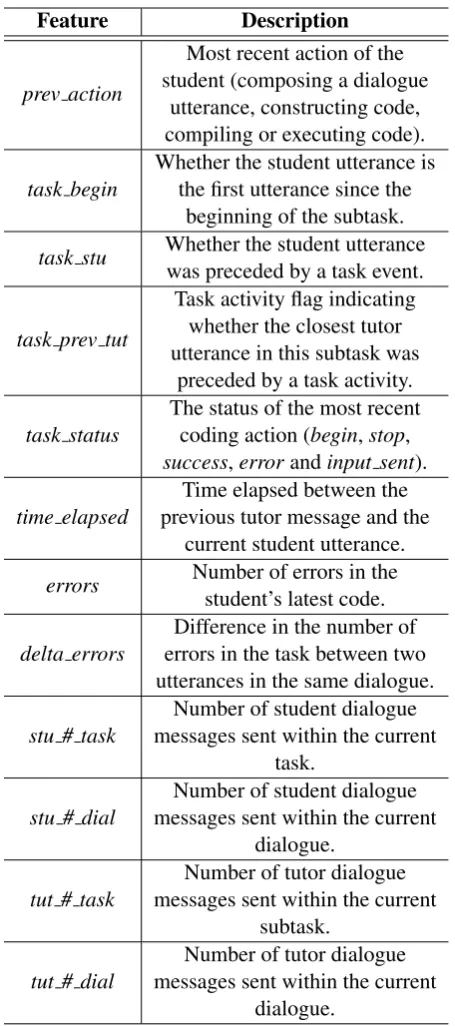
A set of task features was found to be impor-tant for dialogue act classification in this domain in prior work, including most recent programming action, status of the most recent task activity and task activity flag representing whether the utter-ance was preceded by a student’s task activity (Ha et al., 2012). We expand this set of features as shown in Table 4.
5 Experiments
The goal of this work is to investigate the im-pact of including task and dialogue context fea-tures on unsupervised dialogue act models. We hypothesize that incorporating task features will significantly improve the performance of an un-supervised model, and we also hypothesize that properly incorporating dialogue context features, which are at a different granularity than the lex-ical features extracted from utterances, will sub-stantially improve model accuracy.
5.1 Dialogue Act Modeling Withk-medoids Clustering
Feature Description
prev action
Most recent action of the student (composing a dialogue
utterance, constructing code, compiling or executing code).
task begin Whether the student utterance isthe first utterance since the beginning of the subtask. task stu Whether the student utterancewas preceded by a task event.
task prev tut
Task activity flag indicating whether the closest tutor utterance in this subtask was
preceded by a task activity.
task status The status of the most recentcoding action (begin,stop, success,errorandinput sent).
time elapsed previous tutor message and theTime elapsed between the current student utterance. errors Number of errors in thestudent’s latest code.
delta errors errors in the task between twoDifference in the number of utterances in the same dialogue.
stu # task messages sent within the currentNumber of student dialogue task.
stu # dial messages sent within the currentNumber of student dialogue dialogue.
tut # task messages sent within the currentNumber of tutor dialogue subtask.
[image:5.595.70.298.60.574.2]tut # dial messages sent within the currentNumber of tutor dialogue dialogue.
Table 4: Task features extracted from student com-puter programming activities.
2007) which selects the first seed randomly and then greedily chooses seeds that are farthest from the chosen seeds. The goal of using this approach in our application is to choose seeds from different dialogue acts so that the final model achieves good coverage. Our preliminary experiments demon-strated that this greedy seed selection combined with k-medoids outperforms other clustering ap-proaches including those utilized in our prior work
(Ezen-Can and Boyer, 2013a).
In order to select the number of clusters k, a subset of the corpus, constituting 25% of the full corpus (that were not tagged) composed of 462 utterances, was separated as a development set. First, we examined the coherence of clus-ters at different values ofkusing intra-cluster dis-tances. This technique involves identifying an ‘el-bow’ where the decrease in intra-cluster distance becomes less rapid (since adding more clusters can continue to decrease intra-cluster distance to the point of overfitting) (Figure 2). The graph sug-gests an elbow atk=5. Because there may be mul-tiple elbows in the intra-cluster distance, a sec-ond method utilizing Bayesian Information Crite-rion (BIC) was used which penalizes models as the number of parameters increases. The lower the BIC value, the better the model is, achieved atk=5
as well.
Figure 2: Intra-cluster distances with varying number of clusters.
Unlike many other investigations into unsuper-vised dialogue act classification, the current ap-proach reports accuracy on held-out test data, not on the data on which the model was trained. Even though the model training process does not utilize available manual tags, requiring the learned unsu-pervised model to perform well on held-out test data more closely mimics the broader goal of our work which is to utilize these unsupervised mod-els within deployed dialogue systems, where most utterances to be classified have never been encoun-tered by the model before.
[image:5.595.305.526.329.438.2]have served as a held-out test set (in our case, this results inn=42 folds). Within each fold, the clus-ters are learned during training and then for each utterance in the test set, its closest cluster is com-puted by taking the average distance of the test ut-terance to the elements in the cluster. The majority label of the closest cluster is assigned as the dia-logue act tag for the test utterance. If the assigned dialogue act tag matches the manual label of the test utterance, the utterance is counted as correct classification. The average accuracy is computed as the number of correct classifications divided by the total number of classifications.
5.2 Experimental Results
We conducted experiments with seven different feature combinations: L, lexical features only,
T, task features only, D, dialogue context tures only, and then the combinations of these fea-tures, T +D, T +L, D+L, andT +D+L. We hypothesized that the addition of task features would significantly improve the models’ accuracy. As shown in Table 5, adding task features to di-alogue context features significantly outperforms dialogue context features alone (T +D > D). Similarly, adding task features to lexical features provides significant improvement (T +L > L). However, adding task features to the dialogue con-text plus lexical features model does not provide benefit, and in fact slightly (not significantly) de-grades performance (T +D+L 6> D+L). As reflected by the Kappa scores, the test set perfor-mance attained by these models is hardly better than would be expected by chance.
Features Accuracy(%) Kappa
Flat
Clustering
L 33 0.02
T 37.7 0.07
D 37.6 0.07
T+D 39.1* 0.07
T+L 38* 0.06
D+L 38.3 0.07
[image:6.595.72.292.543.671.2]T+D+L 37.3 0.05
Table 5: Test set accuracies and Kappa for the flat clustering model (L: Lexical features, D: Dialogue context features, T: Task features) *indicates sta-tistically significant compared to the similar model without task features (p <0.05).
5.3 Utilizing Dialogue History
The importance of dialogue history, particularly the influence of the most recent turn on an upcom-ing turn, is widely recognized within dialogue re-search, notably by work on adjacency pairs (Sche-gloff and Sacks, 1973; Forbes-Riley et al., 2007; Midgley et al., 2009). Based on these findings, we hypothesized that dialogue history would be sub-stantially beneficial for unsupervised dialogue act models as it has been observed to be in numer-ous studies on supervised classification. However, as seen in the previous section, adding these di-alogue context features with equal weight to the model using Cosine distance only improved its performance slightly though statistically signifi-cantly (for example,T+D > T), while the overall performance is still barely above random chance.
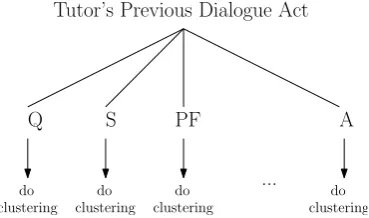
In an attempt to substantially boost the perfor-mance of the unsupervised dialogue act classi-fier, we experimented with a hierarchical cluster-ing structure in which the model first branches on the previous tutor move, and then the clustering models are learned as described previously at the leaves of the tree (Figure 3).
This branching approach results in some branches with too few utterances to train a multi-cluster model. To deal with this situation we set a threshold ofn=10utterances. For those subgroups with fewer than 10 utterances, we take a simple majority vote to classify test cases, and for those subgroups with10 or larger utterances we train a cluster model and use it to classify test cases. For the entire corpus, the number of utterances in each branch is presented in Table 6.
Tutor’s Previous Dialogue Act
Q S PF A
do clustering ...
do clustering do
clustering do
clustering
Figure 3: Branching student utterances according to previous tutor dialogue act.
[image:6.595.325.510.545.654.2]Tutor Dialogue
Act # of studentutterances
Q 818
S 464
H 125
PF 91
A 61
ACK 11
C 8
O 8
[image:7.595.82.281.62.215.2]RACK 6
Table 6: The number of student utterances after branching on the previous tutor dialogue act.
tutor dialogue act while branching. Branching on previous tutor move boosted the model’s accu-racy for student move dialogue act classification by approximately 30% accuracy across all feature sets, a difference that is statistically significant in every case. With the hierarchical model struc-ture, the best performance is achieved by includ-ing all three types of features: lexical, dialogue context and task. However, our hypothesis that task features would significantly improve the ac-curacy does not hold within the hierarchical clus-tering model (T+D6> DandT +L6> L).
Features Accuracy(%) Kappa
Hierarchical
T 64.2† 0.45
D 63.2† 0.46
L 60.7† 0.41
T+D 62.1† 0.44
T+L 63.3*† 0.45
D+L 63.6† 0.46
T+D+L 65*† 0.48
Table 7: Test set accuracies and Kappa for branch-ing on previous tutor dialogue act (L: Lexical tures, D: Dialogue context features, T: Task fea-tures) *indicates statistically significant compared to the similar model without task features and† in-dicates hierarchical clustering performing signifi-cantly better than flat with same features. (p <
0.05).
6 Discussion
The experimental results provide compelling ev-idence that an inclusive approach to features for
unsupervised dialogue act modeling holds great promise. However, we observed a stark difference in model performance when the tutor’s previous move was simply included as one of many features within a flat clustering model compared to when the previous tutor move was treated as a branch-ing feature. In this section we take a closer look and discuss the features that help distinguish par-ticular dialogue acts from each other.
[image:7.595.310.527.368.490.2]Using the hierarchicalT+D+Lmodel which performed best within the experiments, we exam-ine the confusion matrix (Figure 4). Statements and acknowledgments prove challenging for the model, 51.3% and 61.5% accuracy overall. More-over, these two tags are easily confused with each other: 29.7% of statements were misclassified as acknowledgments, while 21.2% of acknowl-edgments were misclassified as statements. The worst overall classification accuracy was for ques-tions (6%) and the best was achieved for answers (95.3%).
Figure 4: Confusion matrix for hierarchical model utilizing all features: T+D+L.
When we analyze the performance of different sets of features with respect to individual dialogue acts, some interesting results emerge. The anal-ysis shows that task features are especially good for classifying statements. Using only task fea-tures, the model correctly classified 61.8% state-ments, compared to the lower 51.3% accuracy that the overall best model (T +D+L) achieved on statements. When we consider the nature of the statement dialogue act within this corpus, we note that it is a large category that encompasses a vari-ety of utterances, some of which have lexical fea-tures in common with acknowledgments. In this case, task features are particularly helpful.
[image:7.595.72.290.449.575.2]ac-curacy) compared to the overall best performing model which achieved a slightly lower 61.5% ac-curacy on acknowledgments. Acknowledgments are another example of an act that may take am-biguous surface form; for example, in our cor-pus an utterance ‘yes’ appears as both an answer and an acknowledgment depending on its context. Therefore, higher level features such as the ones provided by task may be more helpful.
For questions, the highest performing feature set isL. However, as shown in Table 8, the model performed poorly on questions. Inspection of the models reveals that questions are varied in terms of structure throughout the corpus and it is hard to distinguish them from other dialogue acts. For in-stance there are two consequent utterances “i need a write statement” and “don’t i”, both of which are manually labeled as questions. However, in terms of the structure, the first utterance looks very sim-ilar to a statement and therefore the model has dif-ficulty grouping it with questions. Due to the large variety of question forms in the corpus, it is pos-sible that the clustering performed poorly on this dialogue act. In future work it will be promising to investigate the dialogue structures which produce questions and to weight them more in the feature set in order to increase performance of clustering for questions.
We performed one additional experiment to compare the performance of the LCS metric with bigrams. For bigrams, the average leave-one-student-out test accuracy was 25% with flat clus-tering compared to the lexical-only case using LCS (L) which reached 33%.
Features S A Q ACK
L 21.5 41.3 14.2 20.4
T 61.76 95.27 7.30 40.90
D 48.16 95.27 3.00 60.30
T+D 52.69 94.68 3.43 51.64
T+L 42.78 95.13 6.01 63.58
D+L 43.63 94.98 8.58 62.09
[image:8.595.72.289.533.647.2]T+D+L 51.27 95.27 6.01 61.49
Table 8: Accuracies for individual dialogue acts. Acts with fewer than 10 utterances after branching are omitted from the table.
7 Conclusion and Future Work
Dialogue act classification is crucial for dialogue management, and unsupervised modeling
ap-proaches hold great promise for automatically ex-tracting classification models from corpora. This paper has focused on unsupervised dialogue act classification for task-oriented dialogue, investi-gating the impact of task features and dialogue context features on model accuracy within both flat and hierarchical clusterings. Experimental results confirm that utilizing a combination of task and dialogue features improves accuracy and that incorporating one previous tutor move as a high-level branching feature a provides particu-larly marked benefit. Moreover, it was found that task features are particularly important for iden-tifying particular dialogue moves such as state-ments, for which the model with task features only outperformed the model with all features.
In addition to the task stream, future work should consider other sources of nonverbal cues such as posture, gesture and facial expressions to investigate the extent to which these can be suc-cessfully incorporated in unsupervised dialogue act models. Second, models that are built in spe-cialized ways to different user groups (e.g., by gender or by incoming skill level) should be inves-tigated. Finally, the performance of unsupervised dialogue act classification models must ultimately move toward evaluation within implemented dia-logue systems (Ezen-Can and Boyer, 2013a). The overarching goal of these investigations is to cre-ate unsupervised dialogue act models that perform well enough to be used within deployed dialogue systems and enable the system to respond success-fully. It is hoped that in the future, dialogue act classification models for many domains can be ex-tracted automatically from corpora of human dia-logue in those domains without the need for any manual annotation.
Acknowledgments
References
James F. Allen, Lenhart K. Schubert, George Ferguson, Peter Heeman, Chung Hee Hwang, Tsuneaki Kato, Marc Light, Nathaniel Martin, Bradford Miller, Massimo Poesio, et al. 1995. The TRAINS project: A case study in building a conversational planning
agent. Journal of Experimental & Theoretical
Arti-ficial Intelligence, 7(1):7–48.
David Arthur and Sergei Vassilvitskii. 2007. k-means++: The advantages of careful seeding. In
Proceedings of the 18th ACM-SIAM Symposium on Discrete Algorithms, pages 1027–1035. Society for Industrial and Applied Mathematics.
John Langshaw Austin. 1975.How To Do Things with
Words, volume 1955. Oxford University Press.
Srinivas Bangalore, Giuseppe Di Fabbrizio, and Amanda Stent. 2008. Learning the structure of
task-driven human–human dialogs. IEEE
Transac-tions on Audio, Speech, and Language Processing, 16(7):1249–1259.
Kristy Elizabeth Boyer, Eun Young Ha, Robert Phillips, Michael D. Wallis, Mladen A. Vouk, and James C. Lester. 2010. Dialogue act modeling in
a complex task-oriented domain. InProceedings of
SIGDIAL, pages 297–305. Association for Compu-tational Linguistics.
Kristy Elizabeth Boyer, Eun Young Ha, Robert Phillips, and James Lester. 2011. The impact of task-oriented feature sets on HMMs for dialogue
modeling. InProceedings of SIGDIAL, pages 49–
58. Association for Computational Linguistics.
Lin Chen and Barbara Di Eugenio. 2013. Multimodal-ity and dialogue act classification in the RoboHelper
project. In Proceedings of SIGDIAL, pages 183–
192.
Mark G. Core and James Allen. 1997. Coding dialogs
with the DAMSL annotation scheme. In
Proceed-ings of the AAAI Fall Symposium on Communicative Action in Humans and Machines, pages 28–35.
Nigel Crook, Ramon Granell, and Stephen Pulman. 2009. Unsupervised classification of dialogue acts
using a Dirichlet process mixture model. In
Pro-ceedings of SIGDIAL, pages 341–348. Association for Computational Linguistics.
Barbara Di Eugenio, Zhuli Xie, and Riccardo Serafin. 2010. Dialogue act classification, higher order
di-alogue structure, and instance-based learning.
Dia-logue & Discourse, 1(2):1–24.
Myroslava O. Dzikovska, Elaine Farrow, and Jo-hanna D. Moore. 2013. Combining semantic inter-pretation and statistical classification for improved explanation processing in a tutorial dialogue system. In Artificial Intelligence in Education, pages 279– 288.
Aysu Ezen-Can and Kristy Elizabeth Boyer. 2013a. In-context evaluation of unsupervised dialogue act
models for tutorial dialogue. InProceedings of
SIG-DIAL, pages 324–328.
Aysu Ezen-Can and Kristy Elizabeth Boyer. 2013b. Unsupervised classification of student dialogue acts
with query-likelihood clustering. In International
Conference on Educational Data Mining, pages 20– 27.
Oliver Ferschke, Iryna Gurevych, and Yevgen Chebo-tar. 2012. Behind the article: Recognizing dialog
acts in Wikipedia talk pages. InProceedings of the
13th Conference of the European Chapter of the As-sociation for Computational Linguistics, pages 777– 786.
Kate Forbes-Riley and Diane J. Litman. 2005. Us-ing bigrams to identify relationships between stu-dent certainness states and tutor responses in a
spo-ken dialogue corpus. In Proceedings of the
SIG-DIAL Workshop, pages 87–96.
Kate Forbes-Riley, Mihai Rotaru, Diane J. Litman, and Joel Tetreault. 2007. Exploring affect-context de-pendencies for adaptive system development. In
Human Language Technologies 2007: The Confer-ence of the North American Chapter of the Associa-tion for ComputaAssocia-tional Linguistics, pages 41–44.
Barbara J. Grosz and Candace L. Sidner. 1986.
Atten-tion, intentions, and the structure of discourse.
Com-putational Linguistics, 12(3):175–204.
Eun Young Ha, Joseph F. Grafsgaard, Christopher M. Mitchell, Kristy Elizabeth Boyer, and James C. Lester. 2012. Combining verbal and nonverbal features to overcome the ‘information gap’ in
task-oriented dialogue. In Proceedings of SIGDIAL,
pages 247–256.
Daniel S. Hirschberg. 1975. A linear space al-gorithm for computing maximal common
subse-quences. Communications of the ACM, 18(6):341–
343.
Shafiq Joty, Giuseppe Carenini, and Chin-Yew Lin. 2011. Unsupervised modeling of dialog acts in
asynchronous conversations. InProceedings of the
22nd International Joint Conference on Artificial In-telligence, pages 1807–1813.
Daniel Jurafsky, Elizabeth Shriberg, Barbara Fox, and Traci Curl. 1998. Lexical, prosodic, and
syn-tactic cues for dialog acts. In Proceedings of the
ACL/COLING-98 Workshop on Discourse Relations and Discourse Markers, pages 114–120.
Simon Keizer, Rieks op den Akker, and Anton Nijholt. 2002. Dialogue act recognition with Bayesian
net-works for Dutch dialogues. In Proceedings of the
Su Nam Kim, Lawrence Cavedon, and Timothy Bald-win. 2010. Classifying dialogue acts in
one-on-one live chats. In Proceedings of the 2010
Con-ference on Empirical Methods in Natural Language Processing, pages 862–871.
Donghyeon Lee, Minwoo Jeong, Kyungduk Kim, and Seonghan Ryu. 2013. Unsupervised spoken lan-guage understanding for a multi-domain dialog sys-tem. IEEE Transactions On Audio, Speech, and Language Processing, 21(11):2451–2464.
Johanna Marineau, Peter Wiemer-Hastings, Derek Har-ter, Brent Olde, Patrick Chipman, Ashish Karnavat, Victoria Pomeroy, Sonya Rajan, Art Graesser, Tutor-ing Research Group, et al. 2000. Classification of
speech acts in tutorial dialog. InProceedings of the
Workshop on Modeling Human Teaching Tactics and Strategies at the Intelligent Tutoring Systems Con-ference, pages 65–71.
T. Daniel Midgley, Shelly Harrison, and Cara Mac-Nish. 2009. Empirical verification of adjacency
pairs using dialogue segmentation. InProceedings
of SIGDIAL, pages 104–108.
Raymond Ng and Jiawei Han. 1994. Efficient and ef-fective clustering methods for spatial data mining. InProceedings of the 20th International Conference on Very Large Data Bases, pages 144–155.
Norbert Reithinger and Martin Klesen. 1997. Dia-logue act classification using language models. In
Proceedings of EuroSpeech, pages 2235–2238. Alan Ritter, Colin Cherry, and Bill Dolan. 2010.
Unsu-pervised modeling of twitter conversations. In
Pro-ceedings of the Association for Computational Lin-guistics, pages 172–180.
Vasile Rus, Cristian Moldovan, Nobal Niraula, and Arthur C. Graesser. 2012. Automated discovery of
speech act categories in educational games. In
Inter-national Conference on Educational Data Mining, pages 25–32.
Emanuel A. Schegloff and Harvey Sacks. 1973.
Open-ing up closOpen-ings. Semiotica, 8(4):289–327.
John R. Searle. 1969. Speech Acts: An Essay in
the Philosophy of Language. Cambridge University Press.
Riccardo Serafin and Barbara Di Eugenio. 2004.
FLSA: Extending latent semantic analysis with
fea-tures for dialogue act classification. InProceedings
of the 42nd Annual Meeting on Association for Com-putational Linguistics, pages 692–699. Association for Computational Linguistics.
Rangarajan Sridhar, Vivek Kumar, Srinivas Bangalore, and Shrikanth Narayanan. 2009. Combining lexi-cal, syntactic and prosodic cues for improved online
dialog act tagging. Computer Speech & Language,
23(4):407–422.
Andreas Stolcke, Klaus Ries, Noah Coccaro, Eliza-beth Shriberg, Rebecca Bates, Daniel Jurafsky, Paul Taylor, Rachel Martin, Carol Van Ess-Dykema, and Marie Meteer. 2000. Dialogue act modeling for automatic tagging and recognition of conversational
speech. Computational Linguistics, 26(3):339–373.
Maryam Tavafi, Yashar Mehdad, Shafiq Joty, Giuseppe Carenini, and Raymond Ng. 2013. Dialogue act recognition in synchronous and asynchronous
con-versations. InProceedings of SIGDIAL, pages 117–
121.
David R. Traum. 1999. Speech acts for dialogue
agents. In Foundations of Rational Agency, pages