Developing further speech recognition resources for Welsh
Sarah Cooper
Language Technologies Unit
Canolfan Bedwyr
Bangor University
[email protected]Dewi Bryn Jones
Language Technologies Unit
Canolfan Bedwyr
Bangor University
[email protected]Delyth Prys
Language Technologies Unit
Canolfan Bedwyr
Bangor University
[email protected]Abstract
This paper reports on ongoing research into developing large-vocabulary continuous speech recognition (LVCSR) for the Welsh language. We address data design issues and the method for data collection using a purposely designed application for mobile devices. We also discuss the application of the data including the design and collection of a small speech corpus to cov-er the commands used to control a robotic arm in Welsh on a Raspbcov-erry Pi computcov-er the li-censing of the project and our hopes for the application of the project resources to other lan-guages.
1
Introduction
This paper presents an overview of the GALLU (Gwaith Adnabod Lleferydd Uwch- IPA: [ɡaɬɨ], trans-lation: further speech recognition work) project to develop speech recognition technology for the Welsh language. Wales has a population of around 3 million people, of whom around 20% speak Welsh (Office for National Statistics, 2012). Lesser-resourced languages typically lag in digital inno-vation, including in language technologies. However since 2012, the Welsh Government has updated and revised a strategy for supporting Welsh-language technology. Emphasis is placed on “more tools and resources … to facilitate the use of Welsh, including in the digital environment” (Welsh Govern-ment, 2012: 45) and “the development of new Welsh-language software applications and digital ser-vices” (Welsh Government, 2013; 12). With funding from the Welsh Government and S4C (the Welsh language television channel), the GALLU project aims to develop speech recognition technology for the Welsh language. The resources will be available under a permissive open-source licence, and will therefore be available for use in a broad spectrum of platforms and devices, including voice control for smart televisions.
2
Previous speech technology for Welsh
Prior to the GALLU project, the most substantial work on Welsh speech technology was developed under the WISPR (Welsh and Irish Speech Processing Resources) project (Prys et al., 2004). Previous work on a diphone-based synthesiser (Williams, 1994; 1995) and also a small speech database for Welsh (Williams, 1999) was built upon by the WISPR project. An improved synthetic Welsh voice was developed as part of the WISPR project as well as an MSAPI interface to Festival for use in Mi-crosoft Windows environments (Bangor University Text to Speech, [no date]). Following the release of the WISPR resources under an open-source (BSD) licence, further work was facilitated to develop commercial Welsh voices by the Language Technologies Unit at Bangor University, by the Finnish company Bitlips (Bitlips Text to Speech, [no date]) and the Polish company Ivona (Ivona Text to Speech, [no date]). A “Basic Welsh speech recognition" (Bangor University, [no date]) project at the Language Technologies Unit at Bangor University in 2008-9 resulted in laboratory prototypes for a) a “command and control” application for a PC where applications could be launched by voice control and b) a simple voice-driven calculator. The GALLU project will build on this to develop further Welsh speech recognition resources.
3
Data design
The Welsh language has up to 29 consonants and a large number of vowels: up to 13 monophthongs and 13 diphthongs dependent on the variety (Awbery, 1984; Ball, 1984; Jones, 1984; Ball and Wil-liams, 2001; Mayr and Davies, 2011; amongst others). In order to collect the appropriate data to train an acoustic model within HTK ([no date]), a set of phonetically rich words has been designed for con-tributors to read aloud. In designing the prompt set it was important to ensure that a small number of prompts contain representations of all of the phonemes in the language. The WISPR project’s letter-to-sound rules were rewritten based on data mining from a lexicon, and a list of the most common letter-to-sounds and words was extracted from a text corpus. The final prompt set will contain approximately 200 prompts (8 words per prompt) covering all of the phonemes in the language which may be recorded by contributors across different sessions.
{"identifier": "sample1", "text": u"lleuad, melyn, aelodau, siarad, ffordd, ymlaen, cefnogaeth, Helen"}, {"identifier": "sample2", "text": u"gwraig, oren, diwrnod, gwaith, mewn, eisteddfod, disgownt, iddo"}, {"identifier": "sample3", "text": u"oherwydd, Elliw, awdurdod, blynyddoedd, gwlad, tywysog, llyw, uwch"},
{"identifier": "sample4", "text": u"rhybuddio, Elen, uwchraddio, hwnnw, beic, Cymru, rhoi, aelod"}, {"identifier": "sample5", "text": u"rhai, steroid, cefnogaeth, felen, cau, garej, angau, ymhlith"}, {"identifier": "sample6", "text": u"gwneud, iawn, un, dweud, llais, wedi, gyda, llyn"},
{"identifier": "sample7", "text": u"lliw, yng Nghymru, gwneud, rownd, ychydig, wy, yn, llaes"}, {"identifier": "sample8", "text": u"hyn, newyddion, ar, roedd, pan, llun, melin, sychu"},
{"identifier": "sample9", "text": u"ychydig, glin, wrth, Huw, at, nhw, bod, bydd"}
Example 1: Display prompts within the Paldaruo application
A large pronunciation lexicon will be developed and used for speech recognition. The next steps for the project involve further data collection and linguistic model development.
4
Data collection: crowdsourcing and the Paldaruo Application
A large number of speakers are required in order to train the acoustic model which forms the basis of the speech recognition system. Recruiting speakers to attend a recording session at a sound booth with recording software can prove expensive and time consuming. In attempting to tackle this issue, a crowdsourcing approach is being used as a method for collecting data. Crowdsourcing is a low-cost and efficient way of collecting speech data.
A mobile application “Paldaruo” (Welsh for “chattering”) has been developed for iOS and Android devices. Such devices, with inbuilt microphones and internet connectivity, provide a convenient mechanism for many volunteers to contribute speech corpus data. The app is optimised for ease of use in order to maximise potential contributions.
Each volunteer creates their own profile within the app providing metadata related to sex, age, lin-guistic characteristics and geographical background. Following this, the volunteers explicitly agree to their contributions being collected and used. The prompts, described above, are presented one at a time and the volunteer records each one individually. The recording is replayed and the volunteer verifies the quality or re-records. The user can stop and resume at any time. Prompts are provided to the volun-teer in a random order; completed prompts will be included in the corpus even if the user does not rec-ord the full set.
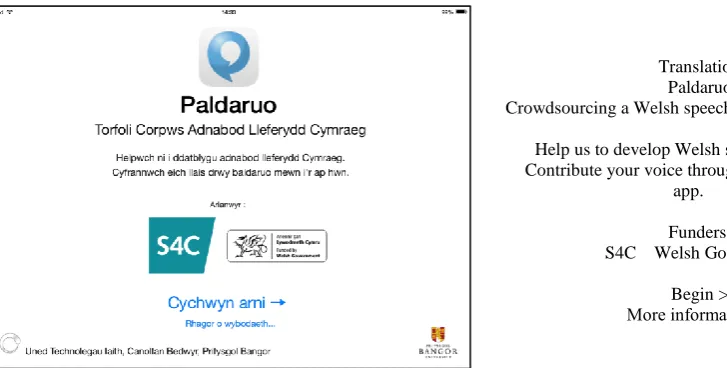
Translation: Paldaruo
Crowdsourcing a Welsh speech recognition corpus
Help us to develop Welsh speech recognition. Contribute your voice through nattering into this
app.
Funders: S4C Welsh Government
[image:3.595.80.444.74.258.2]Begin > More information…
Figure 1: Welcome screen in the Paldaruo App
The app was evaluated in a pilot application (see 5) and proved successful in obtaining a useful speech corpus from invited volunteers. However issues were highlighted with regards to background noise and recording volume levels. To address this, the app now includes background noise and volume lev-el checks.
The official media launch of the app, with the final prompt set, will take place on 7th July 2014. There will be television coverage on S4C with high-profile individuals including the First Minister of Wales and celebrities providing endorsements and appeals for volunteers.
5
Data Application
5.1 Pilot Data Application
To date a small pilot speech corpus has been collected with the Paldaruo app covering the phonemes that appear in a vocabulary to control a robotic arm. 20 speakers contributed to this corpus and record-ed 38 prompts (approx. 200 words) each, totalling around 4000 words. Certain commands, for instance ‘up’, exhibit dialect-dependent lexical variation, and in these cases every speaker recorded both re-gional forms.
Command: Translation: golau ymlaen light on
gafael agor grip open gafael cau grip close arddwrn i fyny / arddwrn lan wrist up arddwrn i lawr wrist down penelin i fyny / penelin lan elbow up penelin i lawr elbow down ysgwydd i fyny / ysgwydd lan shoulder up ysgwydd i lawr shoulder down troi i’r dde turn to the right troi i’r chwith turn to the left
Government’s aim to support initiatives aimed at encouraging and supporting young people to engage “in the digital world in a Welsh-language context” (Welsh Government, 2013: 14).
5.2 Licensing
GALLU will follow the successful strategy of the WISPR project in using permissive open-source li-censing. All outputs will be made available under the MIT licence (MIT, [No date]) which allows roy-alty-free use in both open-source and proprietary systems, including desktop computer software, web applications, mobile apps and embedded systems such as television set firmware.
This strategy allows the widest possible use of the project’s outputs, and the maximal availability of Welsh speech recognition technology.
5.3 Application to other languages
The authors hope other lesser-resourced languages can harness the project’s outputs and experience. The source code of the Paldaruo crowdsourcing app can easily be adapted for use in other languages. The process for developing the LVCSR system has been documented and will be published in the form of a tutorial. All project outputs, including the source code for the app, will be available under the MIT licence.
References
AonSquared. [No date]. Speech recognition using the Raspberry Pi [Online]. Available at: http://aonsquared.co.uk/raspi_voice_control [Accessed: 1 May 2014].
Bangor University [No date]. Bangor University Basic Welsh Speech Recognition Project [Online]. Available at: http://www.bangor.ac.uk/canolfanbedwyr/adllefsyl.php.en [Accessed: 1 May 2014].
Bangor University Text to Speech [No date] Festival Demo voice [Online]. Available at: http://www.e-gymraeg.org/siarad [Accessed: 1 May 2014].
Bitlips Text to Speeeh. [No date]. Welsh Text to Speech Demo [Online]. Available at: bitlips.fi/tts/demo-cy.cgi [Accessed: 1 May 2014].
Briony Williams. 1994. Diphone synthesis for the Welsh language. Proceedings of the 1994 International Con-ference on Spoken Language Processing, Yokohama, Japan:739-742.
Briony Williams. 1995. Text-to-speech synthesis for Welsh and Welsh English. Proceedings of Eurospeech 1995, Madrid, Spain, 2: 1113-1116.
Briony Williams. 1999. A Welsh speech database: preliminary results. Proceedings of Eurospeech 1999, Buda-pest, Hungary, 5: 2283-2286.
Delyth Prys, Briony Williams, Bill Hicks, Dewi Jones, Ailbhe Ní Chasaide, Christer Gobl, Julie Carson-Berndsen, Fred Cummins, Máire Ní Chiosáin, John McKenna, Rónán Scaife and Elaine Uí Dhonnchadha. 2004. SALTMIL Workshop at LREC 2004: First Steps in Language Documentation for Minority Languages.
Glyn E. Jones. 1984. The distinctive vowels and consonants of Welsh. In Martin J. Ball and Glyn E. Jones (eds.).
Welsh phonology: Selected readings. University of Wales Press, Cardiff, UK: 40-64.
Gwenllian M. Awbery. 1984. Phonotactic constraints in Welsh. In Martin J. Ball and Glyn E. Jones (eds.). Welsh phonology: Selected readings. University of Wales Press, Cardiff, UK. 65-104.
HTK. [No date]. Hidden Markov Toolkit [Online]. Available at: http://htk.eng.cam.ac.uk/ [Accessed: 1 May 2014].
Julius. [No date]. Open-Source Large Vocabulary CSR Engine Julius [Online]. Available at: http://julius.sourceforge.jp/en_index.php [Accessed: 1 May 2014].
Martin J. Ball and Briony Williams. 2001. Welsh phonetics. The Edwin Mellen Press, Lampeter, UK.
Martin J. Ball. 1984. Phonetics for phonology. In Martin J. Ball and Glyn E. Jones (eds.). Welsh phonology: Se-lected readings. University of Wales Press, Cardiff, UK.
MIT. [No date]. The MIT License [Online]. Available at: http://opensource.org/licenses/mit-license.html [Ac-cessed: 1 May 2014].
Office for National Statistics. 2012. 2011 Census: Welsh language profile, unitary authorities in Wales. Availa-ble at: http://www.ons.gov.uk/ons/rel/census/2011-census/key-statistics-for-unitary-authorities-in-wales/rft-table-ks208wa.xls [Accessed: 1 May 2014].
Robert Mayr and Hannah Davies. 2011. A cross-dialectal acoustic study of the monophthongs and diphthongs of Welsh. Journal of the International Phonetic Association, 41(1): 1-25.
Raspberry Pi Foundation. [No date]. What is a Raspberry Pi? [Online]. Available at: http://www.raspberrypi.org/help/what-is-a-raspberry-pi/ [Accessed: 1 May 2014].
Welsh Government. 2012. A living language, a language for living. Available at: http://wales.gov.uk/docs/dcells/publications/122902wls201217en.pdf [Accessed: 1 May 2014].