Preference Grammars and Soft Syntactic Constraints
for GHKM Syntax-based Statistical Machine Translation
Matthias Huck and Hieu Hoang and Philipp Koehn School of Informatics
University of Edinburgh 10 Crichton Street Edinburgh EH8 9AB, UK
{mhuck,hhoang,pkoehn}@inf.ed.ac.uk
Abstract
In this work, we investigate the effec-tiveness of two techniques for a feature-based integration of syntactic information into GHKM string-to-tree statistical ma-chine translation (Galley et al., 2004): (1.) Preference grammars on the tar-get language side promote syntactic well-formedness during decoding while also al-lowing for derivations that are not linguis-tically motivated (as in hierarchical trans-lation).(2.) Soft syntactic constraints aug-ment the system with additional source-side syntax features while not modifying the set of string-to-tree translation rules or the baseline feature scores.
We conduct experiments with a state-of-the-art setup on an English→German translation task. Our results suggest that preference grammars for GHKM trans-lation are inferior to the plain target-syntactified model, whereas the enhance-ment with soft source syntactic constraints provides consistent gains. By employ-ing soft source syntactic constraints with sparse features, we are able to achieve im-provements of up to 0.7 points BLEUand 1.0 points TER.
1 Introduction
Previous research in both formally syntax-based (i.e., hierarchical) and linguistically syntax-based statistical machine translation has demonstrated that significant quality gains can be achieved via integration of syntactic information as features in a non-obtrusive manner, rather than as hard con-straints.
We implemented two feature-based extensions for a GHKM-style string-to-tree translation sys-tem (Galley et al., 2004):
• Preference grammars to soften the hard target-side syntactic constraints that are im-posed by the target non-terminal labels.
• Soft source-side syntactic constraints that enhance the string-to-tree translation model with input tree features based on source syn-tax labels.
The empirical results on an English→German translation task are twofold. Target-side prefer-ence grammars do not show an improvement over the string-to-tree baseline with syntactified trans-lation rules. Source-side syntactic constraints, on the other hand, yield consistent moderate gains if applied as supplementary features in the string-to-tree setup.
2 Outline
The paper is structured as follows: First we give an overview of important related publications (Sec-tion 3). In Sec(Sec-tion 4, we review the fundamentals of syntax-based translation in general, and in par-ticular those of GHKM string-to-tree translation.
We present preference grammars for GHKM translation in Section 5. Our technique for ap-plying soft source syntactic constraints in GHKM string-to-tree translation is described in Section 6. Section 7 contains the empirical part of the pa-per. We first describe our experimental setup (7.1), followed by a presentation and discussion of the translation results (7.2). We conclude the paper in Section 8.
3 Related Work
Our syntactic translation model conforms to the GHKM syntax approach as proposed by Galley,
Hopkins,Knight, andMarcu (Galley et al., 2004) with composed rules as in (Galley et al., 2006) and (DeNeefe et al., 2007). Systems based on
this paradigm have recently been among the top-ranked submissions to public evaluation cam-paigns (Williams et al., 2014; Bojar et al., 2014).
Our soft source syntactic constraints features borrow ideas from Marton and Resnik (2008) who proposed a comparable approach for hierarchical machine translation. The major difference is that the features of Marton and Resnik (2008) are only based on the labels from the input trees as seen in tuning and decoding. They penalize violations of constituent boundaries but do not employ syntactic parse annotation of the source side of the training data. We, in contrast, equip the rules with latent source label properties, allowing for features that can check for conformance of input tree labels and source labels that have been seen in training.
Other groups have applied similar techniques to a string-to-dependency system (Huang et al., 2013) and—like in our work—a GHKM string-to-tree system (Zhang et al., 2011). Both Huang et al. (2013) and Zhang et al. (2011) store source labels as additional information with the rules. They however investigate somewhat different fea-ture functions than we do.
Marton and Resnik (2008) evaluated their method on the NIST Chinese→English and Arabic→English tasks. Huang et al. (2013) and Zhang et al. (2011) present results on the NIST Chinese→English task. We focus our attention on a very different task: English→German.
4 Syntax-based Translation
In syntax-based translation, a probabilistic syn-chronous context-free grammar (SCFG) is in-duced from bilingual training corpora. The par-allel training data is word-aligned and annotated with syntactic parses on either target side (string-to-tree), source side to-string), or both (tree-to-tree). A syntactic rule extraction procedure ex-tracts rules which are consistent with the word-alignment and comply with certain syntactic va-lidity constraints.
Extracted rules are of the formA,B→ hα,β,∼i. The right-hand side of the rulehα,βiis a bilingual phrase pair that may contain non-terminal sym-bols, i.e. α ∈(VF∪NF)+ and β ∈(VE∪NE)+, where VF and VE denote the source and target terminal vocabulary, and NF and NE denote the source and target non-terminal vocabulary, respec-tively. The non-terminals on the source side and on the target side of rules are linked in a
one-to-one correspondence. The ∼ relation defines this one-to-one correspondence. The left-hand side of the rule is a pair of source and target non-terminals,A∈NF andB∈NE.
Decoding is typically carried out with a parsing-based algorithm, in our case a customized version of CYK+ (Chappelier and Rajman, 1998). The parsing algorithm is extended to handle transla-tion candidates and to incorporate language model scores via cube pruning (Chiang, 2007).
4.1 GHKM String-to-Tree Translation
In GHKM string-to-tree translation (Galley et al., 2004; Galley et al., 2006; DeNeefe et al., 2007), rules are extracted from training instances which consist of a source sentence, a target sentence along with its constituent parse tree, and a word alignment matrix. This tuple is interpreted as a directed graph (thealignment graph), with edges pointing away from the root of the tree, and word alignment links being edges as well. A set of nodes (the frontier set) is determined that con-tains only nodes with non-overlapping closure of their spans.1 By computing frontier graph frag-ments—fragments of the alignment graph such that their root and all sinks are in the frontier set— the GHKM extractor is able to induce a minimal set of rules which explain the training instance. The internal tree structure can be discarded to ob-tain flat SCFG rules. Minimal rules can be assem-bled to build largercomposed rules.
Non-terminals on target sides of string-to-tree rules are syntactified. The target non-terminal vo-cabulary of the SCFG contains the set of labels of the frontier nodes, which is in turn a subset of (or equal to) the set of constituent labels in the parse tree. The target non-terminal vocabulary further-more contains an initial non-terminal symbol Q. Source sides of the rules are not decorated with syntactic annotation. The source non-terminal vo-cabulary contains a single generic non-terminal symbolX.
In addition to the extracted grammar, the trans-lation system makes use of a specialglue grammar
with aninitial rule,glue rules, afinal rule, andtop rules. The glue rules provide a fall back method to just monotonically concatenate partial deriva-tions during decoding. As we add tokens which
1Thespan of a node in the alignment graph is defined
mark the sentence start (“<s>”) and the sentence end (“</s>”), the rules in the glue grammar are of the following form:
Initial rule:
X,Q→
h
<s>X∼0,<s>Q∼0i
Glue rules:
X,Q→
h
X∼0X∼1,Q∼0B∼1i
for allB∈NE
Final rule:
X,Q→
h
X∼0</s>,Q∼0</s>i
Top rules:
X,Q→
h
<s>X∼0</s>,<s>B∼0</s>i
for allB∈NE
5 Preference Grammars
Preference grammars store a set of implicit label vectors as additional information with each SCFG rule, along with their relative frequencies given the rule. Venugopal et al. (2009) have introduced this technique for hierarchical phrase-based trans-lation. The implicit label set refines the label set of the underlying synchronous context-free gram-mar.
We apply this idea to GHKM translation by not decorating the target-side non-terminals of the extracted GHKM rules with syntactic labels, but with a single generic label. The (explicit) tar-get non-terminal vocabulary NE thus also con-tains only the generic non-terminal symbolX, just like the source non-terminal vocabularyNF. The extraction method remains syntax-directed and is still guided by the syntactic annotation over the target side of the data, but the syntactic labels are stripped off from the SCFG rules. Rules which differ only with respect to their non-terminal la-bels are collapsed to a single entry in the rule ta-ble, and their rule counts are pooled. However, the syntactic label vectors that have been seen with this rule during extraction are stored as implicit la-bel vectors of the rule.
5.1 Feature Computation
Two features are added to the log-linear model combination in order to rate the syntactic well-formedness of derivations. The first feature is similar to the one suggested by Venugopal et al. (2009) and computes a score based on the relative frequencies of implicit label vectors of those rules which are involved in the derivation. The second
feature is a simple binary feature which supple-ments the first one by penalizing a rule application if none of the implicit label vectors match.
We will now formally specify the first feature.2
We give a recursive definition of the feature score
hsyn(d)for a derivationd.
Let r be the top rule in derivation d, with n
right-hand side non-terminals. Let dj denote the sub-derivation ofdat the j-th right-hand side non-terminal of r, 1≤ j≤n. hsyn(d) is recursively
defined as
hsyn(d) =tˆsyn(d) +
∑
nj=1hsyn(dj). (1)
In this equation, ˆtsyn(d) is a simple auxiliary function:
ˆ
tsyn(d) =
(
logtsyn(d) iftsyn(d)6=0
0 otherwise (2)
Denoting with S the implicit label set of the preference grammar, we definetsyn(d) as a
func-tion that assesses the degree of agreement of the preferences of the current rule with the sub-derivations:
tsyn(d) =
∑
s∈Sn+1
p(s|r)·n
∏
+1k=2
ˆ
th(s[k]|dk−1)
! (3)
We use the notation[·]to address the elements of a vector. The first element of ann+1-dimensional vectorsof implicit labels is an implicit label bind-ing of the left-hand side non-terminal of the ruler.
p(s|r)is the preference distribution of the rule. Here, ˆth(Y|d)is another auxiliary function that renormalizes the values ofth(Y|d):
ˆ
th(Y|d) =∑ th(Y|d)
Y0∈Sth(Y0|d) (4)
It provides us with a probability that the derivation
d has the implicit labelY ∈Sas its root. Finally, the functionth(Y|d)is defined as
th(Y|d) =
∑
s∈Sn+1:s[1]=Y p(s|r)·
n+1
∏
k=2ph(s[k]|dk−1)
! .
(5) Note that the denominator in Equation (4) thus equalstsyn(d).
2Our notational conventions roughly follow the ones by
This concludes the formal specification of the first features. The second featurehauxSyn(d)
penal-izes rule applications in cases wheretsyn(d) evalu-ates to 0:
hauxSyn(d) =
(
0 iftsyn(d)6=0
1 otherwise (6)
Its intuition is that rule applications that do not contribute tohsyn(d)should be punished.
Deriva-tions with tsyn(d) = 0 could alternatively be dropped completely, but our approach is to avoid hard constraints. We will later demonstrate empir-ically that discarding such derivations harms trans-lation quality.
6 Soft Source Syntactic Constraints Similar to the implicit target-side label vectors which we store in preference grammars, we can likewise memorize sets of source-side syntactic la-bel vectors with GHKM rules. In contrast to pref-erence grammars, the rule inventory of the string-to-tree system remains untouched. The target non-terminals of the SCFG stay syntactified, and the source non-terminal vocabulary is not extended beyond the single generic non-terminal.
Source-side syntactic labels are an additional la-tent property of the rules. We obtain this property by parsing the source side of the training data and collecting the source labels that cover the source-side span of non-terminals during GHKM rule ex-traction. As the source-side span is frequently not covered by a constituent in the syntactic parse tree, we employ the composite symbols as suggested by Zollmann and Venugopal (2006) for the SAMT system.3In cases where a span is still not covered
by a symbol, we nevertheless memorize a source-side syntactic label vector but indicate the failure for the uncovered non-terminal with a special la-bel. The set of source label vectors that are seen with a rule during extraction is stored with it in the rule table as an additional property. This informa-tion can be used to implement feature-based soft source syntactic constraints.
Table 1 shows an example of a set of source label vectors stored with a grammar rule. The first element of each vector is an implicit source-syntactic label for the left-hand side non-terminal of the rule, the remaining elements are implicit
3Specifically, we applyrelax-parse - -SAMT 2as
implemented in the Moses toolkit (Koehn et al., 2007).
source label vector frequency
(IN+NP,NN,NN) 7
(IN+NP,NNP,NNP) 3
(IN++NP,NNS,NNS) 2
(IN+NP,NP,NP) 2
(PP//SBAR,NP,NP) 1
Table 1: The set of source label vec-tors (along with their frequencies in the training data) for the rule X,PP-MO → hbetweenX∼1andX∼0,zwischenNN∼0undNN∼1i. The overall rule frequency is 15.
source-syntactic labels for the right-hand side source non-terminals.
The basic idea for soft source syntactic con-straints features is to also parse the input data in a preprocessing step and try to match input labels and source label vectors that are associated with SCFG rules.
6.1 Feature Computation
Upon application of an SCFG rule, each of the non-terminals of the rule covers a distinct span of the input sentence. Aninput labelfrom the input parse may be available for this span. We say that a non-terminal has a matchin a given source la-bel vector of the rule if its lala-bel in the vector is the same as a corresponding input label over the span. We define three simple features to score matches and mismatches of the impicit source syn-tactic labels with the labels from the input data:
• A binary feature that fires if a rule is applied which possesses a source syntactic label vec-tor that fully matches the input labels. This feature rewards exact source label matches of complete rules, i.e., the existance of a vector in which all non-terminals of the rule have matches.
• A binary feature that fires if a rule is applied which does not possess any source syntactic label vector with a match of the label for the left-hand side non-terminal. This feature pe-nalizes left-hand side mismatches.
The second and third feature are less strict than the first one and give the system a more detailed clue about the magnitude of mismatch.
6.2 Sparse Features
We can optionally add a larger number of sparse features that depend on the identity of the source-side syntactic label:
• Sparse features which fire if a specific input label is matched. We say that the input la-bel is matchedin case the corresponding non-terminal that covers the span has a match in any of the source syntactic label vectors of the applied rule. We distinguish input label matches via left-hand side and via right-hand side non-terminals.
• Sparse features which fire if the span of a spe-cific input label is covered by a non-terminal of an applied rule, but the input label is not matched.
The first set of sparse features rewards matches, the second set of sparse features penalizes mis-matches.
All sparse features have individual scaling fac-tors in the log-linear model combination. We how-ever implemented a means of restricting the num-ber of sparse features by providing a core set of source labels. If such a core set is specified, then only those sparse features are active that depend on the identity of labels within this set. All sparse features for source labels outside of the core set are inactive.
7 Experiments
We empirically evaluate the effectiveness of preference grammars and soft source syntac-tic constraints for GHKM translation on the English→German language pair using the stan-dard newstest sets of the Workshop on Statisti-cal Machine Translation (WMT) for testing.4 The
experiments are conducted with the open-source
Mosesimplementations of GHKM rule extraction (Williams and Koehn, 2012) and decoding with CYK+ parsing and cube pruning (Hoang et al., 2009).
4http://www.statmt.org/wmt14/ translation-task.html
7.1 Experimental Setup
We work with an English–German parallel train-ing corpus of around 4.5 M sentence pairs (af-ter corpus cleaning). The parallel data origi-nates from three different sources which have been eligible for the constrained track of the ACL 2014 Ninth Workshop on Statistical Ma-chine Translation shared translation task: Europarl (Koehn, 2005), News Commentary, and the Com-mon Crawl corpus as provided on the WMT web-site. Word alignments are created by aligning the data in both directions with MGIZA++ (Gao and Vogel, 2008) and symmetrizing the two trained alignments (Och and Ney, 2003; Koehn et al., 2003). The German target side training data is parsed with BitPar (Schmid, 2004). We remove grammatical case and function information from the annotation obtained with BitPar and apply right binarization of the German parse trees prior to rule extraction (Wang et al., 2007; Wang et al., 2010; Nadejde et al., 2013). For the soft source syntactic constraints, we parse the English source side of the parallel data with the English Berkeley Parser (Petrov et al., 2006) and produce composite SAMT-style labels as discussed in Section 6.
When extracting syntactic rules, we impose sev-eral restrictions for composed rules, in particular a maximum number of 100 tree nodes per rule, a maximum depth of seven, and a maximum size of seven. We discard rules with non-terminals on their right-hand side if they are singletons in the training data.
For efficiency reasons, we also enforce a limit on the number of label vectors that are stored as additional properties. Label vectors are only stored if they occur at least as often as the 50th most frequent label vector of the given rule. This limit is applied separately for both source-side la-bel vectors (which are used by the soft syntactic contraints) and target-side label vectors (which are used by the preference grammar).
Only the 200 best translation options per dis-tinct rule source side with respect to the weighted rule-level model scores are loaded by the decoder. Search is carried out with a maximum chart span of 25, a rule limit of 500, a stack limit of 200, and ak-best limit of 1000 for cube pruning.
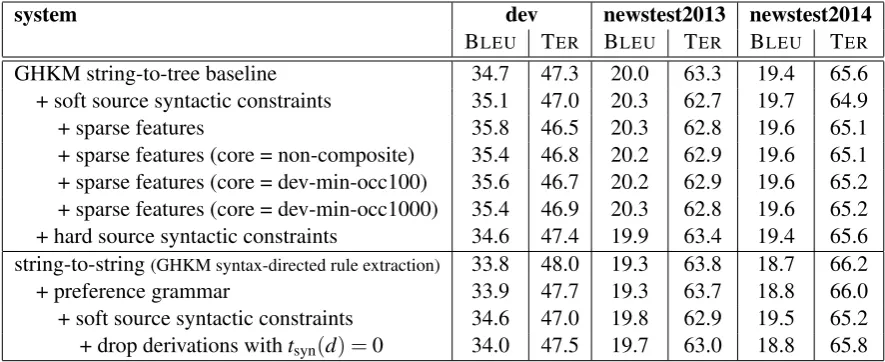
system dev newstest2013 newstest2014
BLEU TER BLEU TER BLEU TER
GHKM string-to-tree baseline 34.7 47.3 20.0 63.3 19.4 65.6
+ soft source syntactic constraints 35.1 47.0 20.3 62.7 19.7 64.9
+ sparse features 35.8 46.5 20.3 62.8 19.6 65.1
+ sparse features (core = non-composite) 35.4 46.8 20.2 62.9 19.6 65.1 + sparse features (core = dev-min-occ100) 35.6 46.7 20.2 62.9 19.6 65.2 + sparse features (core = dev-min-occ1000) 35.4 46.9 20.3 62.8 19.6 65.2 + hard source syntactic constraints 34.6 47.4 19.9 63.4 19.4 65.6 string-to-string(GHKM syntax-directed rule extraction) 33.8 48.0 19.3 63.8 18.7 66.2
+ preference grammar 33.9 47.7 19.3 63.7 18.8 66.0
[image:6.595.77.520.62.243.2]+ soft source syntactic constraints 34.6 47.0 19.8 62.9 19.5 65.2 + drop derivations withtsyn(d) =0 34.0 47.5 19.7 63.0 18.8 65.8 Table 2: English→German experimental results (truecase). BLEU scores are given in percentage. A selection of 2000 sentences from the newstest2008-2012 sets is used as development set.
model, a rule rareness penalty, and the monolin-gual PCFG probability of the tree fragment from which the rule was extracted (Williams et al., 2014). Rule translation probabilities are smoothed via Good-Turing smoothing.
The language model (LM) is a large inter-polated 5-gram LM with modified Kneser-Ney smoothing (Kneser and Ney, 1995; Chen and Goodman, 1998). The target side of the parallel corpus and the monolingual German News Crawl corpora are employed as training data. We use the SRILM toolkit (Stolcke, 2002) to train the LM and rely on KenLM (Heafield, 2011) for language model scoring during decoding.
Model weights are optimized to maximize BLEU (Papineni et al., 2002) with batch MIRA (Cherry and Foster, 2012) on 1000-best lists. We selected 2000 sentences from the newstest2008-2012 sets as a development set. The selected sen-tences obtained high sentence-level BLEU scores when being translated with a baseline phrase-based system, and do each contain less than 30 words for more rapid tuning. newstest2013 and newstest2014 are used as unseen test sets. Trans-lation quality is measured in truecase with BLEU and TER(Snover et al., 2006).5
7.2 Translation Results
The results of the empirical evaluation are given in Table 2. Our GHKM string-to-tree system attains state-of-the-art performance on newstest2013 and newstest2014.
5TER scores are computed withtercomversion 0.7.25
and parameters-N -s.
7.2.1 Soft Source Syntactic Constraints
Adding the three dense soft source syntactic con-straints features from Section 6.1 improves the baseline scores by 0.3 points BLEUand 0.6 points TERon newstest2013 and by 0.3 points BLEUand 0.7 points TERon newstest2014.
Somewhat surprisingly, the sparse features from Section 6.2 do not boost translation quality further on any of the two test sets. We observe a consid-erable improvement on the development set, but it does not carry over to the test sets. We attributed this to an overfitting effect. Our source-side soft syntactic label set of composite SAMT-style la-bels comprises 8504 different lala-bels that appear on the source-side of the parallel training data. Four times the amount of sparse features are possible (left-hand side/right-hand side matches and mis-matches for each label), though not all of them fire on the development set. 3989 sparse weights are tuned to non-zero values in the experiment. Due to the sparse nature of the features, overfitting cannot be ruled out.
non-system(tuned on newstest2012) newstest2012 newstest2013 newstest2014
BLEU TER BLEU TER BLEU TER
GHKM string-to-tree baseline 17.9 65.7 19.9 63.2 19.4 65.3
+ soft source syntactic constraints 18.2 65.3 20.3 62.6 19.7 64.7
+ sparse features 18.6 64.9 20.4 62.5 19.8 64.7
[image:7.595.81.522.62.162.2]+ sparse features (core = non-composite) 18.4 65.1 20.3 62.7 19.8 64.7 + sparse features (core = dev-min-occ100) 18.4 64.8 20.6 62.2 19.9 64.4 Table 3: English→German experimental results (truecase). BLEU scores are given in percentage. newstest2012 is used as development set.
composite) setup, but performance does not in-crease on the test sets.
Next we specified the core label set in another way: We counted how often each source label oc-curs in the input data on the development set. We then applied a minimum occurrence count thresh-old and added labels to the core set if they did not appear more rarely than the threshold. We tried values of 100 and 1000 for the minimum occur-rence, resulting in 277 and 37 labels being in the core label set, respectively. Neither thesparse fea-tures (core = dev-min-occ100)experiment nor the
sparse features (core = dev-min-occ1000) experi-ment yields better translation quality than what we see in the setup without sparse features.
We eventually conjectured that the choice of our development set might be a reason for the ineffec-tiveness of the sparse features, as on a fine-grained level it could possibly be too different from the test sets with respect to its syntactic properties. We therefore repeated some of the experiments with scaling factors optimized on newstest2012 (Table 3). The sparse features (core = dev-min-occ100)setup indeed performs better when tuned on newstest2012, with improvements of 0.7 points BLEU and 1.0 points TER on newstest2013 and of 0.5 points BLEU and 0.9 points TERon news-test2014 over the baseline tuned on the same set.
Finally, we were interested in demonstrating that soft source syntactic constraints are superior to hard source syntactic constraints. We built a setup that forces the decoder to match source-side syntactic label vectors in the rules with input la-bels.6 Hard source syntactic constraints are
in-deed worse than soft source syntactic constraints (by 0.4 BLEUon newstest2013 and 0.3 BLEUon newstest2014). The setup with hard source syntac-tic constraints performs almost exactly at the level of the baseline.
6Glue rules are an exception. They do not need to match
the input labels.
7.2.2 Preference Grammar
In the series of experiments with a preference grammar, we first evaluated a setup with the un-derlying SCFG of the preference grammar sys-tem, but without preference grammar. We de-note this setup asstring-to-string (GHKM syntax-directed rule extraction) in Table 2. The ex-traction method for this string-to-string system is GHKM syntax-directed with right-binarized syn-tactic target-side parses from BitPar, as in the string-to-tree setup. The constituent labels from the syntactic parses are however not used to dec-orate non-terminals. The grammar contains rules with a single generic non-terminal instead of syn-tactic ones. Thestring-to-string (GHKM syntax-directed rule extraction)setup is on newstest2013 0.7 BLEU (0.5 TER) worse and on newstest2014 0.7 BLEU (0.6 TER) worse than the standard GHKM string-to-tree baseline.
We then activated the preference grammar as described in Section 5. GHKM translation with a preference grammar instead of a syntactified target non-terminal vocabulary in the SCFG is consider-ably worse than the standard GHKM string-to-tree baseline and barely improves over the string-to-string setup.
We added soft source syntactic constraints on top of the preference grammar system, thus com-bining the two techniques. Soft source syntactic constraints give a nice gain over the preference grammar system, but the best setup without a pref-erence grammar is not outperformed. In another experiment, we investigated the effect of dropping derivations withtsyn(d) =0 (cf. Section 5.1). Note
that the second featurehauxSyn(d)is not useful in
this setup, as the system is forced to discard all derivations that would be penalized by that fea-ture. We deactivated hauxSyn(d) for the
0.1 BLEUon newstest2013 and a more severe de-terioration of 0.7 BLEUon newstest2014.
8 Conclusions
We investigated two soft syntactic extensions for GHKM translation: Target-side preference gram-mars and soft source syntactic constraints.
Soft source syntactic constraints proved to be suitable for advancing the translation quality over a strong string-to-tree baseline. Sparse features are beneficial beyond just three dense features, but they require the utilization of an appropriate devel-opment set. We also showed that the soft integra-tion of source syntactic constraints is crucial: Hard constraints do not yield gains over the baseline.
Preference grammars did not perform well in our experiments, suggesting that translation mod-els with syntactic target non-terminal vocabular-ies are a better choice when building string-to-tree systems.
Acknowledgements
The research leading to these results has re-ceived funding from the European Union Sev-enth Framework Programme (FP7/2007-2013) un-der grant agreements no 287658 (EU-BRIDGE)
and no288487 (MosesCore).
References
Ondrej Bojar, Christian Buck, Christian Federmann, Barry Haddow, Philipp Koehn, Johannes Leveling, Christof Monz, Pavel Pecina, Matt Post, Herve Saint-Amand, Radu Soricut, Lucia Specia, and Aleš Tamchyna. 2014. Findings of the 2014
Work-shop on Statistical Machine Translation. InProc. of
the Workshop on Statistical Machine Translation (WMT), pages 12–58, Baltimore, MD, USA, June. Jean-Cédric Chappelier and Martin Rajman. 1998. A
Generalized CYK Algorithm for Parsing
Stochas-tic CFG. In Proc. of the First Workshop on
Tab-ulation in Parsing and Deduction, pages 133–137, Paris, France, April.
Stanley F. Chen and Joshua Goodman. 1998. An Empirical Study of Smoothing Techniques for Lan-guage Modeling. Technical Report TR-10-98, Com-puter Science Group, Harvard University, Cam-bridge, MA, USA, August.
Colin Cherry and George Foster. 2012. Batch Tun-ing Strategies for Statistical Machine Translation. In
Proc. of the Human Language Technology Conf. / North American Chapter of the Assoc. for Compu-tational Linguistics (HLT-NAACL), pages 427–436, Montréal, Canada, June.
David Chiang. 2007. Hierarchical Phrase-Based
Translation. Computational Linguistics, 33(2):201–
228, June.
Steve DeNeefe, Kevin Knight, Wei Wang, and Daniel Marcu. 2007. What Can Syntax-Based MT Learn
from Phrase-Based MT? In Proc. of the 2007
Joint Conf. on Empirical Methods in Natural guage Processing and Computational Natural Lan-guage Learning (EMNLP-CoNLL), pages 755–763, Prague, Czech Republic, June.
Michel Galley, Mark Hopkins, Kevin Knight, and Daniel Marcu. 2004. What’s in a translation rule? InProc. of the Human Language Technology Conf. / North American Chapter of the Assoc. for Compu-tational Linguistics (HLT-NAACL), pages 273–280, Boston, MA, USA, May.
Michel Galley, Jonathan Graehl, Kevin Knight, Daniel Marcu, Steve DeNeefe, Wei Wang, and Ignacio Thayer. 2006. Scalable Inference and Training of Context-Rich Syntactic Translation Models. In
Proc. of the 21st Int. Conf. on Computational Lin-guistics and 44th Annual Meeting of the Assoc. for Computational Linguistics, pages 961–968, Sydney, Australia, July.
Qin Gao and Stephan Vogel. 2008. Parallel
Implemen-tations of Word Alignment Tool. InSoftware
Engi-neering, Testing, and Quality Assurance for Natural Language Processing, SETQA-NLP ’08, pages 49– 57, Columbus, OH, USA, June.
Kenneth Heafield. 2011. KenLM: Faster and Smaller
Language Model Queries. InProc. of the Workshop
on Statistical Machine Translation (WMT), pages 187–197, Edinburgh, Scotland, UK, July.
Hieu Hoang, Philipp Koehn, and Adam Lopez. 2009. A Unified Framework for Phrase-Based, Hierarchi-cal, and Syntax-Based Statistical Machine
Transla-tion. InProc. of the Int. Workshop on Spoken
Lan-guage Translation (IWSLT), pages 152–159, Tokyo, Japan, December.
Zhongqiang Huang, Jacob Devlin, and Rabih Zbib. 2013. Factored Soft Source Syntactic Constraints
for Hierarchical Machine Translation. In Proc. of
the Conf. on Empirical Methods for Natural Lan-guage Processing (EMNLP), pages 556–566, Seat-tle, WA, USA, October.
Reinhard Kneser and Hermann Ney. 1995. Improved Backing-Off for M-gram Language Modeling. In
Proceedings of the Int. Conf. on Acoustics, Speech, and Signal Processing, volume 1, pages 181–184, Detroit, MI, USA, May.
Philipp Koehn, Franz Joseph Och, and Daniel Marcu.
2003. Statistical Phrase-Based Translation. InProc.
P. Koehn, H. Hoang, A. Birch, C. Callison-Burch, M. Federico, N. Bertoldi, B. Cowan, W. Shen, C. Moran, R. Zens, C. Dyer, O. Bojar, A. Con-stantin, and E. Herbst. 2007. Moses: Open Source
Toolkit for Statistical Machine Translation. InProc.
of the Annual Meeting of the Assoc. for Computa-tional Linguistics (ACL), pages 177–180, Prague, Czech Republic, June.
Philipp Koehn. 2005. Europarl: A parallel corpus for
statistical machine translation. In Proc. of the MT
Summit X, Phuket, Thailand, September.
Yuval Marton and Philip Resnik. 2008. Soft Syn-tactic Constraints for Hierarchical Phrased-Based
Translation. InProc. of the Annual Meeting of the
Assoc. for Computational Linguistics (ACL), pages 1003–1011, Columbus, OH, USA, June.
Maria Nadejde, Philip Williams, and Philipp Koehn. 2013. Edinburgh’s Syntax-Based Machine
Transla-tion Systems. InProc. of the Workshop on Statistical
Machine Translation (WMT), pages 170–176, Sofia, Bulgaria, August.
Franz Josef Och and Hermann Ney. 2003. A System-atic Comparison of Various Statistical Alignment
Models. Computational Linguistics, 29(1):19–51,
March.
Kishore Papineni, Salim Roukos, Todd Ward, and Wei-Jing Zhu. 2002. Bleu: a Method for Automatic
Evaluation of Machine Translation. InProc. of the
Annual Meeting of the Assoc. for Computational Linguistics (ACL), pages 311–318, Philadelphia, PA, USA, July.
Slav Petrov, Leon Barrett, Romain Thibaux, and Dan Klein. 2006. Learning Accurate, Compact, and
In-terpretable Tree Annotation. InProc. of the 21st Int.
Conf. on Computational Linguistics and 44th An-nual Meeting of the Assoc. for Computational Lin-guistics, pages 433–440, Sydney, Australia, July.
Helmut Schmid. 2004. Efficient Parsing of Highly Ambiguous Context-Free Grammars with Bit
Vec-tors. In Proc. of the Int. Conf. on Computational
Linguistics (COLING), Geneva, Switzerland, Au-gust.
Matthew Snover, Bonnie Dorr, Richard Schwartz, Lin-nea Micciulla, and John Makhoul. 2006. A Study of Translation Edit Rate with Targeted Human
An-notation. In Proc. of the Conf. of the Assoc. for
Machine Translation in the Americas (AMTA), pages 223–231, Cambridge, MA, USA, August.
Daniel Stein, Stephan Peitz, David Vilar, and Hermann Ney. 2010. A Cocktail of Deep Syntactic
Fea-tures for Hierarchical Machine Translation. InProc.
of the Conf. of the Assoc. for Machine Translation in the Americas (AMTA), Denver, CO, USA, Octo-ber/November.
Andreas Stolcke. 2002. SRILM – an Extensible
Lan-guage Modeling Toolkit. InProc. of the Int. Conf.
on Spoken Language Processing (ICSLP), volume 3, Denver, CO, USA, September.
Ashish Venugopal, Andreas Zollmann, Noah A. Smith, and Stephan Vogel. 2009. Preference Grammars: Softening Syntactic Constraints to Improve
Statis-tical Machine Translation. In Proc. of the
Hu-man Language Technology Conf. / North American Chapter of the Assoc. for Computational Linguistics (HLT-NAACL), pages 236–244, Boulder, CO, USA, June.
Wei Wang, Kevin Knight, and Daniel Marcu. 2007. Binarizing Syntax Trees to Improve Syntax-Based
Machine Translation Accuracy. InProc. of the 2007
Joint Conf. on Empirical Methods in Natural guage Processing and Computational Natural Lan-guage Learning (EMNLP-CoNLL), pages 746–754, Prague, Czech Republic, June.
Wei Wang, Jonathan May, Kevin Knight, and Daniel Marcu. 2010. Re-structuring, Re-labeling, and Re-aligning for Syntax-based Machine Translation.
Computational Linguistics, 36(2):247–277, June. Philip Williams and Philipp Koehn. 2012. GHKM
Rule Extraction and Scope-3 Parsing in Moses. In
Proc. of the Workshop on Statistical Machine Trans-lation (WMT), pages 388–394, Montréal, Canada, June.
Philip Williams, Rico Sennrich, Maria Nadejde, Matthias Huck, Eva Hasler, and Philipp Koehn.
2014. Edinburgh’s Syntax-Based Systems at
WMT 2014. In Proc. of the Workshop on
Statis-tical Machine Translation (WMT), pages 207–214, Baltimore, MD, USA, June.
Jiajun Zhang, Feifei Zhai, and Chengqing Zong. 2011. Augmenting String-to-Tree Translation Models with
Fuzzy Use of Source-side Syntax. In Proc. of the
Conf. on Empirical Methods for Natural Language Processing (EMNLP), pages 204–215, Edinburgh, Scotland, UK, July.
Andreas Zollmann and Ashish Venugopal. 2006. Syn-tax Augmented Machine Translation via Chart
Pars-ing. InProc. of the Workshop on Statistical Machine