Search right and thou shalt find ...
Using Web Queries for Learner Error Detection
Michael Gamon Claudia Leacock
Microsoft Research Butler Hill Group
One Microsoft Way P.O. Box 935
Redmond, WA 981052, USA Ridgefield, CT 06877, USA [email protected] [email protected]
Abstract
We investigate the use of web search queries for detecting errors in non-native writing. Dis-tinguishing a correct sequence of words from a sequence with a learner error is a baseline task that any error detection and correction system needs to address. Using a large corpus of error-annotated learner data, we investigate whether web search result counts can be used to distinguish correct from incorrect usage. In this investigation, we compare a variety of query formulation strategies and a number of web resources, including two major search engine APIs and a large web-based n-gram corpus.
1 Introduction
Data-driven approaches to the detection and cor-rection of non-native errors in English have been researched actively in the past several years. Such errors are particularly amenable to data-driven me-thods because many prominent learner writing er-rors involve a relatively small class of phenomena that can be targeted with specific models, in par-ticular article and preposition errors. Preposition and determiner errors (most of which are article errors) are the second and third most frequent er-rors in the Cambridge Learner Corpus (after the more intractable problem of content word choice). By targeting the ten most frequent prepositions involved in learner errors, more than 80% of pre-position errors in the corpus are covered.
Typically, data-driven approaches to learner er-rors use a classifier trained on contextual informa-tion such as tokens and part-of-speech tags within a window of the preposition/article (Gamon et al. 2008, 2010, DeFelice and Pulman 2007, 2008, Han
et al. 2006, Chodorow et al. 2007, Tetreault and Chodorow 2008).
Language models are another source of evidence that can be used in error detection. Using language models for this purpose is not a new approach, it goes back to at least Atwell (1987). Gamon et al. (2008) and Gamon (2010) use a combination of classification and language modeling. Once lan-guage modeling comes into play, the quantity of the training data comes to the forefront. It has been well-established that statistical models improve as the size of the training data increases (Banko and Brill 2001a, 2001b). This is particularly true for language models: other statistical models such as a classifier, for example, can be targeted towards a specific decision/classification, reducing the appe-tite for data somewhat, while language models provide probabilities for any sequence of words - a task that requires immense training data resources if the language model is to consider increasingly sparse longer n-grams.
Language models trained on data sources like the Gigaword corpus have become commonplace, but of course there is one corpus that dwarfs any other resource in size: the World Wide Web. This has drawn the interest of many researchers in natu-ral language processing over the past decade. To mention just a few examples, Zhu and Rosenfeld (2001) combine trigram counts from the web with an existing language model where the estimates of the existing model are unreliable because of data sparseness. Keller and Lapata (2003) advocate the use of the web as a corpus to retrieve backoff probabilities for unseen bigrams. Lapata and Keller (2005) extend this method to a range of additional natural language processing tasks, but also caution that web counts have limitations and add noise. Kilgariff (2007) points out the shortcomings of
accessing the web as a corpus through search que-ries: (a) there is no lemmatization or part-of-speech tagging in search indices, so a linguistically mea-ningful query can only be approximated, (b) search syntax, as implemented by search engine provid-ers, is limited, (c) there is often a limit on the num-ber of automatic queries that are allowed by search engines, (c) hit count estimates are estimates of retrieved pages, not of retrieved words. We would like to add to that list that hit count estimates on the web are just that -- estimates. They are com-puted on the fly by proprietary algorithms, and ap-parently the algorithms also access different slices of the web index, which causes a fluctuation over time, as Tetrault and Chodorow (2009) point out.
In 2006, Google made its web-based 5gram lan-guage model available through the Linguistic Data Consortium, which opens the possibility of using real n-gram statistics derived from the web direct-ly, instead of using web search as a proxy.
In this paper we explore the use of the web as a corpus for a very specific task: distinguishing be-tween a learner error and its correction. This is ob-viously not the same as the more ambitious question of whether a system can be built to detect and correct errors on the basis of web counts alone, and this is a distinction worth clarifying. Any sys-tem that successfully detects and corrects an error will need to accomplish three tasks1: (1) find a part of the user input that contains an error (error de-tection). (2) find one or multiple alternative string(s) for the alleged error (candidate genera-tion) and (3) score the alternatives and the original to determine which alternative (if any) is a likely correction (error correction). Here, we are only concerned with the third task, specifically the comparison between the incorrect and the correct choice. This is an easily measured task, and is also a minimum requirement for any language model or language model approximation: if the model can-not distinguish an error from a well-formed string, it will not be useful.
1 Note that these tasks need not be addressed by separate
com-ponents. A contextual classifier for preposition choice, for example, can generate a probability distribution over a set of prepositions (candidate generation). If the original preposition choice has lower probability than one or more other tions, it is a potential error (error detection), and the preposi-tions with higher probability will be potential correcpreposi-tions (error correction).
We focus on two prominent learner errors in this study: preposition inclusion and choice and article inclusion and choice. These errors are among the most frequent learner errors (they comprise nearly one third of all errors in the learner corpus used in this study).
In this study, we compare three web data sources: The public Bing API, Google API, and the Google 5-gram language model. We also pay close attention to strategies of query formulation. The questions we address are summarized as follows:
Can web data be used to distinguish learner er-rors from correct phrases?
What is the better resource for web-data: the Bing API, the Google API, or the Google 5-gram data?
What is the best query formulation strategy when using web search results for this task? How much context should be included in the query?
2 Related Work
Hermet et al. (2008) use web search hit counts for preposition error detection and correction in French. They use a set of confusable prepositions to create a candidate set of alternative prepositional choices and generate queries for each of the candi-dates and the original. The queries are produced using linguistic analysis to identify both a govern-ing and a governed element as a minimum mea-ningful context. On a small test set of 133 sentences, they report accuracy of 69.9% using the Yahoo! search engine.
errors the hit count estimates (normalized for query length) are used directly. If the ratio of the norma-lized hit count estimate for the alternative article choice to the normalized hit count estimate of the original choice exceeds a manually determined threshold, the alternative is suggested as a correc-tion. For verb-noun collocations, the situation is more complex since the system does not automati-cally generate possible alternative choices for noun/verb collocations. Instead, the snippets (doc-ument summaries) that are returned by the initial web search are analyzed and potential alternative collocation candidates are identified. They then submit a second round of queries to determine whether the suggestions are more frequent than the original collocation. Results on a 400+ sentence corpus of learner writing show 62% precision and 41% recall for determiners, and 30.7% recall and 37.3% precision for verb-noun collocation errors.
Tetreault and Chodorow (2009) make use of the web in a different way. Instead of using global web count estimates, they issue queries with a region-specific restriction and compare statistics across regions. The idea behind this approach is that re-gions that have a higher density of non-native speakers will show significantly higher frequency of erroneous productions than regions with a high-er proportion of native speakhigh-ers. For example, the verb-preposition combinations married to versus married with show very different counts in the UK versus France regions. The ratio of counts for mar-ried to/marmar-ried with in the UK is 3.28, whereas it is 1.18 in France. This indicates that there is signif-icant over-use of married with among native French speakers, which serves as evidence that this verb-preposition combination is likely to be an er-ror predominant for French learners of English. They test their approach on a list of known verb-preposition errors. They also argue that, in a state-of-the-art preposition error detection system, recall on the verb-preposition errors under investigation is still so low that systems can only benefit from increased sensitivity to the error patterns that are discoverable through the region web estimates.
Bergsma et al (2009) are the closest to our work. They use the Google N-gram corpus to disambi-guate usage of 34 prepositions in the New York Times portion of the Gigaword corpus. They use a sliding window of n-grams (n ranging from 2 to 5) across the preposition and collect counts for all resulting n-grams. They use two different methods
to combine these counts. Their SuperLM model combines the counts as features in a linear SVM classifier, trained on a subset of the data. Their SumLM model is simpler, it sums all log counts across the n-grams. The preposition with the high-est score is then predicted for the given context. Accuracy on the New York Times data in these ex-periments reaches 75.4% for SuperLM and 73.7% for SumLM.
Our approach differs from Bergsma et al. in three crucial respects. First, we evaluate insertion, deletion, and substitution operations, not just subs-titution, and we extend our evaluation to article errors. Second, we focus on finding the best query mechanism for each of these operations, which requires only a single query to the Web source. Finally, the focus of our work is on learner error detection, so we evaluate on real learner data as opposed to well-formed news text. This distinction is important: in our context, evaluation on edited text artificially inflates both precision and recall because the context surrounding the potential error site is error-free whereas learner writing can be, and often is, surrounded by errors. In addition, New York Times writing is highly idiomatic while learner productions often include unidiomatic word choices, even though the choice may not be consi-dered an error.
3 Experimental Setup
3.1 Test Data
(errone-ous) text for these. This makes our task harder since we will have to make predictions in text con-taining multiple errors, but it is more realistic giv-en real learner writing. Finally, we eliminate sentences containing nested errors (where the an-notation of one error contains an anan-notation for another error) and multiple article/preposition er-rors. Sentences that were flagged for a replacement error but contained no replacement were also elim-inated from the data. The final set we use consists of a random selection of 9,006 sentences from the CLC with article errors and 9,235 sentences with preposition errors.
3.2 Search APIs and Corpora
We examine three different sources of data to dis-tinguish learner errors from corrected errors. First, we use two web search engine APIs, Bing and Google. Both APIs allow the retrieval of a page-count estimate for an exact match query. Since these estimates are provided based on proprietary algorithms, we have to treat them as a "black box". The third source of data is the Google 5-gram cor-pus (Linguistic Data Consortium 2006) which con-tains n-grams with n ranging from 1 to 5. The count cutoff for unigrams is 200, for higher order n-grams it is 40.
3.3 Query Formulation
There are many possible ways to formulate an ex-act match (i.e. quoted) query for an error and its correction, depending on the amount of context that is included on the right and left side of the er-ror. Including too little context runs the risk of missing the linguistically relevant information for determining the proper choice of preposition or determiner. Consider, for example, the sentence we rely most of/on friends. If we only include one word to the left and one word to the right of the preposition, we end up with the queries "most on friends" and "most of friends" - and the web hit count estimate may tell us that the latter is more frequent than the former. However, in this exam-ple, the verb rely determines the choice of preposi-tion and when it is included in the query as in "rely most on friends" versus "rely most of friends", the estimated hit counts might correctly reflect the in-correct versus in-correct choice of preposition. Ex-tending the query to cover too much of the context,
on the other hand, can lead to low or zero web hit estimates because of data sparseness - if we in-clude the pronoun we in the query as in "we rely most on friends" versus "we rely most of friends", we get zero web count estimates for both queries.
Another issue in query formulation is what strategy to use for corrections that involve dele-tions and inserdele-tions, where the number of tokens changes. If, for example, we use queries of length 3, the question for deletion queries is whether we use two words to the left and one to the right of the deleted word, or one word to the left and two to the right. In other words, in the sentence we traveled to/0 abroad last year, should the query for the cor-rection (deletion) be "we traveled abroad" or "tra-veled abroad last"?
Finally, we can employ some linguistic informa-tion to design our query. By using part-of-speech tag information, we can develop heuristics to in-clude a governing content word to the left and the head of the noun phrase to the right.
The complete list of query strategies that we tested is given below.
SmartQuery: using part-of-speech information to include the first content word to the left and the head noun to the right. If the content word on the left cannot be established within a window of 2 tokens and the noun phrase edge within 5 tokens, select a fixed window of 2 tokens to the left and 2 tokens to the right.
FixedWindow Queries: include n tokens to the left and m tokens to the right. We experimented with the following settings for n and m: 1_1, 2_1, 1_2, 2_2, 3_2, 2_3. The latter two 6-grams were only used for the API’s, because the Google corpus does not contain 6-grams.
3.4 Evaluation Metrics
For each query pair <qerror, qcorrection>, we produce
one of three different outcomes:
correct (the query results favor the correction of the learner error over the error itself):
count(qcorrection) > count(qerror)
incorrect(the query results favor the learner error over its correction):
count(qerror) >= count(qcorrection)
where(count(qerror) & 0 OR
count(qcorrection) & 0)
noresult:
count(qcorrection) = count(qerror) = 0
For each query type, each error (preposition or ar-ticle), each correction operation (deletion, inser-tion, substitution) and each web resource (Bing API, Google API, Google N-grams) we collect these counts and use them to calculate three differ-ent metrics. Raw accuracy is the ratio of correct predictions to all query pairs:
!"#$"%%&'"%( ) $ %*''
%*'' + ,-%*'' + -*'./&01
We also calculate accuracy for the subset of query pairs where at least one of the queries resulted in a successful hit, i.e. a non-zero result. We call this metric Non-Zero-Result-Accurracy (NZRA), it is the ratio of correct predictions to incorrect predic-tions, ignoring noresults:
2*-3.'*!./&014%%&'"%( ) $ %*''
%*'' + ,-%*''
Finally, retrieval ratio is the ratio of queries that returned non-zero results:
4 Results
We show results from our experiments in Table 1 - Table 6. Since space does not permit a full tabula-tion of all the individual results, we restrict our-selves to listing only those query types that achieve best results (highlighted) in at least one metric.
Google 5-grams show significantly better results than both the Google and Bing APIs. This is good news in terms of implementation, because it frees the system from the vagaries involved in relying on search engine page estimates: (1) the latency, (2) query quotas, and (3) fluctuations of page esti-mates over time. The bad news is that the 5-gram corpus has much lower retrieval ratio because, pre-sumably, of its frequency cutoff. Its use also limits
the maximum length of a query to a 5-gram (al-though neither of the APIs outperformed Google 5-grams when retrieving 6-gram queries).
The results for substitutions are best, for fixed window queries. For prepositions, the SmartQue-ries perform with about 86% NZRA while a fixed length 2_2 query (targeted word with a ±2-token window) achieves the best results for articles, at about 85% (when there was at least one non-zero match). Retrieval ratio for the prepositions was about 6% lower than retrieval ratio for articles – 41% compared to 35%.
The best query type for insertions was fixed-length LeftFourgrams with about 95% NZRA and 71% retrieval ratio for articles and 89% and 78% retrieval ratio for prepositions. However, Left-Fourgrams favor the suggested rewrites because, by keeping the query length at four tokens, the original has more syntactic/semantic context. If the original sentence contains is referred as the and the annotator inserted to before as, the original query will be is referred as the and the correction query is referred to as.
Conversely, with deletion, having a fixed win-dow favors the shorter rewrite string. The best query types for deletions were: 2_2 queries for ar-ticles (94% NZRA and 46% retrieval ratio) and SmartQueries for prepositions (97% NZRA and 52% retrieval ratio). For prepositions the fixed length 1_1 query performs about the same as the SmartQueries, but that query is a trigram (or smaller at the edges of a sentence) whereas the av-erage length of SmartQueries is 4.7 words for pre-positions and 4.3 words for articles. So while the coverage for SmartQueries is much lower, the longer query string cuts the risk of matching on false positives.
required. The 5-gram corpus also has sentence boundary markers which is especially helpful to
identify changes at the beginning of a sentence.
Query type
non-zero-result accuracy retrieval ratio raw accuracy B-API G-API G-Ngr B-API G-API G-Ngr B-API G-API G-Ngr SmartQuery 0.8637 0.9548 0.9742 0.8787 0.8562 0.5206 0.7589 0.8176 0.5071 1_1 0.4099 0.9655 0.9721 0.9986 0.9978 0.9756 0.4093 0.9634 0.9484 Table 1: Preposition deletions (1395 query pairs).
Query type
non-zero-result accuracy retrieval ratio raw accuracy B-API G-API G-Ngr B-API G-API G-Ngr B-API G-API G-Ngr Left4g 0.7459 0.8454 0.8853 0.9624 0.9520 0.7817 0.7178 0.8048 0.6920
1_1 0.5679 0.2983 0.3550 0.9973 0.9964 0.9733 0.5661 0.2971 0.3456 Right3g 0.6431 0.8197 0.8586 0.9950 0.9946 0.9452 0.6399 0.8152 0.8116 Table 2: Preposition insertions (2208 query pairs).
Query type
non-zero-result accuracy retrieval ratio raw accuracy B-API G-API G-Ngr B-API G-API G-Ngr B-API G-API G-Ngr SmartQuery 0.7396 0.8183 0.8633 0.7987 0.7878 0.4108 0.5906 0.6446 0.5071 1_1=L3g=R3g 0.4889 0.6557 0.6638 0.9870 0.9856 0.9041 0.4826 0.6463 0.6001 1_2=R4g 0.6558 0.7651 0.8042 0.9178 0.9047 0.6383 0.6019 0.6921 0.5133 Table 3: Preposition substitutions (5632 query pairs).
Query type
non-zero-result accuracy retrieval ratio raw accuracy B-API G-API G-Ngr B-API G-API G-Ngr B-API G-API G-Ngr 2_2 0.7678 0.9056 0.9386 0.8353 0.8108 0.4644 0.6414 0.7342 0.4359
1_1 0.3850 0.8348 0.8620 0.9942 0.9924 0.9606 0.3828 0.8285 0.8281 1_2 0.5737 0.8965 0.9097 0.9556 0.9494 0.7920 0.5482 0.8512 0.7205 Table 4: Article deletions (2769 query pairs).
Query type
non-zero-result accuracy retrieval ratio raw accuracy B-API G-API G-Ngr B-API G-API G-Ngr B-API G-API G-Ngr
Left4g 0.8292 0.9083 0.9460 0.9505 0.9428 0.7072 0.7880 0.8562 0.6690 1_1 0.5791 0.3938 0.3908 0.9978 0.9975 0.9609 0.5777 0.3928 0.3755 Left3g 0.6642 0.8983 0.8924 0.9953 0.9955 0.9413 0.6611 0.8942 0.8400 Table 5: Article insertions (5520 query pairs).
Query type
non-zero-result accuracy retrieval ratio raw accuracy B-API G-API G-Ngr B-API G-API G-Ngr B-API G-API G-Ngr 2_2=Left5g=
[image:6.612.74.537.114.684.2]5 Error Analysis
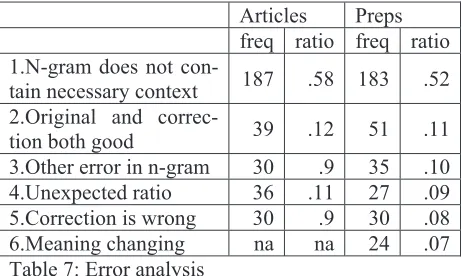
We manually inspected examples where the matches on the original string were greater than matches on the corrected string. The results of this error analysis are shown in table 7. Most of the time, (1) the context that determined article or pre-position use and choice was not contained within the query. This includes, for articles, cases where article usage depends either on a previous mention or on the intended sense of a polysemous head noun. Some other patterns also emerged. Some-times (2) both and the original and the correction seemed equally good in the context of the entire sentence, for example it’s very important to us and it’s very important for us. In other cases, (3) there was another error in the query string (recall that we retained all of the errors in the original sentences that were not the targeted error). Then there is a very subjective category (4) where the relative n-gram frequencies are unexpected, for example where the corpus has 171 trigrams guilty for you but only 137 for guilty about you. These often oc-cur when both of the frequencies are either low and/or close. This category includes cases where it is very likely that one of the queries is retrieving an n-gram whose right edge is the beginning of a compound noun (as in with the trigram have a lunch). Finally, (5) some of the “corrections” either introduced an error into the sentence or the original and “correction” were equally bad. In this catego-ry, we also include British English article usage like go to hospital. For prepositions, (6) some of the corrections changed the meaning of the sen-tence – where the disambiguation context is often not in the sentence itself and either choice is syn-tactically correct, as in I will buy it from you changed to I will buy it for you.
Articles Preps freq ratio freq ratio 1.N-gram does not
con-tain necessary context 187 .58 183 .52 2.Original and
[image:7.612.74.305.568.706.2]correc-tion both good 39 .12 51 .11 3.Other error in n-gram 30 .9 35 .10 4.Unexpected ratio 36 .11 27 .09 5.Correction is wrong 30 .9 30 .08 6.Meaning changing na na 24 .07 Table 7: Error analysis
If we count categories 2 and 5 in Table 7 as not being errors, then the error rate for articles drops 20% and the error rate for prepositions drops 19%.
A disproportionately high subcategory of query strings that did not contain the disambiguating con-text (category 1) was at the edges of the sentence – especially for the LeftFourgrams at the beginning of a sentence where the query will always be a bi-gram.
6 Conclusion and Future Work
We have demonstrated that web source counts can be an accurate predictor for distinguishing between a learner error and its correction - as long as the query strategy is tuned towards the error type. Longer queries, i.e. 4-grams and 5-grams achieve the best non-zero-result accuracy for articles, while SmartQueries perform best for preposition errors. Google N-grams across the board achieve the best non-zero-result accuracy, but not surprisingly they have the lowest retrieval ratio due to count cutoffs. Between the two search APIs, Bing tends to have better retrieval ratio, while Google achieves higher accuracy.
In terms of practical use in an error detection system, a general "recipe" for a high precision component can be summarized as follows. First, use the Google Web 5-gram Corpus as a web source. It achieves the highest NZRA, and it avoids multiple problems with search APIs: results do not fluctuate over time, results are real n-gram counts as opposed to document count estimates, and a lo-cal implementation can avoid the high latency as-sociated with search APIs. Secondly, carefully select the query strategy depending on the correc-tion operacorrec-tion and error type.
whole series of queries and sum over the results. This would increase recall since at least some of the shorter queries are likely to return non-zero results. In a real-time system, however, issuing several dozen queries per potential error location and potential correction could cause performance issues. Finally, the n-gram counts can be incorpo-rated as one of the features into a system such as the one described in Gamon (2010) that combines evidence from various sources in a principled way to optimize accuracy on learner errors.
Acknowledgments
We would like to thank Yizheng Cai for making the Google web ngram counts available through a web service and to the anonymous reviewers for their feedback.
References
Eric Steven Atwell. 1987. How to detect grammatical errors in a text without parsing it. Proceedings of the
3rd EACL, Copenhagen, Denmark, pp 38 - 45.
Michele Banko and Eric Brill. 2001a. Mitigating the paucity-of-data problem: Exploring the effect of training corpus size on classifier performance for natural language processing. In James Allan, editor,
Proceedings of the First International Conference on
Human Language Technology Research. Morgan
Kaufmann, San Francisco.
Michele Banko and Eric Brill. 2001b. Scaling to very very large corpora for natural language disambigua-tion. In Proceedings of the 39th Annual Meeting of the Association for Computational Linguistics and the 10th Conference of the European Chapter of the Association for Computational Linguistics, pp. 26– 33, Toulouse, France.
Shane Bergsma, Dekang Lin, and Randy Goebel. 2009. Web-scale n-gram models for lexical disambiguation. In Proceedings for the 21st International Joint Confe-rence on Artificial Intelligence, pp. 1507 – 1512.
Martin Chodorow, Joel Tetreault, and Na-Rae Han. 2007. Detection of grammatical errors involving pre-positions. In Proceedings of the Fourth ACL-SIGSEM Workshop on Prepositions, pp. 25-30.
Rachele De Felice and Stephen G. Pulman. 2007. Au-tomatically acquiring models of preposition use. In
Proceedings of the Fourth ACL-SIGSEM Workshop on Prepositions, pp. 45-50. Prague.
Rachele De Felice and Stephen Pulman. 2008. A clas-sifier-based approach to preposition and determiner
error correction in L2 English. COLING. Manches-ter, UK.
Michael Gamon, Jianfeng Gao, Chris Brockett, Alexan-der Klementiev, William Dolan, Dmitriy Belenko, and Lucy Vanderwende. 2008. Using contextual speller techniques and language modeling for ESL error correction. In Proceedings of IJCNLP, Hydera-bad, India.
Michael Gamon. 2010. Using mostly native data to cor-rect errors in learners’ writing. In Proceedings of
NAACL.
Na-Rae Han, Martin Chodorow, and Claudia Leacock. 2006. Detecting errors in English article usage by non-native speakers. Natural Language Engineering, 12(2), 115-129.
Matthieu Hermet, Alain Désilets, Stan Szpakowicz. 2008. Using the web as a linguistic resource to auto-matically correct lexico-syntactic errors. In Proceed-ings of the 6th Conference on Language Resources and Evaluation (LREC), pp. 874-878.
Frank Keller and Mirella Lapata. 2003. Using the web to obtain frequencies for unseen bigrams. Computa-tional Linguistics, 29(3): 459-484.
Adam Kilgariff. 2007. Googleology is bad science.
Computational Linguistics 33(1): 147-151.
Mirella Lapata and Frank Keller. 2005. Web-Based Models for Natural Language Processing. ACM Transactions on Speech and Language Processing (TSLP), 2(1):1-31.
Linguistic Data Consortium. 2006. Web 1T 5-gram version 1.
http://www.ldc.upenn.edu/Catalog/CatalogEntry.jsp? catalogId=LDC2006T13 .
Joel Tetreault and Martin Chodorow. 2008. The ups and downs of preposition error detection in ESL.
COLING. Manchester, UK.
Joel Tetreault and Martin Chodorow. 2009. Examining the use of region web counts for ESL error detection.
Web as Corpus Workshop (WAC-5), San Sebastian, Spain.
Xing Yi, Jianfeng Gao and Bill Dolan. 2008. A web-based English proofing system for English as a second language users. In Proceedings of the Third International Joint Conference on Natural Language Processing (IJCNLP). Hyderabad, India.