Reducing False Positives in the Construction of Adjective Scales
Alice Zhang Princeton University Princeton, New Jersey, USA. [email protected]
Abstract
Many adjectives that appear to be syn-onyms of one another differ in their inten-sity. Distinguishing the nuances between adjective synonyms is vital to linguistic understanding of a language, but WordNet currently does not encode the relative in-tensities of adjective synonyms that lie on the scale. Sheinman & Tokunaga (2009) proposed a solution of constructing Adjec-tive Scales by data mining a web corpus. However, this process suffers from some limitations, most notably that of False Pos-itives, which inaccurately suggest that ad-jectiveXis more or less intense thanY.
This paper classifies the types of false pos-itives that Sheinman’s method generates, then proposes a method to diminish the quantity of these false positives using lin-guistic searches in WordNet.
1 Introduction
Adjectives are currently represented in WordNet in a dumbbell structure, such that antonymous ad-jective pairs like ”wet-dry” and ”early-late” are connected with a single antonym link. Each word of the antonym pair is represented as one of two centroids on the dumbbells, and each of their syn-onyms are spread out radially around the cen-troid. This representation is problematic because 1) it suggests that all adjectives within a synset are equally similar to the centroid and 2) because many similar adjectives are misclassified as mem-bers of the same clusters, indicating that they de-scribe the same types of objects, when in reality they are very different.
In their paperLarge, huge or gigantic?: Identi-fying and encoding intensity relations in WordNet, Sheinman et al. (2013) proposed a method to un-cover the differing intensity relationships amongst
a set of adjective synonyms by mining a web cor-pus. In particular, Sheinman noticed particular patterns that occurred naturally in English speech that already codified the intensity relationships be-tween the adjectives that were used within the pat-tern. For example, one of these semantic patterns is ”Xbut notY,” whereYis implied to be more in-tense thanX, e.g. ”good but not great” implies that ”great” is more intense than its synonym ”good” based merely on the pattern ”Xbut notY” In fact, these patterns occur in both directions, such that while some patterns imply thatXis more intense than Y, while others imply thatXis less intense thanY. By discovering pairs of adjectives that oc-curred in the natural patterns, Sheinman was able to construct scales of adjective synonyms, where each adjective was listed according to its relative intensity.
While Sheinman’s method seems, in large part, successful in constructing adjective scales, it also suffers from limitations of false positives, which appear when certain adjective pairs show up in the linguistic patterns, but do not actually indi-cate that adjective Yis more or less intense than X. For instance, the natural phrase ”good but not good enough” would seem to suggest that ”good” is more intense than ”good” based merely on the battern ”X but not Y,” even though this is not true. These false positives are significant: a simple Google News search of the phrase ”hot but not” will return false positives for over half of the re-sults. This paper classifies the different types of false positives that can be generated and proposes an algorithm that utilizes WordNet to be able to detect these false positives.
2 Type A False Positives
2.1 Classification
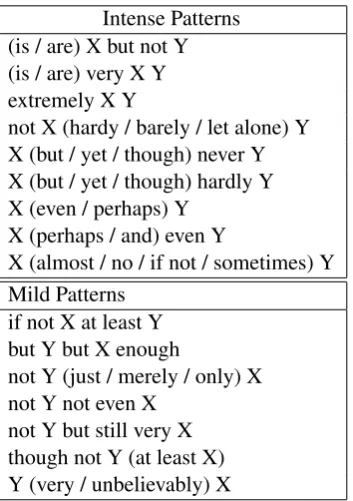
Intense Patterns (is / are) X but not Y (is / are) very X Y extremely X Y
not X (hardy / barely / let alone) Y X (but / yet / though) never Y X (but / yet / though) hardly Y X (even / perhaps) Y
X (perhaps / and) even Y
X (almost / no / if not / sometimes) Y Mild Patterns
if not X at least Y but Y but X enough
not Y (just / merely / only) X not Y not even X
[image:2.595.74.251.65.316.2]not Y but still very X though not Y (at least X) Y (very / unbelievably) X
Table 1 Examples of the linguistic patterns that Sheinman et al. noticed in natural language. X and Y represent adjectives such that X is more intense than Y.
X, even though bothXandYfall on the same ad-jective scale, butYis not more intense thanX. In particular, Type A False Positives can be further classified into three particular types: repetitions, antonyms, and reversals.
Repetitions occur when both adjectivesXand Yare the same word. For example, one naturally occurring English phrase that follows the ”Xbut notY” pattern that Sheinman noted is the phrase ”It was good, but not good enough.” Another ex-ample would be the phrase ”It was good, but not as good as it could have been.” In both instances, the two adjectives that are being compared cannot have one be more intense than the other because they are the same.
Antonyms occur when X and Y are direct antonyms of one another - both X andY fall on the same scale, but they cannot be synonyms of one another because they lie on opposite ends of the same scale. For example, consider the fol-lowing sentence: ”He is not tall, but not short ei-ther.” Sheinman’s method would falsely classify ”short” as a more intense synonym to the word ”tall,” which is a misclassification.
Finally,reversalsoccur whereXandYare real adjective synonyms of one another, butXis a more intense adjective than Y. For example, the
sen-tences ”This artifact is ancient, perhaps even old enough to have existed before dinosaurs,” ”The water was scorching, but not hot enough to kill the bacteria,” and ”President Taft was extremely obese, fat to the point of getting stuck in his own bathtub” are all instances that would seem, based on Sheinman’s method, to suggest thatYis more intense thanX, when in reality,Xis more intense thanY.
2.2 Correcting Type A False Positives
To identify Type A false positives, one only needs an algorithm that can detect instances of repeti-tions, antonyms, and reversals.
Checking for repetitions is a trivial task: one simply needs to determine ifXandYare the same word.
To detect antonyms, one can take advantage of the pointers that are built into WordNet to check if any of the direct or indirect antonyms of Xis equal toY, or alternatively, that any of the direct or indirect antonyms ofYis equal toX.
Finally, we can fix reversals by taking advan-tage of a web database. Let the phrasep1 be the original phrase, and letp2 be the original phrase withXandY swapped. After conducting queries on a search engine for bothp1 andp2, we can de-termine that the query for which more results ap-pear is the correct intensity ordering of the two ad-jectives.
3 Type B False Positives
3.1 Classification
The second type of false positives isType Bfalse positives, which are phrases whereinYis inaccu-rately classified as being a more intense synonym ofX becauseXand Yare adjectives that do not fall on the same scale.
For example, consider the sentence ”Stevie Wonder is very good, but not lyrical.” Using Sheinman’s method of pattern extraction, one would falsely infer that ”lyrical” is a more intense synonym to ”good,” which cannot be true, as ”lyri-cal” is not even a synonym for ”good”, much less a more intense form of it.
3.2 Correction with Level 1 Searches
The most straightforward way of fixing Type B false positives is to performa simple search, test-ing to see ifXfalls under the synset - a word’s set of synonyms - ofY, or ifYfalls under the synset of x. This term can be classified as a Level 1 search.
Level 1 searches are searches conducted in WordNet, wherein only the two synsets of words XandYwill be explored. They differ from Level 2 searches, which increase the depth of the search. In general, a Level N search searches through a set of wordsw, then a Level N+1 search will search through all synsets for each word contained inw. Thus a Level 2 search will search through all the synsets of words contained in synsets of wordsX andY.
The Level 1 searches are successfully able to eliminate a large number of Type B false positives. For instance, TYPEB-LEVEL1 can correctly iden-tify ”good but not lyrical” and ”tasty but not ex-pensive” as false positives.
These types of false positives are interesting be-cause they reveal innate patterns of cultural think-ing. People sometimes associate a given quality or attribute with another, such as price and qual-ity. A phrase such as ”wealthy but not arrogant” might seem to suggest that human thinking asso-ciates the wealthy as having arrogant qualities, or a phrase such as ”fat but not jolly” might seem to suggest that a culture views associates fat people with being jolly. Future work might be to further investigate Type B false positives to extract cul-tural associations from the linguistic patterns.
The problem is that Level 1 searches overgen-erate the number of false positives. The following table lists a collection of instances where the Level 1 searches classify the phrases as a false positive, even though intuition as an English speaker tells us otherwise.
X Y LEVEL1(X, Y)
[image:3.595.79.284.623.721.2]good wonderful true good awesome true good amazing true wonderful awesome true elephantine monstrous true gnomish pocket-size true
Table 2 Misclassified examples from a Level 1 search.
As evidenced, these examples suggest that Level-1 searches overgenerate the actual number of false positives. Further investigation allows us to see why: if we take all of the words included in the synset of goodand all the words included in the synset ofwonderf ul, we can observe that neither word appears in the other’s synset.
However, we can observe that triangulation appears in the synsets: great appears as one of the words contained in the synset of good, and the words great and wonderf ul both have the word extraordinary contained in both their synsets. Something that is good must also be
great, which is alsoextraordinary. Since some-thing wonderf ul is also extraordinary, it fol-lows thatgood andwonderf ul are, indeed, true synonyms of one another.
3.3 Correction with Level 2 Searches
We have observed that two synonymous words that differ in intensity may not be included in each other’s synsets, but may nonetheless share a common word between the two synsets. The wordwonderf uldoes not appear in the synset of
good and good does not appear in the synset of
wonderf ul, but bothgoodandwonderf ulshare
greatin their synsets. This leads us to believe that many of the falsely identified false positives could be eliminated by performing a Level 2 search in-stead of a Level 1 search.
A Level 2 search performs its searches one level deeper. A Level 2 search chooses one of the pair
(X, Y)as its base, and then calculates the synset of the other word. For each word in the synset, the Level 2 search performs a Level 1 search against the base word that it chose earlier. Then, it switches the base word and performs the same set of Level 1 searches on the opposite synset. For each Level 1 search, if the the algorithm has found a word common to both X and Y’s synsets, the checker identifies the pair as a false positive. Oth-erwise, if every synset pair has been searched and no word has been found common to both synsets, the algorithm identifies the pair as a false positive. The pseudocode for a Level 2 search is given in Algorithm 1.
3.4 Results
Algorithm 1This function returnstrueif phrase
X and Y are identified as being a Type B false positive, and returnsf alseotherwise.
procedureTYPEB-LEVEL2(X, Y)
synsetx ←GETADJECTIVESYNSET(X)
for alliinsynsetxdo .Search forY in the synsets ofX
if TYPEA(i, Y) is f alse and TYPE B-LEVEL1(i, Y) isf alsethen
returnfalse
synsety ← GETADJECTIVESYNSET(Y)
for all iinsynsetydo .Search forXin the synsets ofY
if TYPEA(i, X) is f alse and TYPE B-LEVEL1(i, X) isf alsethen
returnfalse returntrue
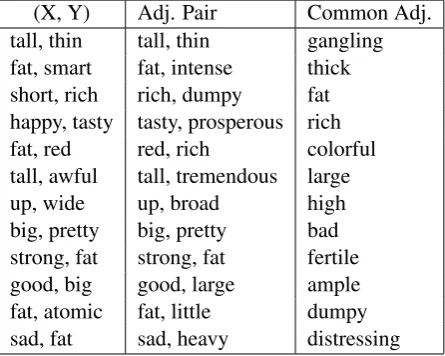
synsets contain so many different senses that a Level-2 search could easily identify two words as synonyms based off of a faulty ”common word.” Sample adjective queries are shown in the table below, along with the adjective pair that was found to be a successful Level-1 pair and the word that the two adjectives held in common.
[image:4.595.73.296.450.628.2](X, Y) Adj. Pair Common Adj. tall, thin tall, thin gangling fat, smart fat, intense thick short, rich rich, dumpy fat happy, tasty tasty, prosperous rich fat, red red, rich colorful tall, awful tall, tremendous large up, wide up, broad high big, pretty big, pretty bad strong, fat strong, fat fertile good, big good, large ample fat, atomic fat, little dumpy sad, fat sad, heavy distressing
Table 3 Misclassified examples from a Level 2 search.
Our goal now is to reconcile the undergenera-tion of Level 1 searches with the overgeneraundergenera-tion of the Level 2 searches. We do not consider searches deeper than a Level 2 search, because a Level 2 search already overgenerates.
4 Attributes
WordNet pointers contain information about a word’s attribute, which stores the word’s category, e.g. ”size” for the adjectives ”big” and ”small.” Adding checks that discard words of different attributes successfuly eliminates all the searches stored in Table 3.
The pseudocode for the altered algorithm, which includes attribute checks, is included as Al-gorithm 3. Running this altered alAl-gorithm corrects all of the results found in Table 3.
Algorithm 2ReturnstrueifXandY are Type B false positives, andf alseotherwise.
procedureTYPEB-LEVEL2-ATTR(X, Y)
Ax ←GETATTRIBUTE(X)
Ay ←GETATTRIBUTE(Y)
ifAxis notnullandAyis notnullandAx is not equal toAythen
returntrue
synsetx ←GETADJECTIVESYNSET(X)
for alliinsynsetxdo
Ai← GETATTRIBUTE(i)
ifAy is notnullandAi is notnulland
Ayis notAi then
continue
if TYPEA(i, Y) is f alse and TYPE B-LEVEL1(i, Y) isf alsethen
returnfalse
synsety ←GETADJECTIVESYNSET(Y)
for all iinsynsetydo
Ai← GETATTRIBUTE(i)
ifAxis notnullandAi is notnulland
Axis notAithen
continue
if TYPEA(i, X) is f alse and TYPE B-LEVEL1(i, X) isf alsethen
returnfalse returntrue
4.1 Limitations
The most notable limitation is that the set of adjec-tives that have attributes is extremely small, and are thus susceptible to all of the pitfalls of the Level-2 searches described in Algorithm 3. In fact, most of the adjectives contained in WordNet do not have attribute pointers. Our algorithm could be substantially improved by encoding the attribute pointer more consistently in WordNet.
two adjectives are actually synonyms, but Word-Net gives the two words different pointers. For ex-ample, the word ”good” has an attribute of ”qual-ity” whereas the word ”extraordinary” has an at-tribute of ”ordinariness.” Speakers of the English language can recognize that ”good” and ”extraor-dinary” are synonyms, but the algorithm would immediately reject them because they have differ-ent attributes.
4.2 Results
To test the algorithm, we ran four adjective pairs on it, selecting the phrases by the following crite-ria: 1) Returning a high enough number of hits on Google News so that the results can be considered significant, 2) Returning a low enough number of hits on Google News so that it is not overstrenuous to hand-classify each of the results, and 3) Adjec-tives that could be represented on a scale.
The searches were run by typing the pattern into a Google News search query in quotes (e.g. ”hot but not”). Then, each search was classified by run-ning it into the False Positive Checker described in Algorithm 1, and the accuracy of the classifica-tions were checked by hand.
Overall, the False Positive Checker returns ro-bust results for most adjectives. The vast majority of the errors occured because their attribute point-ers returnednull, leaving them susceptible to the Type 2 errors.
Altogether, for the two example searches listed above, the algorithm had 18 misclassifications out of 823 search results, for a total accuracy of 97.81%. All 823 instances described in Table 4 are instances of positives generated by Sheinman’s method, but classifying these as true positives or false positives is left up to our algorithm. The high degree of accuracy from from the searches suggests that this algorithm is successfully able to classify Sheinman’s phrases a true positives or false positives. If one could encode adjective at-tributes more consistently in WordNet, most of these errors would be able to be eliminated.
4.3 Limitations of WordNet
All of our searches rely on the ability of WordNet to classify adjectives correctly. However, many of our searches using the False Positive Checker in-dicate that there are gaps in WordNet’s structure. More specifically, limitations on attribute pointers make it difficult to completely eliminate the ap-pearance of false positives in Sheinman’s method.
phrase misclassified/total percentage hot but not 9/148 93.92% big but not 5/423 98.82% old but not 2/136 98.53% happy but not 2/116 98.28%
[image:5.595.307.530.67.153.2]Total 18/823 97.81%
Table 4 Accuracy of phrases searched on Google News.
Furthermore, synset membership is not always consistent with human intuition. For instance, both the words ”subatomic” and ”gnomish” might be included in the synset for ”small,” but ”sub-atomic” is used to describe particles, whereas ”gnomish” is used to describe people. These flaws suggest that WordNet needs to be more consistent in its attribute pointers for adjectives, as well as in how it links its adjectives together in synsets. In order to consistently be able to detect the false positive errors using Sheinman’s method, it is vital for WordNet to be improve the quality of synsets, as well as to vastly expand the coverage of its at-tribute pointers.
Finally, the dumbbell structure of WordNet as it is renders it difficult to encode adjective scales within each synset. For future use, it would be important to rework the organization of WordNet such that adjective scales could be extracted more easily.
5 Conclusion
Type A false positives suggest that adjectives X andYare on the same scale, but thatYis not more intense thanX. There are three types of Type A false positives: repetitions, antonyms, and rever-sals, and all of these can be corrected relatively easily.Type Bfalse positives occur whenXandY are not synonyms of one another and also do not fall on th same scale. Performing a Level 1 search on WordNet undergenerates false positives, but a Level 2 search overgenerates them. To solve this issue, we must use the attribute pointers, which can accurately classify the category of many of the adjectives contained in WordNet.
and the coverage of its attribute pointer.
All in all, the ability to distinguish the differ-ing intensities of adjective synonyms is vital to be-ing able to master the nuances of the English lan-gauge. By improving the accuracy of Sheinman’s method, we can continue to improve our ability to encode these unstated nuances into a lexical tool.
6 Acknowledgments
I would like to thank my advisor, Professor Chris-tiane Fellbaum, for her support and guidance in helping me with this paper. She has provided valuable assistance to the undertaking of the work summarized here. I am also grateful to Prince-ton University’s Student Activities Funding En-gine (SAFE) for their generous sponsorship of my travel to the Global WordNet Conference.
References
Fellbaum, Christiane. 1998. WordNet: an electronic lexical database. MIT Press WordNet is avail-able fromhttp://www.cogsci.princeton. edu/wn. 2010.
Vera Sheinman, Christiane Fellbaum, Isaac Julien, Pe-ter Schulam, Takenobu Tokunaga. 2013. Large, huge or gigantic? Identifying and encoding intensity relations among adjectives in WordNet. Language Resources and Evaluation, 47:1-20.
Vera Sheinman, Takenobu Tokunaga. 2009. Ad-jscales: Differentiating between similar adjectives for language learners. Proceedings of the Interna-tional conference on computer supported education (CSEDU-09), 229-235.