Distributional Composition using Higher-Order Dependency Vectors
Julie Weeds, David Weir and Jeremy Reffin Department of Informatics
University of Sussex Brighton, BN1 9QH, UK
{J.E.Weeds, D.J.Weir, J.P.Reffin}@sussex.ac.uk
Abstract
This paper concerns how to apply compo-sitional methods to vectors based on gram-matical dependency relation vectors. We demonstrate the potential of a novel ap-proach which uses higher-order grammat-ical dependency relations as features. We apply the approach to adjective-noun com-pounds with promising results in the pre-diction of the vectors for (held-out) ob-served phrases.
1 Introduction
Vector space models of semantics characterise the meaning of a word in terms of distributional fea-tures derived from word co-occurrences. The most widely adopted basis for word co-occurrence is proximity, i.e. that two words (or more generally lexemes) are taken to co-occur when they occur together within a certain sized window, or within the same sentence, paragraph, or document. Lin (1998), in contrast, took the syntactic relationship between co-occurring words into account: the dis-tributional features of a word are based on the word’s grammatical dependents as found in a de-pendency parsed corpus. For example, observing that the wordglassappears as the indirect object of the verb fill, provides evidence that the word glasshas the distributional feature iobj:fill, where
iobjdenotes the inverse indirect object grammati-cal relation. The use of grammatigrammati-cal dependents as word features has been exploited in the discovery of tight semantic relations, such as synonymy and hypernymy, where an evaluation against a gold standard such as WordNet (Fellbaum, 1998) can be made (Lin, 1998; Weeds and Weir, 2003; Cur-ran, 2004).
Pado and Lapata (2007) took this further by considering not just direct grammatical depen-dents, but also including indirect dependents. Thus, observing the sentenceShe filled her glass slowlywould provide evidence that the wordglass has the distributional feature iobj:advmod:slowly where iobj:advmod captures the indirect depen-dency relationship betweenglassandslowlyin the sentence.
Note that Pado and Lapata (2007) included a basis mapping function that gave their frame-work flexibility as to how to map paths such as
iobj:advmod:slowly onto the basis of the vector space. Indeed, the instantiation of their framework that they adopt in their experiments uses a ba-sis mapping function that removes the dependency path to leave just the word, soiobj:advmod:slowly would be mapped toslowly.
In this paper, we are concerned with the prob-lem of distributional semantic composition. We show that the idea that the distributional seman-tics of a word can be captured with higher-order dependency relationships, provides the basis for a simple approach to compositional distributional semantics. While our approach is quite gen-eral, dealing with arbitrarily high-order depen-dency relationships, and the composition of ar-bitrary phrases, in this paper we consider only first and second order dependency relations, and adjective-noun composition.
In Section 2, we illustrate our proposal by showing how second order dependency relations can play a role in computing the semantics of adjective-noun composition. In Section 3 we de-scribe a number of experiments that are intended to evaluate the approach, with the results presented in Section 4.
The basis for our evaluation follows Baroni and
Zamparelli (2010) and Guevara (2010). Typically, compositional distributional semantic models can be used to generate an (inferred) distributional vector for a phrase from the (observed) distribu-tional vectors of the phrase’s constituents. One of the motivations for doing this is that the ob-served distributional vectors for most phrases tend to be very sparse, a consequence of the frequency with which typical phrases occur in even large cor-pora. However, there are phrases that occur suffi-ciently frequently that a reasonable characterisa-tion of their meaning can be captured with their observed distributional vector. Such phrases can be exploited in order to assess the quality of a model of composition. This is achieved by mea-suring the distributional similarity of the observed and inferred distributional vectors for these high frequency phrases.
The contributions of this paper are as follows. We propose a novel approach to phrasal composi-tion which uses higher order grammatical depen-dency relations as features. We demonstrate its potential in the context of adjective-noun compo-sition by comparing (held-out) observed and in-ferred phrasal vectors. Further, we compare dif-ferent vector operations, difdif-ferent feature associa-tion scores and investigate the effect of weighting features before or after composition.
2 Composition with Higher-order Dependencies
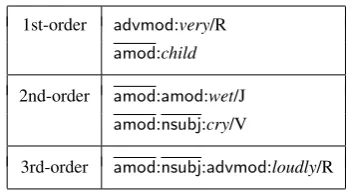
Consider the problem of adjective-noun compo-sition. For example, what is the meaning of the phrase small child? How does it relate to the meanings of the lexemessmallandchild? Figure 1 shows a dependency analysis for the sentenceThe very small wet child cried loudly. Tables 1 and 2 show the grammatical dependencies (with other open-class words) for the lexemessmallandchild which would be extracted from it.
the/D very/R small/J wet/J child/N cry/V loudly/R amod
amod advmod
det
nsubj advmod
Figure 1: Example Dependency Tree
From Table 1 we see what kinds of (higher-order) dependency paths appear in the distribu-tional features of adjectives such assmall. Simi-larly, Table 2 indicates this for nouns such aschild.
1st-order advmod:very/R
amod:child 2nd-order amod:amod:wet/J
amod:nsubj:cry/V
[image:2.595.328.504.60.155.2]3rd-order amod:nsubj:advmod:loudly/R Table 1: Grammatical Dependencies ofsmall
1st-order amod:wet/J
amod:small/J
nsubj:cry/V
2nd-order amod:advmod:very/R
[image:2.595.336.495.190.275.2]nsubj:advmod:loudly/R Table 2: Grammatical Dependencies ofchild
It is clear that with a conventional grammatical dependency-based approach where only first or-der dependencies for small and child would be considered, there will be very little overlap be-tween the features of nouns and adjectives because quite different grammatical relations are used in the two types of vectors, and correspondingly lex-emes with different parts of speech appear at the end of these paths.
However, as our example illustrates, it is possi-ble to align the 2nd-order feature space of adjec-tives with the 1st-order feature space of nouns. In this example, we have evidence thatchildren cry and thatsmall thingscry. Consequently, in order to compose an adjective with a noun, we would want to align 2nd-order features of the adjective with 1st-order features of the noun; this gives us a prediction of the first order features of the noun in the context of the adjective1.
something that we will pursue further in this paper. We now clarify how features vectors are aligned and then composed. Suppose that the lexemesw1 andw2 which we wish to compose are connected by relationr. Let w1 be the head of the relation andw2 be the dependent. In our example, w1 is child, w2 is small and r is amod. We first pro-duce a repro-duced vector for w2 which is designed to lie in a comparable feature space as the vector for w1. To do this we take the set of 2nd order features ofw2 which start with the relationr¯and reduce them to first order features (by removing ther¯at the start of the path). So in our example, we create a reduced vector for small where fea-turesamod:nsubj:xfor some tokenxare reduced tonsubj:x, featuresamod:amod:xfor some token
xare reduced to the featureamod:x, and features
amod:nsubj:advmod:x for some token x are re-duced tonsubj:advmod:x. Once the vector forw2 has been reduced, it can be composed with the vec-tor forw1using standard vector operations.
In Section 3 we describe experiments that ex-plore the effectiveness of this approach to distri-butional composition by measuring the similarity of composed vectors with observed vectors for a set of frequently occurring adjective-noun pairs (details given below). We evaluate a number of instantiations of our approach, and in particular, there are three aspects of the model where alter-native solutions are available: the choice of which vector composition operation to use; the choice of how to weight dependency features; and the ques-tion as to whether feature weighting should take place before or after composition.
Vector composition operation. We consider each of the following seven alternatives: pointwise addition (add), pointwise multiplication (mult), pointwise geometric mean2 (gm), pointwise
max-imum (max), pointwise minimum (min), first ar-gument (hd), second argument (dp). The latter two operations simply return the first (respectively second) of the input vectors.
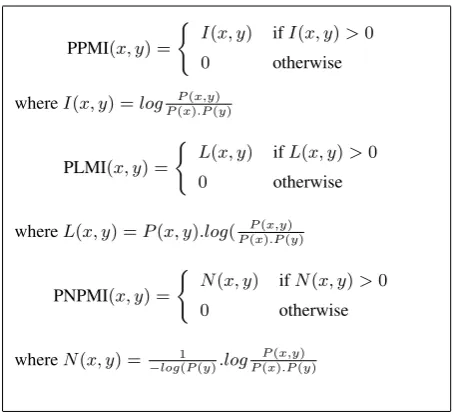
Feature weighting. We consider three options. Much work in this area has used positive pointwise mutual information (PPMI) (Church and Hanks, 1989) to weight the features. However, PPMI is known to over-emphasise low frequency events, and as a result there has been a recent shift to-wards using positive localised mutual information
2The geometric mean ofxandyisp (x·y).
PPMI(x, y) = (
I(x, y) ifI(x, y)>0 0 otherwise whereI(x, y) =log P(x,y)
P(x).P(y)
PLMI(x, y) = (
L(x, y) ifL(x, y)>0 0 otherwise
whereL(x, y) =P(x, y).log( P(x,y)
P(x).P(y)
PNPMI(x, y) = (
N(x, y) ifN(x, y)>0
0 otherwise
whereN(x, y) = 1
[image:3.595.306.533.60.268.2]−log(P(y).logPP(x()x,y.P()y)
Table 3: Feature Association Scores
(PLMI) (Scheible et al., 2013) and positive nor-malised point wise mutual information (PNPMI) (Bouma, 2009). For definitions, see Table 3.
Timing of feature weighting. We consider two alternatives: we can weight features before com-position so that the comcom-position operation is ap-plied to weighted vectors, or we can compose vec-tors prior to feature weighting, in which case the composition operation is applied to unweighted vectors, and feature weighting is applied in the context of making a similarity calculation. In other work, the former order is often implied. For exam-ple, Boleda et al. (2013) state that they use “PMI to weight the co-occurrence matrix”. However, if we allow the second order, features which might have a zero association score in the context of the the individual lexemes, could be considered sig-nificant in the context of the phrase.
3 Evaluation
not possible to draw conclusions from the absolute value of the cosine score since this would favour models which always assign higher cosine scores. Hence, we draw conclusions from the change in cosine score with respect to a baseline within the same model.
Methodology
For each noun and adjective which occur more than a threshold number of times in a corpus, we first extract conventional first order dependency vectors. The features of these lexemes define the semantic space, and feature probabilities (for use in association scores) are calculated from this data. Given a list of adjective-noun phrases, we ex-tract first order vectors for the nouns and second order vectors for the adjectives, which we refer to as observed constituent vectors. We also extract first order vectors for the nouns in the context of the adjective, which we refer to as the observed phrasal vector.
For each adjective-noun pair, we build bespoke constituent vectors for the adjective and noun, in which we remove all counts which arise from co-occurrences with that specific adjective-noun pair. It is these constituent vectors that are used as the basis for inferring the vector for that particular adjective-noun phrase.
Our rationale for this is as follows. Without this modification, the observed constituent vectors will contain co-occurrences which are due to the ob-served adjective-noun vector co-occurrences. To see why this is undesirable, suppose that one of the adjective-noun phrases wassmall child. We take the observed vector forsmall childto be what we are calling the observed phrasal vector forchild(in the context ofsmall). Suppose that when building the observed phrasal vector, we observe the phrase the small child cried. This will lead to a count for the featurensubj:cryin the observed phrasal vec-tor forchild.
But if we are not careful, this same phrase will contribute to counts in theconstituentvectors for smallandchild, producing counts for the features
amod:nsubj:cryandnsubj:cry, in their respective vectors. To see why these counts should not be in-cluded when building the constituent vectors that we compose to produce inferred vectors for the adjective-noun phrase small child, consider the case where all of the evidence forsmallthings be-ing thbe-ings that can cryandchildrenbeing things
that can crying comes from having observed the phrasesmall children crying. Despite not having learnt anything about the composition ofsmalland childin general, we would be able to infer thecry feature for the phrase. An adequate model of com-position should be able to infer this on the basis that othersmall things have been seen tocry, and that non-small childrenhave been seen tocry.
Here, we compare the proposed approach, based on higher order dependencies, with the standard method of composing conventional first-order dependency vectors. The vector operation,
hd provides a baseline for comparison which is the same in both approaches. This baseline corre-sponds to a composition model where the first or-der dependencies of the phrase (i.e. the noun in the context of the adjective) are taken to be the same as the first order dependencies of the uncontextu-alized noun. For example, if we have never seen the phrase small child before, we would assume that it means the same as the head wordchild.
We hypothesise that it is not possible to im-prove on this baseline using traditional first-order dependency relation vectors, since the vector for the modifier does not contain features of the right type, but that with the proposed approach, the in-ferred vector for a phrase such assmall childwill be closer than observed vector forchildto the ob-served vector forsmall child. We also ask the re-lated question of whether our inferred vector for small childis closer than the constituent vector for smallto the observed vector forsmall child. This comparison is achieved through use of the vector operationdpthat ignores the vector for the head, simply returning a first-order vector derived from the dependent.
Experimental Settings
Our corpus is a mid-2011 dump of WikiPedia. This has been part-of-speech tagged, lemmatised and dependency parsed using the Malt Parser (Nivre, 2004). All major grammatical dependency relations involving open class parts of speech (nsubj, dobj,iobj, conj, amod, advmod, nnmod) have been extracted for all POS-tagged and lem-matised nouns and adjectives occurring 100 or more times. In past work with conventional de-pendency relation vectors we found that using a feature threshold of100, weighting features with PPMI and a cosine similarity score work well.
spanish british african japanese modern classical female natural
digital military medical musical scientific free black white
[image:5.595.72.282.62.173.2]heavy common small large strong short long good similar previous future original former subsequent next possible
Table 4: Adjectives considered
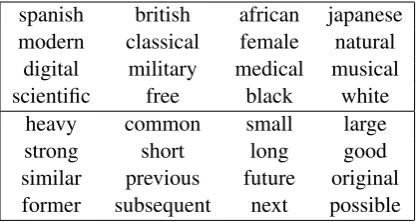
32 of the most frequently occurring adjectives (see Table 4). These adjectives include ones which would generally be considered intersective (e.g., female), subsective (e.g,, long) and non-subsective/intensional (e.g.,former) (Pustejovsky, 2013) . For all of these adjectives there are at least 100 adjective-noun phrases which occur at least 100 times in the corpus. We randomly selected 50 of the phrases for each adjective. Note that our proposed method does not require any hyper parameters to be set during training, nor does it require a certain number of phrases per adjective. For the purpose of these experiments we have a list of1600adjective-noun phrases, all of which occur at least100times in WikiPedia.
4 Results and Discussion
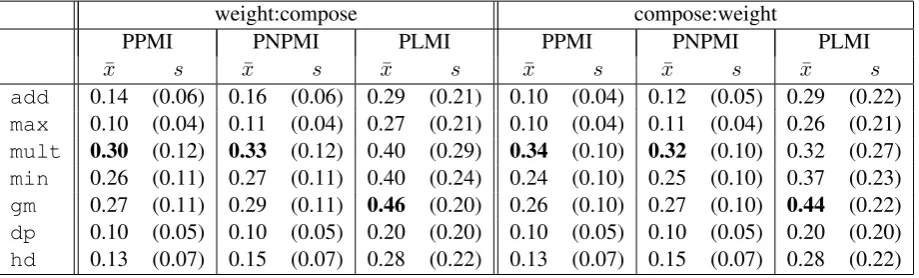
Tables 5 and 6 summarise the average cosines for the proposed higher-order dependency approach and the conventional first-order dependency ap-proach, respectively. In each case, we consider each combination of vector operation, feature as-sociation score, and composition timing (i.e. be-fore, or after, vector weighting).
Table 7 shows the average improvement over the baseline (hd), for each combination of exper-imental variables, when considering the proposed higher-order dependency approach. Note that this is an average of paired differences (and not the dif-ference of the averages in Table 6). For brevity, we omit the results for PNPMI here, since there do not appear to be substantial differences between using PPMI and PNPMI. To indicate statistical signifi-cance, we show estimated standard errors in the means. All differences are statistically significant (under a paired t-test) except those marked†.
From Table 5, we see that none of the com-positional operations on conventional dependency vectors are able to beat the baseline of selecting the head vector (hd). This is independent of the
choice of association measure and the order in which weighting and composition are carried out. For the higher order dependency vectors (Tables 6 and 7), we note, in contrast, that some com-positional operations produce large increases in cosine score compared to the head vector alone (hd). Table 7 examines the statistical significance of these differences. We find that for the inter-sective composition operations (mult,min, and
gm), performance is statistically superior to using the head alone in all experimental conditions stud-ied. By contrast, additive measures (add, max) typically have no impact, or decrease performance marginally relative to the head alone. An explana-tion for these significant differences is that inter-sective vector operations are able to encapsulate the way that an adjective disambiguates and spe-cialises the sense of the noun that it is modifying.
We also note that the alternative baseline, dp, which estimates the features of a phrase to be the aggregation of all things which are modified by the adjective, performs significantly worse than the standard baseline,hd, which estimates the fea-tures of a phrase to be the feafea-tures of the head noun. This is consistent with the intuition that the distributional vector for small child should more similar to the vector forchildthan it is to the vec-tor for the things that can besmall.
Considering the different intersective opera-tions, mult appears to be the best choice when the feature association score is PPMI or PNPMI andgmappears to be the best choice when the fea-ture association score is PLMI.
Further, PLMI consistently gives all of the vec-tor pairings higher cosine scores than PPMI. Since PLMI assigns less weight to low frequency event and more weight to high frequency events, this suggests that all of the composition methods, in-cluding the baseline (hd), do better at predicting the high frequency co-occurrences. This is not sur-prising as these will more likely have been seen with the phrasal constituents in other contexts.
weight:compose compose:weight
PPMI PNPMI PLMI PPMI PNPMI PLMI
¯
x s x¯ s x¯ s x¯ s x¯ s x¯ s
add 0.12 (0.06) 0.13 (0.05) 0.15 (0.16) 0.11 (0.05) 0.12 (0.06) 0.22 (0.20)
max 0.12 (0.06) 0.13 (0.05) 0.15 (0.16) 0.11 (0.05) 0.12 (0.06) 0.22 (0.20)
mult 0.06 (0.05) 0.06 (0.06) 0.06 (0.11) 0.07 (0.05) 0.07 (0.12) 0.07 (0.05)
min 0.05 (0.05) 0.06 (0.05) 0.04 (0.09) 0.05 (0.04) 0.05 (0.04) 0.04 (0.08)
gm 0.06 (0.05) 0.06 (0.05) 0.07 (0.11) 0.05 (0.04) 0.06 (0.04) 0.08 (0.11)
[image:6.595.73.532.62.186.2]hd 0.13 (0.07) 0.15 (0.07) 0.28 (0.22) 0.13 (0.07) 0.15 (0.07) 0.28 (0.22)
Table 5: Means and Standard Deviations for Cosines Between Observed and Predicted Vectors for Con-ventional First-Order Dependency Based Approach.
weight:compose compose:weight
PPMI PNPMI PLMI PPMI PNPMI PLMI
¯
x s x¯ s x¯ s x¯ s x¯ s x¯ s
add 0.14 (0.06) 0.16 (0.06) 0.29 (0.21) 0.10 (0.04) 0.12 (0.05) 0.29 (0.22)
max 0.10 (0.04) 0.11 (0.04) 0.27 (0.21) 0.10 (0.04) 0.11 (0.04) 0.26 (0.21)
mult 0.30 (0.12) 0.33 (0.12) 0.40 (0.29) 0.34 (0.10) 0.32 (0.10) 0.32 (0.27)
min 0.26 (0.11) 0.27 (0.11) 0.40 (0.24) 0.24 (0.10) 0.25 (0.10) 0.37 (0.23)
gm 0.27 (0.11) 0.29 (0.11) 0.46 (0.20) 0.26 (0.10) 0.27 (0.10) 0.44 (0.22)
dp 0.10 (0.05) 0.10 (0.05) 0.20 (0.20) 0.10 (0.05) 0.10 (0.05) 0.20 (0.20)
hd 0.13 (0.07) 0.15 (0.07) 0.28 (0.22) 0.13 (0.07) 0.15 (0.07) 0.28 (0.22)
Table 6: Means and Standard Deviations for Cosines Between Observed and Predicted Vectors for Pro-posed Higher-Order Dependency Based Approach
remaining features. This can be explained by considering the recall and precision of the com-posed vector’s prediction of the observed vec-tor. If we compose using gm before weighting vectors, we increase the recall of the prediction, but decrease precision. Whether we use PPMI, PNPMI or PLMI, recall of features increases from 88.8% to 99.5% and precision drops from 5.5% to 4.8%. If we compose usingmultbefore weight-ing vectors, contrary to expectation, recall de-creases and precision inde-creases. Whether we use PPMI, PNPMI or PLMI, recall of features de-creases from 88.8% to 59.4% but precision in-creases from 5.5% to 18.9%. Hence, multiplica-tion of the raw vectors is causing a lot of potential shared features to be “lost” when the weighting is subsequently carried out (since multiplication stretches out the value space). This leads to an increase in cosines when PPMI is used for weight-ing, and a decrease in cosines when PLMI is used. Hence, it appears that the features being removed by multiplying the raw vectors before weighting must be low frequency co-occurrences, which are not observed with the phrase.
5 Related Work
In this work, we bring together ideas from sev-eral different strands of distributional semantics: incorporating syntactic information into the distri-butional representation of a lexeme; representing phrasal meaning by creating distributional repre-sentations through composition; and representing word meaning in context by modifying the distri-butional representation of a word.
The use of syntactic structure in distributional representations is not new. Two of the earliest proponents of distributional semantics, Lin (1998) and Lee (1999) used features based on first order dependency relations between words in their dis-tributional representations. More recently, Pado and Lapata (2007) propose a semantic space based on dependency paths. This model outperformed traditional word-based models which do not take syntax into account in a synonymy relation detec-tion task and a prevalent sense acquisidetec-tion task.
[image:6.595.73.533.235.374.2]pro-weight:compose compose:weight
PPMI PLMI PPMI PLMI
¯
x sx¯ x¯ sx¯ x¯ sx¯ x¯ sx¯
add 0.01 (0.001) †0.004 (0.003) -0.03 (0.001) †0.006 (0.004)
max -0.03 (0.001) -0.01 (0.003) -0.04 (0.001) -0.02 (0.003)
mult 0.16 (0.002) 0.11 (0.006) 0.21 (0.002) 0.03 (0.006)
min 0.13 (0.001) 0.11 (0.007) 0.10 (0.001) 0.09 (0.007)
gm 0.14 (0.001) 0.18 (0.005) 0.12 (0.001) 0.16 (0.005)
[image:7.595.115.486.62.185.2]dp -0.03 (0.002) -0.09 (0.007) -0.04 (0.002) -0.09 (0.007)
Table 7: Means and Standard Errors for Increases in Cosine with respect to thehdBaseline for Proposed Higher-Order Dependency Based Approach. All differences statistically significant (under a paired t-test) except those marked†.
duce a data structure that represents the phrase or sentence. Mitchell and Lapata (2008, 2010) found that simple additive and multiplicative func-tions applied to proximity-based vector represen-tations were no less effective than more com-plex functions when performance was assessed against human similarity judgements of simple paired phrases.
The simple functions evaluated by Mitchell and Lapata (2008) are generally acknowledged to have serious theoretical limitations in their treatment of composition. How can a commutative func-tion such as multiplicafunc-tion or addifunc-tion provide dif-ferent interpretations for difdif-ferent word orderings such as window glass and glass window? The majority of attempts to rectify this have offered a more complex, non-commutative function — such as weighted addition — or taken the view that some or all words are no longer simple vec-tors. For example, in the work of Baroni and Zamparelli (2010) and Guevara (2010), an adjec-tive is viewed as a modifying function and rep-resented by a matrix. Coecke et al. (2011) and Grefenstette et al. (2013) also incorporate the no-tion of funcno-tion applicano-tion from formal seman-tics. They derived function application from syn-tactic structure, representing functions as tensors and arguments as vectors. The MV-RNN model of Socher et al. (2012) broadened the Baroni and Zamparelli (2010) approach; all words, regardless of part-of-speech, were modelled with both a vec-tor and a matrix. This approach also shared fea-tures with Coecke et al. (2011) in using syntax to guide the order of phrasal composition. These higher order structures are typically learnt or in-duced using a supervised machine learning tech-nique. For example, Baroni and Zamparelli (2010)
learnt their adjectival matrixes by performing re-gression analysis over pairs of observed nouns and adjective-noun phrases. As a consequence of the computational expense of the machine learning techniques involved, implementations of these ap-proaches typically require a considerable amount of dimensionality reduction.
A long-standing topic in distributional seman-tics has been the modification of a canonical repre-sentation of a lexeme’s meaning to reflect the con-text in which it is found. Typically, a canonical vector for a lexeme is estimated from all corpus occurrences and the vector then modified to reflect the instance context (Lund and Burgess, 1996; Erk and Pad´o, 2008; Mitchell and Lapata, 2008; Thater et al., 2009; Thater et al., 2010; Thater et al., 2011; Van de Cruys et al., 2011; Erk, 2012). As described in Mitchell and Lapata (2008, 2010), lexeme vectors have typically been modified using simple additive and multiplicative compositional functions. Other approaches, however, share with our proposal the use of syntax to drive modifica-tion of the distribumodifica-tional representamodifica-tion (Erk and Pad´o, 2008; Thater et al., 2009; Thater et al., 2010; Thater et al., 2011). For example, in the SVS rep-resentation of Erk and Pad´o (2008), a word was represented by a set of vectors: one which en-codes its lexical meaning in terms of distribution-ally similar words3, and one which encodes the
tor of the contextualising word.
Turney (2012) offered a model of phrasal level similarity which combines assessments of word-level semantic relations. This work used two different word-level distributional representations to encapsulate two types of similarity. Distribu-tional similarity calculated from proximity-based features was used to estimate domain similarity and distributional similarity calculated from syn-tactic pattern based features is used to estimate functional similarity. The similarity of a pair of compound noun phrases was computed as a func-tion of the similarities of the components. Cru-cially different from other models of phrasal level similarity, it does not attempt to derive modified vectors for phrases or words in context.
6 Conclusions and Further Work
Vectors based on grammatical dependency rela-tions are known to be useful in the discovery of tight semantic relations, such as synonymy and hypernymy, between lexemes (Lin, 1998; Weeds and Weir, 2003; Curran, 2004). It would be use-ful to be able to extend these methods to deter-mine similarity between phrases (of potentially different lengths). However, conventional proaches to composition, which have been ap-plied to proximity-based vectors, cannot sensibly be used on vectors that are based on grammatical dependency relations.
In our approach, we consider the vector for a phrase to be the vector for the head lexeme in the context of the other phrasal constituents. Like Pado and Lapata (2007), we extend the concept of a grammatical dependency relation feature to include dependency relation paths which incor-porate higher-order dependencies between words. We have shown how it is possible to align the de-pendency path features for words of different syn-tactic types, and thus produce composed vectors which predict the features of one constituent in the context of the other constituent.
In our experiments with AN compounds, we have shown that these predicted vectors are closer than the head constituent’s vector to the observed phrasal vector. We have shown this is true even when the observed phrase is in fact unobserved, i.e. when its co-occurrences do not contribute to the constituents’ vectors. Consistent with work us-ing proximity-based vectors, we have found that intersective operations perform substantially
bet-ter than additive operations. This can be under-stood by viewing the intersective operations as en-capsulating the way that adjectives can specialise the meaning of the nouns that they modify.
We have investigated the interaction between the vector operation used for composition, the fea-ture association score and the timing of applying feature weights. We have found that multiplication works best if using PPMI to weight features, but that geometric mean is better if using the increas-ingly popular PLMI weighting measure. Whilst applying an intersective composition operation be-fore applying feature weighting does allow more features to be retained in the predicted vector (it is possible to achieve 99.5% recall), in general, this does not correspond with an increase in co-sine scores. In general, the corresponding drop in precision (i.e., the over-prediction of unobserved features) causes the cosine to decrease. The one exception to this is using multiplication with the PPMI feature weighting score. Here we actually see a drop in recall, and an increase in precision due to the nature of multiplication and PPMI.
One assumption that has been made throughout the work, is that the observed phrasal vector pro-vides a good estimate of the distributional repre-sentation of the phrase and, consequently, the best composition method is the one which returns the most similar prediction. However, in general, we notice that while the recall of the compositional methods is good, the precision is very low. Lack of precision may be due to the prevalence of plausi-ble, but unobserved, co-occurrences of the phrase. Consequently, this introduces uncertainty into the conclusions which can be drawn from a study such as this. Further work is required to develop effec-tive intrinsic and extrinsic evaluations of models of composition.
A further interesting area of study is whether distributional models that include higher-order grammatical dependencies can tell us more about the lexical semantics of a word than the conven-tional first-order models, for example by distin-guishing semantic relations such as synonymy, antonymy, hypernymy and co-hyponymy.
Acknowledgements
References
Marco Baroni and Roberto Zamparelli. 2010. Nouns are vectors, adjectives are matrices: Representing adjective-noun constructions in semantic space. In
Proceedings of the 2010 Conference on Empirical Methods in Natural Language Processing.
Gemma Boleda, Marco Baroni, The Nghia Pham, and Louise McNally. 2013. Intensionality was only al-leged: On adjective-noun composition in distribu-tional semantics. InProceedings of the 10th Inter-national Conference on Computational Semantics (IWCS 2013) – Long Papers, pages 35–46, Pots-dam, Germany, March. Association for Computa-tional Linguistics.
Gerlof Bouma. 2009. Normalised (point wise) mu-tual information in collocation extraction, from form to meaning: Processing texts automatically. In Pro-ceedings of the Biennial International Conference of the German Society for Computational Linguistics and Language Technology.
Kenneth Ward Church and Patrick Hanks. 1989. Word association norms, mutual information, and lexicog-raphy. InProceedings of the 27th Annual Meeting on Association for Computational Linguistics, ACL ’89, pages 76–83, Stroudsburg, PA, USA. Associa-tion for ComputaAssocia-tional Linguistics.
Bob Coecke, Mehrnoosh Sadrzadeh, and Stephen Clark. 2011. Mathematical foundations for a com-positional distributed model of meaning. Linguistic Analysis, 36(1-4):345–384.
James Curran. 2004. From Distributional to Semantic Similarity. Ph.D. thesis, University of Edinburgh. Katrin Erk and Sebastian Pad´o. 2008. A structured
vector space model for word meaning in context. In Proceedings of the 2008 Conference on Empiri-cal Methods in Natural Language Processing, pages 897–906, Honolulu, Hawaii, October. Association for Computational Linguistics.
Katrin Erk. 2012. Vector space models of word mean-ing and phrase meanmean-ing: a survey. Language and Linguistics Compass, 6(10):635–653.
Christiane Fellbaum. 1998. WordNet: An Electronic Lexical Database. Bradford Books.
Edward Grefenstette, Georgiana Dinu, Yao-Zhong Zhang, Mehrnoosh Sadrzadeh, and Marco Baroni. 2013. Multi-step regression learning for compo-sitional distributional semantics. Proceedings of the 10th International Conference on Computational Semantics (IWCS 2013).
Gregory Grefenstette. 1994. Corpus-derived first, sec-ond and third-order word affinities. InProceedings of Euralex 1994.
Emiliano Guevara. 2010. A Regression Model of Adjective-Noun Compositionality in Distributional
Semantics. InProceedings of the ACL GEMS Work-shop, pages 33–37.
Lillian Lee. 1999. Measures of distributional simi-larity. InProceedings of the 37th Annual Meeting of the Association for Computational Linguistics, pages 25–32, College Park, Maryland, USA, June. Association for Computational Linguistics.
Dekang Lin. 1998. Automatic retrieval and clustering of similar words. InProceedings of the 17th Inter-national Conference on Computational Linguistings (COLING 1998).
K. Lund and C. Burgess. 1996. Producing high-dimensional semantic spaces from lexical co-occurrence. Behavior Research Methods, Instru-mentation, and Computers, 28:203–208.
Jeff Mitchell and Mirella Lapata. 2008. Vector-based models of semantic composition. In Proceedings of ACL-08: HLT, pages 236–244, Columbus, Ohio, June. Association for Computational Linguistics. Jeff Mitchell and Mirella Lapata. 2010. Composition
in distributional models of semantics. Cognitive Sci-ence, 34(8):1388–1429.
Joakim Nivre. 2004. Incrementality in determinis-tic dependency parsing. InProceedings of the ACL Workshop on Incremental Parsing, pages 50–57. Sebastian Pado and Mirella Lapata. 2007.
Dependency-based construction of semantic space models. Computational Linguistics, 33(2):161–199. James Pustejovsky. 2013. Inference patterns with in-tensional adjectives. In Proceedings of the IWCS Workshop on Interoperable Semantic Annotation, Potsdam,Germany, March. Association for Compu-tational Linguistics.
Silke Scheible, Sabine Schulte im Walde, and Sylvia Springorum. 2013. Uncovering distributional dif-ferences between synonyms and antonyms in a word space model. In Proceedings of the International Joint Conference on Natural Language Processing, pages 489–497, Nagoya, Japan.
Heinrich Sch¨utze. 1998. Automatic word sense dis-crimination. Computational Linguistics, 24(1):97– 123.
Richard Socher, Brody Huval, Christopher D Manning, and Andrew Y Ng. 2012. Semantic compositional-ity through recursive matrix-vector spaces. In Pro-ceedings of the 2012 Joint Conference on Empiri-cal Methods in Natural Language Processing and Computational Natural Language Learning, pages 1201–1211. Association for Computational Linguis-tics.
Stefan Thater, Hagen F¨urstenau, and Manfred Pinkal. 2010. Contextualizing semantic representations us-ing syntactically enriched vector models. In Pro-ceedings of the 48th Annual Meeting of the Associa-tion for ComputaAssocia-tional Linguistics, pages 948–957, Uppsala, Sweden, July. Association for Computa-tional Linguistics.
Stefan Thater, Hagen Frstenau, and Manfred Pinkal. 2011. Word meaning in context: A simple and ef-fective vector model. InProceedings of 5th Interna-tional Joint Conference on Natural Language Pro-cessing (IJCNLP 2011).
P. D. Turney and P. Pantel. 2010. From frequency to meaning: Vector space models of semantics. Jour-nal of Artificial Intelligence Research, 37:141–188. Peter D. Turney. 2012. Domain and function: A
dual-space model of semantic relations and compositions.
Journal of Artificial Intelligence Research, 44. Tim Van de Cruys, Thierry Poibeau, and Anna
Korho-nen. 2011. Latent vector weighting for word mean-ing in context. In Proceedings of the 2011 Con-ference on Empirical Methods in Natural Language Processing, pages 1012–1022, Edinburgh, Scotland, UK., July. Association for Computational Linguis-tics.