Overview of the Entity Relations (REL) supporting task of
BioNLP Shared Task 2011
Sampo Pyysalo∗ Tomoko Ohta∗ Jun’ichi Tsujii† ∗
Department of Computer Science, University of Tokyo, Tokyo, Japan
†
Microsoft Research Asia, Beijing, China
{smp,okap}@is.s.u-tokyo.ac.jp, [email protected]
Abstract
This paper presents the Entity Relations (REL) task, a supporting task of the BioNLP Shared Task 2011. The task concerns the ex-traction of two types of part-of relations be-tween a gene/protein and an associated en-tity. Four teams submitted final results for the REL task, with the highest-performing system achieving 57.7% F-score. While experiments suggest use of the data can help improve event extraction performance, the task data has so far received only limited use in support of event extraction. The REL task continues as an open challenge, with all resources available from the shared task website.
1 Introduction
The BioNLP Shared Task 2011 (BioNLP ST’11) (Kim et al., 2011a), the follow-up event to the BioNLP’09 Shared Task (Kim et al., 2009), was organized from August 2010 (sample data release) to March 2011. The shared task was divided into two stages, with supporting tasks carried out be-fore the main tasks. The motivation for this task setup drew in part from analysis of the results of the previous shared task, which suggested that events that involve coreference or entity relations repre-sent particular challenges for extraction. To help ad-dress these challenges and encourage modular ex-traction approaches, increased sharing of successful solutions, and an efficient division of labor, the two were separated into independent supporting tasks on Coreference (CO) (Nguyen et al., 2011) and Entity Relations in BioNLP ST’11. This paper presents the Entity Relations (REL) supporting task.
2 Task Setting
In the design of the REL task, we followed the gen-eral policy of the shared task in assuming named entity recognition (NER) as a given starting point: participants were provided with manually annotated gold standard annotations identifying gene/protein names in all of the training, development, and final test data. By limiting effects due to NER perfor-mance, the task remains more specifically focused on the key challenge studied.
Following the results and analysis from previous studies (Pyysalo et al., 2009; Ohta et al., 2010), we chose to limit the task specifically to relations in-volving a gene/protein named entity (NE) and one other entity. Fixing one entity involved in each re-lation to an NE helps assure that the rere-lations are “anchored” to real-world entities, and the specific choice of the gene/protein NE class further pro-vides a category with several existing systems and substantial ongoing efforts addressing the identifica-tion of those referents through named entity recog-nition and normalization (Leaman and Gonzalez, 2008; Hakenberg et al., 2008; Krallinger et al., 2008; Morgan et al., 2008; Wermter et al., 2009). The recognition of biologically relevant associations of gene/protein NEs is a key focus of the main event extraction tasks of the shared task. By contrast, in the REL task setting, only one participant in each binary relation is a gene/protein NE, while the other can be either a non-name reference such aspromoter or the name of an entity not of the gene/protein type (e.g. a complex).1Motivated in part by the relatively limited number of existing methods for the
detec-1
Pronominal references are excluded from annotation scope.
Figure 1: Simple REL annotation example showing a PROTEIN-COMPONENT (PR-CO) relation between “hi-stone H3” and “lysine 9”. An associated METHYLATION
event and its arguments (shaded, not part of the REL task targets) shown for context.
tion of such entity references, their detection is in-cluded in the task: participants must recognize these secondary entities in addition to extracting the rela-tions they participate in. To limit the demands of this NER-type task, these entities are not assigned spe-cific types but rather the generic type ENTITY, and exact matching of their boundaries is not required (see Section 4).
The general task setting encompasses a rich set of potential relation extraction targets. For the task, we aimed to select relations that minimize overlap between the targets of other tasks while maintain-ing relevance as a supportmaintain-ing goal. As the main tasks primarily target events (“things that happen”) involving change in entities, we chose to focus in the REL task on what we have previously termed “static relations” (Pyysalo et al., 2009), that is, rela-tions such as part-of that hold between entities with-out necessary implication of causality or change. A previous study by Van Landeghem et al. (2010) in-dicated that this class of relations may benefit event extraction. We based our choice of specific target relation on previous studies of entity relations do-main texts (Pyysalo et al., 2009; Ohta et al., 2010), which indicated that part-whole relations are by far the most frequent class of relevant relations for the task setting and proposed a classification of these relations for biomedical entities. We further found that – in terms of the taxonomy of Winston et al. (1987) – object-component and collection-member relations account for the the great majority of part-of relations relevant to the domain. For REL, we chose to omit collection-member relations in part to minimize overlap with the targets of the coreference task. Instead, we focused on two specific types of object-component relations, that holding between a gene or protein and its part (domain, regions, pro-moters, amino acids, etc.) and that between a protein
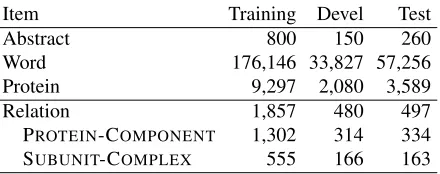
Item Training Devel Test
Abstract 800 150 260
Word 176,146 33,827 57,256
Protein 9,297 2,080 3,589
Relation 1,857 480 497
[image:2.612.317.537.59.146.2]PROTEIN-COMPONENT 1,302 314 334 SUBUNIT-COMPLEX 555 166 163
Table 1: REL dataset statistics.
and a complex that it is a subunit of. Following the biological motivation and the general practice in the shared task to term genes and gene products PRO -TEIN for simplicity, we named these two relations PROTEIN-COMPONENT and SUBUNIT-COMPLEX. Figure 1 shows an illustration of a simple relation with an associated event (not part of REL). Events withSitearguments such as that shown in the figure are targeted in the GE, EPI, and ID tasks (Kim et al., 2011b; Ohta et al., 2011; Pyysalo et al., 2011) that REL is intended to support.
3 Data
The task dataset consists of new annotations for the GENIA corpus (Kim et al., 2008), building on the existing biomedical term annotation (Ohta et al., 2002), the gene and gene product name annota-tion (Ohta et al., 2009) and the syntactic annotaannota-tion (Tateisi et al., 2005) of the corpus. The general fea-tures of the annotation are presented by Pyysalo et al. (2009), describing a previous release of a subset of the data. The REL task annotation effort extended the coverage of the previously released annotation to all relations of the targeted types stated within sen-tence scope in the GENIA corpus.
NLP Extraction Other resources
Rank Team Org Word Parse Entities Relations Corpora Other
1 UTurku 1BI Porter McCCJ + SD SVM SVM -
-2 VIBGhent 1NLP, 1ML, 1BI Porter McCCJ + SD SVM SVM GENIA, PubMed word similarities
3 ConcordU 2NLP - McCCJ + SD Dict Rules -
-3 HCMUS 6L OpenNLP OpenNLP Dict Rules -
-Table 2: Participants and summary of system descriptions. Abbreviations: BI=Bioinformatician, NLP=Natural Language Processing researcher, ML=Machine Learning researcher, L=Linguist, Porter=Porter stemmer, McCCJ=McClosky-Charniak-Johnson parser, SD=Stanford Dependency conversion, Dict=Dictionary
UTurku VIBGhent ConcordU HCMUS
PROTEIN-COMPONENT 50.90 / 68.57 /58.43 47.31 / 36.53 / 41.23 23.35 / 52.05 / 32.24 20.96 / 21.63 / 21.29 SUBUNIT-COMPLEX 48.47 / 66.95 /56.23 47.85 / 38.12 / 42.43 26.38 / 39.81 / 31.73 4.91 / 66.67 / 9.14
Total 50.10 / 68.04 /57.71 47.48 / 37.04 / 41.62 24.35 / 46.85 / 32.04 15.69 / 23.26 / 18.74
Table 3: Primary evaluation results for the REL task. Results given as recall / precision / F-score.
4 Evaluation
The evaluation of the REL task is relation-based and uses the standard precision/recall/F1-score metrics. Similarly to the BioNLP’09 ST and most of the 2011 main tasks, the REL task relaxes the equality criteria for matching text-bound annotations: for a submis-sion entity to match an entity in the gold reference annotation, it is sufficient that the span of the sub-mitted entity (i.e. its start and end positions in text) is entirely contained within the span of the gold an-notation. This corresponds largely to the approxi-mate span matchingcriterion of the 2009 task (Kim et al., 2009), although the REL criterion is slightly stricter in not involving testing against an extension of the gold entity span. Relation matching is exact: for a submitted relation to match a gold one, both its type and the related entities must match.
5 Results
5.1 Participation
Table 2 summarizes the participating groups and ap-proaches. We find a remarkable number of sim-ilarities between the approaches of the systems, with all four utilizing full parsing and a depen-dency representation of the syntactic analysis, and the three highest-ranking further specifically the phrase structure parser of Charniak and Johnson (2005) with the biomedical domain model of
Mc-Closky (2009), converted into Stanford Dependency form using the Stanford tools (de Marneffe et al., 2006). These specific choices may perhaps be influ-enced by the success of systems building on them in the 2009 shared task (e.g. Bj¨orne et al. (2009)). While UTurku (Bj¨orne and Salakoski, 2011) and VIBGhent (Van Landeghem et al., 2011) further agree in the choice of Support Vector Machines for the recognition of entities and the extraction of rela-tions, ConcordU (Kilicoglu and Bergler, 2011) and HCMUS (Le Minh et al., 2011) pursue approaches building on dictionary- and rule-based extraction. Only the VIBGhent system makes use of resources external to those provided for the task, extracting specific semantic entity types from the GENIA cor-pus as well as inducing word similarities from a large unannotated corpus of PubMed abstracts.
5.2 Evaluation results
[image:3.612.75.554.59.134.2]system, UTurku, shows an F-score in the general range of state-of-the-art results in the main event extraction task, which could be taken as an indica-tion that the reliability of REL task analyses created with presently available methods may not be high enough for direct use as a building block for the main tasks. However, the emphasis of the UTurku system on precision is encouraging for such ap-plications: nearly 70% of the entity-relation pairs that the system predicts are correct. The two top-ranking systems show similar precision and recall results for the two relation types. The submission of HCMUS shows a decided advantage for PROTEIN -COMPONENT relation extraction as tentatively pre-dicted from the relative numbers of training exam-ples (Section 3 and Table 1), but their rule-based approach suggests training data size is likely not the decisive factor. While the limited amount of data available prevents strong conclusions from be-ing drawn, overall the lack of correlation between training data size and extraction performance sug-gests that performance may not be primarily limited by the size of the available training data.
6 Discussion
The REL task was explicitly cast in a support role for the main event extraction tasks, and REL par-ticipants were encouraged to make their predictions of the task extraction targets for the various main task datasets available to main task participants. The UTurku team responded to this call for supporting analyses, running their top-ranking REL task sys-tem on all main task datasets and making its output available as a supporting resource (Stenetorp et al., 2011). In the main tasks, we are so far aware of one application of this data: the BMI@ASU team (Emadzadeh et al., 2011) applied the UTurku REL predictions as part of their GE task system for re-solving theSitearguments in events such as BIND -INGand PHOSPHORYLATION(see Figure 1). While more extensive use of the data would have been de-sirable, we find this application of the REL analyses very appropriate to our general design for the role of the supporting and main tasks and hope to see other groups pursue similar possibilities in future work.
7 Conclusions
We have presented the preparation, resources, re-sults and analysis of the Entity Relations (REL) task, a supporting task of the BioNLP Shared Task 2011 involving the recognition of two specific types of part-of relations between genes/proteins and associ-ated entities. The task was run in a separate early stage in the overall shared task schedule to allow participants to make use of methods and analyses for the task as part of their main task submissions.
Of four teams submitting finals results, the highest-performing system, UTurku, achieved a pre-cision of 68% at 50% recall (58% F-score), a promising level of performance given the relative novelty of the specific extraction targets and the short development period. Nevertheless, challenges remain for achieving a level of reliability that would allow event extraction systems to confidently build on REL analyses to address the main information extraction tasks. The REL task submissions, repre-senting four independent perspectives into the task, are a valuable resource for further study of both the original task data as well as the relative strengths and weaknesses of the participating systems. In future work, we will analyse this data in detail to better understand the challenges of the task and effective approached for addressing them.
The UTurku team responded to a call for sup-porting analyses by providing predictions from their REL system for all BioNLP Shared Task main task datasets. These analyses were adopted by at least one main task participant as part of their system, and we expect that this resource will continue to serve to facilitate the study of the position of part-of relations in domain event extraction. The REL task will continue as an open shared challenge, with all task data, evaluation software, and analysis tools available to all interested parties from http://
sites.google.com/site/bionlpst/.
Acknowledgments
References
Jari Bj¨orne and Tapio Salakoski. 2011. Generaliz-ing biomedical event extraction. In Proceedings of the BioNLP 2011 Workshop Companion Volume for Shared Task, Portland, Oregon, June. Association for Computational Linguistics.
Jari Bj¨orne, Juho Heimonen, Filip Ginter, Antti Airola, Tapio Pahikkala, and Tapio Salakoski. 2009. Extract-ing complex biological events with rich graph-based feature sets. InProceedings of the BioNLP 2009 Work-shop Companion Volume for Shared Task, pages 10– 18, Boulder, Colorado, June. Association for Compu-tational Linguistics.
Eugene Charniak and Mark Johnson. 2005. Coarse-to-Fine n-Best Parsing and MaxEnt Discriminative Reranking. InProceedings of the 43rd Annual Meet-ing of the Association for Computational LMeet-inguistics (ACL’05), pages 173–180.
Marie-Catherine de Marneffe, Bill MacCartney, and Christopher D. Manning. 2006. Generating Typed Dependency Parses from Phrase Structure Parses. In Proceedings of the Fifth International Conference on Language Resources and Evaluation (LREC’06), pages 449–454.
Ehsan Emadzadeh, Azadeh Nikfarjam, and Graciela Gonzalez. 2011. Double layered learning for bio-logical event extraction from text. In Proceedings of the BioNLP 2011 Workshop Companion Volume for Shared Task, Portland, Oregon, June. Association for Computational Linguistics.
J. Hakenberg, C. Plake, R. Leaman, M. Schroeder, and G. Gonzalez. 2008. Inter-species normaliza-tion of gene mennormaliza-tions with GNAT. Bioinformatics, 24(16):i126.
Halil Kilicoglu and Sabine Bergler. 2011. Adapting a general semantic interpretation approach to biological event extraction. InProceedings of the BioNLP 2011 Workshop Companion Volume for Shared Task, Port-land, Oregon, June. Association for Computational Linguistics.
Jin-Dong Kim, Tomoko Ohta, and Jun’ichi Tsujii. 2008. Corpus annotation for mining biomedical events from literature.BMC Bioinformatics, 9(10).
Jin-Dong Kim, Tomoko Ohta, Sampo Pyysalo, Yoshi-nobu Kano, and Jun’ichi Tsujii. 2009. Overview of BioNLP’09 Shared Task on Event Extraction. In Proceedings of Natural Language Processing in Biomedicine (BioNLP) NAACL 2009 Workshop, pages 1–9.
Jin-Dong Kim, Sampo Pyysalo, Tomoko Ohta, Robert Bossy, and Jun’ichi Tsujii. 2011a. Overview of BioNLP Shared Task 2011. In Proceedings of the BioNLP 2011 Workshop Companion Volume for
Shared Task, Portland, Oregon, June. Association for Computational Linguistics.
Jin-Dong Kim, Yue Wang, Toshihisa Takagi, and Aki-nori Yonezawa. 2011b. Overview of the Genia Event task in BioNLP Shared Task 2011. In Proceedings of the BioNLP 2011 Workshop Companion Volume for Shared Task, Portland, Oregon, June. Association for Computational Linguistics.
M. Krallinger, A. Morgan, L. Smith, F. Leitner, L. Tan-abe, J. Wilbur, L. Hirschman, and A. Valencia. 2008. Evaluation of text-mining systems for biology: overview of the Second BioCreative community chal-lenge. Genome biology, 9(Suppl 2):S1.
Quang Le Minh, Son Nguyen Truong, and Quoc Ho Bao. 2011. A pattern approach for biomedical event anno-tation. InProceedings of the BioNLP 2011 Workshop Companion Volume for Shared Task, Portland, Oregon, June. Association for Computational Linguistics. R. Leaman and G. Gonzalez. 2008. Banner: an
exe-cutable survey of advances in biomedical named en-tity recognition. Pacific Symposium on Biocomputing, pages 652–663.
David McClosky. 2009. Any Domain Parsing: Auto-matic Domain Adaptation for Natural Language Pars-ing. Ph.D. thesis, Department of Computer Science, Brown University.
A.A. Morgan, Z. Lu, X. Wang, A.M. Cohen, J. Fluck, P. Ruch, A. Divoli, K. Fundel, R. Leaman, J. Haken-berg, et al. 2008. Overview of BioCreative II gene normalization.Genome biology, 9(Suppl 2):S3. Ngan Nguyen, Jin-Dong Kim, and Jun’ichi Tsujii. 2011.
Overview of the Protein Coreference task in BioNLP Shared Task 2011. InProceedings of the BioNLP 2011 Workshop Companion Volume for Shared Task, Port-land, Oregon, June. Association for Computational Linguistics.
Tomoko Ohta, Yuka Tateisi, Hideki Mima, and Jun’ichi Tsujii. 2002. GENIA corpus: An annotated research abstract corpus in molecular biology domain. In Pro-ceedings of the Human Language Technology Confer-ence (HLT’02), pages 73–77.
Tomoko Ohta, Jin-Dong Kim, Sampo Pyysalo, Yue Wang, and Jun’ichi Tsujii. 2009. Incorporating GENETAG-style annotation to GENIA corpus. In Proceedings of BioNLP’09, pages 106–107.
Companion Volume for Shared Task, Portland, Oregon, June. Association for Computational Linguistics. Sampo Pyysalo, Tomoko Ohta, Jin-Dong Kim, and
Jun’ichi Tsujii. 2009. Static Relations: a Piece in the Biomedical Information Extraction Puzzle. In Proceedings of Natural Language Processing in Biomedicine (BioNLP) NAACL 2009 Workshop, pages 1–9, Boulder, Colorado. Association for Computa-tional Linguistics.
Sampo Pyysalo, Tomoko Ohta, Rafal Rak, Dan Sul-livan, Chunhong Mao, Chunxia Wang, Bruno So-bral, Jun’ichi Tsujii, and Sophia Ananiadou. 2011. Overview of the Infectious Diseases (ID) task of BioNLP Shared Task 2011. In Proceedings of the BioNLP 2011 Workshop Companion Volume for Shared Task, Portland, Oregon, June. Association for Computational Linguistics.
Pontus Stenetorp, Goran Topi´c, Sampo Pyysalo, Tomoko Ohta, Jin-Dong Kim, and Jun’ichi Tsujii. 2011. BioNLP Shared Task 2011: Supporting Resources. In Proceedings of the BioNLP 2011 Workshop Compan-ion Volume for Shared Task, Portland, Oregon, June. Association for Computational Linguistics.
Yuka Tateisi, Akane Yakushiji, Tomoko Ohta, and Jun’ichi Tsujii. 2005. Syntax annotation for the GE-NIA corpus. In Proceedings of IJCNLP’05, pages 222–227.
Sofie Van Landeghem, Sampo Pyysalo, Tomoko Ohta, and Yves Van de Peer. 2010. Integration of static re-lations to enhance event extraction from text. In Pro-ceedings of the 2010 Workshop on Biomedical Natural Language Processing, pages 144–152.
Sofie Van Landeghem, Thomas Abeel, Bernard De Baets, and Yves Van de Peer. 2011. Detecting entity rela-tions as a supporting task for bio-molecular event ex-traction. In Proceedings of the BioNLP 2011 Work-shop Companion Volume for Shared Task, Portland, Oregon, June. Association for Computational Linguis-tics.
J. Wermter, K. Tomanek, and U. Hahn. 2009. High-performance gene name normalization with GeNo. Bioinformatics, 25(6):815.