Transliteration based Search Engine for Multilingual Information Access
Anand Arokia Raj
Speech and Language Technology Lab Bhrigus Software (I) Pvt Ltd
Hyderabad, India
Harikrishna Maganti
Speech and Language Technology Lab Bhrigus Software (I) Pvt Ltd
Hyderabad, India
Abstract
Most of the Internet data for Indian languages exist in various encodings, causing difficul-ties in searching for the information through search engines. In the Indian scenario, ma-jority web pages are not searchable or the in-tended information is not efficiently retrieved by the search engines due to the following: (1) Multiple text-encodings are used while authoring websites. (2) Inspite of Indian languages sharing common phonetic nature, common words like loan words (borrowed from other languages like Sanskrit, Urdu or English), transliterated terms, pronouns etc., can not be searched across languages. (3) Fi-nally the query input mechanism is another major problem. Most of the users hardly know how to type in their native language and pre-fer to access the information through English based transliteration. This paper addresses all these problems and presents a transliteration based search engine (inSearch) which is ca-pable of searching 10 script and multi-encoded Indian languages content on the web.
1 Introduction
India is a multi-language and multi-script coun-try with 23 official languages and 11 written script forms. About a billion people in India use these lan-guages as their first language. About 5% of the pop-ulation (usually the educated class) can understand English as their second language. Hindi is spoken by about 30% (G. E. Burkhart, S. E. Goodman, A. Mehta and L. Press, 1998) of the population, but it is concentrated in urban areas and north-central India,
and is still not only foreign, but often unpopular in many other regions.
Though considerable amount of Indic content is available on the World Wide Web (WWW), we can observe that search development is very less when compared to the official languages of the United Na-tions (UN). The primary reason for this can be at-tributed for much delayed standards and lack of sup-port from operating systems and browsers in ren-dering Indic scripts. This caused web publishers to develop their own proprietory encodings/fonts, who are now hesitant to use available standards such as Unicode/ISCII. This creates a major hinderance in accessing Indian content through existing search en-gines.
Most of the search engines support Indic search in Unicode data only. But, considerable amount of content is available in ASCII based font encod-ings which is much larger (more dynamic also) than Unicode (Unicode Consortium - Universal Code Standard, 1991) or ISCII (ISCII - Indian Stan-dard Code for Information Interchange, 1983) for-mats. Apart from this, language independent infor-mation like loan words, transliterated words, pro-nouns etc., are also not accessible across Indian lan-guages. Most users are familiar with English key-board typing than any Indian language, and would be interested to query through English translitera-tion. So, a meta standard transliteration scheme (IT3 sec3.1) has to be commonly defined across all the Indian languages, and the web content has to be appropriately converted. Also, the web pages need to be indexed using phonetic features like (diphone/triphones/syllables), which will be
nient to retrieve and rank the pages. In this paper, we incorporate all these aspects to make search en-gine as the meaningful searching tool for Indian lan-guages.
The paper is organized into six sections. The first section explains the nature of Indic scripts. The second section details the various major en-coding formats and transliteration scheme used to store and render Indic data. In section three, novel approaches for preprocessing Indic data like font-encoding identification and font-data conversion are explained. In section four, the experiments regard-ing stemmregard-ing and grapheme-to-phoneme (G2P) for Indian-English using Classification and Regression Tree (CART) are described and stop words identifi-cation is also explained. The fifth section discusses the issues in developing a multi-lingual search en-gine for Indian languages. The sixth section explains the three possible ways to devlope a cross-lingual search engine. Finally the report and summary are included with conclusion.
2 Nature of Indic Scripts
The scripts in Indian languages have originated from the ancient Brahmi script. The basic units of the writing system are referred to as Aksharas. The properties of Aksharas are as follows: (1) An Ak-shara is an orthographic representation of a speech sound (2) Aksharas are syllabic in nature (3) The typical forms of Akshara are V, CV, CCV and CCCV, thus have a generalized form of C*V. The shape of an Akshara depends on its composition of consonants and the vowel, and sequence of the con-sonants. In defining the shape of an Akshara, one of the consonant symbols acts as pivotal symbol (re-ferred to as semi-full form). Depending on the con-text, an Akshara can have a complex shape with other consonant and vowel symbols being placed on top, below, before, after or sometimes surrounding the pivotal symbol (referred to as half-form).
Thus to render an Akshara electronically, a set of semi-full or half-forms have to be rendered, which are in turn rendered using a set of basic shapes referred to as glyphs. Often a semi-full form or half-form is rendered using two or more glyphs, thus there is no one-to-one correspondence between glyphs of a font and semi-full or half-forms.
2.1 Convergence and Divergence
All Indian languages except English and Urdu share a common phonetic base, i.e., they share a com-mon set of speech sounds. While all of these lan-guages share a common phonetic base, some of the languages such as Hindi, Marathi and Nepali also share a common script known as Devanagari. But languages such as Telugu, Kannada and Tamil have their own scripts. The property which distinguishes these languages can be attributed to the phonotactics in each of these languages rather than the scripts and speech sounds. Phonotactics is the permissible com-bination of phones that can co-occur in a language.
This knowledge helps us in designing a common transliteration scheme, and also in identifying and converting different text encodings.
3 Indic Data Formats
Another aspect involved in the diversity of electronic content of Indian languages is their format of digi-tal storage. Storage formats like ASCII (American Standard Code for Information Interchange) based fonts, ISCII (Indian Standard code for Information Interchange), Unicode and phonetic based translit-eration schemes are often used to store the digital text data in Indian languages. Most of the text is rendered using some fonts of these formats.
3.1 Phonetic Transliteration Schemes
To handle diversified storage formats of scripts of Indian languages such as ASCII based fonts, ISCII and Unicode etc., it is useful and becomes essen-tial to use a meta-storage format. ISO 15919 stan-dards (Transliteration of Indic Scripts: How to use ISO 15919, ) describes development of translitera-tion for Indic scripts. A transliteratranslitera-tion scheme maps the Aksharas of Indian languages onto English al-phabets and it could serve as meta-storage format for text-data. Since Aksharas in Indian languages are orthographic representation of speech sound, and they have a common phonetic base, it is suggested to have a phonetic transliteration scheme such as IT3 (Ganapathiraju M., Balakrishnan M., Balakrishnan N. and Reddy R., 2005) (Prahallad Lavanya, Pra-hallad Kishore and GanapathiRaju Madhavi, 2005). Thus, when the font-data is converted into IT3, it es-sentially turns the whole effort into font-to-Akshara conversion. Thus IT3 transliteration is used as com-mon representation scheme for all Indic data for-mats. The same is used to get the input from the user also.
4 Indic Data Preprocessing
In search engine development, it is an absolute re-quirement that the content should be in an unique format to build a efficient index table. So, prepro-cessing the web content is unavoidable here. Most of the Indian language electronic data is either Uni-code enUni-coded or glyph based font enUni-coded. Process-ing Unicode data is quite straight forward because it follows distinguished code ranges for each language and there is a one-to-one correspondence between glyphs (shapes) and characters. But this is not true in the case of glyph based font encoded data. Hence, it becomes necessary to identify the font encoding and convert the font-data into a phonetic transliteration sheme like IT3. The following subsections explain the stages in detail.
4.1 Font-Encoding Identification
The problem of font-identification could be defined as, given a set of words or sentences to identify the font-encoding by finding the minimum distance be-tween the input glyph codes and the models repre-senting font-encodings. Existing works (Anil Ku-mar Singh and Jagadeesh Gorla, 2007) addressed the
Table 1: Font-Type Identification for Words.
Font Name Uniglyph Biglyph Triglyph Amarujala (Hindi) 100% 100% 100% Jagran (Hindi) 100% 100% 100% Webdunia (Hindi) 0.1% 100% 100% Shree-Tel (Telugu) 7.3% 100% 100% Eenadu (Telugu) 0.2% 100% 100% Vaarttha (Telugu) 29.1% 100% 100% E-Panchali (Tamil) 93% 100% 100% Amudham (Tamil) 100% 100% 100% Shree-Tam (Tamil) 3.7% 100% 100%
English-Text 0% 96.3% 100%
same problem but with limited success.
In this context, the proposed approach (A. A. Raj and K. Prahallad, 2007) use vector space model and Term Frequency - Inverse Document Frequency (TF-IDF) for font-encoding identification. This ap-proach is used to weigh each term in the font-data according to its uniqueness. Thus it captures the relevancy among term and document. Here, Term:
refers to a unit of glyph. In this work, experiments are performed with different units such as single glyphgi (uniglyph), two consecutive glyphs gi−1gi (biglyph) and three consecutive glyphs gi−1gigi+1
(triglyph). Document: It refers to the font-data (words and sentences) in a specific font-encoding.
To build a model for each font-encoding scheme, we need sufficient data. So we have collected man-ually an average of 0.12 million unique words per type for nearly 37 different glyph based fonts. To create a vector space model for a font-encoding, pri-marily the term (uniglyph or biglyph or triglyph) is extracted out of the font-data. Then TF-IDF weights are calculated for all terms in the documents.
Table 2: Font-Type Identification for Sentences.
Font Name Uniglyph Biglyph Triglyph Amarujala (Hindi) 100% 100% 100% Jagran (Hindi) 100% 100% 100% Webdunia (Hindi) 100% 100% 100% Shree-Tel (Telugu) 100% 100% 100% Eenadu (Telugu) 0% 100% 100% Vaarttha (Telugu) 100% 100% 100% E-Panchali (Tamil) 100% 100% 100% Amudham (Tamil) 100% 100% 100% Shree-Tam (Tamil) 100% 100% 100%
English-Text 0% 100% 100%
of test data were prepared for testing. One is a set of unique words and the other is a set of sentences. It should also be noted that the accuracy depends on various factors: a) The number of font-encodings from which the identifier has to select one b) The in-herent confusion of one font-encoding with another and c) The type of unit used in modeling. For 1000 different number of inputs (words and sentences) we have identified the closest models and calculated the accuracy. It is repeatedly done for various (uniglyph, biglyph and triglyph) categories. From Tables 1 and 2, it is clear that triglyph seems to be an appropriate unit for a term in the identification of font-encoding. It can also be seen that the performance at word and sentence level is 100% with triglyph.
4.2 Font-Data Conversion
The problem of font-data conversion could be de-fined as a module whose input is sequence of glyph codes and whose output is a sequence of Aksharas (characters) of Indian languages.
Existing methods and solutions proposed by (Hi-manshu Garg, 2005) (Khudanpur S. and Schafer C., Devanagari Converters, 2003) lack in, a) Framing a generic methodology or algorithm for conversion of font-data of all Indian languages b) Since glyph codes are manually constructed, 100% accurate con-version is achievable c) Existing methods requires large amount of effort for each font-encoding d) Large number of rules have to be written for rule based system e) Large parallel corpora has to be pre-pared for training f) They don’t exploit shape and positional information of the glyphs, thus reducing
accuracy in conversion process.
Exploiting Position and Shape Information: (A. A. Raj and K. Prahallad, 2007) Characters in Indian languages change their shape where they appear (top, bottom, left, right) in the script. In this work, an unambiguous glyph code mapping is done by intro-ducing a simple alphanumeric scheme where the al-phabets denote the corresponding phoneme and the number denotes the glyph position. We followed IT3 phonetic notations and the position numbers as described below. Glyphs which could be in a) piv-otal (center) position are referred by code 0/1. b) left position of pivotal symbol are referred by code 2. c) right position of pivotal symbol are referred by code 3. d) top position of pivotal symbol are referred by code 4. e) bottom position of pivotal symbol are referred by code 5.
Training: First in the training, a font-encoding for a language is selected and a glyph-map table is pre-pared by hand-coding the relation between glyphs (suffixed with their position and shape information) and IT3 notations. In the second stage, a simple set of glyph assimilation rules are defined (Multi-Lingual Screen Reader and Processing of Font-data in Indian Languages, ). We iterated through the fol-lowing steps until there are minimal errors on held-out test set of words. Results are checked for errors using human evaluation. If errors are found then the rules are updated or redefined. The above process is repeated for 3 different font-encodings of different font-families of the chosen language.
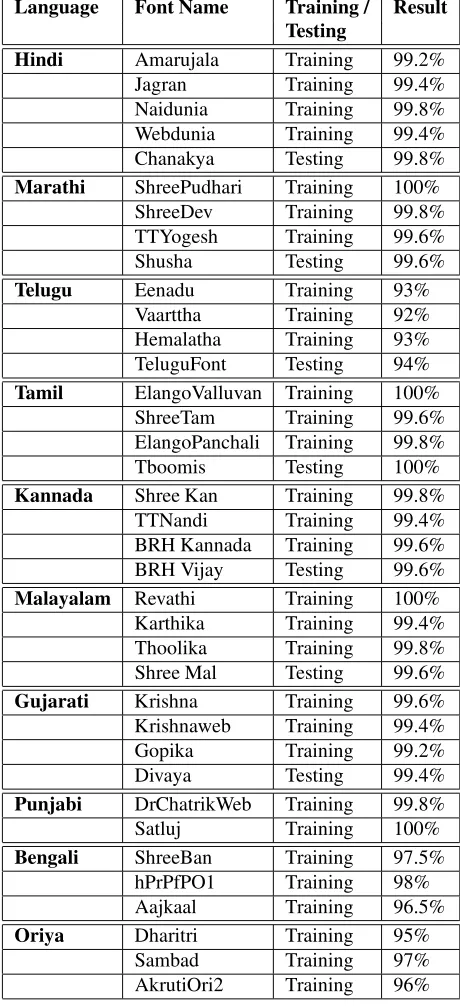
In Table 3, we can observe inferior performance for Telugu. It is due to the number of glyphs and their possible combinations are higher than other languages. Also it is common for all Indian lan-guages that the pivotal character glyph comes first and other supporting glyphs come next in the script. But in Telugu the supporting glyphs may come be-fore the pivotal glyph which creates ambiguity in forming assimilation rules.
5 Experiments and Discussion
In this section, the experiments performed to build the tools/modules are explained. Most of them used the CART tool to train and test. These modules/tools are integrated and used for development of the pro-posed search engine.
5.1 CART (Classification and Regression Tree)
CART is a decision tree procedure introduced by Breiman et al., in 1984. CART uses an exhaus-tive, recursive partitioning routine to generate binary splits that divide each parent node into two child nodes by posing a series of yes-no questions. CART searches for questions that split nodes into relatively homogenous child nodes. As the tree evolves, the nodes become increasingly more homogenous, iden-tifying segments. The basic CART building algo-rithm is a greedy algoalgo-rithm which chooses the lo-cally best discriminatory feature at each stage in the process.
Stop Parameter: The stop parameter specifies the minimum number of samples necessary in the train-ing set before a question is hypothesized to distin-guish the group. Normally with smaller stop value the model may become over-trained. The optional stop value may differ for different datasets of differ-ent languages.
Predictee: In a given feature set, the feature that is to be predicted as the output is termed as the pre-dictee. By default, the first feature in the feature-set is taken as the predictee, but always the predictee can be specified while giving the description of the data. Some times CART is over-fit with training data, which may reduce the performance.
Feature Selection: Many experiments were con-ducted for different problems like grapheme to phoneme conversion (G2P) for English
(Indian-Table 3: Font-Data Conversion Results (Precision Val-ues).
Language Font Name Training / Result Testing
Hindi Amarujala Training 99.2% Jagran Training 99.4% Naidunia Training 99.8% Webdunia Training 99.4% Chanakya Testing 99.8% Marathi ShreePudhari Training 100%
ShreeDev Training 99.8% TTYogesh Training 99.6%
Shusha Testing 99.6%
Telugu Eenadu Training 93% Vaarttha Training 92% Hemalatha Training 93% TeluguFont Testing 94% Tamil ElangoValluvan Training 100%
ShreeTam Training 99.6% ElangoPanchali Training 99.8%
Tboomis Testing 100%
Kannada Shree Kan Training 99.8% TTNandi Training 99.4% BRH Kannada Training 99.6% BRH Vijay Testing 99.6% Malayalam Revathi Training 100%
Karthika Training 99.4% Thoolika Training 99.8% Shree Mal Testing 99.6% Gujarati Krishna Training 99.6% Krishnaweb Training 99.4% Gopika Training 99.2%
Divaya Testing 99.4%
Punjabi DrChatrikWeb Training 99.8%
Satluj Training 100%
Bengali ShreeBan Training 97.5% hPrPfPO1 Training 98% Aajkaal Training 96.5% Oriya Dharitri Training 95%
Sambad Training 97%
[image:5.612.312.542.161.664.2]English) and stemming. These experiments were conducted with different possible features and stop values. Features for English G2P conversion were manually prepared for each letter and for stemming, the roots were manually identified for each word. The features vary from experiment to experiment and consequently the dimension of the features also vary.
Evaluation: For each experiment, we have con-sidered ’N’ number of words per language and we have generated ’M’ number of features out of them. From the available features we have segregated ’X’ number of features for training and ’Y’ number of features for testing in 80:20 ratio. Using these sets, we have evaluated the training and testing perfor-mance for various stop values.
5.2 Stemming
Stemming is the use of linguistic analysis to get to the root form of a word. Search engines that use stemming compare the root forms of the search terms to the documents in its database. For example, if the user enters “viewer” as the query, the search engine reduces the word to its root (”view”) and re-turns all documents containing the root - like doc-uments containing view, viewer, viewing, preview, review etc. Since our training data is very small it fails for out-of-vocabulary words. And also, it fails for homographs (a homograph is one of a group of words that share the same spelling but have different meanings).
For stemming in Indian languages, inflections of the words are formed mostly by suffixes than pre-fixes. So considering the first 5 phones of a word would help to predict the root of the word. But, for English prefixes as well as suffixes are equally used to form inflections. So prefixes are separated and considered as a single unit like a phone here. So we have selected the features like
• First 6 phones for English and
• First 5 phones for Indian languages
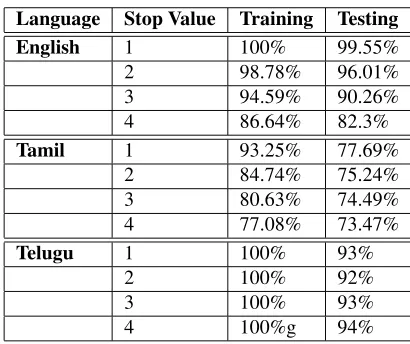
[image:6.612.323.528.100.272.2]Stemming results for various languages are shown in Table 4. It shows that sto-value 1 would be op-timal, when we used training and testing features in the ratio 907:227 for English, 3606:902 for Tamil and 987:247 for Telugu.
Table 4: Stemming Performance.
Language Stop Value Training Testing
English 1 100% 99.55%
2 98.78% 96.01%
3 94.59% 90.26%
4 86.64% 82.3%
Tamil 1 93.25% 77.69%
2 84.74% 75.24%
3 80.63% 74.49%
4 77.08% 73.47%
Telugu 1 100% 93%
2 100% 92%
3 100% 93%
4 100%g 94%
5.3 English G2P Conversion
Our search uses phonetic features like syllables. In cross-linguagl search support for English input is neccessary. So we need a mechanism to convert the query from its grapheme form to phoneme form. It is very challenging since English words doesn’t fol-low one-to-one correspondence between its letters and its phonemes.
For G2P conversion of English words, the letters of the word are used as features. We hypothesize that the first and last letters of the word and previ-ous and next letters of the current letter help much to predict its phoneme. So we have selected the fea-tures like
• First and Last letters of the word and Previous and Next letters of the Current letter
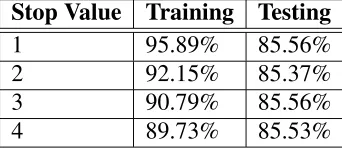
The G2P conversion results for Indian-English is shown in Table 5. It shows that stop-value 1 would be optimal for a training feature set of 106896 and testing feature set of 26724.
5.4 Stop Words Identification
Table 5: English G2P Conversion Performance.
Stop Value Training Testing
1 95.89% 85.56%
2 92.15% 85.37%
3 90.79% 85.56%
4 89.73% 85.53%
words for Indian languages have not been identified yet. So, we tried to generate the list by the basic idea that the most common words of a language might have occurred more frequently than other words in the corpus. We generated a list of top 500 frequently occurred words in a language. Then stop words list was produced with the help of a linguist who manu-ally cleaned it.
6 inSearch - Search Engine for Indian Languages
Most information seekers use a search engine to begin their web activity (Prasad Pingali, Jagadeesh Jalagarlamudi and Vasudeva Varma, 2006). In this case, users submit a query (typically a list of key-words) and receive a list of web pages that may be relevant. In conventional information retrieval sys-tems (Google, Live, Yahoo, Guruji etc.) the user must enter a search query in the language/encoding of the documents in order to retrieve it. This re-striction clearly limits the amount of information to which an user will have access.
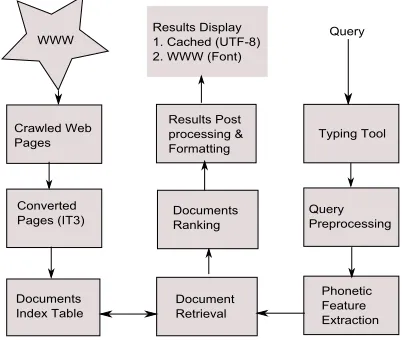
Developing a search engine for Indian languages faces many challenges. Some of them are, identify-ing the text-encodidentify-ing of the web content, convertidentify-ing them into a transliteration scheme, developing stem-mers and identifying the stop words etc. Also one need to design a good mechanism/tool (A. Joshi, A. Ganu, A. Chand, V. Parmar and G. Mathur, 2004) to accept user’s query in transliteration scheme or standard encoding like UTF-8 and even in English also. inSearch is a search engine for Indian lan-guages developed by considering all the above dis-cussed issues and solutions. Fig 1 shows the basic architecture and the following sub-sections explain them further.
6.0.1 Web Crawling
Our web crawling is language focused. It takes a list of identified URLs per language for which we have converters. Then it crawls those pages and stores the documents locally for further processing. It maintains the same directory structure as on the web and ordered by date.
6.0.2 Indexing
The effectiveness of any search engine mainly de-pends on its index structure. The structure should be capable of catering sufficient and relevant informa-tion to the users in terms of their needs. To serve users with the contexual information in their own language, the system needs to index on meaning rep-resentation and not on plain text. Also, the size of the index should not be too large.
Conventional search engines use stemming tech-nology to get the root of the word and index the doc-ument about it. Thus, it will search not only for the search terms, but also for its inflexions and similar to some or all of those terms. But in case of Indian lan-guages, there is no effective algorithm or tool to do stemming. So we used phonetic features like sylla-bles to index the pages. We extract the first two syl-lables (since they are almost equal to the root of the word most of the times) of the word and index about it. Since, we have identified a method for stemming, we used them also for indexing. The detailed exper-iments are provided in the above section 5.2. Our index structure includes syllables, stem, word, term-frequency, language, date and doc-id. This struc-ture enables efficient multi-lingual and cross-lingual search.
6.0.3 Retrieval
6.0.4 User Interface
[image:8.612.85.286.311.481.2]Presently, there is no standard/convenient nota-tion or keyboard layout to input the query in Indian languages. Even with UTF-8 encoding most of the users don’t know how to type the query. So, for cross-lingual search we provide a phonetic mapping table to be refered by the user to type the query in IT3 notation. But for language specific search, we provide a query typing tool. This tool has buttons for characters of the selected language. By click-ing the buttons, user can type the query in his native script since most of the queries won’t be more than a word/phrase. After forming the query, user can search the web and the ranked results are displayed much like the standard search engine’s results. Here the cached pages for even font encoded pages are displayed in UTF-8 encoding.
Figure 1: Search Engine Architecture.
7 Cross-Lingual Search
The development of digital and online information repositories has created many opportunities and new problems in information retrieval. Online docu-ments are available Internationally in many different languages. This makes it possible for users to di-rectly access previously unimagined sources of in-formation. However in conventional information re-trieval systems, the user must enter a search query in the language of the documents in order to retrieve it. This restriction clearly limits the amount and type of information which an individual user really has access to. Cross Language Information Retrieval
(CLIR) (F. Gey, N. Kando and C. Peters, 2002) (L. S. Larkey, M. S. Connell and N. Abduljaleel, 2003) enables users to enter queries in languages they are fluent in, and uses language translation methods to retrieve documents originally written in other lan-guages.
The aim of this attempt is to extend the search ca-pability to search across all Indian languages. The users are ordinary Indians who master one of the In-dian languages, but have only passive knowledge in the other neighbour languages. This means that they can read a text but not search for it since they do not have active knowledge of how the different concepts in the other languages are written or spelled. This will also strengthen the use of the Indian languages on the Internet and further avoid unnecessary use of the English language. We are trying to achieve it step-by-step by using the below mentioned methods.
1.Phonetic Relativeness Measure: In this ap-proach the phonetic distance (how many inser-tions/substitutions/deletions occured) between the query words and the available words is calculated. Then the closest words are considered as query re-lated words and the results are produced for those words. There are many methods to calculate the phonetic distance and we used DTW (Dynamic Time Warping) method to calculate the phonetic dis-tance for our experiments. We used equal weightage (i.e 1) for insertion, substitution and deletion here.
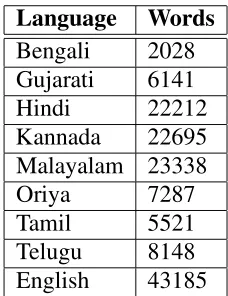
2.Dictionary Lookup: Here bilingual/multilingual dictionaries are used to get the translation of the key-words. Creating such dictionaries for all the words of a language is time consuming process. Instead, creating dictionaries for the stems of the words alone will reduce the effort. Unfortunately there are no such dictionaries available or methods to create the stems for all Indian languages. So we developed CART based decision trees to produce the stems. We have created such stem based bilingual dictionaries for 5 Indian languages. Also, we have created a mul-tilingual dictionary (Table 6) for 8 Indian languages by keeping English words as keys.
Table 6: Multi-lingual Dictionary.
Language Words Bengali 2028 Gujarati 6141 Hindi 22212 Kannada 22695 Malayalam 23338 Oriya 7287 Tamil 5521 Telugu 8148 English 43185
Cross Language Information Retrieval (CLIR) and Machine Translation (MT). But such systems for In-dian languages are under development. We are also focussing our effort in the same direction to use it with our engine in the future.
8 Conclusion
In this paper we discussed the importance of be-ing able to search the Indian language web content and presented a multi-lingual web search engine in-Search capable of searching 10 Indian languages. The nature of Indic scripts, Indic data storage for-mats and how to preprocess them efficiently are de-tailed. It explained about how language identifica-tion, grapheme to phoneme conversion for English and stemming can be achieved using CART. This shows that transcoding of proprietary encodings into a meta standard transliteration scheme makes Indian language web content accessible through search en-gines.
9 Acknowledgments
We like to thank Speech and Language Technolo-gies Lab, Bhrigus (India) Pvt Ltd, Hyderabad, In-dia and our collegues Ms.Bhuvaneshwari, Mr.Prasad and others for all their support and encouragement.
References
A. Joshi, A. Ganu, A. Chand, V. Parmar and G. Mathur. 2004. Keylekh: a keyboard for text entry in indic
scripts. CHI ’04 Extended Abstract on Human Fac-tors in Computing Systems, ACM Press.
A. A. Raj and K. Prahallad. 2007. Identification and conversion of font-data in indian languages. InIn In-ternational Conference on Universal Digital Library (ICUDL), Pittsburgh, USA.
A. K. Singh and J. Gorla. 2007. Identification of lan-guages and encodings in a multilingual document. In
Proceedings of the 3rd ACL SIGWAC Workshop on Web As Corpus, Louvain-la-Neuve, Belgium.
Dr. P. Bhattacharyya. 2006. White paper on cross lingual search and machine translation. Proposal to Govern-ment of India.
F. Gey, N. Kando and C. Peters. 2002. Cross language information retrieval: A research roadmap.SIGIR Fo-rum, 36(2):72–80.
G. E. Burkhart, S. E. Goodman, A. Mehta and L. Press. 1998. The internet in india: Better times ahead? Com-mun. ACM, 41(11):21–26.
G. Salton and C. Buckley. 1988. Term-weighting ap-proaches in automatic text retrieval. Information Pro-cess. Management, 24(5):513–523.
M. Ganapathiraju , M. Balakrishnan , N. Balakrishnan and R. Reddy 2005. Om: One tool for many (in-dian) languages. Journal of Zhejiang University Sci-ence, 6A(11):1348–1353.
H. Garg. 2005. Overcoming the font and script barriers among indian languages. MS Thesis at International Institute of Information Technology Hyderabad, India. ISCII - Indian Standard Code for Information
Inter-change. 1983. http://tdil.mit.gov.in/standards.htm. S.Khudanpur and C.Schafer , Devanagari Converters.
2003. http://www.cs.jhu.edu/cschafer/jhu devanagari cvt ver2.tar.gz.
L. S. Larkey, M. S. Connell and N. Abduljaleel. 2003. Hindi clir in thirty days. ACM Trans. on Asian Lan-guage Information Processing (TALIP), 2(2):130–142. P. Lavanya, P. Kishore and G. R. Madhavi. 2005. A simple approach for building transliteration editors for indian languages. Journal of Zhejiang University Sci-ence, 6A(11):1354–1361.
P. Prasad , J. Jagadeesh and V. Varma. 2006. Webkhoj: Indian language ir from multiple character encodings.
International World Wide Web Conference.
Transliteration of Indic Scripts: How to use ISO 15919. http://homepage.ntlworld.com/stone-catend/trind.htm. Unicode Consortium - Universal Code Standard. 1991.
http://www.unicode.org.
Multi-Lingual Screen Reader and Processing of Font-data in Indian Languages.