Using First and Second Language Models to Correct Preposition Errors
in Second Language Authoring
Matthieu Hermet Alain Désilets
School of Information Technology and Engineering
Institute for Information Technology
University of Ottawa National Research Council of Canada
800, King Edward, Ottawa, Canada
Bldg M-50, Montreal Road, Ottawa, K1A 0R6, Canada
[email protected] [email protected]
Abstract
In this paper, we investigate a novel approach to correcting grammatical and lexical errors in texts written by second language authors. Contrary to previous approaches which tend to use unilingual models of the user's second language (L2), this new approach uses a sim-ple roundtrip Machine Translation method which leverages information about both the author’s first (L1) and second languages. We compare the repair rate of this roundtrip translation approach to that of an existing ap-proach based on a unilingual L2 model with shallow syntactic pruning, on a series of preposition choice errors. We find no statisti-cally significant difference between the two approaches, but find that a hybrid combina-tion of both does perform significantly better than either one in isolation. Finally, we illus-trate how the translation approach has the po-tential of repairing very complex errors which would be hard to treat without leverag-ing knowledge of the author's L1.
1 Introduction
In this paper, we investigate a novel approach to correcting grammatical and lexical errors in texts written by second language learners or authors. Contrary to previous approaches which tend to use unilingual models of the user's second language
(L2), this new approach uses a translation model based on both the user's first (L1) and second lan-guages. It has the advantage of being able to model linguistic interference phenomena, that is, errors which are produced through literal translation from the author's first language. Although we apply this method in the context of French-as-a-Second-Lan-guage, its principles are largely independent of lan-guage, and could also be extended to other classes of errors. Note that this is preliminary work which, in a first step, focuses on error correction, and ig-nores for now the preliminary step of error detec-tion which is left for future research.
This work is of interest to applications in Comput-er-Assisted-Language-Learning (CALL) and Intel-ligent Tutoring Systems (ITS), where tutoring ma-terial often consists of drills such as fill-in-the-blanks or multiple-choice-questions. These require very little use of a learner's language production capacities, and in order to support richer free-text assessment capabilities, ITS systems thus need to use error detection and correction functionalities (Heift and Schulze, 2007).
Editing Aids (EA) are tools which assist a user in producing written compositions. They typically use rules for grammar checking as well as lexical heuristics to suggest stylistic tips, synonyms or fal-lacious collocations. Advanced examples of such
tools include Antidote1 for French and StyleWriter2
for English. Text Editors like MS Word and Word Perfect also include grammar checkers, but their style checking capabilities tend to be limited. All these tools can provide useful assistance to editing style, but they were not designed to assist with many errors found typically in highly non-idiomat-ic sentences produced by L2 authors.
Recent work in the field of error correction, espe-cially as applied to English in the context of En-glish as a Second Language (ESL), show an in-creasing use of corpora and language models. These have the advantage of offering a model of correctness based on common usage, independent-ly of any meta-information on correctness. Corpus-based approaches are also able to correct higher level lexical-syntactic errors, such as the choice of preposition which is often semantically governed by other parts of the sentence.
The reminder of this paper is organized as follows. In section 2, we give a detailed account of the problem of preposition errors in a Second Lan-guage Learning (SLL) context. Related work is re-viewed in section 3 and the algorithmic framework is presented in section 4. An evaluation is dis-cussed in section 5, and conclusions and directions for future research are presented in section 6.
2 The Preposition Problem
Prepositions constitute 14% of all tokens produced in most languages (Fort & Guillaume 2007). They are reported as yielding among the highest error class rates across various languages (Izumi, 2004, for Japanese, Granger et al., 2001, for French). In their analysis of a small corpus of advanced-inter-mediate French as a Second Language (FSL) learn-ers, Hermet et al. (2008) found that preposition choice accounted for 17.2 % of all errors. Preposi-tions can be seen as a special class of cognates, in the sense that the same L1 preposition used in ferent L1 sentences, could translate to several dif-ferent L2 prepositions.
Automatic error detection/correction methods often process prepositions and determiners in the same way because they both fall in the class of
function-1 www.druide.com 2 www.stylewriter-usa.com
words. However, one can make the argument that preposition errors deserve a different and deeper kind of treatment, because they tend to be more se-mantically motivated (event hough some preposi-tions governed by verbs draw a purely functional relation). In contrast, determiners are not semanti-cally motivated and only vary on the register of quantity (or genre in some languages).
For example, there are 37 determiners in French, most of which can be used interchangeably without significantly affecting the syntax of a sentence, and often, not even its meaning ("I'll have one coffee"/"I'll have a coffee"/"I'll have some coffee"/"I'll have my coffee"/"I'll have coffee" are all rather alike). Comparatively, there are 85 sim-ple prepositions and 222 compounds ones and they cannot be used interchangeably without signifi-cantly modifying the sense of an utterance, except for cases of synonymy.
In this paper, we focus our attention on preposition correction only, as it seems to be a more complex problem than determiners. While in principle the methods described here could handle determiner errors, we feel that our framework, which involves parsing in combination with a very large language model and Machine Translation, constitutes heav-ier machinery than is warranted for that simpler problem.
There are two major causes of preposition errors in a SLL context. The first kind is caused by lexical confusion within the second language itself. For example, a L2 author writing in English may erro-neously use a location preposition like "at" where another location preposition like "in" would have been more appropriate. The second kind involves linguistic interference between prepositions in L1 and prepositions in L2 (Granger et al., 2001). For example, a Second Language Learner who wants to render the following two English sentences in French "I go to Montreal" and "I go to Argentina",
might use the same French preposition "à" for "to", when in fact, French usage dictates that you write
Studies have found that the majority of errors made by L2 authors (especially intermediate to advanced ones) are caused by such linguistic interference (Wang and Garigliano, 1992, Cowan, 1983, p 109). Note that this kind of linguistic interference can of-ten lead to much more severe and hard to repair er-rors, as illustrated by the following example, taken from an actual SLL corpus. Say a native English author wants to render "Police arrived at the scene of the crime" into French (her L2). Because she is not fluent in French, she translates the last part of the sentence to "à la scène de la crime". This liter-al translation turns out to be highly unidiomatic in French, and should instead be written as "sur les lieux du crime" (which in English, would translate literally to "on the location of the crime").
One might suspect that preposition errors of the first type would be solvable using unilingual L2 language models, but that the second type might benefit from a language model which also takes L1 into account. This is the main question investigated in this paper.
3 Related Work
Historically, grammatical error correction has been done through parsing-based techniques such as syntactic constraint-relaxation (L'haire & Vande-venter-Feltin, 2003), or mal-rules modeling (Schneider and McCoy, 1998). But generating the rule-bases needed by these types of approaches in-volves a lot of manual work, and may still in the end be too imprecise to convey information on the nature and solution of an error. Recently, more ef-fort has been put in methods that rely on automati-cally built language models. Typiautomati-cally, this kind of work will focus either on a restricted class of errors or on specific domains. Seneff and Lee (2006) pro-pose a two-phased generation-based framework where a n-gram model re-ranked by a stochastic context-free-grammar model is used to correct sen-tence-level errors in the language domain of flight reservation. Brockett et al. (2006) used a Brown noise channel translation model to record patterns of determiner error correction on a small set of mass-nouns, and reducing the error spectrum in both class and semantic domain, but adding detec-tion capabilities. Note that although they use a
translation model, it processes only text that is in one language. More specifically, the system learned to "translate" from poorly written English into correctly written English.
Chodorow et al. (2007) employed a maximum en-tropy model to estimate the probability of 34 prepositions based on 25 local context features ranging from words to NP/VP chunks. They use lemmatization as a means of generalization and trained their model over 7 million prepositional contexts, achieving results of 84% precision and 19% recall in preposition error detection in the best of the system's configurations. Gamon et al. (2008) worked on a similar approach using only tagged trigram left and right contexts: a model of preposi-tions uses serves to identify preposition errors and the Web provides examples of correct form. They evaluate their framework on the task of preposition identification and report results ranging from 74 to 45% precision on a set of 13 prepositions.
Yi et al. (2008) use the Web as corpus and send segments of sentences of varying length as bag-of-constituents queries to retrieve occurrence con-texts. The number of the queried segments is a PoS condition of "check-points" sensitive to typical er-rors made by L2 authors. The contexts retrieved are in turn analyzed for correspondence with the original input. The detection and correction meth-ods differ according to the class of the error. Deter-miner errors call for distinct detection and correc-tion procedures while collocacorrec-tion errors use the same procedure for both. Determiner errors are dis-covered by thresholds ratios on search hits statis-tics, taking into account probable ambiguities, since multiple forms of determiners can be valid in a single context. Collocation errors on the other hand, are assessed only by a threshold on absolute counts, that is, a form different from the input au-tomatically signals an error and provides its correc-tion. This suggests that detection and correction procedures coincide when the error ceases to bear on a function word.
al-ternate sentences for each error. The main interest of their study is the use of a syntax-based sentence generalization method to maximize the likelihood that at least one of the alternatives will have at least one hits on the Web. They achieve accuracy of 69% in error repair (no error detection), on a small set of clauses written by FSL Learners.
Very little work has been done to actually exploit knowledge of a L2 author's first language, in cor-recting errors. Several authors (Wang and Garigliano, 1992, Anderson, 1995, La Torre, 1999, Somers, 2001) have suggested that students may learn by analyzing erroneous sentences pro-duced by a MT system, and reflecting on the prob-able cause of errors, especially in terms of interfer-ence between the two languages. In this context however, the MT system is used only to generate exercises, as opposed to helping the student find and correct errors in texts that he produces.
Although it is not based on an MT model, Wang and Garigliano propose an algorithm which uses a hand-crafted, domain-specific, mixed L1 and L2 grammar, in order to identify L1 interference errors in L2 sentences. L2 sentences are parsed with this mixed grammar, giving priority to L2 rules, and only employing L1 rules as a last resort. Parts of the sentence which required the user of L1 rules are labeled as errors caused by L1 interference. The paper does not present an actual evaluation of the algorithm.
Finally, a patent by Dymetman and Isabelle (2005) describes several ways in which MT technology could be used to correct L2 errors, but to our knowledge, none of them has been implemented and evaluated yet.
4 Algorithmic Framework
As discussed in section 2, L2 authoring errors can be caused by confusions within the L2 itself, or by linguistic interference between L1 and L2. In order to account for this duality, we investigate the use of two correction strategies, one which is based on unilingual models of L2, and one which is based on translation models between L1 and L2.
The first approach, called the Unilingual strategy, is illustrated by the example in Figure 1. It uses a web search engine (Yahoo) as a simple, unilingual language model, where the probability of a L2 phrase is estimated simply by counting its number of occurrences in Web pages of that language. A severe limitation of this kind of model is that it can only estimate the probability of phrases that appear at least once on the Web. In contrast, an N-gram model (for example) is able to estimate the proba-bility of phrases that it has never seen in the train-ing corpus. In order to deal with this limitation, syntactic pruning is therefore applied to the phrase before it is sent to the search engine, in order to eliminate parts which are not core to the context of use of the preposition, thus increasing the odds that the pruned sentence will have at least one oc-currence on the Web.
This pruning and generalization is done by carry-ing out syntactic analysis with the Xerox Incre-mental Parser for the syntactic analysis (Ref XIP). XIP is an error robust, symbolic, dependency pars-er, which outputs syntactic information at the con-stituency and dependency levels. Its ability to pro-duce syntactic analyses in the presence of errors is
Input Sentence
Il y a une grande fenêtre qui permet au soleil <à> entrer
(there is a large window which lets the sun come in)
Syntactic Pruning and Lemmatization permettre <à> entrer
(let come in)
Generation of alternate prepositions
semantically related: dans, en, chez, sur, sous, au, dans, après, avant, en, vers
most common: de, avec, par, pour
Query and sort alternative phrases permettre d'entrer: 119 000 hits permettre avant entrer: 12 hits permettre à entrer: 4 hits permettre en entrer: 2 hits
...
→preposition <d'>is returned as correction
Figure 1. Typical processing carried out by the Unilingual
particularly interesting in the context of second language authoring where the sentences produced by the authors can be quite far from grammatical correctness. The input sentence is fed to the parser as two segments split at error point (in this case, at the location of the erroneous preposition). This en-sures that the parses are correct and not affected at dependency level by the presence of error. The syntactic analyses are needed to perform syntactic pruning, which is a crucial step in our framework, following Hermet et. al (2008). Pruning is per-formed by way of chunking heuristics, which are controlled by grammatical features, provided by XIP's morphological analysis (PoS tagger). The heuristics are designed to suppress syntactically extraneous material in the sentence, such as ad-verbs, some adjectives and some NPs. Adverbs are removed in all cases, while adjectives are only re-moved when they are not in a position to govern a Prepositional Phrase. NPs are suppressed in con-trolled cases, based on the verb sub-categorization frame, when a PP can be attached directly to the preceding verb. In case of ambiguity in the attach-ment of the PP, two versions of the pruned sen-tence can be produced reflecting two different PP attachments. Lemmatization of verbs is also car-ried out in the pruning step.
After pruning, the right and left sides of the sen-tences are re-assembled with alternate prepositions. The replacement of prepositions is controlled by way of semantics. Since prepositions are richer in sense than strict function words, they can therefore
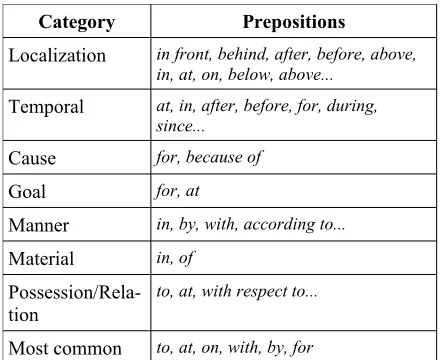
be categorized according to semantics. Saint-Dizier (2007) proposes such a taxonomy, and in our framework, prepositions have been grouped in 7 non-exclusive categories. Table 1 provides details of this categorization. The input preposition is mapped to all the sets it belongs to, and corre-sponding alternates are retrieved as correction can-didates. The 6 most frequent French preposition are also added automatically to the candidates list.
The resulting sentences are then sent to the Yahoo Search Engine and hits are counted. The number of hits returned by each of the queries is used as deci-sion criteria, and the preposition contained in the query with the most hits is selected as the correc-tion candidate.
While the above Unilingual strategy might work for simple cases of L1 interference, one would not expect it to work as well in more complex cases where both the preposition and its governing parts have been translated too literally. For example, in the case of the example from section 2, while the
Unilingual strategy might be able to effect correc-tion “sur la scène du crime” which is marginally better than the original “à la scène du crime” (12K hits versus 1K), it cannot address the root of the problem, that is, the unidiomatic expression
“scène du crime” which should instead be ren-dered as “lieux du crime” (38K hits). In this partic-ular case, it is not really an issue because it so hap-pens that “sur” is the correct preposition to use for both “lieux du crime” and “scène du crime”, but in our experience, that is not always the case. Note also that the Unilingual approach can only deal with preposition errors (although it would be easy enough to extend it to other kinds of function words), and cannot deal with more semantically deep L1 interference.
To address these issues, we experimented with a second strategy which we will refer to as the
Roundtrip Machine Translation approach (or
Roundtrip MT for short). Note that our approach is different from that of Brockett et al. (2006), as we do make use of a truly multi-lingual translation model. In contrast, Brockett’s translation model was trained on texts that were written in the same language, with the sources being ill-written text in the same language as the properly-formed target texts. One drawback of our approach however is
Category Prepositions
Localization in front, behind, after, before, above, in, at, on, below, above...
Temporal at, in, after, before, for, during, since...
Cause for, because of
Goal for, at
Manner in, by, with, according to...
Material in, of
Possession/Rela-tion
to, at, with respect to...
[image:5.612.77.298.80.260.2]Most common to, at, on, with, by, for
that it may require different translation models for speakers with different first languages.
There are many ways in which error-correction could be carried out using MT techniques. Several of these have been described in a patent by Dymet-man and Isabelle (2005), but to our knowledge, none of them have yet been implemented and eval-uated. In this paper, we use the simplest possible implementation of this concept, namely, we carry out a single round-trip translation. Given a poten-tially erroneous L2 sentence written by a second language author, we translate it to the author's L1 language, and then back to L2. Even with this sim-ple approach, we often find that errors which were present in the original L2 sentence have been re-paired in the roundtrip version. This may sound surprising, since one would expect the roundtrip sentence to be worse than the original, on account of the "Chinese Whisper" effect. Our current theo-ry for why this is not the case in practice goes as follows. In the course of translating the original L2 sentence to L1, when the MT system encounters a part that is ill-formed, it will tend to use single word entries from its phrase table, because longer phrases will not have been represented in the well-formed L2 training data. In other words, the system tends to generate a word for word translation of ill-formed parts, which mirrors exactly what L2 au-thors do when they write poorly formed L2 sen-tences by translating too literally from their L1 thought. As a result, the L1 sentence produced by the MT system is often well formed for that lan-guage. Subsequently, when the MT system tries to translate that well-formed L1 sentence back to L2, it is therefore able to use longer entries from its phrase table, and hence produce a better L2 trans-lation of that part than what the author originally produced.
We use Google Translate as a translation engine for matter of simplicity. A drawback of using such an online service is that it is essentially a closed box, and we therefore have little control over the translation process, and no access to lower level data generated by the system in the course of trans-lation (e.g. phrase alignments between source and target sentences). In particular, this means that we can only generate one alternative L2 sentence, and have no way of assessing which parts of this single alternative have a high probability of being better
than their corresponding parts in the original L2 sentence written by the author. In other words, we have no way of telling which changes are likely to be false positives, and which changes are likely to be true positives. This is the main reason why we focus only on error repair in this preliminary work.
The roundtrip sentences generated with Google Translate often differ significantly from the origi-nal L2 sentence, and in more ways than just the er-roneous preposition used by the author. For exam-ple, the (pruned) clause "avoir du succès en le re-crutement"("to be successful in recruiting") might come back as as "réussir à recruter"("to succeed
in recruiting"). Here, the translation is acceptable, but the preposition used by the MT system is not appropriate for use in the original sentence as writ-ten by the L2 author. Conversely, a roundtrip translation can be ill-formed, yet use a preposition which would be correct in the original L2 sentence. For example, "regarder à des films"("look at some movies") might come back as "inspecter des films" ("inspect some films"). Here, the original meaning is somewhat lost, but the system correctly suggest-ed that there should be no preposition before “des films”.
Hence, in the context of the Roundtrip MT ap-proach, we need two ways of measuring appropri-ateness of the suggested corrections for given clauses. The first approach, which we call the
Clause criteria, looks at whether or not the whole clause has been restored to a correct idiomatic form (including correct use of preposition) which also preserves the meaning intended by the author of the original sentence. Hence, according to this approach, an MT alternative may be deemed cor-rect, even if it chooses a preposition which would have been incorrect if substituted in the original L2 sentence as is. In the second approach, called the
Of course, in the case of the Prep evaluation crite-ria, having the MT system return a sentence which employs the proper preposition to use in the con-text of the original L2 sentence is not the end of the process. In an error correction context, one must also isolate the correct preposition and insert it in the appropriate place in the original L2 sen-tence. This part of the processing chain is not cur-rently implemented, but would be easy to do, if we used an MT system that provided us with the align-ment information between the source sentence and the target sentence generated. The accuracy figures which we present in this paper assume that this mapping has been implemented and that this par-ticular part of the process can be done with 100% accuracy (a claim which, while plausible, still needs to be demonstrated in future work).
We also investigate a third strategy called Hybrid, which uses the Roundtrip MT approach as a back-up for cases where the Unilingual approach is un-able to distinguish between different choices of preposition. The latter typically occurs when the system is not able to sufficiently prune and gener-alize the phrase, resulting in a situation where all pruned variants yield zero hits on the Web, no mat-ter what preposition is used. One could of course also use the Unilingual approach as a backup for the Roundtrip MT approach, but this would be harder to implement since the MT system always returns an answer, and our use of the online Google Translate system precludes any attempt to estimate the confidence level of that answer.
In conclusion to this section, we use three preposi-tion correcpreposi-tion strategies: Unilingual, Roundtrip MT and Hybrid, and in the case of the Roundtrip MT approach, appropriateness of the corrections can be evaluated using two criteria: Prep and
Clause.
5 Evaluation and Results
5.1 Corpus and Evaluation Metric
For evaluation, we extracted clauses containing preposition errors from a small corpus of texts written by advanced-intermediate French as a Sec-ond Language (FSL) student in the course of one semester. The corpus contained about 50, 000
words and 133 unique preposition errors. While relatively small, we believe this set to be suffi-ciently rich to test the approach. Most clauses also presented other errors, including orthographic, tense, agreement, morphologic and auxiliary er-rors, of which only the last two affect parsing. The clauses were fed as is to the correction algorithms, without first fixing the other types of errors. But to our surprise, XIP's robust parsing has proven resis-tant in that it produced enough information to en-able correct pruning based on chunking informa-tion, and we report no pruning errors. Chodorow et al. (2008) stress the importance of agreement be-tween annotators when retrieving or correcting preposition errors. In our case, our policy has been to only retain errors reported by both authors of this paper, and correction of these errors has raised little matter of dispute.
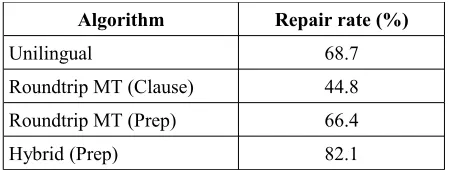
We evaluated the various algorithms in terms of re-pair rate, that is, the percentage of times that the al-gorithm proposed an appropriate fix (the absence of a suggestion was taken to be an inappropriate fix). These figures are reported in Table 2.
5.2 Discussion
ANOVA of the data summarized in Table 2 reveals a statistically significant (p < 0.001) effect of the algorithm on repair rate. Although Roundtrip MT
performed slightly worse than Unilingual (66.4% versus 68.7%), this difference was not found to be statistically significant. On one hand, we found that round-trip translation sometimes result in spectacular restorations of long and clumsy phrases caused by complex linguistic interference. Howev-er, too often the Chinese whispers effect destroyed the sense of the original phrase, resulting in inap-propriate suggestions. This is evidenced by the fact that repair rate of the Roundtrip MT approach was significantly lower (p < 0.001) when using the
Algorithm Repair rate (%)
Unilingual 68.7
Roundtrip MT (Clause) 44.8 Roundtrip MT (Prep) 66.4
[image:7.612.313.539.79.164.2]Hybrid (Prep) 82.1
Clause criteria (44.8%) than when using the Prep
criteria (66.4%). It seems that, in the case of prepo-sition correction, roundtrip MT is best used as a way to to generate an L2 alternative from which to mine the correct preposition. Indeed, flawed as they are, these distorted roundtrip segments cor-rected prepositions errors in 66.4% of the cases. However, for a full picture, the approach should be tried on more data, and on other classes of errors. Particularly, we currently lack sufficient data to test the hypothesis that the approach could address the correction of more complex literal translations by SL Learners.
In the Unilingual approach, the Yahoo Web search engine proved to be an insufficient language model for 31 cases out of 133, meaning that even the pruned and generalized phrases got zero hits, no matter what alternative preposition was used. In those cases, the Hybrid approach would then at-tempt correction using MT Roundtrip approach. This turned out to work quite well, since it resulted in an overall accuracy of 82.1%. ANOVA on the data for Hybrid and the two pure approaches re-veals a significant effect (p < 0.001) of the algo-rithm factor. Individual t-tests between the Hybrid
approach and each of the two pure approaches also reveal statistically significant differences (p < 0.001). The improvements provided by the hybrid approach are fairly substantial, and represent rela-tive gains of 19.5% over the pure Unilingual ap-proach, and 23.6% over the pure Roundtrip MT ap-proach. The success of this combined approach might be attributable to the fact that the two ap-proaches follow different paradigms. Roundtrip MT uses a model of controlled incorrectness (er-rors of anglicism) and Unilingual a model of cor-rectness (occurrences of correct forms). In this re-spect, the relatively low agreement between the two approaches (65.4%) is not surprising.
6 Conclusion and Future Work
In this paper, we have demonstrated for the first time that a bilingual Machine Translation approach can be used to good effect to correct errors in texts written by Second Language Authors or Learners. In the case of preposition error correction we found that, while the MT approach on its own did not perform significantly better than a unilingual
ap-proach, a hybrid combination of both performed much better than the unilingual approach alone. More work needs to be carried out in order to fully evaluate the potential of the MT approach. In par-ticular, we plan to experiment with this kind of ap-proach to deal with more complex cases of L1 in-terference which result in severely damaged L2 sentences.
In this paper, we compared the bilingual MT ap-proach to a unilingual baseline which used a rela-tively simple Web as a corpus algorithm, whose accuracy is comparable to that reported in the liter-ature for a similar preposition correction algorithm (Yi et al, 2008). Notwithstanding the fact that such simple Web as a corpus approaches have often been shown to be competitive with (if not better than) more complex algorithms which cannot leverage the full extent of the web (Halevy et al., 2009), it would be interesting to compare the bilin-gual MT approach to more sophisticated unilinbilin-gual algorithms for preposition correction, many of which are referenced in section 3.
Acknowledgments
The authors are indebted to the following people (all from NRC) for helpful advice on how to best exploit MT for second language correction: Pierre Isabelle, George Foster and Eric Joanis.
References
Anderson, D. D. 1995. Machine Translation As a Tool in Second Language Learning. CALICO Journal, v13 n1 p68-97.
Brockett C., Dolan W. B., and Gamon M.. 2006. Cor-recting ESL errors using phrasal SMT techniques. In Proc. 21st International Conf. On Computational Lin-guistics and the 44th annual meeting of the ACL, p. 249–256, Sydney, Australia.
Chodorow M., Tetreault J. R. and Han N.-R.. 2007. Detection of Grammatical Errors Involving Preposi-tions. In Proc. ACL-SIGSEM Workshop on Preposi-tions. Prague, Czech Republic.
Cowan, J. R. 1983. Towards a Psychological Theory of Interference in Second Language Learning. In Sec-ond Language Learning: Contrastive Analysis, Error Analysis, and Related Aspects, edited by B. W. Robi-nett, J. Schachter, pp 109-119, The Univ. of Michi-gan Press.
Dymetman M., Isabelle, P. 2007. Second language writ-ing advisor. US Patent #20070033002 , Feb 8, 2007. Fort K., Guillaume B. 2007. PrepLex: un lexique des
prépositions du français pour l'analyse syntaxique. TALN 2007, Toulouse, June 5-8.
Gamon M., Gao J. F., Brockett C., Klementiev A., Dolan W. B., and Vanderwende L. 2008. Using con-textual speller techniques and language modeling for ESL error correction. In Proceedings of IJCNLP 2008, Hyderabad, India, January.
Granger S., Vandeventer A. & Hamel M. J. 2001. Analyse de corpus d'apprenants pour l'ELAO basé sur le TAL. TAL 42(2), 609-621.
Halevy, A., Norvig, P., Pereira, F. 2009. "The Unrea-sonable Effectiveness of Data.", IEEE Intelligent Systems, March/April 2009, pp 8-12.
Heift, T. & Schulze, M. 2007. Errors and Intelligence in Computer-Assisted Language Learning: Parsers and Pedagogues. Routledge.
Hermet, M., Désilets, A., Szpakowicz, S. 2008. Using the Web as a Linguistic Resource to Automatically
Correct Lexico-Syntactic Errors. In Proceedings of the LREC'08. Marrakech, Morroco.
Izumi, E., K. Uchimoto, and H. Isahara. 2004. The overview of the sst speech corpus of Japanese learn-er English and evaluation through the explearn-eriment on automatic detection of learners’ errors. In LREC. La Torre, M. D. 1999. A web-based resource to imprive
translation skills. ReCALL, Vol 11, No3, pp. 41-49. Lee J. and Seneff S. 2006. Automatic grammar
correc-tion for second-language learners. In Interspeech. ICSLP. p. 1978-1981. Pittsburgh.
L'haire S. & Vandeventer Faltin A. 2003. Error diagno-sis in the FreeText project. CALICO 20(3), 481-495, special Issue Error Analysis and Error Correction in Computer-Assisted Language Learning, T. Heift & M. Schulze (eds.).
Schneider, D. and McCoy, K. F. 1998. Recognizing syn-tactic errors in the writing of second language learn-ers. In Proceedings of COLING/ACL 98.
Saint-Dizier, P. 2007. Regroupement des Prépositions par sens. Undated Report. IRIT. Toulouse.
http://www.irit.fr/recherches/ILPL/Site-Equipe/publi_fichier/prepLCS.doc
Somers, Harold. 2001. Three Perspectives on MT in the Classroom, MT SUMMIT VIII Workshop on Teaching Machine Translation, Santiago de Compostela, pages 25-29.
Tetreault J. and Chodorow M. 2008. The Ups and Downs of Preposition Error Detection. COLING, Manchester.
Ueffing, N., Simard, M., Larkin, S., Johnson, J. H. (2007), NRC's PORTAGE system for WMT 2007, ACL-2007 Workshop on SMT, Prague, Czech Re-public 2007.
Wang, Y. and Garigliano, R. 1992. An Intelligent Lan-guage Tutoring System for Handling Errors caused by Transfer. In Proceedings of ITS-92, pp. 395-404. Yi X., Gao J. F., Dolan W. B., 2008. A Web-based