D S Sharma, R Sangal and A K Singh. Proc. of the 13th Intl. Conference on Natural Language Processing, pages 2–9, Varanasi, India. December 2016. c2016 NLP Association of India (NLPAI)
Integrating WordNet for Multiple Sense Embeddings in Vector Semantics
David Foley
Kutztown University of Pennsylvania
Jugal Kalita
University of Colorado, Colorado Springs
Abstract
Popular distributional approaches to se-mantics allow for only a single embedding of any particular word. A single embed-ding per word conflates the distinct mean-ings of the word and their appropriate con-texts, irrespective of whether those usages are related or completely disjoint. We compare models that use the graph struc-ture of the knowledge base WordNet as a post-processing step to improve vector-space models with multiple sense embed-dings for each word, and explore the ap-plication to word sense disambiguation.
Keywords: Vector Semantics, WordNet, Syn-onym Selection, Word Sense Disambiguation
1 INTRODUCTION
Vector semantics is a computational model of writ-ten language that encodes the usage of words in a vector space, which facilitates performing mathe-matical manipulations on words as vectors (Mar-tin and Jurafsky, 2016; Turney and Pantel, 2010). These vectors encode the contexts of words across a corpus, and are learned based on word distri-butions throughout the text. Vectors can then be compared by various distance metrics, usually the cosine function, to determine the similarity of the underlying words. They also seem to possess some modest degree of compositionality, in the sense that the addition and subtraction of vectors can sometimes result in equations that appear to reflect semantically meaningful relationships be-tween words (Mikolov et al., 2013a; Mikolov et al., 2013b). Because it allows for the use of these well studied techniques from linear algebra to be brought to bear on the difficult domain of seman-tics, vector space models (VSMs) have been the focus of much recent research in NLP.
While vector representations of word meaning are capable of capturing important semantic fea-tures of words and performing tasks like meaning comparison and analogizing, one of their short-comings is their implicit assumption that a sin-gle written word type has exactly one meaning (or distribution) in a language. But many words clearly have different senses corresponding to dis-tinct appropriate contexts. Building distributional vector space models that account for this polyse-mous behavior would allow for better performance on tasks involving context-sensitive words, most obviously word sense disambiguation. Previous research that attempted to resolve this issue is dis-cussed at length in the next section. Most common methods either use clustering or introduce knowl-edge from an ontology. The goal of the present research is to develop or improve upon methods that take advantage of the semantic groups and re-lations codified in WordNet, and specifically to fo-cus on the downstream WSD task, which is often neglected in favor of less useful similarity judg-ment evaluations.
show can improve performance on several tasks.
2 Related Work
Our work is based primarily on that of Jauhar et al’s RETROFIT algorithm (Jauhar et al., 2015), which is discussed at greater length in Section 3. Below we discuss previous models for building sense embeddings.
2.1 Clustering-Based Methods
(Reisinger and Mooney, 2010) learn a fixed num-ber of sense vectors per word by clustering context vectors corresponding to individual occurrences of a word in a large corpus, then calculating the clus-ter centroids. These centroids are the sense vec-tors. (Huang et al., 2012) build a similar model us-ing k-means clusterus-ing, but also incorporate global textual features into initial context vectors. They compile the Stanford Contextual Word Similarity dataset (SCWS), which consists of over two thou-sand word pairs in their sentential context, along with a similarity score based on human judgments from zero to ten. (Neelakantan et al., 2015) in-troduce an unsupervised modification of the skip-gram model (Mikolov et al., 2013b) to calculate multiple sense embeddings online, by maintaining clusters of context vectors and forming new word sense vectors when a context under consideration is sufficiently far from any of the word’s known clusters. The advantage of the method is that it is capable of detecting different numbers of senses for different words, unlike the previous implemen-tations of Huang et al. and Reisinger and Mooney.
2.2 Ontology-Based Methods
(Chen et al., 2014) first learn general word em-beddings from the skip-gram model, then initial-ize sense embeddings based on the synsets and glosses of WN. These embeddings are then used to identify relevant occurrences of each sense in a training corpus using simple-to-complex words-sense disambiguation (S2C WSD). The skip-gram model is then trained directly on the disam-biguated corpus. (Rothe and Sch¨utze, 2015) build a neural-network post-processing system called AutoExtend that takes word embeddings and learns embeddings for synsets and lexemes. Their model is an autoencoder neural net with lexeme and synset embeddings as hidden layers, based on the intuition that a word is the sum of its lexemes and a synset is the sum of its lexemes.
Our intuitions are most similar to those of (Jauhar et al., 2015) and we will be building on one of their approaches. Their RETROFIT algo-rithm learns embeddings for different word senses from WN by iteratively combining general embed-dings according to the graph structure of WN. The approach is discussed in more detail below.
3 Improved Sense Embeddings from Word Embeddings
3.1 RETROFIT Algorithm
Because our work follows so directly from (Jauhar et al., 2015), we repeat the essential details of the RETROFIT algorithm here. Let Ω = (SΩ, EΩ) be a directed graph. We call Ωanontologywhen
the set of vertices SΩ represent semantic objects of some kind and the set of edgesEΩrepresent re-lationships between those objects. In the case of WN, SΩ is the set of synsets andEΩ are the se-mantic links (notably hypernyms and hyponyms). Given a set of sense-agnostic word embeddings
ˆ
V and an ontologyΩ, RETROFIT infers a set of sense embeddings Sˆ that is maximally
“consis-tent” with both Vˆ and Ω. By “consistency” we
refer to the minimization of the objective function
D( ˆS) =X
ij
αkwˆi−~sijk2
+X
ij
X
i0j0∈Nij
βr
~sij−~si0j02
(1)
wheresijis thejthsense of theithword,Nijis the set of neighbors ofsij defined inEΩandαandβ are hyperparameters controlling the importance of intial sense-agnositc embeddings and various on-tological relationships, respectively. Essentially RETROFIT aims to make a sense embedding as similar to its sense-agnostic embedding as possi-ble, while also reducing the distance between re-lated senses as defined by Ω. It achieves this by iteratively updating sense embeddings according to
~sij =
αwˆi+
X
i0j0∈Nij
βr~si0j0
α+ X
i0j0∈Nij
βr
(2)
The RETROFIT algorithm genertes embed-dings for word senses only from words whose sur-face form matches the entry in WordNet. Below we discuss several of the limitations associated with this RETROFIT implementation and possible improvements.
3.1.1 Impoverished Synsets
Many word senses are relatively isolated in the WordNet structure. They occur in synsets with few or no synonyms or semantic relations. In the case that the word has only one meaning, this is not a problem, because the sense-agnostic em-bedding is in that case unambiguous. But in the case that the word has one or more other seman-tically rich senses (ie, senses with synonyms and hyper/hyponym relations), the impoverished sense is unduly influenced by the general embedding and its unique meaning is not distinguishable. In the extreme case both senses are identical. Thou-sands of such synsets exist, including the synsets for words such asinclementandegalitarian.
3.1.2 Compound Words and Multi-word Lemmas
The original RETROFIT implementation discards multi-word lemmas (and entire synsets if they con-sist only of multi-word lemmas.) But there exist synsets for whom most or all of the related WN synsets contain only multi-word lemmas. See, for instance, the noun form of the wordunseen, or the more extreme case of the synsetbrass.n.01, which has eleven distinct hypernym and hyponym rela-tions, all but two of which are compound words for types of brass. Adjusting the RETROFIT algo-rithm to allow for embeddings of the multi-word lemmas that appear in WN would greatly reduce the number of impoverished synsets.
3.1.3 Underrepresented Senses
The general embedding produced by word2vec1
(Mikolov et al., 2013a; Mikolov et al., 2013b) con-flates all usages of a word. If a particular sense of a word is significantly less common than others, the word2vec embedding will not be a good represen-tation of the sense. RETROFIT indiscriminately tries to minimize the distance from any particular sense and its word2vec embedding. Consider the usage of the wordtapgiven by the synsettap.v.11, meaning “to pierce in order to draw liquid from.”
1https://code.google.com/archive/p/ word2vec/
This usage occurs nowhere in the labelled Sem-Cor corpus (Mihalcea, 1998), and is plausibly not well represented by the word2vec sense-agnostic embedding.
3.2 Modified RETROFIT Algorithm
For these reasons we make the following modifi-cations to RETROFIT.
1) Regardless of the position of a word sense in WordNet, it will be equipped with a descrip-tive gloss that clarifies its usage. We incorporate all content words from each synset’s gloss in the RETROFIT algorithm’s objective function, where “content words” refers to any word for which we have a sense-agnostic embedding. Content words that appear more than once in the gloss are weighted according to the number of times they occur (ie, if a word is repeated in the gloss, it has a stronger influence on the sense embedding.)
2) We implement a naive model to handle a compound word by simply representing its agnostic embedding as the average of the sense-agnostic embeddings of its constituent words. Al-though this is obviously inadequate for many com-pound words, we find it is already an improve-ment.
3)The sense-agnostic embedding of a word is assumed to be the weighted average of its sense embeddings, proportional to how common a par-ticular word sense is. We calculate the sense-frequencies from the SemCor corpus, which con-sists of around 300,000 words tagged with their WordNet 3.0 synsets (Mihalcea, 1998).
3.3 Weighted RETROFIT Algorithm
Weigthed RETROFIT proceeds very similarly to RETROFIT algorithm by (Jauhar et al., 2015). We begin by intializing an embedding for each word sense as the sense-agnostic embedding (or, in the case of multi-word lemmas, the average of the sense-agnostic embeddings of the constituant words). The embeddings are then iteratively up-dated to make them more similar to their semantic neighbors in the WordNet ontology, and to make the weighted average of the sense embeddings of a word closer to the sense-agnostic embedding. The weighted average is learned from the SemCor counts as discussed.
More precisely, letM = (V,V , S,ˆ S, P,ˆ Ω)be
a model consisting of a vocabulary V and
sense-agnostic embeddings Vˆ, a set of word senses S
and sense-embeddings Sˆ, a discrete probability
density functionP : V ×S → R, and an
ontol-ogyΩ. We seek the setSˆthat minimizes the new
objective function for the weighted RETROFIT al-gorithm (Equation 3).
D(M) =X
i
αwˆi−Pjpij~sij
2
+X
ij
X
i0j0∈Nij
βr
~sij −~si0j02
+X
ij
X
i0∈Gij
γkwˆi0−~sijk2
(3)
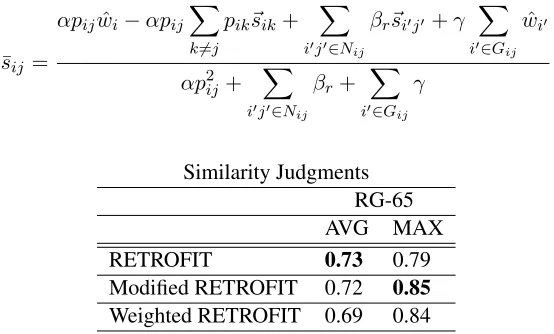
by iteratively updating embeddings according to Equation (4). where wˆi ∈ Vˆ, ~sij ∈ Sˆ, pij =
P(sij|wi), Nij is the set of neighbor indices of thejthsense of theithword defined in Ω,Gij = {i : wi ∈ Vˆ is in the gloss ofsij} and α, βr andγ are the parameters controlling the weights
of sense-agnostic word embeddings, relations and gloss words respectively. Note that iteratively up-dating the sense embeddings via Eqs. 2 or 4 is equivalent to optimizing their respective objective functions via coordinate descent.
4 Evaluation
We train three variations of the RETROFIT algo-rithm on the 50-dimensional global context vec-tors produced by (Huang et al., 2012): the unmod-ified RETROFIT, RETROFIT with gloss words and multi-word lemmas (which we refer to as Modified RETROFIT), and Weighted RETROFIT with weighted senses as discussed above. Train-ing time is similar between the first two; weighted RETROFIT takes about twice as long. All con-verge to a solution within 0.01 within fifteen iter-ations.
The models are evaluated on two different tasks: Synonym Selection and Word Sense Disambigua-tion. We first include and discuss results from some similarity judgment tasks, but these serve more as stepping stone than an as a rigorous mea-sure of model quality. (Faruqui et al., 2016) give a comprehensive assessment of the inadequacies of evaluating the quality of embeddings on word sim-ilarity tasks. In general, these tasks are fairly sub-jective and a model’s performance on them does not correlate with performance on downstream NLP tasks.
4.1 Similarity Judgments
We evaluate the models on the RG-65 dataset, (Rubenstein and Goodenough, 1965) which con-sists of sixty-five pairs of words and an average human judgment of similarity scaled from one to four. Evaluation is a straightforward calculation of the average cosine similarity of each pair of sense embeddings, as used by (Jauhar et al., 2015) and originally proposed by (Reisinger and Mooney, 2010). As an exploration, we also consider the results of using the maximum cosine similarity, which returns the highest cosine similarity among any pair of senses from the respective words.
Our results are displayed in Table 1. Every model performs best on the task using the maxi-mum cosine similarity metric, with our improved systems performing noticeably better. Interest-ingly, the commonly used average similarity met-ric causes our models to lose their advantage, par-ticularly Weighted RETROFIT, whose chief credit is its ability to produce more distinct sense em-beddings. Averaging these vectors together throws away the improvements gained by separating out the distinct meanings.
4.2 Synonym Selection
We test the models on two synonym selection datasets: ESL-50 (Turney, 2002) and TOEFL (Landauer and Dumais, 1997). ESL-50 is a set of fifty English sentences with a target word for which a synonym must be selected from four can-didate words. TOEFL consists of eighty context-independent words and four potential candidates for each. For both datasets, we use the same maxSim selection criteria as (Jauhar et al., 2015). We select the sense vector~sij that corresponds to:
maxSim(wi, wi0) = max
j,j0 cos(~sij, ~si0j0)
Our results are presented in Table 2. The results on this task are less straightforward. Although the ESL-50 and TOEFL datasets are remarkably simi-lar in form, the models do not perform consistently across them. Our modified RETROFIT method produces an enormous improvement on TOEFL, while ESL-50 gives our models some difficulties. Whether this is an effect of the relatively small number of words in the task or whether there are specific features about how the datasets were as-sembled is unclear.
¯ sij =
αpijwˆi−αpij
X
k6=j
pik~sik+
X
i0j0∈Nij
βr~si0j0+γ
X
i0∈Gij
ˆ wi0
αp2ij+ X
i0j0∈Nij
βr+
X
i0∈Gij
γ (4)
Similarity Judgments RG-65 AVG MAX
RETROFIT 0.73 0.79
[image:5.612.169.446.37.204.2]Modified RETROFIT 0.72 0.85 Weighted RETROFIT 0.69 0.84
Table 1: Performance on RG-65 word similarity dataset. Scores are Spearman’s rank correlation.
Synonym Selection
ESL-50 TOEFL
RETROFIT 64.0 68.75
[image:5.612.91.290.248.316.2]Modified RETROFIT 62.0 81.25 Weighted RETROFIT 60.0 75.0
Table 2: Percent accuracy on ESL-50 and TOEFL synonym selection using maxSim comparison
4.3 Word Sense Disambiguation
We use Semeval 2015 task 13 (Moro and Nav-igli, 2015) as our English WSD test. The cor-pus for the task consists of four documents taken from the biomedical, mathematical and social is-sues domains, annotated with part of speech infor-mation. The task also includes named entity dis-ambiguation, which we do not handle, except in the incidental case where there is a WN synset for a named entity. We explore two different meth-ods for WSD. The first chooses a word sense by identifying a word that co-occurs in the sentence and has a sense that is closest to a sense of our target word. The intuition of the model is that al-though particular words may be totally unrelated to the sense of the target word, there should ex-ist somewhere in the sentence a word pertaining to the subject described by the ambiguous word. For-mally, this method is described as thecontextMax
function:
contextM ax(w, c) = arg max
s∈Si
( max
c∈S
k6=i Sk
cos(~s, ~c)·p(s|w))
(5) whereSiis the set of senses of theithword of the context sentence.
The second WSD method incorporates both lo-cal and global context in equal parts. The intuition is that nearby words in a particular sentence will capture information about the particular usage of a word, while words that appear over the course of a passage will characterize the subject matter be-ing discussed. Both of these component are essen-tial to human understanding and should aid WSD algorithms, as discussed in (Weissenborn et al., 2015). Formally, we define the localGlobal WSD function as
localGlobal(w, c) = arg max
s∈Wij
(cos(~s, ~cij)·p(s|w))
(6) where the context vector~cij for thejthword of the
ithsentence is given by
~cij =
~lij |~lij|
+ ~gi
|~gi|
and the local context vector~lij of thejthword of theithsentence and global context vector~giof the
ithsentence are given by
~lij =
X
k6=j
1
|j−k|wˆik
~gi = i+2
X
n=i−2
X
k
ˆ wnk
As a baseline we compare against the most-frequent sense tagger (MFS) trained on the Sem-cor Sem-corpus (Moro and Navigli, 2015), defined sim-ply as
mf s(w) = arg max
s∈Sw
(p(s|w)) (7)
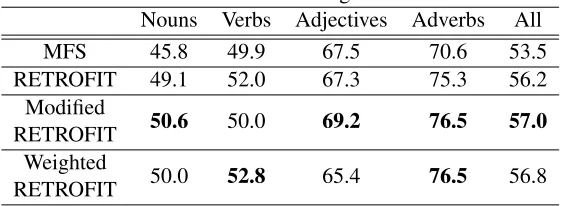
Word Sense Disambiguation
Nouns Verbs Adjectives Adverbs All
MFS 45.8 49.9 67.5 70.6 53.5
RETROFIT 49.1 52.0 67.3 75.3 56.2 Modified
RETROFIT 50.6 50.0 69.2 76.5 57.0 Weighted
[image:6.612.167.449.48.151.2]RETROFIT 50.0 52.8 65.4 76.5 56.8
Table 3: Semeval 2015 task 13 F1 scores of the models using the contextMax disambiguation function.
Nouns Verbs Adjectives Adverbs All RETROFIT 52.5 57.2 77.3 77.8 61.1
Modified
RETROFIT 53.6 56.4 76.0 79.0 61.6 Weighted
RETROFIT 53.9 59.2 75.4 77.8 62.1
Table 4: Semeval 2015 task 13 F1 scores of the models using the contextMax disambiguation function, restricted to correct POS
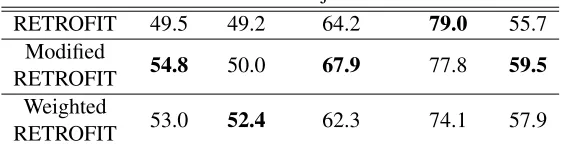
Tables 3 and 4 display results for our models using contextMax disambiguation with and without re-striction by POS information, along with the MFS tagging baseline. In both cases, RETROFIT and MFS are outperformed overall by our improve-ments. Tables 5 and 6 show the WSD results using localGlobal disambiguation, which for the most part appears to be a strictly better metric. Re-sults are ranked by F1 score, the harmonic mean of precision and recall (uniformly weighted). Al-though it underperforms on the compartively eas-ier task of disambiguating adjectivs and adverbs, Weighted RETROFIT is the best model of verbs by every single metric.
By all measures, the various RETROFIT implementations outperform the MFS baseline. Weighted RETROFIT and Modified RETROFIT both improve the initial model. The best per-forming systems on the Semeval 2015 task 13 En-glish corpus are LIMSI and SUDOKU (Moro and Navigli, 2015), which achieve F1 scores of 65.8 and 61.6 respectively. This would position both Weighted RETROFIT and RETROFIT with com-pound words and gloss words as second only to the top system, even with the use of relatively low dimensional embeddings.
5 Discussion
Results on similarity judgment are mixed, al-though it should be noted that despite the fact that
in principle average similarity appears to be a good measure of word relatedness, in our trials the max-imum similarity between two words is a better pre-dictor of human judgments on RG-65 with all al-gorithms. It’s possible that in the absence of dis-ambiguating context human judges are not actu-ally good at combining the relatedness of different senses of words and instead specifically search for related meanings when evaluating similarity. It’s worth noting that the metric by which our modi-fications provide the largest improvements is the metric which RETROFIT itself also performs best by. But, as discussed above and in [4], even human judges often do not score particularly well similar-ity tasks, and in fact there may be no real “gold standard” on such a task.
The results of the synonym selection task are also mixed. On the ESL-50 dataset our modifica-tions slightly underperform, while on the TOEFL dataset they provide an enormous improvement. We have not investigated the particulars of the datasets enough to see if there are anomolous fea-tures (over or under-representation of certain parts of speech, rare word senses, etc), or if these per-formance gaps are due more to the small sample size of the test data. Testing on a wider array of larger synonym selection datasets could yield in-sight into the models’ shortcomings.
Nouns Verbs Adjectives Adverbs All RETROFIT 49.5 49.2 64.2 79.0 55.7
Modified
RETROFIT 54.8 50.0 67.9 77.8 59.5 Weighted
[image:7.612.167.448.48.122.2]RETROFIT 53.0 52.4 62.3 74.1 57.9
Table 5: Semeval 2015 task 13 F1 scores of the models using the localGlobal disambiguation function
Nouns Verbs Adjectives Adverbs All RETROFIT 52.2 55.6 73.5 80.2 60.2
Modified
RETROFIT 56.6 57.6 74.1 80.2 63.4 Weighted
RETROFIT 55.6 59.2 72.9 76.5 62.1
Table 6: Semeval 2015 task 13 F1 scores of the models using the localGlobal disambiguation function, restricted to correct POS
all metrics. Again, whether this is a quirk of the specific corpus is unclear. If not, it may in-dicate that homophonous verbs in English tend to be more distinct from each other than other parts of speech, perhaps because of more common metaphorical language use. We at least can say confidently that utilizing more features from WN is an across the board improvement.
Future Work
As mentioned above, the limited size and scope of the test sets leaves room for doubt about the mod-els’ performance on new datasets, especially when two datasets for the same task yield strikingly dif-ferent results, like synonym selection. A use-ful exploration may be looking at domain-specific datasets for this task, as the results might suggest that the performance discrepancies are present be-tween domains. It is possible, for example, that WordNet underrepresents certain domains. (Con-sider the case of the wordnugget, which in Word-Net has no synsets related to food, but in Amer-ican English is most often used in the compound
chicken nugget.) It will also be important to try the same task with significantly larger datasets.
We also use only a crude model of compound word vectors. An investigation of better composi-tional semantic models could greatly benefit the algorithm, as a large percentage of WN synsets contain compound words.
The RETROFIT algorithm may also be discard-ing valuable information by constructdiscard-ing the sense
vectors only from the sense-agnostic embeddings for words whose exact surface form matches en-tries in WordNet. But word2vec and most other VSM algorithms learn embeddings for many dif-ferent conjugations of words, and in fact those conjugations may themselves contain information (such as part-of-speech) that can help further dif-ferentiate senses.
Our models are all trained on the relatively low dimensional global feature vectors produced by (Huang et al., 2012), but significantly richer em-beddings exist, such as the GoogleNews vectors, which are 300 dimensional and were trained on a 100 billion word corpus using CBOW (Mikolov et al., 2013a; Mikolov et al., 2013b). We expect that the quality of the embeddings produced by the RETROFIT algorithms will scale with the qual-ity of the underlying embeddings, and can hope for continual improvement as larger and better datasets become available.
6 Acknowledgement
This work was funded under NSF grant 1359275. The authors would also like to thank Feras Al Tarouti for his valuable input.
References
Xinxiong Chen, Zhiyuan Liu, and Maosong Sun. 2014. A unified model for word sense representation and disambiguation. InEMNLP, pages 1025–1035. Manaal Faruqui, Yulia Tsvetkov, Pushpendre Rastogi,
and Chris Dyer. 2016. Problems with evaluation of
word embeddings using word similarity tasks. arXiv preprint arXiv:1605.02276.
Eric H Huang, Richard Socher, Christopher D Man-ning, and Andrew Y Ng. 2012. Improving word representations via global context and multiple word prototypes. InProceedings of the 50th Annual Meet-ing of the Association for Computational LMeet-inguis- Linguis-tics: Long Papers-Volume 1, pages 873–882.
Sujay Kumar Jauhar, Chris Dyer, and Eduard Hovy. 2015. Ontologically grounded multi-sense represen-tation learning for semantic vector space models. In
Proceedings of National Association for Computa-tional Linguistics (NAACL).
Thomas K Landauer and Susan T Dumais. 1997. A solution to plato’s problem: The latent semantic analysis theory of acquisition, induction, and rep-resentation of knowledge. Psychological review, 104(2):211.
James H Martin and Daniel Jurafsky. 2016. Semantics with dense vectors, in speech and language process-ing.Third Edition, Draft.
Rada Mihalcea. 1998. SemCor semantically tagged corpus.Unpublished manuscript.
Tomas Mikolov, Kai Chen, Greg Corrado, and Jef-frey Dean. 2013a. Efficient estimation of word representations in vector space. arXiv preprint arXiv:1301.3781.
Tomas Mikolov, Ilya Sutskever, Kai Chen, Greg Cor-rado, and Jeffrey Dean. 2013b. Distributed repre-sentations of words and phrases and their composi-tionality. Advances in Neural Information Process-ing Systems, pages 3111–3119.
George A Miller. 1995. Wordnet: A lexical database for english. Communications of the ACM, 38(11):39–41.
Andrea Moro and Roberto Navigli. 2015. Semeval-2015 task 13: Multilingual all-words sense dis-ambiguation and entity linking. Proceedings of SemEval-2015.
Arvind Neelakantan, Jeevan Shankar, Alexandre Pas-sos, and Andrew McCallum. 2015. Effi-cient non-parametric estimation of multiple embed-dings per word in vector space. arXiv preprint arXiv:1504.06654.
Joseph Reisinger and Raymond J Mooney. 2010. Multi-prototype vector-space models of word mean-ing. InHuman Language Technologies: The 2010 Annual Conference of the North American Chap-ter of the Association for Computational Linguistics, pages 109–117.
Sascha Rothe and Hinrich Sch¨utze. 2015. Au-toextend: Extending word embeddings to embed-dings for synsets and lexemes. arXiv preprint arXiv:1507.01127.
Herbert Rubenstein and John B Goodenough. 1965. Contextual correlates of synonymy. Communica-tions of the ACM, 8(10):627–633.
Peter D Turney and Patrick Pantel. 2010. From fre-quency to meaning: Vector space models of se-mantics. Journal of artificial intelligence research, 37(1):141–188.
Peter D Turney. 2002. Mining the web for syn-onyms: Pmi-ir versus lsa on toefl. arXiv preprint cs/0212033.
Dirk Weissenborn, Leonhard Hennig, Feiyu Xu, and Hans Uszkoreit. 2015. Multi-objective optimiza-tion for the joint disambiguaoptimiza-tion of nouns and named entities. InProceedings of the 53rd Annual Meet-ing of the Association for Computational LMeet-inguistics and the 7th International Joint Conference on Natu-ral Language Processing of the Asian Federation of Natural Language Processing, pages 596–605.