TESTING AND ANALYSIS OF SURVIVABILITY
OF SHAPED-CHARGES IN BULLET IMPACT
CONDITIONS
T. Yarom, R. Ceder, S. Miller, M. Rav-Hon
RAFAEL, MANOR - Propulsion & Explosive Systems Division
I S R A E L
ABSTRACT
Shaped charges subjected to bullet impact test may react in various types of reactions, starting from full detonation to charge disintegration only. The type of reaction depends on the explosive composition, the charge dimensions, and bullet hit point. Bullet Impact tests show that even relatively sensitive pressed explosives can pass the BI test in a specific charge geometry. In order to predict the reaction type in BI conditions, we need to understand the bullet penetration process, and then to investigate the complex phenomenon of detonation. The approach adopted here was to observe the pressure profile and the P2dt criterion of the explosive at several points along the bullet path. The explosive was treated as an inert material. A simplified 2-D model was developed using the AUTODYN code. The basic model consists of a steel bullet hitting a 100 mm diameter cylindrical target of PBX-9404. The bullet and the target were mapped using Lagrangian and Eulerian grids respectively, while the interaction between the two was enabled using AUTODYN's Euler-Lagrange coupling processor. The modeling was supported by a series of single bullet impact tests using our LX-07 and PBXN-110. The bullet was aimed at various points of the charge. The results vary from no-reaction to full detonation. The paper provides an insight into the phenomenon of bullet impact to unconfined explosive charges. The initiation phenomenon should be further investigated to predict the explosive response in bullet impact conditions.
1. INTRODUCTION
Shaped charges traditionally contain high quality pressed explosives to achieve high performance. In the last decade, attempts have been made to load shaped charges with less sensitive [3] and low-cost explosives including cure-cast explosives. The advantage of using cure-cast explosives for this application is IM and low cost. Cure-cast explosives may also be advantagous in tandem warheads where the main charge needs to withstand the precursor detonation impact.
Preliminary Bullet Impact tests of pressed and cure-cast shaped charges show that the reaction type varies from full detonation to a charge disintegration only. The type of reaction depends not only on the explosive composition but also on the charge dimensions, geometry and bullet hit point and direction. In some tests even relatively sensitive pressed explosives may pass the Bullet Impact test in certain geometries and hit points. Also the explosive liner interaction during the bullet penetration is an issue that should be addressed.
The paper is a preliminary study of the explosive behavior during bullet penetration. The approach adopted here is to treat the explosive as an inert material and to observe the pressure profiles along the bullet path, and then to use the simplified P2dt shock initiation criterion [2][4][5]. A simplified 2-D model was developed using the AUTODYN code. The basic model consists of a steel bullet, a 100mm diameter cylindrical target of PBX-9404. The "liner section" of the shaped charge is modeled by addition of a thin copper plate at the end of the explosive cylinder. The bullet and the target were mapped using Lagrangian and Eulerian grids respectively, while the interaction between the two was enabled using AUTODYNE's Euler-lagrange coupling processor.
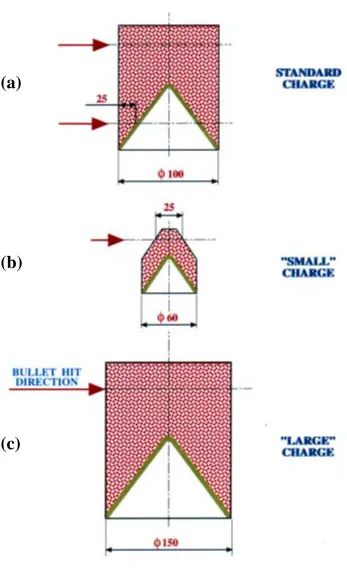
The modeling was supported by a series of single bullet impact tests that were conducted using the our LX-07 and PBXN-110 explosives. The basic charge was an unconfined 100 mm diameter charge. The bullet was aimed at several distinct points as shown in Figure 1. Smaller and larger charges were also tested, as described in detail in Section 2. The results varied from no-reaction through burning to full detonation.
The paper presents the tests and their results in comparison to the simulations and preliminary analysis.
2. BULLET IMPACT TESTS AND RESULTS
The generic charges, defined for this program represent the typical dimensions of anti-tank missile warheads. Three generic warheads, shown in Figure 1, were defined. The basic charge (Figure 1a) is 100 mm in diameter. The generic smaller charge, shown in Figure 1b, represents a typical precursor, and the larger charge, shown in Figure 1c, represent larger missile shaped charges. Figure 1 also provides the bullet hitting points and directions as conducted in the tests.
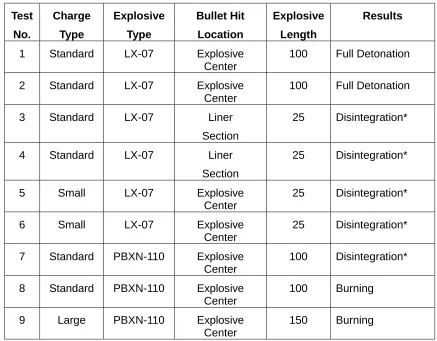
A series of tests, described in Table 1, have been ferformed to examine the different parameters: explosive composition, charge dimensions and the effect of the copper liner. These three parameters were also simulated and analyzed later.
Two explosive composition were tested: the Israeli LX-07 (90% HMX) and the Israeli cure-cast PBXN-110 (88% HMX) designated PX-80. Both compositions are used for shaped charges. A single bullet at velocity of about 880 m/s hit the charges at points and directions shown in Figure 1.
(a)
(b)
[image:3.595.129.476.106.678.2]Test No. Charge Type Explosive Type Bullet Hit Location Explosive Length Results
1 Standard LX-07 Explosive Center
100 Full Detonation
2 Standard LX-07 Explosive Center
100 Full Detonation
3 Standard LX-07 Liner Section
25 Disintegration*
4 Standard LX-07 Liner Section
25 Disintegration*
5 Small LX-07 Explosive Center
25 Disintegration*
6 Small LX-07 Explosive Center
25 Disintegration*
7 Standard PBXN-110 Explosive Center
100 Disintegration*
8 Standard PBXN-110 Explosive Center
100 Burning
9 Large PBXN-110 Explosive Center
150 Burning
[image:4.595.109.546.105.446.2]* Disintegration consists of throwing particles within allowed radius, Most of the explosive recovered intact.
Table 1: Bullet Impact tests and results
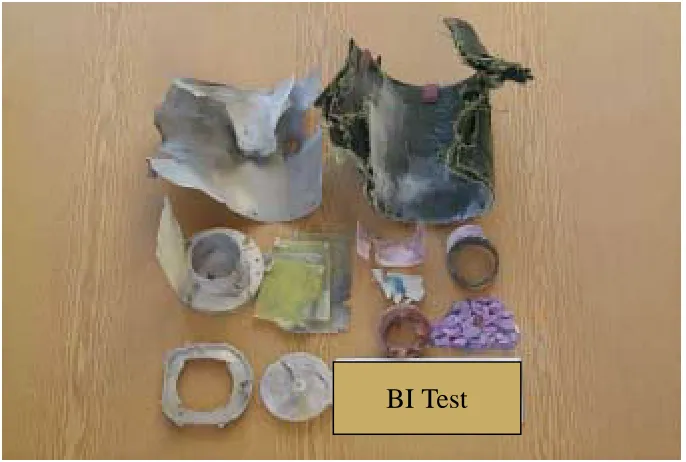
The full detonation reaction in Tests 1 and 2 (identical tests) were expected since LX-07 does not withstand the bullet impact at 100mm explosive length. Observing the results of Test 3 (Figure 2) we can see that most of the explosive was recovered and no aggressive reaction occurred. Simmilar results were observed in Tests 4, 5 and 6. In Tests 3 through 6 the explosive length was shorter than in the first two tests, and a totally different reaction has been observed. This shows us that the boundaries of the bullet path plays an important role in the explosive reaction, as will be analyzed in the next section.
Figure 2: Post test view of Test 3
Figure 3: Post test view of Test 7
3.
SIMULATIONS AND ANALYSIS
The bullet penetration process was simulated using the AUTODYN code. For simplification we use a 2-D axsisymmetric model to observe the pressure profile (pressure vs. time) inside the explosive along the bullet path. The cylinder diameter in all the simulasions was 100mm. Figure 4 shows the three points at which the bullet was aimed and the simplified models used for each case. Three locations were selected: explosive center, top of the liner and liner center. In the 2-D model the explosive was modeled as a cylinder of the relevant length and the liner was a copper plate attached to the explosive charge. A rigid steel bullet was used, its initial velocity was 880 m/s. The bullet and the target were mapped using lagrangian and Eulerian grids respectively, while the interaction between the two was enabled using AUTODYN’s Euler-Lagrange coupling proccesor. The basic explosive for the simulation was PBX-9404.
Figure 5 shows the bullet pentration when aimed at the liner center (Case 3) and the resulting pressures after 2.9Microseconds.
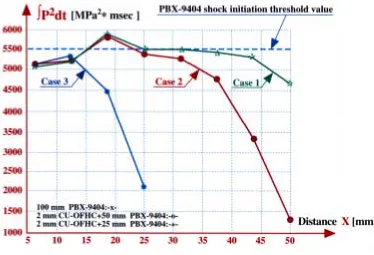
As mentioned before, our approach was to observe the pressure profiles inside the explosive along the bullet path and to use the P2dt shock initiation criterion [3] as a simplified criterion for detonation. To this end, we define several points along the explosive centerline (see Figure 6), and obtain their pressure data as illustrated in Figure 7. In Figure 8 we summarize the P2dt values along the bullet path for the three mentioned cases. The figure also describes the initiation threshold value for PBX-9404, as found from the literature [5].
The effect of the liner on the pressure inside the explosive was simulated and presented in Figure 9. Here we can observe the P2dt values of Case 3 with and without the addition of 2mm copper liner.
Analysis
Observing the P2dt values of Figure 8, we can see that in Case 1, where the bullet penetrated 100 mm of explosive we find a long line inside the explosive which was subjected to high P2dt values (5.5 – 5.8 Gpa2-µs). In Case 3, where the rarefaction waves from the boundary appears significantly earlier, the P2dt values are lower and appear earlier along the path.
The initiation threshold value for PBX-9404, as found from the literature [5], is 5.8 Gpa2-µs. It is interesting to watch that value, which lies exactly between Case 1 and 3. The experimental data, summarized in Table 1, match the simulation since in Case 1 we got full detonation while only disintegration occurred in Case 3.
The effect of the copper liner can be easily observed in Figure 9, where the liner has been removed fron the 25 mm long cylinder of exlosive. As shown, the graphs are very similar with a slight increase values in the liner case. This increase in the pressure values is a result of the reflected shock waves from the copper plate. In the typical dimensions of explosive/copper liner as shown in the simulations we can conclude that the copper has only a slight effect on the results.
Although we used simplified 2-D model, basic explosive and a simple initiation criterion, we got interesting and meaningful information on the explosive behavior and the
Figure 4: 2-D simplified modeling of bullet impact
Figure 6: Definition of points along bullet path (Case 3 – liner center)
Figure 8: P2dt values along bullet path (three cases)
3. SUMMARY AND CONCLUSIONS
A series of single Bullet Impact tests of shaped charges have been conducted. The testing parameters were: explosive composition (pressed and cure-cast explosives), charge dimensions, and bullet aiming points. The work was supported with simpified 2-D modeling using AUTODYN code, where the explosive was treated as an inert material and P2dt was observed along the bullet path.
Tests and simulations show that the charge dimensions and geometry play a major role in the explosive response. Small charges may pass the bullet impact even when loaded with relatively sensitive explosives. The P2dt criterion was found usefull in getting insight to the bullet impact conditions. In order to predict the explosive response in bullet impact conditions, initiation phenomenon should be further investigated using more advanced initiation models and geometric modeling (3-D).
4. REFERENCES
1. Dobratz, B.M., and Crawford, P.C., LLNL Explosives Handbook, LLNL Laboratory, University of california, Livermore, CA 1985.
2. Howe, P., Frey, R., Taylor, B. and Boyle, V., Shock initiation and the critical
energy concept, Sixth Detonation SymposiumAugust 1976.
3. Montesi, L.J., and Alexander, K.E., Developmet of the high performance metal acceleratiing explosive, PBXW-11, Proc. Of ADPA Insensitive Munition Symposium, San- Diego, CA, March 1996. ( shaped charges of insensitive explosives)
4. Walker, F.E., and Wasley, R.J., Critical energy for shock initiation of heterogenous explosves, Explosivstoffe, 17,9 1969.