Solid-Supported Reagents
in Organic Synthesis
David H. Drewry,1Diane M. Coe,2Steve Poon1
1Glaxo Wellcome Research and Development, 5 Moore Dr., Research Triangle Park, NC, USA 27709
2Glaxo Wellcome Medicine Research Center, Gunnels Wood Road, Stevenage, Hertfordshire. SG1 2NY United Kingdom
▼
Abstract: The current interest in solid-phase organic synthesis has led to a renewed interest in a complementary technique in which solid supported reagents are used in solution phase chemistry. This technique obviates the need for attachment of the substrate to a solid-support, and enables the chemist to monitor the reactions using familiar analytical techniques. The purpose of this re-view is to increase awareness of the wide range of useful transformations which can be accom-plished using solid-supported reagents. © 1999 John Wiley & Sons, Inc. Med Res Rev 19, 97–148, 1999.
Keywords: solid-supported reagents; solid-phase reagents; polymer-supported reagents; parallel synthesis; scavenger reagents; ion-exchange resins; solution-phase synthesis; combinatorial chemistry
1. I N T R O D U C T I O N
Medicinal chemists in the pharmaceutical industry now routinely utilize solid-phase organic syn-thesis (SPOS) to prepare libraries of small organic molecules for screening.1The advantages of this
methodology have been well described in the recent literature: excess reagents can be used to drive reactions to completion, impurities and excess reagents can be removed by simple washing of the solid-phase, and enormous numbers of compounds can be created using the mix and split technique. Limitations to SPOS may include (a) the presence of a resin vestige in the final molecules (the point of attachment of the molecule to the solid support), (b) the need for two extra synthetic steps (at-taching the starting material to the solid support, and removing the material from the solid support), (c) a potential scale limitation imposed by the loading level of the solid support, and (d) the need to re-optimize solution phase chemistry on the desired solid support. Recent reports indicate that phar-maceutical companies are now also increasing efforts toward high throughput solution phase syn-thesis using solid supported reagents (SSRs).2Polymer-supported reagents have been in use since
the 1960s, and have been the subject of several review articles.3Synthesis using SSRs is attractive
and suitable for parallel synthesis because the reactions are often very clean and high yielding, and the workup involves simple filtration and evaporation of the solvent. This review is prompted by the current rediscovery of the utility of these types of reagents, and exemplifies transformations of in-terest to the medicinal chemist that can be accomplished using polymer-supported reagents.
97
© 1999 John Wiley & Sons, Inc. CCC 0198-6325/99/020097-52
For the purpose of this review, the definition of a SSR will encompass reagents that are either covalently or ionically bound to the support. The SSR can serve a variety of purposes: stoichiomet-ric reagents that participate in the reaction, catalysts for a reaction, protecting groups allowing for selective transformation on another portion of the molecule, or scavengers that aid in the removal of impurities (for example, excess starting material). The yields given in the schemes represent the high-est yield obtained for a given transformation. The reader is encouraged to go to the primary litera-ture for the exact conditions used to obtain a particular yield.
2. R E A C T I O N S U S I N G P O L Y M E R - S U P P O R T E D T R I P H E N Y L P H O S P H I N E
Triphenylphosphine (TPP) is a standard reagent in organic synthesis, although the by-product triph-enylphosphine oxide often complicates purification of the reaction mixture. The use of polymer-sup-ported triphenylphosphine (poly-TPP) leads to much simpler workups and product isolations. A TPP/ carbon tetrachloride reagent system has many applications in organic synthesis, and a review of this reagent system has been published.4Many of these transformations have been carried out success-fully using poly-TPP/CCl4. As shown in Scheme 1, poly-TPP/CCl4 can be used to convert primary carboxamides and oximes into nitriles in good yields.5Secondary amides can be converted into imi-doyl chlorides.
The same reagent system is useful for the conversion of acids into acid chlorides and alcohols into alkyl chlorides.6An attractive feature of this conversion is that no HCl is evolved, so the con-ditions are essentially neutral. This technique can be used to generate amides by treating the car-boxylic acid with poly-TPP/CCl4in the presence of an amine. This is exemplified by the prepara-tion of the para-toluidide from benzoic acid in 90% yield (Scheme 2). Secondary alcohols lead to some elimination product. Carboxylic acids can also be converted into acid chlorides in excellent yields using polymer-bound triphenylphosphine dichloride (poly-TPPCl2).7Recently, a convenient synthesis of this reagent has been described.8
Triphenylphosphine dibromide has also been employed in organic synthesis, and has been shown to be a method of choice for the formation of unstable carbodiimides from ureas.9The poly-mer-supported derivative poly-TPPBr2has been used to convert ureas and thioureas into carbodi-imides and secondary amides into imidoylbromides (Scheme 3).10Poly-TPPI
2has been used to
pare N-protected -amino iodides from N-protected -amino alcohols.11The reaction proceeds
with-out racemization and Cbz, Boc, and Fmoc protecting groups are tolerated (Scheme 4).
Primary and secondary alcohols can be conveniently converted to their formate esters using poly-TPPI2 (generated in situ) and DMF (Scheme 5).12A range of primary and secondary alcohols
were employed with yields from 78 to 96%. Under the same conditions, tertiary alcohols are con-verted to the corresponding iodide derivatives. Carboxylic acids can also be esterified with a variety of alcohols using poly-TPPI2 (Scheme 6).13The alcohol component is not restricted to simple
aliphatic alcohols.
Scheme 2.Conversion of acids into acid chloride and alcohols into alkyl chlorides.
Scheme 3. Conversion of ureas and thioureas into carbodi-imides, and secondary amides into imidoyl bromides.
Epoxides can be cleanly and efficiently converted to halohydrins using poly-TPP-dihalides (Scheme 7).14Due to the instability of some halohydrins, the nonacidic reaction conditions and facile removal of the phosphine oxide byproduct give this procedure considerable value. Yields are high and product isolation requires only filtration and evaporation of solvent.
Poly-TPP is also a very useful reagent for amide bond formation, as shown in Schemes 8 and 9. The poly-TPP/CCl4reagent system couples N-protected amino acids with primary amines (includ-ing amino acid esters).15The chiral integrity of the amino acids employed is preserved, and the
stan-Scheme 5. Formic acid ester formation.
Scheme 6. Esterification of carboxylic acids with alcohols and poly-mer-supported triphenylphosphine dihalides.
Scheme 7. Halohydrin formation from epoxides.
Scheme 8. Amide formation using poly-TPP and carbon tetrachlo-ride.
dard N-protecting groups are not affected by the reaction conditions. Similar success is achieved with a poly-TPP and iodine reaction mixture.16Fmoc, Cbz, and Boc groups were utilized as N-protecting groups, and methyl, allyl, benzyl, and t-butyl esters were employed. Hindered amino acids (Fmoc-Val ⫹Val-allyl ester) coupled well (99%) and no racemization was observed.
One of the most common and useful transformations employing triphenylphosphine is the Wit-tig reaction. A number of groups have explored this reaction using poly-TPP, and a few simple ex-amples are outlined in Scheme 10.17A caveat to this transformation is that different conditions need to be employed to make the phosphonium salts from different alkylating agents, and different bases are optimal for different resins. One report describes the use of a phase transfer catalyst in the pres-ence of the polymer-supported phosphonium salt and carbonyl compound. However, irrespective of the method of preparation, the polymer-supported Wittig reagents react with a variety of aldehdyes to give good yields of olefins. The approach was exemplified in the synthesis of ethyl retinoate.18 It should be noted that poly-TPP is not the only supported species that can be used to prepare olefins. Phosphonates with electron-withdrawing groups can be supported on ion-exchange resin and the supported reagent reacts with aldehydes and ketones in excellent yields (Scheme 11).19
More recently, a functionalized polymer-bound phosphonium salt has been utilized to synthe-size three different types of molecules, depending on the reaction conditions (Scheme 12).20 Reac-tion with base and aldehyde affords the olefin, reductive cleavage affords the methyl compound, and treatment with base and heating affords the indole via an intramolecular cyclization. In these exam-ples the poly-TPP serves as a versatile traceless linker.
Scheme 10. Wittig reactions using poly-TPP.
Scheme 11. Olefination using reagents supported on an ion-exchange resin.
An additional application of poly-TPP is the synthesis of (E)-nitro olefins by isomerization of (Z)-nitro olefins.21The nitro olefins are prepared as a mixture of E/Z isomers via a nitroaldol reac-tion followed by dehydrareac-tion of the -nitro alcohols. Treatment of this mixture with a substoichio-metric amount of poly-TPP afforded the (E)-nitro olefin.
3. R E D U C T I O N S U S I N G P O L Y M E R - S U P P O R T E D R E A G E N T S
The selective reduction of functional groups is a common need in organic synthesis. Boro-hydride exchange resin (BER)22was introduced in the 1970s and has since proven to be of consid-erable value in the reduction of organic compounds. This reagent reduces both ketones and aldehy-des readily, but can be used to reduce aldehyaldehy-des in the presence of ketones as shown in Table I.23 In-terestingly, one also observes chemoselectivity between aromatic aldehydes with varying electronic characteristics in addition to between aromatic and aliphatic aldehydes.
BER can be used to reduce ␣,-unsaturated carbonyl compounds into the corresponding ␣, -unsaturated alcohols (Scheme 13).24NaBH
4itself can give competitive reduction of the double bond along with reduction of the carbonyl, indicating that the polymer-supported reagent has modified reducing properties. Aldehydes react more quickly than ketones, and unhindered ke-tones react more rapidly than hindered ones. Not all double bonds are inert to BER, however. For example, BER cleanly reduces conjugated nitroalkenes to nitroalkanes (Scheme 14).25The reaction takes place at room temperature in methanol, and the desired products are isolated in high yields.
The reduction of azides to amines is a synthetically useful process. BER in MeOH reduces aryl azides and sulfonyl azides to the corresponding aryl amines and sulfonamides, respectively (Scheme 15).26Alkyl azides are either not reduced at all, or the reactions proceed in poor yield. The reactiv-ity of NaBH4can be enhanced by combining it with certain transition metal salts. The same is true of BER, and a system employing BER-Ni(OAc)2 reduces both alkyl and aryl azides in high yields (Scheme 16).27Primary, secondary, and tertiary azides are all reduced under these conditions. In ad-dition, ketones are reduced to alcohols, and alkyl iodides are converted to the corresponding hydro-carbon.
The same BER-Ni(OAc)2system reduces aliphatic nitro groups and aryl nitro groups to amines
Table I. Chemoselective Reductions Using BER
Starting Material Temp (ºC) Time (hr) % Reduced
benzaldehyde 25 5 99%
acetophenone 25 5 1%
benzaldehyde ⫺10 1 98.5%
hexanal ⫺10 1 6.5%
p-NO2 benzaldehyde ⫺10 1 92.3%
p-MeO benzaldehyde ⫺10 1 5.2%
cyclohexanone 0 9 95.1%
Scheme 13. Selective reduction of ␣,-unsaturated car-bonyl compounds.
Scheme 14. Nitroalkene reduction by BER.
Scheme 15. Reduction of aryl and sulfonyl azides to amides with BER.
(Scheme 17).28At room temperature these reaction conditions convert benzyl alcohols, benzalde-hydes, and benzaldehyde dimethyl acetals to the toluene derivatives, benzonitriles to benzyl amines, and aromatic chlorides to the benzene derivatives. If the reaction is carried out at 0 ⬚C, the aromatic nitro group is still readily reduced, and these other functional groups can be preserved.
Another synthetically useful transformation carried out by BER-Ni(OAc)2is the reduction of oximes to benzylamines (Scheme 18).29The nature of the substituents on the ring has a signifi-cant influence on the reaction rate, but compounds with electron-donating groups can still be re-duced in high yields by employing longer reaction times or elevated temperatures. These exam-ples also show that aromatic halogens can be reduced by this system. Further examexam-ples are shown in Table II.30
It was mentioned in the previous examples that BER-Ni(OAc)2can be used to reduce certain aromatic halogens. This reagent also reduces a variety of alkyl halides to the hydrocarbons in good yields (Table III).31Primary and secondary alkyl bromides are readily reduced, although only
cer-Scheme 18. Oxime reduction with BER-Ni(OAc)2.
tain chlorides can be reduced. These conditions compare favorably with the standard solution meth-ods for reducing alkyl halides, in particular with respect to ease of workup and product isolation.
As mentioned previously, aldehydes are easily reduced by BER to alcohols. Complete reduc-tion of benzaldehydes to the corresponding hydrocarbons can be accomplished using BER-Ni(OAc)2 (Table IV).32Less reactive aromatic aldehydes, such as those with two electron-donating groups, are reduced only to the benzyl alcohols.
CuSO4has also been used as an additive to increase the reactivity of BER.33The results of sev-eral different reductions using BER-CuSO4are depicted in Table V. Aldehydes and ketones are re-duced to alcohols. Amides and esters are not rere-duced, and nitriles are rere-duced only in poor yield. Alkyl and aryl halides (not chloro) can be reduced to hydrocarbons under certain conditions. Azides and nitro compounds are cleanly reduced to give amines in high yields. Acetylenes and di- or tri-sub-stituted olefins are reduced only very sluggishly by this reagent, but carbon-carbon double bonds conjugated with an aromatic ring or a carbonyl group are readily reduced. Pyridine N-oxide is clean-ly reduced to pyridine in 99% yield at reflux temperature.
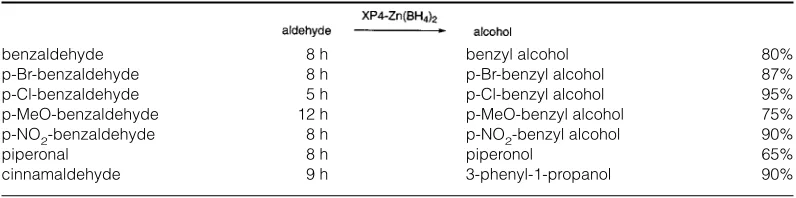
Zinc borohydride has been used as a selective reducing agent. It is typically prepared as an ethe-real solution, and stored cold, due to instability. Zinc borohydride supported on crosslinked 4-polyvinylpyridine (XP4-Zn(BH4)2) is a white powder that is stable at room temperature for months,
Table II. Reduction of Aryl Halides with BER-Ni(OAc)2
chlorobenzene benzene 98%
bromobenzene benzene 100%
iodobenzene benzene 97%
2-chlorobenzoic acid benzoic acid 81% 4-chloronitrobenzene aniline 92%
Table III. Alkyl Reduction Using BER-Ni(OAc)2
octyl chloride octane trace
octyl bromide octane 100%
cyclohexyl bromide cyclohexane 98%
benzyl chloride toluene 96%
benzyl-a-bromoacetate benzyl acetate 98%
Table IV. Reduction of Aromatic Aldehydes to Hydrocarbons Using BER-Ni(AcO)2
furfuraldehyde 2-Me-furan 86%
benzaldehyde toleune 91%
4-Me-benzaldehyde 4-Me-toluene 92%
4-Cl-benzaldehyde toluene 95%
3-NO2-benzaldehyde 3-NH2-toluene 97%
2-OH-benzaldehyde 2-OH-toluene 98%
3-MeO-benzaldehyde 3-MeO-toluene 93%
4-(CH3)2N-benzaldehyde 4-(CH3)2N-toluene 98%
and shows useful reducing properties (Table VI).34The utility of this reagent lies in its discrimina-tion between aldehydes and ketones; ketones are not reduced.
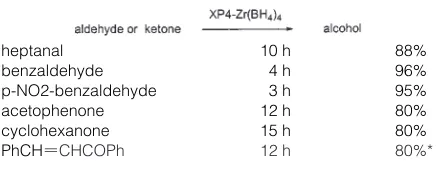
A similar reagent prepared with zirconium instead of zinc (XP4-Zr(BH4)4) has enhanced reac-tivity (Table VII).35Ketones are now also reduced, although, unlike BER-CuSO
[image:10.504.119.385.79.459.2] [image:10.504.53.451.575.674.2]4, conjugated dou-ble bonds are left untouched. Zr(BH4)4decomposes at close to room temperature, inflames in air,
Table V. Reductions Using BER-CuSO4
benzaldehyde benzyl alcohol 99%
2-heptanone 2-heptanol 98%
D-camphor no reaction
acetophenone 1-phenylethanol 100%
cyclohexenone cyclohexanol 98%
ethyl benzoate no reaction
benzamide no reaction
hexanenitrile hexylamine 35% (reflux) benzonitrile benzylamine 58% (reflux)
(dibenzylamine) (21%)
1chlorooctane no reaction
1-bromooctane octane 99%
1-bromo-4-chlorobutane 1-chlorobutane 95%
benzyl chloride toluene 83%
(1,2-diphenylethane) 8%
chlorobenzene no reaction
bromobenzene benzene 36%
bromobenzene benzene 55%a
bromobenzene benzene 100%a,b
iodobenzene benzene 99%
p-bromochlorobenzene chlorobenzene 99%a,b
p-bromoiodobenzene bromobenzene 97%
octyl azide octylamine 97% (6 hr)
benzyl azide benzylamine 99% (6 hr)
phenyl azide aniline 97% (1 hr)
nitrocyclohexane cyclohexylamine 98%
nitrobenzene aniline 95%a
p-bromonitrobenzene p-bromoaniline 95%a
areflux b0.5 eq CuSO
4instead of 0.1 eq
Table VI. Aldehyde Reduction Using XP4-Zn(BH4)2
benzaldehyde 8 h benzyl alcohol 80%
p-Br-benzaldehyde 8 h p-Br-benzyl alcohol 87%
p-Cl-benzaldehyde 5 h p-Cl-benzyl alcohol 95%
p-MeO-benzaldehyde 12 h p-MeO-benzyl alcohol 75%
p-NO2-benzaldehyde 8 h p-NO2-benzyl alcohol 90%
piperonal 8 h piperonol 65%
Table VII. Reduction of Aldehydes and Ketones Using XP4-Zr(BH4)4
heptanal 10 h 88%
benzaldehyde 4 h 96%
p-NO2-benzaldehyde 3 h 95%
acetophenone 12 h 80%
cyclohexanone 15 h 80%
PhCHuCHCOPh 12 h 80%*
*no reduction of double bond
Scheme 19. Selective reduction of conjugated ethylenic link-age using ion exchange resin bound borohydride.
and hydrolyzes explosively; however, the polymer-supported version is stable. This reagent has clear advantages in terms of both safety and ease of workup and product isolation when compared to the unsupported reagent. The authors indicate that preliminary studies show reduction of acid chlorides to aldehydes, epoxides to the more substituted alcohols, and azides and nitriles to amines.
diacetates, and ketones is selectively reduced while ␣,-unsaturated aldehydes are reduced to the saturated alcohols.
BER can also reduce imines, and has proven to be useful as a reducing agent in the reductive amination of aldehydes and ketones (Table VIII).37Aldehydes are reductively aminated cleanly with both primary and secondary amines. Ketones react well with less hindered aliphatic amines, and give lower yields with aromatic amines.
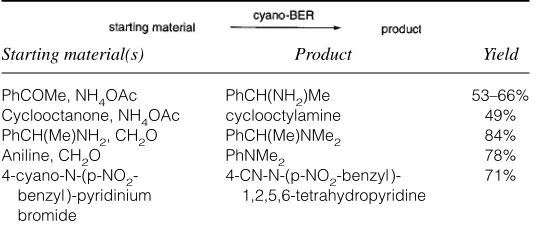
Cyanoborohydride has also been supported on an anion exchange resin, and, like its unsup-ported counterpart, is a useful reagent for reductive amination (Table IX).38The dimethylation of primary amines with formaldehyde works particularly well. An advantage of this process is that the toxic cyanide residues are retained on the polymer. Unlike the solution phase method, the Cyano-BER reaction requires mild heating to proceed, indicating a lower reactivity for the supported reagent.
Polymer-supported reagents have been used in the reduction of ozonides formed in the ozonol-ysis of alkenes (Table X). Methodology using poly-TPP was developed when the scientists had
dif-Table VIII. Reductive Amination Using BER
Carbonyl Amine Yield
hexanal cyclohexylamine 89%
hexanal diethylamine 86%
hexanal piperidine 92%
benzaldehyde cyclohexylamine 94%
benzaldehyde aniline 88%
benzaldehyde piperidine 90%
cyclohexanone benzylamine 92%
[image:12.504.120.389.430.548.2]cyclohexanone NH4OAc 59%
Table IX. Reductive Amination Using Cyano-BER
Starting material(s) Product Yield
PhCOMe, NH4OAc PhCH(NH2)Me 53–66%
Cyclooctanone, NH4OAc cyclooctylamine 49%
PhCH(Me)NH2, CH2O PhCH(Me)NMe2 84%
Aniline, CH2O PhNMe2 78%
4-cyano-N-(p-NO2- 4-CN-N-(p-NO2-benzyl)- 71%
benzyl)-pyridinium 1,2,5,6-tetrahydropyridine bromide
Table X. Reduction of Ozonides Using Poly-TPP
1. ozone R1UCR
2uCHUR
3 j R1UCOR
2⫹R3UCHO
2. Poly-TPP
R1uPh, R2uH, R3uH 80%
R1uC9H19, R2uH, R3uH 92%
R1uC7H15, R2uH, R3uC7H15 91%
R1uPh, R2uMe, R3uH 86%
[image:12.504.114.390.579.660.2]ficulty removing triphenylphosphine oxide from a particular steroidal aldehyde product.39 3,3´ thiodipropionic acid bound to an ion-exchange resin has also been used in the reductive quenching of ozonolysis reactions.40The resin can be readily regenerated and, thus, provides a cost-effective reagent.
Tributyltin hydride is a versatile reagent useful for many transformations in organic synthesis. One drawback to this reagent is the difficulty in removing the tin byproducts from the desired com-pound. One way to address this problem is the incorporation of the tin reagent onto a polymer back-bone. Indeed, an organotin hydride bound to crosslinked polystyrene and some of its uses have been reported (Scheme 20).41A variety of compounds can be dehalogenated in good yield, including mol-ecules with significant functionality. The reagent is also useful for the second step of the Barton-type dehydroxylation of alcohols and in the conversion of isocyanides into the corresponding hydrocar-bons. In order to further reduce the tin contamination further a system has been recently developed which uses “catalytic” amounts of polymer-supported tin hydride reagent generated in situ from a polymer-supported organotin halide and sodium borohydride.42The use of Polymer-(CH
2)4SnBu2I/ NaBH4system afforded ⬎90% yields in the reduction of 1-bromoadamantane using 0.2 equivalents of the tin halide with no tin being detectable.
A BER-NiB2system has also been used in radical addition of alkyl halides to alkenes.43 Cou-pling of representative alkenes with a-bromo acid derivatives occurred in the presence of excess sodi-um iodide using BER-NiB2prepared in situ from BER-Ni(OAc)2in methanol.
4. O X I D A T I O N S U S I N G P O L Y M E R - S U P P O R T E D R E A G E N T S
Medicinal chemists often need to perform mild and selective oxidation reactions. A variety of polymer-supported oxidizing agents have been developed which offer some advantages over more traditional oxidants. Peracids can be utilized for epoxidation reactions, oxidation of sulfides or sulfoxides to sul-fones, and conversion of ketones to esters. Peracid type resins (PARs) prepared from polymer-bound carboxylic acids perform the same transformations (Table XI), and offer ease of removal of the spent reagent.44The PARs are quite stable, and can be easily regenerated after each use. Polymer-supported persulfonic acids have been used to carry out similar transformations in good yields (Table XII).45
A number of chromium derived oxidants are routinely used in organic synthesis. Removal of the by-products from the reaction can often be a problem, and with certain reagents, safety is a large is-sue. Frechet and colleagues developed poly(vinylpyridinium dichromate) (PVPDC) as an inexpen-sive, convenient to use, recyclable oxidant.46 Table XIII lists some of the oxidations of alcohols to carbonyl compounds performed with this reagent. Primary alcohols are converted to aldehydes, and
Table XI. Oxidations With Peracid Resins
Substrate Solvent Temp (ºC) Time (h) Conversion (%) Product
CH3SOCH3 dioxane 20 0.1 98.7 sulfone
cyclohexene dioxane 20 0.5 83.8 epoxide
CH3SCH3 dioxane 20 2 92.2 sulfone
2-pentene dioxane 30 2 85.4 epoxide
cyclododecene t-BuOH 30 2 86.0 epoxide
cyclohexanone H2O 40 1.5 96.0 lactone
styrene t-BuOH 60 6 81.2 epoxide
Table XII. Oxidations Using Polymer-Supported Persulfonic Acid
acetophenone phenyl acetate 85% benzophenone phenyl benzoate 81% cyclopentanone d-valerolactone 99% ethyl methyl ketone ethyl acetate 99%
cyclohexene epoxide 80%
styrene epoxide 80%
stilbene epoxide 80%
chalcone epoxide 80%
Table XIII. Oxidations of Alcohols With PVPDC
secondary alcohols are transformed into the corresponding ketones. Other polymer-supported chromium based oxidants have been prepared, and may be useful in certain circumstances. For ex-ample, a polymer-supported quaternary ammonium perchromate converts allylic alcohols to ␣, -unsaturated aldehydes but does not oxidize saturated alcohols (Scheme 21).47
[image:15.504.155.350.245.378.2]Several groups have reported on the utility of chromium reagents supported on silica gel. A sil-ica gel-supported chromium trioxide reagent was recently described that is easily prepared, oxidizes alcohols cleanly in short reaction times at room temperature, uses a simple work up, and has a good shelf life.48A few transformations carried out by the reagent are shown in Table XIV. Silica gel sup-ported bis(trimethylsilyl)chromate has also been appeared recently disclosed in the literature.49This reagent oxidizes various types of alcohols to carbonyls, reaction times are short, and over oxidation to carboxylic acids is not observed (Table XV). Oxidation of aryl substituted unsaturated alcohols (e.g., cinnamaldehyde) is not satisfactory in that partial cleavage of the double bond is observed. The reagent can also be used with cyanotrimethylsilane to convert benzaldehydes into the corresponding aroyl cyanides, useful precursors for amino alcohol synthesis.
Table XIV. Oxidations With Silica-Gel-Supported CrO3
octanol octanol 85%
benzyl alcohol benzaldehyde 80%
2-nitrobenzyl alcohol 2-nitro-benzaldehyde 46% cinnamyl alcohol cinnamaldehyde 67%
Table XV. Oxidations With Silica-Gel-Supported Bis(trimethylsilyl)chromate
o-MeO-benzyl alcohol o-MeO-benzaldehyde 99% p-Br-benzyl alcohol p-Br-benzaldehyde 98% m-NO2-benzyl alcohol m-NO2-benzaldehyde 98%
1-octanol 1-octanol 94%
2-cyclohexylethanol cyclohexylacetaldehyde 97%
phenylethanol phenylacetaldehyde 96%
1-indanol 1-indanone 98%
menthol menthone 98%
methyl mandelate methyl phenylglyoxalate 93%
mandelonitrile benzoyl cyanide 96%
Ammonium chlorochromate adsorbed on silica gel is another convenient oxidant recently re-ported.50The reagent is prepared by adding silica gel to a solution of ammonium chlorochromate in water, and evaporating to dryness. The reagent can be stored in the air at room temperature without losing activity. Benzoins are converted cleanly to benzils (Table XVI). Alcohols are converted to ke-tones or aldehydes, and sensitive structures such as allylic alcohols work well (Table XVII). Unlike the oxidation with BTSC on silica, cinnamyl alcohol is cleanly converted to cinnamaldehyde. Table XVIII depicts selected oxidations using KMnO4supported on kieselguhr.51Once again, preparation of the reagent is simple, and the oxidations are easy to perform.
A polymer-supported perruthenate (PSP) has been developed on Amberlyst resin,52and was
Table XVI. Oxidations of Benzoins With Silica-Gel-Supported Ammonium Chlorochromate
Ar Yield
Ph 95%
p-Me-Ph 91%
p-MeO-Ph 90%
p-Cl-Ph 79%
2-furoyl 85%
Table XVII. Oxidations of Alcohols With Silica-Gel-Supported Ammonium Chlorochromate
R R1 Yield
Ph H 91%
Ph Me 90%
Ph Ph 80%
PhCHuCH
2 H 81%
PhCH2 H 65%
U(CH
2)4U 85%
CH2(CH2)6 H 81%
Table XVIII. Oxidations With KMnO4Supported on Kieselguhr
R R1 Yield
Et Me 82%
Ph Ph 97%
Ph H 91%
PhCHuCH2 H 94%
used in the oxidation of primary and secondary alcohols as a stoichiometric reagent or in catalytic amounts with a N-oxide co-oxidant. A further development was the use of molecular oxygen as an oxidant in conjunction with catalytic PSP.53This modification allows the oxidation of a range of al-cohols to aldehydes and avoids the need for conventional workup procedures. This procedure affords the highest yield of cinnamaldehyde of the solid supported reagents described above (⬎95%).
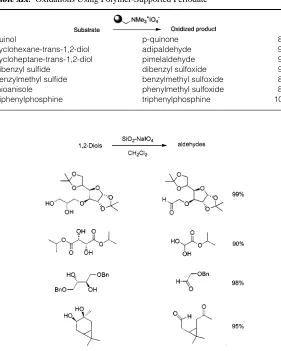
Periodates oxidize various functional groups, but due to solubility limitations, these salts are typically only utilized in hydroxylic media. Polymer-supported periodate, however, can be used in a variety of solvents, and in many cases, filtering off the resin and evaporating the solvent gives clean oxidized product. Quinols are converted to quinones, 1,2-diols are cleaved to the corresponding car-bonyl compounds, sulfides are oxidized to sulfoxides, and triphenylphosphine is converted to tri-phenylphosphine oxide (Table XIX).54
[image:17.504.108.389.286.637.2]A silica-gel supported metaperiodate reagent useful for the oxidative cleavage of 1,2-diols has been reported.55The reagent is easy to prepare, can be stored, and affords products in high yield, and pure enough for further synthetic operations (Scheme 22). The reaction can be performed in dichloromethane, and the reagent can thus be used for reactants not soluble in THF or water (typi-cal solvents for the nonsupported reagent).
Table XIX. Oxidations Using Polymer-Supported Periodate
quinol p-quinone 86%
cyclohexane-trans-1,2-diol adipaldehyde 90% cycloheptane-trans-1,2-diol pimelaldehyde 90%
dibenzyl sulfide dibenzyl sulfoxide 99%
benzylmethyl sulfide benzylmethyl sulfoxide 85%
thioanisole phenylmethyl sulfoxide 81%
triphenylphosphine triphenylphosphine 100%
Osmium tetroxide is a useful reagent for converting alkenes to diols. This reagent has been an-chored to solid supports either via an ionic interaction or more recently via microencapsulation, and can be used with co-oxidants to catalytically hydroxylate olefins (Table XX).56The polymer-sup-ported reagent offers ease of workup compared to the classical method. Use of these polymers in conjunction with sodium periodate allows for cleavage of the vicinal diol formed by the hydroxyla-tion reachydroxyla-tion to the corresponding carbonyl compounds (Table XXI).57
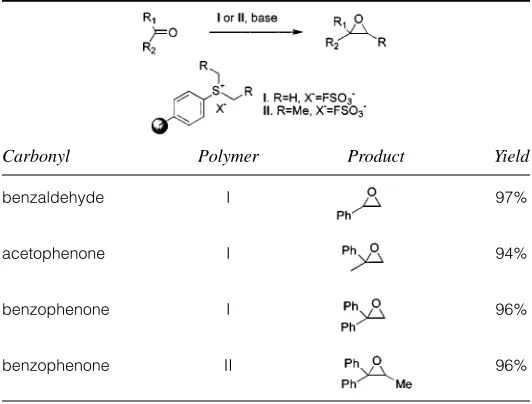
Sulfonium salts have been anchored to solid supports, and have been used to prepare epoxides by reaction of their ylides with carbonyl compounds (Table XXII).58These salts are prepared by de-rivatization of crosslinked polystyrene. The polymeric reagent can be regenerated and reused with-out loss of reactivity.
Dimethyl dioxirane oxidizes alkenes to epoxides, primary amines to nitro compounds, tertiary amines to amine oxides, and sulfides to sulfoxides. This reagent is prepared at low temperature, of-ten in situ, is unstable to heat and light, and has a short shelf life unless stored cold. The recently re-ported polymer-bound dioxirane overcomes these liabilities, and still affords a versatile oxidizing agent.59Table XXIII outlines some of the transformations using the polystyrene-supported dioxi-rane.
Table XX. Catalytic Hydroxylation of Olefins by Polymer-Bound Osmium Tetroxide
R1 R2 R3 R4 Catalyst Co-oxidant Temp Time Yield
H H H n-C8H17 2 Me3NO 83 0.5 h 95%
H H H n-C8H17 1 Me3NO 83 0.5 h 90%
Me H H n-C8H17 2 Me3NO 83 0.5 h 90%
cyclooctene 2 Me3NO 83 0.5 h 90%
Ph H H Ph 2 Me3NO 83 0.5 h 80%
Ph H H CO2Et 2 tBuOOH r.t. 48 h 70%
CO2Et H H CO2Et 2 tBuOOH r.t. 60 h 95%
Table XXI. Cleavage of Olefins by Polymer-Supported Osmium Tetroxide and Sodium Periodate
R1 R2 Time Product Yield
H n-C8H17 0.5 h nonanal 77%
n-C3H7 n-C3H7 2 h butanal 90%
CH3 n-C5H11 2 h hexanal 75%
Ph Ph 1 h benzadehyde 73%
U(CH
2)4U 1 h hexanedial 65%
Ph CO2Et 2 h benzaldehyde 85%
Table XXII. Conversion of Carbonyl Compounds to Epoxides via Polymer-Bound Sulfonium Ylide
Carbonyl Polymer Product Yield
benzaldehyde I 97%
acetophenone I 94%
benzophenone I 96%
benzophenone II 96%
Scheme 23. Swern-type oxidation with a polymer-bound sulfoxide. Table XXIII. Oxidations Using Polystyrene-Supported Dioxirane
aniline 43 h nitrobenzene 83%
o-toluidine 39 h o-nitrotoluene 85%
2-aminophenol 52 h 2-nitrophenol 80%
pyridine 35 h pyridine N-oxide 83%
2,6-lutidine 30 h 2,6-lutidine N-oxide 85% 2-aminopyridine 50 h 2-nitropyridine 80%
styrene 40 h styrene oxide 82%
cyclohexene 60 h cyclohexene oxide 73%
5. H A L O G E N A T I O N S U S I N G P O L Y M E R -S U P P O R T E D R E A G E N T -S
Many methods are available for the halogenation of organic molecules and the choice of reagents of-ten comes down to selectivity, functional group compatibility, and ease of use. Included in the arse-nal are a number of polymer-supported halogenating agents. Attachment to a polymer backbone of-ten increases the ease of handling of some of these reagents, and can serve to modulate the reactivity profile of the reagent.
Amberlyst A-26 in the perbromide form conveniently brominates a number of organic substrates in good yields (Scheme 24).62Saturated aldehydes are readily brominated, as are ketones. ␣, -Unsaturated ketones are converted into the saturated di-bromo product in high yield. Esters are not alpha brominated, except for a doubly activated compound such as diethyl malonate.
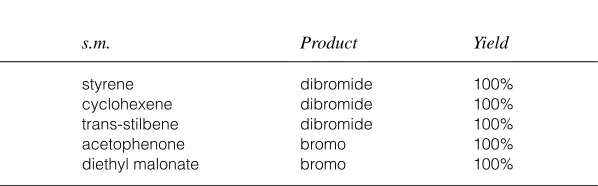
Poly(4-methyl-5-vinylthiazolium)hydrotribromide has recently been introduced as a stable and useful brominating agent.63The polymer backbone is prepared by radical copolymerization of 4-methyl-5-vinylthiazole with styrene and divinylbenzene. Alkenes are readily dibrominated (Table XXIV). Acetophenone is quantitatively alpha-brominated, and diethyl malonate can be cleanly con-verted to the monobromo derivative.
In addition to brominations of olefins, or brominations alpha to carbonyls, side chains of aryl groups can also be brominated with polymer-supported reagents (Table XXV).64The bromine complex of poly(styrene-co-4-vinylpyridine) in the presence of dibenzoyl peroxide converts alkyl substituted ben-zene derivatives into the brominated products. The yields obtained are higher than those found prepar-ing the compounds by other methods, and the experimental procedure used is operationally simpler.
Bromination of aryl rings can also be accomplished using polymer-supported reagents. Table XXVI lists the bromination of a variety of aromatic molecules using derivatives of crosslinked co-polystyrene-4-vinylpyridine.65Polymer 1 is the milder brominating agent, and in certain cases gives better selectivity; for example, polymer 1 converts phenol to 4-bromophenol, and polymer 2 con-verts phenol to 2,4-dibromophenol. N-methyl indole, benzofuran, and benzothiophene could all be brominated, although they each gave a different type of product (see Table XXVI).
Table XXIV. Brominations With Poly-(4-Me-5-vinyl-thiazolium)hydrotribromide
s.m. Product Yield
styrene dibromide 100%
cyclohexene dibromide 100%
trans-stilbene dibromide 100%
acetophenone bromo 100%
diethyl malonate bromo 100%
[image:21.504.107.401.235.347.2]PMVTHT ⫽Poly-(4-Me-5-vinyl-thiazolium)hydrotribromide
Table XXV. Side Chain Bromination Using Bromide Complex of Poly(styrene-co-vinylpyridine)
toluene (bromomethyl)benzene 78%
1-methylnaphtalene 1-(bromomethyl)naphthalene 63% 2-methylnaphthalene 2-(bromomethyl)naphthalene 79% ethylbenzene 1-phenyl-1-bromoethane 81% 1,2-dimethylbenzene 1,2-bis(bromomethyl)benzene 85% 2,6-dimethylpyridine 2,6-bis(bromomethyl)pyridine 66%
Table XXVI. Bromination of Aromatic Molecules
phenol poly 1 4-Br-phenol 68%
phenol poly 2 2,4-dibromophenol 77%
N,N-dimethylaniline poly 1 4-Br-N,N-dimethylaniline 74%
anisole poly 2 4-Br-methoxybenzene 77%
N-acetylaminobenzene poly 2 1-N-acetylamino-4-bromobenzene 71% 1-methylindole poly 1 2,3-dibromo-1-N-methylindole 72%
benzothiophene poly 1 3-bromo-benzothiophene 79%
benzofuran poly 1 trans-2,3-diBr-2,3-dihydrobenzofuran 76%
N-acetyltyramine poly 2 3,5-diBr-N-acetyltyramine 84%
[image:21.504.52.456.480.660.2]Other halogens can also be introduced with solid supported reagents. Chlorination of crosslinked styrene-4-vinyl-(N-methylpyridinium iodide) copolymer yields a reagent that converts acetophe-none to chloroacetopheacetophe-none in excellent yield (Scheme 25).66A similar reagent, poly[styrene-co-(4-vinylpyridinium dichloroiodate)], also smoothly chlorinates acetophenone (Scheme 26).67This par-ticular reagent also iodinates the cyclic ketones indanone, 1-tetralone, and 6,7,8,9-tetrahydro-5H-benzocyclohepten-5-one.
Poly[styrene-co-(4-vinylpyridinium dichloroiodate)] can also be used for regio- and stereospe-cific iodochlorination of alkenes and alkynes (Table XXVII).68This reagent gives Markovnikov type regioselectivity, and gives trans addition products. The solid-supported reagent gives purer products than the corresponding reaction with unsupported iodochloride.
With the increasing number of efficient metal mediated coupling reactions of aryl iodides and bromides, the simple preparation of these starting materials becomes more important. Poly[styrene-co-(4-vinylpyridinium dichloroiodate)]69and poly[styrene(iodoso diacetate)]70regioselectively io-dinate activated aromatic and heteroaromatic molecules (Table XXVIII). Typical electrophilic iodi-nation conditions require additional washing steps to remove impurities and iodine formed in the reaction. In some cases, multiple iodo atoms can be introduced by using more of the polymer. For example, 3-amino-2,4,6-triiodobenzoic acid is formed in 75% yield from 3-aminobenzoic acid us-ing 2 grams of the resin for each millimole of substrate, as opposed to 0.5 g of resin for mono-iodi-nation of 1 mmol of substrate.
Solid supported reagents that incorporate fluorine into organic molecules have also been devel-oped. Olah and coworkers prepared poly-4-vinylpyridinium poly(hydrogen fluoride) from crosslinked poly-4-vinylpyridine and anhydrous hydrogen fluoride.71This material is a stable solid up to 50 ⬚C, and needs to be stored under nitrogen. This reagent hydrofluorinates alkenes and alkynes, fluorinates secondary and tertiary alcohols, and, in the presence of N-bromosuccinimide, bromoflu-orinates alkenes (Table XXIX). This fluorinating agent offers the typical advantages of polymer-sup-ported reagents.
Scheme 26. Halogenation with poly[styrene-co-(4-vinylpyridinium dichloroiodate).
Table XXVII. Iodochlorination of Alkenes and Alkynes With Poly[styrene-co-(4-vinylpyridinium dichloroiodate)
Table XXVIII. Regioselective Iodination of Aromatic and Heteroaromatic Molecules
N,N-dimethylaniline 4-iodo-N,N-dimethylaniline 80%
phenol 4-iodo-phenol 60%
anisole 4-iodo-anisole 85%
1-MeO-naphthalene 4-iodo-1-MeO-naphthalene 85% 2-MeO-naphthalene 1-iodo-2-MeO-naphthalene 77%
1-naphthol 4-iodo-1-naphthol 68%
2-naphthol 1-iodo-2-naphthol 73%
1,3,5-trimethylbenzene 2-iodo-1,3,5-trimethylbenzene 76% 3-aminobenzoic acid 3-amino-2,4,6-triiodobenzoic acid 77% 1,3-dimethyluracil 5-iodo-1,3-dimethyluracil 90% 8-OH-quinoline 8-OH-5,7-diiodoquinoline 81%
Table XXX. Fluorinations With Polymer-Supported Fluoride Ion
n-octyl bromide 82%
n-octyl chloride 87%
n-octyl mesylate 92%
benzyl chloride 100%
ethylbromoacetate 65% bromoacetophenone 98%
Alkyl fluorides can also be obtained from the reaction of the fluoride form of Amberlyst A-26 ion exchange resin with primary alkyl bromides, chlorides, and mesylates (Table XXX).72Secondary alkyl halides give mostly elimination products. Secondary mesylates afford better yields of the sub-stitution product than do the corresponding bromides. This same reaction can be utilized for bromo to iodo, bromo to chloro, and chloro to bromo conversions simply by starting with the appropriate halide supported on the anion exchange resin. Reaction conditions are mild, and yields are general-ly quite high.
6. S U B S T I T U T I O N R E A C T I O N S U S I N G P O L Y M E R -S U P P O R T E D N U C L E O P H I L E -S O R R E A G E N T -S
The previous section contained an example illustrating the utility of polymer-supported halide ions in nucleophilic displacement reactions (Table XXX). In addition to halogen, a variety of nucleophiles have been supported on ion exchange resin, and these reagents often offer advantages such as easy work up, high yields, and mild reaction conditions.
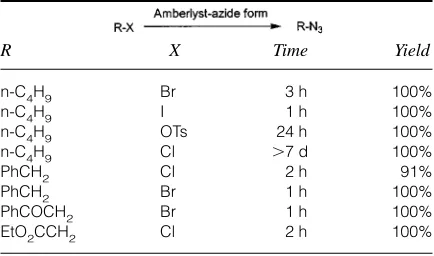
[image:24.504.149.354.277.367.2]Alkyl azides are useful intermediates in organic synthesis, and can be prepared using a poly-meric quaternary ammonium azide. This reagent allows for the conversion of activated and nonac-tivated alkyl halides into azides at room temperature (Table XXXI).73The reaction proceeds most rapidly in polar solvents such as DMF and acetonitrile, but reasonable reaction rates are also obtained in a variety of other solvents. This reagent has also been used to open epoxides of polycyclic aro-matic hydrocarbons to give azidohydrins.74
Table XXIX. Fluorinations With Poly-4-vinylpyridinium poly(hydrogen fluoride)
cyclohexene cyclohexyl fluoride 76%
1-methylcyclohexene 1-Me-1-F-cyclohexane 80%
norbornene 2-norbornyl fluoride 79%
cycloheptene cycloheptyl fluoride 81%
1-hexyne 2,2-diflourohexane 56%
3-hexyne 3,3-diflourohexane 59%
1-adamantanol 1-adamantyl fluoride 94% 2-adamantanol 2-adamantyl fluoride 88% triphenylmethanol triphenylmethyl fluoride 77% cycloheptanol cycloheptyl fluoride 67%
A variety of nucleophiles have been supported on Amberlyst ion exchange resin and used for synthetic transformations. Cyanide ion supported on Amberlyst resin can be used to convert acti-vated halides into the corresponding nitriles (Table XXXII).75This reagent is commercially avail-able and can be used in a variety of solvents.
Amberlyst resin in the cyanate form converts alkyl halides into the corresponding symmetrical ureas in solvents such as benzene and pentane (Table XXXIII). Switching to ethanol as solvent gives good yields of the ethylcarbamates (Table XXXIV).76Thiocyanate supported on Amberlyst converts alkyl halides to thiocyanates (Table XXXV).
[image:25.504.144.361.91.219.2] [image:25.504.156.351.412.477.2] [image:25.504.148.353.522.659.2]Thioacetate ion has also been supported on Amberlyst resin, and readily converts alkyl halides and tosylates into thioacetates (Table XXXVI).77Due to the mild reaction conditions, easy workup,
Table XXXI. Conversion of Alkyl Halides to Alkyl Azides Using a Polymeric Quaternary Ammonium Azide
R X Time Yield
n-C4H9 Br 3 h 100%
n-C4H9 I 1 h 100%
n-C4H9 OTs 24 h 100%
n-C4H9 Cl ⬎7 d 100%
PhCH2 Cl 2 h 91%
PhCH2 Br 1 h 100%
PhCOCH2 Br 1 h 100%
EtO2CCH2 Cl 2 h 100%
Table XXXII. Nitrile Synthesis Using Polymer-Supported Cyanide Ion
benzyl bromide 72%
p-Br-benzyl bromide 98% p-Me-benzyl bromide 43% m-Cl-benzyl bromide 68%
and high yields, this reaction represents a convenient method for the introduction of sulfur into or-ganic molecules. The thioacetate can be converted into the thiol via a palladium catalyzed methanol-ysis utilizing BER.78The formation of the thiol from an alkyl halide can be achieved in one-pot us-ing the supported reagents in sequence.
Phenoxides can be supported on resin, and this serves as a useful method for carrying out O-alkylation when reacted with alkyl halides. Table XXXVII illustrates the reaction of phenoxides bound to a strongly basic Amberlite resin.79Primary halides give higher yields than secondary halides, and bromides give higher yields than chlorides. This methodology was recently expanded on, and used to make a library of aryl and heteroaryl ethers.80
Polymer-supported 1,5,7-triazabicyclo[4.4.0]dec-5-ene (PTBD) can also be used to deprotonate and support a variety of phenols, which can then be O-alkylated with a good variety of alkyl halides (Table XXXVIII).81Of note is the ability to use tertiary halides and phenols with electron-donating or withdrawing groups. A wide range of aryl alkyl ethers was obtained using this methodology in good yields and high purity after filtration and solvent evaporation. A phenol supported in this man-ner could also be used in nucleophilic aromatic substitution reactions to give aryl ether products. As a further extension of this work, it was demonstrated that other acidic functionality, such as the nitrogen of saccharin or 2,4-thazolidinedione, could also be alkylated in the same straightforward manner.
Table XXXIV. Carbamate Formation Using Polymer-Supported Cyanate Ion in Ethanol
PhCH2Cl 83%
[image:26.504.151.354.305.428.2]n-C8H17 85%
Table XXXV. Thiocyanate Formation Using Polymer-Supported Thiocyanate
n-C8H17 90%
EtO2CCH2-Br 91%
n-C6H13-CH(Br)CH3 77%
Table XXXVI. Introduction of Sulfur Using Polymer-Supported Thioacetate
R X Yield
n-C8H17 BR 90%
n-C8H17 Cl 92%
n-C8H17 TsO 95%
H2CuCHUCH2 Br 56%
EtO2CCH2 Cl 85%
PhCH2 Br 87%
PhUCOUCH
Table XXXVII. Ether Formation Using Phenoxides Supported on Amberlite Resin
Anion R-X Yield
phenoxide MeI 95%
phenoxide allyl bromide 100%
phenoxide benzyl chloride 100%
phenoxide n-butyl iodide 100%
phenoxide n-butyl chloride 15%
2-naphthoxide MeI 60%
4-NO2-phenoxide MeI 95%
2,4-dinitrophenoxide MeI 10%
Table XXXVIII. Alkylations Using the Polymer-Supported Bicyclic Guanidine Base, PTBD
Phenol Halide Product Yield Purity
79% 91%
98% 98%
65% 94%
32% 95%
73% 99%
39% 39%
In addition to this polymer-supported bicyclic guanidine base (PTBD), a new synthesis of poly-styrene supported biguanides has also been recently reported.82Biguanides are significantly more basic than the bicyclic guanidines, and have been used in base-catalyzed transesterification reactions. Reaction of guanidines with a polymer-bound carbodiimide yields supported biguanides which are more reactive and more stable than previously reported polymer-supported guanidines.
Polymer-supported carbonate ion has been utilized for the conversion of -iodoamines into aziridines in high yield (Table XXXIX).83The reactions are performed in methanol, and pure prod-uct is obtained after filtration of the resin and evaporation of the solvent. Polymer-supported acetate ion transforms the same substrates into the amino alcohol (Table XL). Utilizing the resin-bound ac-etate for this transformation meant an aqueous work up was avoided, which turned out to be partic-ularly important for these water-soluble compounds.
The same group used polymer-supported carbonate ion and iodine to transform allylic amines into 5-(iodomethyl)oxazolidin-2-ones in excellent yields (Scheme 27).84To emphasize the utility of this methodology, this research group synthesized the -adrenoceptor antagonist propanolol in 6 steps (Scheme 28). Three of the steps involved solid-supported reagents.
The Mitsunobu reaction is a widely used reaction for the replacement of hydroxy groups by oxy-gen, nitrooxy-gen, and carbon nucleophiles. In certain examples, a major limitation is the purification of the crude reaction products. In addition to the use of polymer-supported phosphines,85a polymer-supported alkyl azodicarboxylate reagents has been prepared on polystyrene.86The immobilized reagent functioned effectively in Mitsunobu reactions, giving comparable yields to the correspond-ing soluble reagents. The resin was shown to have no tendency to explode or ignite and could be re-cycled at least five times.
A phthalimide containing resin has also been used in the conversion of a hydroxyl group to the corresponding amine under Mitsunobu conditions.87Reaction of N6-benzyladenosine with the resin in the presence of diethylazodicarboxylate and triphenylphosphine yielded a resin bound intermedi-ate which was readily isolintermedi-ated. Subsequent treatment with hydrazine and evaporation gave a pure sample of the 5⬘-amine nucleoside as shown in Scheme 29.
[image:28.504.151.357.466.539.2]A polymer-bound tosyl azide has also been developed and used in the synthesis of diazoke-tones.88The diazo transfer reagent was synthesized on Amberlite XE 305 in two steps. The resin-bound reagent has one distinct advantage over tosyl azide in that it is not shock sensitive.
Table XXXIX. Aziridine Formation Using Polymer-Supported Carbonate Ion
R1uH, R2uMe 96% R1uC5H11, R2uH 95% R1uCH(Me)2, R2uH 95%
Table XL. Amino Alcohol Formation From -Iodo-Amines Using Solid-Supported Reagents
7. P R O T E C T I O N A N D D E P R O T E C T I O N U S I N G P O L Y M E R - S U P P O R T E D R E A G E N T S
The protection and subsequent deprotection of sensitive functionality in organic molecules is a com-mon task in the synthesis of complex molecules. Considerable effort has gone into the development of simple, mild, and high-yielding protection and deprotection reactions. Due to some of the inher-ent advantages of solid-supported reaginher-ents, it is not surprising that they can play a role in these sorts of transformations.
Table XXXVII described the alkylation of polymer-supported phenoxides with various alkyl halides to give ethers. The methyl ether is a common protecting group for phenols, and can be con-veniently introduced by the action of dimethyl sulfate on resin-bound phenoxides (Table XLI).89The
Scheme 28. Propanolol synthesis.
Scheme 27. Synthesis of 5-(Iodomethyl)oxazolidin-2-ones.
authors found dimethyl sulfate more effective than methyl iodide in this transformation. Supported phenoxide ions can also be protected with the more readily removed t-butyldimethylsilyl (TBDMS) group (Table XLII).90
The tetrahydropyranyl moiety is a very useful protecting group for alcohols and phenols. It can be introduced conveniently by using the hydrochloride salt of poly(4-vinylpyridine) resin as a cata-lyst.91The reaction can be carried out on dihydropyran as solvent, and a range of alcohols are pro-tected in high yields following filtration and evaporation of the excess DHP (Table XLIII). Sulfuric acid absorbed on silica gel has also been used as the catalyst for this transformation with great suc-cess.92This method also offers the advantages of no aqueous workup, mild reaction conditions, short reaction times, and high yields.
[image:30.504.126.379.91.233.2] [image:30.504.133.373.532.660.2]Carbonyl groups are often protected as acetals during the course of a multistep synthesis. Poly-mer-bound triphenylphosphine diiodide has been successfully employed to convert a range of car-bonyl compounds into acetals, cyclic acetals, dithioacetals, and oxathioacetals.93Some of their results are highlighted in Table XLIV. The reaction is carried out in anhydrous acetonitrile at room tempera-ture, and the reaction by-product, polymer-supported triphenylphosphine oxide, is removed by filtra-tion. This by-product can be recycled by reduction to the starting phosphine form with trichlorosi-lane.94Polymer-supported boron trifluoride, formed by reaction of crosslinked polystyrene-4-vinyl pyridine resin with boron trifluoride in chloroform, can also catalyze the acetalization of certain car-bonyl compounds.95This reagent can also be used to esterify carboxylic acids.
Table XLI. Protection of Polymer-Supported Phenoxides as Methyl Ethers
Anion Yield
phenoxide 92%
o-Me-phenoxide 96%
m-Me-phenoxide 92%
p-Me-phenoxide 95%
1-naphthoxide 98%
2-naphthoxide 95%
p-Br-phenoxide 98%
2,6-diisopropylphenoxide 75%
Table XLII. Protection of Polymer-Supported Phenoxides as TBDMS Ethers
Anion Yield
phenoxide 85%
4-nitrophenoxide 82%
2-nitrophenoxide 91%
2-naphthoxide 72%
2-formyl-phenoxide 96%
4-methylphenoxide 90%
In addition to the preceding examples, which mostly illustrate solid-supported reagents as cat-alysts for the introduction of protecting groups, the polymer itself can be used as the protecting group. This allows for selective transformations on another reactive site of the molecule, and is the basis for solid phase organic synthesis (SPOS). Leznoff and coworkers published several seminal articles in this area in the early 1970s, helping pave the way for the current explosion in small molecule SPOS.96Highlighted in Scheme 30 is an illustration of the selective protection of diols, and their subsequent conversion into monoethers.97
[image:31.504.115.391.300.433.2]Table XLIV contains examples of protection of phenoxides as TBDMS ethers. Deprotection of these compounds can be accomplished using fluoride ions supported on Amberlite resin (Scheme 31).98
Table XLIII. Protection of Alcohols as Tetrahydropyranyl Ethers
Alcohol Yield
2-pyridine propanol 94% 3-pyridine methanol 93%
cyclohexanol 98%
benzyl alcohol 97%
phenol 91%
menthol 96%
4-mehtoxyphenol 90%
cholesterol 94%
2-phenyl-2-propanol 84%
Table XLIV. Acetalization of Carbonyl Compounds Mediated by Poly-TPP-I2
R1 R2 Alcohol/thiol Yield
Ph Me HOU(CH2)2UOH 87%
Ph Me HSU(CH2)2USH 98%
Ph Me HOU(CH2)2USH 92%
Ph Ph HSU(CH2)2USH 86%
Ph H HSU(CH2)2USH 98%
U(CH2)4CH(CH3)U HOU(CH2)2UOH 90% NUC7H15 H HOU(CH2)2UOH 84%
[image:31.504.169.333.590.634.2]The deprotection takes place over 24 to 36 h at room temperature, or in 6 to 12 h with heating at 50 to 60 ⬚C. This transformation leads to resin-bound phenoxides, which are removed from the resin us-ing 0.1 N hydrochloric acid.
Another common protecting group for alcohols and phenols is the acetate group. In ad-dition to the numerous transformations outlined in Section 3, borohydride exchange resin (BER) cleanly removes acetyl groups from phenols, yet does not deacylate alkyl acetates (Table XLV).99Pure compounds are obtained after filtration to remove the resin and evaporation of the filtrate.
Protection of amine moieties can be achieved in a number of ways using polymer-supported reagents. A variety of amines can be protected as carbamate derivative (Boc, Cbz,and FMOC) us-ing a polymer-bound 1-hydroxybenzotriazole (Scheme 32)100Fmoc and Cbz derivatives of prima-ry and secondaprima-ry amines were obtained in fair to excellent yields. The Boc derivatives and carba-mates of aromatic amines were obtained in poor yields.
Trifluoroacetylation of amines and amino acids has been reported using a polymer-bound S-ben-zyl trifluorothioacetate or benS-ben-zyl trifluoroacetate.101The reagents are prepared by reaction of triflu-oroacetic anhydride with the polymer-bound benzyl thioalcohol or benzyl alcohol, respectively. Re-action with amines or amino acids results in the trifluoroacetate in high yields with no racemization of the chiral centers.
The simultaneous deprotection and purification of Boc amines has recently appeared.102 Treat-ment of the protected amine with Amberlyst 15 removes the Boc group and leaves the amine ioni-cally bound to the resin. After washing the resin to remove unreacted starting material, the amine is released upon treatment with methanolic ammonia (Scheme 33).
Ytterbium triflate supported on silica has been shown to be a highly selective reagent for the de-protection of BOC protected carboxamides.103Other acid sensitive protecting groups Cbz or N-Boc amino groups and acetonide were left intact by the procedure (Scheme 34).
The phthalimide group is a robust protecting group for amines, and it has found widespread use in carbohydrate chemistry. A number of deprotection methods are available, but for particularly com-plex or sensitive molecules, the typical methods are not always appropriate. Recently, alkyldiamines immobilized on polystyrene resin have been utilized for the removal of both phthalimido and N-tetrachlorophthalimido groups (Scheme 35).104
[image:32.504.105.402.68.107.2]Scheme 31. Deprotection of TBDMS ethers using fluoride ion supported on Amberlite resin.
Table XLV. Deacylation of Aryl Acetates Using BER
X Yield
H 95%
NO2 92%
Cl 95%
8. P O L Y M E R - S U P P O R T E D C A T A L Y S T S A N D M E T A L S
In addition to the polymer-supported reagents and polymer-supported substrates described above, there is also an interest in polymer-supported catalysts, and metals. In many cases, these types of polymer-supported reagents can improve low reactivity, simplify work up procedures, and should be useful in large scale synthesis.
Polymer-supported quaternary ammonium cyanides have been used as catalysts for the benzoin condensation.105The catalyst is prepared from Merrifield resin. The yields of the benzoin are mod-erate (around 60%), but product isolation is simplified. A chiral resin was also used as the catalyst, and produced a benzoin with an ee of 23%.
A more successful application of a polymer-bound catalyst to an asymmetric transformation is found in the asymmetric dihydroxylation of alkenes.106Bolm and colleagues derivatized silica with alkaloids and used the resulting catalysts to hydroxylate various olefins. High enantioselectivities (⬎98%) were achieved with both styrene and stilbene. Dec-1-ene was dihydroxylated with an ee of 84%. These catalysts were recovered quantitatively after the reactions by filtration, and the catalysts could be reused in subsequent reactions.
Approaches to a heterogeneous Sharpless-type epoxidation catalyst have been reported. The use of a branched/crosslinked poly(tartrate ester) for the complexation of Ti(OiPr)4is the most success-ful, with high isolated yields and enantiomeric excess comparable to the homogeneous catalyst.107
Scheme 32. Amine protection using polymer-supported HOBT.
Scheme 33. Deprotection of Boc-protected amines using a sulfonic acid resin.
Scheme 35. Solid-supported alkyldiamines for the re-moval of N-phthalimido protecting groups.
A number of research groups have explored the utility of polymer-supported palladium catalysts in organic synthesis. A diphenylphosphine-terminated ethylene oligomer has been used as a ligand for palladium (0) and palladium (II).108This polymer is soluble at 100⬚C in toluene, and success-fully catalyzed reactions typically catalyzed by (Ph3P)4Pd and (Ph3P)2Pd(OAc)2. For example, al-lylic esters could be cleanly displaced by secondary amines, to give the tertiary amine product (Table XLVI). The catalyst could be removed by filtration at room temperature.
Another report describes the use of a polymer-bound PdCl2catalyst and CuI to synthesize func-tionalized acetylenes and benzofurans.1092-Bromoaniline cleanly couples with phenylacetylene, and 2-bromophenol couples and then spontaneously cyclizes to give 2-phenyl benzofuran (Scheme 36). The palladium catalyst is made by treating polymer-supported triphenylphosphine with palla-dium chloride in DMF.
[image:34.504.134.366.346.635.2]The Heck reaction, palladium mediated arylation of olefins, is very useful for the construction of carbon–carbon bonds. The utility of polymer-supported palladium catalysts in this reaction has been explored.1102-Arylethylamines, an important moiety in many pharmacologically active mole-cules, can be synthesized via Heck reactions of acrylamide with iodobenzenes using a polymer-bound palladium catalyst (Scheme 37).111The particular catalyst used for this example is obtained from poly(styryl)phenanthroline and palladium acetate. Aryl iodides containing both electron-with-drawing and electron-releasing substituents work well in the coupling step. Reduction of the double bond of the cinnamide, followed by Hoffman reaction converts the Heck coupling product into the phenethylamine derivatives.
Table XLVI. Allylic Substitution of Allylic Esters Using a Polymer-Supported Catalyst
XuCH
2 100%
XuO 100%
Scheme 37. Synthesis of cinnamides using a polymer-supported palladium catalyst.
Recently, palladium-phosphine complexes on polyethylene glycol-polystyrene graft copolymer (PEG-PS) resin were designed and prepared. PEG-PS support was chosen in order to be able to car-ry out reactions in aqueous media.112The polymer-supported catalyst allowed for the allylic substi-tution of allyl acetates with a variety of nucleophiles. Scheme 38 shows the results for the reaction of 1,3-diphenyl-2-propenyl acetate and eight different nucleophiles. Because the reaction is carried out in water, nucleophiles that have limited solubility in organic solvents, such as the hydrochloride salt of phenylalanine ethyl ester and sodium azide, can be utilized successfully. Importantly, the cat-alyst could be reused with no loss in catalytic activity and continued high yields.
Polymer-bound palladium species have also been used for the Suzuki reaction, another very im-portant carbon–carbon bond forming reaction.113The palladium (0) catalyst cleanly cross-coupled organoboranes with 1-alkenyl bromides, aryl halides, and aryl or alkenyl triflates (Table XLVII). The polymeric catalyst could be recovered by filtration and reused more than ten times with no decrease in activity. The polymer-supported reagent is comparable to Pd(PPh3)4.
A recent report describes a polymer-bound hydrogenation catalyst that is soluble and active in basic aqueous media, but insoluble and inactive in acidic aqueous media.114This unique property allows for homogeneous reactions in base, and catalyst recovery by acidification. The polymeric sup-port is synthesized by reaction of a commercially available copolymer of maleic anhydride and methyl vinyl ether with a phosphine containing amine, and subsequent complexation with rhodium. Hydrogenation of N-isopropyl acrylamide proceeds in 94% yield.
[image:35.504.111.397.65.219.2]Scheme 38. Allylic substitution with a polymer-supported palladium-phosphine catalyst.
Table XLVII. Suzuki Reaction Using a Polymer-Bound Palladium Catalyst
Triflate Organoborane Product Yield
85%
97%
Other more conventionally supported catalysts have been used in asymmetric hydrogenations. Attachment of an acid functionalized (R)-BINAP to a polystyrene resin followed by treatment with a ruthenium complex afforded a catalyst, presumed to be the ruthenium dibromide species, which demonstrated similar activity to the solution phase catalyst.115Analysis of the reaction products for ruthenium content showed less than 1 mol% of the total amount of ruthenium leached into the reac-tion product.
A range of polymer-supported versions of chiral auxilaries or ligands have been prepared. Gen-erally this has been achieved via attachment of catalyst at a position pendant to the polymer backbone. These have been successfully utilized in transfer hydrogenation,116 allylation using allylboron reagents,117and alkylation reactions.118The incorporation of the catalytic ligand at the resin cross link has recently been investigated.119(R,R)-1,2-diaminocyclohexane was functionalized with sty-rene-sulfonyl chloride and then copolymerized with styrene to afford resin with the ligand incorporated at the cross link. The resin was used in enantioselective alkylation of aldehydes and cyclopropanation of allylic alcohols and produced enantiomeric excesses slightly below the values obtained in solution. Two recent examples from the Kobayashi group highlight the utility of polymer-supported cat-alysts in the preparation of combinatorial libraries. A library of tetrahydroquinolines was prepared from the multicomponent condensation of aldehydes, anilines, and olefins in the presence of (polyal-lyl)scandium trifylamide di-triflate (PA-Sc-TAD).120The catalyst is synthesized in three steps from polyacrylonitrile. PA-Sc-TAD is partially soluble in the reaction solvent system (CH2Cl2—CH3CN, 2:1), but can be precipitated by the addition of hexane. Fifteen examples are given in the article, with yields from 65 to 100%. Scheme 39 illustrates some of the products that can be formed using this chemistry.
Diverse amino ketones, amino esters, and amino nitriles are obtained from the multicomponent condensation of aldehydes, amines, and a silyl nucleophile in the presence of PA-Sc-TAD.121The reaction is performed at room temperature, yields are high, and products are quite pure after removal of the catalyst by filtration. Examples using three different silyl nucleophiles are shown in Table XLVIII. The PA-Sc-TAD has a lower reactivity than the monomeric Lewis acid and additional work has resulted in an alternative polymer-supported reagent, a microencapsulated Lewis acid.122The catalyst has been demonstrated to be effective in many carbon–carbon bond forming reactions and can be reused without loss of activity.
Table XLVIII. Three-Component Reaction Using a Polymer-Supported Scandium Catalyst
Aldehyde Amine Silyl nucleophile Product Yield
PhUCHO PhUNH2 91%
PhUCHO p-Cl-PhUNH2 88%
PhUCHO PhUNH2 Me3Si-CN 86%
In addition to the solid-supported scandium examples outlined above, a number of other lan-thanides have been supported on ion exchange resins.123Ytterbium resins catalyzed a variety of re-actions including the reaction of indole with hexanal, the aldol condensation of benzaldehyde with a silyl enol ether, acetal formation, nucleophilic addition to imines, allylation of an aldehyde, aza-Diels Alder reaction, epoxide opening, and glycosylation with glycosyl fluorides. The broad range of chemistries catalyzed by lanthanides, combined with the convenience of the solid support, should lead to widespread utility and application.
The hydroxide form of Amberlyst A-26 resin can be used as a catalyst for the Dieckman cycliza-tion to give 2,4-pyrrolidinediones (Scheme 40).124Cyclized material remains ionically bound to the resin, which can be washed to remove impurities. The pure product is removed from the resin by treat-ment with acid. It is interesting to note that the cyclization precursor is made in two steps (reductive amination and amide formation), both of which could be performed using solid supported reagents.
The use of catalytic quantities of arenes as electron carriers has been proven to be beneficial in lithiation reactions at low temperatures. Attachment of naphthalene to a polymer support has allowed the preparation and reaction of very reactive organolithium species to be achieved without contam-ination of the final product with the electron carrier.125(Scheme 41)
Scheme 41. Naphthalene resin for lithiation reactions.