Constructing and Evaluating Controlled Bilingual Terminologies
Rei Miyata
The University of Tokyo [email protected]
Kyo Kageura
The University of Tokyo [email protected]
Abstract
This paper presents the construction and evaluation of Japanese and English controlled bilingual terminologies that are particularly intended for controlled authoring and machine translation with special reference to the Japanese municipal domain. Our terminologies are constructed by ex-tracting terms from municipal website texts, and the term variations are controlled by defining preferred and proscribed terms for both the source Japanese and the target English. To assess the coverage of the terms/concepts in the municipal domain and validate the quality of the con-trol, we employ a quantitative extrapolation method that estimates the potential vocabulary size. Using Large-Number-of-Rare-Event (LNRE) modelling, we compare two parameters: (1) un-controlled and un-controlled and (2) Japanese and English. The results show that our terminologies currently cover about 45–65% of the terms and 50–65% of the concepts in the municipal domain, and are well controlled. The detailed analysis of growth patterns of terminologies also provides insight into the extent to which we can enlarge the terminologies within the realistic range.
1 Introduction
In this study, we construct controlled terminologies for the municipal domain and evaluate them in terms of the coverage and the quality of the variation control. Term variation management is essential in helping with the consistent use of terminology by not only authors but also translators and machine translation (MT) (Daille, 2005). On Japanese municipal websites, the case in point, we can find a number of variant forms of the same referent, such as ‘印鑑登録証明書’ and ‘印鑑証明書’ (seal registration certificate). As the former might be a preferred term in the municipal domain, we can define the latter as a proscribed term. In the target language texts, we also encounter various translations that correspond to the source terms, such as ‘personal seals registration certificate’ and ‘seal proof certificate’. To maintain the consistency of the terminology use on the target side, we need to prescribe authorised translations.
Since there are no bilingual municipal terminologies that are well maintained and easily available, fo-cusing on the municipal life information, we construct Japanese-English controlled terminologies from scratch by extracting terms from municipal texts and controlling the variant forms. To facilitate the man-ual extraction of terms, we developed a simple platform in which laypeople can collect terms efficiently. While many attempts have been made to conduct extrinsic evaluation of terminological resources such as MT output evaluation (Langlais and Carl, 2004; Thicke, 2011), the intrinsic status of terminology such as coverage has not been examined much. The methodological difficulty in validating the coverage, i.e. how much of the potential terminology in a given domain is covered by the current terminology, is due to the fact that the population size of the terminology to compare is rarely available.1 Sager (2001,
p.763) pointed out, however, that statistical means ‘can be used to decide when the addition of more text does not produce any new terms’. We can tackle this issue by employing a statistical method proposed for inspecting the current status of the corpus (Kageura and Kikui, 2006). It is also difficult to assess the quality of controlled terminology, i.e. how well the term variations are managed and standardised. In this paper, we present the idea of comparing the controlled terminologies of multiple languages to validate the quality of control.
This work is licensed under a Creative Commons Attribution 4.0 International Licence. Licence details: http:// creativecommons.org/licenses/by/4.0/
1If it is available, we no longer need toevaluatesuch a gold standard.
2 Controlled Bilingual Terminology 2.1 Compiling Parallel Corpus
To build bilingual terminologies, we first compiled a parallel corpus by (1) extracting Japanese and English sentences from the municipal websites including body texts, headings and texts in tables, and (2) aligning the sentences between the languages.
We chose three website texts as sources:CLAIR,2Shinjuku3andHamamatsu.4 Each website covers
a full range of categories for municipal life information such as residential procedures, tax payment and child care. The CLAIR website provides general purpose life information independent of particular municipalities, while theShinjukuandHamamatsuwebsites provide life information pertaining to the particular municipalities. It should be noted that the source texts of Hamamatsu are written in Easy Japanese, the lexicon and grammar of which are simplified in order to make the texts easier to read for non-native speakers of the language. We can reasonably assume that the three websites cover a wide range of content and linguistic phenomena.
We first extracted all sentences from the three sources, obtaining 16741 Japanese sentences and 15503 English sentences. We then manually aligned the Japanese and English sentences and obtained 15391 aligned sentence pairs,5from which we extracted bilingual term pairs.
2.2 Collecting Terms 2.2.1 Terms to be Collected
Our aim is to provide a practical terminology useful for authoring and (machine) translation. As Fischer (2010, p.30) pointed out, translators ‘tend to consider terms in the broader sense, wishing to include everything which makes their work easier into a terminological database’. We thus decided to collect terms as widely as possible. The range of terms to be collected is defined as below.
1. Technical terms and proper nouns
e.g. 外国人登録証明書/gaikokujin-touroku-shomeisho(alien registration card)
e.g. JR西日本/JR-nishi-nihon(JR West Japan)
2. More general words that refer to municipal services and activities
e.g. 収入印紙/shunyu-inshi(stamp)
e.g. 外交活動/gaikou-katsudou(diplomatic activity)
2.2.2 Extracted Terms
Ideally, the term extraction should be conducted by experts of the municipal domain. There is, however, a shortage of skilled municipal writers, and it is unrealistic to hire such experts. We thus employed four university students and asked them to manually extract bilingual term candidates from the parallel corpus. They are all native speakers of Japanese and have a sufficient command of English to correctly identify the translated terms.
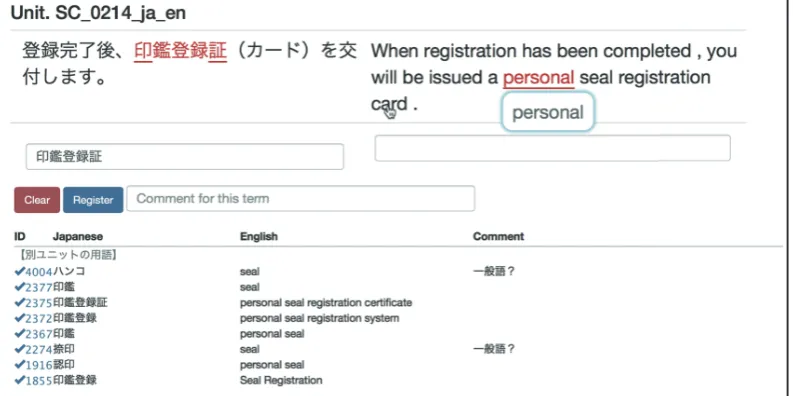
In order to facilitate the extraction of terms, we developed a web-based platform to help with collab-orative work. Figure 1 depicts the interface in which a pair of paralleled sentences is presented. This system enables users to capture the span of a term by clicking the starting word and the ending word.6 At
the bottom of the screen, terms that have been previously registered are also displayed. Registration of a pair of bilingual terms identical to an already identified pair is not allowed. These mechanisms support human decision-making and prevent duplicate registration, leading to improved efficiency of extraction. 2CLAIR (Council of Local Authorities for International Relations) Multilingual Living Information. http://www. clair.or.jp/tagengo/
3Shinjuku City, Living Information.http://www.city.shinjuku.lg.jp/foreign/english/index.html 4Hamamatsu City, Canal Hamamatsu.https://www.city.hamamatsu.shizuoka.jp/hamaeng/
5For some Japanese sentences, there were no corresponding English sentences, and vice versa.
Figure 1: Term registration platform
Another important feature of this platform is that it is designed to facilitate collaborative term extrac-tion and validaextrac-tion. As soon as a user adds a comment to each pair of paralleled sentences and/or to each term, other users can refer to the comments and a task manager can promptly respond to the comment if necessary. The status of the work progress as well as the extracted terms can be checked online at any time, which helps conduct the task smoothly.
The identification of terms is difficult even for experts (Frantzi et al., 2000). To alleviate the individual differences of term identification and ensure comprehensiveness, we instructed the students to extract the terms as widely as possible. Finally, we validated all the terms they extracted to improve the accuracy of the terms.
A total of 3741 bilingual term pairs were collected from 15391 aligned sentence pairs. The number of distinct Japanese terms is 3012, while that of English terms is 3465, suggesting that in general the translated English terms are more varied than the Japanese source terms. This can be explained by the general tendency of greater inconsistencies in the translated terms, i.e. ‘terminology inconsistencies often increase in frequency in the translated version compared to the original, due to the fact that there can be several ways to translate a given term or expression’ (Warburton, 2015, p.649). She also pointed out an important factor leading to the terminology inconsistencies as follows:
When a document or a collection of documents is divided into smaller parts which are trans-lated by several translators, terminology in the target language will be more inconsistent than when only one translator is involved.
We can reasonably assume that several translators took charge of translating the municipal texts (terms) we deal with here, as the organisations in charge (CLAIR, Shinjuku City and Hamamatsu City) are different. Besides, the unavailability of bilingual municipal terminologies they can consult can aggravate the problem of terminology inconsistencies.
2.3 Controlling Term Variations
The range of the term variations to be addressed is dependent on foreseen applications (Daille, 2005). In this study, from the point of view of controlled authoring and MT, we cover a wide range of variations, including not only morphological and syntactic variations, but also synonyms and orthographic variations (Jacquemin, 2001; Yoshikane et al., 2003; Daille, 2003; Carl et al., 2004).
Term Dic. Freq. Typology
1 健康診査/kenkou shinsa ✓ 30
2 健康診断/kenkou shindan ✓ 5
3 検査/kensa ✓ 51 (A-1) omission 4 健診/ken-shin ✓ 12 (C-1) initialism 1 health medical examination 1 (A-1) insertion 2 health check-up 17 (B-3) hyphen 3 medical check-up 3 (B-3) hyphen 4 medical examination ✓ 10
5 health checkup ✓ 37
6 check-up 14 (A-1) omission, (B-3) hyphen
7 health check 1
[image:4.595.122.478.61.242.2]8 physical check-up 2 (B-3) hyphen Table 1: Examination of term variations
(a) Uncontrolled types (b) Controlled types b/a Tokens
Japanese 3012 2802 93.0% 15313
English 3465 2740 79.1% 15708
Table 2: The basic statistics of the controlled terminologies
and English (Warburton, 2014). We take into account the following three criteria to examine the variant terms:
Dictionary evidence: If a term is registered as an entry form in general dictionaries,7we regard it
as preferable.
Frequency evidence: Higher frequency in the corpus is preferable.
Typological preference: The following types of variations are not preferable:8 (A-1) omitting
necessary information/inserting unnecessary information, (A-2) posses-sive case/personal pronouns, (B-1) emphasis symbols, (B-2) Kana charac-ters, (B-3) hyphens, (C-1) initialisms/acronyms, (C-2) clipping and (D-1) transliteration.
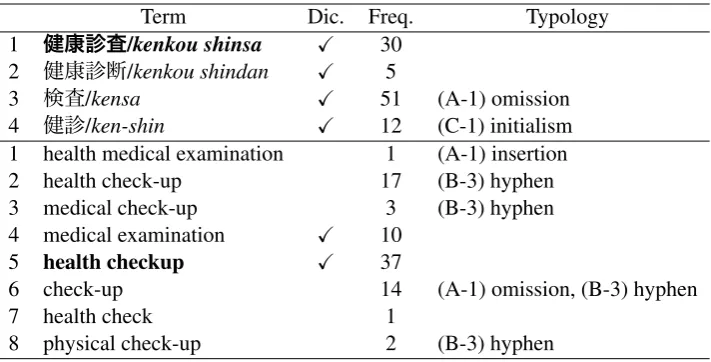
Table 1 shows some examples of how each term meets each of the criteria. From this, we can define, for instance, ‘健康診査’ as a preferred term since it is registered in the dictionary and also observed frequently (30 times) in the corpus, while the other three can be defined as proscribed terms. On the other hand, for the English translated terms, we can choose ‘health checkup’ as a standard translation. Though ‘health check-up’ (with a hyphen) is also frequently used in the corpus, we prefer ‘health checkup’ (without a hyphen) based on the typological preference policy (B-3) we adopted above.
Table 2 gives the basic statistics of our terminologies, showing the reduced number of term types after the variations were controlled. It can be noted that the number of English term types was reduced by about 20%, and the number of controlled term types in Japanese and in English became closer. This is not surprising because it is reasonable to assume that Japanese terminology and English terminology should contain the same size of concepts (orreferents) in the parallel corpus. Controlling the variant forms of terms can be regarded as assigning one (authorised) linguistic form to one concept. We can estimate that the number of municipal concepts in our corpus is around 2700–2800.
We are now in the position to address the question: How do we evaluate the terminology and the controlled terminology we constructed? In the following sections, we propose a way to quantitatively evaluate the coverage of terminology and the quality of variation control, and evaluate our terminologies. 7In this study, we consulted the Sanseido Grand Concise English Dictionary and the Kenkyusha New Japanese-English Dictionary.
3 Method for Evaluating Uncontrolled and Controlled Terminologies
To present the basic idea and framework of the evaluation, henceforth we use the following symbols based on Baayen (2001):
V(N): number of distinct terms (number of types).
N: number of term occurrences in the corpus (number of tokens). m: index for frequency class (mis an integer value).
V(m, N): number of types that occurmtimes in the corpus.
3.1 Self-Referring Coverage Estimation
To estimate the coverage of the terminologies without using external terminologies, we employ the self-referring quantitative evaluation method proposed by Kageura & Kikui (2006). The basic idea is (1) to extrapolate the size ofN to infinity using the observed data and estimate the saturation point, and (2) to evaluate the current status of theV(N)in comparison with the saturation point.
While Kageura & Kikui (2006) estimated the coverage of the lexical items of a Japanese travel ex-pression corpus, specifically focusing on the content words (nouns, verbs and adjectives), we assume this method can be applied to our task of estimating the coverage of the terms (mostly noun compounds) that appeared in our municipal corpus. They also emphasised that this method presupposes that the corpus qualitatively represents the whole range of relevant language phenomena in the given domain. Though the size of our municipal corpus itself is not large, it is possible to apply the method to our case, as the corpus focuses on a narrow domain (municipal life information) and covers a wide and well-balanced range of linguistic phenomena.
3.2 Conditions for Evaluation
We compare two parameters: (i) controlled and uncontrolled and (ii) Japanese and English. Thus, four conditions of terminology were prepared: (1) uncontrolled Japanese terminology, (2) uncontrolled En-glish terminology, (3) controlled Japanese terminology, and (4) controlled EnEn-glish terminology.
To estimate the coverage of terms, we investigate the uncontrolled conditions. Our previous obser-vations showed that uncontrolled English terminology is more varied than uncontrolled Japanese termi-nology, which may affect the population size of the terminologies. On the other hand, investigating the controlled conditions is important to see the coverage ofconceptsin the domain.
From the point of view of validating how well our terminologies are controlled, we explore the con-trolled conditions of the terminologies. Our hypothesis is that if the terminologies are well concon-trolled, the estimated population number of Japanese and English term types become closer, as both represent the same set of concepts.
3.3 Expected Number of Terms
A number of methods have been proposed to estimate the population item size (Efron and Thisted, 1976; Tuldava, 1995; Baayen, 2001). Here we adopt Large-Number-of-Rare-Event (LNRE) modelling, which has been used in the field of lexical statistics (Khmaladze, 1987; Baayen, 2001; Kageura, 2012). We outline the computational steps behind the method, following Baayen (2001).
Let the population number of types beS and let each type be denoted bywi (i = 1,2, ..., S). With eachwi population probability pi (i = 1,2, ..., S) is associated. Using the binomial theorem, we can express the expected number of types that occurmtimes in a sample ofN as follows:
E[V(m, N)] = ∑S
i=1
(
N m
)
pm
i (1−pi)N−m = S
∑
i=1
(Npi)m
m! e−Npi. (1)
At the final step of (1), the Poisson approximation with parameterλ=npis applied.
the probability thatwi occurs at least once in the sampleN. Hence, theE[V(N)]is given as follows:
E[V(N)] = ∑S
i=1 (1− ( N 0 ) p0
i(1−pi)N−0) = S
∑
i=1
(1−e−Npi). (2)
Note that the Poisson approximation is used again in the last step of (2).
For mathematical convenience, we rewrite the Poisson models in integral forms using the structural type distribution G(p), the cumulative number of types with probabilities equal to or greater than p, which is defined as follows: G(p) =∑Si=1I[pi≥p], whereI = 1whenpi ≥p, and 0 otherwise. We can renumber the subscript ofpforpj >0, such thatpj < pj+1(j= 1,2, ..., κ). AsG(p)is a step function,
jumps at the probabilitiespj, in other words, the number of types in the population with probabilitiespj, are given by∆G(pj) =G(pj)−G(pj+1). We can now restate the equations (1) and (2):
E[V(m, N)] = ∑κ
j=1
(Npj)m
m! e−Npj∆G(pj) = ∫ ∞
0
(Np)m
m! e−NpdG(p). (3)
E[V(N)] = ∑κ
j=1
(1−e−Npj)∆G(p
j) =
∫ ∞
0 (1−e
−Np)dG(p). (4)
Using some hypotheses about the form of distributions such as inverse Gauss-Poisson distribution, we can obtain models to extrapolate theV(N)andV(m, N)forN → ∞.
3.4 Growth Rate of Terms
The constructed model also gives us insight into the growth rate, or how fast the number of types in-creases as we extract more terms from texts in the domain. The growth rate is obtained by taking the derivative ofE[V(N)]as follows:
d
dNE[V(N)] = d dN
∫ ∞
0 (1−e
−Np)dG(p) = 1 N
∫ ∞
0 Npe
−NpdG(p) = E[V(1, N)] N . (5) 4 Results and Discussions
[image:6.595.133.506.241.311.2]4.1 Population Types and Present Status of Terminologies
Table 3 gives the estimated population number of term types E[S], together with the coverage ratio CR(=V(N)/E[S]).
Though there are several models of LNRE, we chose the following two models, which were shown to be effective in this estimation task: Generalised Inverse Gauss-Poisson (GIGP) model (Sichel, 1975) and finite Zipf-Mandelbrot (fZM) model (Evert, 2004; Evert and Baroni, 2005).9
The lower χ2-value and higher p-value indicate a better fit of the LNRE model, and Baayen (2008,
p.233) remarks that ap-value above 0.05 is preferable. Though all of thep-values are below 0.05, the χ2-values are not bad compared to the related work by, for example, Kageura (2012) or Baayen (2001),
so we can reasonably assume that the estimation results are meaningful.
The estimated population sizeE[S]ranges from 4299 to 7616, and the coverage ratioCRranges from 42.7% to 64.0%. Though the values of E[S]andCR depend on the models used,10 we can observe
several important points of the result.
Firstly, focusing on the uncontrolled terminologies, we recognise very different results between Japanese and English: the population number of types of Japanese, 5505 (GIGP) and 4626 (fZM), is much smaller than that of English, 7616 (GIGP) and 6083 (fZM). Consequently, the coverage ratio of Japanese is generally higher than that of English. This may reflect the higher diversity of the uncontrolled English terminology. As we have seen in Section 2.3, the ratio of variations in the English uncontrolled 9Though we tried two other LNRE models, the lognormal model (Carroll, 1969) and the Yule-Simon model (Simon, 1960), the fit of the models to our data was not good compared to the GIGP and fZM models, so we did not adopt these models.
Model E[S] V(N) CR(%) χ2 p
Uncontrolled Ja
GIGP 5505.3 2953 53.6 35.260 0.0008 fZM 4626.2 2953 63.8 33.930 0.0012 En GIGP 7616.4fZM 6083.0 32553255 42.753.5 23.857 0.032528.197 0.0085
Controlled Ja
[image:7.595.124.477.60.187.2]GIGP 5111.9 2753 53.9 34.620 0.0010 fZM 4299.0 2753 64.0 27.905 0.0093 En GIGP 5380.2fZM 4444.5 26112611 48.558.7 35.354 0.000736.525 0.0005
Table 3: Population typesE[S]and coverageCR
terminology is much higher than that in the Japanese one, which suggests the potential diversity of trans-lated English terminology in the population.
Secondly, the controlled terminologies tend to exhibit a lowerE[S]and higherCR than the uncon-trolled terminologies. For example, theCR of controlled terminology when fZM is adopted is 64.0% for Japanese and 58.7% for English, which means that around two thirds of the concepts in the domain are included in our terminologies. It is worth noting that the coverage of the controlled terminologies exceeds that of the uncontrolled ones. This result is fairly good as a starting point and encourages the practical use of the terminologies.
Finally, related to the second point, the differences of E[S]and CR values between Japanese and English in the controlled conditions are much smaller than those in the uncontrolled conditions. In principle, the (population) size of the concepts in the parallel data of a given domain should be the same across the languages. The closer values ofE[S]between Japanese and English demonstrate that our constructed terminologies have a desirable nature. We should, however, remain aware that there are still differences between the Japanese and English controlled terminologies. We believe this is mainly because (1) the English translated sentences in the parallel corpus are sometimes not word-for-word translations of the original Japanese sentences, which may affect the distribution of terms in the corpus, and (2) the term variation control was performed solely by the authors of the paper, i.e. native speakers of Japanese, and there is still room for improvement in English term variation control.
4.2 Growth Patterns of Terminology
From the practical point of view, it is impossible to observe an infinite size ofN within the limited textual data that is available. Our next question is to what extent we can enlarge the size of the terminologies and extend their coverage within the realistic range. To address this question, we take a closer look at the dynamic trends of the terminology growth.
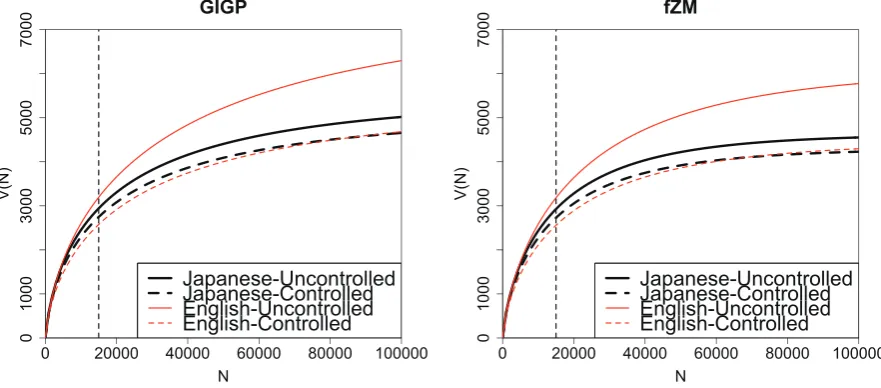
We first observe how the expected number of term types V(N) shifts as the number of term tokens N increases. Figure 2 draws for each LNRE model the growth curves ofV(N), asN grows to 100000, which is approximately 6.5 times as large as the presentN.11 The vertical dotted line indicatesN =
15000, which is close to the presentN.
Comparing the growth curves of the four conditions, we can easily recognize the general tendencies that conform to what we pointed out in Section 4.1. We summarise them as follows:
1. The English uncontrolled terminology grows more rapidly than the Japanese one. 2. The controlled terminologies shows more moderate growth than the uncontrolled ones. 3. The growth curves of the controlled Japanese and English align very closely.
The growth curves also enable us to visually grasp the shift of the growth rate. We can observe that all of the curves grow rapidly in the beginning and become gentler when N reaches around 30000, about twice the size of the present N. Although within the size of 100000, all the growth curves do
0 20000 40000 60000 80000 100000 0 1 0 0 0 3 0 0 0 5 0 0 0 7 0 0 0 GIGP N V(N ) Japanese-Uncontrolled Japanese-Controlled English-Uncontrolled English-Controlled
0 20000 40000 60000 80000 100000
0 1 0 0 0 3 0 0 0 5 0 0 0 7 0 0 0 fZM N V(N ) Japanese-Uncontrolled Japanese-Controlled English-Uncontrolled English-Controlled
Figure 2: Growth curves of the terminologies
0.5N N 1.5N 2N 2.5N 3N CR GR CR GR CR GR CR GR CR GR CR GR
Uncont. Ja
GIGP 39.0 0.144 53.9 0.082 63.2 0.055 69.8 0.040 74.6 0.030 78.4 0.024 fZM 45.9 0.146 63.8 0.081 74.5 0.051 81.5 0.035 86.4 0.024 89.8 0.018 En GIGP 29.9 0.162 42.9 0.100 51.6 0.072 58.1 0.055 63.1 0.044 67.2 0.036fZM 37.2 0.163 53.5 0.099 64.2 0.069 71.8 0.050 77.4 0.038 81.8 0.030
Cont. Ja
[image:8.595.85.526.72.266.2]GIGP 39.4 0.133 54.2 0.075 63.4 0.051 69.9 0.037 74.7 0.028 78.4 0.022 fZM 46.3 0.134 64.0 0.074 74.6 0.047 81.5 0.032 86.3 0.023 89.8 0.016 En GIGP 35.0 0.125 48.9 0.074 57.8 0.051 64.3 0.038 69.2 0.030 73.1 0.024fZM 41.9 0.126 58.7 0.073 69.3 0.049 76.5 0.035 81.8 0.025 85.7 0.019
Table 4: Shift in the coverage ratio (CR: %) and the growth rate (GR)
not seem flattened out, we can gain insight into how to effectively extend the size of the terminologies. Considering the difficulty in compiling bilingual (or multilingual) parallel municipal corpora on a large scale, we further restrict ourselves to a realistic size of N. Table 4 shows the shift in the estimated coverage ratioCRand the growth rateGR at0.5N intervals up to3N (about 450000 tokens). These two measures give us different perspectives for the terminology extension.
CRis a goal-oriented measure, which tells us how much addition of term tokens (or texts) is needed to attain a certain coverage of the potential terminology in the domain. If we double the token sizeN, we achieve nearly 80% coverage of the Japanese terms, 70% coverage of the English terms and 80% coverage of the concepts in the domain (when estimating by fZM), showing an increase of more than 15% compared to the original sizeN. If we trebleN, we achieve an additional increase of at most 10% in the coverage ratio, with some of the values reaching nearly 90%. Setting goals for terminological (lexical) development is crucial in practical applications such as MT dictionary development (Dillinger, 2001; Kim et al., 2005). Using this measure, we can set the goal of terminology construction in terms of coverage.
5 Conclusion and Future Work
In this study, we constructed controlled bilingual municipal terminologies and evaluated their status. The outcomes and contributions of this study are summarised as follows:
1. Using the term collection tool we developed, we efficiently extracted 3741 Japanese-English term pairs from a municipal text corpus. We then controlled the term variations by defining the preferred and proscribed terms to construct controlled bilingual terminologies.
2. The evaluation results showed that our terminology currently covers (1) about 55–65% (Japanese) and 45–55% (English) of the terms and (2) about 55–65% (Japanese) and 50–60% (English) of the concepts in the municipal domain. Also, the closer values of the population number of the term types and the similar shapes of the terminology growth curves for Japanese and English demonstrated that our terminologies are well controlled.
3. We proposed a method to evaluate the coverage of terminology. Though the self-referring method employed in this paper has difficulty in obtaining a good fit of the model for the observed data, we consider our method to respond to the practical need for estimating the potential size of terminology.
As future work, we plan to utilise the terminologies in our controlled authoring and MT environment, and evaluate their effectiveness and utility. We are now developing a real-time interactive terminology checker that detects term variations in the source text and suggests a preferred term (Miyata et al., 2016). The list of synsets of preferred terms and proscribed terms constructed in this study will be implemented in the checker. Furthermore, controlled authored source texts can be consistently translated by MT systems if their user dictionaries register pairs of preferred source and target terms.
We will also expand the size of our terminologies. Based on the estimation presented above, to achieve about 80–90% coverage of municipal terms and concepts, we need to check 15000–30000 more term tokens. At this stage, automatic term extraction (ATE) would be a viable option to efficiently collect term candidates (Itagaki et al., 2007; Macken et al., 2013; Aker et al., 2013; Kilgarriff et al., 2014). We also intend to adopt a ‘generate and validate’ method (Sato et al., 2013), which makes use of constituents of terms to obtain new term candidates. The terminologies constructed in this study enable us to employ this method.
Acknowledgements
This work was supported by JSPS KAKENHI Grant Number 16J11185, the Research Grant of Tokyo Institute of Technology, and the Research Grant Program of KDDI Foundation, Japan.
References
Ahmet Aker, Monica Paramita, and Robert Gaizauskas. 2013. Extracting bilingual terminologies from comparable corpora. InProceedings of the 51st Meeting of the Association for Computational Linguistics (ACL 2013), pages 402–411, Sofia, Bulgaria.
Harald Baayen. 2001.Word Frequency Distributions. Kluwer Academic Publishers, Dordrecht.
Harald Baayen. 2008. Analyzing Linguistic Data: A Practical Introduction to Statistics using R. Cambridge University Press, Cambridge.
Michael Carl, Ecaterina Rascu, Johann Haller, and Philippe Langlais. 2004. Abducing term variant translations in aligned texts. Terminology, 10(1):101–130.
John B. Carroll. 1969. A rationale for an asymptotic lognormal form of word-frequency distributions. InResearch Bulletin. Educational Testing Service, Princeton, New Jersey.
B´eatrice Daille. 2003. Conceptual structuring through term variations. InProceedings of the ACL 2003 Workshop
on Multiword Expressions: Analysis, Acquisition and Treatment (MWE 2003), pages 9–16, Sapporo, Japan.
Mike Dillinger. 2001. Dictionary development workflow for MT: Design and management. InProceedings of the Machine Translation Summit VIII, pages 83–88, Galicia, Spain.
Bradley Efron and Ronald Thisted. 1976. Estimating the number of unseen species: How many words did Shakespeare know? Biometrika, 63(3):435–447.
Stefan Evert and Marco Baroni. 2005. Testing the extrapolation quality of word frequency models. InProceedings
of the Corpus Linguistics 2005, Birmingham, UK.
Stefan Evert. 2004. A simple LNRE model for random character sequences. InProceedings of the 7es Journ´ees internationales d’Analyse statistique des Donn´ees Textuelles (JADT 2004), pages 411–422, Louvain-la-Neuve, France.
M´arta Fischer. 2010. Language (policy), translation and terminology in the European Union. In Marcel Thelen and Frieda Steurs, editors, Terminology and Lexicography Research and Practice: Terminology in Everyday Life, volume 13, pages 21–34. John Benjamins, Amsterdam.
Katerina Frantzi, Sophia Ananiadou, and Hideki Mima. 2000. Automatic recognition of multi-word terms: The C-value/NC-value method. International Journal on Digital Libraries, 3(2):115–130.
Masaki Itagaki, Takako Aikawa, and Xiaodong He. 2007. Automatic validation of terminology translation con-sistency with statistical method. InProceedings of the Machine Translation Summit XI, pages 269–274, Copen-hagen, Denmark.
Christian Jacquemin. 2001. Spotting and Discovering Terms through Natural Language Processing. The MIT Press, Cambridge.
Kyo Kageura and Genichiro Kikui. 2006. A self-referring quantitative evaluation of the ATR Basic Travel Ex-pression Corpus (BTEC). In Proceedings of the 5th International Conference on Language Resources and
Evaluation (LREC 2006), pages 1945–1950, Genoa, Italy.
Kyo Kageura. 2012. The Quantitative Analysis of the Dynamics and Structure of Terminologies. John Benjamins, Amsterdam.
Estate V. Khmaladze. 1987. The Statistical Analysis of Large Numbers of Rare Events. Technical Report MS-R8804, Department of Mathematical Sciences, CWI, Amsterdam.
Adam Kilgarriff, Miloˇs Jakub´ıˇcek, Vojtˇech Kov´aˇr, Pavel Rychl´y, and V´ıt Suchomel. 2014. Finding terms in corpora for many languages with the Sketch Engine. InProceedings of the Demonstrations at the 14th
Con-ference of the European Chapter of the Association for Computational Linguistics (EACL 2014), pages 53–56,
Gothenburg, Sweden.
Young-Gil Kim, Seong-Il Yang, Munpyo Hong, Chang-Hyun Kim, Young-Ae Seo, Cheol Ryu, Sang-Kyu Park, and Se-Young Park. 2005. Terminology construction workflow for Korean-English patent MT. InProceedings
of the Machine Translation Summit X, pages 55–59, Phuket, Thailand.
Philippe Langlais and Michael Carl. 2004. General-purpose statistical translation engine and domain specific texts: Would it work? Terminology, 10(1):131–153.
Lieve Macken, Els Lefever, and V´eronique Hoste. 2013. TExSIS: Bilingual terminology extraction from parallel corpora using chunk-based alignment. Terminology, 19(1):1–30.
Rei Miyata, Anthony Hartley, Kyo Kageura, C´ecile Paris, Masao Utiyama, and Eiichiro Sumita. 2016. MuTUAL: A controlled authoring support system enabling contextual machine translation. InProceedings of the 26th
In-ternational Conference on Computational Linguistics (COLING 2016), System Demonstrations, Osaka, Japan.
(forthcoming).
Juan C. Sager. 2001. Terminology compilation: Consequences and aspects of automation. In Sue Ellen Wright and Gerhard Budin, editors,Handbook of Terminology Management, volume 2: Application-Oriented Terminology Management, pages 761–771. John Benjamins, Amsterdam.
Koichi Sato, Koichi Takeuchi, and Kyo Kageura. 2013. Terminology-driven augmentation of bilingual terminolo-gies. InProceedings of the Machine Translation Summit XIV, pages 3–10, Nice, France.
Herbert Simon. 1960. Some further notes on a class of skew distribution functions. Information and Control, 3(1):80–88.
Lori Thicke. 2011. Improving MT results: A study. Multilingual, January/February:37–40. Juhan Tuldava. 1995.Methods in Quantitative Linguistics. Wissenschaftlicher Verlag Trier, Trier.
Kara Warburton. 2014. Developing lexical resources for controlled authoring purposes. InProceedings of LREC
2014 Workshop: Controlled Natural Language Simplifying Language Use, pages 90–103, Reykjavik, Iceland.
Kara Warburton. 2015. Terminology management. In Sin-Wai Chan, editor,Routledge Encyclopedia of
Transla-tion Technology, pages 644–661. Routledge, New York.
![Table 3 gives the estimated population number of term types EC R [ S ] , together with the coverage ratio( =V( N) /E [ S ] ) .](https://thumb-us.123doks.com/thumbv2/123dok_us/1487061.688715/6.595.133.506.241.311/table-gives-estimated-population-number-types-coverage-ratio.webp)
![Table 3: Population types E [ S ] and coverage C R](https://thumb-us.123doks.com/thumbv2/123dok_us/1487061.688715/7.595.124.477.60.187/table-population-types-e-s-and-coverage-c.webp)