Automatic Extraction of Complex Predicates in Bengali
Dipankar Das Santanu Pal Tapabrata Mondal Tanmoy Chakraborty
Sivaji Bandyopadhyay
Department of Computer Science and Engineering
Jadavpur University
[email protected],
[email protected],
[email protected], [email protected],
[email protected]
Abstract
This paper presents the automatic ex-traction of Complex Predicates (CPs) in Bengali with a special focus on compound verbs (Verb + Verb) and conjunct verbs (Noun /Adjective + Verb). The lexical patterns of com-pound and conjunct verbs are extracted based on the information of shallow morphology and available seed lists of verbs. Lexical scopes of compound and conjunct verbs in consecutive sequence of Complex Predicates (CPs) have been identified. The fine-grained error analysis through confusion matrix highlights some insufficiencies of lexi-cal patterns and the impacts of different constraints that are used to identify the Complex Predicates (CPs). System achieves F-Scores of 75.73%, and 77.92% for compound verbs and 89.90% and 89.66% for conjunct verbs respectively on two types of Bengali corpus.
1 Introduction
Complex Predicates (CPs) contain [verb] +
verb (compound verbs) or [noun/ adjective/adverb] +verb (conjunct verbs) combinations in South Asian languages (Hook, 1974). To the best of our knowledge, Bengali
is not only a language of South Asia but also the sixth popular language in the World1, second in India and the national language of Bangladesh. The identification of Complex Predicates (CPs) adds values for building lexical resources (e.g. WordNet (Miller et al., 1990; VerbNet (Kipper-Schuler, 2005)), parsing strategies and machine translation systems.
Bengali is less computerized compared to English due to its morphological enrichment. As the identification of Complex Predicates (CPs) requires the knowledge of morphology, the task of automatically extracting the Com-plex Predicates (CPs) is a challenge. Complex Predicates (CPs) in Bengali consists of two types, compound verbs (CompVs) and conjunct verbs (ConjVs).
The compound verbs (CompVs) (e.g. ���� ���� mere phela ‘kill’, ���� ���� bolte laglo ‘started saying’) consist of two verbs. The first verb is termed as Full Verb (FV) that is present at surface level either as conjunctive participial form -e –e or the infinitive form -�� –te. The
second verb bears the inflection based on
Tense, Aspect and Person. The second verbs that are termed as Light Verbs (LV) are polysemous, semantically bleached and confined into some definite candidate seeds (Paul, 2010).
On the other hand, each of the Bengali con-junct verbs (ConjVs) (e.g. ���� ��� bharsha
kara ‘to depend’, ���� ��� jhakjhak kara ‘to glow’) consists of noun or adjective followed by a Light Verb (LV). The Light Verbs (LVs) bear the appropriate inflections based on
Tense, Aspect and Person.
According to the definition of multi-word expressions (MWEs)(Baldwin and Kim, 2010), the absence of conventional meaning of the
Light Verbs in Complex Predicates (CPs) entails us to consider the Complex Predicates (CPs) as MWEs (Sinha, 2009). But, there are some typical examples of Complex Predicates (CPs), e.g. ���� ��� dekha kara ‘see-do’ that bear the similar lexical pattern as Full Verb
(FV)+ Light Verb (LV) but both of the Full Verb (FV) and Light Verb (LV) loose their conventional meanings and generate a completely different meaning (‘to meet’ in this case).
In addition to that, other types of predicates such as ���� ��� niye gelo ‘take-go’ (took and went), ���� ��� diye gelo ‘give-go’ (gave and went) follows the similar lexical patterns
FV+LV as of Complex Predicates (CPs) but they are not mono-clausal. Both the Full Verb
(FV) and Light Verb (LV) behave like independent syntactic entities and they belong to non-Complex Predicates (non-CPs). The verbs are also termed as Serial Verb (SV) (Mukherjee et al., 2006).
Butt (1993) and Paul (2004) have also mentioned the following criteria that are used to check the validity of complex predicates (CPs) in Bengali. The following cases are the invalid criteria of complex predicates (CPs).
1. Control Construction (CC): ����� ���
likhte bollo ‘asked to write’, ����� ���� ��� likhte badhyo korlo ‘forced to write’
2. Modal Control Construction (MCC):
���� ��� jete hobe ‘have to go’ ���� ���
khete hobe ‘have to eat’
3. Passives (Pass) : ��� ��� dhora porlo ‘was caught’, ���� �� mara holo ‘was beaten’
4. Auxiliary Construction (AC): ��� ���
bose ache ‘is sitting’, ���� ��� niye chilo ‘had taken’.
Sometimes, the successive sequence of the Complex Predicates (CPs) shows a problem of deciding the scopes of individual Complex
Predicates (CPs) present in that sequence. For example the sequence, u�� ��� ������ uthe pore
dekhlam ‘rise-wear-see’ (rose and saw) seems to contain two Complex Predicates (CPs) (u�� ��� uthe pore ‘rose’ and ��� ������ pore dekhlam ‘wore and see’). But there is actually one Complex Predicate (CP). The first one u�� ��� uthe pore ‘rose’ is a compound verb (CompV) as well as a Complex Predicate (CP). Another one is ������ dekhlam ‘saw’ that is a simple verb. As the sequence is not mono-clausal, the Complex Predicate (CP) u�� ���
uthe pore ‘rose’ associated with ������ dekhlam
‘saw’ is to be separated by a lexical boundary. Thus the determination of lexical scopes of Complex Predicates (CPs) from a long con-secutive sequence is indeed a crucial task.
The present task therefore not only aims to extract the Complex Predicates (CPs) containing compound and conjunct verbs but also to resolve the problem of deciding the lexical scopes automatically. The compound verbs (CompVs) and conjunct verbs (ConjVs) are extracted from two separate Bengali corpora based on the morphological information (e.g. participle forms, infinitive forms and inflections) and list of Light Verbs
(LVs). As the Light Verbs (LVs) in the compound verbs (CompVs) are limited in number, fifteen predefined verbs (Paul, 2010) are chosen as Light Verbs (LVs) for framing the compound verbs (CompVs). A manually prepared seed list that is used to frame the lexical patterns for conjunct verbs (ConjVs) contains frequently used Light Verbs (LVs).
An automatic method is designed to identify the lexical scopes of compound and conjunct verbs in the long sequences of Complex Predicates (CPs). The identification of lexical scope of the Complex Predicates (CPs) improves the performance of the system as the number of identified Complex Predicates (CPs) increases.
The error analysis shows that not only the lexical patterns but also the augmentation of argument structure agreement (Das, 2009), the analysis of Non-MonoClausal Verb (NMCV) or
Serial Verb, Control Construction (CC), Modal Control Construction (MCC), Passives
(Pass) and Auxiliary Construction (AC) (Butt, 1993; Paul, 2004) are also necessary to identify the Complex Predicates (CPs). The error analysis shows that the system suffers in distinguishing the Complex Predicates (CPs) from the above constraint constructions.
The rest of the paper is organized as fol-lows. Section 2 describes the related work done in this area. The automatic extraction of compound and conjunct verbs is described in Section 3. In Section 4, the identification of lexical scopes of the Complex Predicates (CPs) is mentioned. Section 5 discusses the results of evaluation along with error analysis. Finally, Section 6 concludes the paper.
2 Related Work
The general theory of complex predicate is discussed in Alsina (1996). Several attempts have been organized to identify complex predicates in South Asian languages (Abbi, 1991; Bashir, 1993; Verma, 1993) with a spe-cial focus to Hindi (Burton-Page, 1957; Hook, 1974), Urdu (Butt, 1995), Bengali (Sarkar, 1975; Paul, 2004), Kashmiri (Kaul, 1985) and Oriya (Mohanty, 1992). But the automatic ex-traction of Complex Predicates (CPs) has been carried out for few languages, especially Hindi.
The task described in (Mukherjee et al., 2006) highlights the development of a database based on the hypothesis that an English verb is projected onto a multi-word sequence in Hindi. The simple idea of projecting POS tags across an English-Hindi parallel corpus considers the Complex Predicate types, adjective-verb (AV), noun-verb (NV), adverb-verb (Adv-V), and verb-verb (VV) composites. A similar task (Sinha, 2009) presents a simple method for detecting Complex Predicates of all kinds us-ing a Hindi-English parallel corpus. His simple strategy exploits the fact that Complex Predi-cate is a multi-word expression with a meaning that is distinct from the meaning of the Light Verb. In contrast, the present task carries the
identification of Complex Predicates (CPs) from monolingual Bengali corpus based on morphological information and lexical pat-terns.
The analysis of V+V complex predicates termed as lexical compound verbs (LCpdVs) and the linguistic tests for their detection in Hindi are described in (Chakrabarti et al., 2008). In addition to compound verbs, the pre-sent system also identifies the conjunct verbs in Bengali. But, it was observed that the identi-fication of Hindi conjunct verbs that contain noun in the first slot is puzzling and therefore a sophisticated solution was proposed in (Das, 2009) based on the control agreement strategy with other overtly case marked noun phrases. The present task also agrees with the above problem in identifying conjunct verbs in Ben-gali although the system satisfactorily identi-fies the conjunct verbs (ConjVs).
Paul (2003) develops a constraint-based mechanism within HPSG framework for com-posing Indo-Aryan compound verb construc-tions with special focus on Bangla (Bengali) compound verb sequences. Postulating seman-tic relation of compound verbs, another work (Paul, 2009) proposed a solution of providing lexical link between the Full verb and Light Verb to store the Compound Verbs in Indo WordNet without any loss of generalization. To the best of our knowledge, ours is the first attempt at automatic extraction of Complex Predicates (CPs) in Bengali.
3 Identification of Complex
Predi-cates (
CPs
)
The compound verbs (CompVs) and conjunct verbs (ConjVs) are identified from the shallow parsed result using a lexical pattern matching technique.
3.1 Preparation of Corpora
Two types of Bengali corpus have been con-sidered to carry out the present task. One cor-pus is collected from a travel and tourism do-main and another from an online web archive of Rabindranath Rachanabali 2 . Rabindra Rachanabali corpus is a large collection of short stories of Rabindranath Tagore. The
mer EILMT travel and tourism corpus is ob-tained from the consortium mode project “De-velopment of English to Indian Languages Machine Translation (EILMT 3) System”. The second type of corpus is retrieved from the web archive and pre-processed accordingly. Each of the Bengali corpora contains 400 and 500 development and test sentences respec-tively.
The sentences are passed through an open source Bengali shallow parser 4. The shallow parser gives different morphological informa-tion (root, lexical category of the root, gender, number, person, case, vibhakti, tam, suffixes etc.) that help in identifying the lexical patterns of Complex Predicates (CPs).
3.2 Extracting Complex Predicates (CPs)
Manual observation shows that the Complex Predicates (CPs) contain the lexical pattern {[XXX] (n/adj) [YYY] (v)} in the shallow parsed sentences where XXX and YYY repre-sent any word. But, the lexical category of the root word of XXX is either noun (n) or adjec-tive (adj) and the lexical category of the root word of YYY is verb (v). The shallow parsed sentences are pre-processed to generate the simplified patterns. An example of similar lexical pattern of the shallow parsed result and its simplified output is shown in Figure 1.
((NP a���� NN <fs
�f='a����,n,,sg,,d,����,����'> ))
((VGF ������� VM <fs
�f='�r,v,,,5,,��,��'> )) a����|no�n|a����/NN/NP/
(a����^n^*^sg^*^d^��^����)_
�������|v��b|�������/VM/VGF/ (�r^v^*^*^1^*^��^��)
Figure 1. Example of a pre-processed shallow parsed result.
3 The EILMT project is funded by the Department of
Information Technology (DIT), Ministry of Communica-tions and Information Technology (MCIT), Government of India.
4http://ltrc.iiit.ac.in/showfile.php?filename=downloads/sh
allow_parser.php
The corresponding lexical categories of the root words a���� adhyan ‘study’ (e.g. noun for ‘n’) and '�r kar, ‘do’ (e.g. verb for ‘v’) are shown in bold face in Figure 1. The f ollowing example is of conjunct verb (ConjV).
The extraction of Bengali compound verbs (CompVs) is straightforward rather than con-junct verbs (ConjVs). The lexical pattern of compound verb is {[XXX](v) [YYY] (v)} where the lexical or basic POS categories of the root words of “XXX” and “YYY” are only verb. If the basic POS tags of the root forms of “XXX” and “YYY” are verbs (v) in shallow parsed sen-tences, then only the corresponding lexical patterns are considered as the probable candi-dates of compound verbs (CompVs).
Example 1:
��i��|v��b|��i��/VM/VGNF/��� ^v^*^*^�ny^*^i��^i��) #������|v��b|������/VM/VGF/(��^v^*^*^1^*^�^�)
Example 1 is a compound verb (CompV) but Example 2 is not. In Example 2, the lexical category or the basic POS of the Full Verb
(FV) is noun (n) and hence the pattern is dis-carded as non-compound verb (non-CompV).
Example 2:
�k� |noun|�k� /NN/NP/(�k� ^n^*^*^*^*^*^pos lcat="NM") #
�����|verb|�����/VM/VGNF/(�r^v^*^*^any^*^i�� ^i��)
Bengali, like any other Indian languages, is morphologically very rich. Different suffixes may be attached to a Light Verb (LVs) (in this case [YYY]) depending on the various features such as Tense, Aspect, and Person.
In case of extracting compound verbs (CompVs), the Light Verbs are identified from a seed list (Paul, 2004). The list of Light Verbs
is specified in Table 1. The dictionary forms of the Light Verbs are stored in this list. As the
Light Verbs contain different suffixes, the pri-mary task is to identify the root forms of the
Light Verbs (LVs) from shallow parsed result. Another table that stores the root forms and the corresponding dictionary forms of the Light Verbs is used in the present task. The table contains a total number of 378 verb entries including Full Verbs (FVs) and Light Verbs
(LVs). The dictionary forms of the Light Verbs
(LVs) are retrieved from the Table.
(FVs) (in this case [XXX]) in compound verbs (CompVs). i�� / iya and i��/ ite are also used for conjunctive participial form -e –e or the
infinitive form -�� –te respectively in litera-ture. The participial and infinitive forms are checked based on the morphological informa-tion (e.g. suffixes of the verb) given in the shallow parsed results. In Example 1, the Full Verb (FV) contains -i�� -iya suffix. If the dic-tionary forms of the Light Verbs (LVs) are pre-sent in the list of Light Verbs and the Full Verbs (FVs) contain the suffixes of -e/i�� -e/iya or ��/i�� –te/ite, both verbs are combined to frame the patterns of compound verbs (CompVs).
aSa ‘come’ dãRa ‘stand’
rakha ‘keep’ ana ‘bring’
deoya ‘give’ pOra ‘fall’
paTha ‘send’ bERano ‘roam’
neoya ‘take’ tola ‘lift’
bOSa ‘sit’ oTha ‘rise’
jaoya ‘go’ chaRa ‘leave’
[image:5.595.92.283.277.381.2]phEla ‘drop’ mOra ‘die’
Table 1. List of Light Verbs for compound verbs.
The identification of conjunct verbs (ConjVs) requires the lexical pattern (Noun / Adjective + Light Verb) where a noun or an adjective is followed by a Light Verb (LV). The dictionary forms of the Light Verbs (LVs) that are frequently used as conjunct verbs (ConjVs) are prepared manually. The list of Light Verbs
(LVs) is given in Table 2. The detection of
Light Verbs (LVs) for conjunct verbs (ConjVs) is similar to the detection of the Light Verbs
(LVs) for compound verbs (CompVs) as de-scribed earlier in this section. If the basic POS of the root of the first words ([XXX]) is either “noun” or “adj” (n/adj) and the basic POS of the following word ([YYY]) is “verb” (v), the patterns are considered as conjunct verbs (ConjVs). The Example 2 is an example of conjunct verb (ConjV).
For example, ���� ��� (jhakjhak kara ‘to glow’), ���� ��� (taktak ‘to glow’), ������ ��� (chupchap kara ‘to silent’) etc are identified as conjunct verbs (ConjVs) where the basic POS of the former word is an adjective (adj)
fol-lowed by ��� kara ‘to do’, a common Light
Verb.
deoya ‘give’ kara ‘do’
neoya ‘take’ laga ‘start’
paoya ‘pay’ kata ‘cut’
Table 2. List of Light Verbs for conjunct verbs.
Example 3:
����|�dj|���� /JJ/JJP/(���� ^�dj) #
����|v��b|����/VM/VGF/(�r^v^*^*^5^*^�^�)
But, the extraction of conjunct verbs (ConjVs) that have a “noun+verb” construction is descriptively and theoretically puzzling (Das, 2009). The identification of lexical pat-terns is not sufficient to recognize the com-pound verbs (CompVs). For example, �i �����
boi deoya ‘give book’ and ���� ����� bharsa
deyoa ‘to assure’ both contain similar lexical pattern (noun+verb) and same Light Verb �����
deyoa. But, ���� ����� bharsa deyoa ‘to assure’ is a conjunct verb (ConjV) whereas �i ����� boi
deoya ‘give book’ is not a conjunct verb (ConjV). Linguistic observation shows that the inclusion of this typical category into conjunct verbs (ConjVs) requires the additional knowl-edge of syntax and semantics.
In connection to conjunct verbs (ConjVs), (Mohanty, 2010) defines two types of conjunct verbs (ConjVs), synthetic and analytic. A syn-thetic conjunct verb is one in which both the constituents form an inseparable whole from the semantic point of view or semantically non-compositional in nature. On the other hand, an analytic conjunct verb is semantically compositional. Hence, the identification of conjunct verbs requires knowledge of seman-tics rather than only the lexical patterns.
It is to be mentioned that sometimes, the negative markers (�� no, ��i nai) are attached with the Light Verbsu����� uthona ‘do not get up’ ������� phelona ‘do not throw”. Negative attachments are also considered in the present task while checking the suffixes of Light Verbs
(LVs).
4 Identification of Lexical Scope for
Complex Predicates (
CPs
)
Predicates (CPs) can occur in a long sequence. An automatic method is employed to identify the Complex Predicates (CPs) along with their lexical scopes. The lexical category or basic POS tags are obtained from the parsed sen-tences.
If the compound and conjunct verbs occur successively in a sequence, the left most two successive tokens are chosen to construct the Complex Predicate (CP). If successive verbs are present in a sequence and the dictionary form of the second verb reveals that the verb is present in the lists of compound Light Verbs
(LV), then that Light Verb (LV) may be a part of a compound verb (CompV). For that reason, the immediate previous word token is chosen and tested for its basic POS in the parsed result. If the basic POS of the previous word is “verb
(v)” and any suffixes of either conjunctive par-ticipial form -e/i�� -e/iya or the infinitive form -��/i�� –te/ite is attached to the previous verb, the two successive verbs are grouped together to form a compound verb (CompV) and the lexical scope is fixed for the Complex Predi-cate (CP).
If the previous verb does not contain -e/i��
-e/iya or -��/i�� –te/ite inflections, no com-pound verb (CompV) is framed with these two verbs. But, the second Light Verb (LV) may be a part of another Complex Predicate (CP). This
Light Verb (LV) is now considered as the Full Verb (FV) and its immediate next verb is searched in the list of compound Light Verbs
(LVs) and the formation of compound verbs (CompVs) progresses similarly. If the verb is not in the list of compound Light Verbs, the search begins by considering the present verb as Full Verb (FV) and the search goes in a similar way.
The following examples are given to illus-trate the formation of compound verbs (CompVs) and find the lexical scopes of the compound verbs (CompVs).
��� ���� ���� ��� ����� (ami) (chalte) (giye) (pore) (gelam). I <fell down while walking>.
Here, “chalte giye pore gelam” is a verb group. The two left most verbs ���� ���� chalte giye are picked and the dictionary form of the second verb is searched in the list of
com-pound Light Verbs. As the dictionary form (jaoya ‘go’) of the verb ���� giye is present in the list of compound Light Verbs (as shown in Table 1), the immediate previous verb ����
chalte is checked for inflections -e/i�� -e/iya
or -��/i�� –te/ite. As the verb ���� chalte con-tains the inflection -�� -te, the verb group ����
���� chalte giye is a compound verb (CompV) where ���� giye is a Light Verb and ���� chalte is the Full Verb with inflection (-�� -te). Next verb group, ��� ����� pore gelam is identified as compound verb (CompV) in a similar way (��+ (-e) por+ (-e) + ����� gelam (jaoya ‘go’)). Another example is given as follows.
��� u�� ��� ������ ��
(ami) (uthe) (pore) (dekhlam) (je) ���� e���� ��i
(tumi) (ekhane) (nei)
I <get up and saw> that you are not here
Here, u�� ��� ������ uthe pore dekhlam is another verb group. The immediate next verb of u�� uthe is ��� pore that is chosen and its dictionary form is searched in the list of com-pound Light Verbs (LV) similarly. As the dic-tionary form (��� pOra) of the verb ��� pore
is present in the list of Light Verbs and the verb u�� uthe contains the inflection -e –e,
the consecutive verbs frame a compound verb (CompV) u�� ��� where u�� uthe is a Full Verb with inflection -e –e and ��� pore is a Light
Verb. The final verb ������ dekhlam is chosen and as there is no other verb present, the verb ������ dekhlam is excluded from any formation of compound verb (CompV) by con-sidering it as a simple verb.
Similar technique is adopted for identifying the lexical scopes of conjunct verbs (ConjVs). The method seems to be a simple pattern matching technique in a left-to-right fashion but it helps in case of conjunct verbs (ConjVs). As the noun or adjective occur in the first slot of conjunct verbs (ConjVs) construction, the search starts from the point of noun or adjec-tive. If the basic POS of a current token is ei-ther “noun” or “adjective” and the dictionary form of the next token with the basic POS “verb (v)” is in the list of conjunct Light Verbs
combined to frame the pattern of a conjunct verb (ConjV).
For example, the identification of lexical scope of a conjunct verb (ConjV) from a se-quence such as u����� ���� ����� uparjon korte
gelam ‘earn-do-go’ (went to earn) identifies the conjunct verb (ConjV) u����� ���� uparjon
korte. There is another verb group ���� �����
korte gelam that seems to be a compound verb (CompV) but is excluded by considering ������
gelam as a simple verb.
5 Evaluation
The system is tested on 800 development sen-tences and finally applied on a collection of 500 sentences from each of the two Bengali corpora. As there is no annotated corpus avail-able for evaluating Complex Predicates (CPs), the manual evaluation of total 1000 sentences from the two corpora is carried out in the pre-sent task.
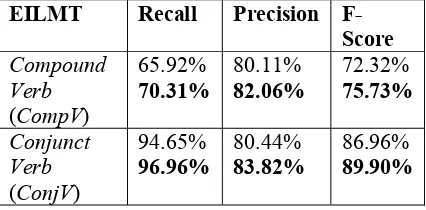
The recall, precision and F-Score are con-sidered as the standard metrics for the present evaluation. The extracted Complex Predicates (CPs) contain compound verb (CompV) and conjunct verbs (ConjVs). Hence, the metrics are measured for both types of verbs individu-ally. The separate results for two separate cor-pora are shown in Table 3 and Table 4 respec-tively. The results show that the system identi-fies the Complex Predicates (CPs) satisfacto-rily from both of the corpus. In case of Com-pound Verbs (CompVs), the precision value is higher than the recall. The lower recall value of Compound Verbs (CompVs) signifies that the system fails to capture the other instances from overlapping sequences as well as non-Complex predicates (non-CPs).
But, it is observed that the identification of lexical scopes of compound verbs (CompVs) and conjunct verbs (ConjVs) from long se-quence of successive Complex Predicates (CPs) increases the number of Complex Predi-cates (CPs) entries along with compound verbs (CompVs) and conjunct verbs (ConjVs). The figures shown in bold face in Table 3 and Ta-ble 4 for the Travel and Tourism corpus and Short Story corpus of Rabindranath Tagore indicates the improvement of identifying lexi-cal scopes of the Complex Predicates (CPs).
In comparison to other similar language such as Hindi (Mukerjee et al., 2006) (the re-ported precision and recall are 83% and 46% respectively), our results (84.66% precision and 83.67% recall) are higher in case of ex-tracting Complex Predicates (CPs). The reason may be of resolving the lexical scope and han-dling the morphosyntactic features using shal-low parser.
In addition to Non-MonoClausal Verb
(NMCV) or Serial Verb, the other criteria (Butt, 1993; Paul, 2004) are used in our pre-sent diagnostic tests to identify the complex predicates (CPs). The frequencies of
Compound Verb (CompV), Conjunct Verb
(ConjV) and the instances of other constraints of non Complex Predicates (non-CPs) are shown in Figure 2. It is observed that the num-bers of instances of Conjunct Verb (ConjV),
Passives (Pass), Auxiliary Construction (AC) and Non-MonoClausal Verb (NMCV) or Serial Verb are comparatively high than other in-stances in both of the corpus.
EILMT Recall Precision F-Score Compound
Verb
(CompV)
65.92%
70.31%
80.11%
82.06%
72.32%
75.73%
Conjunct Verb
(ConjV)
94.65%
96.96%
80.44%
83.82%
86.96%
89.90%
Table 3. Recall, Precision and F-Score of the system for acquiring the CompVs and ConjVs
from EILMT Travel and Tourism Corpus.
Rabindra Rachana-bali
Recall Precision F-Score
Compound Verb
(CompV)
68.75%
72.22%
81.81%
84.61%
74.71%
77.92%
Conjunct Verb
(ConjV)
94.11%
95.23%
83.92%
84.71%
88.72%
89.66%
[image:7.595.303.516.374.479.2]CompV ConjV NMCV CC MCC Pass AC
CompV 0.76 0.00 0.02 0.00 0.00 0.03 0.02
ConjV 0.04 0.72 0.03 0.01 0.02 0.02 0.02
NMCV 0.17 0.18 0.65 0.00 0.02 0.02 0.02
CC 0.01 0.00 0.00 0.56 0.01 0.02 0.02
MCC 0.00 0.00 0.00 0.07 0.65 0.00 0.02
Pass 0.12 0.01 0.00 0.00 0.00 0.78 0.00
[image:8.595.76.509.84.189.2]AC 0.06 0.07 0.04 0.00 0.00 0.08 0.54
Table 5. Confusion Matrix for CPs and constraints of non-CPs (in %).
0 50 100 150 200
C
o
m
p
V
C
o
n
jV
C
C MC
C
P
as
s
A
C NM
C
V
EILMT Rabindra
Figure 2. The frequencies of Complex Predi-cates (CPs) and different constrains of non-Complex Predicates (non-CPs).
The error analysis is conducted on both of the corpus. Considering both corpora as a whole single corpus, the confusion matrix is developed and shown in Table 5. The bold face figures in Table 5 indicate that the percentages of non-Complex Predicates (non-CPs) such as
Non-MonoClausal Verbs (NMCV), Passives (Pass) and Auxiliary Construction (AC) that are identified as compound verbs (CompVs). The reason is the frequencies of the non-Complex Predicates (non-CPs) that are rea-sonably higher in the corpus. In case of con-junct verbs (ConjVs), the Non-MonoClausal Verbs (NMCV) and Auxiliary Construction
(AC) occur as conjunct verbs (ConjVs). The system also suffers from clausal detection that is not attempted in the present task. The Pas-sives (Pass) and Auxiliary Construction (AC) requires the knowledge of semantics with ar-gument structure knowledge.
6 Conclusion
In this paper, we have presented a study of Bengali Complex Predicates (CPs) with a spe-cial focus on compound verbs, proposed auto-matic methods for their extraction from a cor-pus and diagnostic tests for their evaluation. The problem arises in case of distinguishing Complex Predicates (CPs) from Non-Mono-Clausal verbs, as only the lexical patterns are insufficient to identify the verbs. In future task, the subcategorization frames or argument structures of the sentences are to be identified for solving the issues related to the errors of the present system.
References
Abbi, Anvita. 1991. Semantics of Explicator Com-pound Verbs. In South Asian Languages, Lan-guage Sciences, 13(2): 161-180.
Alsina, Alex. 1996. Complex Predicates: Structure and Theory. Center for the Study of Language and Information Publications, Stanford, CA. Bashir, Elena. 1993. Causal chains and compound
verbs. In M. K. Verma ed. (1993) Complex Predicates in South Asian Languages, Manohar Publishers and Distributors, New Delhi.
Burton-Page, John. 1957. Compound and conjunct verbs in Hindi. Bulletin of the School of Oriental and African Studies, 19: 469-78.
Butt, Miriam. 1995. The Structure of Complex Predicates in Urdu. Doctoral Dissertation, Stan-ford University.
[image:8.595.115.288.235.350.2]Das, Pradeep Kumar. 2009. The form and function of Conjunct verb construction in Hindi. Global Association of Indo-ASEAN Studies, Daejeon, South Korea.
Hook, Peter. 1974. The Compound Verbs in Hindi.
The Michigan Series in South and South-east Asian Language and Linguistics. The University of Michigan.
Kaul, Vijay Kumar. 1985. The Compound Verb in Kashmiri. Unpublished Ph.D. dissertation. Ku-rukshetra University.
Kipper-Schuler, Karin. 2005. VerbNet: A broad-coverage, comprehensive verb lexicon. Ph.D. thesis, Computer and Information Science Dept., University of Pennsylvania, Philadelphia,PA Miller, George, Richard Beckwith, Christiane
Fell-baum, Derek Gross and Katherine Miller. 1990. Five Papers on WordNet. CSL Report 43, Cogni-tive Science Laboratory, Princeton University, Princeton.
Mohanty, Gopabandhu. 1992. The Compound Verbs in Oriya. Ph. D. dissertation, Deccan Col-lege Post-Graduate and Research Institute, Pune. Mohanty, Panchanan. 2010. WordNets for Indian Languages: Some Issues. Global WordNet Con-ference-2010, pp. 57-64.
Mukherjee, Amitabha, Soni Ankit and Raina Achla M. 2006. Detecting Complex Predicates in Hindi using POS Projection across Parallel Corpora.
Multiword Expressions: Identifying and Exploit-ing UnderlyExploit-ing Properties Association for Com-putational Linguistics, pp. 28–35, Sydney. Paul, Soma. 2010. Representing Compound Verbs
in Indo WordNet. Golbal Wordnet Conference-2010, pp. 84-91.
Paul, Soma. 2004. An HPSG Account of Bangla Compound Verbs with LKB Implementation. Ph.D dissertation, University of Hyderabad, Hy-derabad.
Paul, Soma. 2003. Composition of Compound Verbs in Bangla. Multi-Verb constructions. Trondheim Summer School.
Sarkar, Pabitra. 1975. Aspects of Compound Verbs in Bengali. Unpublished M.A. dissertation, Chi-cago University.
Sinha, R. Mahesh, K. 2009. Mining Complex Predicates In Hindi Using A Parallel Hindi-English Corpus. Multiword Expression Work-shop, Association of Computational Linguistics-International Joint Conference on Natural Lan-guage Processing-2009, pp. 40-46, Singapore.
Timothy, Baldwin, Su Nam Kim. 2010. Multiword Expressions. In Nitin Indurkhya and Fred J. Damerau (eds.) Handbook of Natural Language Processing, Second Edition, Chapman & Hall/CRC, London, UK, pp. 267-292.