Multiple sequence alignments in linguistics
Jelena Proki´c
University of Groningen
The Netherlands
[email protected]
Martijn Wieling
University of Groningen
The Netherlands
[email protected]
John Nerbonne
University of Groningen
The Netherlands
[email protected]
Abstract
In this study we apply and evaluate an iterative pairwise alignment program for producing multiple sequence alignments, ALPHAMALIG (Alonso et al., 2004), us-ing as material the phonetic transcriptions of words used in Bulgarian dialectological research. To evaluate the quality of the multiple alignment, we propose two new methods based on comparing each column in the obtained alignments with the cor-responding column in a set of gold stan-dard alignments. Our results show that the alignments produced by ALPHAMALIG correspond well with the gold standard alignments, making this algorithm suitable for the automatic generation of multiple string alignments. Multiple string align-ment is particularly interesting for histor-ical reconstruction based on sound corre-spondences.
1
Introduction
Our cultural heritage is studied today not only in museums, libraries, archives and their digital por-tals, but also through the genetic and cultural lin-eaments of living populations. Linguists, popula-tion geneticists, archaeologists, and physical and cultural anthropologists are all active in research-ing cultural heritage on the basis of material that may or may not be part of official cultural heritage archives. The common task is that of understand-ing the histories of the peoples of the world, espe-cially their migrations and contacts. To research and understand linguistic cultural heritage we re-quire instruments which are sensitive to its signals, and, in particular sensitive to signals of common provenance. The present paper focuses on pronun-ciation habits which have been recognized to bear signals of common provenance for over two hun-dred years (since the work of Sir William Jones).
We present work in a research line which seeks to submit pronunciation data to phylogenetic analy-sis (Gray and Atkinson, 2003) and which requires an alignment of the (phonological) segments of cognate words. We focus in this paper on evalu-ating the quality of multi-aligned pronunciations.
In bioinformatics, sequence alignment is a way of arranging DNA, RNA or protein sequences in order to identify regions of similarity and deter-mine evolutionary, functional or structural simi-larity between the sequences. There are two main types of string alignment: pairwise and multiple string alignment. Pairwise string alignment meth-ods compare two strings at a time and cannot di-rectly be used to obtain multiple string alignment methods (Gusfield, 1997, 343-344). In multiple string alignment all strings are aligned and com-pared at the same time, making it a good technique for discovering patterns, especially those that are weakly preserved and cannot be detected easily from sets of pairwise alignments. Multiple string comparison is considered to be the holy grail of molecular biology (Gusfield, 1997, 332):
It is the most critical cutting-edge tool for ex-tracting and representingbiologically important, yet faint or widely dispersed, commonalities from a set of strings.
requires the simultaneous examination of corre-sponding sounds in order to compare hypotheses about their evolution. Alignment identifies which sounds correspond. Historical linguists align the sequences manually, while we seek to automate this process.
In recent years there has been a strong fo-cus in historical linguistics on the introduction of quantitative methods in order to develop tools for the comparison and classification of lan-guages. For example, in his PhD thesis, Kondrak (2002) presents algorithms for the reconstruction of proto-languages from cognates. Warnow et al. (2006) applied methods taken from phylogenet-ics on Indo-European phonetic data in order to model language evolution. Heeringa and Joseph (2007) applied the Levensthein algorithm to the Dutch pronunciation data taken from Reeks Ned-erlandse Dialectatlassenand tried to reconstruct a ‘proto-language’ of Dutch dialects using the pair-wise alignments.
Studies in historical linguistics and dialectome-try where string comparison is used as a basis for calculating the distances between language vari-eties will profit from tools to multi-align strings automatically and to calculate the distances be-tween them. Good multiple alignment is of ben-efit to all those methods in diachronic linguistics such as the comparative reconstruction method or the so-called CHARACTER-BASED METHODS taken from phylogenetics, which have also been successfully applied in linguistics (Gray and Jor-dan, 2000; Gray and Atkinson, 2003; Atkinson et al., 2005; Warnow et al., 2006). The multi-alignment systems can help historical linguistics by reducing the human labor needed to detect the regular sound correspondences and cognate pairs of words. They also systematize the linguistic knowledge in intuitive alignments, and provide a basis for the application of the quantitative meth-ods that lead to a better understanding of language variation and language change.
In this study we apply an iterative pairwise alignment program for linguistics, ALPHAMA-LIG, on phonetic transcriptions of words used in dialectological research. We automatically multi-align all transcriptions and compare these gener-ated alignments with manually aligned gold stan-dard alignments. At the same time we propose two methods for the evaluation of the multiple se-quence alignments (MSA).
The structure of this paper is as follows. An example of a multiple alignment and a discus-sion of the advantages over pairwise alignment is given in the next section, after which we dis-cuss our data set in section 3. Section 4 explains the iterative pairwise alignment algorithm and the program ALPHAMALIG. Section 5 discusses the gold standard and two baselines, while section 6 discusses the novel evaluation procedures. The re-sults are given in section 7 and we end this paper with a discussion in section 8.
2
Example of Multiple Sequence
Alignment
In this section we will give an example of the au-tomatically multi-aligned strings from our data set and point out some important features of the si-multaneous comparison of more than two strings.
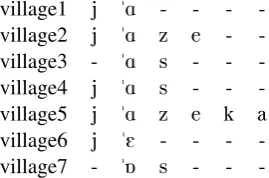
village1 j "A - - - -village2 j "A z e - -village3 - "A s - - -village4 j "A s - - -village5 j "A z e k a
village6 j "E - - - -village7 - "6 s - -
-Figure 1: Example of multiple string alignment
In Figure 1 we have multi-aligned pronuncia-tions of the word az ’I’ automatically generated by ALPHAMALIG. The advantages of this kind of alignment over pairwise alignment are twofold:
• First, it is easier to detect and process corre-sponding phones in words and their alterna-tions (like ["A] and ["E] and ["6] in the second column in Figure 1).
• Second, the distances/similarities between strings can be different in pairwise compari-son as opposed to multiple comparicompari-son. This is so because multi-aligned strings, unlike pairwise aligned strings, contain information on the positions where phones were inserted or deleted in both strings. For example, in Figure 1 the pairwise alignment of the pronunciations from village 1 and village 3 would be:
[image:2.595.346.481.322.411.2]These two alignments have one matching el-ement out of three in total, which means that the similarity between them is 1/3 = 0.33. At the same time the similarity be-tween these two strings calculated based on the multi-aligned strings in Figure 1 would be4/6 = 0.66. The measurement based on multi-alignment takes the common missing material into account as well.
3
Data set
The data set used in this paper consists of pho-netic transcriptions of 152 words collected from 197 sites evenly distributed all over Bulgaria. It is part of the project Buldialect—Measuring lin-guistic unity and diversity in Europe.1 Pronun-ciations of almost all words were collected from all the sites and for some words there are mul-tiple pronunciations per site. Phonetic transcrip-tions include various diacritics and suprasegmen-tals, making the total number of unique characters (types) in the data set 98.2
4
Iterative pairwise alignment
Multiple alignment algorithms iteratively merge two multiple alignments of two subsets of strings into a single multiple alignment that is union of those subsets (Gusfield, 1997). The simplest ap-proach is to align the two strings that have the minimum distance over all pairs of strings and it-eratively align strings having the smallest distance to the already aligned strings in order to generate a new multiple alignment. Other algorithms use different initializations and different criteria in se-lecting the new alignments to merge. Some begin with the longest (low cost) alignment instead of the least cost absolutely. A string with the smallest edit distance to any of the already merged strings is chosen to be added to the strings in the multiple alignment. In choosing the pair with the minimal distance, all algorithms are greedy, and risk miss-ing optimal alignments.
ALPHAMALIG is an iterative pairwise align-ment program for bilingual text alignalign-ment. It uses the strategy of merging multiple alignments of subsets of strings, instead of adding just one string
1The project is sponsored by Volkswagen Stiftung. More information can be found at http://sfs.uni-tuebingen.de/dialectometry.
2
The data is publicly available and can be found at http://www.bultreebank.org/BulDialects/index.html.
at the time to the already aligned strings.3 It was originally developed to align corresponding words in bilingual texts, i.e. with textual data, but it func-tions with any data that can be represented as a sequence of symbols of a finite alphabet. In addi-tion to the input sequences, the program needs to know the alphabet and the distances between each token pair and each pair consisting of a token and a gap.
In order to perform multiple sequence align-ments of X-SAMPA word transcriptions we modi-fied ALPHAMALIG slightly so it could work with the tokens that consist of more than one symbol, such as ["e], ["e:] and [t_S]. The distances be-tween the tokens were specified in such a way that vowels can be aligned only with vowels and con-sonants only with concon-sonants. The same tokens are treated as identical and the distance between them is set to 0. The distance between any token in the data set to a gap symbol has the same cost as replacing a vowel with a vowel or a consonant with a consonant. Except for this very general lin-guistic knowledge, no other data-specific informa-tion was given to the program. In this research we do not use any phonetic features in order to define the segments more precisely and to calculate the distances between them in a more sensitive way than just making a binary ’match/does-not-match-distinction’, since we want to keep the system lan-guage independent and robust to the highest pos-sible degree.
5
Gold standard and baseline
In order to evaluate the performance of AL-PHAMALIG, we compared the alignments ob-tained using this program to the manually aligned strings, our gold standard, and to the alignments obtained using two very simple techniques that are described next: simple baseline and advanced baseline.
5.1 Simple baseline
The simplest way of aligning two strings would be to align the first element from one string with the first element from the other string, the second el-ement with the second and so on. If two strings are not of equal length, the remaining unaligned tokens are aligned with the gap symbol which
resents an insertion or a deletion. This is the align-ment implicit in Hamming distance, which ignores insertions and deletions.
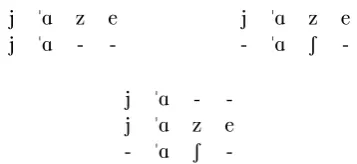
By applying this simple method, we obtained multiple sequence alignments for all words in our data set. An example of such a multiple sequence alignment is shown in Figure 2. These align-ments were used to check how difficult the mul-tiple sequence alignment task is for our data and how much improvement is obtained using more advanced techniques to multi-align strings.
j "A -
-j "A z e "A S -
-Figure 2: Simple baseline
5.2 Advanced baseline
Our second baseline is more advanced than the first and was created using the following proce-dure:
1. for each word the longest string among all pronunciations is located
2. all strings are pairwise aligned against the longest string using the Levensthein algo-rithm (Heeringa, 2004). We refer to both se-quences in a pairwise alignment as ALIGN-MENT LINES. Note that alignment lines in-clude hyphens indicating the places of inser-tions and deleinser-tions.
3. the alignment lines—all of equal length—are extracted
4. all extracted alignment lines are placed below each other to form the multiple alignment
An example of combining pairwise alignments against the longest string (in this case [j"aze]) is shown in Figure 3.
5.3 Gold standard
Our gold standard was created by manually cor-recting the advanced baseline alignments de-scribed in the previous section. The gold stan-dard results and both baseline results consist of 152 files with multi-aligned strings, one for each word. The pronunciations are ordered alphabeti-cally according to the village they come from. If there are more pronunciations per site, they are all present, one under the other.
j "A z e j "A -
-j "A z e
- "A S
-j "A -
-j "A z e
- "A S
-Figure 3: Advanced baseline. The top two align-ments each contain two alignment lines, and the bottom one contains three.
6
Evaluation
Although multiple sequence alignments are broadly used in molecular biology, there is still no widely accepted objective function for evaluating the goodness of the multiple aligned strings (Gusfield, 1997). The quality of the existing methods used to produce multiple sequence alignments is judged by the ’biological meaning of the alignments they produce’. Since strings in linguistics cannot be judged by the biological criteria used in string evaluation in biology, we were forced to propose evaluation methods that would be suitable for the strings in question. One of the advantages we had was the existence of the gold standard alignments, which made our task easier and more straightforward—in order to determine the quality of the multi-aligned strings, we compare outputs of the different algorithms to the gold standard. Since there is no off-the-shelf method that can be used for comparison of multi-aligned strings to a gold standard, we propose two novel methods—one sensitive to the order of columns in two alignments and another that takes into account only the content of each column.
6.1 Column dependent method
The first method we developed compares the con-tents of the columns and also takes the column se-quence into account. The column dependent eval-uation (CDE) procedure is as follows:
[image:4.595.323.502.62.144.2]• The similarity of a candidate column with a gold standard column is calculated by divid-ing the number of correctly placed elements in every candidate column by the total num-ber of elements in the column. A score of 1 indicates perfect overlap, while a score of 0 indicates the columns have no elements in common.
• The similarity score of the whole multiple alignment (for a single word) is calculated by summing the similarity score of each candi-date column and dividing it by the total ber of matched columns plus the total num-ber of unmatched columns in both multiple alignments.
• The final similarity score between the set of gold standard alignments with the set of can-didate multiple alignments is calculated by averaging the multiple alignment similarity scores for all strings.
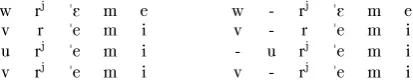
As an example consider the multiple alignments in Figure 4, with the gold standard alignment (GS) on the left and the generated alignment (GA) on the right.
w rj "E m e v r "e m i u rj "e m i v rj "e m i
[image:5.595.314.512.177.217.2]w - rj "E m e v - r "e m i - u rj "e m i v - rj "e m i Figure 4: GS and ALPHAMALIG multiple string alignments, the gold standard alignment left, the ALPHAMALIG output right.
The evaluation starts by comparing the first col-umn of the GS with the first and second colcol-umn of the GA. The first column of the GA is the best match, since the similarity score between the first columns is 0.75 (3 out of 4 elements match). In similar fashion, the second column of the GS is compared with the second and the third column of the GA and matched with the third column of GA with a similarity score of 1 (all elements match). The third GS column is matched with the fourth GA column, the fourth GS column with the fifth GA column and the fifth GS column with the sixth GA column (all three having a similarity score of 1). As a consequence, the second column of the GA remains unmatched. In total, five columns are matched and one column remains unmatched. The total score of the GA equals:
(0.75 + 1 + 1 + 1 + 1)
(5 + 1) = 0.792
It is clear that this method punishes unmatched columns by increasing the value of the denomina-tor in the similarity score calculation. As a conse-quence, swapped columns are punished severely, which is illustrated in Figure 5.
"o rj @ j
-"o rj @ - u "o rj @ f
-"o rj @ - j "o rj @ u
[image:5.595.85.292.423.465.2]-"o rj @ - f
Figure 5: Two alignments with swapped columns
In the alignments in Figure 5, the first three columns of GS would be matched with the first three columns of GA with a score of 1, the fourth would be matched with the fifth, and two columns would be left unmatched: the fifth GS column and the fourth GA column yielding a total similarity score of4/6 = 0.66. Especially in this case this is undesirable, as both sequences of these columns represent equally reasonable multiple alignment and should have a total similarity score of 1. We therefore need a less strict evaluation method which does not insist on the exact ordering. An alternative method is introduced and discussed in the following section.
6.2 Modified Rand Index
In developing an alternative evaluation we pro-ceeded from the insight that the columns of a mul-tiple alignment are a sort ofPARTITION of the el-ements of the alignment strings, i.e., they consti-tute a set of disjoint multi-sets whose union is the entire multi-set of segments in the multiple align-ment. Each column effectively assigns its seg-ments to a partition, which clearly cannot overlap with the elements of another column (partition). Since every segment must fall within some col-umn, the assignment is also exhaustive.
Our second evaluation method is therefore based on the modified Rand index (Hubert and Arabie, 1985). The modified Rand index is used in classification for comparing two different parti-tions of a finite set of objects. It is based on the Rand index (Rand, 1971), one of the most popular measures for comparing the degree to which parti-tions agree (in classification).
Given a set ofnelementsS=o1, ...onand two
R= a+b a+b+c+d
where:
• a: the number of pairs of elements in Sthat are in the same set (column) inU and in the same set inV
• b: the number of pairs of elements inS that are in different sets (columns) inUand in dif-ferent sets inV
• c: the number of pairs of elements inS that are in the same set inU and in different sets inV
• d: the number of pairs of elements inSthat are in different sets inU and in the same set inV
Consequently, aandbare the number of pairs of elements on which two classifications agree, while c and d are the number of pairs of elements on which they disagree. In our case classifications agree about concrete segment tokens only in the cases where they appear in the same columns in the alignments.
The value of Rand index ranges between 0 and 1, with 0 indicating that the two partitions (multi-alignments) do not agree on any pair of points and 1 indicating that the data partitions are exactly the same.4 A problem with the Rand index is that it does not return a constant value (zero) if two par-titions are picked at random. Hubert and Arabie (1985) suggested a modification of the Rand in-dex (MRI) that corrects this property. It can be expressed in the general form as:
MRI= Rand index−Expected index Maximum index−Expected index
The expected index is the expected number of pairs which would be placed in the same set inU and in the same set inV by chance. The maximum index represents the maximum number of objects that can be put in the same set in U and in the same set inV. The MRI value ranges between−1 and 1, with perfect overlap being indicated by 1 and values≤ 0indicating no overlap. For a more detailed explanation of the modified Rand index, please refer to Hubert and Arabie (1985).
4
In dialectometry, this index was used by Heeringa et al. (2002) to validate dialect clustering methods.
We would like to emphasize that it is clear that the set of columns of a multi-alignment have more structure than a partitionsec, in particular because the columns (subpartitions) are ordered, unlike the subpartitions in a partition. But we shall compen-sate for this difference by explicitly marking order.
"o[1] rj[2] @[3] j[4]
-"o[5] rj[6] @[7] - u[8] "o[9] rj[10] @[11] f[12]
-Figure 6: Annotated alignment
In our study, each segment token in each tran-scription was treated as a different object (see Fig-ure 6), and every column was taken to be a sub-partition to which segment tokens are assigned. Both alignments in Figure 5 have 12 phones that are put into 5 groups. We “tag” each token sequen-tially in order to distinguish the different tokens of a single segment from each other, but note that the way we do this also introduces an order sensitivity in the measure. The two partitions obtained are:
GS1 = {1,5,9} GS2 = {2,6,10} GS3 = {3,7,11} GS4 = {4,12} GS5 = {8}
GA1 = {1,5,9} GA2 = {2,6,10} GA3 = {3,7,11} GA4 = {8} GA5 = {4,12}
Using the modified Rand index the quality of each column is checked, regardless of whether the columns are in order. The MRI for the alignments in Figure 5 will be 1, because both alignments group segment tokens in the same way. Even though columns four and five are swapped, in both classifications phones [j] and [f] are grouped to-gether, while sound [u] forms a separate group.
The MRI itself only takes into account the quality of each column separately since it sim-ply checks whether the same elements are together in the candidate alignment as in the gold-standard alignment. It is therefore insensitive to the order-ing of columns. While it may have seemed coun-terintuitive linguistically to proceed from an order-insensitive measure, the comparison of “tagged to-kens” described above effectively reintroduces or-der sensitivity.
7
Results
After comparing all files of the baseline algo-rithms and ALPHAMALIG against the gold stan-dard files according to the column dependent eval-uation method and the modified Rand index, the average score is calculated by summing up all scores and dividing them by the number of word files (152).
The results are given in Table 1 and also in-clude the number of words with perfect multi-alignments (i.e. identical to the gold standard). Using CDE, ALPHAMALIG scored0.932out of 1.0 with 103 perfectly aligned files. The result for the simple baseline was 0.710 with 44 per-fectly aligned files. As expected, the result for the advanced baseline was in between these two results—0.869with72files that were completely identical to the GS files. Using MRI to eval-uate the alignments generated we obtained gen-erally higher scores for all three algorithms, but with the same ordering. ALPHAMALIG scored 0.982, with 104 perfectly aligned files. The ad-vanced baseline had a lower score of 0.937 and 74 perfect alignments. The simple baseline per-formed worse, scoring 0.848 and having 44 per-fectly aligned files.
The scores of the CDE evaluation method are lower than the MRI scores, which is due to the first method’s problematic sensitivity to column order-ing in the alignments. It is clear that in both evalu-ation methods ALPHAMALIG outperforms both baseline alignments by a wide margin.
It is important to notice that the scores for the simple baseline are reasonably high, which can be explained by the structure of our data set. The variation of word pronunciations is relatively small, making string alignment easier. However, ALPHAMALIG obtained much higher scores us-ing both evaluation methods.
Additional qualitative error analysis reveals that the errors of ALPHAMALIG are mostly caused by the vowel-vowel consonant-consonant alignment restriction. In the data set there are 21 files that contain metathesis. Since vowel-consonant ments were not allowed in ALPHAMALIG, align-ments produced by this algorithm were different from the gold standard, as illustrated in Figure 7.
The vowel-consonant restriction is also respon-sible for wrong alignments in some words where metathesis is not present, but where the vowel-consonant alignment is still preferred over
align-v l "7 k v "7 l k
v l "7 - k v - "7 l k
Figure 7: Two alignments with metathesis
ing vowels and/or consonants with a gap (see for example Figure 4).
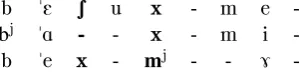
The other type of error present in the AL-PHAMALIG alignments is caused by the fact that all vowel-vowel and consonant-consonant dis-tances receive the same weight. In Figure 8 the alignment of word bjahme ’were’ produced by ALPHAMALIG is wrong because instead of aligning [mj] with [m] and [m] it is wrongly aligned with [x] and [x], while [x] is aligned with [S] instead of aligning it with [x] and [x].
b "E S u x - m e
-bj "A - - x - m i -b "e x - mj - - 7
-Figure 8: Alignment error produced by AL-PHAMALIG
8
Discussion and future work
In this study we presented a first attempt to auto-matically multi-align phonetic transcriptions. The algorithm we used to generate alignments has been shown to be very reliable, produce alignments of good quality, with less than 2%error at the seg-ment level. In this study we used only very sim-ple linguistic knowledge in order to align strings. The only restriction we imposed was that a vowel should only be aligned with a vowel and a con-sonant only with a concon-sonant. The system has shown to be very robust and to produce good qual-ity alignments with a very limited information on the distances between the tokens. However, in the future we would like to apply this algorithm using more detailed segment distances, so that we can work without vowel-consonant restrictions. Using more detailed language specific feature system for each phone, we believe we may be able to improve the produced alignments further. This especially holds for the type of errors illustrated in Figure 8 where it is clear that [mj] is phonetically closer to [m] than to [x] sound.
[image:7.595.338.490.289.327.2]CDE CDE perfect columns MRI MRI perfect columns
Simple baseline 0.710 44 0.848 44
Advanced baseline 0.869 72 0.937 74
[image:8.595.114.485.63.120.2]ALPHAMALIG 0.932 103 0.982 104
Table 1: Results of evaluating outputs of the different algorithms against the GS
set and try to replicate the good results we ob-tained here. On one hand, high performance of both baseline algorithms show that our task was relatively easy. On the other hand, achieving per-fect alignments will be very difficult, if possible at all.
Additionally, we proposed two methods to eval-uate multiple aligned strings in linguistic research. Although these systems could be improved, both of them are giving a good estimation of the qual-ity of the generated alignments. For the examined data, we find MRI to be better evaluation tech-nique since it overcomes the problem of swapped columns.
In this research we tested and evaluated AL-PHAMALIG on the dialect phonetic data. How-ever, multiple sequence alignments can be also applied on the sequences of sentences and para-graphs. This makes multiple sequence alignment algorithm a powerful tool for mining text data in social sciences, humanities and education.
Acknowledgements
We are thankful to Xavier Messeguer of the Tech-nical University of Catalonia who kindly sup-plied us with the source code of ALPHAMALIG. We also thank Therese Leinonen and Sebastian Kürschner of the University of Groningen and Es-teve Valls i Alecha of the University of Barcelona for their useful feedback on our ideas.
References
Laura Alonso, Irene Castellon, Jordi Escribano, Xavier Messeguer, and Lluis Padro. 2004. Multiple Sequence Alignment for characterizing the linear structure of revision. InProceedings of the 4th In-ternational Conference on Language Resources and Evaluation.
Quentin Atkinson, Geoff Nicholls, David Welch, and Russell Gray. 2005. From words to dates: water into wine, mathemagic or phylogenetic inference. Transcriptions of the Philological Society, 103:193– 219.
Lyle Campbell. 2004. Historical Linguistics: An In-troduction. Edinburgh University Press, second edi-tion.
Russel D. Gray and Quentin D. Atkinson. 2003. Language-tree divergence times support the Ana-tolian theory of Indo-European origin. Nature, 426:435–339.
Russel D. Gray and Fiona M. Jordan. 2000. Lan-guage trees support the express-train sequence of Austronesian expansion. Nature, 405:1052–1055.
Dan Gusfield. 1997. Algorithms on Strings, Trees and Sequences: Computer Science and Computational Biology. Cambridge University Press.
Wilbert Heeringa and Brian Joseph. 2007. The rela-tive divergence of Dutch dialect pronunciations from their common source: An exploratory study. In John Nerbonne, T. Mark Ellison, and Grzegorz Kondrak, editors,Proceedings of the Ninth Meeting of the ACL Special Interest Group in Computational Morphol-ogy and PhonolMorphol-ogy.
Wilbert Heeringa, John Nerbonne, and Peter Kleiweg. 2002. Validating dialect comparison methods. In Wolfgang Gaul and Gunter Ritter, editors, Classifi-cation, Automation, and New Media. Proceedings of the 24th Annual Conference of the Gesellschaft für Klassifikation e. V., University of Passau, March 15-17, 2000, pages 445–452. Springer, Berlin, Heidel-berg and New York.
Wilbert Heeringa. 2004.Measuring Dialect Pronunci-ation Differences using Levenshtein Distance. Ph.D. thesis, Rijksuniversiteit Groningen.
Lawrence Hubert and Phipps Arabie. 1985. Compar-ing partitions.Journal of Classification, 2:193–218.
Grzegorz Kondrak. 2002. Algorithms for Language Reconstruction. PhD Thesis, University of Toronto.
William M. Rand. 1971. Objective criteria for the evaluation of clustering methods. Journal of Amer-ican Statistical Association, 66(336):846–850, De-cember.