Proceedings of the Fourth Workshop on Statistical Machine Translation, pages 173–181,
Improving Arabic-Chinese Statistical Machine Translation
using English as Pivot Language
Nizar Habash Jun Hu
Center for Computational Learning Systems Computer Science Department
Columbia University Columbia University
New York, NY 10115, USA New York, NY 10115, USA
[email protected] [email protected]
Abstract
We present a comparison of two approaches for Arabic-Chinese machine translation using Eng-lish as a pivot language: sentence pivoting and phrase-table pivoting. Our results show that using English as a pivot in either approach out-performs direct translation from Arabic to Chi-nese. Our best result is the phrase-pivot system which scores higher than direct translation by 1.1 BLEU points. An error analysis of our best system shows that we successfully handle many complex Arabic-Chinese syntactic variations.
1 Introduction
Arabic and Chinese are two languages with a very large global presence; however, there has not been, to our knowledge, any work on MT for this pair. Given the cost involved in creat-ing parallel corpora for Arabic and Chinese and given that there are lots of available resources (in particular parallel corpora) for Arabic and English and for Chinese and English, we are interested in exploring the role English might serve as a pivot (or bridge) language. In this paper we explore different ways of pivoting through English to translate Arabic to Chinese. Our work is similar to previous research on pivot languages except in that our three lan-guages (source, pivot and target) are very dif-ferent and from completely unrelated families. We focus our experiments on a trilingual paral-lel corpus to keep all conditions experimentally clean. Our results show that using English as a pivot language for translating Arabic to Chinese actually outperforms direct translation. We be-lieve this may be a result of English being a sort of middle ground between Arabic and Chinese in terms of different linguistic features and, in particular, word order.
Section 2 describes previous work. Section 3 discusses relevant linguistic issues of Arabic, Chinese and English. Section 4 describes our system and different pivoting techniques. And Section 5 presents our experimental results.
2 Previous Work
There has been a lot of work on translation from Chinese to English (Wang et al., 2007; Crego and Mariño, 2007; Carpuat and Wu, 2007; among others) and from Arabic to Eng-lish (Sadat and Habash, 2006, Al-Onaizan and Papineni, 2006; among others). There is also a fair amount of work on translation into Chinese from Japanese, Korean and English (Isahara et al., 2007; Kim et al., 2002; Ye et al., 2007; among others). In 2008, the National Institute of Standards and Technology (NIST) MT Evaluation competition introduced English-Chinese as a new evaluation track.1
Much work has been done on exploiting multi-lingual corpora for MT or related tasks such as lexical induction or word alignment. Schafer and Yarowsky (2002) induced translation lexi-cons for languages without common parallel corpora using a bridge language that is related to the target languages. Simard (1999) de-scribed a sentence aligner that makes simulta-neous decisions in a trilingual parallel text. Kumar et al. (2007) improved Arabic-English MT by using available parallel data in other languages. Callison-Burch et al (2006) ex-ploited the existence of multiple parallel cor-pora to learn paraphrases for Phrase-based MT. Filali and Bilmes (2005) improved word align-ment by leveraging multilingual parallel trans-lations.
Most related to our work on pivoting are the following: Utiyama and Isahara (2007) studied
sentence and phrase pivoting strategies using three European languages (Spanish, French and German). Their results showed that pivoting does not work as well as direct translation. Wu and Wang (2007) focused on phrase pivoting. They proposed an interpolated scheme that em-ploys two phrase tables: one extracted from a small amount of direct parallel data; and the other extracted from large amounts of indirect data with a third pivoting language. They com-pared results for different European language as well as Chinese-Japanese translation using Eng-lish as a pivoting language. Their results show that simple pivoting does not improve over di-rect MT; however, extending the didi-rect MT sys-tem with phrases learned through pivoting helps. Babych et al. (2007) compared two methods for translating into English from Ukrainian: direct Ukrainian-English MT versus translation via a cognate language, Russian. Their comparison showed that it is possible to achieve better translation quality via pivoting.
In this paper we use a standard phrase-based MT approach (Koehn, 2004) that is in the same spirit of most statistical MT nowadays. We be-lieve that we are the first to explore the Arabic-Chinese language pair in MT. We differ from previous pivoting research in showing that piv-oting can outperform direct translation even when the source, target and pivot languages are all linguistically unrelated.
3 Linguistic Issues
In this section we discuss different linguistic phenomena in which Arabic, English and Chi-nese are divergent. We consider orthography, morphology and syntax. We also present a new metric for quantifying linguistic differences.
3.1 Orthography
Arabic is written from right-to-left using an al-phabet of 36 letters and eight optional
diacriti-cal marks. Arabic is written in a cursive mostly word-internal connected form, but words are separated by white spaces. The absence of Ara-bic diacritics adds a lot of ambiguity.
Chinese uses a complex orthography that in-cludes around 10,000 characters in common use. Characters convey semantic rather than phonological information. Chinese is written from left-to-right or top-down. Chinese words
can be made out of one, two or more charac-ters. However, words are written without sepa-rating spaces. Word segmentation is a major challenge for processing Chinese (Wu, 1998).
English uses the Roman alphabet and its words are written with separating white spaces. Eng-lish orthography is much closer to Arabic than it is to Chinese.
3.2 Morphology
Arabic is a morphologically rich language with a large set of morphological features such per-son, number, gender, voice, aspect, mood, case, and state. Arabic features are realized using both concatenative (affixes and stems) and templatic (root and patterns) morphology with a variety of morphological, phonological and orthographic adjustments. In addition, Arabic has a set of very common clitics that are writ-ten attached to the word, e.g., the conjunction
و
+ w+ ‘and’, the preposition ب+ b+2 ‘with/in’,
the definite article لا + Al+ ‘the’ and a range of
pronominal clitics that can attach to nouns (as possessives) or verbs and prepositions (as ob-jects).
In stark contrast to Arabic, Chinese is an isolat-ing language with no morphology to talk of. However, what Chinese lacks in morphology it replaces with a complex system of nominal quantifiers and verbal aspects. For example, in Figure 1 (at the end of this paper), Chinese marks the definiteness and humanness of the
word学生 Xue Sheng ‘student’ using the two
characters 这位 Zhe Wei ‘this person’, while
the indefiniteness and book-ness of the word书
Shu ‘book’ are indicated through the characters
一本Yi Ben ‘one book-type’.
English has a simple limited morphology pri-marily indicating number and tense. English stands in the middle between Arabic and Chi-nese in terms of morphological complexity.
3.3 Syntax
Arabic is morpho-syntactically complex with many differences from Chinese and English. We describe here three prominent syntactic issues in which Arabic, Chinese and English vary widely: subject-verb order,
2 Arabic transliteration is in the Habash-Soudi-Buckwalter
prepositional phrase order and nominal modifi-cation.
First, Arabic verb subjects may be: (a.) pro-dropped (verb conjugated), (b.) pre-verbal, or (c.) post-verbal. The morphology of the Arabic verb varies in the three cases. By contrast Eng-lish and Chinese are both generally subject-verb languages. When translating from Arabic, the challenge is to determine whether there is an explicit subject and, if there is, whether it is pre- or post-verbal. Since Arabic objects also follow the verb, a sequence of Verb NounPhrase may
be a verb subject or a pro-drop-verb object. In
the example in Figure 1, the subject (student)
appears after the sentence initial verb in Arabic, but at the beginning of the sentence in Chinese and English.
Secondly, as for the word order of prepositional phrases (PP), Arabic and English are similar in that PPs generally appear at the end of the sen-tence (after all the verbal arguments) and to a lesser extent at its beginning. In Chinese, how-ever, some PPs (in particular locatives and tem-porals) must appear between subject and verb. Other PPs may appear at end of sentence. In the example in Figure 1, the location of the reading,
‘in the classroom’ appears at the end of the Arabic and English sentences; however, it is between subject and verb in Chinese.
Finally, we distinguish three types of nominal modification: adjectival (as in ‘red book’), pos-sessive (as in ‘John’s book’) and relative (as in ‘the book [which] John gave me’). All of these modification types are handled in a similar manner in Chinese: using the particle的De to
connect modifier with modified. Modifiers al-ways precede the modified. For example, in Figure 1, ‘a book about China’ appears as 关于
中国 的书Guan Yu Zhong Guo De Shu ‘about
China De book’. Similarly, ‘the student’s
book’ would be translated as 学生 的 书 Xue
Sheng De Shu ‘student DE book’. Like Chinese,
English adjectival modifiers precede what they modify. However, relative modifiers follow. Possessive modifiers in English can appear be-fore or after: ‘the student’s book’ or ‘the book of the student’. Unlike English and Chinese, Arabic adjectival modifiers typically follow their nouns (with a small exception of some su-perlative adjectives). However, similar to Eng-lish but not Chinese, Arabic relative modifiers
follow what they modify. As for possessive modifiers, Arabic has a special construction called Idafa, in which modifiers immediately
follow what they modify without connecting particles. For example, ‘the student’s book’ can only be translated in Arabic as NOPQOا بPRآ ktAb AlTAlb‘book the-student’.3
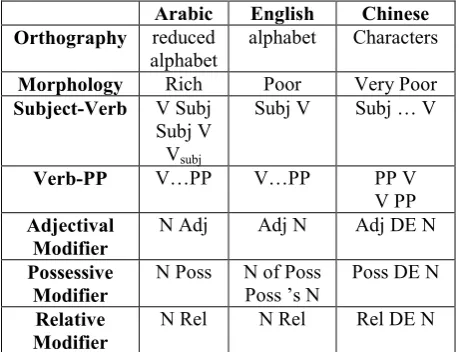
These different phenomena are summarized in Table 1. It is interesting to point out that Eng-lish phenomena are a middle ground for Arabic and Chinese: in some cases English is closer to Arabic and in others to Chinese.
Arabic English Chinese Orthography reduced
alphabet
alphabet Characters
Morphology Rich Poor Very Poor Subject-Verb V Subj
Subj V Vsubj
Subj V Subj … V
Verb-PP V…PP V…PP PP V V PP Adjectival
Modifier
N Adj Adj N Adj DE N
Possessive Modifier
N Poss N of Poss Poss ’s N
Poss DE N
Relative Modifier
[image:3.595.309.539.246.422.2]N Rel N Rel Rel DE N
Table 1: Comparing different linguistic phenomena in Arabic, English and Chinese
3.4 Quantifying Linguistic Differences
The previous section described specific types of linguistic phenomena without distinguishing them in terms of frequency or effect distance. For example, Arabic nominals (nouns, adjec-tives and adverbs) are seven times as frequent as verbs; and nominal modification phenomena are more likely local than long distance com-pared to verb-subject order. A proper quantifi-cation of these different phenomena requires trilingual parallel treebanks, which are not available. As such, we propose a simple metric to quantify linguistic differences by measuring the translation complexity of different language pairs. The metric is Average Relative Align-ment Length (ARAL):
ARAL= 1
|L|
pa Sa
lab∈L
∑
− pbSb
3 Arabic dialects allow an additional construction. We
We define L as the set of all alignment links
linking words in a parallel corpus of languages A and B. For each alignment link, lab, linking words a and b, we define pa and pb as the posi-tion of words a and b in their respective
sen-tences. We also define Sa and Sb as the lengths of the sentences in which a and b appear,
re-spectively. ARAL is the mean of the absolute difference in relative word position (pi/Si) of the words of every alignment link. The larger ARAL is, the more reordering and inser-tions/deletions we expect, and the more com-plexity and difference. ARAL is a harsh metric since it ignores syntactic structure facts that ex-plain how clusters of words move together.
A-C A-E E-C 0.1679 0.0846 0.1531
Table 2: Average Relative Alignment Length for pairs of Arabic (A), English (E) and Chinese (C)
Table 2 presents the ARAL scores for each lan-guage pair. These scores are computed over the
grow-diag-final symmetrized alignment we use
in our system (Koehn, 2004). ARALAC is the highest and ARALAE is the lowest. The average length of sentences is generally close among these languages (given the segmentation we use): Arabic is ~32 words, English is ~31 and Chinese is ~29. Arabic and English are much closer to each other than either to Chinese. This may be the result of Arabic tokenization and Chinese segmentation technologies which have been developed for translation into English. We address this issue in section 4.1. The ARAL scores agree with our assessment that English is closer to Arabic and to Chinese than Arabic is to Chinese. As a result, we believe it may serve as a good pivot language for translating Arabic to Chinese.
4 System Description
In this section, we describe the different sys-tems we compare.
4.1 Data
Our data collection is the United Nations (UN) multilingual corpus, provided by the LDC4 (catalog no. LDC2004E12). The UN corpus has in principle parallel sentences for Arabic, Eng-lish and Chinese. However, the Arabic-EngEng-lish
4http://www.ldc.upenn.edu
(A-E) data and Chinese-English (C-E) data sets were not in synch. The A-E data set has 3.2M lines while the C-E data set has 5.0M lines. We used the document ID provided in the data to match sentences from A-E against those in C-E to generate a three-way parallel corpus with 2.6M lines.
We tokenized the Arabic data in the Arabic Treebank scheme (Sadat and Habash, 2006). Chinese was segmented into words using a segmenter developed by Howard Johnson for the Portage Chinese-English MT system.5 So a sentence consists of multiple words with spaces between them and each word is comprised of one or more characters. English was simply processed to split punctuation and “’s”. The same preprocessing was used in all systems compared.
We are aware of two potentially biased aspects of our experimental setting. First, the Arabic and Chinese portions of our data collection, the UN corpus, are known to be generated from English originals. And secondly, the preproc-essing techniques we used on Arabic and Chi-nese were developed for translation from these languages into English. These two aspects make English potentially more central to our experiments than if the data collection and pre-processing were done on Arabic and Chinese independent of English. Of course, it must be noted that the data bias is not unique to our work but rather a challenge for any bilingual corpus, in which translation is done from one language to another. Additionally, we can ar-gue that the English bias in data and preproc-essing does not only affect the Arabic-English and English-Chinese pipelines, but it also makes the Arabic and Chinese data potentially closer. Finally, given the expense involved in creating direct Arabic-Chinese parallel text and given the large amounts of Arabic-English and English-Chinese data, we think our results (with English bias) are still valid and interest-ing. That said, we leave the question of Arabic-Chinese optimization to future work.
4.2 Direct A-C MT System
In our baseline direct A-C system, we used the Arabic and Chinese portions of our parallel corpus to train a direct phrase-based MT sys-tem. We use GIZA++ (Och and Ney, 2003) for
word alignment, and the Pharaoh system suite to build the phrase table and decode (Koehn, 2004). The Chinese language model (LM) used 200M words from the UN corpus segmented in a manner consistent with our training. The tri-gram LM was built using the SRILM toolkit (Stolcke, 2002).
4.3 Sentence Pivoting MT System
The sentence pivoting system (A-s-C) used English as an interface between two separate pharse-based MT systems: an Arabic-English direct system and an English-Chinese direct system. When translating Arabic to Chinese, the English top-1 output of the Arabic-English sys-tem was passed as input to the English-Chinese system. The English LM used to train the Ara-bic-English system is built from the counterpart of the Chinese data used to build the Chinese LM in our parallel corpus. We use 210M Eng-lish words in total.
4.4 Phrase Pivoting MT System
The phrase pivoting system (A-p-C) extracts a new Arabic to Chinese phrase table using the Arabic-English phrase table and the English-Chinese phrase table. We consider a English-Chinese phrase a translation of an Arabic phrase only if some English phrase can bridge the two. We use the following formulae to compute the lexical and phrase probabilities in the new phrase table in a similar manner to Utiyama and Isahara (2007). Here,
φ
is the lexical probability andw
p is the phrase probability.
'( | ) ( | ) ( | )
e
a c a e e c
φ
=∑
φ
φ
'( | ) ( | ) ( | )
e
c a c e e a
φ
=∑
φ
φ
'( | ) ( | ) ( | )
w w w
e
p a c =
∑
p a e p e c'( | ) ( | ) ( | )
w w w
e
p c a =
∑
p c e p e aThe left hand side of the formulae represents the four required probabilities in a Pharaoh Arabic-Chinese phrase table.
5 Evaluation
For each of the direct system, the sentence-pivoting system and the phrase-sentence-pivoting system,
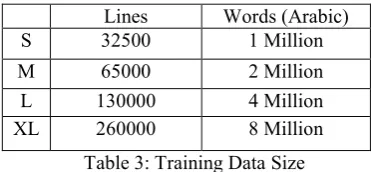
we conduct four sets of experiments with dif-ferent data sizes. Table 3 illustrates the training data size for each experiment. The training data is collected from the beginning of the same parallel corpus, so the larger training sets in-clude the smaller ones.
[image:5.595.323.509.156.242.2]Lines Words (Arabic) S 32500 1 Million M 65000 2 Million L 130000 4 Million XL 260000 8 Million
Table 3: Training Data Size
We use two other data sets (1K lines each) for tuning and testing. Each sentence in these sets has only one reference. Tuning and testing data sets are the same across all experiments and systems. In all our experiments, we decode using Pharaoh (Koehn, 2004) with a distortion limit of 4 and a maximum phrase length of 7. Tuning is done for each experimental condition using Och’s Minimum Error Training (Och, 2003).
Note that for each set of experiments with the same data size, we draw Chinese, Arabic and English from the same chunk of three way par-allel corpus. For example, in S size experi-ments, the two phrase tables used to build a new table in the phrase-pivoting approach are extracted respectively from the A-E and E-C systems built in the sentence-pivoting approach with size S corpora.
5.1 Direct System Results
A-C A-E E-C
S 11.17 21.89 19.29
M 13.43 (+20.2%)
23.86
(+9.0%)
20.85
(+8.1%) L 14.62
(+8.9%)
24.86
(+4.2%)
22.42
(+7.5%) XL 16.17
(+10.6%)
27.96
(+12.5%)
24.11
(+7.5%) Table 4: BLEU-4 scores comparing performance of direct translation of Chinese (A-C), Arabic-English (A-E) and Arabic-English-Chinese (E-C) for four training data sizes. The percentage increases are against the immediately lower data size.
5.2 Pivoting System Results
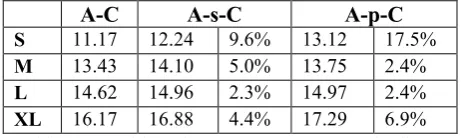
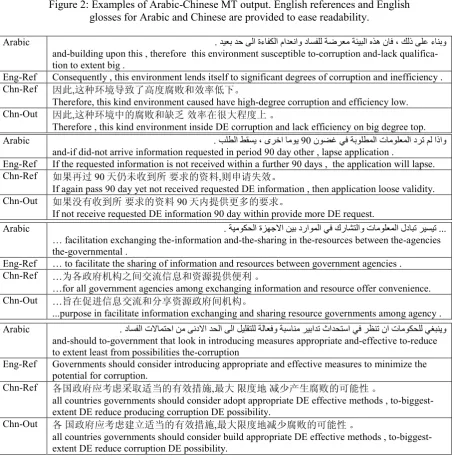
In Table 5, we present the results of the sen-tence pivoting system (A-s-C) and the phrase pivoting system (A-p-C). Under all conditions, A-s-C and A-p-C outperform A-C. A-p-C gen-erally outperforms A-s-C except in the M data condition. The effect in the S conditions is big-ger than the XL condition. In our best result (XL), we increase the BLEU score by over 1.12 points. Furthermore, the relative BLEU score increase from the L condition for A-p-C is 15.5% as opposed to A-C’s 10.6%. The A-s-C relative increase from L to XL is 12.8%. This suggests that we are making better use of the available resources. The differences between A-s-C and A-C and between A-p-C and A-C are statistically significant at the 95% confidence level (Zhang et al., 2004). The differences be-tween the two pivoting systems are not statisti-cally significant. Examples from our best performing system are shown in Figure 2.
A-C A-s-C A-p-C
S 11.17 12.24 9.6% 13.12 17.5% M 13.43 14.10 5.0% 13.75 2.4% L 14.62 14.96 2.3% 14.97 2.4% XL 16.17 16.88 4.4% 17.29 6.9% Table 5: Word-based BLEU-4 scores. A-C is direct translation. A-s-C is indirect translation through sen-tence pivoting and A-p-C is indirect translation through phrase pivoting. The percentages indicate relative improvement over A-C.
Our results are consistent with (Utiyama and Isahara, 2007) in that phrase-pivoting generally does better than sentence pivoting. However, we disagree with them in that, for us, direct translation is not the best system to use. We be-lieve that this effect is caused by the
combina-tion of the very different languages we use. English is truly bridging between Arabic and Chinese in many linguistic dimensions. We think it’s English’s middle-ground-ness that makes these results possible.
A-C A-s-C A-p-C S 53.75 54.38 1.2% 54.64 1.7% M 56.65 57.00 0.6% 55.88 -1.4% L 58.37 57.69 -1.2% 58.79 0.7%
B
L
E
U
-1
XL 59.90 60.34 0.7% 60.28 0.6% S 21.32 21.80 2.3% 22.88 7.3% M 23.84 24.22 1.6% 23.76 -0.3% L 24.98 25.14 0.6% 25.87 3.6%
B
L
E
U
-4
XL 25.95 27.11 4.5% 27.70 6.7% S 9.82 10.02 2.0% 11.42 16.3% M 11.56 11.84 2.4% 11.64 0.7% L 12.23 12.52 2.4% 13.09 7.0%
B
L
E
U
-7
[image:6.595.63.287.95.200.2]XL 12.69 13.52 6.5% 14.57 14.8% Table 6: Character-based BLEU scores for n-grams of maximum size 1, 4, and 7. The percentages are relative to the direct system.
In Table 6, we present additional scores using BLEU-1, BLEU-4 and BLEU-7 measured at the character level as opposed to the harsher measure at word level. Ignoring the odd behav-ior in M and L conditions, the sentence-pivot and phrase-pivot approaches improve over the direct translation baseline in terms of fluency (BLEU-7) and accuracy (BLEU-1). Under the small data condition, the phrase-pivot approach increases the BLEU-4 score three times the increase of the sentence-pivot approach. That ratio reduces to 1.5 times in the XL condition. The relative improvements of the pivoting sys-tems over the direct system are small at BLEU-1 and much bigger at higher BLEU scores. This suggests that differences between the piv-oting systems and the direct system are not in terms of lexical coverage but rather in terms of better reordering.
The lengths of the outputs of all the systems (direct and pivoting) are larger than the refer-ence length which means no brevity penalty was applied in BLEU calculation. Also, no BLEU-gaming was done by OOV deletion: all OOV words were left in the output.
5.3 Error Analysis
[image:6.595.309.531.144.319.2] [image:6.595.63.294.552.621.2]future. We took a sample of 50 sentences re-stricted in length to be between 15 and 35 Chi-nese words. A ChiChi-nese native speaker compared our output to the reference translation and judged its quality in terms of two categories: syntax and lexical choice.
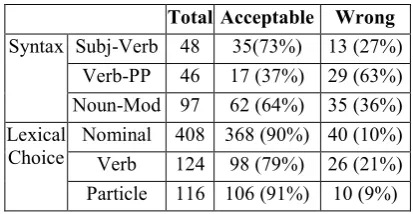
In terms of syntax, our judge identified all the occurrences of (a) subjects and verbs, (b) prepo-sitional phrases and verbs and (c) modified nouns. Each case was judged as acceptable or wrong. Placing a verb before its subject, a
pre-verbal prepositional phrase after its verb, or a modifier after the noun it modifies are all con-sidered wrong. We correctly produce
subject-verb order 73% of the time; and we produce nominal modification order correctly 64% of the time. Our biggest weakness in terms of syn-tax is prepositional phrase order. It is worth noting that the two phenomena we do better on are addressed in translation from Arabic to Eng-lish, unlike prepositional phrase order which is where Chinese is different from both Arabic and English.
In terms of lexical choice our judge considered the translation quality of three classes of words: Nominals (nouns, pronouns, adjectives and ad-verbs), Verbs, and other particles (prepositions, conjunctions and quantifiers). An incorrectly translated or deleted word is considered wrong.
We perform on nominals and particles at about the same level of 90%. Verbs are our biggest challenge with accuracy below 80%. The ratio of deleted words among all wrong words is rather high at about 30% (for nominals and for verbs). The detailed results of the error analysis are shown in Table 7.
Finally, there are 27 instances of Arabic Out-of-Vocabulary (OOV) words (1.93% of all words) that are not handled. Ten (37%) of these are proper nouns. The rest belong to mostly nouns and adjectives. Orthogonally, 19 (70%) of all OOV words belong to the genre of science re-ports, which is quite different from the data we train on. The OOVs include complex terms like _`aPbآcdeوfg`bOا AlsybrwflwksAsyn
‘ciproflox-acin’ and hiراkl تPnPnر rjAjAt mdAryħ
‘[chemi-cal] orbital shakers’. Other less frequent OOV cases involve bad tokenization and less com-mon morphological constructions.
Total Acceptable Wrong Subj-Verb 48 35(73%) 13 (27%)
Verb-PP 46 17 (37%) 29 (63%) Syntax
Noun-Mod 97 62 (64%) 35 (36%) Nominal 408 368 (90%) 40 (10%) Verb 124 98 (79%) 26 (21%) Lexical
Choice
[image:7.595.312.519.80.187.2]Particle 116 106 (91%) 10 (9%) Table 7: Results of human error analysis on a sample from the A-p-C system (XL)
6 Conclusion and Future Work
We presented a comparison of two approaches for Arabic-Chinese MT using English as a piv-ot language against direct MT. Our results show that using English as a pivot in either ap-proach outperforms direct translation from Arabic to Chinese. We believe that this is a result of English being a sort of middle ground between Arabic and Chinese in terms of differ-ent linguistic features (in particular word or-der). Our best result is the phrase-pivot system which scores higher than direct translation by 1.1 BLEU points. An error analysis of our sys-tem shows that we successfully handle many complex Arabic-Chinese syntactic variations although there is a large space for improvement still.
In the future, we plan on exploring tighter cou-pling of Arabic and Chinese through compar-ing different methods of preprocesscompar-ing Arabic for Arabic-Chinese MT, in a similar manner to Sadat and Habash (2006). We also plan to study how well these results carry on to differ-ent corpora (bilingual Arabic-English and Eng-lish-Chinese) as opposed to the trilingual corpus used in this paper. We also plan to in-vestigate whether our findings in Arabic-English-Chinese can be used for other different language triples.
Acknowledgements
Figure 1: An example highlighting Arabic-English-Chinese syntactic differences
Figure 2: Examples of Arabic-Chinese MT output. English references and English glosses for Arabic and Chinese are provided to ease readability.
Arabic .k`op kq rOا ةءPuvOا ماkoxاو دPbudO hzfol h{`gOا |}ه نPe ، Oذ rd ءPpو and-building upon this , therefore this environment susceptible to-corruption and-lack qualifica-tion to extent big .
Eng-Ref Consequently , this environment lends itself to significant degrees of corruption and inefficiency . Chn-Ref 因此,这种环境导致了高度腐败和效率低下。
Therefore, this kind environment caused have high-degree corruption and efficiency low. Chn-Out 因此,这种环境中的腐败和缺乏效率在很大程度上。
Therefore , this kind environment inside DE corruption and lack efficiency on big degree top. Arabic . NdQOا bi ، ىfا Plci 90 نc e hpcdQOا تPlcdoOا دf O اذاو
and-if did-not arrive information requested in period 90 day other , lapse application .
Eng-Ref If the requested information is not received within a further 90 days , the application will lapse. Chn-Ref 如果再过90天仍未收到所要求的资料,则申请失效。
If again pass 90 day yet not received requested DE information , then application loose validity. Chn-Out 如果没有收到所要求的资料90天内提供更多的要求。
If not receive requested DE information 90 day within provide more DE request.
Arabic . h`lcvOا ةnا _`p دراcOا e كرPROاو تPlcdoOا لدPg f`b` ... … facilitation exchanging the-information and-the-sharing in the-resources between the-agencies the-governmental .
Eng-Ref … to facilitate the sharing of information and resources between government agencies .
Chn-Ref …为各政府机构之间交流信息和资源提供便利。
…for all government agencies among exchanging information and resource offer convenience.
Chn-Out …旨在促进信息交流和分享资源政府间机构。
...purpose in facilitate information exchanging and sharing resource governments among agency .
Arabic . دPbuOا تPRqا _l rxدا kOا rOا `dRdO hOPoeو hgaPl f`pاk ثاkRaا e f نا تPlcvdO giو and-should to-government that look in introducing measures appropriate and-effective to-reduce to extent least from possibilities the-corruption
Eng-Ref Governments should consider introducing appropriate and effective measures to minimize the potential for corruption.
Chn-Ref 各国政府应考虑采取适当的有效措施,最大限度地减少产生腐败的可能性。
all countries governments should consider adopt appropriate DE effective methods , to-biggest-extent DE reduce producing corruption DE possibility.
Chn-Out 各国政府应考虑建立适当的有效措施,最大限度地减少腐败的可能性。
all countries governments should consider build appropriate DE effective methods , to-biggest-extent DE reduce corruption DE possibility.
أfi
1
NOPQOا
2
kROا
3
PpPRآ
4
_
5
_`Oا
6
e
7
Oا
8
.
yqrÂ1 AlTAlb2 Almjthd3 ktAbA4 ςn5 AlSyn6 fy7 AlSf8 .
read1 the-student2 the-diligent3 a-book4 about5 china6 in7 the-classroom8 .
这1位2勤奋3 的4 学生5 在6教室7 读8 一9 本10 关于11 中国12 的 13书14。
this1 quant2 diligent3 de4 student5 in6 classroom7 read8 one9 quant10 about11 china12 de13 book14 Zhe1 Wei2 Qin Fen3 De4 Xue Sheng5 Zai6 Jiao Shi7 Du8 Yi9 Ben10 Guan Yu11 Zhong Guo12 De13 Shu14
References
Yaser Al-Onaizan and Kishore Papineni. 2006 Dis-tortion models for statistical machine transla-tion. In Proceedings of Coling-ACL’06.
Sydney, Australia.
Bogdan Babych, Anthony Hartley, and Serge Sharoff. 2007. Translating from under-resourced languages: comparing direct transfer against pivot translation. In Proceedings of MT
Summit XI, Copenhagen, Denmark.
Tim Buckwalter. 2002. Buckwalter Arabic morpho-logical analyzer version 1.0.
Chris Callison-Burch, Philipp Koehn, and Miles Osborne. 2006. Improved statistical machine translation using paraphrases. In Proceedings of HLT-NAACL’06. New York, NY, USA.
Marine Carpuat and Dekai Wu. 2007. Context-dependent phrasal translation lexicons for sta-tistical machine translation. In Proceedings of
MT Summit XI, Copenhagen, Denmark.
Josep M. Crego and José B. Mariño. 2007. Syntax-enhanced n-gram-based SMT. In Proceedings of MT Summit XI, Copenhagen, Denmark.
Karim Filali and Jeff Bilmes. Leveraging Multiple Languages to Improve Statistical MT Word Alignments. In Proceedings of ASRU’05,
Can-cun, Mexico.
Nizar Habash. 2007. Syntactic preprocessing for statistical machine translation. In Proceedings of MT Summit XI, Copenhagen, Denmark.
Nizar Habash, Abdelhadi Soudi, and Tim Buckwal-ter. 2007. On Arabic Transliteration. In A. van den Bosch and A. Soudi, editors, Arabic Com-putational Morphology: Knowledge-based and Empirical Methods. Springer.
Hitoshi Isahara, Sadao Kurohashi, Jun’ichi Tsujii, Kiyotaka Uchimoto, Hiroshi Nakagawa, Hiro-yuki Kaji, and Shun’ichi Kikuchi. 2007. De-velopment of a Japanese-Chinese machine translation system. In Proceedings of MT Summit XI, Copenhagen, Denmark.
Philipp Koehn. 2004. Pharaoh: a Beam Search De-coder for Phrase-based Statistical Machine Translation Models. In Proceedings of
AMTA’04, Washington, DC, USA.
Shankar Kumar, Franz Och, and Wolfgang Ma-cherey. 2007. Improving word alignment with bridge languages. In Proceedings of
EMNLP-CoNLL’07, Prague, Czech Republic.
Young-Suk Lee. 2004. Morphological Analysis for Statistical Machine Translation. In Proceedings of HLT-NAACL’04, Boston, MA, USA.
Franz Josef Och and Hermann Ney. 2003. A Sys-tematic Comparison of Various Statistical
Alignment Models. Computational Linguistics,
29 (1):19–52.
Franz Josef Och. 2003. Minimum Error Rate Train-ing for Statistical Machine Translation. In Pro-ceedings of ACL’03, Sapporo, Japan.
Fatiha Sadat and Nizar Habash. 2006. Combination of Arabic preprocessing schemes for statistical machine translation. In Proceedings of Coling-ACL’06. Sydney, Australia.
Kishore Papineni, Salim Roukos, Todd Ward, and Wei-Jing Zhu. 2002. BLEU: a Method for Automatic Evaluation of Machine Translation.
In Proceedings of ACL’02, Philadelphia, PA,
USA.
Charles Schafer & David Yarowsky. 2002. Induc-ing translation lexicons via diverse similarity measures and bridge languages. In Proceedings of CoNLL’02, Taipei, Taiwan.
Micheal. Simard. 1999. Text translation alignment: Three languages are better than two. In Pro-ceedings of EMNLP-VLC’99, College Park, MD, USA.
Michel Simard, Nicola Ueffing, Pierre Isabelle, and Roland Kuhn. 2007. Rule-based translation with statistical phrase-based post-editing. In Proceedings of the workshop on Statistical
Machine Translation, ACL’07, Prague, Czech Republic.
Andreas Stolcke. 2002. SRILM - an Extensible Language Modeling Toolkit. In Proceedings of
ICSLP’02, Denver, CO, USA.
Masao Utiyama and Hitoshi Isahara. 2007. A com-parison of pivot methods for phrase-based sta-tistical machine translation. In Proceedings of
NAACL-HLT’07, Rochester, NY, USA. Chao Wang, Michael Collins, and Philipp Koehn.
2007. Chinese syntactic reordering for statisti-cal machine translation. In Proceedings of
EMNLP-CoNLL’07, Prague, Czech Republic. Dekai Wu. 1998. A Position Statement on Chinese Segmentation. Presented at the Chinese Lan-guage Processing Workshop. http://www.
cs.ust.hk/~dekai/papers/segmentation.html. Hua Wu and Haifeng Wang. 2007. Pivot language
aproach for phrase-based statistical machine translation. In Proceedings of ACL’07, Prague, Czech Republic.
Yang Ye, Karl-Michael Schneider, and Steven Abney. 2007. Aspect marker generation in English-to-Chinese machine translation. In Proceedings of MT Summit XI, Copenhagen, Denmark.
Ying Zhang, Stephan Vogel and Alex Waibel, In-terpreting Bleu/NIST scores: How much im-provement do we need to have a better system?,