IITP: Multiobjective Differential Evolution based Twitter Named Entity
Recognition
Md Shad Akhtar, Utpal Kumar Sikdar and Asif Ekbal
Dept of Computer Science and Engineering IIT Patna
Patna, India
(shad.pcs15,utpal.sikdar,asif)@iitp.ac.in
Abstract
In this paper we propose a differential evo-lution (DE) based named entity recogni-tion (NER) system in twitter data. In the first step, we develop various NER systems using different combinations of the features. We implemented these fea-tures without using any domain-specific features and/or resources. As a base clas-sifier we use Conditional Random Field (CRF). In the second step, we propose a DE based feature selection approach to determine the most relevant set of fea-tures and its context information. The op-timized feature set applied to the train-ing set yields the precision, recall and F-measure values of 60.68%, 29.65% and 39.84%, respectively for the fine-grained named entity (NE) types. When we con-sider only the coarse-grained NE types, it shows the precision, recall and F-measure values of 63.43%, 51.44% and 56.81%, re-spectively.
1 Introduction
During the last few years there has been a phe-nomenal growth in the number of users that make use of different social networking platforms to share their opinions and views. Twitter now has upto over 500 million users with approx 302 mil-lion active users 1. One can easily imagine that
amount of tweets generated per day would be enormous i.e. almost 500 million tweets per day
2. These information are usually unstructured and
noisy in nature. The reason behind its unstruc-tured nature is that tweets are rather short mes-sages (constitute upto 140 characters only), con-tains several grammatical & spelling mistakes etc.
1http://en.wikipedia.org/wiki/Twitter
2
http://www.cnet.com/news/report-twitter-hits-half-a-billion-tweets-a-day/
The size limitation bounds a user to invent sev-eral short forms (e.g. 2mrw, tmrw for tomorrow) of a valid word which a human mind can interpret easily but, on the other hand, becomes very diffi-cult to come up with an accurate system for solv-ing any problem related to natural language pro-cessing (NLP). Also in order to show their emo-tions, users sometime put extra emphasis by elon-gating a valid word (e.g. yeeesssss!! for yes). Named entity recognition (NER) can be seen as one of the important and foremost tasks for many natural language processing (NLP) tasks such as machine translation, information extrac-tion, question-answering etc. The task of NER can be thought of as a two-step process that in-volves identifying proper names from the text and classifying them into some predefined categories such as person, organization, location etc. Al-though the techniques (Bikel et al., 1999; Ekbal and Bandyopadhyay, 2008a; Ekbal and Bandy-opadhyay, 2008b; Sikdar et al., 2012) for recog-nizing named entities (NEs) in newswire and other well-formatted traditional corpus has already ma-tured but it is still a challenging task to perform in unstructured and noisy twitter data.
The concept of NER in twitter has recently drawn the attention of researchers worldwide. Very few authors have reported their works (Liu et al., 2011; Ramage et al., 2009; Li et al., 2012) for NER in twitter. A semi-supervised model for NER has been reported in (Liu et al., 2011) where K-nearest neighbour classifier is combined with CRF. Application of LabeledLDA (Ramage et al., 2009) in supervised environment can be found in (Ritter et al., 2011). Their method classifies NEs into fine-grained types of 10 classes (as in our case). In another work (Li et al., 2012), authors have used random walk model to build an unsu-pervised approach to NER. They modelled their system on local(tweets) and global (www) context without employing any of the linguistic features.
Few more related works can be found in (Derczyn-ski et al., 2015) and (Locke and Martin, 2009).
Due to several challenges it pose, recently there has been a huge interest to identify NE in twit-ter data. In compliance with this a shared task “ACL2015 W-NUT: Named Entity Recognition in Twitter”3 was organized. The work that we
report here is a part of this shared task. The main objective of the shared task was to effi-ciently identify various coarse-grained and fine-grained named entities. Fine-fine-grained NE types include 10 different categories namely, person, product, company, geo-loc, movie, musicartist, tvshow, facility, sportsteam and other. We have used a rich feature set based on lexical and syntac-tic properties of a tweet as discussed in Section 3.9. Our proposed work uses Conditional Ran-dom Field (CRF) (Lafferty et al., 2001) as learning algorithm, which is very efficient as a sequence learner. Subsequently we have applied Differen-tial Evolution (DE), a stochastic, population based optimization algorithm, introduced by Storn and Prince in 1996 (Storn and Price, 1997), to obtain the optimal feature set for NER in twitter data. The organization of the paper is as follows. Sec-tion 2 provides a very brief theoretical discussion of DE. Feature set and methodology used in the proposed work are discussed in Section 3. Experi-mental result and analysis can be found in Section 4. We conclude the paper in Section 5.
2 MultiObjective Differential Evolution (DE)
Differential Evolution (DE) (Storn and Price, 1997) is a heuristic search optimization technique and it provides near optimal solution for an opti-mization problem. Within a search space the pa-rameters are encoded in the form of string, which is called chromosome/vector. A chromosome is, therefore, nothing but of D number of real val-ues. A collection of such types of chromosomes is called population. A fitness value is associ-ated with each chromosome. For single objective optimization the fitness value depends upon the these D number of real parameters. For multiob-jective optimization, more than one fitness value is associated with each chromosome. The fitness value denotes the goodness of the chromosome. DE generates new vector by adding the weighted difference between two vectors to the third
vec-3http://noisy-text.github.io/
tor. This operation is called the mutation. In the next step, the mutant vector parameters are mixed with the parameters of the predefined vector. The new vector is termed as the trial vector, and the parameter mixing process is called crossover. The best vectors are selected from the trial vectors. The process of selecting new vectors from the current population is known as selection. The algorithm that we follow for this is known as the crowding distance sorting algorithm. The processes of mu-tation, crossover and selection continue for a fixed number of generation.
3 Methods
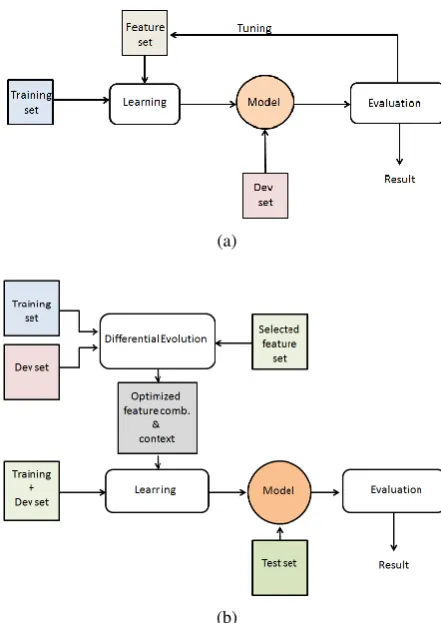
The proposed system is consisting of two steps. In the very first step we generate many models based on the best fitting feature sets. Following this heuristic based approach we select the best model by fine-tuning on the development data. In the second step we develop a multiobjective DE based feature selection approach to find out the best feature combinations and its contextual infor-mation from the selected feature set. Schematic diagram of the proposed system is depicted in fig-ure 1.
3.1 Problem Formulation
Suppose there are D features available, and these are denoted byF1, . . . , FD, whereA={Fi :i=
1;D} Determine the subset of features A0 ⊆ A
such that we learn a classifier with these subset of features and optimize some metrics. In our pro-posed multiobjective DE, we optimize two func-tions, namely precision and recall.
3.2 Problem Representation and Population Initialization
All the chromosomes are initialized with the bi-nary values of either 0 or 1, where 1 denotes that the corresponding feature is present and 0 denotes that the corresponding feature is off. Total number of available features denote the length of the chro-mosome, and we set this as D. A classifier learns with the available set of features. One example of chromosome representation is shown in Figure 2.
3.3 Fitness Computation
(a)
(b)
Figure 1: Proposed methodology (a) Step 1 (b) Step 2.
Figure 2: Chromosome representation: Here #available features = 15 and #features present = 8
M number of features. The classifier is then evalu-ated on the development data. We calculate preci-sion and recall as the two objective functions. The goal is to maximize these two functions.
3.4 Mutation
In mutation process, a mutant vector Vi,G+1 is
generated for each target vector Xi,G; i = 1,2,3, . . . , NP, according to
Vi,G+1 =xr1,G+F ×(xr2,G−xr3,G), (1)
wherer1,r2,r3are generated randomly with dif-ferent indices, not equals to current indexiand be-long to{1,2, . . . , NP},Gis the generation num-ber and F is the mutant factor which is set to 0.5. If
the parameters of mutant vectorvi,j,G+1 >1, then
the parameter values are set to 1. If the parameters of mutant vectorvi,j,G+1 <0, then the parameter
values are set to 0.
3.5 Crossover
To generate better solutions (represented by the chromosomes) to the next generation population, crossover is needed. The parameter mixing of the target vectorXi,Gand mutant vectorVi,G+1is
called crossover. Crossover generates a trial vector as follows:
Ui,G+1= (u1,i,G+1, u2,i,G+1, . . . , uD,i,G+1) (2)
where
uj,i,G+1=vj,i,G+1if(rj ≤CR)orj=ir (3)
=xj,i,Gif(rj > CR)andj6=ir (4) forj = 1,2, . . . , D, whererj is an uniform ran-dom number of thejth evaluation which belongs to[0,1]and CR is crossover constant which is set to 0.5. The index valueirbelongs to{1,2, . . . , D} that ensures that at least one parameter of trial vec-tors Ui,G+1 gets one parameter from the mutant
vectorVi,G+1. 3.6 Selection
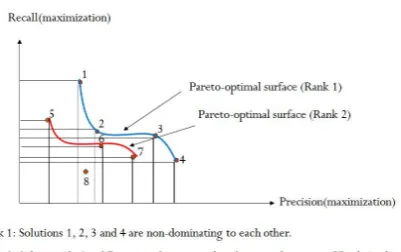
In selection process, trial vectors are merged with the current population to get the best NP solu-tions from the merged solusolu-tions 2×NP in the next generation population. The merged solutions are sorted based on dominated and non-dominated concept and generate ranked solutions. As an ex-ample, the dominated and non-dominated sorting are shown in Figure 3. The non-dominated solu-tions are represented in the pareto-optimal surface. The non-dominated solutions are added to the next generation population until the number of solu-tions becomes equal toNP. If the number of so-lutions in a particular rank exceedsNP, then it is sorted based on crowding distance algorithm. The required number of solutions are added from the beginning of the sorted rank to makeNP number solutions in the next generation population. The selection process determines the bestNP number of solutions in the next generation population.
3.7 Termination Condition
[image:3.595.73.294.62.374.2]Figure 3: Representation of dominated and non-dominated solutions
3.8 Selecting the best solution
The multiobjective optimization (MOO) based al-gorithm yields a set of solutions on the Pareto op-timal front at the end. None of these solutions is better compared to the others. However, we may often require to find out a solution at the end. Depending upon the user’s requirements dif-ferent criteria for selecting the best solutions can exist. Each feature vector of the final Pareto op-timal front generates a classifier. We compute the F-measure value on the development set for each classifier. We select the solution which reports highest F-measure value. The features encoded in this chromosome is used to train a CRF and report the final evaluation on the test data.
3.9 Feature Set
In this section we describe the features that we implement for performing NER. The features are domain-independent and we implement these without using any external resources and/or tools.
1. Local context: We use local contextual in-formation as the features of CRF. We use pre-vious few and succeeding few words as the features for learning.
2. Part-of-Speech information: PoS informa-tion is one of the prominent features in iden-tifying the NE. We have used CMU-ARK Twitter NLP tool4 for extracting the PoS
in-formation. We use the PoS information of preceding and succeeding few tokens as the features.
4http://www.ark.cs.cmu.edu/TweetNLP/
3. Word length: From the given training data we observed that NEs generally become longer in lengths. We define a feature that is set to high if the length of the candidate token exceeds a predetermined threshold. In our case we assume the token to be a NE if if its length exceeds 5 characters.
4. Suffix and Prefix: Suffixes and prefixes of length upto 4 characters of the current word are used as the features.
5. Word normalization:We normalize the cur-rent token and use it as a feature. For normal-ization we map the capitalized letter to ‘A’, small letter to ‘a’ and numbers or symbols to ‘x’.
6. Previous word: We prepare a list of most frequent words that appear before a NE in the training data. A binary valued feature is then defined that fires if the current word appears in this list.
7. Stop word: This checks whether the current word appears in the list of stop words or not. We obtain the list of stop words available at
5.
8. Uppercase:This feature checks whether the current word starts with a capital letter or contains a upper case letter inside the word or all the characters of the word are capital-ized.
9. All digit: This feature checks whether the current token is consisting of only digits. 10. AlphaDigit: Tokens having combination of
alphabet and digit have less probability of be-ing a NE. This concept is used to define a bi-nary feature in the proposed work which fires when the token is alphanumeric.
11. First & last word: Tweet level information are employed for defining two features i.e. if the current token is the first or last word of a particular tweet.
12. Word frequency: We observe that most fre-quently occurring words have a tendency of not being NE. We prepare a list of most fre-quent words from the training data. A binary
valued feature is then defined that checks whether the current word appears in this list or not.
13. Gazetteer: We prepare a list of NEs from the training and development datasets. Along with the NE we also store the NE types. We define an integer-valued feature that takes the value that corresponds to the respective NE type.
4 Datasets and Experiments
In this section we firstly describe the datasets and then report the evaluation results.
4.1 Data Set
As discussed earlier, objective of the shared task was to identify both the coarse-grained and fine-grained NE from the tweets. Shared task orga-nizers provided two separate versions of train-ing (trainnotype and train10type) datasets and four versions of development datasets (devnotype,
dev2015notype, dev10type and dev201510type).
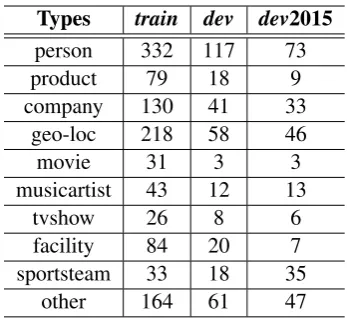
The training dataset comprise of 1,795 tweets while development datasets comprises of 599 & 420 tweets fordevanddev2015, respectively. A total of 1,768 NEs are present in the dataset, out of which 1,140 are present in the training set and rest 628 are present in the development set. Brief statistics of the datasets are shown in Table 1 and Table 2 for the coarse-grained NE tagged and fine-grained NE tagged datasets, respectively. Gold standard test datasets comprise of 1,000 tweets.
Dataset # Tweets # Token # NE
train 1795 34899 1140
dev 599 11570 356
dev2015 420 6789 272
test2015 1000 16261
-Table 1: Statistics of the coarse-grained dataset
4.2 Experimental Results
As a base learning algorithm we make use of Conditional Random Field (CRF)(Lafferty et al., 2001). We use the CRF++ 6 based package for
our experiments. Evaluation of all the systems are performed in compliance with CoNLL 2002 evaluation script7 as recommended in the shared
6http://taku910.github.io/crfpp/
7http://www.cnts.ua.ac.be/conll2002/ner/bin/conlleval.txt
Types train dev dev2015
person 332 117 73
product 79 18 9
company 130 41 33
geo-loc 218 58 46
movie 31 3 3
musicartist 43 12 13
tvshow 26 8 6
facility 84 20 7
sportsteam 33 18 35
[image:5.595.329.503.60.219.2]other 164 61 47
Table 2: Statistics of the fine-grained dataset.
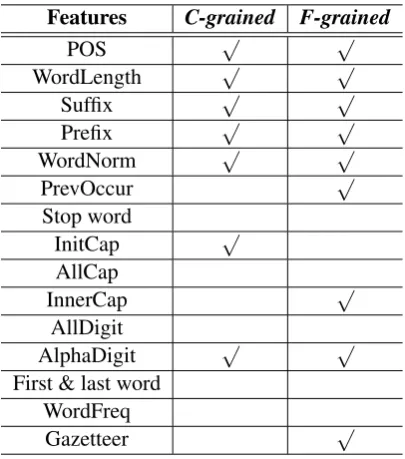
task. For comparative analysis a baseline system was also provided by the organizers for both fine-grained and coarse-fine-grained versions. We started our experiments by training the model on the fea-tures defined in Section 3.9. Iteratively we have trained, tested and evaluated the system in order to find out the best fitting feature sets. Afterwards we shifted our focus to DE for optimizing the feature set in terms of relevant features and its context in-formation. DE was initialized with the population size equal to 100, and it was executed for 50 gener-ations. We have carried out these experiments for both fine-grained and coarse-grained datasets. On termination, multiobjective differential evolution (MODE) reported optimized feature combinations for both the types of datasets. At the final step these optimized feature combinations were used to build the final system. We show the optimized fea-ture sets as determined by MODE in Table 3.
[image:5.595.86.277.516.590.2]Types Dataset Model Precision Recall F-measure Accuracy
Baseline 65.25 55.90 60.21 96.95
dev All features 65.08 57.58 61.10 96.92
MODE 69.81 62.36 65.88 97.12
Baseline 55.79 49.82 52.63 95.08
notype dev2015 All features 51.49 50.92 51.21 94.31
MODE 60.97 53.51 57.43 95.60
Baseline 53.86 46.44 49.88 95.01
test2015 All features 52.37 56.32 54.27 95.55
MODE 63.43 51.44 56.81 95.50
Baseline 57.04 44.38 49.92 96.44
dev All features 61.23 39.04 47.68 96.29
MODE 70.71 39.33 50.54 96.43
Baseline 38.53 30.88 34.29 94.14
10type dev2015 All features 37.14 23.90 29.08 93.50
MODE 48.33 24.26 32.35 94.33
Baseline 35.56 29.05 31.97 93.41
test2015 All features 42.41 30.00 35.14 94.94
[image:6.595.113.488.59.328.2]MODE 60.68 29.65 39.84 94.54
Table 4: Results of various systems on different dataset. All values are in %.
Features C-grained F-grained
POS √ √
WordLength √ √
Suffix √ √
Prefix √ √
WordNorm √ √
PrevOccur √
Stop word
InitCap √
AllCap
InnerCap √
AllDigit
AlphaDigit √ √
First & last word WordFreq
[image:6.595.80.283.374.604.2]Gazetteer √
Table 3: Optimized feature sets.
5 Conclusion
In this paper we have presented our works that we carried out as part of our participation in the Twitter NER shared task. We have used a set of features which were implemented without using much domain specific resources and/or tools. We have considered various combinations of features and finally select the combination that yields the
best result. We further apply MODE based feature selection on this feature set. Official evaluation shows F-measure of 39.84% for the fine-grained NE types and 56.81% F-measure for the coarse-grained NE type.
In future we would like to carry out more com-prehensive analysis on the evaluation results. The features that we used here are very general in nature. In future we would like to investigate domain-specific features to improve the accuracy of the system.
References
Daniel M. Bikel, Richard Schwartz, and Ralph M. Weischedel. 1999. An algorithm that learns what’s
in a name. Mach. Learn., 34(1-3):211–231,
Febru-ary.
Leon Derczynski, Diana Maynard, Giuseppe Rizzo, Marieke van Erp, Genevieve Gorrell, Raphal Troncy, Johann Petrak, and Kalina Bontcheva. 2015. Anal-ysis of named entity recognition and linking for
tweets. Information Processing & Management,
51(2):32–49.
Asif Ekbal and Sivaji Bandyopadhyay. 2008a. Bengali named entity recognition using support vector
ma-chine. In Third International Joint Conference on
Asif Ekbal and Sivaji Bandyopadhyay. 2008b. Named entity recognition in indian languages using
maxi-mum entropy approach. Int. J. Comput. Proc.
Ori-ental Lang., 21(3):205–237.
John D. Lafferty, Andrew McCallum, and Fernando C. N. Pereira. 2001. Conditional Random Fields: Probabilistic Models for Segmenting and Labeling
Sequence Data. InICML, pages 282–289.
Chenliang Li, Jianshu Weng, Qi He, Yuxia Yao, An-witaman Datta, Aixin Sun, and Bu-Sung Lee. 2012. Twiner: Named entity recognition in targeted
twit-ter stream. InProceedings of the 35th International
ACM SIGIR Conference on Research and Develop-ment in Information Retrieval, SIGIR ’12, pages 721–730, New York, NY, USA. ACM.
Xiaohua Liu, Shaodian Zhang, Furu Wei, and Ming Zhou. 2011. Recognizing named entities in tweets. In Proceedings of the 49th Annual Meeting of the Association for Computational Linguistics: Human Language Technologies - Volume 1, HLT ’11, pages 359–367, Stroudsburg, PA, USA. Association for Computational Linguistics.
B. Locke and J. Martin. 2009. Named entity
recog-nition: Adapting to microblogging. University of
Colorado.
Daniel Ramage, David Hall, Ramesh Nallapati, and Christopher D. Manning. 2009. Labeled lda: A su-pervised topic model for credit attribution in
multi-labeled corpora. InProceedings of the 2009
Con-ference on Empirical Methods in Natural Language Processing: Volume 1 - Volume 1, EMNLP ’09, pages 248–256, Stroudsburg, PA, USA. Association for Computational Linguistics.
Alan Ritter, Sam Clark, Mausam, and Oren Etzioni. 2011. Named entity recognition in tweets: An
ex-perimental study. InProceedings of the Conference
on Empirical Methods in Natural Language Pro-cessing, EMNLP ’11, pages 1524–1534, Strouds-burg, PA, USA. Association for Computational Lin-guistics.
Utpal Kumar Sikdar, Asif Ekbal, and Sriparna Saha. 2012. Differential evolution based feature selection and classifier ensemble for named entity
recogni-tion. InCOLING 2012, 24th International
Confer-ence on Computational Linguistics, Proceedings of the Conference: Technical Papers, 8-15 December 2012, Mumbai, India, pages 2475–2490.
Rainer Storn and Kenneth Price. 1997. Differential evolution a simple and efficient heuristic for global
optimization over continuous spaces. J. of Global