Proceedings of the Fifth Named Entity Workshop, joint with 53rd ACL and the 7th IJCNLP, pages 72–77,
Multiple System Combination for Transliteration
Garrett Nicolai, Bradley Hauer, Mohammad Salameh, Adam St Arnaud, Ying Xu, Lei Yao, Grzegorz Kondrak
Department of Computing Science University of Alberta, Edmonton, Canada
{nicolai,bmhauer,msalameh,ajstarna, yx2,lyao1,gkondrak}@ualberta.ca
Abstract
We report the results of our experiments in the context of the NEWS 2015 Shared Task on Transliteration. We focus on methods of combining multiple base sys-tems, and leveraging transliterations from multiple languages. We show error reduc-tions over the best base system of up to 10% when using supplemental translitera-tions, and up to 20% when using system combination. We also discuss the quality of the shared task datasets.
1 Introduction
The 2015 NEWS Shared Task on Machine Transliteration continues the series of shared tasks that were held yearly between 2009 and 2012. With the exception of the 2010 edition that in-cluded transliteration mining, the task has been limited to learning transliteration models from the training sets of word pairs. Participants are al-lowed to use target lexicons or monolingual cor-pora, but since those are “non-standard”, the re-sults are not comparable across different teams. Another drawback of the current framework is the lack of context that is required to account for mor-phological alterations.
Our University of Alberta team has participated in each of the five editions of this shared task. Al-though this year’s task is virtually identical to the 2012 task, there has been progress in translitera-tion research since then. In particular, transliter-ation projects at the University of Alberta have led to the design of novel techniques for lever-aging supplemental information such as phonetic transcriptions and transliterations from other lan-guages. During those projects, we also observed that combinations of diverse systems often outper-form their component systems. We decided to test this hypothesis in the current rerun of the NEWS shared task.
In this paper, we describe experiments that in-volve three well-known transliteration approaches. DIRECTL+, SEQUITUR, and statistical machine
translation toolkits (SMT). In an effort to harness the strengths of each system, we explore various techniques of combining their outputs. Further-more, we experiment with leveraging translitera-tions from other languages, in order to test whether this can improve the overall results. We obtain state-of-the-art results on most language pairs. 2 Base Systems
In this section, we describe our three base systems: DIRECTL+, SEQUITUR, and SMT.
2.1 DirecTL+
DIRECTL+ is a publicly-available1discriminative
string transduction tool, which was initially de-veloped for grapheme-to-phoneme conversion (Ji-ampojamarn et al., 2008). DIRECTL+ was
suc-cessfully applied to transliteration in the previous NEWS shared tasks by our team (Jiampojamarn et al., 2009; Jiampojamarn et al., 2010b; Bhargava et al., 2011; Kondrak et al., 2012), as well as by other teams (Okuno, 2012; Wu et al., 2012). We make use of all features described by Jiampojamarn et al. (2010a). We perform source-target pair align-ment withmpaligner(Kubo et al., 2011) because it performed slightly better in our development ex-periments thanM2M-aligner (Jiampojamarn et al.,
2007). The parameters of the transducer and the aligner were tuned separately for each language pair.
2.2 SEQUITUR
SEQUITUR is a joint n-gram-based string
transduction system2 originally designed for
grapheme-to-phoneme transduction (Bisani and Ney, 2008), which is also applicable to a wide
1https://code.google.com/p/directl-p
variety of monotone translation tasks including transliteration (Finch and Sumita, 2010; Nejad et al., 2011). Unlike DIRECTL+, which requires
aligned source-target pairs, SEQUITUR directly
trains a jointn-gram model for transduction from unaligned data. Higher order n-gram models are trained iteratively: a unigram model is created first; this model is then used to train a bigram model, which is then in turn used to train a trigram model, and so on. The order of the model trained is a parameter tuned on a development set.
An important limitation of SEQUITUR is that
both the source and target character sets are lim-ited to a maximum of 255 symbols each. This pre-cludes a direct application of SEQUITURto scripts
such as Chinese, Korean, and Japanese Kanji. Ul-timately, it was a factor in our decision to leave out the datasets that involve these languages.
2.3 SMT
We frame the transliteration task as a machine translation task by treating individual characters as words, and sequences of characters as phrases. We align the word pairs with GIZA++ (Och and Ney, 2003), and use Moses (Koehn et al., 2007), a phrase-based SMT system, to generate translit-erations. The decoder’s log-linear model includes a standard feature set. Four translation model fea-tures encode phrase translation probabilities and lexical scores in both directions. Both alignment and generation are monotonic, i.e. reordering is disabled, with distortion limit set to zero. We train a KN-smoothed 5-gram language model on the target side of the parallel training data with SRILM (Stolcke, 2002). If a source word is pro-vided with several target transliterations, we se-lect the first one. The decoder’s log-linear model is tuned with MERT (Och, 2003). We use BLEU score (Papineni et al., 2002) as an evaluation met-ric during tuning.
3 Language-specific Preprocessing
Our development experiments showed that roman-ization of Chinese and Japanese characters can be helpful.
For the alignment of English and Chinese (EnCh) names, we convert the Chinese names in the training data into Pinyin romanization, as described in Kondrak et al. (2012). This set of training pairs is aligned using our many-to-many aligner, and the resulting alignment links
are projected onto Chinese characters. In cases where alignments split individual Chinese charac-ters, they are expanded to include the entire char-acter. Finally, the generation model is derived from the alignment between English letters to Chi-nese characters.
For English-to-Japanese (EnJa) transliteration, the Katakana symbols are first converted to Latin characters following a deterministic mapping, as described in Jiampojamarn et al. (2009). The En-glish characters are aligned to the Latin charac-ters, and a generation model is learned from the alignments. At test time, the model outputs Latin symbols, which are converted back into Japanese Katakana. We employed a similar approach for SEQUITUR.
4 System Combination
Each of our base systems can generaten-best lists of predictions, together with confidence scores. We experimented with several methods of combin-ing the outputs of the base systems.
4.1 LINCOMB
We generate the n-best transliterations for each test input, and combine the lists via a linear com-bination of the confidence scores. Scores are first normalized according to the following formula:
normScore= (maxScore(score−minScore−minScore) )
where minScore is the confidence score of the n-th best prediction, and maxScore is the con-fidence score of the best prediction. Predictions that do not occur in a specific system’sn-best pre-dictions are also given a score of 0 for combina-tion. nis set to 10 in all of our experiments. If an n-best list contains less than 10 predictions, minScore is set to the score of the last predic-tion in the list. Our development experiments in-dicated that this method of combination was more accurate than a simpler method that uses only the prediction ranks.
4.2 RERANK
representations, several types of n-gram features, and the confidence scores of the base system itself. Once a feature vector is created for each output, weights are learned with an SVM reranker.
Bhargava et al. (2011) apply the reranking ap-proach (RERANK) to system combination. The
idea is to rerank then-best list output from a base system, using the top prediction from another sys-tem. If the correct output is in the n-best list, reranking has the potential to elevate it to the top. The paper reports a 5% relative increase in accu-racy on EnHi with DIRECTL+ and SEQUITURas
the base and supplemental system, respectively. For this shared task, we investigated two modi-fications of RERANK. First, we attempted to
ex-tend the original approach to take advantage of more than one supplemental system. For this pur-pose, we experimented with cascaded reranking, in which then-best list is reranked using the top outputs of both supplemental systems in turn. Sec-ond, in an attempt to emulate the effectiveness of the linear combination approach, we experimented with restricting the set of features to confidence scores from the individual systems.
4.3 JOINT
Yao and Kondrak (2015) propose a JOINT
gen-eration approach that can incorporate multiple transliterations as input, and show that it outper-forms the reranking approach of Bhargava and Kondrak (2012). TheJOINTsystem is a modified
version of DIRECTL+ that utilizes aligned
supple-mental transliterations to learn additional features. Supplemental transliterations are then provided to the system at test time, in order to generate the fi-nal output.
For this shared task, we performed two sets of experiments with the JOINT system. While
theJOINTsystem was designed to incorporate
ad-ditional transliterations as supplemental informa-tion, we were also interested if it could be used for system combination. For this purpose, we pro-vided theJOINTsystem with the output of all three
base systems as supplemental inputs. In addi-tion, we experimented with attaching distinct tags to each character in the supplemental inputs, in order to make a distinction between the symbols produced by different supplemental systems. The
JOINTsystem was trained on a held-out set
com-posed of the outputs of the base systems generated for each source word.
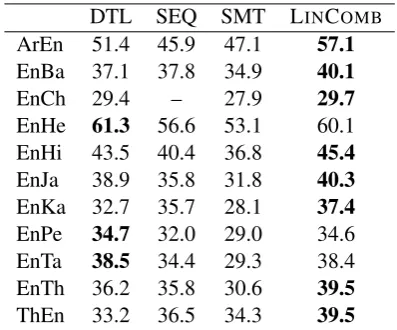
DTL SEQ SMT LINCOMB
[image:3.595.308.507.86.251.2]ArEn 51.4 45.9 47.1 57.1 EnBa 37.1 37.8 34.9 40.1 EnCh 29.4 – 27.9 29.7 EnHe 61.3 56.6 53.1 60.1 EnHi 43.5 40.4 36.8 45.4 EnJa 38.9 35.8 31.8 40.3 EnKa 32.7 35.7 28.1 37.4 EnPe 34.7 32.0 29.0 34.6 EnTa 38.5 34.4 29.3 38.4 EnTh 36.2 35.8 30.6 39.5 ThEn 33.2 36.5 34.3 39.5
Table 1: Transliteration accuracy of DIRECTL+,
SEQUITUR, and SMT on the development sets.
The second set of experiments followed the original design of Yao and Kondrak (2015), in which the supplemental data consists of transliter-ations of a source word in other languages. We ex-tracted the supplemental transliterations from the NEWS 2015 Shared Task training and develop-ment sets for which English was the source lan-guage. For words with no supplemental transliter-ations, we fall back on base DIRECTL+ output.
5 Development Experiments
For our development experiments, we randomly split the provided training sets into ten equal folds, of which eight were used for base system train-ing, and one for base system tuntrain-ing, with the fi-nal fold held out for system combination training. The base models were trained without language-specific preprocessing.
Table 1 shows the results on the provided de-velopment set. DIRECTL+ is the best
perform-ing base system on eight datasets, with SEQUITUR
winning on the remaining three. Although SMT is never the best, it comes second on three tasks. The absolute differences between the three system are within 10%.
Because of its simplicity, we expected LIN
-COMB to serve as the baseline combination
method. However, as shown in Table 1, it per-forms surprisingly well, providing an improve-ment over the best base system on eight out of eleven datasets. An additional advantage of LIN
-COMBis that it requires no training or parameter
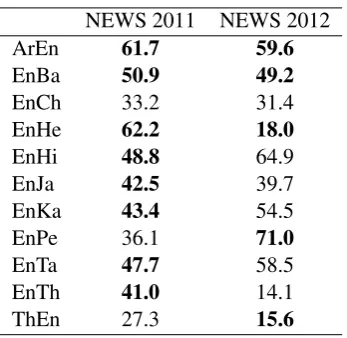
NEWS 2011 NEWS 2012
ArEn 61.7 59.6
EnBa 50.9 49.2
EnCh 33.2 31.4
EnHe 62.2 18.0
EnHi 48.8 64.9
EnJa 42.5 39.7
EnKa 43.4 54.5
EnPe 36.1 71.0
EnTa 47.7 58.5
EnTh 41.0 14.1
ThEn 27.3 15.6
Table 2: Official test results for standard linear combination (LINCOMB).
Some configurations of RERANK did achieve
improvements over the best base system on most sets, but the results were generally below LIN
-COMB. This confirms the observation of
(Bhar-gava and Kondrak, 2012) that LINCOMB is a
strong combination baseline because it utilizes en-tiren-best lists from all systems.
The JOINT approach was unable to improve
over base DIRECTL+ when trained on relatively
small held-out sets. We also tried to leverage the entire training set for this purpose using 10-cross validation. However, that method requires a sub-stantial amount of time and computing resources, and after disappointing initial results on selected datasets, we decided to forgo further experimen-tation. It remains an open question whether the joint generation approach can be made to work as a system combination.
The JOINT approach performs much better in
its original setup, in which additional translitera-tions from other languages are provided as input. However, its effectiveness depends on the amount of supplemental information that is available per source word. The improvement of JOINT over
base DIRECTL+ seems to be correlated with the
percentage of words with at least two supplemen-tal transliterations in the corresponding test set. The language pairs with over 50% of such words in the development set include EnHi, EnKa, and EnTa.
[image:4.595.87.261.84.253.2]6 Test Results
Table 2 shows the official test results for LIN
-COMB. Following our development results, we
designated LINCOMBfor our primary runs except
NEWS 2011 NEWS 2012
DTL JOINT DTL JOINT
EnHe 62.2 61.6 17.4 18.4 EnHi 47.7 53.1 55.8 55.9 EnKa 42.5 44.1 47.5 49.1 EnTa 47.6 48.0 53.7 52.8
EnPe 38.2 – 68.3 –
Table 3: Official test results for standard DI -RECTL+, and for non-standard JOINT with
sup-plemental transliterations.
on EnHe, EnPe, and EnTa, where DIRECTL+ was
chosen instead (see the results in Table 3). Over-all, our standard runs achieved top results on 14 out of 22 datasets.
Table 3 includes our remaining test results. We submitted the JOINT runs on languages that had
promising improvements in the development re-sults. These runs were designated as non-standard even though the supplemental transliterations are from the provided NEWS datasets. For these lan-guages, we also submitted standard DIRECTL+
runs, in order to gauge the improvement obtained by JOINT. The JOINT outperformed base DI -RECTL+ on six out of eight datasets.
We observe many cases where the test results diverge from our development results. It appears that the provided development sets are not always representative of the final sets. To give some ex-amples, the 2012 ArEn test set contains only a sin-gle space, as compared to 878 spaces present on the source side of the corresponding development set, while one-third of the target-side characters in the EnCh development set do not occur at all in the corresponding training set. In addition, the 2011 and 2012 test sets vary wildly in difficulty, as evi-denced by the results in Table 2.
7 Conclusion
[image:4.595.316.501.86.183.2]Acknowledgments
This research was supported by the Natural Sciences and Engineering Research Council of Canada, and the Alberta Innovates – Technology Futures.
References
Aditya Bhargava and Grzegorz Kondrak. 2012. Lever-aging supplemental representations for sequential transduction. In Proceedings of the 2012 Confer-ence of the North American Chapter of the As-sociation for Computational Linguistics: Human Language Technologies, pages 396–406, Montr´eal, Canada.
Aditya Bhargava, Bradley Hauer, and Grzegorz Kon-drak. 2011. Leveraging transliterations from mul-tiple languages. InProceedings of the 3rd Named Entities Workshop (NEWS 2011), pages 36–40, Chi-ang Mai, Thailand.
Maximilian Bisani and Hermann Ney. 2008. Joint-sequence models for grapheme-to-phoneme conver-sion.Speech Communication, 50(5):434–451.
Andrew Finch and Eiichiro Sumita. 2010. Transliter-ation using a phrase-based statistical machine trans-lation system to re-score the output of a joint multi-gram model. InProceedings of the 2010 Named En-tities Workshop, pages 48–52, Uppsala, Sweden.
Sittichai Jiampojamarn, Grzegorz Kondrak, and Tarek Sherif. 2007. Applying many-to-many alignments and hidden markov models to letter-to-phoneme conversion. In Human Language Technologies 2007: The Conference of the North American Chap-ter of the Association for Computational Linguistics; Proceedings of the Main Conference, pages 372– 379, Rochester, New York.
Sittichai Jiampojamarn, Colin Cherry, and Grzegorz Kondrak. 2008. Joint processing and discriminative training for letter-to-phoneme conversion. In Pro-ceedings of ACL-08: HLT, pages 905–913, Colum-bus, Ohio.
Sittichai Jiampojamarn, Aditya Bhargava, Qing Dou, Kenneth Dwyer, and Grzegorz Kondrak. 2009. Di-recTL: a language independent approach to translit-eration. InProceedings of the 2009 Named Entities Workshop: Shared Task on Transliteration (NEWS 2009), pages 28–31, Suntec, Singapore.
Sittichai Jiampojamarn, Colin Cherry, and Grzegorz Kondrak. 2010a. Integrating joint n-gram features into a discriminative training framework. InHuman Language Technologies: The 2010 Annual Confer-ence of the North American Chapter of the Associa-tion for ComputaAssocia-tional Linguistics, pages 697–700, Los Angeles, California.
Sittichai Jiampojamarn, Kenneth Dwyer, Shane Bergsma, Aditya Bhargava, Qing Dou, Mi-Young Kim, and Grzegorz Kondrak. 2010b. Translitera-tion generaTranslitera-tion and mining with limited training re-sources. InProceedings of the 2010 Named Entities Workshop, pages 39–47, Uppsala, Sweden.
Philipp Koehn, Hieu Hoang, Alexandra Birch, Chris Callison-Burch, Marcello Federico, Nicola Bertoldi, Brooke Cowan, Wade Shen, Christine Moran, Richard Zens, Chris Dyer, Ondrej Bojar, Alexan-dra Constantin, and Evan Herbst. 2007. Moses: Open source toolkit for statistical machine transla-tion. InProceedings of the 45th Annual Meeting of the Association for Computational Linguistics Com-panion Volume Proceedings of the Demo and Poster Sessions, pages 177–180, Prague, Czech Republic. Grzegorz Kondrak, Xingkai Li, and Mohammad
Salameh. 2012. Transliteration experiments on Chi-nese and Arabic. In 4th Named Entity Workshop (NEWS), pages 71–75, Jeju, Korea. System paper. Keigo Kubo, Hiromichi Kawanami, Hiroshi
Saruwatari, and Kiyohiro Shikano. 2011. Un-constrained many-to-many alignment for automatic pronunciation annotation. In Asia-Pacific Signal and Information Processing Association Annual Summit and Conference (APSIPA ASC), Xi’an, China.
Najmeh Mousavi Nejad, Shahram Khadivi, and Kaveh Taghipour. 2011. The Amirkabir machine translit-eration system for NEWS 2011: Farsi-to-English task. In2011 Named Entities Workshop, page 91. Franz Josef Och and Hermann Ney. 2003. A
sys-tematic comparison of various statistical alignment models.Computational Linguistics, 29.
Franz Josef Och. 2003. Minimum error rate train-ing in statistical machine translation. In Proceed-ings of the 41st Annual Meeting of the Association for Computational Linguistics, pages 160–167, Sap-poro, Japan, July.
Yoh Okuno. 2012. Applying mpaligner to ma-chine transliteration with Japanese-specific heuris-tics. InProceedings of the 4th Named Entity Work-shop (NEWS) 2012, pages 61–65, Jeju, Korea. Kishore Papineni, Salim Roukos, Todd Ward, and Wei
jing Zhu. 2002. BLEU: a method for automatic evaluation of machine translation. In Proceedings of 40th Annual Meeting of the Association for Com-putational Linguistics, pages 311–318.
Andreas Stolcke. 2002. SRILM - an extensible lan-guage modeling toolkit. InIntl. Conf. Spoken Lan-guage Processing, pages 901–904.
Lei Yao and Grzegorz Kondrak. 2015. Joint generation of transliterations from multiple representations. In