The Diffusion of Tc-99 in Beishan
Granite-Temperature Effect
*
C. Li1,2, Z. Zheng1, X. Y. Liu1, T. Chen1,3, W. Y. Tian1, L. H. Wang1, C. L. Wang1, C. L. Liu1#
1Beijing National Laboratory for Molecular Science, Radiochemistry & Radiation Chemistry Key Laboratory for Fundamental
Science, College of Chemistry and Molecular Engineering, Peking University, Beijing, China
2State Nuclear Security Technology Center, Beijing, China 3North China Electric Power University, Beijing, China
Email: #[email protected]
Received October 12, 2012; revised November 21, 2012; accepted December 13, 2012
ABSTRACT
In the safety assessment of a potential site for high-level radioactive wastes (HLW) disposal, the investigation on the geochemical behaviors of key radionuclides with the possibility for releasing from the potential repository is an impor-tant aspect. Due to the high mobility of technetium under most repository conditions, lots of research works were per-formed to investigate the diffusion of technetium in different potential rocks. In spite of these studies, there remains a lack of data addressing temperature effects. In this paper, the diffusion of 99Tc in Beishan granite at temperatures from 25˚C to 55˚C was studied with laboratory small scale diffusion devices. The experimental data were fitted with a finite difference scheme to get the effective diffusion coefficient (De) of 99
4
TcO. The results indicated that the relationship of De with temperatures could be described as the modified Stokes-Einstein equation, and the formation factor of Beishan granite was constant in the temperature range of 25˚C - 55˚C with the value of (3.91 ± 1.77) × 10−4.
Keywords: Diffusion; Technetium; Beishan Granite; Temperature Effect
1. Introduction
Safety disposal of high-level radioactive wastes (HLW) is a worldwide challenge of nuclear industry. Deep geo-logical disposal is the most acceptable way in isolating the HLW from biosphere. To demonstrate that the wastes can be safely isolated from the biosphere in a long time scale which is needed for the HLW radioactivity decays to natural level, the safety assessment of the geologic repository is an essential task. In the safety assessment of a potential site for HLW disposal, investigation on the geochemical behaviors of key radionuclides with the possibility for releasing from the potential repository is an important aspect. It is well understood that after the placement of HLW into the repository, the wastes will release considerable amount of heat due to the decay of radionucludes in a period of 100 years. The temperature of the HLW container will be rised up to 90˚C [1-3] or
even higher. Naturally, the temperatures of the sur-rounding backfilling materials and the host rock in the near field will also be increased. The rising temperature increases the solubility and diffusion coefficient of con-taminants (radionuclides) in most cases, while lowering the viscosity, density of the groundwater, and the sorp-tion coefficient of radionuclides [4,5]. So that the migra-tion of radionuclides in the near field will be enhanced [6,7]. The effects of temperature on fluid density and viscosity are well understood, and equations describing those effects are readily available [8,9]. In general, tem-perature increase leads to decreasing in both water den-sity and viscoden-sity, which induces buoyant groundwater flow, and faster mass transport [10]. But there remains a lack of data addressing the temperature effects on ra-dionuclide diffusion and migration in natural rock/water systems.
In China, Beishan granite area in Gansu province has been pre-selected as one of the most potential research site for HLW repository [11]. Started from 1985, many research works have been performed in regard to site investigation, geologic survey, groundwater chemistry, core sample drilling, as well as radionuclide transport experiments[12-14]. For example, Lu et al. investigated *The project was jointly supported by the National Natural Science
Foundation of China (Grant No. 10775008, 11075006, 91026010), Research Fund for Ph.D. Program of the Ministry of Education (20060001032), Special Foundation for High-level Waste Disposal (2007-840), the Fundamental Research Funds for the Central Universi-ties, Analysis foundation of Peking University (13-18) and the 111 projects.
the diffusion of 125I− as a surrogate for 129I− in Beishan
granite obtained at 300-m depth by laboratory diffusion experiments, and the results showed that the effective diffusion coefficient ranged from 2.44 × 10⁻¹² to 2.72 × 10⁻¹² m2/s [15]. After this work, Chen et al. investigated the influence of temperature on 125I− diffusion in 600-m
deep Beishan granite, and found that the relationship between the effective diffusion coefficient and tempera- ture could be described by the modified Nernst equation at 27˚C - 50˚C [16]. That was the first effort of our group in temperature effects for radionuclide diffusion. Like 125I, 99Tc is one of the most important fission products in the spent fuels from nuclear power plants, due to its high mobility and long half-life [17-25]. Its diffusion and mi- gration data are important to the data base for perform- ance assessment of the potential geologic repository, while the temperature effect on the diffusion of 99Tc in host rocks has not yet been reported. In this work, the temperature effect on its diffusion in Beishan granite was investigated by through-diffusion method.
2. Experimental
2.1. Materials
A Beishan granite core sample was drilled out in the depth of about 600 m at Beishan area, in Northwest China’s Gansu province, China. The core sample was cut into slices which were 64 mm in diameter and 5 mm in thickness. Another small fraction of the same granite core sample was crushed and sieved by 200 mesh sieves to get granite powder sample, which was used for char-acterization. The mineralogical composition of the gran-ite sample was determined by the XRD method, and the data is given in Table 1. The chemical and elemental
composition of the granite sample which is characterized by an X-ray fluorescence spectrometer (XRFS) (ARL ADVANT XP+, Thermo electron co.) is given in Table 2.
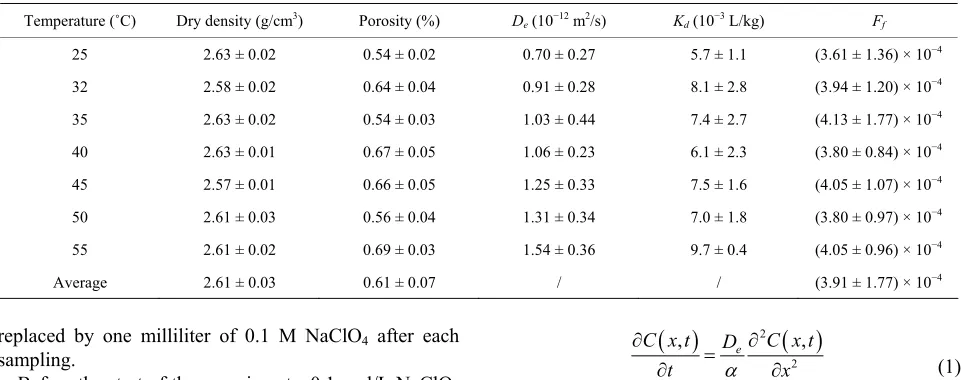
The porosity values of the granite slices were measured by water immersion technique [15-17]. Table 3 shows
the physical parameters of the granite slices. 99Tc was in
the form of NH4TcO4 (Eckert & Ziegler Isotope). All other chemicals were in AR grade and bought from Si-nopharm Chemical Reagent Co.
2.2. Through-Diffusion Experiments
The through-diffusion technique was used to investigate the diffusion of 99Tc in Beishan granite. The diffusion device was described in detail in previous work and is schematically shown in Figure 1. It consisted of a large
source cell (ca. 1800 mL) and a small sample cell (ca. 70 mL). A granite slice (cross section area: 24.9 ± 0.4 cm2; thickness 0.5 cm) was mounted between the two cells. The cells were filled with a 0.1 M NaClO4 solution. The hydraulic heads in the two cells were kept the same dur-ing the experiment. A small amount of 99Tc (ca. 0.02 mCi) was added as TcO4
to the source cell. After
mix-ing for 24 hours, one mL solution was taken from each cell and assayed for 99Tc by liquid scintillation counting (TriCarb 3110 TR, Perkin Elmer) using 10 mL of scintil-lation cocktail (Optiphase Hisafe 2, Perkin Elmer). The counting efficiency of 99Tc was 54.9%. The specific ac-tivity of Tc in the source cell was (5.0 ± 0.1) 102 Bq/L. The one milliliter sample removed from both cells was
Figure 1. Set-up of the diffusion cell. 1: Sealing caps; 2: Sampling cell; 3: Granite slice; 4: Source cell; 5: Stirring bar.
Table 1. Mineralogical composition of 600-m deep Beishan granite (%).
Microcline Albite Biotite Quartz Cordierite Amesite
[image:2.595.311.536.381.529.2]46.14 27.50 15.65 8.50 1.33 0.89
Table 2. Chemical and elemental composition of Beishan granite (%)
SiO2 Al2O3 K2O Fe2O3 CaO Na2O MgO P2O5 TiO2 SrO LOIa
57.78 15.42 6.15 4.07 3.25 2.54 2.12 0.96 0.79 0.13 6.45
O Si Al K Fe Ca Na Mg Px Ti LOIa
43.66 27.01 8.16 5.10 2.85 2.32 1.88 1.28 0.42 0.48 6.45
[image:2.595.56.539.592.727.2]Table 3. Physical parameters of the granite slices.
Temperature (˚C) Dry density (g/cm3) Porosity (%) D
e(10−12 m2/s) Kd(10−3 L/kg) Ff
25 2.63 ± 0.02 0.54 ± 0.02 0.70 ± 0.27 5.7 ± 1.1 (3.61 ± 1.36) × 10−4 32 2.58 ± 0.02 0.64 ± 0.04 0.91 ± 0.28 8.1 ± 2.8 (3.94 ± 1.20) × 10−4
35 2.63 ± 0.02 0.54 ± 0.03 1.03 ± 0.44 7.4 ± 2.7 (4.13 ± 1.77) × 10−4 40 2.63 ± 0.01 0.67 ± 0.05 1.06 ± 0.23 6.1 ± 2.3 (3.80 ± 0.84) × 10−4
45 2.57 ± 0.01 0.66 ± 0.05 1.25 ± 0.33 7.5 ± 1.6 (4.05 ± 1.07) × 10−4 50 2.61 ± 0.03 0.56 ± 0.04 1.31 ± 0.34 7.0 ± 1.8 (3.80 ± 0.97) × 10−4
55 2.61 ± 0.02 0.69 ± 0.03 1.54 ± 0.36 9.7 ± 0.4 (4.05 ± 0.96) × 10−4 Average 2.61 ± 0.03 0.61 ± 0.07 / / (3.91 ± 1.77) × 10−4
replaced by one milliliter of 0.1 M NaClO4 after each sampling.
Before the start of the experiments, 0.1 mol/L NaClO4 solution was added into both the source and the sample cell. The hydraulic heads in the two cells were kept the same by monitoring the water levels in the cells and fresh 0.1 mol/L NaClO4 solution was added when needed. Then a dose (~0.02 mCi) of 99Tc solution was added into the source cell. After stirring for 24 hours, 1.0 mL solu-tion was taken from each cell and mixed with 10.0 mL scintillation cocktail (Optiphase Hisafe 2, Perkin Elmer) for radioactivity measurement with a Liquid Scintillation Counter (Tri-Carb 3110TR, Perkin Elmer). The counting efficiency of 99Tc was 54.9%. The specific activity of 99Tc in the source cell was measured as (5.0 ± 0.1) 102 into each cell. The activity of 99Tc in the sample cell was measured in the same way at a 2-day interval in the first 10 days and in a 4-day interval in the rest of the 81-day experiment.
3. Model Description
As all of our experiments were performed under atmos-pheric condition, 99Tc could not be reduced into lower oxidation state and stayed as during the ex-periment [26,27]. Since the concentration of 99Tc in the sample cell was diluted after each sampling due to the replacement of 1.0 mL water sample with 1.0 mL Na-ClO4 solution, the experimental data were corrected with the method used in our previous work [15,16]. The ra-dioactive decay of 99Tc can be ignored, due to its long half life of 2.1 × 10⁵ y.
99 4
TcO
According to the set up of our experiment, the diffu-sion of radionuclide in the diffudiffu-sion cell could be de-scribed by the decreasing inlet concentration-increasing outlet concentration through-diffusion model (DC-IC) or approximately by the constant inlet concentration-in- creasing outlet concentration through-diffusion model (CC-IC), and the diffusion of 99Tc in the granite can be described as [28,29]:
2
2
, e ,
d
C x t D C x t
t x
K
(1)
where C x t
, [cpm/mL] is the pore water concentra-tion of 99Tc in the granite at the time t [s] and at positionx along the diffusion direction; De [m2/s]is the effective diffusion coefficient of 99Tc in the granite; ε, ρ [kg/dm3] are the porosity and dry bulk density of the granite sam-ple.
According to the experimental set up, Equation (1) subjects to the following initial and boundary conditions [29]:
I.C.
0 0 0, 0 ,, 0
t
x L C x t
C x
(2)
B.C.
0 ,
0 u
u
e x
C t C x t V
D A t x
(3)
,0 d
d
e x L
C t C x t V
D A t x
(4)
where L [m], and A [m2] are the thickness and effective diffusion area of the granite sample, respectively; Vu [m3] and Vd[m3] are the volume of the source and sample cell, respectively; C0 [cpm/mL] is the initial concentration of 99Tc in the source cell.
u
C t [cpm/mL] and Cd
t[cpm/mL] are the concentration of 99Tc in the source and sample cell when the experiment lasts for time t [s], equals to C
0,t and C L t
, in value, respectively. Since u d, the decrease of Cu can be ignored.In order to obtain the effective diffusion coefficient De, the experimental data were fitted with Equation (1) by a finite difference scheme. We assumed:
V V
, 1
,C i j C i j C
t t
(5)
1,
1,
2
C i j C i j C
x x
2
2 2
1, 2 , 1,
C i j C i j C i j C
x x
(7)
Then Equation (1) could be transformed into:
2
2
2
, 1 1,
2 1
1, e
e
e
D t
C i j C i j x
D t
C i j x
D t
C i j x
, (8)
When Δt and Δx are chosen to satisfy the following condition, Equation (8) will have a stable numerical so-lution:
e 2 0.5 D tx
(9)
For each experiment, we got the De and Kd by solving the equation set of Equation (2)-(4), (8)when L, A, Vu, Vd,
[image:4.595.310.537.384.554.2] [image:4.595.59.539.646.734.2]C0 and C t Cd
0 at different temperatures are given. Figure 2 shows the fitting result of one of the diffusionexperiment. Figure 2 indicates that the model fit our
experimental data well.
4. Results and Discussions
The De and Kd values of 99Tc− in Beishan granite at
dif-ferent temperatures are listed in Table 3. The De value
obtained at room temperature is comparable to the data reported in literatures (Table 4) [17,18,30]. The results
show that the Kd values do not significantly change with temperature, but that the De values do. In our previous work, it was found that the relationship between the ef-fective diffusion coefficients of 125I− in the Beishan
gran-ite with temperature could be described by modified Nernst equation [16]. Following the same method to un-derstand the temperature effect of 99Tc, the limit ionic equivalent conductivity of at different tempera-tures was needed. Since there was no such data in the literature, the relation between the De and the tempera-ture of 99Tc should be discussed in a new way.
99 4
TcO
Since the diffusion of a solute in a porous media is re-lated to the tortuosity (τ) and contrictivity (δ) of the pores, the porosity (ε) of the media and the self-diffusion coef-ficient of the solute (Dw) which describes its diffusion behavior in free water [16], the effective diffusion coef-ficient (De) of the solute is described as:
2
e w f
D D F Dw
(10)
As δ and τ is hardly measured individually with ex-periments, the formation factor Ff is carried out to de-scribe the relation between Deand Dw. Ffequls to 2 and only depends on the inner structure of the porous media [31]. According to the explanation of the Brownian motion by Einstein, the self-diffusion coefficient of the solute Dw depends on temperature [32]:
w
D kT (11)
where k [J/K] is the Boltzmann constant, ζ [kg/s] is the friction constant. For a spherical solute particle larger than the particles of the solvent, ζis taken approximately as the friction term in Stokes’ law, ζ = 6πηri, where η
[kg·m−1·s−1]is the viscosity of the solvent and r
i[m] is the radius of the particle of the solute. Then Equation (11) is
Figure 2. Breakthrough curve of the diffusion of 99Tc in Beishan Granite at 40˚C. Solid circles are experimental data and the solid line is the fitting curve with decreasing inlet concentration-increasing outlet concentration through-dif- fusion model.
Table 4. De and Kd of 99TcO4 in Beishan granite in comparison with literature data.
Reported by Granite Conditions De(10−12 m2/s) Kd(L/kg)
This work Beishan granite 0.1 mol·L−1 NaClO4 0.70 ± 0.27 (5.7 ± 1.1) × 10−3
Liu et al. [18] Beishan granite Simulated groundwater (pH = 8.84) 0.499 - 0.943 0.118 - 0.315
Liu et al. [17] Chinese granite Groundwater 1.4 -
Bradbury et al. [30] English granite KNO3 0.7 -
transformed into Stokes-Einstein equation:
6π
w
D kT ri (12) In this work, 99Tc was in the form of 99
4
TcO, which could be taken as a spherical particle (close to the size of I−, r = 2.16Å) and definitely larger than the water
mo-lecular (r = 1.4Å). Therefore the Stokes-Einstein equa-tion can be used to describe the diffusion of 4
99TcO in
water. Substituting Equation (12) into Equation (10), the following relation between De and temperature is ob-tained:
6π
6π
e f i f
i
k T
D F kT r F
r
(13)
In Equation (13), the viscosity of water η is changed with temperature. The data of ηin the temperature range in this study are taken from Lange’s handbook of chem-istry, 13th edition and listed in Table 5 [33]. The
ex-perimental data showed that the ratio of De and T/ηwas constant (see Figure 3), which suggested that the for-
mation factor Ff of the Beishan granite was constant in the temperature range. H. Sato et al. measured the Dw value of 99
4 at 25˚C as (1.95 ± 0.56) × 10−9 m2/s
[34]. From Equation (12), the Dw value of
TcO
99 4
TcO at the corresponding temperature was calculated. So Ff of Beishan granite could be derived by dividing De with Dw. The results were listed in Table 3 and shown in Figure 4. Figure 4 indicated that the formation factor of Beishan
granite was nearly constant in the temperature range. This was in a good agreement with our previous work with 125I− [16]. The F
fvalues we obtained in this work are comparable to the literature data (Table 6) [16,35],
but higher than our previous work. The difference in Ff may due to the difference in De values of 99
4 TcO ob-tained in this work (7.4 × 10⁻¹³ - 1.4 × 10⁻¹² m2/s) to 125I−
obtained in our previous work (3.4 × 10⁻¹³ - 5.3 × 10⁻¹³ m2/s), which was caused by the characteristics of the granite slices and the different diffusion behaviors of
and 125I− in the granite.
99 4
TcO
Table 5. Viscosity of water at different temperatures [33].
Temperature (˚C) Viscosity (mPa·s)
25 0.8903
32 0.7679a
35 0.7190
40 0.6526
45 0.5972
50 0.5468
55 0.5042
aCalculated from the viscosity values at other temperatures by fitting the viscosity-temperature curve.
Figure 3. Effective diffusion coefficient De of 99Tc in Beishan
granite as a function of T/η.
Figure 4. Formation factor of Beishan granite at the tem-peratures in this work.
Table 6. Formation factors of Beishan granite compared with literature data.
Reported by Granite Log Ff
Forsmark, granodiorite −3.58 ± 0.31
Simpervarp, granite −4.52 ± 0.91
Laxemar, granite −3.86 ± 0.31
Sweden, granite −4.06 ± 0.44
Sweden, crystalline rock −4.15 ± 0.45
International, crystalline rock −3.72 ± 0.47 SKB [35]
Forsmark, granodiorite −3.58 ± 0.31
Our previous work [16] Beishan granite −3.99
This work Beishan granite −3.41 ± 0.26
po-tential geologic repository. The enhanced diffusion of in Beishan granite at higher temperatures were come from the increasing of Dw of .
99 4
TcO
99 4
TcO
5. Conclusion
The effect of temperature on diffusion of 99 4 TcO in Beishan granite was studied using the through-diffusion technique. It was indicated that the effective diffusion coefficient of 99
4 in Beishan granite was linearly
related with T/η in the temperature range of 25˚C - 55˚C. The formation factor of Beishan granite was constant in the temperatures range, which suggested that the inner structure of Beishan granite did not change in the tem-perature range. The result of this work was in good agreement with our previous work except that the value of Ff is larger. The difference of Ffcould be considered as experiment uncertainty. The result indicated Beishan granite was stable below 55˚C and appropriate to be a host rock.
TcO
REFERENCES
[1] D. G. Bennett and R. Gens, “Overview of European Con-cepts for High-Level Waste and Spent Fuel Disposal with Special Reference Waste Container Corrosion,” Journal of Nuclear Materials, Vol. 379, No. 1-3, 2008, pp. 1-8. doi:10.1016/j.jnucmat.2008.06.001
[2] H. Hökmark and B. Fälth, “Thermal Dimensioning of the Deep Repository,” 2003, p. 83.
[3] T. Tarandi, “Calculated Temperature Field in and around Repository for Spent Nuclear Fuel,” KBS Teknisk Rap-port, Vol. 83, No. 22, 1983, p. 32.
[4] B. B. Looney and R. W. Falta, “Vadose Zone: Science and Technology Solutions,” Battelle Press, Columbus, 2000.
[5] J. R. Boulding and J. S. Ginn, “Practical Handbook of Soil, Vadoze Zone and Groundwater Contamination, As-sessment, Prevention, and Remediation,” A. F. Lewis, New York, 2004.
[6] F. G. Sanchez, L. R. Van Loon, T. Gimmi, et al., “Self- Diffusion of Water and Its Dependence on Temperature and Ionic Strength in Highly Compacted Montmorillonite, Illite and Kaolinite,” Applied Geochemistry, Vol. 23, No. 12, 2008, pp. 3840-3851.
doi:10.1016/j.apgeochem.2008.08.008
[7] A. V. Simonyan, H. Behrens and S. Dultz, “Diffusive Transport of Water in Porous Feldspars from Granitic Saprolites: In Situ Experiments Using FTIR Spectros-copy,” Geochimica et Cosmochimica Acta, Vol. 73, No. 23, 2009, pp. 7019-7033. doi:10.1016/j.gca.2009.08.031 [8] E. O. Holzbecher, “Modeling Density-Driven Flow in
Porous Media: Principles, Numerics, Software,” Springer, Berlin, 1998. doi:10.1007/978-3-642-58767-2
[9] D. A. Nield, “Convection in Porous Media,” Springer, Berlin, 2006.
[10] M. M. Krol, B. E. Sleep and R. L. Johnson, “Impact of
Low-Temperature Electrical Resistance Heating on Sub-surface Flow and Transport,” Water Resources Research, Vol. 47, No. 5, 2011.
[11] G. Q. Xu, J. Wang, Y. X. Jin, et al., “Progress in Site Selection for China’s High Level Radioactive Waste Re-pository,” Secondary Progress in Site Selection for China’s High Level Radioactive Waste Repository, 1995. [12] M. Z. Min, X. Z. Luo, J. Wang, et al., “Sorption Behavior
of U(VI), U-234(VI) and U-238(VI) onto Fracture-Filling Clays in Beishan Granite, Gansu: Application to Select-ing the Site of High-Level Radwaste Repository in China,” Science in China Series D: Earth Sciences, Vol. 48, No. 10, 2005, pp. 1649-1655. doi:10.1360/03yd0475 [13] Z. X. Sun and Z. S. Zhang, “Geochemical Modeling of
Water-Granite Interaction in Beishan Area, NW-China,”
Geochimica et Cosmochimica Acta, Vol. 72, No. 12, 2008, pp. A917-A917.
[14] Y. H. Dong, G. M. Li and M. Li, “Numerical Modeling of the Regional Ground Water Flow in Beishan Area, Gansu Province,” Chinese Science Bulletin, Vol. 54, No. 17, 2009, pp. 3112-3115. doi:10.1007/s11434-009-0344-7 [15] C. J. Lu, C. L. Liu, T. Chen, et al., “Determination of the
Effective Diffusion Coefficient for 125I(−) in Beishan Granite,” Radiochimica Acta, Vol. 96, No. 2, 2008, pp. 111-117. doi:10.1524/ract.2008.1469
[16] T. Chen, M. Sun, C. Li, et al., “The Influence of Tem-perature on the Diffusion of (125)I(−) in Beishan Gran-ite,” Radiochimica Acta, Vol. 98, No. 5, 2010, pp. 301- 305. doi:10.1524/ract.2010.1717
[17] C. L. Liu, X. Y. Wang, S. S. Li, et al., “Diffusion of Tc-99 in Granite: A Small Scale Laboratory Simulation Experiment,” Radiochimica Acta, Vol. 89, No. 10, 2001, pp. 639-642. doi:10.1524/ract.2001.89.10.639
[18] D. J. Liu, X. H. Fan, J. Yao, et al., “Diffusion of Tc-99 in Granite under Aerobic and Anoxic Conditions,” Journal of Radioanalytical and Nuclear Chemistry, Vol. 268, No. 3, 2006, pp. 481-484. doi:10.1007/s10967-006-0194-6 [19] D. Q. Cui and T. Eriksen, “Reactive Transport of Sr, Cs
and Tc through a Column Packed with Fracture-Filling Material,” Radiochimica Acta, Vol. 82, 1998, pp. 287- 292.
[20] H. Vinsova, P. Vecernik and V. Jedinakova-Krizova, “Sorption Characteristics of Tc-99 onto Bentonite Mate-rial with Different Additives under Anaerobic Condi-tions,” Radiochimica Acta, Vol. 94, No. 8, 2006, pp. 435- 440. doi:10.1524/ract.2006.94.8.435
[21] W. Um and R. J. Serne, “Sorption and Transport Behav-ior of Radionuclides in the Proposed Low-Level Radioac-tive Waste Disposal Facility at the Hanford Site, Wash-ington,” Radiochimica Acta, Vol. 93, No. 1, 2005, pp. 57-63. doi:10.1524/ract.93.1.57.58295
[22] X. K. Wang, X. L. Tan, Q. L. Ning, et al., “Simulation of Radionuclides Tc-99 and Am-243 Migration in Com-pacted Bentonite,” Applied Radiation and Isotopes, Vo. 62, No. 5, 2005, pp. 759-764.
doi:10.1016/j.apradiso.2004.10.012
of Natural Minerals,” Radiochimica Acta, Vol. 44-45, 1988, pp. 183-186.
[24] D. W. Oscarson, H. B. Hume and J. W. Choi, “Diffusive Transport in Compacted Mixtures of Clay and Crushed Granite,” Radiochimica Acta, Vol. 65, No. 3, 1994, pp. 189-194.
[25] Z. Szanto, E. Svingor, M. Molnar, et al., “Diffusion of H-3, Tc-99, I-125, Cl-36 and Sr-85 in Granite, Concrete and Bentonite,” Journal of Radioanalytical and Nuclear Chemistry, Vol. 252, No. 1, 2002, pp. 133-138.
doi:10.1023/A:1015256308843
[26] K. H. Lieser and C. Bauscher, “Technetium in the Hy-drosphere and in the Geosphere. 1. Chemistry of Techne-tium and Iron in Natural-Waters and Influence of the Re-dox Potential on the Sorption of Technetium,” Radio-chimica Acta, Vol. 42, No. 4, 1987, pp. 205-213. [27] I. Alliot, C. Alliot, P. Vitorge, et al., “Speciation of
Tech-netium(IV) in Bicarbonate Media,” Environmental Sci-ence & Technology, Vol. 43, No. 24, 2009, pp. 9174- 9182. doi:10.1021/es9021443
[28] K. Skagius and I. Neretnieks, “Porosities and Diffusivi-ties of Some Nonsorbing Species in Crystalline Rocks,”
Water Resources Research, Vol. 22, No. 3, 1986, pp. 389-398. doi:10.1029/WR022i003p00389
[29] M. Zhang and M. Takeda, “Theoretical Evaluation of the
Through-Diffusion Test for Determining the Transport Properties of Geologic Materials,” WM’05 Conference, Tucson, 27 February-3 March 2005.
[30] M. H. Bradbury and A. Green, “Measurement of Impor-tant Parameters Determining Aqueous Phase Diffusion Rates through Crystalline Rock Matrices,” Journal of Hydrology, Vol. 82, No. 1-2, 1985, pp. 39-55.
doi:10.1016/0022-1694(85)90045-9
[31] K. B. Harvey, “Measurement of Diffusive Properties of Intact Rock,” 1996, p. 97.
[32] R. Mills and V. M. M. Lobo, “Self-Diffusion in Electro-lyte Solutions: A Critical Examination of Data Compiled from the Literature,” 1989, p. 3.
[33] J. A. Dean, “Lange’s handbook of chemistry,” 13th Edi-tion, McGraw-Hill, New York, 1985.
[34] H. Sato, M. Yui and H. Yoshikawa, “Ionic Diffusion Co- efficient of Cs+, Pb2+, Sm3+, Ni2+, 2
4
Se and TcO4 in
Free Water Determined from Conductivity Measure-ments,” Journal of Nuclear Science and Technology, Vol. 33, No. 12, 1996, pp. 950-955.
doi:10.1080/18811248.1996.9732037