Run-time Validation of Behavioral Adaptations
Nicolás Cardozo
1, Laurent Christophe
2, Coen De Roover
3,2, Wolfgang De Meuter
21Future Cities, DSG, Trinity College Dublin - College Green 2, Dublin 2, Ireland 2
Software Languages lab, Vrije Universiteit Brussel - Pleinlaan 2, 1050 Brussels, Belgium 3
Osaka University - 1-5 Yamadaoka, Suita, Osaka 565-0871, Japan
[email protected], [email protected], [email protected], [email protected]
ABSTRACT
Context-oriented programming enables the composition of behavioral adaptations into a running software system. Be-havioral adaptations provide the most appropriate behavior of a system when their contexts are activated or deactivated, according to the situations at hand in the system’s execu-tion environment. Behavioral adaptaexecu-tions can be defined by third-party vendors or even be acquired at run time. As the systems grows in complexity it becomes increasingly difficult to reason about every possible runtime adaptation. There-fore, behavioral adaptations that lead to erroneous states or compromise the system’s security might be difficult to detect statically. To prevent such undesired behavioral adaptations from happening, we introduce a run-time correctness verifi-cation approach. Our approach uses a symbolic execution engine to reason about the reachable states of the system, whenever contexts are activated or deactivated. Context ac-tivation and deacac-tivation requests are allowed depending on the presence of erroneous states within reachable states. Our approach is a step forward to ensure the run-time correctness of software systems that adapt their behavior dynamically.
Categories and Subject Descriptors
D.1.5 [Programming Techniques]: Object-oriented Pro-gramming; D.2.4 [Programming Languages]: Software/Pro-gram Verification
General Terms
Languages, VerificationKeywords
Context-oriented programming, Correctness, Symbolic exe-cution, Validation
1.
INTRODUCTION
Permission to make digital or hard copies of all or part of this work for personal or classroom use is granted without fee provided that copies are not made or distributed for profit or commercial advantage and that copies bear this notice and the full citation on the first page. To copy otherwise, to republish, to post on servers or to redistribute to lists, requires prior specific permission and/or a fee.
COP’14, July 28 - August 01 2014, Uppsala, Sweden Copyright 2014 ACM 978-1-4503-2861-6/14/07 ...$15.00. http://dx.doi.org/10.1145/2637066.2637071.
Current day software systems are able to adapt their be-havior at run time according to the situations in their sur-rounding execution environment. Adaptive software systems can compose/withdraw application behavior based on infor-mation gathered from a sensor network or previous uses of the system. Context-Oriented Programming (COP) [4] is a programming paradigm that enables run-time adaptations of a software system. COP provides language level abstrac-tions to define and compose fine-grained adaptaabstrac-tions in a running system, respectively, as contexts and their associ-ated behavioral adaptations.
Run-time adaptations, as proposed in COP, are modu-lar and localized, enabling the extension and modification of existing third-party programs and frameworks [2]. As a consequence of the offered flexibility in modifying the be-havior, multiple vendors can propose variations to a given service by adapting its basic behavior. Note that if compo-sition and withdrawal of run-time adaptations is not dealt with carefully, it may lead to incorrect states of the system or even security breaches. On the one hand, adaptations of a service may not respect the API offered by the service, or depend on other transient services (i.e., provided by other adaptations). These lead to incorrect states of the system either exhibiting incorrect computations or causing the ap-plication to be interrupted abruptly. On the other hand, security of the system may be compromised with the intro-duction of adaptations that, for example, bypass security checks of the system (e.g.,login–password verification).
This paper represents the first use of a run-time symbolic execution engine for verifying the correctness of behavioral adaptations.
2.
MOTIVATION: MULTI-VENDOR
POSI-TIONING SERVICE
This section motivates the need for validating behavioral adaptations at run-time. To this end, we present a proof-of-concept application for mobile devices. The application consists of a geo-positioning service that can be extended or modified by different vendors. We develop the application using the Ambience [5] COP language.
The multi-vendor positioning service is an application that uses the GPS coordinate system for devices that can receive Global Navigation Satellite (GNS) signals. The service is provided through a simple API that consists of a function for displaying and a function for acquiring the current position. Both interacting functions are depicted in Snippet 1. The positioning service should only be available if there is an en-abled GNS receiver, thus the service is provided as an adap-tation rather than as a standalone application. An adapta-tion is defined by means of the(defcontext ctx)construct, which defines a context object, and the(with−context (ctx )...) construct, which defines the behavioral adaptations associated with that context object. The definition of the GPS adaptation including its context object and associated behavioral adaptations is shown in Snippet 2.
1(defmethod d i s p l a y - p o s i t i o n ( pos )
2 (format t " C u r r e n t p o s i t i o n is (~ ,3 f , ~ ,3 f ) ~% " ( car res ) ( cdr res ) ) )
3
4(defmethod g e t - p o s i t i o n (( u s e r @ p e r s o n ) )
5 ( t h r o w ’ n o - p o s " No a n t e n n a " ) )
Snippet 1: Basic system behavior with no GNS antenna enabled.
1 (defcontext @ g p s - a n t e n n a )
2
3 (with−context ( @ g p s - a n t e n n a )
4 ; ; gps o b j e c t d e f i n i t i o n
5 (defproto @ g p s - d e v i c e ( c l o n e @ o b j e c t ) )
6 (defmethod l o n g i t u d e (( gps @ g p s - d e v i c e ) ) . . . )
7 (defmethod l a t i t u d e (( gps @ g p s - d e v i c e ) ) . . . )
8 (defparameter * gps * ( c l o n e @ g p s - d e v i c e ) ) 9
10 (defmethod g e t - p o s i t i o n (( u s e r @ p e r s o n ) ) 11 (l e t ( p o s x ( x u s e r ) )
12 ( p o s y ( y u s e r ) )
13 ( l o g - m e s s a g e : i n f o " U s e r ~ a p o s i t i o n (~ ,3 f , ~ ,3 f ) ~% " ( n a m e u s e r ) p o s x p o s y ) ’
14 (cons p o s x p o s y ) ) )
Snippet 2: GPS positioning adaptation.
Three different vendors decide to extend the existing ser-vice with their own specialized functionality.Vendor1offers a service, similar to the GPS adaptation, optimized for the European market by taking advantage of the Galileo posi-tioning system. Whenever users are found to be in a Euro-pean country, they will query this specialized service instead. Besides the way of acquired positions from the GNS satel-lite,Vendor1uses its own format for the retrieval of the po-sition (i.e.,using a@locationobject), but reuses the display
functionality offered by the original service. This service, as shown in Snippet 3, is offered in form of the adaptation characterized by the@galileocontext object.
1(with−context ( @ g a l i l e o )
2 (defmethod g e t - p o s i t i o n (( u s e r @ p e r s o n ) )
3 (l e t ( loc ( c l o n e @ l o c a t i o n ) ) )
4 (s e t f ( x - p o s loc ) ( l a t i t u d e * g a l i l e o * u s e r ) )
5 (s e t f ( y - p o s loc ) ( l o n g i t u d e * g a l i l e o * u s e r ) )
6 loc ) )
Snippet 3: Behavioral adaptation of Vendor1.
Note that theget-positionbehavioral adaptation associ-ated with the @galileocontext does not respect the inter-action with the original display-positionbehavior, defined in Snippet 1. The interaction between these two methods yields an error when trying to use thecarandcdrprimitives on the object returned byget-position.
Vendor2enhances the original service by providing an ap-proximation to the positioning service whenever the GPS an-tenna is not available (e.g.,inside a building). This function-ality is enabled in the@compasscontext, whenever a digital compass is available in the device. The introduced behav-ioral adaptation reuses previous calculations of the position (using the GPS adaptation) to give an approximated posi-tion of the user based on its direcposi-tion and speed. Snippet 4 shows the definition of theget-positionbehavioral adapta-tion associated with the@compasscontext.
1(with−context ( @ c o m p a s s )
2 (defproto @ c o m p a s s ( c l o n e @ o b j e c t ) )
3 (defmethod d i r e c t i o n (( c o m p @ c o m p a s s ) ) . . . )
4 (defparameter * c o m p a s s * ( c l o n e @ c o m p a s s ) )
5
6 (defmethod g e t - p o s i t i o n (( u s e r @ p e r s o n ) )
7 ( if (or (equal ( x c o o r d u s e r ) nil ) (equal ( y c o o r d u s e r ) nil ) )
8 ( t h r o w ’ n o - i n i t i a l - p o s " No i n i t i a l p o s i t i o n " )
9 (cons ( l a t i t u d e ( d i r e c t i o n * c o m p a s s *) u s e r ) ( l o n g i t u d e ( d i r e c t i o n * c o m p a s s *) u s e r ) ) ) ) )
Snippet 4: Behavioral adaptation forVendor2.
Unlike for Vendor1, this behavioral adaptation respects the interaction between thedisplay-positionandget-position
methods. However, for the successful execution of the in-troduced behavioral adaptation, the @gps-antenna context behavioral adaptations are required to have been used previ-ously. This creates a fragile dependency on the@gps-antenna
context. Execution of the system when the@compasscontext is active may or may not lead to errors.
Finally,Vendor3has some high-profile clients, whose po-sition should never be disclosed. With this in mind,Vendor3
is required to offer a privacy mode adaptation to a subset of its users. In this mode, characterized by the @privacy con-text, information must not be leaked out of the system. The behavioral adaptations associated with the @privacy
with the@privatecontext.
1(with−context ( @ p r i v a c y )
2 (defmethod d i s p l a y - p o s i t i o n ( pos )
3 ( r e s e n d )
4 ( t h r o w ’ n o - p o s " P o s i t i o n is not a v a i l a b l e " ) )
5
6 (defmethod l o g - m e s s a g e ( a r g s )
7 ( t h r o w ’ p r i v a t e - l o g g i n g " P r i v a t e i n f o r m a t i o n l e a k i n g " ) ) )
Snippet 5: Behavioral adaptation for Vendor3.
The above examples demonstrate that an adaptation’s as-sumptions about available services and how they interact may not always be satisfied at run-time (e.g., interaction between the @compass and @gps-antenna contexts). There-fore, behavioral adaptations must be validated at run time before they are composed with the system; this with the objective of avoiding errors.
3.
CORRECTNESS OF BEHAVIORAL
ADAP-TATIONS
This section presents our approach for the validation of correctness of fine-grained behavioral adaptations as pro-posed by the COP paradigm. We define a behavioral adap-tation A to bevalid if and only if, for system S at state e, afterAis composed with the system, then the composed adapted systemS ◦ Adoes not reach a statee0wheree0is an
error. Our approach is based on Kusasa, a run-time sym-bolic execution engine, which over-approximates reachable states at context activation time for ensuring correctness.
3.1
Symbolic Execution
Before diving into our proposed approach, we introduce the basic notions of symbolic execution. Symbolic execution is a program analysis technique that traverses the source code of a program to generate constraints that should be satisfied, in order to reach specific points in the program during its concrete execution. Using constraint solvers such as Z31 or CVC4,2 one can generate the inputs that would lead the execution to the targeted point. Symbolic execu-tion can be used for many purposes, such as bug detecexecu-tion, program verification, debugging, maintenance, and fault lo-calization [3].
Static symbolic execution involves executing the program with some values as symbols that range over a set of con-crete values. The objective of static symbolic execution is to explore the tree of all possible computation branches a program can have [7]. This exploration approach has as drawback that it does not scale to large systems since the number of feasible paths is subject to combinatorial explo-sion [1].
Dynamic symbolic execution involves instrumenting a pro-gram to record symbolic constraints while it is concretely executed. A prominent application of dynamic symbolic ex-ecution is automatic test generation where test inputs are generated to maximize coverage. In automatic test genera-tion, symbolic constraints are used to generate new inputs that would lead the execution to unexplored areas.
1http://z3.codeplex.com/ 2
http://cvc4.cs.nyu.edu/web/
Kusasa is a novel interpreter that executes a program by interleaving concrete execution with static symbolic explo-ration. During the static symbolic exploration phases of the system, Kusasa generates a tree of future computations starting from the current concrete execution point. When concrete execution is resumed, Kusasa moves from the root of the computation tree to one of its leaf nodes by resolving symbolic constraints and performing buffered input/output actions.
Unlike traditional static symbolic execution, Kusasa does not attempt to explore all possible computation paths in their entirety. In fact the symbolic exploration can be param-eterized to restrict the exploration space.
3.2
Run-time Validation of Behavioral
Adap-tations
We now present our approach for validating behavioral adaptations at run-time. We consider validation of an active process of the run-time system to be performed whenever an adaptation is requested —rather than after adaptations have been composed.
We integrate Kusasa as the execution engine of the Ambi-ence COP language. Specifically, to verify the correctness of adaptations we choose to trigger the Kusasa symbolic explo-ration phase at context activation time —that is, every time a context is requested for activation or deactivation. We propose the following extension of the constructs for con-text activation and deactivation to interact with Kusasa:
(a c t i v a t e ctx c t x - l i s t s a f e t y d e p t h s p a n ) (deactivate ctx c t x - l i s t s a f e t y d e p t h s p a n )
The purpose of this extension is to couple validation through symbolic execution with the run-time activation of contexts, and hence, the dynamic composition of their associated be-havioral adaptations. Table 1 details the different parame-ters to the (de)activation constructs.
Parameter Default Description
ctx Context to be (de)activated.
ctx-list nil List of alternative contexts providing similar behavioral adaptations, in case (de)activatingctxfails.
safety ’none A symbol specifying the safety policy.
depth 0 An integer indicating the targeted depth of the computation tree.0means the exploration stop only at final states.
span 0 A time span (in milliseconds) specify-ing the lease Kusasa has for the sym-bolic exploration. 0means there is no time threshold.
Table 1: Activation/deactivation parameters API.
Every time a (de)activation is requested, the symbolic ex-ploration phase of Kusasa is triggered to explore the future of the execution from the current execution state. First, Kusasa symbolically explores the execution paths correspond-ing to the (de)activation ofctx. Then it explores the
Thedepthparameter represents the targeted depth of each computation tree —that is, how many steps into the future should be explored. Thespan parameter defines the maxi-mum time span Kusasa should take for exploring the gener-ated paths. Thespanparameter is important since the size of computation trees may grow exponentially with their depth. Note that Kusasa equitably distributes the time to investi-gate each context (de)activation; taking span/(|ctx-list|+ 1) for expanding each computation tree.
We define three main policies to assess when the adapta-tion of the system leads to a correct state: (1)none: always allow the context switching, this is introduced to support the original (de)activate semantics. (2)strict: all computation paths must be safe —that is, the computation tree must be error-state free. (3)lenient: at least one computation path must be safe —that is, at least one branch of the computa-tion tree must be error-state free. Independently from these policies, we also allow the programmer to specify that the targeted depth must be reached (i.e.,the time span is not used). Table 2 depicts the available safety policies.
For each safety policy, we interpret the response of Kusasa. For instance, a positive answer to a context activation using thestrict-completepolicy means that the computation tree generated by Kusasa is error free. Additionally, we know that each branch of the generated exploration tree either containsdepthsteps, or leads to a final success state. This means the nextdepthcomputation steps are safe.
There are three possible outcomes at the end of the Kusasa’s symbolic exploration:
• The contextctxrequested for (de)activation respects the specified safety policies and it is effectively (de)activated.
• The context ctx requested for (de)activation breaks the
safety policy but one of the alternative contexts passes it. In case of activation, the best fallback adaptation that is safe will be activated. In the case of deactivation, the context is deactivated, and the best fallback adaptation that is safe is activated in its place.
• None of the given contexts satisfies the safety policy, thus no context is effectively (de)activated.
Note that the decision in the latter two cases to whether an alternative context is (de)activated still complies with the intention of adaptive systems. Since the desired adaptations (and its possible alternatives) are unsafe, the most appropri-ate behavior of the system would be not to compose unsafe adaptations. The role of the safety policies in the process is to dictate how conservative is the approach. For example, the use of thestrictpolicy requires all computation path of the context to be (de)activated to be safe. If the condition is not satisfied, the execution of the system proceeds as if no context (de)activation was requested. In the following section we demonstrate how this process is used to validate different context activation situations in the multi-vendor positioning service.
4.
EVALUATION
We evaluate the usefulness of our approach by demon-strating that the verification of behavioral adaptations at context activation time can help to prevent run-time errors of the system. To this end, we focus on three situations of the multi-vendor positioning service example and observe
the behavior of our analysis for each of them. (1) The ac-tivation of the@galileocontext using the’strictpolicy. r (2) The activation of the@compasscontext using the’lenient
policy. (3) The activation of the @private context using a time span with the’strictpolicy.
(1) Galileo context.
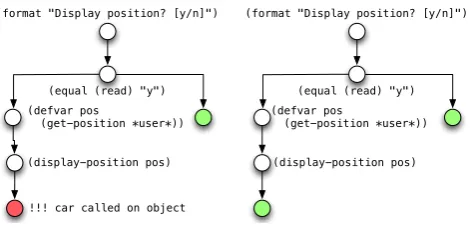
In the first situation, described in Snippet 6, the user is asked whether he wants the position to be displayed. If the response is affirmative, the position is retrieved and displayed. Given that the user’s profile signals the posi-tion to be in Europe,Vendor1’s service should be available to use the behavioral adaptations associated with context
@galileo. Unfortunately, since the behavioral adaptation is inconsistent with the system’s API, activating@galileowill lead to an error and it should be denied. Nonetheless, the context activation defines a fallback mechanism (Line 3 in Snippet 6). In case@galileocannot be activated, then the activation of@gps-antennais evaluated.
1(defmethod m a i n ()
2 ... ; ; get u s e r i n f o r m a t i o n
3 (a c t i v a t e @ g a l i l e o (l i s t @ g p s - a n t e n n a ) ’ s t r i c t )
4 (format " D i s p l a y p o s i t i o n ? [ y / n ] " )
5 (when (equal (read) " yes " )
6 (defvar pos ( g e t - p o s i t i o n * u s e r *) ) 7 ( d i s p l a y - p o s i t i o n pos ) ) )
Snippet 6: Situation to active the@galileocontext.
Upon activation request (Line 3), the execution of the system is paused, triggering the symbolic exploration phase. Kusasa first investigates the activation of the@galileo con-text, generating the left computation tree of Figure 1. This tree leads to an error state from calling the car primitive on a location object returned by the get-position behav-ioral adaptation. Since the activation of the context was requested using the ’strict safety policy, this context ac-tivation is rejected. Subsequently, Kusasa investigates the activation of@gps-antenna. The generated computation tree (right tree of Figure 1), being free of error states, results in the activation of the@gps-antennacontext.
(format "Display position? [y/n]")
(equal (read) "y") (defvar pos
(get-position *user*))
(display-position pos)
!!! car called on object (format "Display position? [y/n]")
(equal (read) "y") (defvar pos
(get-position *user*))
[image:4.595.320.556.509.623.2](display-position pos)
Figure 1: Kusasa generated computations trees: left(right) tree generated from the activation of @galileo(@gps-antenna).
(2) Compass context.
Safety policy Definition Result Guarantee (depth:=n)
none Always satisfied Yes None
No Not applicable
strict Allcomputation paths are safe Yes None
No An errormight happen in maximumnsteps
lenient Onecomputation path is safe Yes None
No An errorwill happen in maximumnsteps
strict-complete Allcomputation paths are safe and the tar-geted depth is reached
Yes The nextnstepswill be safe
No An errormight happen in maximumnsteps
lenient-complete Onecomputation path is safe and the tar-geted depth is reached
Yes The nextnstepsmight be safe
[image:5.595.321.552.475.543.2]No An errorwill happen in maximumnsteps
Table 2: Available safety policies and interpretation of their results.
calculated using the@gps-antennacontext. Note that to dis-play the position some arithmetic manipulation is done ac-cording to the sensor input and the device’s screen (Line 9 in Snippet 7). Vendor2 notices that the @compass behav-ioral adaptation fails from time to time, but the reason for this failure is unknown. As a consequence, activation of the
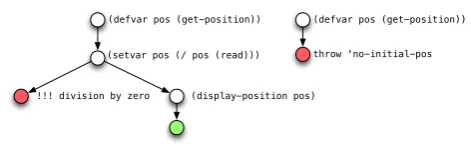
@compass context should only happen when it is safe. In this situation, using the’strictsafety policy is too restric-tive because the symbolic exploration signals the division at Line 9 as a failure if thereadmethod returns zero. Instead using the’lenientsafety policy for activation would result in the correct activation of the context (Line 7 in Snippet 7) since it is only needed for one of the generated paths to reach a correct state.
1(defmethod m a i n ()
2 ... ; ; get u s e r and a n t e n n a i n f o r m a t i o n
3 (when * a n t e n n a *
4 (a c t i v a t e @ g p s - a n t e n n a )
5 ( g e t - p o s i t i o n * u s e r *)
6 (deactivate @ g p s - a n t e n n a ) )
7 (a c t i v a t e @ c o m p a s ’ l e n i e n t ) 8 (defvar pos ( g e t - p o s i t i o n ) )
9 ( s e t v a r pos (/ pos (read) ) )
10 ( d i s p l a y - p o s i t i o n pos ) )
Snippet 7: Situation to activate the@compasscontext.
As in the previous case, execution is paused upon con-text activation. In this situation Kusasa generates one of the computation trees depicted in Figure 3. If there is a GPS antenna nearby, Kusasa produces the left tree and the
@compasscontext is activated since the programmight suc-ceed. If there is no GPS antenna, Kusasa produces the right tree and the@compasscontext is not activated.
throw 'no-initial-pos (defvar pos (get-position))
(setvar pos (/ pos (read))) (defvar pos (get-position))
(display-position pos) !!! division by zero
Figure 2: Kusasa generated computations trees: the left tree is generated when a GPS antenna is avail-able, the right tree is generated otherwise.
(3) Privacy context.
Our final situation concerns the behavioral adaptations associated with the@privacycontext. At first, the@privacy
context is activated without a safety property. Kusasa then investigates which of the context (@gps-antennaor@galileo) is safe to activate. However, many statements may remain to be processed in the program. Hence, the symbolic explo-ration is explicitly restricted to last 1 second.
1(defmethod m a i n ()
2 ... ; ; get u s e r i n f o r m a t i o n
3 (a c t i v a t e @ p r i v a c y )
4 (a c t i v a t e @ g p s - a n t e n n a @ g a l i l e o ’ s t r i c t 0 1 0 0 0 )
5 (defvar pos ( g e t - p o s i t i o n * u s e r *) )
6 . . . ) ; ; m a n y s a f e s t a t e m e n t s
Snippet 8: Situation to activate the@privacycontext.
The first explored path corresponds to the @gps-antenna
context. This exploration quickly finds an error state due to the call tolog-message(Snippet 2), which is prohibited in the
@privatecontext. The second exploration, for the@compass
context, satisfies the’strict policy although Kusasa might not have had time to complete the exploration of all paths.
throw 'private-logging
(defvar pos (get-position)) (get-position *user*)
...
[image:5.595.55.291.584.658.2]??? ??? ???
Figure 3: Kusasa generated computations tree: left(right) tree generated from the activation of @gps-antenna(@galileo) activation.
5.
RELATED WORK
based on the notion of a transitional-invariant lattice. The approach consist in providing a specification of the system in terms of a lattice (with states as nodes and computations as edges) and invariant state predicates. Invariants can define states of the system during and after adaptation, so it is pos-sible to verify the correctness of partial adaptation states; permitting identification of errors early in the adaptation process. At run time, components of the system are mod-ified, if a transitional-invariant lattice is found at the end of the adaptation process, then the adaptation is said to be correct. Similar to our approach, Kulkarni et al. [8] use an abstract representation of the system (i.e.,a lattice) for the verification of correctness, and in their case this is verified against system invariants. Our use of a symbolic execution engine differs in two ways. On the one hand, our approach does not require a correctness specification for the system. We are, however, limited to detecting run-time errors ahead of time. On the other hand, using Kusasa, it is possible to evaluate different paths to achieve adaptation, which is not yet possible using transitional-invariant lattices.
Hayden et al. [6] introduce the concept of Client-Oriented specification (CO-spec) for the correctness verification of dy-namic software upgrades. CO-specs are used to express in-teraction between the program and its updates (e.g., backward-compatibility, post-updates, and interface changes). In or-der to verify CO-specs the program version is merged with its update via defined program transformations. Once the program has been merged off-the-shelf verification tools can be used to check its correctness. Similar to our proposal, Hayden et al. [6] use a symbolic engine (Otter) to simulate the update of the system. The system differs from our ap-proach in two ways. First, to account for incompleteness of symbolic execution, the verification is complemented by a verification tool (Thor). A similar approach could be in-tegrated in our proposal in the future. Second, unlike our approach, the verification of the system takes place once the program has been merged with its update. In that sense the verification using Otter can only signal that there are errors in the merged program. With Kusasa verification takes place before the programs are merged, so that, in case of errors the merging does not take place. Additionally, Kusasa offers the possibility of recovering from errors by using alternative adaptations.
6.
CONCLUSION
Run-time adaptation of a system’s behavior can lead to erroneous execution states because behavioral adaptations introduced into or removed from the system may violate the contract of its API, or overlook possible interactions with other active adaptations. This paper proposes to verify cor-rectness of behavioral adaptations as their associated con-texts are (de)activated. The cornerstone of our approach is the Kusasa symbolic execution engine. Kusasa is triggered upon context activation, generating an execution tree con-sisting of different branches for each context to be activated. If there are errors identified during the symbolic exploration of the tree, then the context (de)activation is not performed. The use of Kusasa as a means to verify the correctness of behavioral adaptations is a first approach that tackles fine-grained adaptations and validates for correctness before the adaptation is actually composed with the system.
Nonetheless, we have identified various avenues for future work. First, the technique should be assessed using more
comprehensive case studies to validate its real benefit and to measure its performance. Second, more refined means to bound the symbolic execution phase than pre-determined time and depth limits could be explored. Candidates include advanced leasing mechanisms and context-aware bounds. Finally, we could explore the use of assertions to enhance the correctness verification with respect to the behavior in-troduced/removed by adaptations.
Acknowledgements
This work was supported, in part, by Science Foundation Ireland grant 10/CE/I1855 to Lero - the Irish Software En-gineering Research Center (www.lero.ie). We thank the anonymous reviewers for their comments on earlier versions of this paper.
References
[1] Anand, S., Godefroid, P., and Tillmann, N.
Demand-driven compositional symbolic execution. In Tools and Algorithms for the Construction and Analy-sis of Systems. Springer, 2008, pp. 367–381.
[2] Appeltauer, M., and Hirschfeld, R. Declarative
layer composition in framework-based environments. In Proceedings of the International Workshop on Context-Oriented Programming (New York, NY, USA, 2012), COP ’12, ACM, pp. 1:1–1:6.
[3] Clarke, L. A., and Richardson, D. J. Applications
of symbolic evaluation.Journal of Systems and Software 5, 1 (1985), 15–35.
[4] Costanza, P., and Hirschfeld, R. Language
con-structs for context-oriented programming: an overview of ContextL. InProceedings of the Dynamic Languages Symposium (Oct. 2005), ACM Press, pp. 1–10. Co-located with OOPSLA’05.
[5] Gonz´alez, S., Mens, K., and C´adiz, A.
Context-Oriented Programming with the Ambient Object Sys-tem. Journal of Universal Computer Science 14, 20 (2008), 3307–3332.
[6] Hayden, C., Magill, S., Hicks, M., Foster, N.,
and Foster, J. Specifying and verifying the
correct-ness of dynamic software updates. InVerified Software: Theories, Tools, Experiments, R. Joshi, P. M¨uller, and A. Podelski, Eds., vol. 7152 of LNCS. Springer Berlin Heidelberg, 2012, pp. 278–293.
[7] King, J. C. Symbolic execution and program testing.
Commun. ACM 19, 7 (July 1976), 385–394.
[8] Kulkarni, S. S., and Biyani, K. N. Correctness of