A Metadata Schema for the Description of Language Resources (LRs)
M. Gavrilidou, P. Labropoulou, S.
Piperi-dis
ILSP / R.C. ‘Athena’- Greece
{maria, penny, spip}
@ilsp.gr
G. Francopoulo
TAGMATICA - France
[email protected]
M. Monachini, F. Frontini
CNR – ILC - Italy
{monica.monachini, francesca.
frontini}@ilc.cnr.it
V. Arranz, V. Mapelli
ELDA - France
{arranz, mapelli}@elda.org
Abstract
This paper presents the metadata schema for describing language resources (LRs) cur-rently under development for the needs of META-SHARE, an open distributed facility for the exchange and sharing of LRs. An es-sential ingredient in its setup is the existence of formal and standardized LR descriptions, cornerstone of the interoperability layer of any such initiative. The description of LRs is granular and abstractive, combining the taxonomy of LRs with an inventory of a structured set of descriptive elements, of which only a minimal subset is obligatory; the schema additionally proposes recom-mended and optional elements. Moreover, the schema includes a set of relations cater-ing for the appropriate inter-linkcater-ing of re-sources. The current paper presents the main principles and features of the metadata schema, focusing on the description of text corpora and lexical / conceptual resources.
1
Credits
This paper has been written in the framework of the project T4ME, funded by DG INFSO of the European Commission through the 7th Framework Program, Grant agreement no.: 249119.
2
Introduction
The very diverse and heterogeneous landscape of huge amounts of digital and digitized re-sources collections (publications, datasets, multimedia files, processing tools, services and applications) has drastically transformed the requirements for their publication, archiving,
discovery and long-term maintenance. Digital repositories provide the infrastructure for de-scribing and documenting, storing, preserving, and making this information publicly available in an open, user-friendly and trusted way. Re-positories represent an evolution of the digital libraries paradigm towards open access, ad-vanced search capabilities and large-scale dis-tributed architectures.
META-SHARE (www.meta-share.eu) is a sustainable network of repositories of lan-guage data, tools and related web services
documented with high-quality metadata, ag-gregated in central inventories allowing for uniform search and access to resources.
In the context of META-SHARE, the term
metadata refers to descriptions of Language Resources, encompassing both data sets (tex-tual, multimodal/multimedia and lexical data, grammars, language models etc.) and tools / technologies / services used for their processing.
3
Design principles for the metadata
model
The metadata descriptions constitute the means by which LR users identify the resources they seek. Thus, the META-SHARE metadata model (Gavrilidou et al., 2010) forms an integral part of the search and retrieval me-chanism, with a subset of its elements serving as the access points to the LRs catalogue. The model must therefore be as informative and flexible as possible, allowing for multi-faceted search and viewing of the catalogue, as well as dynamic re-structuring thereof, offering LR consumers the chance to easily and quickly spot the resources they are looking for among
a large bulk of resources. Although META-SHARE aims at an informed community (HLT specialists), this is by no means interpreted as a permission to create a complex schema; user-friendliness of the search interface should be supported by a well motivated, easy-to-understand schema.
In this effort, we have built upon three main building blocks:
(a)study of previous initiatives (the most widespread in the LT area metadata models & LR catalogue descriptions1). The study has focused on the following issues: LR typolo-gies, metadata elements currently in use and/or recommended, value types and obligatoriness thereof.
(b)user requirements, as collected through a survey conducted in the framework of the project (Federmann et al., 2011).
(c)the recommendations of the e-IRG re-port of ESFRI (e-IRG, 2009), in what concerns its purpose of usage, its aims and its features.
The basic design principles of the META-SHARE model are:
semantic clarity: clear articulation of a term's meaning and its relations to other terms
expressiveness: successful description of any type of resource
flexibility: provision of complete descrip-tions of resources but also of minimal but in-formative descriptions
customisability: adequate description of all types of resources (from the provider's perspective) and identification of the appropri-ate resource (user's perspective).
interoperability (for exchange and har-vesting purposes): mappings to at least the
1
The schemas taken into account include: Cor-pus Encoding Initiative (CES & XCES - www.xces.org/), Text Encoding Initiative (TEI - www.tei-c.org/index.xml), Open Language Archives Community (OLAC - www.language-archives.org/), ISLE Meta Data Initiative (IMDI - www.mpi.nl/IMDI/), European National Activities for Basic Language Resources (ENABLER - www.ilc.cnr.it/enabler-network/index.htm), Basic Metadata Description (BAMDES - www.theharvestingday.eu/docs/TheBAMDESIn2P ages-June2010.pdf), Dublin Core Metadata Initiative (DCMI - dublincore.org/), ELRA Catalogue (www.elra.info/Catalogue.html), ELRA Universal Catalogue (www.elra.info/Universal-Catalogue.html), LRE map (www.resourcebook.eu), LDC catalogue (www.ldc.upenn.edu/Catalog/), CLA-RIN metadata activities (www.clarin.eu) and the ISO 12620 – DCR (www.isocat.org/).
Dublin Core metadata & other widely used schemas and link of all elements to the ISOcat Data Categories
user friendliness: provision of an editor to aid LR description
extensibility: allow for future extensions, as regards both the model itself and the cover-age of more resource types as they become available.
harvestability: allow harvesting of the metadata (OAI-compatible).
4
The metadata model essentials
As a general framework, the mechanism we have decided to adopt is the component-based mechanism proposed by the ISO DCR model grouping together semantically coherent ele-ments which form components and providing relations between them (Broeder et al., 2008). More specifically, elements are used to encode specific descriptive features of the LRs, while
relations are used to link together resources that are included in the META-SHARE reposi-tory (e.g. original and derived, raw and anno-tated resources, a language resource and the tool that has been used to create it etc.), but also peripheral resources such as projects that created the LRs, standards used, related docu-mentation etc.
The set of all the components and elements describing specific LR types and subtypes represent the profile of this type. Obviously, certain components include information com-mon to all types of resources (e.g. identifica-tion, contact, licensing information etc.) and are, thus, used for all LRs, while others (e.g. components including information on the con-tents, annotation etc. of a resource) differ across types. The LR provider will be pre-sented with proposed Profiles for each type, which can be used as templates or guidelines for the completion of the metadata description of the resource. Experience has proved that LR providers need guidelines and help in the process of metadata addition to their resources, and the Profiles are to be interpreted in this way and not as rigid structures to be adhered to.
In order to accommodate flexibility, the elements belong to two basic levels of descrip-tion:
a second level with a higher degree of granularity (maximal schema), providing more detailed information on each resource and cov-ering all stages of LR production and use.
This has advantages for addition of metadata descriptions from scratch in two steps, first implementing the minimal schema, and subse-quently, but not necessarily, the maximal schema. Harvesting is also served better by distinguishing between the two levels. Finally, LRs consumers can initially identify the re-sources best suited for their needs through the first level, and by accessing the second level, inspect the exact features of the resource.
The minimal schema contains those ele-ments considered indispensable for LR de-scription and identification. It takes into ac-count the views expressed in the user survey concerning which features are considered suf-ficient to give a sound "identity" to a resource. It is considered as the "guarantee level" for interoperability as regards LR identification and metadata harvesting.
These two levels contain four classes of elements:
the first level contains Mandatory (M) and Condition-dependent Mandatory (MC) ele-ments (i.e. they have to be filled in when spe-cific conditions are met), while
the second level includes Recommended (R, i.e. LRs producers are advised to include information on these elements) and Optional (O) elements.
For each element, the appropriate field type has been chosen among the following options: free text, closed list of values, open list of val-ues (recommended valval-ues are provided but users can add their own), numeric fields and special fields (e.g. urls, dates, phone numbers etc.). Special attention has been given to the choice of the field type, taking into considera-tion user requirements and metadata providers' practices; the intention has been to balance appropriately user-added with system-driven values in order to make the most of each ap-proach. Consistency checking of user-added values will enhance the final results in the course of the META-SHARE operation.
Currently, the schema has been imple-mented as an XML schema (XSD), while im-plementation in RDF is also under considera-tion.2
2
In the current version, all relations are represented in the form of elements.
To cater for semantic interoperability with other metadata schemas, all elements will be linked to existing ISOcat DCR data categories (ISO 12620, 2009) and, if they have no coun-terpart, they will be added to the DCR with appropriate definitions.
5
The META-SHARE ontology
META-SHARE takes a more global view on resources, which aims to provide users not on-ly with a catalogue of LRs (data and tools) but also with information that can be used to en-hance their exploitation. For instance, research papers that document the production of a re-source as well as standards and best practice guidelines can play an informative role for LR users and an advisory role for prospective LR producers; similarly, information on the usage of a certain resource, as pointed out in the user interviews, is considered valuable for LR users wishing to find whether a certain resource is appropriate for their own application and the steps that they should take to get the best re-sults.
Thus, the metadata model and its associated taxonomy should cover all types of resources (in the broad sense) to be included in META-SHARE.
In the proposed META-SHARE ontology, a distinction is made between LR per se and all other related resources/entities, such as:
reference documents related to the re-source (e.g. papers, reports, manuals etc.)
persons and organizations involved in their creation and use (e.g. creators, funders, distributors etc.)
related projects and activities (e.g. fund-ing projects, activities of usage etc.)
licenses (for the distribution of the LRs). In the META-SHARE ontology, some of the entities will correspond to digital objects: for instance, all LRs descriptions will have a pointer to the resource itself, licenses and ref-erence documents will point to document files (included in META-SHARE) etc. Entities such as persons and organizations, of course, can optionally be linked to external links (e.g. URL pointers for personal webpages). All these enti-ties will be included in META-SHARE only so far as they are related to a LR.
de-vised specifically for them, e.g. CERIF for re-search entities (projects, actors etc.), BibTex for bibliographical references etc.
6
Proposed LR taxonomy
Central to the model is the LR taxonomy, which allows us to organize the resources in a
more structured way, taking into consideration the specificities of each type.
The study of the existing LR taxonomies has revealed their diversity, which hampers the request for interoperability.3
The proposed LR taxonomy constitutes an integral part of the metadata model, whereby the types of LRs (attributes and values) belong to the element set. The resourceType is the basic element according to which the LR types and subsequently the specific profiles are de-fined and may take one of the following val-ues:
corpus (including written/text, oral/spoken, multimodal/multimedia corpora)
lexical / conceptual resource (includ-ing terminological resources, word lists, se-mantic lexica, ontologies etc.)
language description (including grammars, language models, typological data-bases, courseware etc.)
technology / tool / service (including basic processing tools, applications, web ser-vices etc. required for processing data re-sources)
evaluation package (for packages of datasets, tools and metrics used for evaluation purposes).
It should be noted here that, according to the practice of the HLT community, the term "lan-guage resource" is reserved for a collec-tion/compilation of items (text, audio files etc.), mainly of considerable size or (in the
3
For a more detailed discussion on the LR tax-onomy discrepancies, cf. Gavrilidou et al. (2011).
case of tools) able to perform a well-defined task. Parts of LRs clearly identifiable can also be considered as LRs on their own: for in-stance, monolingual components of multilin-gual corpora can (and should) be regarded as monolingual corpora themselves. But the focus is on the set rather than the unit (e.g. single
text / audio file, in the case of corpora, or word / entry, in the case of lexica).
Further sub-classification is dependent upon sets of type-dependent features, which allow the viewing of the same resource along mul-tiple dimensions. Thus, for instance language
as an organizing feature can be used to bring together monolingual corpora / lexica and mo-nolingual parts of multilingual corpora / lexica. Similarly, domain, format, annotation features etc. can be used as different dimensions ac-cording to which the catalogue of LRs can be accessed.
7
Contents of the model
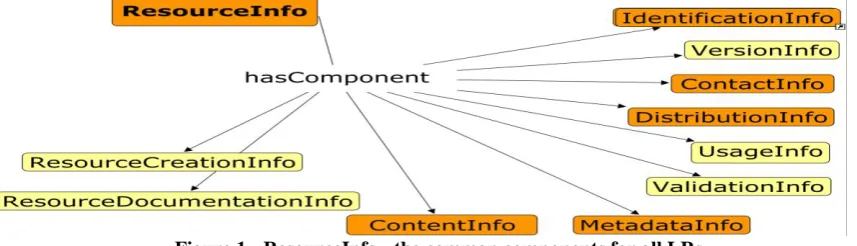
The core of the model is the ResourceInfo
component (Figure 1), which contains all the information relevant for the description of a LR. It subsumes components and elements that combine together to provide this description. A broad distinction can be made between the "administrative" components, which are com-mon to all LRs, and the components that are idiosyncratic to a specific LR type (e.g. Corpu-sInfo, LexicalConceptualResourceInfo etc., as explained further below). For instance, ele-ments needed for the description of video re-sources are only used for the specific media-Type.
The set of components that are common to all LRs are the following:
the IdentificationInfo component in-cludes all elements required to identify the re-source, such as the resource full and short name, the persistent identifier (PID, to be
[image:4.595.81.510.172.295.2]signed automatically by the system), identifiers attributed by the source organization or other entities (e.g. ELRA, LDC identifiers) etc.
the PersonInfo component provides in-formation about the person that can be con-tacted for further information or access to the resource
all information relative to versioning and revisions of the resource is included in the
VersionInfo component
crucial is the information on the legal is-sues related to the availability of the resource, specified by the DistributionInfo component, which provides a description of the terms of availability of the resource and its attached
LicenseInfo component, which gives a descrip-tion of the licensing condidescrip-tions under which the resource can be used; linking to the license documents themselves is also possible through the relevant relation.
the ValidationInfo component provides at least an indication of the validation status of the resource (with Boolean values) and, if the resource has indeed been validated, further details on the validation mode, results etc.
the ResourceCreationInfo and its de-pendent components group together informa-tion regarding the creainforma-tion of a resource (crea-tion dates, funding informa(crea-tion such as fund-er(s), relevant project name etc.)
the UsageInfo component aims at pro-viding information on the intended use of a resource (i.e. the application(s) for which it was originally designed) and its actual use (i.e. applications for which it has already been used, projects in which it has been exploited, products and publications having resulted from its use etc.).
the MetadataInfo is responsible for all information relative to the metadata record creation, such as the catalog from which the harvesting was made and the date of harvesting (in the case of harvested records) or the crea-tion date and metadata creator (in case of records created from scratch using the metada-ta editor) etc.
the ResourceDocumentationInfo pro-vides information on publications and ments describing the resource; basic docu-ments (e.g. manuals, tagset docudocu-ments) can (and should be) included in the META-SHARE repository; the possibility to introduce links to published web documents and/or im-port bibliographic references in standard for-mats will be catered for
finally, the ContentInfo component de-scribes the essence of the resource, specifying the resourceType and the mediaType elements, which give rise to specific components, dis-tinct for each LR type, as presented below.
A further set of four components enjoy a "special" status in the sense that they can be attached to various components, namely Per-sonInfo, OrganizationInfo, CommunicationInfo
and SizeInfo. For instance, PersonInfo and Or-ganizationInfo can be used for all per-sons/organizations acting as resource creators, distributors etc. Similarly, sizeInfo can be used either for the size of a whole resource or, in combination with another component, to de-scribe the size of parts of the resource (e.g. per domain, per language etc.).
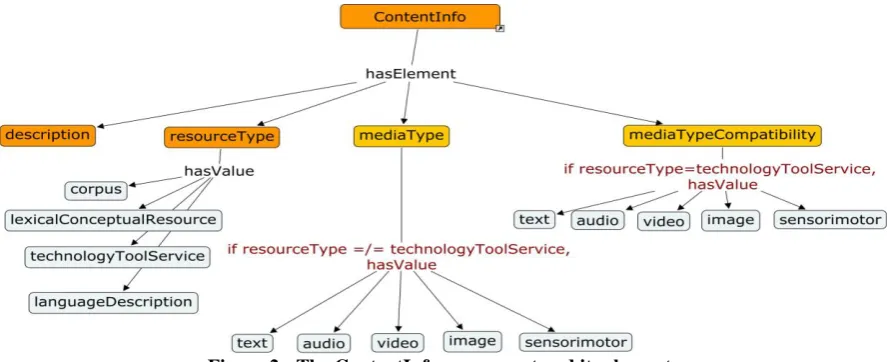
The ContentInfo component (Figure 2) is meant to group together descriptive informa-tion as regards the contents of the resource. The elements included are:
[image:5.595.77.521.69.250.2]description: free text of the resource
resourceType with the values corpus, lex-ical/conceptual resource, language description, technology/tool/service, evaluation package
mediaType (used for data resources) &
mediaTypeCompatibility (used for tools): the notion of medium constitutes an important de-scriptive and classificatory element for corpora but also for tools; it is preferred over the writ-ten/spoken/multimodal distinction, as it has clearer semantics and allows us to view re-sources as a set of modules, each of which can be described through a distinctive set of fea-tures. The following media type values are fo-reseen:
text: used for resources with only written medium (and modules of spoken and multimodal corpora),
audio (+ text): the audio feature set will be used for a whole resource or part of a resource that is recorded as an audio file; its transcripts will be described by the relevant Text feature set
image (+ text): the Image feature set is used for photographs, drawings etc., while the Text set will be reserved for its cap-tions
video: moving image (+ text) (+ audio (+ text): used for multi-media corpora, with Video for the moving image part, Audio for the dialogues, and Text referring to the transcripts of the dialogues and/or subtitles
sensorimotor: used for sensorimo-tor resources which contain data collected through the use of relevant equipment (gloves, helmets, body suits, laryngographs, etc.) and used to measure the activity of non-verbal modalities (such as gestures, facial expres-sions, body movements, gaze, articulatory ac-tivity, etc.) and their interaction with objects, be it common objects or control sequences of human-machine interaction (keyboard, mouse, touch screen).
A resource may consist of parts belonging to different types of media: for instance, a multi-modal corpus includes a video part (moving image), an audio part (e.g. dialogues) and a text part (subtitles and/or transcription of the dialogues); a multimedia lexicon includes the
text part, but also a video and/or an audio part; a sign language resource is also a good exam-ple for a resource with various media types. Similarly, tools can be applied to resources of particular types of medium: e.g. a tool can be used both for video and for audio files.
Each of the values of the resourceType and
mediaType gives rise to a new component, re-spectively:
CorpusInfo, LexicalConceptualResour-ceInfo, LanguageDescriptionInfo, Technolo-gyToolServiceInfo and EvaluationPackageInfo
which include information specific to each LR type (e.g. subtypes of corpora and lexi-cal/conceptual resources, tasks performed for tools etc.)
TextInfo, AudioInfo, VideoInfo, Im-ageInfo and SensorimotorInfo which provide information depending on the media type of a resource; this information can be broadly de-scribed as belonging to one of the following categories (all represented in the form of com-ponents and elements):
content: it mainly refers to lan-guages covered in the resource and classifica-tory information (e.g. domains, geographic coverage, time coverage, setting, type of con-tent etc.)
format: file format, size, duration, character encoding etc.; obviously, this infor-mation is more media-type-driven (e.g. we have different file formats for text, audio and video files)
linguistic information encoding: the relevant components include information on the types, theoretic models, methods, tools etc. used for adding linguistic information to the resource, which takes the form of encoding for lexica and annotation for corpora and tools; it is both resource-type- and media-type-driven (e.g. morpho-syntactic tagging, parsing, se-mantic annotation is used for text files, while transcription, prosody annotation etc. for audio parts/corpora etc.).
The mandatory generic components and elements thereof for the description of a re-source (for the minimal schema) are:
IdentificationInfo, incl. name of the re-source and persistent identifier
ContentInfo: all elements (description,
resourceType & mediaType) are mandatory
DistributionInfo: availability must be filled in and depending on the type of availa-bility, further elements are mandatory (e.g. license, distributor and distribution/access me-dium for all available resources, types of re-strictions for resources available under restric-tions etc.)
MetadataInfo: depending on the way the metadata record has been created (harvesting vs. manual creation), a different set of ele-ments must be filled in, some of which are au-tomatically provided (e.g. metadataCreation-Date vs. harvestingDate, metadataCreator vs.
source etc.)
PersonInfo: at least an email must be provided for the contact person.
Depending on the resource type, a further set of components are mandatory.
In the next sections, we provide a more de-tailed view of text corpora and lexical / con-ceptual resources as exemplary cases of the model.
8
Text corpora
Text corpora are marked as such by the ele-ment resourceType=corpus & mediaType=text
and their description must include a CorpusIn-fo component and a TextInfo one (Figure 3). As aforementioned, here we include, alongside the traditional text corpora, also the textual parts of audio corpora (transcriptions) and vid-eo ones (e.g. subtitles).
Besides the generic components, the type dependent information for text corpora is represented in the following components:
LingualityInfo: it provides information on the linguality type (mono-/bi-/multilingual corpora) and multilinguality type of text re-sources (parallel vs. comparable corpora)
LanguageInfo: it comprises information on the language(s) of a resource and can be repeated for all languages of the resource; a
LanguageVarietyInfo component is foreseen to supply further information if the resource in-cludes data in regional language varieties, di-alects, slang etc.
SizeInfo: it provides information on the size of the whole resource but it can also be attached to every other component that needs a specification of size (e.g. size per language, per format etc.);
AnnotationInfo: it groups information on the annotation of text corpora, such as spe-cification of the types of annotation level (e.g. segmentation, alignment, structural annotation, lemmatization, semantic annotation etc.), an-notation methods and tools etc.
The above four components are obligatory for all text corpora. A further set of compo-nents are recommended:
FormatInfo: it gives information on the format (in the form of mime-type) of the cor-pus
CharacterEncodingInfo: it includes in-formation on character encoding of the re-source
TextCorpusCreationInfo: it is used to provide specific information on the creation of the text files, as aforementioned;
finally, four components are used to give information on the classification of the corpus, namely: TimeCoverageInfo (for the time period of the texts), GeographicCovera-geInfo (for the geographic region from which the texts are collected), DomainInfo (present-ing the domains covered by the corpus) and
TextGenreInfo (for the text genre / text type of the texts).
9
Lexical / Conceptual resources
The type dependent subschema for lexical / conceptual resources (LCRs) is activated if the
resourceType element of the ContentInfo com-ponent has the value lexicalConceptualRe-source (Figure 4). If this condition is verified, the LexicalConceptualResourceInfo compo-nent becomes mandatory. In this compocompo-nent a first mandatory element is lexicalConceptua-lResourceType, where the provider is asked to define the type of LRC under description. There is still an open debate on what should be the values to be given in this part and as to which should be the labels thereof. An open list is currently proposed, its suggested values being: wordList; computationalLexicon; ontol-ogy; wordnet; thesaurus; framenet; termino-logicalResource; machineReadableDictionary. Providers can choose to add other values if they consider these not appropriate.
Two optional components are foreseen:
LexicalConceptualResourceCreationIn-fo, where information on the originalSource, a string field where the main sources (dictiona-ries, grammars, lexica, corpora,) for the crea-tion of the LCR are listed; creationMode, with a closed list of values (automatic, semi-automatic, manual, mixed interactive); crea-tionModeDetails, which allows to further spe-cify the theoretical and practical principles that guided the creation of the resource; creation-Tool, a repeatable element where either a string, a url or a hyperlink can be entered, the latter enabling the provider to create a connec-tion between the resource and the tool(s) used for its development.
LexicalConceptualResourceEncodingIn-fo (which is recommended) groups all informa-tion regarding the contents of the LCR; it in-cludes the following elements: the mandatory element encodingLevel with an open list of values (e.g. phonetics; phonology; semantics), the optional but more detailed linguisticInfor-mation with a complex set of suggested values of a varying degree of granularity (e.g. par-tOfSpeech, syntax-SubcatFrame, semantics-relations, semantics-Relations-Synonyms, se-mantics-Relations-Antonyms etc.) and the op-tional extratextualInformation (with values images, videos, soundRecordings); this last element can be used for multimedia lexica; if a more detailed account is considered appropri-ate, the AudioInfo, VideoInfo, ImageInfo com-ponents can also be used.
The TextInfo and its subsumed components are also to be used for the description of LCRs; the only exceptions are the TextGenre and An-notation components, which are specific to text corpora.
10
Conclusions and future work
The current version contains, besides the gen-eral presentation of the model, the application of the model to text corpora & to LCRs as pre-sented above. The next steps include:
extension to other media and LR types: the application of the model to the remaining media types (audio, video, image, sensorimo-tor) and LR types (languageDescription; tech-nologyToolService; evaluationPackages) is ongoing. In this process, the expressive power of the model is being tested and it is expected that new components and elements will arise.
exemplary instantiations: a set of re-sources selected to represent all LR and media types is being described according to the mod-el, in order to test its functionality; these re-sources with their descriptions will be up-loaded in the prototype infrastructure for test-ing and exemplification purposes.
discussion with experts group: this ver-sion of the model will be communicated to the metadata experts group that has been set up within WP7, with the purpose of getting feed-back for its improvement.
implementation of the schema for the description of LRs produced or collected by three collaborating projects, namely META-NET4U, CESAR and META-NORD.
References
Broeder, D., T. Declerck, E. Hinrichs, S. Piperidis, L. Romary, N. Calzolari and P. Wittenburg (2008). Foundation of a Component-based Flex-ible Registry for Language Resources and Tech-nology. In Proceedings of the 6th International Conference of Language Resources and Evalua-tion (LREC 2008).
e-IRG (2009). eIRG Report on Data Mangement.
http://www.e-irg.eu/images/stories/publ/task_force_reports/dm tfjointreport.pdf
Federmann, C., B. Georgantopoulos, R. del Gratta, B. Magnini, D. Mavroeidis, S. Piperidis, M. Speranza (2011). META-NET Deliverable D7.1.1 – META-SHARE functional and technical specifications.
Gavrilidou M., P. Labropoulou, E. Desipri, S. Piperidis (2010). Preliminary Proposal for a Me-tadata Schema for the Description of Language Resources (LRs) in Proceedings of the
Work-shop 'Language Resource and Language Tech-nology Standards – state of the art, emerging needs, and future developments', LREC 2010, Malta 2010.
Gavrilidou, M., P. Labropoulou, S. Piperidis, M. Speranza, M. Monachini, V. Arranz, G. Francopoulo (2011). META-NET Deliverable D7.2.1 - Specification of Metadata-Based Descriptions for Language Resources and Technologies