Efficient Parallel CKY Parsing on GPUs
Youngmin Yi1 Chao-Yue Lai2 Slav Petrov3 Kurt Keutzer4
1University of Seoul
Seoul, Korea
2,4University of California, Berkeley
Berkeley, CA, USA
{colbylai,keutzer} @eecs.berkeley.edu
3Google Research
New York, NY, USA
Abstract
Low-latency solutions for syntactic parsing are needed if parsing is to become an inte-gral part of user-facing natural language ap-plications. Unfortunately, most state-of-the-art constituency parsers employ large prob-abilistic context-free grammars for disam-biguation, which renders them impractical for real-time use. Meanwhile, Graphics Pro-cessor Units (GPUs) have become widely available, offering the opportunity to alle-viate this bottleneck by exploiting the fine-grained data parallelism found in the CKY algorithm. In this paper, we explore the de-sign space of parallelizing the dynamic pro-gramming computations carried out by the CKY algorithm. We use the Compute Uni-fied Device Architecture (CUDA) program-ming model to reimplement a state-of-the-art parser, and compare its performance on two recent GPUs with different architectural features. Our best results show a 26-fold speedup compared to a sequential C imple-mentation.
1 Introduction
Syntactic parsing of natural language is the task of analyzing the grammatical structure of sentences and predicting their most likely parse trees (see Figure 1). These parse trees can then be used in many ways to enable natural language process-ing applications like machine translation, ques-tion answering, and informaques-tion extracques-tion. Most syntactic constituency parsers employ a weighted context-free grammar (CFG), that is learned from a treebank. The CKY dynamic programming algo-rithm (Cocke and Schwartz, 1970; Kasami, 1965; Younger, 1967) is then be used to find the most likely parse tree for a given sentence of length n
inO(|G|n3)time. While often ignored, the gram-mar constant|G|typically dominates the runtime in practice. This is because grammars with high accuracy (Collins, 1999; Charniak, 2000; Petrov et al., 2006) have thousands of nonterminal symbols and millions of context-free rules, while most sen-tences have on average only aboutn= 20words.
Meanwhile, we have entered a manycore com-puting era, where the number of processing cores in computer systems doubles every second year, while the clock frequency has converged some-where around 3 GHz (Asanovic et al., 2006). This opens up new opportunities for increasing the speed of parsers. We present a general ap-proach for parallelizing the CKY algorithm that can handle arbitrary context-free grammars (Sec-tion 2). We make no assump(Sec-tions about the size of the grammar and we demonstrate the efficacy of our approach by implementing a decoder for the state-of-the-art latent variable grammars of Petrov et al. (2006) (a.k.a. Berkeley Parser) on a Graphics Processor Unit (GPU).
We first present an overview of the general ar-chitecture of GPUs and the efficient synchroniza-tion provided by the Compute Unified Device Ar-chitecture (CUDA (Nickolls et al., 2008)) pro-gramming model (Section 3). We then discuss how the hundreds of cores available on a GPU can enable a fine-grained parallel execution of the CKY algorithm. We explore the design space with different thread mappings onto the GPU and discuss how the various synchronization methods might be applied in this context (Section 4). Key to our approach is the observation that the compu-tation needs to be parallelized over grammar rules rather than chart cells. While this might have been difficult to do with previous parallel computing architectures, the CUDA model provides us with
(a) (b) ROOT
S
@S .
.
NP VP
VBP NP
I love
you
PRP
Lexicon:
(P1) Pr(IPRP) = -0.23 (P2) Pr(..) = -0.01 …
Grammar:
[image:2.595.325.501.62.161.2](G1) Pr(NPPRP) = -1.35 (G2) Pr(VPVBP NP) = -2.45 …
Figure 1: An example of a parse tree for the sentence “I love you .”
fine-grained parallelism and synchronization op-tions that make this possible.
We empirically evaluate the various parallel im-plementations on two NVIDIA GPUs (GTX480 and GTX285) in Section 5. We observe that some parallelization options are architecture dependent, emphasizing that a thorough understanding of the programming model and the underlying hardware is needed to achieve good results. Our implemen-tation on NVIDIA’s GTX480 using CUDA results in a 26-fold speedup compared to the original se-quential C implementation. On the GTX285 GPU we obtain a 14-fold speedup.
Parallelizing natural language parsers has been studied previously (see Section 6), however, pre-vious work has focused on scenarios where only a limited level of coarse-grained parallelism could be utilized, or the underlying hardware required unrealistic restrictions on the size of the context-free grammar. To the best of our knowledge, this is the first GPU-based parallel syntactic parser us-ing a state-of-the-art grammar.
2 Natural Language Parsing
While we assume a basic familiarity with prob-abilistic CKY parsing, in this section we briefly review the CKY dynamic programming algorithm and the Viterbi algorithm for extracting the highest scoring path through the dynamic program.
2.1 Context-Free Grammars
In this work we focus our attention on con-stituency parsing and assume that a weighted CFG is available to us. In our experiments we will use a probabilistic latent variable CFG (Petrov et al., 2006). However, our algorithms can be used with any weighted CFG, including discriminative ones, such as the ones in Petrov and Klein (2007a) and
I love you .
love you .
you . you I
I love I love you
(0,1) (0,2)
(0,3) (0,4)
(1,4)
(2,4)
(2,3) (1,2)
love love you
(1,3)
.
0 1 2 3 4
(3,4)
Execution order
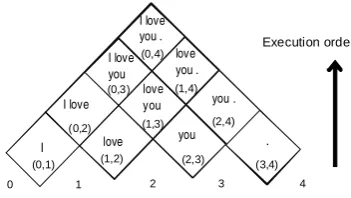
Figure 2: The chart that visualizes the bottom-up pro-cess of CKY parsing for the sentence “I love you .”
Finkel et al. (2008).1 The grammars in our experi-ments have on the order of thousands of nontermi-nals and millions of productions.
Figure 1(a) shows a constituency parse tree. Leaf nodes in the parse tree, also called termi-nal nodes, correspond to words in the language. Preterminals correspond to part-of-speech tags, while the other nonterminals correspond to phrasal categories. For ease of exposition, we will say that terminal productions are part of a lexicon. For ex-ample, (L1) in Figure 1(b) is a lexical rule provid-ing a score (of−0.23) for mapping the word ”I” to the symbol “PRP.” We assume that the grammar has been binarized and contains only unary and
binary productions. We refer to the application of
grammar rules as unary/binary relaxations.
2.2 Sequential CKY Parsing
The CKY algorithm is an exhaustive bottom-up algorithm that uses dynamic programming to incrementally build up larger tree structures. To keep track of the scores of these structures, a chart indexed by the start and end positions and the symbol under consideration is used:
scores[start][end][symbol] (see also Figure 2).
After initializing the preterminal level of the chart with the part-of-speech scores from the lexicon, the algorithm continues by repeatedly applying all binary and unary rules in order to build up larger spans (pseudocode is given in Figure 3). To recon-struct the highest scoring parse tree we perform a top-down search. We found this to be more effi-cient than keeping backpointers.2
One should also note that many real-world ap-plications benefit from, or even expectn-best lists of possible parse trees. Using the lazy evaluation algorithm of Huang and Chiang (2005) the
extrac-1
For feature-rich discriminative models a trivially paral-lelizable pass can be used to pre-compute the rule-potentials.
[image:2.595.78.286.68.182.2]Algorithm: parse(sen, lex, gr)
Input:sen/* the input sentence */
lex/* the lexicon */
gr/* the grammar */
Output:tree/* the most probable parse tree */
1 scores[][][]=initScores(); 2 nW ords=readSentence(sen);
3 lexiconScores(scores, sen, nW ords, lex); 4 forlength= 2tonW ords
[image:3.595.309.525.64.290.2]5 binaryRelax(scores, nW ords, length, gr); 6 unaryRelax(scores, nW ords, length, gr); 7 tree=backtrackBestParseTree(scores); 8 returntree;
Figure 3: Pseudocode for CKY parsing.
tion of an n-best list can be done with very little overhead after running a slightly modified version of the CKY algorithm. Our parallel CKY algo-rithm could still be used in that scenario.
3 GPUs and CUDA
Graphics Processor Units (GPUs) were origi-nally designed for processing graphics applica-tions, where millions of operations can be exe-cuted in parallel. In order to increase the efficiency by exploiting this parallelism, typical GPUs (Lind-holm et al., 2008) have hundreds of processing cores. For example, the NVIDIA GTX480 GPU has 480 processing cores called stream
proces-sors (SP). The processing cores are organized
hi-erarchically as shown in Figure 5: A group of SPs makes up a streaming multiprocessor (SM). A number of SMs form a single graphics device. The GTX480, for example, contains 15 SMs, with 32 SPs in each SM, resulting in the total of 480 SPs. Despite this high number of processors, it should be emphasized that simply using a GPU, without understanding the programming model and the un-derlying hardware architecture, does not guarantee high performance.
3.1 Compute Unified Device Architecture
Recently, Nickolls et al. (2008) introduced the Compute Unified Device Architecture (CUDA). It allows programmers to utilize GPUs to acceler-ate applications in domains other than graphics. CUDA is essentially the programming language C with extensions for thread execution and GPU-specific memory access and control. A CUDA
thread is executed on an SP and a group of threads
(called a thread block) is executed on an SM. CUDA enables the acceleration of a wide range
Algorithm: binaryRelax(scores, nW ords, length, gr)
Input:scores/* the 3-dimensional scores */
nW ords/* the number of total words */
length/* the current span */
gr/* the grammar */
Output: None
1 forstart= 0tonW ords−length 2 end=start+length; 3 foreachsymbol∈gr
4 max=FLOAT MIN;
5 foreach rulerpersymbol// defined by gr 6 // r is "symbol ⇒ l sym r sym" 7 forsplit=start+ 1toend−1
8 // calculate score
9 lscore=scores[start][split][l sym]; 10 rscore=scores[split][end][r sym]; 11 score=rule score+lscore+rscore;
12 // maximum reduction
13 ifscore > max
14 max=score;
[image:3.595.72.292.64.211.2]15 scores[start][end][symbol]=max;
Figure 4: Binary relaxations in CKY parsing.
of applications in various domains by executing a number of threads and thread blocks in paral-lel, which are specified by the programmer. Its popularity has grown rapidly because it provides a convenient API for parallel programming. In or-der to better utilize the massive parallelism in the GPU, it is typical to have hundreds of threads in a thread block and have hundreds or even thousands of thread blocks launched for a single kernel: a data-parallel function that is executed by a num-ber of threads on the GPU.
3.2 Single Instruction Multiple Threads
…
SM SM SM
SP
…
shared memory
SP
…
shared memory
SP
…
shared memory
Graphics Processor Units
SP
…
shared memory
[image:4.595.73.292.64.192.2]SM
Figure 5: The hierarchical organization of GPUs.
branch and should be avoided as much as
possi-ble when designing parallel algorithms and map-ping applications onto a GPU. In the programming model of CUDA, one or more warps are implic-itly grouped into thread blocks. Different thread blocks are mapped to SMs and can be executed independently of one another.
3.3 Shared Memory
Generally speaking, manycore architectures (like GPUs) have more ALUs in place of on-chip caches, making arithmetic operations relatively cheaper and global memory accesses relatively more expensive. Thus, to achieve good perfor-mance, it is important to increase the ratio of Com-pute to Global Memory Access (CGMA) (Kirk and Hwu, 2010), which can be done in part by cleverly utilizing the different types of shared on-chip memory in each SM.
Threads in a thread block are mapped onto the same SM and can cooperate with one another by sharing data through the on-chip shared
mem-ory of the SM (shown in Figure 5). This shared
memory has two orders of magnitude less latency than the off-chip global memory, but is very small (16KB to 64KB, depending on the architecture). CUDA therefore provides the programmer with the flexibility (and burden) to explicitly manage shared memory (i.e., loading a value from global memory and storing it).
Additionally, GPUs also have so called texture
memory and constant memory. Texture memory
can be written only from the host CPU, but pro-vides caching and is shared across different SMs. Hence it is often used for storing frequently ac-cessed read-only data. Constant memory is very small and as its name suggests is only appropriate for storing constants used across thread blocks.
3.4 Synchronization
CUDA provides a set of APIs for thread synchro-nization. When threads perform a reduction, or need to access a single variable in a mutually ex-clusive way, atomic operations are used. Atomic operation APIs take as arguments the memory lo-cation (i.e., pointer of the variable to be reduced) and the value. However, atomic operations on global memory can be very costly, as they need to serialize a potentially large number of threads in the kernel. To reduce this overhead, one usu-ally applies atomic operations first to variables de-clared in the shared memory of each thread block. After these reductions have completed another set of atomic operations is done.
In addition, CUDA provides an API ( syncthreads()) to realize a barrier synchro-nization between threads in the same thread block. This API forces each thread to wait until all threads in the block have reached the calling line. Note that there is no API for the barrier synchro-nization between all threads in a kernel. Since a return from a kernel accomplishes a global barrier synchronization, one can use separate kernels when a global barrier synchronization is needed.
4 Parallel CKY Parsing on GPUs
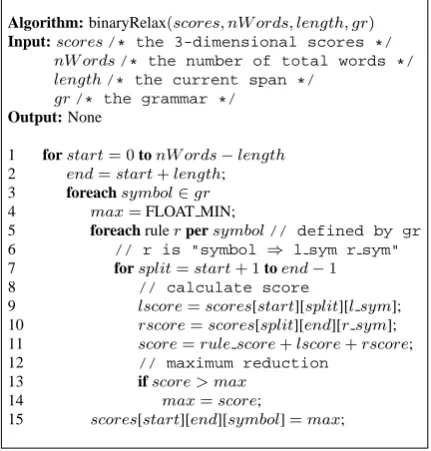
The dynamic programming loops of the CKY algorithm provide various types of parallelism. While the loop in Figure 3 cannot be parallelized due to dependencies between iterations, all four loops in Figure 4 could in principle be parallelized. In this section, we discuss the different design choices and strategies for parallelizing the binary relaxation step that accounts for the bulk of the overall execution time of the CKY algorithm.
4.1 Thread Mapping
Algorithm: threadBasedRuleBR(scores, nW ords, length, gr)
Input:scores/* the 3-dimensional scores */
nW ords/* the number of total words */
length/* the current span */
gr/* the grammar */
Output: None
1 forstart= 0tonW ords−lengthin parallel
2 end=start+length; 3 foreach ruler∈grin parallel
4 shared intsh max[NUM SYMBOL]= FLOAT MIN; 5 // r is "symbol ⇒ l sym r sym" 6 forsplit=start+ 1toend−1
7 // calculate score
8 lscore=scores[start][split][l sym]; 9 rscore=scores[split][end][r sym]; 10 score=rule score+lscore+rscore;
11 // local maximum reduction
12 ifscore > local max 13 local max=score;
14 atomicMax(&sh max[symbol],local max); 15 // global maximum reduction
16 foreachsymbol∈grin parallel
[image:5.595.72.282.59.324.2]17 atomicMax(&scores[start][end][symbol], sh max[symbol]);
Figure 6: Thread-based parallel CKY parsing.
GPUs,3 but it can also suffer from load imbal-ance due to the fact that each symbol has a varying number of rules associated with it. Since threads in the same warp execute in SIMT fashion, this load imbalance among threads results in divergent branches, degrading the performance significantly. It is therefore advantageous to map rules rather than symbols to threads.
4.1.1 Thread-Based Mapping
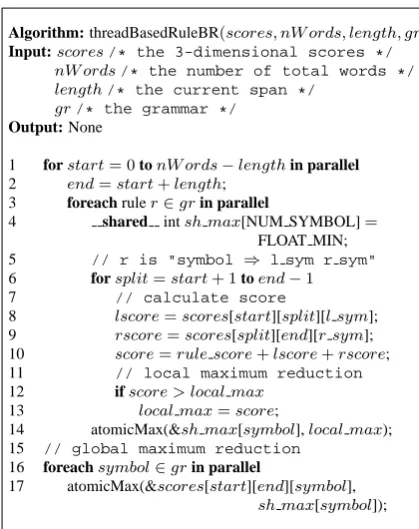
If we map rules to threads, the nested loops in line 3 and line 5 of Figure 4 become one flat loop that iterates over all rules in the grammar and the loop can be executed in parallel as shown in line 3 of Figure 6. Since the grammar we use has about one million rules, this mapping provides sufficient par-allelism to fully utilize the GPU, without running into load imbalance issues. We call this mapping
thread-based mapping.
Unfortunately, thread-based mapping has a ma-jor drawback. Since each rule is mapped to a dif-ferent thread, threads for rules with the same par-ent symbol need to be synchronized in order to avoid write conflicts. In this mapping, the syn-chronization can be done only through atomic op-erations (shown in line 14 and line 17 of Figure 6), which can be costly.
3#threads/warp
×max(#warps)/SM ×#SM =
32×48×15 = 23,040threads in the GTX480.
Algorithm: blockBasedRuleBR(scores, nW ords, length, gr)
Input:scores/* the 3-dimensional scores */
nW ords/* the number of total words */
length/* the current span */
gr/* the grammar */
Output: None
1 forstart= 0tonW ords−lengthin parallel
2 end=start+length; 3 foreachsymbol∈grin parallel
4 shared intsh max=FLOAT MIN; 5 foreach rulerpersymbolin parallel
6 // r is "symbol ⇒ l sym r sym" 7 forsplit=start+ 1toend−1
8 // calculate score
9 lscore=scores[start][split][l sym]; 10 rscore=scores[split][end][r sym]; 11 score=rule score+lscore+rscore;
12 // local maximum reduction
13 ifscore > local max
14 local max=score;
15 atomicMax(&sh max,local max); 16 // global maximum reduction 17 foreachsymbol∈grin parallel
18 atomicMax(&scores[start][end][symbol],sh max);
Figure 7: Block-based parallel CKY parsing.
4.1.2 Block-Based Mapping
Another mapping can be obtained by exploiting the two levels of granularity in the GPU archi-tecture: threads and thread blocks. We can map each symbol to a thread block, and the rules as-sociated with each symbol to threads in the re-spective thread block. This mapping creates a bal-anced load because an SM can execute any avail-able thread block independently of other thread blocks, instead of waiting for other SMs to com-plete. For example, when the first SM completes the computation of a thread block (because the as-sociated symbol has few rules), it can proceed to the next available thread block (which corresponds to another symbol). This corresponds to mapping each iteration of the loop in line 3 of Figure 4 to thread blocks and the loop in line 5 to threads. We call this mapping block-based mapping and pro-vide pseudocode in Figure 7. The main advantage of this mapping is that it allows synchronization without using costly atomic operations.
[image:5.595.306.523.65.317.2]rule #0
rule #1
rule #2
rule #1023
rule #1024
rule #1025
…
rule #0
rule #1
rule #2
rule #1023
…
virtual symbol j
rule #0
rule #1 virtual
symbol j+1 symbol
[image:6.595.337.495.61.186.2]i
Figure 8: Creating virtual symbols whenever a symbol has too many rules.
thread block needs to perform the check. Since this check involves a global memory access, it is costly. Minimizing the number of global memory accesses is key to the performance of parallel al-gorithms on GPUs.
A challenging aspect of the block-based map-ping comes from the fact that the number of rules per symbol can exceed the maximum number of threads per thread block (1,024 or 512 depending on the GPU architecture). To circumvent this lim-itation, we introduce virtual symbols, which host different partitions of the original rules, as shown in Figure 8. Introducing virtual symbols does not increase the complexity of the algorithm, because virtual symbols only exist until we perform the maximum reductions, at which point they are con-verted to the original symbols.
4.2 Span-Level Parallelism
Another level of parallelism, which is orthogonal to the previously discussed mappings, is present in the first loop in Figure 4. Spans in the same level in the chart (see Figure 2), are independent of each other and can hence be executed in par-allel by mapping them to thread blocks (line 1 of Figure 6 and Figure 7). Since CUDA provides up to three-dimensional (x, y, z) indexing of thread blocks, this can be easily accomplished: we create two-dimensional grids whose X axis corresponds to symbols in block-based mapping or simply a group of rules in thread-based mapping, and the Y axis corresponds to the spans.
4.3 Thread Synchronization
Thread synchronization is needed to correctly compute the maximum scores in parallel. Syn-chronization can be achieved by atomic operations or by parallel reductions using syncthreads() as
explained in Section 3. The most viable
synchro-> > > >
> >
> step 1
step 2
step 3
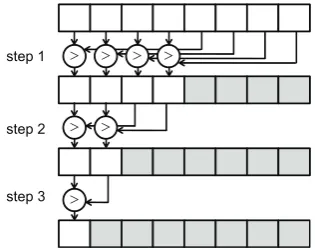
Figure 9: Parallel reduction on shared memory between threads in the same thread block with 8 threads.
nization method will of course vary depending on the mapping we choose. In practice, only atomic operations are an option in thread-based mapping, since we would otherwise need as many execu-tions of parallel reducexecu-tions, as the number of dif-ferent parent symbols in each thread block. In block-based mapping, on the other hand, both par-allel reductions and atomic operations can be ap-plied.
4.3.1 Atomic Operations
In thread-based mapping, to correctly update the score, each thread needs to call the atomic API max operation with a pointer to the desired write location. However, this operation can be very slow (as we will confirm in Section 5), so that we in-stead perform a first reduction by calling the API with a pointer to the shared variable (as shown in line 14 of Figure 6), and then perform a sec-ond reduction with a pointer to the scores array (as shown in line 17 of Figure 6). When we call atomic operations on shared memory, shared variables need to be declared for all symbols. This is necessary because in thread-based map-ping threads in the same thread block can have dif-ferent parent symbols.
[image:6.595.73.291.66.172.2]4.3.2 Parallel Reductions
Parallel reduction is another option for updating scores in block-based mapping. Each thread in the thread block stores its computed score in an array declared as a shared variable and performs paral-lel reduction with a binary-tree order as shown in Figure 9 (from leaves to the root). When there are N threads in a thread block, the maximum score in the thread block is obtained afterlog 2N
steps and stored in the first element in the array. Note that when implementing the parallel reduc-tion syncthreads() needs to be called at the end of
each step to ensure that every thread can read the updated value of the previous step. This approach can potentially be faster than the inherently serial atomic operations, but it comes with the cost of us-ing more shared memory (proportional to the num-ber of participating threads). This synchroniza-tion method is in practice only applicable to block-based mapping and cannot be applied to thread-based mapping since it assumes that all threads in a thread block perform reductions for the same parent symbol.
4.4 Reducing Global Memory Accesses
By now it should be clear that increasing CGMA and reducing global memory access is important for high GPU performance. We can approximately calculate the CGMA ratio of our kernel by count-ing global memory accesses and arithmetic oper-ations per thread. There are three global memory accesses for each binary rule: the left child sym-bol ID, right child symsym-bol ID, and the rule score itself. Moreover, there are two global memory ac-cesses for referencing the scores with left child ID and right child ID in the split-point loop in line 7 of Figure 4. The loop in line 7 iterates up to the
length of the span. The number of global memory
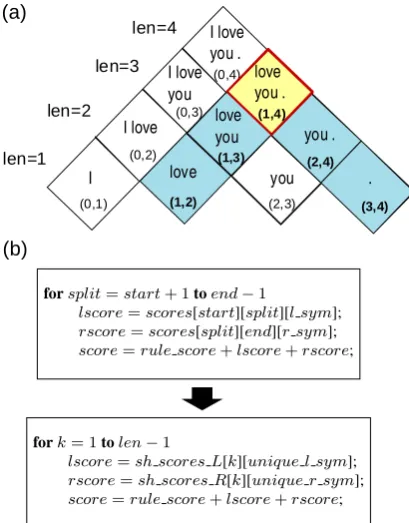
accesses is thus2·length+ 3. On the other hand, there are only two additions in the kernel, resulting in a very low CGMA. To improve performance, we need to increase the CGMA ratio by better uti-lizing the shared memory. Since shared memory is rather limited, and global memory accesses to the scores array in line 9 and 10 of Figure 4 spread over a wide range of memory locations, it is im-possible to simply transform those global memory accesses into shared memory accesses. Instead, we need to modify the access pattern of the kernel code to meet this constraint.
If we look into the access pattern (ignoring the
(1,2)
you
(0,1)
(0,3) (0,4)
(2,4)
(2,3) (1,3)
.
(3,4)
I love you .
you .
I I love
I love you
love love you (a)
(b)
(0,2) len=2
len=3 len=4
love you .
(1,4)
len=1
forsplit=start+ 1toend−1
lscore=scores[start][split][l sym]; rscore=scores[split][end][r sym]; score=rule score+lscore+rscore;
fork= 1tolen−1
lscore=sh scores L[k][unique l sym]; rscore=sh scores R[k][unique r sym]; score=rule score+lscore+rscore;
Figure 10: (a) Chart example illustrating the access pat-terns of the scores array: the shaded cells are the loca-tions that the threads with start = 1, end = 4 accesses. (b) Better memory access patterns with the new arrays
symbol dimension of the scores array), we can see
that the accesses actually occur only in restricted locations that can be easily enumerated. For exam-ple, the accesses are restricted within the shaded cells in Figure 10(a) when the current cell is (1, 4). We can thus introduce two arrays (sh scores L and
sh scores R) that keep track of the scores of the
children in the shaded cells. These two arrays can easily fit into shared memory because there are only about 1000 unique symbols in our grammar and the sentence lengths are bounded, whereas the scores array can only reside in global mem-ory. Figure 10(b) shows how the new arrays are accessed. For each unique left/right child sym-bol, we need to load the score from scores to
sh scores L and sh scores R once through a global
memory access. Thus, the number of global mem-ory access will be reduced when multiple rules share the same child symbols.
[image:7.595.317.522.67.329.2]How-CPU type Core i7 2.80 GHz
System memory 2GB
GPU type GTX285 GTX480
648 MHz 1400 MHz
GPU memory 1GB 1.5GB
#SM 30 15
#SP/SM 8 32
Shared memory/SM 16KB up to 64KB
[image:8.595.87.272.64.169.2]L1 cache/SM N/A up to 64KB
Table 1: Experimental platforms specifications.
ever, as the array is updated at every iteration of binary relaxation, we need to update it also in texture memory by calling a binding API (be-tween line 4 and 5 in Figure 3). While it can be costly to bind such a large array every it-eration, we can reduce this cost by transform-ing its layout from scores[start][end][symbol] to
scores[length][start][symbol], where length = end−start. With the new layout, we only need to bind the array up to size(length−1)(rather than the entire array), significantly reducing the cost of binding it to texture memory.
5 Experimental Results
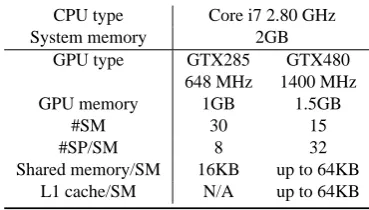
We implemented the various versions of the paral-lel CKY algorithm discussed in the previous sec-tions in CUDA and measured the runtime on two different NVIDIA GPUs used in a quad-core desk-top environment: GTX285 and GTX480. The de-tailed specifications of the experimental platforms are listed in Table 1.
The grammar we used is extracted from the pub-licly available parser of Petrov et al. (2006). It has 1,120 nonterminal symbols including 636 preter-minal symbols. The grammar has 852,591 binary rules and 114,419 unary rules. We used the first 1000 sentences from Section 22 of the Wall Street Journal (WSJ) portion of the Penn Treebank (Mar-cus et al., 1993) as our benchmark set. We verified for each sentence that our parallel implementation obtains exactly the same parse tree and score as the sequential implementation. We compare the execution times of various versions of the parallel parser in CUDA, varying the mapping, synchro-nization methods and memory access patterns.
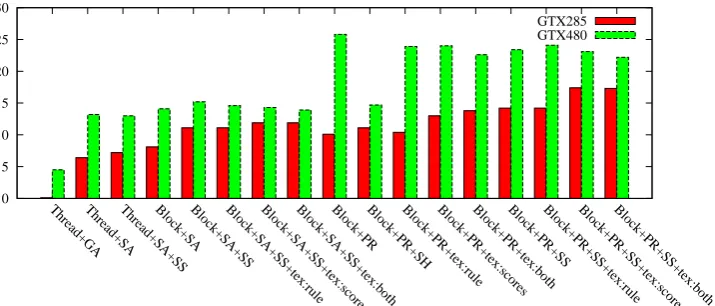
Figure 11 shows the speedup of the different parallel parsers on the two GPUs: Thread stands for the thread-based mapping and Block for the block-based one. The default parallelizes over spans, while SS stands for sequential spans,
mean-ing that the computation on spans is executed se-quentially. GA stands for global atomic synchro-nization, SA for shared atomic synchrosynchro-nization, and PR for the parallel reduction. SH stands for the transformed access pattern for the scores array in the shared memory. tex:rule stands for load-ing the rule information from texture memory and
tex:scores for loading the scores array from
tex-ture memory. tex:both means both the tex:rule and
tex:scores are applied.
The exhaustive sequential CKY parser was written in C and is reasonably optimized, taking 5.5 seconds per sentence (or 5,505 seconds for the 1000 benchmark sentences). This is compa-rable to the better implementations presented in Dunlop et al. (2011). As can be seen in Figure 11, the fastest configuration on the GTX285 is
Block+PR+SS+tex:scores, which shows a 17.4× speedup against the sequential parser. On the GTX480, Block+PR is the fastest, showing a 25.8× speedup. Their runtimes were 0.32 sec-onds/sentence and 0.21 secsec-onds/sentence, respec-tively. It is noteworthy that the fastest configura-tion differs for the two devices. We provide an explanation later in this section.
On both the GTX285 and the GTX480,
Thread+GA shows the worst performance as
global atomic synchronization is very costly.
Thread+GA on the GTX285 is even about 8 times
slower than the sequential CKY parser. Note that although it is still the slowest one, Thread+GA on the GTX480 actually shows a 4.5×speedup.
On the GTX285, Thread+SA, Block+SA, and
Block+PR show 6.4×, 8.1×, and 10.1×speedups, respectively. Perhaps somewhat surprisingly, par-allelizing over spans actually hurts performance. By not serializing the computations for spans, we can get speedups of 13% for Thread+SA+SS over
Thread+SA and about 40% for Block+SA+SS and Block+PR+SS over their parallel spans versions.
In thread-based mapping, the atomic operations on shared memory are the bottleneck, so that se-quential processing of spans makes only a small difference. On the other hand, in Block+SA and
Block+PR on the GTX285, the global memory
0 5 10 15 20 25 30
Thread+GAThread+SAThread+SA+SSBlock+SABlock+SA+SSBlock+SA+SS+tex:ruleBlock+SA+SS+tex:scoresBlock+SA+SS+tex:bothBlock+PRBlock+PR+SHBlock+PR+tex:ruleBlock+PR+tex:scoresBlock+PR+tex:bothBlock+PR+SSBlock+PR+SS+tex:ruleBlock+PR+SS+tex:scoresBlock+PR+SS+tex:both GTX285
[image:9.595.109.467.109.262.2]GTX480
Figure 11: Speedups of various versions of parallel CKY parser that have different mappings, synchronization methods, and different memory access optimizations.
On the GTX285, the transformed access pat-tern for the scores array along with accesses to the shared memory (Block+PR+SH) im-proves the performance by about 10%, show-ing a 11.1× speedup. Placing the scores ar-ray in texture memory improves all implemen-tations. The reduced binding cost due to the array reorganization results in additional gains of about 25% for Block+PR+SS+tex:scores and
Block+PR+tex:scores against Block+PR+SS and Block+PR (for a total speedup of 17.4× and 13.0×, respectively). However, placing the rule information in texture memory improves the per-formance little as there are many more accesses to the scores array than to the rule information.
The GTX480 is the Fermi architecture (NVIDIA, 2009), with many features added to the GTX285. The number of cores doubled from 240 to 480, but the number of SMs was halved from 30 to 15. The biggest difference is the introduction of L1 cache as well as the shared memory per SM. For these reasons, all parallel implementations are faster on the GTX480 than on the GTX285. On the GTX480, parallelizing over spans (SS) does not improve the performance, but actually degrades it. This is because this GPU has L1 cache and a higher global memory bandwidth, so that reducing the parallelism actually limits the performance. Utilizing texture memory or shared memory for the scores array does not help either. This is because the GTX480 hardware already caches the scores array into the L1 cache.
Interestingly, the ranking of the various
paral-lelization configurations in terms of speedup is ar-chitecture dependent: on the GTX285, the block-based mapping and sequential span processing are preferred, and the parallel reduction is preferred over shared-memory atomic operations. Using texture memory is also helpful on the GTX285. On the GTX480, block-based mapping is also pre-ferred but sequential spans mapping is not. The parallel reduction is clearly better than shared-memory atomic operations, and there is no need for utilizing texture memory on the GTX480. It is important to understand how the different design choices affect the performance, since one differ-ent choices might be necessary for grammars with different numbers of symbols and rules.
6 Related Work
pro-cessors to parallelize upon. We exploit the mas-sive fine-grained parallelism inherent in natural language parsing and achieve a speedup of more than an order of magnitude.
Another difference is that previous work has of-ten focused on parallelizing agenda-based parsers (van Lohuizen, 1999; Giachin and Rullent, 1989; Pontelli et al., 1998; Manousopoulou et al., 1997). Agenda-based parsers maintain a queue of priori-tized intermediate results and iteratively refine and combine these until the whole sentence is pro-cessed. While the agenda-based approach is easy to implement and can be quite efficient, its po-tential for parallelization is limited because only a small number of intermediate results can be han-dled simultaneously. Chart-based parsing on the other hand allows us to expose and exploit the abundant parallelism of the dynamic program.
Bordim et al. (2002) present a CKY parser that is implemented on a field-programmable gate ar-ray (FPGA) and report a speedup of up to 750×. However, this hardware approach suffers from in-sufficient memory or logic elements and limits the number of rules in the grammar to 2,048 and the number of non-terminal symbols. Their approach thus cannot be applied to real-world, state-of-the-art grammars.
Ninomiya et al. (1997) propose a parallel CKY parser on a distributed-memory parallel machine consisting of 256 nodes, where each node con-tains a single processor. Using their parallel lan-guage, they parallelize over cells in the chart, as-signing each chart cell to each node in the ma-chine. With a grammar that has about 18,000 rules and 200 nonterminal symbols, they report a speedup of 4.5× compared to an optimized C++ sequential version. Since the parallel machine has a distributed-memory system, where the synchro-nization among the nodes is implemented with message passing, the synchronization overhead is significant, preventing them from paralleliz-ing over rules and nonterminal symbols. As we saw, parallelizing only over chart cells (i.e., words or substrings in a sentence) limits the achievable speedups significantly. Moreover, they suffer from load imbalance that comes from the different num-ber of nonteriminal symbols that each node needs to process in the assigned cell. In contrast, we parallelize over rules and nonterminal symbols, as well as cells, and address the load imbalance prob-lem by introducing virtual symbols (see Figure 8).
It should be noted that there are a also number of orthogonal approaches for accelerating natural language parsers. Those approaches often rely on coarse approximations to the grammar of in-terest (Goodman, 1997; Charniak and Johnson, 2005; Petrov and Klein, 2007b). These coarse models are used to constrain and prune the search space of possible parse trees before applying the final model of interest. As such, these approaches can lead to great speed-ups, but introduce search errors. Our approach in contrast preserves opti-mality and could in principle be combined with such multi-pass approaches to yield additional speed improvements. There are also some opti-mality preserving approaches based on A∗-search
techniques (Klein and Manning, 2003; Pauls and Klein, 2009) or grammar refactoring (Dunlop et al., 2011) that aim to speed up CKY inference. We suspect that most of the ideas therein are orthogo-nal to our approach, and therefore leave their inte-gration into our GPU-based parser for future work.
7 Conclusion
In this paper, we explored the design space for par-allelizing the CKY algorithm for parsing, which is widely-used in constituency based natural lan-guage parsers. We compared various implementa-tions on two recent NVIDIA GPUs. The fastest parsers on each GPU are different implementa-tions, since the GTX480 supports L1 cache while the GTX285 does not, among other different ar-chitectural features. Compared to an optimized se-quential C implementation our parallel implemen-tation is 26 times faster on the GTX480 and 17 times faster on the GTX285. All our parallel im-plementations are faster on the GTX480 than on the GTX285, showing that performance improves with the addition of more Streaming Processors.
Acknowledgements
This work was supported in part by the 2010 Re-search Fund of the University of Seoul. This work was also supported by Microsoft (Award #024263) and Intel (Award #024894) funding and by matching funding by U.C. Discovery (Award #DIG07-10227). Additional supports comes from UC Berkeley Par Lab affiliates National Instru-ments, Nokia, NVIDIA, Oracle, and Samsung.
References
K. Asanovic, R. Bodik, B. Catanzaro, J. Gebis, P. Husbands, K. Keutzer, D. Patterson, W. Plishker, J. Shalf, S. Williams, and K. Yelick. 2006. The landscape of parallel computing research: A view
from berkeley. Technical report, Electrical
Engi-neering and Computing Sciences, University of Cal-ifornia at Berkeley.
J. Bordim, Y. Ito, and K. Nakano. 2002. Accelerating the CKY parsing using FPGAs. In ICHPC ’02.
X. Carreras, M. Collins, and T. Koo. 2008. TAG,
dynamic programming, and the perceptron for effi-cient, feature-rich parsing. In CoNLL ’08.
E. Charniak and M. Johnson. 2005. Coarse-to-Fine N-Best Parsing and MaxEnt Discriminative Reranking. In ACL ’05.
E. Charniak. 2000. A maximum–entropy–inspired
parser. In NAACL ’00.
J. Cocke and J. T. Schwartz. 1970. Programming
languages and their compilers: Preliminary notes. Technical report, Courant Institute of Mathematical Sciences, New York University.
M. Collins. 1999. Head-Driven Statistical Models for
Natural Language Parsing. Ph.D. thesis, University
of Pennsylvania, Philadelphia, PA, USA.
A. Dunlop, N. Bodenstab, and B. Roark. 2011. Effi-cient matrix-encoded grammars and low latency par-allelization strategies for CYK. In IWPT ’11.
J. Finkel, A. Kleeman, and C. D. Manning. 2008. Effi-cient, feature-based, conditional random field pars-ing. In ACL/HLT ’08.
E. P. Giachin and C. Rullent. 1989. A parallel parser for spoken natural language. In IJCAL ’89.
J. Goodman. 1997. Global thresholding and multiple-pass parsing. In EMNLP ’97.
L. Huang and D. Chiang. 2005. Better k-best parsing. In IWPT ’05.
T. Kasami. 1965. An efficient recognition and syntax-analysis algorithm for context-free languages. Sci-entific Report AFCRL-65-758, Air Force Cam-bridge Research Lab.
David B. Kirk and Wen-mei W. Hwu. 2010.
Program-ming Massively Parallel Processors: A Hands-on Approach. Morgan Kaufmann Publishers Inc., San
Francisco, CA, USA, 1st edition.
D. Klein and C. Manning. 2003. A* parsing: Fast exact viterbi parse selection. In NAACL ’03.
E. Lindholm, J. Nickolls, S. Oberman, and J. Montrym. 2008. Nvidia tesla: A unified graphics and comput-ing architecture. IEEE Micro, 28(2):39–55.
A. G. Manousopoulou, G. Manis, P. Tsanakas, and G. Papakonstantinou. 1997. Automatic generation of portable parallel natural language parsers. In
Pro-ceedings of the 9th conference on Tools with Artifi-cial Intelligence.
M. Marcus, B. Santorini, and M. Marcinkiewicz. 1993. Building a large annotated corpus of English: The Penn Treebank. In Computational Linguistics.
J. Nickolls, I. Buck, M. Garland, and K. Skadron. 2008. Scalable parallel programming with CUDA.
ACM Queue, 6(2):40–53.
T. Ninomiya, K. Torisawa, K. Taura, and J. Tsujii. 1997. A parallel cky parsing algorithm on large– scale distributed–memory parallel machines. In
PA-CLING ’97.
NVIDIA. 2009. Fermi: NVIDIA’s next
gener-ation CUDA compute architecture. http://
www.nvidia.com/content/PDF/fermi_ white_papers/NVIDIA_Fermi_Compute_ Architecture_Whitepaper.pdf.
A. Pauls and D. Klein. 2009. Hierarchical search for parsing. In NAACL-HLT ’09.
S. Petrov and D. Klein. 2007a. Discriminative log-linear grammars with latent variables. In NIPS ’07.
S. Petrov and D. Klein. 2007b. Improved inference for unlexicalized parsing. In NAACL ’07.
S. Petrov, L. Barrett, R. Thibaux, and D. Klein. 2006. Learning accurate, compact, and interpretable tree annotation. In ACL ’06.
E. Pontelli, G. Gupta, J. Wiebe, and D. Farwell. 1998. Natural language processing: A case study. In AAAI
’98.
M. P. van Lohuizen. 1999. Parallel processing of natu-ral language parsers. In ParCo ’99, pages 17–20.
D.H. Younger. 1967. Recognition and parsing of
context-free languages in timen3
. Information and