Proceedings of the Second International Conference on Dependency Linguistics (DepLing 2013), pages 137–146,
Predicative Adjunction in a Modular Dependency Grammar
Sylvain Kahane
Modyco, Université Paris Ouest Nanterre & CNRS, France
Abstract
This paper shows how to introduce predica-tive adjunction in a dependency grammar inspired from TAG, MTT and RG. The ad-dition of predicative adjunction allows us to obtain a modular surface syntactic grammar, the derivation structures of which can be in-terpreted as semantic representations.
1
Introduction
The dependency grammar we propose is in-spired by TAG (Joshi 1987), MTT (Mel’čuk 1988) and Relational Grammar (Perlmutter 1980). Like TAG, we combine elementary tree structures in order to generate the surface syn-tactic structures of sentences. Also like TAG, we want our derivation structures to be inter-pretable as semantic structures (Rambow & Joshi 1994, Candito & Kahane 1998). Like MTT, our syntactic structures are dependency trees and our semantic structures are graphs of predicate-argument relations between the lexi-cal and grammatilexi-cal meanings of the sentence. Like RG, the syntactic structures are con-structed by strata and a syntactic function can be revaluated. Such a formalism has actually already been fully established (see Nasr 1995, Kahane 2001, Kahane & Lareau 2005, and Lareau 2008). Kahane 2006 exlores the under-lying formalism, which we call Polarized Uni-fication Grammar (PUG), and shows that re-writing systems (including CFG), TAG, HPSG or LFG can be strongly simulated by PUG.
In this paper, we propose to write a PUG with rules (i.e. elementary structures) that are simple (from a mathematical point of view), but that cover rather complex linguistic phe-nomena, like extraction and complex deter-miners. The grammar makes extensive use of predicative adjunction, an operation borrowed from TAG for combining structures. Predica-tive adjunction adjoins the syntactic governor to a node, which means that the syntactic gov-ernor is the semantic modifier of its dependent
(Shieber & Schabes 1994). As far as we know, the formalism we propose is the first genuine dependency grammar using predicative ad-junction. With the help of predicative adjunc-tion, elegant rules are possible that directly interpret the derivation structure as a semantic representation.
2
The base formalism
Polarized Unification Grammar (PUG) gener-ates a set of finite structures by combining elementary structures. A structure is based on objects, for instance, on nodes and dependen-cies in a dependency tree. Objects are linked to three kinds of elements: 1) other objects (like a dependency to its source and target nodes), 2) atomic values (labels or feature values), and 3) polarities. Polarities differ from atomic values in the way they combine.
When two (elementary) structures combine, at least one object of a structure must be identi-fied with an object of the other structure (like with TAG substitution, whereby the root of one tree is identified with a leaf of the other tree). When two objects are identified, all the elements linked to them must be combined: objects and values are identified (this is tradi-tionally called unification in unification-based formalisms), while polarities combine by a special operation called the product on polari-ties. We consider three polarities in this paper:
□ = white = unsaturated; ■ = black = saturated; ■= grey = invisible.
Only the white polarity can combine with other polarities and white is the identity element of the product:
· □ ■ ■
□ □ ■ ■
■ ■ ⊥ ⊥
■ ■ ⊥ ⊥
Polarities can be interpreted as follows. White objects are unsaturated: they absolutely
must combine with a non-white object. A final structure derived by the grammar must not contain any white object. Black objects are the elements of the structure constructed by the grammar. Grey objects are introduced during the derivation but are “invisible” in the end.1
[image:2.612.357.498.208.298.2]Fig. 1 proposes five rules for our depend-ency grammar. These rules are based on Nasr 1995, with improvements proposed by Kahane & Lareau 2005. Lexemes are represented by nodes and labeled with small capitals (SLEEP, BOY…). Syntactic dependencies are repre-sented by downward pointing arrows. A third kind of objects, represented by diamonds, cor-respond to grammemes, that is, to what are more or less inflectional morphemes (Mel’čuk 1988).
Figure 1. Sample rules and combination
The rule RSLEEP indicates that the lexeme
SLEEP needs a nominal subject and a mood (mood includes finiteness and its value can infinite as well as indicative). The subject de-pendency and the lexeme (polarized in black) are built by the rule, while the noun and the mood (polarized in white) are requests. The rule Rindicative gives a verb the indicative mood
1 It is possible to write a powerful grammar using only black and white polarities. A grey object is in fact a saturated object that is invisible for the other modules of the grammar – for instance, the topological module en-suring the linearization of the syntactic tree. Each de-pendency thus bears a special polarity (called an interface polarity) indicating to the topological module whether it needs to be linearized or not (Kahane & Lareau 2005). From this point of view, a grey object in the present grammar is an object the interface polarity of which is saturated (Lareau 2008). Conversely a black object in the present grammar is visible, that is, it is an object the interface polarity of which is white and must be saturated by the topological module.
and says that the indicative must combine with tense.2 The rule R
BOY introduces the noun BOY
and asks for definiteness and number for it. Note that the request for a grammeme of definiteness forces the noun to take a deter-miner. The rule Rdefinite adjoins THE to a noun and gives it a clear value for definiteness. The rule RLITTLE adjoins LITTLE to a noun. These
five rules can combine together, as suggested in Fig. 1 (cf. dashed arrows), yielding the de-pendency tree in Fig. 2. The result of such a derivation is called a derived structure.
Figure 2. A (non-final) derived structure
[image:2.612.92.295.266.439.2]Note that the tree in Fig. 2 is not saturated. It needs to combine with at least two more rules that introduce tense on SLEEP and number on BOY. We have also simplified the rule for the indicative mood: this mood not only asks for a tense, but for person and number agreement.
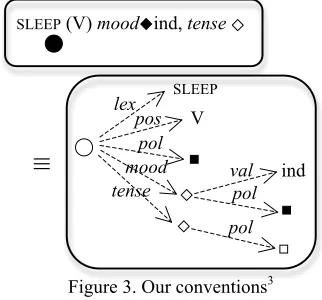
Figure 3. Our conventions3
Fig. 3 makes our formal conventions more precise. A black node has black polarity. The
2 In a PUG, it is easy, by using a dedicated polarity, to ensure that the structure is a tree and to specify which node is the root (Kahane 2006). This point will not be developed here however.
3 Worth is noting that our formalism is not unlike other unification-based formalisms such as HPSG. The schema in Fig. 3 can be easily interpreted as a (recursive) feature structure and a dependency grammar of the kind pre-sented here can be implemented in an HPSG-like formal-ism (Kahane 2009). Conversely, HPSG can be strongly simulated by PUG (Kahane 2006).
SLEEP (V) mood ind,tense
subj
det
THE (D)
BOY (N) def def, num
mod
LITTLE (Adj)
subj
(N)
SLEEP (V) mood
det (N) def def
THE (D)
mod (N)
LITTLE (Adj) BOY (N) def , num
(V) mood ind, tense
RSLEEP:
RLITTLE: Rindicative:
RBOY:
Rdefinite:
SLEEP (V) mood ind, tense
mood SLEEP pos V
lex
ind
pol
val pol tense
pol
[image:2.612.337.498.414.564.2]polarity is the value of a map we call pol. The lexeme name and the part of speech (pos) are atomic values. Grammemes are objects linked to the lexeme node by a map labeled by the name of the inflectional category (mood, tense…). These objects have their own polari-ties and values in turn. When the rules RSLEEP
and Rindicative are combined, two nodes are iden-tified and the values of the maps pol, pos and mood common to both of them are unified. The values of the map mood and tense are objects, so they must be identified and their own maps unified and so on.4
The structure showing the way of how the rules combine in a derivation is called a deri-vation structure (see Vijay-Shanker 1992 for TAG). We consider three ways of combining rules. The first way is by substitution: RBOY
substitutes in RSLEEP because RBOY saturates a
leaf of RSLEEP’s structure. The second way is by adjunction: RLITTLE adjoins to RBOY because
RLITTLE adds a dependency to a black node of
RBOY’s structure.5 The third way is grammatical completion: Rdefinite completes RBOY by
[image:3.612.140.241.367.446.2]saturat-ing a grammeme in RBOY’s structure.
Figure 4. Derivation structure
Fig. 4 shows the derivation structure associ-ated with the derivation suggested in Fig.1 giving the derived structure in Fig. 2. We adopt the following conventions: a substitution is represented by a downward arrow, an ad-junction by an upward arrow, and an inflec-tional completion by a horizontal arrow. With these conventions, the derivation structure can
4 We have slightly simplified Fig. 3. A map host from each grammeme to its lexeme is needed in order to en-sure that the identification of two grammemes entails the identification of their host lexemes.
5 This kind of adjunction is called sister adjunction by Rambow et al. 1995. Contrary to predicative adjunction, sister adjunction does not change the weak generative capacity of the formalism. One can note that the distinc-tion between substitudistinc-tion and adjuncdistinc-tion is small in PUG: in both cases, a black and a white node are identified. The only difference is the direction of the dependency, which is not really relevant in PUG (source and target are inter-changeable from a graph-theoretical perspective).
be interpreted as a graph of predicate-argument relations (as shown in Candito & Kahane 1998 for TAG) and is the basis for a semantic repre-sentation (see Mel’čuk 2012). Indeed, each arrow in the derivation structure can be inter-preted as a semantic dependency that points from a predicate to one of its arguments.
To conclude this section, it must be re-marked that we focus on the syntax-semantics interface in this paper and we do not discuss word order. Gerdes & Kahane 2001 propose a formalism—topological grammar—for line-arizing dependency trees, even for languages with non-projective constructions. It is possi-ble to write a topological grammar in PUG and to combine it with the grammar presented here (see Kahane & Lareau 2005 for the combina-tion of different modules in PUG).
3
Dependency rules
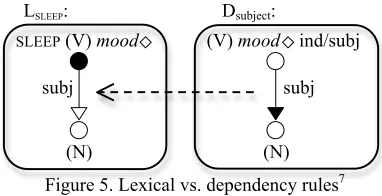
[image:3.612.325.516.432.530.2]The first improvement to the base grammar that we propose is to separate the rules associ-ated with the lexemes proper from the depend-ency rules ensuring the realization of a given dependency (see the nodal vs. sagittal rules of Kahane & Mel’čuk 1999). We modify our previous rules as a consequence and add sepa-rate rules for dependencies. See Fig. 5, which shows two rules the combination of which (LSLEEP⊕ Dsubject) results in RSLEEP.6
Figure 5. Lexical vs. dependency rules7
The dependency rule Dsubject constrains the subject dependency to be saturated only if the verb has the indicative or subjunctive mood. If
6 We will use the following conventions to name our rules: L for rules instantiating a lexeme, D for a depend-ency, G for a grammeme and S for structural rules that do not instantiate any object. R is an umbrella identifier used in Section 2, when lexical rules and dependency rules were not separated.
7 In fact, a black dependency has to combine with a white one (if not, a second subject relation could be added to a verb). This can be easily solved by adding a second polarity: every black dependency will have a white addi-tional polarity, while a white dependency will have a black one (see also positive and negative polarities in Kahane 2006).
(N) subj
(N)
LSLEEP: Dsubject:
subj (V) mood ind/subj
SLEEP (V) mood
RSLEEP
RLITTLE Rindicative
the subject requirement is lexical (the subject is the first actant of the verb, cf. Tesnière 1959), the subject realization is controlled by the mood (mood includes finiteness) (cf. the position of the subject under IP in X-bar syn-tax). When the verb has another mood, like infinitive or participle, the subject requirement of LSLEEP is not realized by a dependency on
[image:4.612.325.523.209.395.2]SLEEP. For instance, with a progressive form (is sleeping), the subject is lifted to the auxil-iary BE. The subject requirement of SLEEP unifies with a grey polarity (and becomes in-visible for other modules) and is replaced by a subject dependency on BE. Fig. 6 shows the rule (Gprogressive) and the result of its combina-tion with LSLEEP (LSLEEP⊕ Gprogressive).8
Figure 6. Invisible dependency.9
The fact that our formalism allows us to suppress a dependency and to replace it with another one is similar to what is proposed by RG. This leads us to consider deep and surface functions (Fillmore 1968). A surface function appears in a surface syntactic tree. A surface function must have been instantiated by a satu-ration rule, like Dsubject for the subject function (Fig. 5). A deep function is the initial function received by a lexeme, which can have been instantiated into an identical surface function or which may have been made invisible and replaced by another function.
Some deep functions will never be instanti-ated as surface functions. This is the case with
8 A similar rule has been proposed by Kahane (2001), where a grey dependency is called a quasi-dependency. The idea to consider a quasi-dependency as a dependency with a saturated interface polarity occured later (Kahane & Lareau 2005) and is explained in Lareau 2008. 9 We do not represent grey objects in derived structures in order to simplify the figures and to emphasize the fact they are invisible for further treatments.
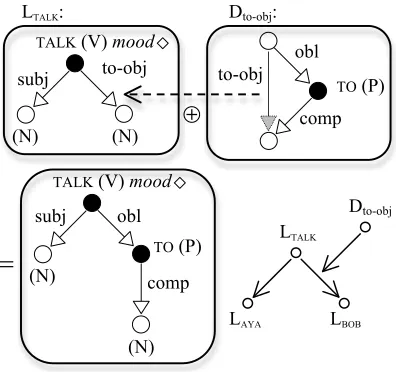
the to-obj of TALK, which must be marked by the preposition TO. Fig. 7 shows the rule for the lexeme TALK and the to-obj dependency, as well as their combination (LTALK⊕ Dto-obj). The
last schema in Fig. 7 is a part of the derivation structure of the sentence Aya talks to Bob; it shows that LBOB combines directly with LTALK,
while Dto-obj is not interpreted as a lexical rule (TO is only a syntactic marker), but as a re-valuation of the connection between two lexi-cal rules. Such a rule is ignored when the deri-vation is interpreted at the semantic level.
Figure 7. Governed preposition.
We choose not to introduce TO in the ele-mentary structure of TALK contrary to what is done in TAG or in previous versions of our dependency grammar (Kahane 2001). We want our grammar to be as modular as possible, separating everything that can be separated. The government markers must be separated from the lexemes that call them for at least two reasons:
• they can be repeated in coordination: Aya talks to Bob and to Dave.
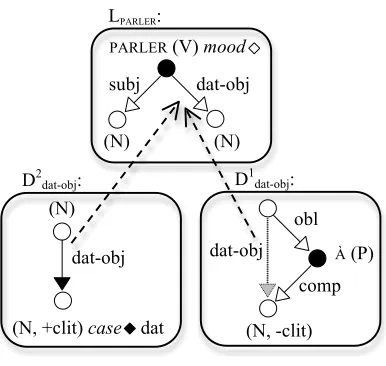
• they can have an alternative realiza-tion; for instance, in French, an indirect object is marked by the preposition À for a noun phrase, but by the dative case for a clitic pronoun (Fig. 8).10 In English, a complementizer can be real-ized or not: Aya knew (that) Bob came.
10 The two constructions of PARLER ‘talk’ are: (i) Aya parle à Bob ‘Aya talks to Bob’ (ii) Aya lui parle ‘Aya talks to him’
Gprogressive:
subj
(N) LSLEEP:
SLEEP (V) mood
subj aux
BE (V) mood
(V) mode prp subj
subj aux
BE (V) mood
SLEEP (V) mood prp
⊕
=
⊕
=
LTALK
LBOB LAYA
obl
TO (P)
comp subj
(N)
(N)
TALK (V) mood
to-obj obl
TO (P)
comp subj
(N)
to-obj
(N)
TALK (V) mood
LTALK: Dto-obj:
[image:4.612.86.301.260.429.2]Figure 8. Indirect object in French
Therefore, we want the government markers to be realized by separate rules, but, for seman-tic reasons, we also want a predicative lexeme to combine directly with its arguments. We have solved these constraints thanks to the grey polarity and the invisible objects; as is shown in Fig. 7, the verb TALK has a direct connection with its semantic argument and it is only in the derived structure that the preposi-tion appears between the verb and its argu-ment.
The case of adjectives is interesting. Adjec-tives occur in two basic constructions. In the attributive construction they modify a noun (the red book) and in the predicative construc-tion they form a verbal complex with the cop-ula (the book is red). In both cases, ‘red’ is a semantic predicate and ‘book’ is its semantic argument. But some adjectives take an event as argument and this argument can be realized by a verb (reading this book is tough). Such ad-jectives cannot modify their verbal argument, but the direct object of this argument can be promoted (so-called tough-movement) and become the syntactic governor of the adjective (a book tough to read). According to these facts, we cannot assume that the attributive construction is the base construction of every adjective, since this construction is impossible for adjectives taking a verbal argument. We thus propose that, in its base construction, the argument of the adjective has a special deep function we call subj’ (Fig. 9). This deep func-tion does not exist as a surface funcfunc-tion, but at least three constructions can apply to it: the attributive construction (Dsubj’), the predicative construction (Scopula) and the construction of tough-movement (Stough-mvt). Note that the
[image:5.612.323.522.100.273.2]at-tributive construction can only apply if the argument is realized as a noun or after tough-movement, which promotes a noun as subj’.
Figure 9. Adjectival constructions
The same deep function subj’ is used for the passive past participle, which can enter into a predicative construction (a book has been stolen) or an attributive construction (the book
stolen by Bob). The passive construction marked by the past participle inflection can be derived from a verbal base form by a rule us-ing grey polarities again (Fig.10).
Figure 10. Passive voice
Intermediate conclusion: Thanks to the grey polarities, which allow us to make an object invisible (for other modules) and to replace it with another configuration, we are able to separate the rules describing the various con-structions associated with a lexeme from the rule describing the lexeme itself. In a lexical-ized grammar like TAG, an elementary struc-ture describes a lexeme with one of its con-structions and the set of elementary structures associated to a given lexeme must be generated by another module (like a metagrammar in Candito 1996). An advantage of the approach presented here is that the rules associated with the lexemes and their constructions are in the same formalism. They can be precompiled to obtain a lexicalized grammar or they can be triggered on-line during text analysis or syn-thesis.
Scopula:
mod
(Adj)
Dsubj-:
subj pred
BE (V) mood
subj’
subj’
(N)
LITTLE (Adj)
LLITTLE:
subj’
(Adj) (N)
subj’
(V)
TOUGH (Adj) LTOUGH:
Stough-mvt:
subj’ vcomp subj’
obj (Adj)
(V)
Gpassive:
subj’ by-obj (V) mood pp
subj obj
dat-obj obl
À (P)
comp subj
(N)
dat-obj
(N)
PARLER (V) mood
LPARLER:
D1 dat-obj:
dat-obj (N)
(N, -clit) (N, +clit) case dat
We will now see how grey polarities can be used for modeling another way of combining lexemes: predicative adjunction.
4
Complex determiners
Numerous determiners are idiomatic construc-tions like loads of in (1):
(1) Aya read loads of books.
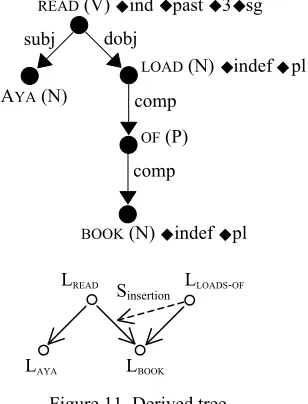
[image:6.612.327.521.94.185.2]Such a construction causes a mismatch be-tween the syntactic and the semantic struc-tures: loads is the syntactic head of the NP loads of books and thus the syntactic depend-ent of read, but ‘book’ is its semantic head and the argument of ‘read’. As a consequence, we want the derived tree and the derivation struc-ture of (1) to be as in Fig. 11 (besides Sinsertion, which is a technical rule introduced below).
Figure 11. Derived tree and derivation structure for (1)11
This problem can be solved by predicative adjunction, as in the standard analysis of com-plex determiners in TAG (Shieber & Schabes 1994). A predicative adjunction is an adjunc-tion where the adjunct is inserted in the syntac-tic governor position. This is making possible in our formalism by way of a special rule, Sin-sertion, allowing the insertion of a node and a dependency between two other nodes (Fig. 12). This rule can be compared to a rule like Dto-obj, which introduces a marker. But Sinsertion is a generic rule that can apply on any depend-ency ($r is a variable) and does not replace it but only inserts a dependency [insert:+]
11 We have simplified the derived tree by suppressing the attribute before the grammemes.
[image:6.612.121.275.285.487.2]hind. The formalism forces us to replace the $r dependency by a new one, but in fact we just want to “move” it to a new dependent.
Figure 12. Predicative adjunction12
The predicative adjunction is indicated by a downward arrow in the derivation structure, like a substitution (Fig.11). A purely structural rule like Sinsertion, which does not saturate any object, is represented by a dashed arrow. Note that LBOOK substitutes in LLOADS-OF like in a
nor-mal substitution. Consequently, LBOOK
substi-tutes in two rules (LREAD and LLOADS-OF), which is
made possible by Sinsertion. It is important to note that it is BOOK and not LOAD that fulfill the object position of READ. Therefore deter-miners that (predicatively) adjoin do not need to be nouns. In French there is a productive construction where the complex determiner is an adverb governing the noun (trop de N ‘too_much of N’, moins de N ‘less of N’ …). It is also possible to treat simple determiners, including articles, as syntactic governors of the noun they determine (Abney 1987, Hudson 2007). But even if in read a book the deter-miner A becomes the governor of BOOK, it is the noun of the unit a book that will combine with READ and it is not really legitimate to consider a book as a DP.
Note that the rule Sinsertion can be applied re-cursively, as in more than half of all known species are insects; indeed half of predicatively adjoins to all known species and more than predicatively adjoins to half.
5
Extraction
We will focus on relative clauses and start with wh-relative clauses, that is, with relative clauses marked by a wh-word, like in (2):
(2) (the guy)who I invited.
A relative clause depends on a noun (here guy), which is the antecedent of a wh-word (here who). Each wh-word will have its own
12 Again the preposition (of in loads of books) is added by a separated rule.
LREAD
LBOOK LAYA
LLOADS-OF
subj
AYA (N)
dobj
comp
comp
LOAD (N) indef pl
BOOK (N) indef pl
READ (V) ind past 3 sg
OF (P)
Sinsertion
$r $r
[insert:+]
LOAD (N) indef pl
LLOADS-OF:
Sinsertion:
of-obj [insert:+]
rule: the rule SWHO attaches the wh-word WHO
[image:7.612.96.295.160.461.2]to a noun bearing the feature +human (Fig. 13). The rule Dwh-rel allows predicative adjunc-tion on a wh-word.13 The rule Drel instantiates the dependency between the antecedent noun and the relative clause and forces the head of the relative clause to be a finite verb in the indicative or subjunctive mood (Fig. 14).
Figure 13. Rules for wh-relatives
Figure 14. Derivation structure and derived tree for (2)
Tesnière 1959 argues that the wh-word oc-cupies two positions in the dependency struc-ture: it is both a complementizer (thus being the syntactic head of the relative clause) and a pronoun (filling the “extracted” position) (see additional arguments in Kahane 2002). Even though the wh-word occupies only the pro-nominal position in the derived tree in our account, the wh-word directly attaches to the antecedent noun (see SWHO in Fig. 13 and in the
derivation structures of Fig. 14 and 16) and thus carries out a complementizer role. It is even possible to not make invisible the wh-rel dependency between the antecedent noun and the wh-word and to obtain a dependency struc-ture similar to Tesnière’s stemma for extrac-tion.
13 We could have proposed a rule directly combining SWHO and Dwh-rel, as it was done in previous works
(Ka-hane 2001).
It has been well established since Ross 1967 that the string of dependencies between the antecedent noun and the “extracted” position (that is, the position filled by the wh-word) is potentially unbounded but nevertheless very constrained. In (3), the verb THINK has been added in the relative clause and has become the syntactic head of the clause.
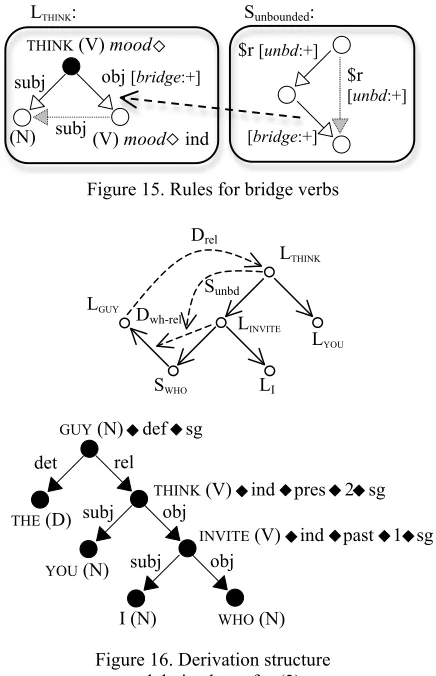
[image:7.612.316.534.302.640.2](3) (the guy) who you think I invited. Such a verb is called a bridge verb. We intro-duce a new rule, Sunbounded, allowing the predi-cative adjunction of a bridge verb (Fig. 15). Note that only syntactic dependencies labeled [bridge:+] can be inserted behind a depend-ency labeled [unbd:+]. This is comparable to the LFG’s functional uncertainty (Kaplan & Zaenen 1989), where the constraints on extrac-tion are also controlled at the syntactic func-tion level.
Figure 15. Rules for bridge verbs
Figure 16. Derivation structure and derived tree for (3)
In the derivation of (3), who adjoins on GUY and substitutes into the object position of INVITE (Fig. 16). The latter is then inserted between WHO and GUY thanks to Swh-rel, which introduces a rel(ative) dependency. In the same
LINVITE
LI
LGUY
SWHO Drel
det
THE (D)
rel
GUY (N) def sg
subj
I (N)
obj
WHO (N)
INVITE (V) ind past 1 sg Dwh-rel
$r [unbd:+]
[bridge:+]
Sunbounded:
$r
[unbd:+]
(N) LTHINK:
subj obj [bridge:+]
THINK (V) mood
(V) mood ind subj
rel (N) Drel:
(V) ind/subj wh-rel
(N) [hum:+]
WHO (N:RelPro)
SWHO:
rel
[unbd:+]
Dwh-rel:
wh-rel
LTHINK
LYOU LINVITE
det
THE (D) rel
GUY (N) def sg
THINK (V) ind pres 2 sg subj
YOU (N)
obj
subj
I (N)
obj
WHO (N)
INVITE (V) ind past 1 sg
LI
LGUY
SWHO Dwh-rel
Sunbd
way, INVITE substitutes in the object position of THINK. As the object dependency bears a feature [bridge:+], the rule Sunbounded can apply and insert THINK between GUY and INVITE, replacing the rel relation by a new one. This can be done recursively. At the end, the rel dependency is instantiated by Drel.
Our analysis of wh-relative clauses is simi-lar to the TAG analysis, where the bridge verbs predicatively adjoin (Kroch & Joshi 1986). It can also be compared to the analysis in other frameworks, in particular to LFG with the functional uncertainty, to the generative gram-mar with Move α, or to HPSG with the slash feature. Contrary to the Move α or slash analy-ses, it is not the wh-word that is moved, but the bridge verbs that are inserted, like in the func-tional uncertainty. Moreover, it is not the verb THINK that is a bridge, but only its object dependency, like in LFG again (Kaplan & Zaenen 1989). Nevertheless, Sunbounded is a rule that moves the rel dependency from INVITE to THINK, which can be seen as movement of the complementizer role of the wh-word.
We will now contrast wh-relatives with that-relative clauses, like (4):
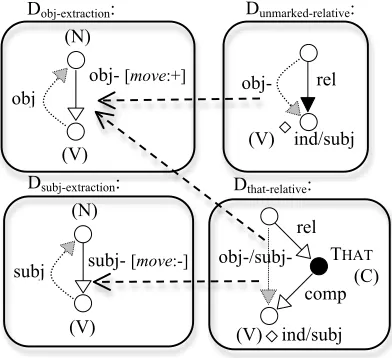
(4) (the guy)that you think I invited. It has often been argued that that-relatives are syntactically different from wh-relatives, be-cause 1) THAT also marks complement clauses (you think that I invited this guy), 2) it does not accept pied-piping (the guy to whom I speak vs. *the guy to that I speak), 3) that-clauses alternate with unmarked clauses (the guy you think I invited), and 4), contrarily to wh-words, THAT does not have a “human” feature. Con-sequently, THAT is not analyzed as a pronoun like wh-words, but only as a complementizer, which marks the subordination of a finite clause. We thus necessitate different extraction rules for that-relatives, where the antecedent noun directly fills the “extracted” position: Dobj-extraction and Dsubj-extraction (Fig. 17). Subject and object extraction are differentiated because 1) only the object extraction really accepts the predicative adjunction of bridge verbs (?*the guy that you think that invited me), and 2) only the object extraction can be unmarked (He is the guy *(that) invited me). Consequently, only Dobj-extraction can combine with Sunbounded and Dunmarked-relative.
With this new set of rules we obtain a dif-ferent syntactic structure (Fig. 18): THAT is the
[image:8.612.329.525.120.299.2]syntactic head of the relative clause and con-trarily to WHO, THAT does not fill the “ex-tracted” position and does not combine with INVITE in (4). THAT only intervenes to mark the subordination of the relative clause.
[image:8.612.325.538.256.601.2]Figure 17. Rules for that-relatives
Figure 18. Derivation structure and derived tree for (4)
The case of French confirms the relevance of the distinction between wh-relatives and that-relatives. French has a +human wh-word QUI, comparable to WHO, but which can only be used after a preposition (la fille à qui je parle ‘the girl to whom I talk’). In case of ob-ject extraction, the relative clause is marked by
THAT
(C)
obj-comp rel Dthat-relative:
obj-/subj- Dunmarked-relative:
rel
(V) ind/subj Dobj-extraction:
obj- [move:+]
(N)
Dsubj-extraction:
subj
(V) (N) obj
subj- [move:-]
(V)
(V) ind/subj
det
THE (D)
rel
GUY (N) def sg
THINK (V) ind pres 2 sg
subj
YOU (N)
dobj
subj
I (N)
INVITE (V) ind past 1 sg comp
THAT (C) LTHINK
LI
LINVITE LYOU
LGUY Dthat-clause
Dobj-extr
QUE, which can be compared to THAT (le livre
que je lisais ‘the book that I read’); in particu-lar, QUE is also the marker of complement clauses (tu penses que j’ai invité ce gars ‘you think that I invited this guy’) and no pied-piping is possible with QUE. Subject extraction is marked by a QUI form, different from the other QUI, because this one is not +human (le livre qui est là ‘the book that is there’). Kayne 1975 argues that QUE is always a pure com-plementizer, even when it marks relative clauses. His main argument is the so-called qui-que alternation:
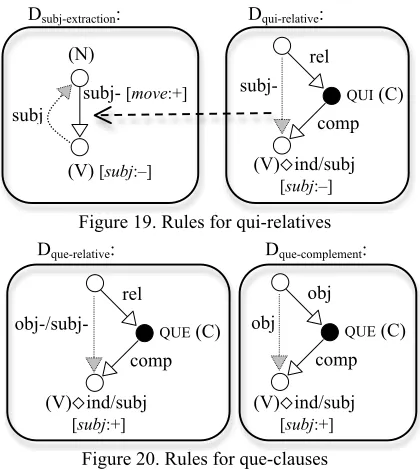
(5) (la fille)que je pense qui m’a invité the girl that I think that invited me ‘the girl that I think invited me’ In (5), the subject of the complement clause is extracted, but, contrarily to what might have been expected, the marker of the relative clause is QUE (la fille que …) and moreover the marker of the complement clause is QUI (je pense qui …). As a consequence, we can con-clude that QUE and QUI are not exactly the subject and object relative markers and that they are not selected according to the “ex-tracted” position they fill. We propose rather that these markers are selected according to the verb they complementize: QUI complementizes a verb without a realized subject, while QUE must complementize a verb with a subject. Such a solution can only be implemented in our formalism if QUI and QUE are treated as markers and connected to the verb they com-plementize in the syntactic tree (which is not the case for WHO in our analysis). Conse-quently, we propose subject and object extrac-tion rules for French similar to the rules for English (of Fig. 17), but we add a ±subject feature on the subordinated verb indicating whether its subject has been extracted or not (Dsubj-extraction in Fig. 19). The QUI marker can only mark a relative clause if the main verb of the clause is [subj:-] (Dqui-relative in Fig. 19).
The rule for relatives marked by QUE is similar (Dque-relative in Fig. 20); the only differ-ence is that the verb must have its subject and be marked [subj:+]. The rules for QUI and QUE could be merged assuming that qui and que are two forms of a same lexeme with an opposi-tion of case (nominative for qui and oblique for que) (Kahane 2002). Moreover the two rules for QUE (Dque-relative and Dque-complement in Fig. 20) are almost identical: only the syntactic functions involved change. This corroborates
[image:9.612.320.530.82.317.2]Kayne’s hypothesis that all these complemen-tizers are one and the same.
Figure 19. Rules for qui-relatives
Figure 20. Rules for que-clauses
6
Conclusion
We have presented a dependency grammar that constructs syntactic dependency trees like any other dependency grammar. But this grammar accomplishes more than others. First, it takes into account the syntax-semantics in-terface: the derivation structure can be inter-preted as a graph of predicate-argument rela-tions, that is, as the skeleton of a semantic representation (in the sense of Mel’čuk 1988, 2012). Second, this grammar accomodates the syntax-text interface, that is, linearization and morphology. Even though the linearization rules are not presented here (see Kahane & Lareau 2005 or Gerdes 2004 for linearization rules in PUG), it could be shown that the de-rived structure contains all the surface syntac-tic dependencies necessary to calculate the linear order (Gerdes & Kahane 2001).
In other respects, the grammar presented here is very modular. Grammatical construc-tions have their own independent rules, sepa-rated from the lexical rules, which describe only the base construction of lexemes. From this point a view, this grammar enters in the paradigm of construction grammars (CxGs) and can even be seen as a formalization of the Relational Grammar (Perlmutter 1980).
Our formalism makes a big use of the in-visible polarity and the predicative adjunction. Formally, the derived structure is a graph with
QUE (C)
comp rel Dque-relative:
obj-/subj-
[subj:+]
QUE (C) comp obj Dque-complement:
obj
(V) ind/subj
[subj:+]
(V) ind/subj
QUI (C)
comp rel Dqui-relative:
subj- Dsubj-extraction:
subj
(V) [subj:–]
(N)
subj- [move:+]
[subj:–]
a tree skeleton, which is the visible part of the derived structure (the objects polarized in black). The fact that we constantly maintain a tree skeleton during the derivation process is probably an important property from a compu-tational point of view, but this has not been investigated further and the formalism has not been implemented.
Acknowledgments
I would like to thank Kim Gerdes, François Lareau and Tim Osborne for many valuable comments and corrections.
References
Abney S. 1987. The English Noun Phrase in its Sentential Aspect. PhD Dissertation, MIT. Candito M.-H., Kahane S. 1998. Can the derivation
tree represent a semantic graph? An answer in the light of Meaning-Text Theory, Proc. TAG+4, Philadelphia, 21-24.
Candito M.-H. 1996. A principle-based hierarchical representation of LTAGs. Proc. COLING, Copenhagen.
Fillmore Ch. J. 1968. The Case for Case. In Bach and Harms (eds.): Universals in Linguistic Theory. Holt, Rinehart, and Winston, New York, 1-88.
Gerdes K. 2004. Tree Unification Grammar Prob-lems and Proposals for Topology, TAG, and German, Electronic Notes in Theoretical Computer Science, 53, 108-136.
Gerdes K., Kahane S. 2001. Word Order in Ger-man: A Formal Dependency Grammar Using a Topological Hierarchy. Proc. ACL, Toulouse. Hudson R. 2007. Language Networks: The New
Word Grammar, Oxford University Press. Joshi A. 1987. Introduction to Tree Adjoining
Grammar. In Manaster Ramer (ed.), The Mathematics of Language, Benjamins, Am-sterdam, 87-114.
Kahane S. 2001. A fully lexicalized grammar for French based on Meaning-Text theory. Proc. CICLing, Mexico, Springer Verlag, 18-31. Kahane S. 2002. A propos de la position syntaxique
des mots qu-. In P. Le Goffic (ed.), Interroga-tion, indéfiniInterroga-tion, subordination, Verbum, 24(4), 399-435.
Kahane S. 2006. Polarized Unification Grammars,
Proc. Coling-ACL, Sydney.
Kahane S. 2009. On the Status of Phrases in Head-driven Phrase Structure Grammar: Illustration by a Fully Lexical Treatment of Extraction, in A. Polguère & I. Mel’čuk (eds.), Dependency in Linguistic Description, Benjamins,111-150.
Kahane S., Mel’čuk I. 1999. La synthèse séman-tique ou la correspondance entre graphes sémantiques et arbres syntaxiques – Le cas des phrases à extraction en français contemporain,
T.A.L., 40(2), 25-85.
Kahane S., Lareau F. 2005. Meaning-Text Unifica-tion Grammar: Modularity and polarizaUnifica-tion.
MTT 2005, Moscow.
Kaplan R., Zaenen A. 1989. Long-distance depen-dencies, constituent structure, and functional uncertainty. In M. Baltin and A. Kroch (eds.),
Alternative Conceptions of Phrase Structure.
Chicago University Press, 17-42.
Kayne R. 1975. French Syntax: The Transforma-tional Cycle, Cambridge : MIT Press.
Kroch A., Joshi A. 1986. Analysing Extraposition in a TAG. In G. Huck & A. Ojeda (eds.), Dis-continuous Constituents, Syntax and Seman-tics, vol. 20, Academic Press, 107-149. Lareau F. 2008. Vers une grammaire d'unification
Sens-Texte du français : le temps verbal dans l'interface sémantique-syntaxe, Ph.D. thesis, University of Montreal/University Paris 7. Mel’čuk I. 1988. Dependency Syntax: Theory and
Practice, SUNY, Albany.
Mel’čuk I. 2012, Semantics: From Meaning to Text, Benjamins, Amsterdam.
Nasr A. 1995. A Formalism and a Parser for Lexi-calised Dependency Grammars, Proc. IWPT, Prague, 186-195.
Perlmutter D. 1980. Relational grammar. In E. Moravcsik & J. Wirth (eds.), Syntax and seman-tics: Current approaches to syntax (Vol. 13), Academic Press, New York, 195-229.
Pollard Carl, Sag Ivan, 1994, Head-Driven Phrase Structure Grammar, CSLI, Stanford.
Rambow O., Vijay-Shanker K., Weir D. 1995. D-tree grammars. Proceedings of ACL, Cambridge. Tesnière L. 1959. Éléments de syntaxe structurale.
Klincksieck, Paris.
Rambow O., Joshi A. 1994. A formal look at de-pendency grammars and phrase-structure grammars, with special consideration of word-order phenomena. In L. Wanner (ed.), Current Issue in Meaning-Text Theory, Pinter,London. Ross J. 1967. Constraints on Variables in Syntax.
PhD Thesis, MIT; 1985. Infinite syntax !, Rei-del, Dordrecht.
Shieber S., Schabes Y. 1994. An alternative con-ception of tree-adjoining derivation. Computa-tional Linguistics, 20(1), 91-124.